Two objects lay side by side on the bench in the restoration workshop. One was a two hundred and ten year old timer in a brass case with a cracked dial. The other was a dark grey stone smaller than a palm, resting on a square of black velvet.
The watch restorer lifted his loupe and pointed at the older object. You know what this is, he said.
I do, said the cosmochemist. But I would like to hear you say it.
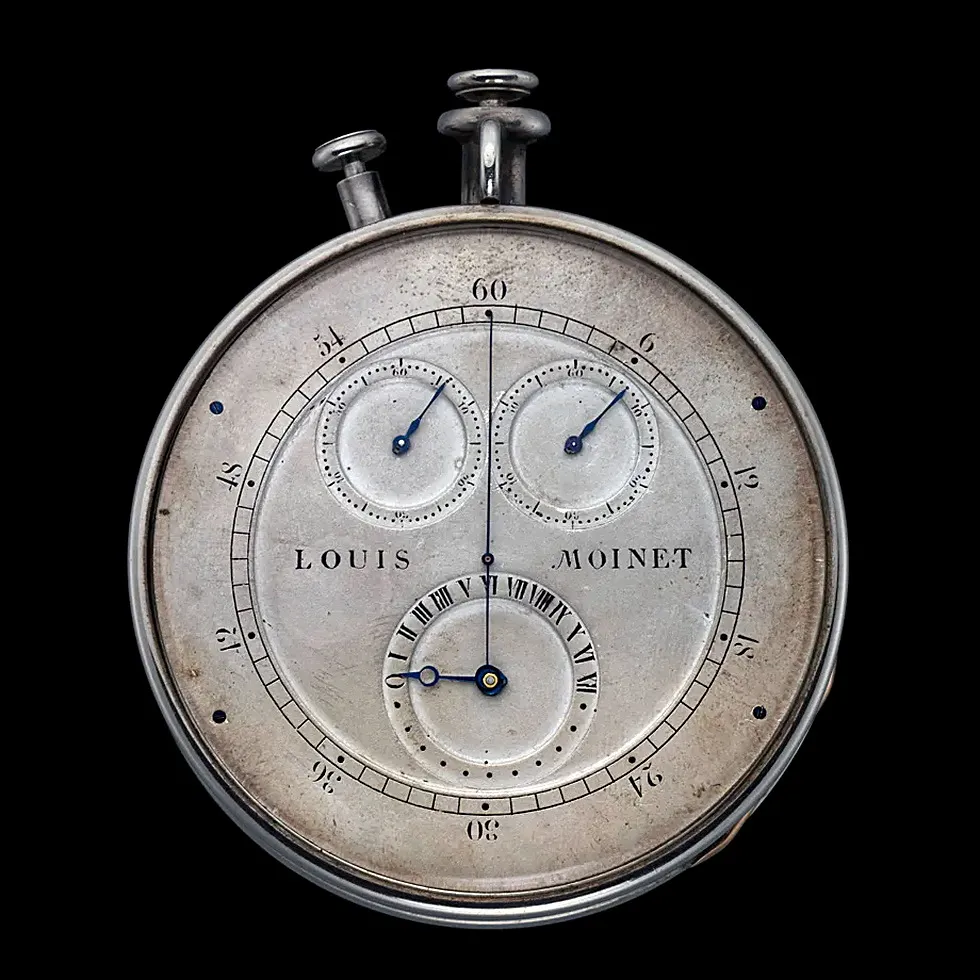
It is an instrument built to measure a sixtieth of a second, said the restorer. It was made in 1816. The man who made it was not an astronomer but a watchmaker, and he designed it for people who watched the sky. He wanted to record the moment a star or a planet crossed a line in the field of a telescope. To do that he used a speed nobody had attempted before. The balance inside it swings thirty times a second.
The cosmochemist leaned in. Thirty, she said. Today’s watches stop at four.
Even now you could count the movements that reach that rate on one hand, said the restorer. He did it in a century with no radio, no electricity and no high speed photography.
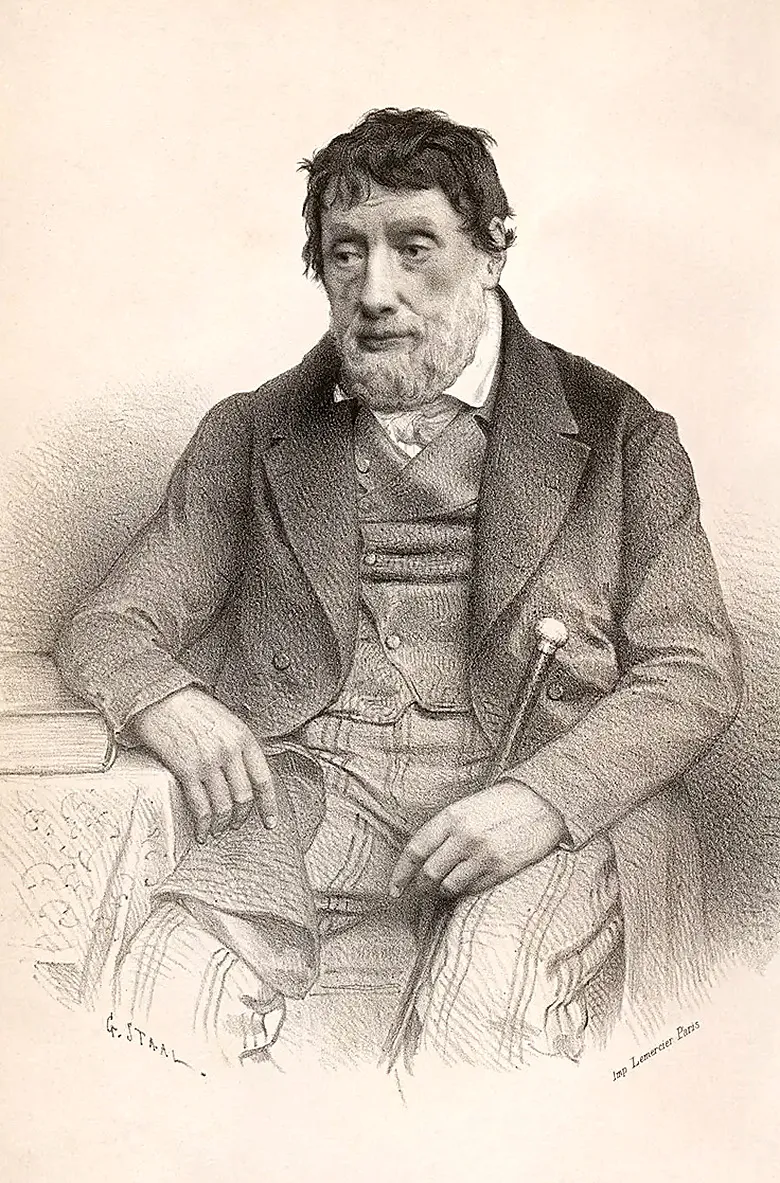
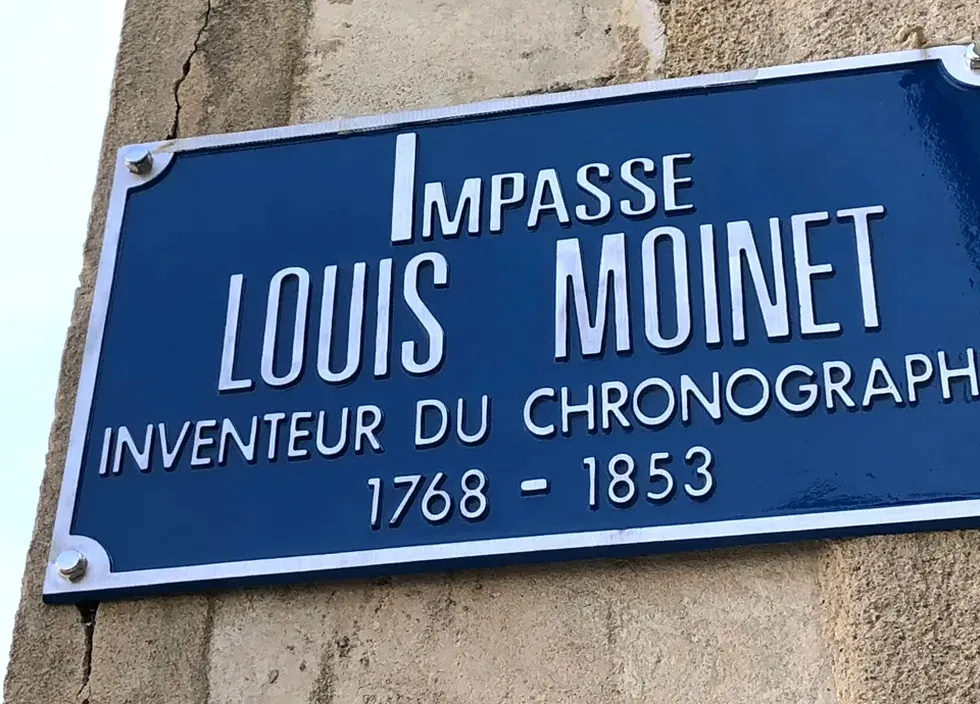
The man was Louis Moinet, who lived from 1768 to 1853. For a long time he was treated as a second rank name in the history of watchmaking. He was known in his own day, he wrote a substantial treatise on the craft and he was close to the great makers of the period. Even so, his name stayed in the shadow of more famous contemporaries whose friend and pupil he had been.
That changed in 2013. The instrument he had made with his own hands appeared at auction, and when it was examined it pulled a date in horological history backwards. The invention of the chronograph had long been attributed to 1821 and to another maker. Moinet’s instrument predated it by five years and was a working chronograph in the sense we use the word today: it started, it stopped and it reset.
The same object entered the official record twice. First as the world’s first chronograph. A few years later, because its balance beats thirty times a second, it was registered again as the world’s first high frequency stopwatch.
The workshop that carries his name today was founded in Neuchâtel in 2004 by Jean Marie Schaller. The Cosmopolis is the furthest point that workshop has reached.
format_quote"For two centuries the invention of the chronograph was filed under the wrong name. An auction catalogue moved the date back by five years."
Hasan Bekmezci
The cosmochemist turned to the stone on the bench and shifted the cloth a little.
My turn, she said. You showed me a two hundred year old instrument. I am going to show you a four and a half billion year old stone.
The restorer dropped his loupe again. How do you know where it came from, he asked. It is a meteorite, fine. But how do you work out that it is lunar?
From oxygen, she said.
Oxygen comes in three stable varieties, and the ratio between them was fixed differently in different regions of the solar system. Whatever ratio a body had when it solidified, that ratio stays unchanged for billions of years. A stone’s oxygen fingerprint is the address of the place it was born.
The Moon’s fingerprint is nearly identical to ours, because the Moon came out of us. A large body struck this planet in its youth, the material of the two was stirred together, and what emerged solidified with a shared ratio. The fingerprint of Mars is plainly different. So when we measure a stone we do not argue about its origin. The number tells us.
And how do you establish that something came from Mars, the restorer asked. Nobody has brought samples back.
Nobody has, she said, and that is the beautiful part. When a meteorite is blasted off Mars, some of its interior melts instantly under the shock that launched it and turns to glass. As that glass cools it traps a little of the surrounding air inside itself.
So certain stones in our hands contain minute gas bubbles, and those bubbles are samples of the Martian atmosphere. When landers measured the composition of that atmosphere in the mid nineteen seventies, it became possible to compare the two. The measurements matched.
The restorer was quiet for a while. So I could hold the air of another planet in my palm, he said.
You could, she said. And humanity obtained it before ever going there and coming back. We have not reached that place. What comes from it has reached us.
format_quote"A stone thrown off Mars traps a little Martian air inside the glass the impact melted. The atmosphere of a planet we have never reached is therefore already in our hands."
Hasan Bekmezci
Now consider how all of that is gathered onto a single dial.
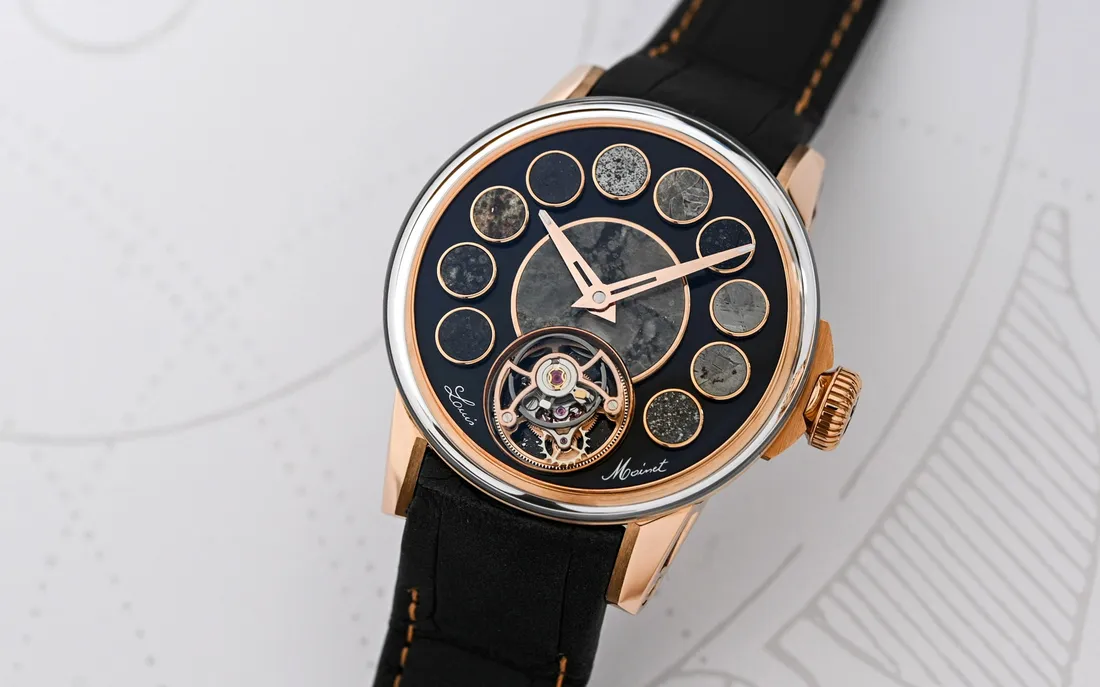
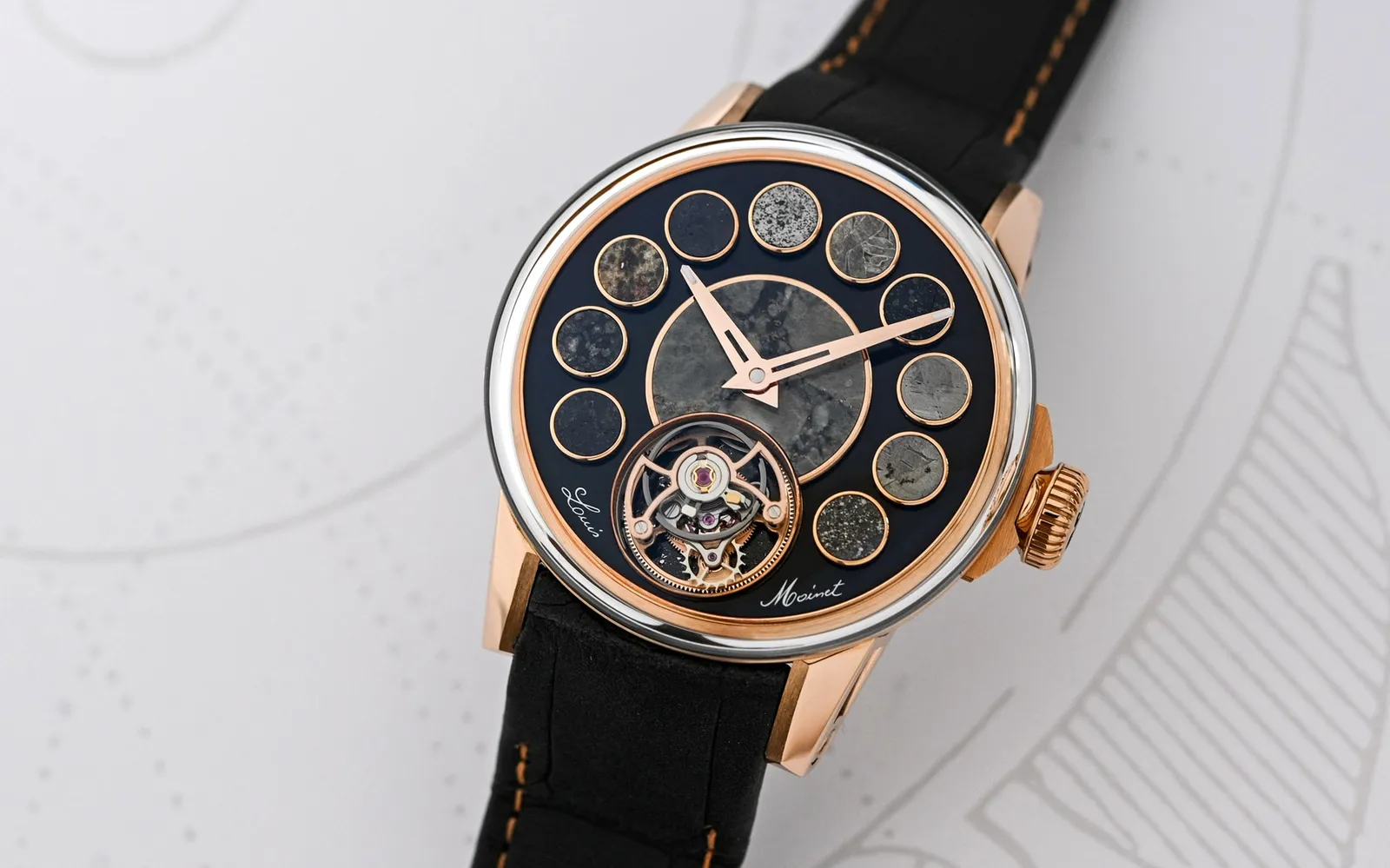
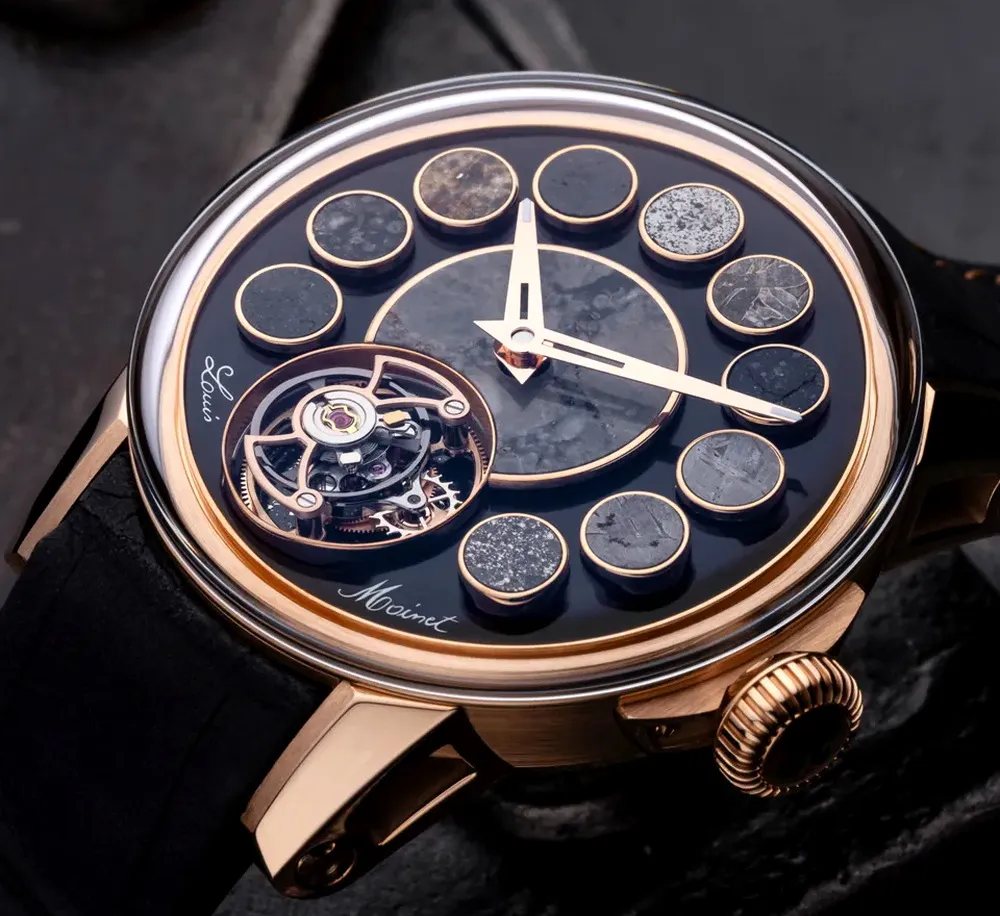
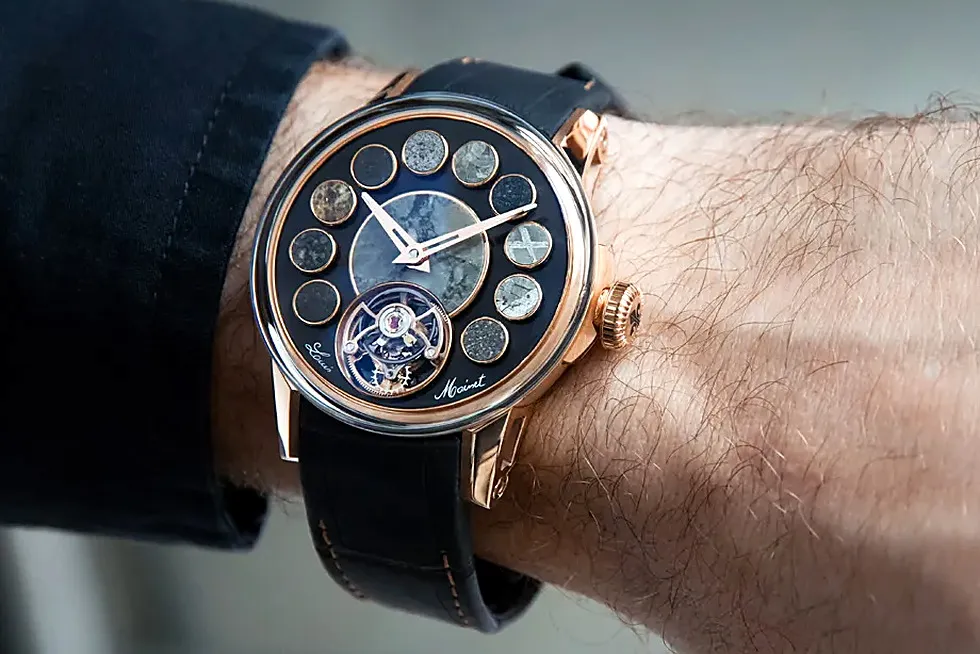
The Cosmopolis is a forty point seven millimetre case in 18k rose gold. The lugs are hollowed and bevelled, the crown is unusually large, and polished and satin brushed surfaces alternate across the whole. There is no bezel. The domed sapphire crystal sits directly on the upper edge of the case, an arrangement that enlarges the visible area of the dial. Water resistance is thirty metres.
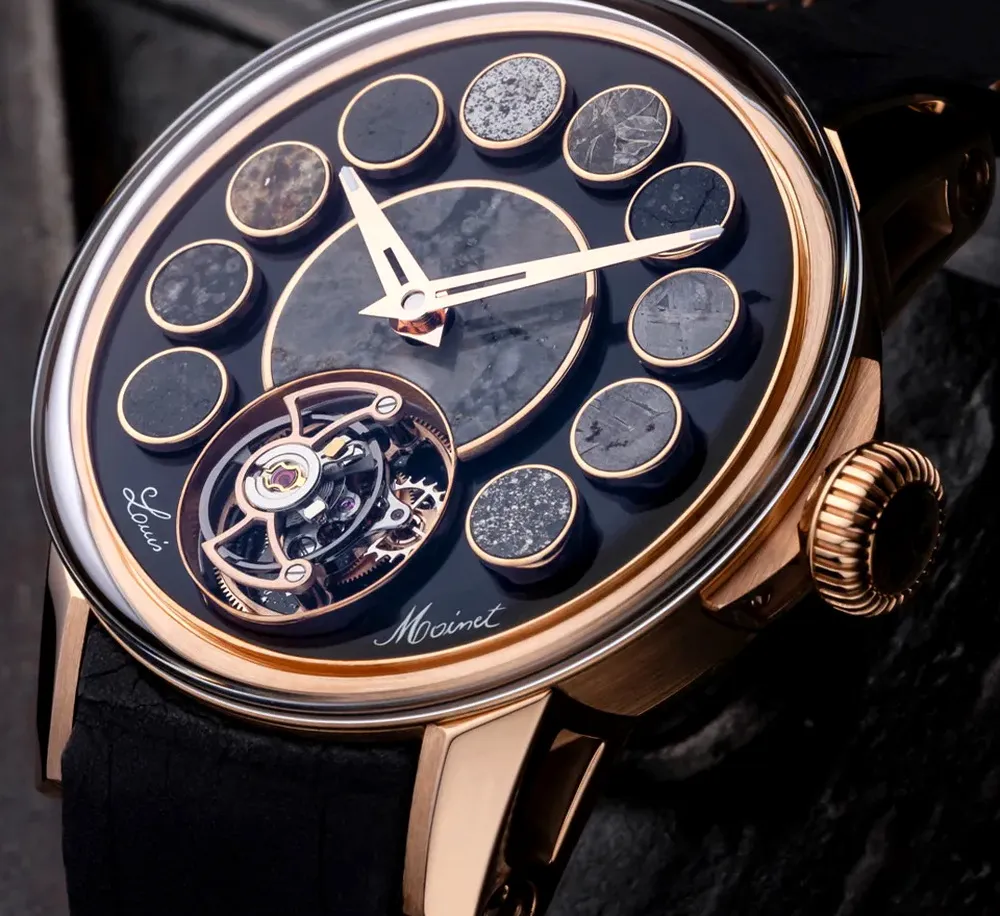
Twelve separate meteorites sit on that dial, the highest number ever set into a wristwatch. The fact was formally recorded in Geneva in September 2023.
Ten of them are applied to the dark grey dial as round slices inside gold frames. Each comes from a different source; some are lunar, some Martian, and others were gathered from fragments of the large asteroids that circle out beyond us.
At the exact centre sits a large disc, cut from an extremely rare white speckled lunar meteorite found in the Dhofar region of Oman. Desert ground is favourable for finds of this kind: a dark stone stands out at once against pale limestone, and the dry climate slows the decay of a meteorite through the years it spends on the surface.
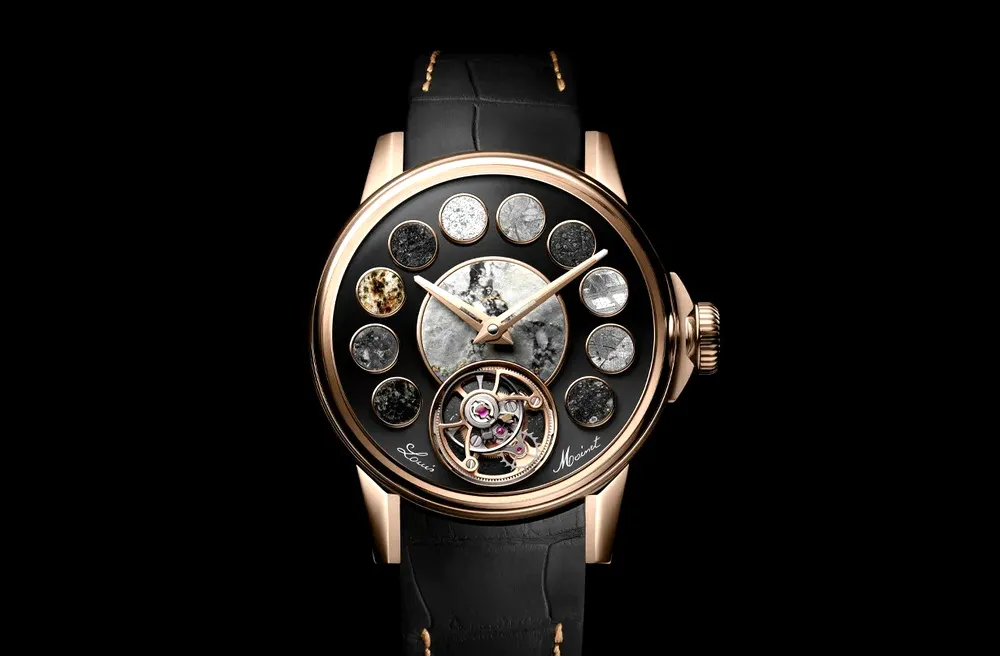
That central disc intersects the tourbillon aperture at six o’clock, and together the two draw a figure of eight lying on its side. The tourbillon is of the flying type, held by no upper bridge and supported only from beneath, so it appears to hang in the opening as it turns.
A separate stone has been placed directly behind the cage. It is a black chondrite, produced by a collision between two asteroids. Chondrites are the oldest stones in the solar system and they contain millimetre sized droplets called chondrules. Those droplets were once molten silicate and they cooled and hardened within minutes or hours. Exactly what melted them is still argued over. What is certain is that they existed before any planet did.
So the oldest matter on the dial sits behind the fastest moving part of it. On one side a stone that has done nothing for four and a half billion years; on the other a cage that completes a revolution every minute. That juxtaposition is not accidental. It is the entire idea of the watch.

The calibre is the LM135. It is hand wound, runs on twenty six jewels and beats four times a second. Its most striking figure is the power reserve: ninety six hours, a full four days.
No single barrel delivers that. Two are used, coupled in series. A series coupling extends duration; a parallel coupling raises torque. Here the object is duration.
The workshop’s name for the arrangement means to turn one’s face, because the two barrels are stacked upside down on one another. They release their energy at the same moment, and that detail addresses the largest problem a four day reserve creates.
The problem is this: as a mainspring unwinds, the force it delivers falls. It pushes hard in the first hours and weakly in the last. When the force reaching the balance changes, the amplitude of the swing changes and the watch loses its rate. Staying stable across four days requires that fall to be softened, and two barrels working together flatten the curve.
The caseback is sapphire. The base plate carries circular Côtes de Genève and has been cut away in places to reveal the works. The strap is matte black alligator and the pin buckle is 18k rose gold.

Before the lamp went out that night the restorer asked one more question.
This is a unique piece and it costs two hundred and twenty five thousand francs. How much of that figure comes from the stones?
Far less than you would think, she said. Meteorite is sold by weight and a good lunar specimen genuinely commands a high price per gram. But what goes onto a dial does not exceed a few grams. The cost is in the cutting.
A meteorite is not a uniform material. It contains metal grains, silicate crystals and voids, and their hardnesses differ. Slicing something like that below a millimetre means accepting that it may come apart on the saw. You would rather not know how many of every ten pieces cut come out usable.
The restorer laughed and put the two hundred year old instrument back in its box. The same thing happens on both sides then, he said. In my trade you also never tell anybody how many parts you ruined before you got one right.
format_quote"Slicing a meteorite thinner than a millimetre means accepting that it may fall apart on the saw. The price of this watch comes less from the stones used than from the stones lost."
Hasan Bekmezci
On her way out the cosmochemist said one last thing.
Our relationship with the sky has always been conducted at a distance, she said. We look, we measure, we name, but we cannot touch. The only things we ever get our hands on are the ones that fall here of their own accord.
A chain of events had to run for these stones to arrive. Something had to strike a celestial body; the fragments had to escape its gravity; they had to drift in orbit for millions of years; they had to cross our own path; they had to survive the atmosphere without burning away entirely; and finally they had to land somewhere they could be found. Every link in that chain is a separate improbability.
For a person to then cut the stone at the end of that chain and wear it on a wrist is something else again. It stops being an ornament. It becomes a record.
The restorer answered as he locked the door. The man who worked here two hundred years ago was doing the same job, he said. He built an instrument to record the sky as well. The difference is this: he wrote down when the sky went past. These have brought the sky itself.
The work of a wristwatch is to show the time, and in a sense that work is an attempt to make a human life comprehensible by cutting it into small pieces. The Cosmopolis reverses the attempt. Standing over this dial, the thing you are measuring is no longer your day.
The stone in the middle came from a body on which nothing has ever lived. The stone behind the cage existed before any planet was assembled. Billions of years lie between them, and today they sit side by side inside a forty millimetre circle.
What a person feels looking at that is not admiration so much as something else. On one hand they see how short their own life is beside material this old. On the other they notice that the old material waited billions of years for a mind capable of setting it on a dial. The stones were already there. The eye that could look at them arrived afterwards.