
In the Matrix trilogy of Lana and Lilly Wachowski, which shook the history of cinema and of philosophy alike, two scenes take up partial will, divine knowledge and destiny in the plainest and most shattering form.
The first is the scene with the sweet, and it is in the second film. The Oracle holds out a sweet to Neo and, before he has even reached for it, tells him she already knew he would take it. Neo stops and asks the ancient question: if you already know what I am going to choose, do I have any choice at all? The Oracle gives one of the deepest answers in the history of thought. Neo did not come there to make the choice; he has already made it. He came there to try to understand why he made it.
The second is the red and blue pill scene in the first film. Holding both pills out in his palm, Morpheus asks Neo whether he believes in fate. Neo says no without hesitating. His reason is this: he does not like the idea that he is not in control of his life. Morpheus tells him that if he takes the blue pill the story ends, he wakes up in his bed and believes whatever he wants to believe; and that if he takes the red one he will see how deep the rabbit hole goes. What he is offering is the truth, nothing more.
These two scenes put the question of whether free will is an illusion, or the desire for control itself, on the table along the axis of knowledge and choice.
The problem here is different both from the driver who broke one rule and from the crossing of small mishaps that knew nothing of one another. Here nobody is pushing anybody. The question is only this: does the fact that a thing is known in advance force it to happen?
format_quote"Is free will an illusion, or is it the desire for control itself?"
Hasan Bekmezci
In the great hall of thought of East and West the schools of kalam, the giants of philosophy, the quantum physicists and the neuroscientists have gathered, and are analysing these two scenes step by step.
The Jabriyya school speaks first. When the Oracle says she already knew he would take it, it says, she is certifying the truth. Neo was bound to take the red pill and bound to reach for the sweet. Neo says he does not like the idea of not controlling his life, but he is mistaken; the control is not his. People are like programs in the simulation who believe they move of their own will.
Baruch Spinoza agrees with him. The universe is a rigid chain of causes. Neo’s hand going out to the red pill was a consequence of the eternal laws of nature. What a person calls free will, and the control being theirs, is a sweet illusion born of not knowing the causes of their own act.
Against this passivity the Mu’tazila school objects furiously. A barren claim, it says. When Morpheus held out the two pills, was there any compulsion? None. Neo chose the red pill by his own will and opened the door of the truth. The Oracle’s knowing does not force Neo to take that pill. A teacher who knows a pupil will fail the examination does not thereby make the pupil fail. Knowledge does not compel; it encompasses.
Jean-Paul Sartre supports him. Existence comes before essence, he says. Neo could have taken the blue pill and woken in his bed. By taking the red one he wrote his own destiny and his own essence from the beginning. A human being is condemned to be free; no simulation and no decree can take that responsibility off him.
From the science side of the table the neurobiologist Benjamin Libet joins in. If we had measured Neo’s brain as Morpheus held out the pills, he says, we would have seen a readiness potential forming in the motor cortex about five hundred and fifty milliseconds before he became conscious of thinking I am taking the red pill; and yet a person notices that urge only about two hundred milliseconds before the movement. Between the two there is a gap of roughly three hundred and fifty milliseconds.
But consciousness could have slid across to the blue pill in the last hundred to two hundred milliseconds, or stopped the hand altogether, Libet adds. We call this free won’t, the right of veto. Neo was right to say the control was his; the power of veto belongs to the person.
Then Werner Heisenberg takes the floor. The two pills in Morpheus’s palm are like the indeterminacy of the subatomic world, he says. Until Neo put out his hand both futures were inside a set of possibilities; the system was not locked onto a single one.
But do not draw a human freedom straight out of this, Heisenberg adds. The uncertainty principle unlocks the door; it does not open it. A die that falls at random is not free either. All I am saying is that the future is not a closed book as far as physics goes. Freedom itself is a matter not for physics but for ethics and for kalam.
The schools that speak last set the relation between knowledge and destiny on its final footing.
The Ash’ari school recalls the most basic rule of kalam: knowledge follows the known, and the known does not follow knowledge. Which is to say that Neo did not take the red pill because the Oracle knew; the Oracle knew beforehand because Neo would choose the red pill of his own will. Knowledge does not compel. It certifies.
Immanuel Kant confirms him. In the dimension of pure reason, which is to say seen from outside time, the future can be known, he says. But in the dimension of practical reason, which is to say of morals, Neo is a free agent. Choosing the blue pill or the red one is a decision of duty, and duty presupposes that it can be done.
The Maturidi school unties the knot. My friends, it says, these two scenes sum up the deepest wisdom of destiny. The Oracle’s line, that he has already made the choice and came to understand why, and Neo’s statement that he does not like the idea of not being in control, are not opposites. A person chooses their act with their partial will; and life is the examination in which they grasp the wisdom and the responsibility behind that choice.
Let us seal the truth with a simulation and the one who wrote it, it goes on. Think of someone coding an enormous simulation. That person has set two options before the character inside, and knows, looking from the timeless dimension of the code, which the character will take in which circumstance. But the character reaches for that option by their own decision. The coder knowing in advance does not drag the character’s hand there. Knowledge is not a compelling force but an encompassing one. The character is responsible to the last for making that choice and for what follows from it.
format_quote"Eternal knowledge encompasses a person’s choices, but it has not made them a robot."
Hasan Bekmezci
Though both schools meet before these scenes at the point that knowledge follows the known, they part in the philosophy behind it.
For the Ash’ari school a person’s power and will are created at the very moment the act takes place; the power of choice was created in the instant Neo put out his hand. For the Maturidi school there is an independent potential of choice in a person before the act as well; before he put out his hand Neo was in a position to choose the blue pill, and the act was created according to that choice already in place.
The reason for the unknown differs too. For the Ash’ari school its source is divine power and eternal knowledge; for the Maturidi it is a potential that really exists in the person and could have been used otherwise. They part on the role of reason as well: for the Ash’ari school reason cannot declare good and evil with certainty without revelation, while for the Maturidi school reason can find it by its own grasp.
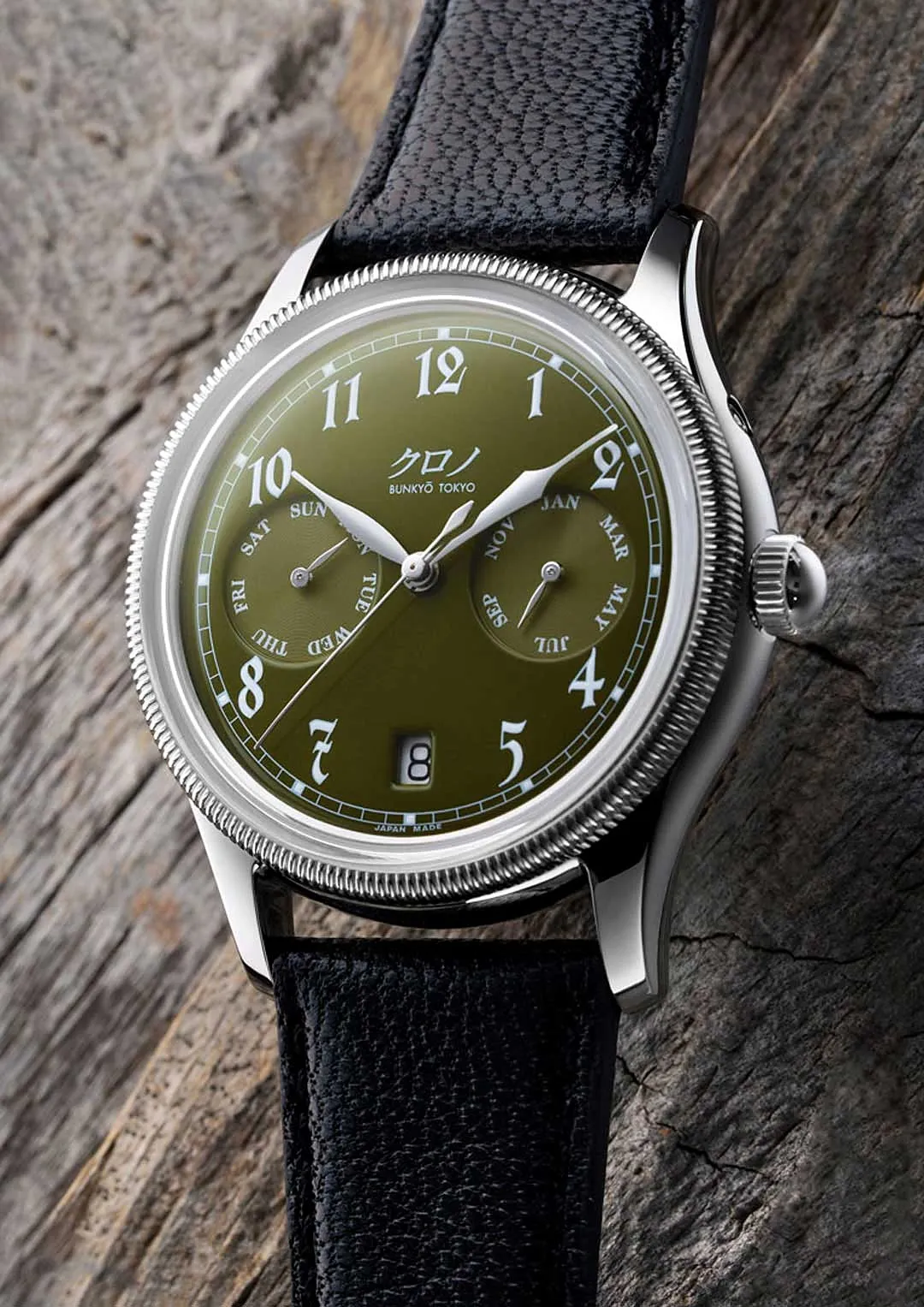
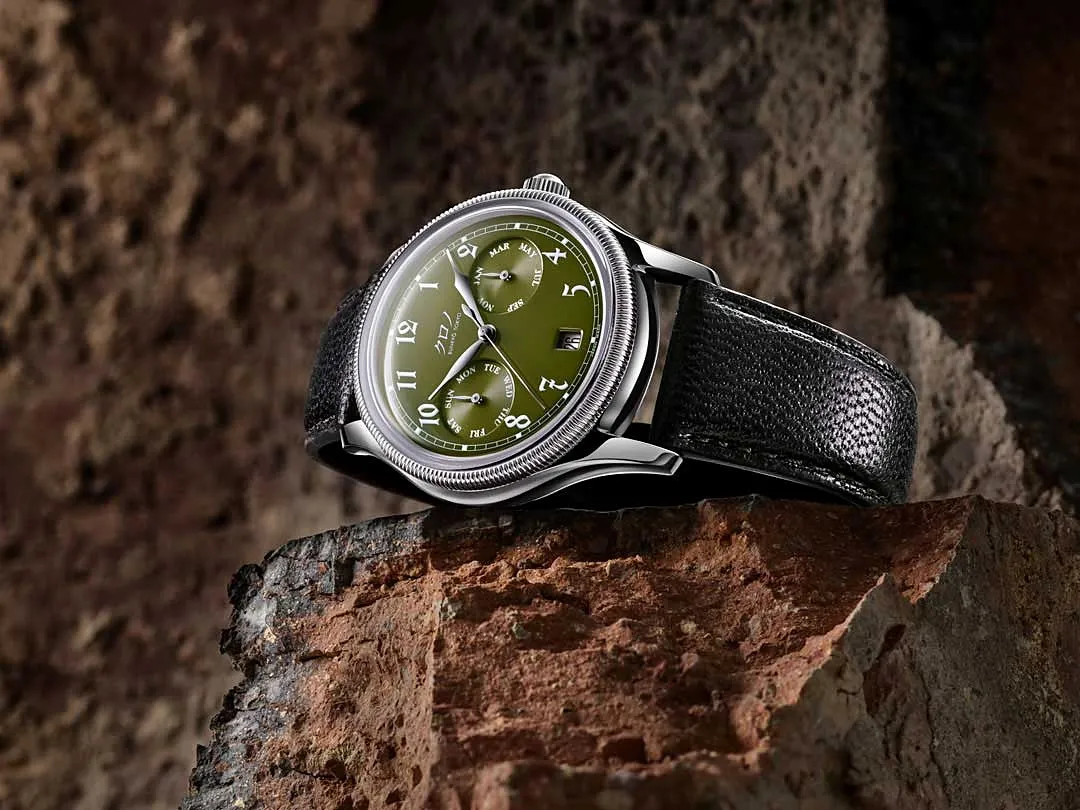
That timeless architecture of the code, and the balance of a calendar that goes round, find a concrete counterpart in the Kurono Tokyo Calendrier Type I, signed by Hajime Asaoka, standing on our table.
Asaoka never passed through the traditional Swiss schools. He built his own lathes and climbed to the summit alone in his Tokyo atelier. Kurono is the brand he founded to carry watches of his own design to a wider circle.
The Calendrier Type I is a complete calendar: the day of the week, the name of the month and the day of the month are all read on the same dial. Inside runs the Miyota 9122. It beats twenty eight thousand eight hundred times an hour, runs for forty hours and has twenty six jewels.
The dial is khaki green and the numerals are printed in a raised format in an old typeface, with a railway track minute scale turning at the edge. The month counter sits at twelve and the day counter at six, the date window is at three, and the name of the maison is written at the centre in katakana. The guilloche is on the counters.
The real matter is in the structure of the dial. By the maker’s own description this is a cylinder dial: it curves from the centre towards the outer edge, and two separate layers are pressed together into one three-dimensional surface. What you are looking at is not a flat plane; there is a second layer under the visible one, and the two were made into a single thing under the press.
The case is forged 316L steel, its sides mirror finished, its bezel milled like the edge of a coin. The hands are high-polish leaf hands curved at both ends; the seconds hand is very thin and its tip is bent by hand.
Asaoka says he designed this watch to be scratched. The blemishes it gathers belong to one wearer alone, he says, and are a written record of that person’s journey and adventures; owners should spend their time on meaningful pursuits rather than worrying about scratches. The design therefore embraces those marks, takes character from them, and looks better with time.
That is a quiet answer to the question on the screen. A scratch is the mark a choice already made leaves on the body of a thing. The watch was built to carry it, not to erase it.
The same thing shows in the maker’s own choice. For the anniversary version of the calendar he chose a salmon pink dial, though a saxe blue was seriously on the table. I was very fond of both colours, he says; but as it was an anniversary piece I released only the salmon pink. Then he could never quite get that blue out of his mind, and came back, purely as a personal passion project, and made it too. That is how the small batch release was born.
A choice is made, and afterwards the reason for it is understood. Which is what the Oracle told Neo.
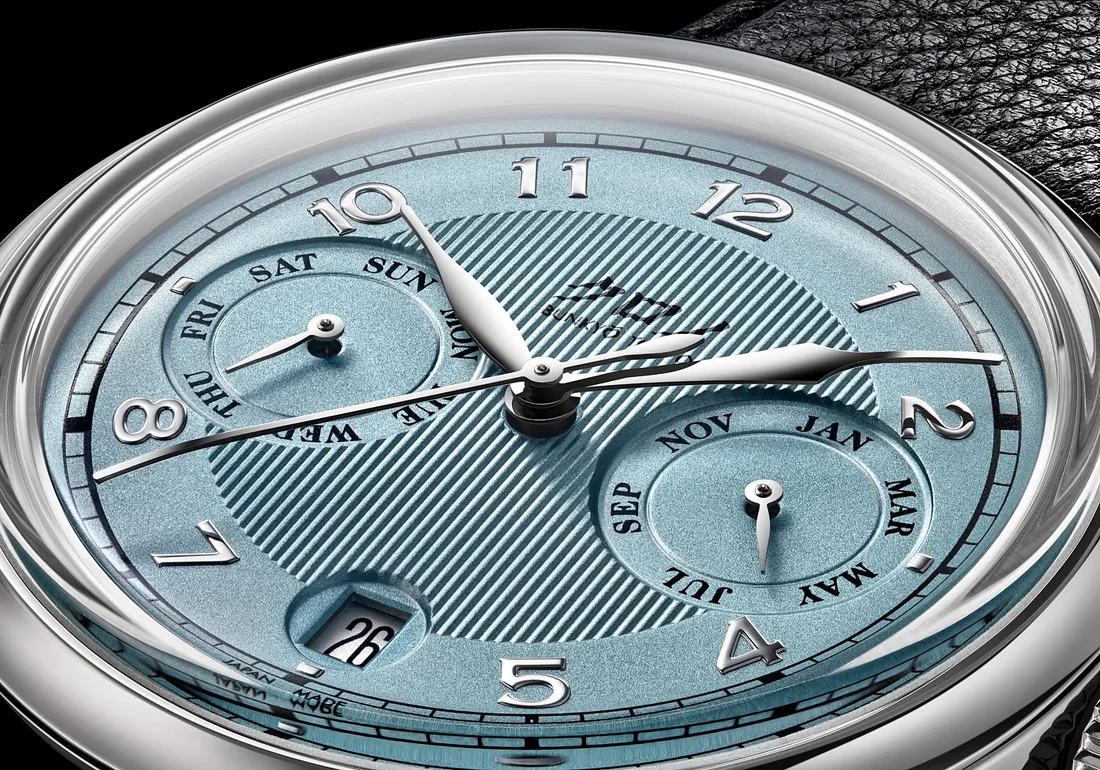
format_quote"The one who looks at the watch does not only see the time; they watch their own intervention bring the day, the month and the date into line."
Hasan Bekmezci
As the Ancient Master of the East said when he spoke of a knot whose untying unties the question too, and as the Maturidi school certifies, eternal knowledge encompasses a person’s choices but has not made them a robot. The human being has been given both the freedom and the responsibility to choose between the red pill and the blue.
A watch lover looking at the curved dial of the Kurono Tokyo Calendrier Type I, watching the wheels turn over tick by tick, remembers once again the delicate responsibility of their own partial will in the universe, and the deep wisdom behind the choices they have made. The human will is a line of choice inside the simulation; and the order that discloses itself when that line runs belongs to the Infinite Architect of the worlds.
The watch on its maker’s own site: Kurono Tokyo, Calendrier Type I