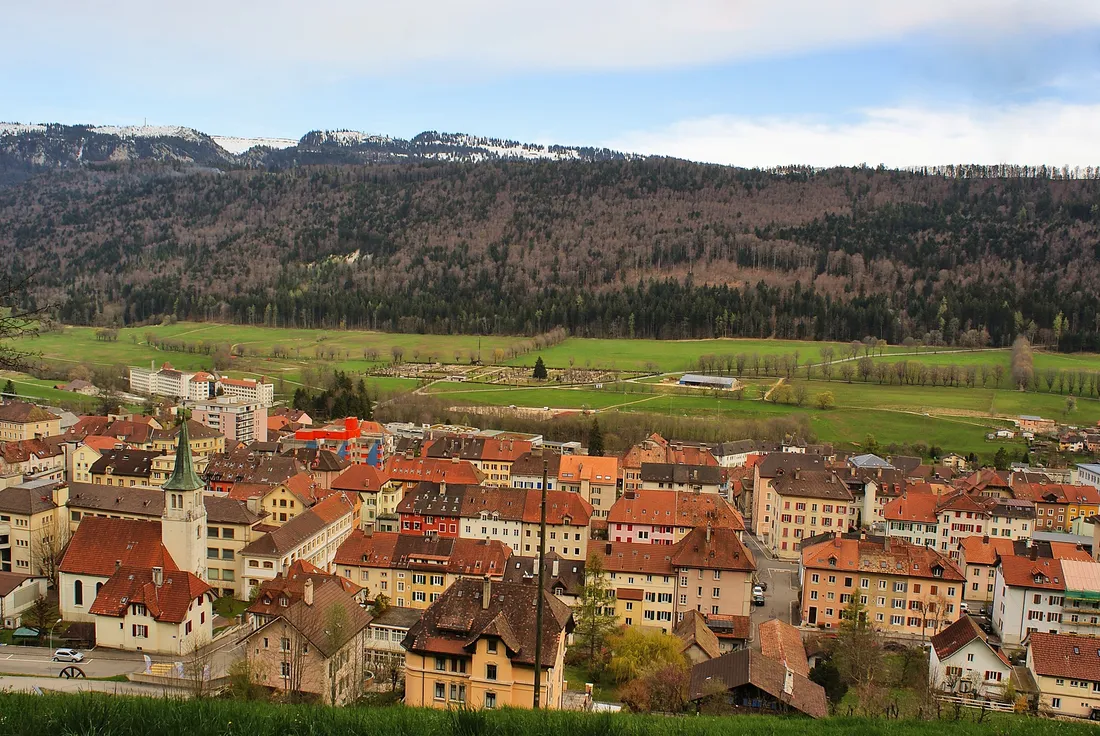
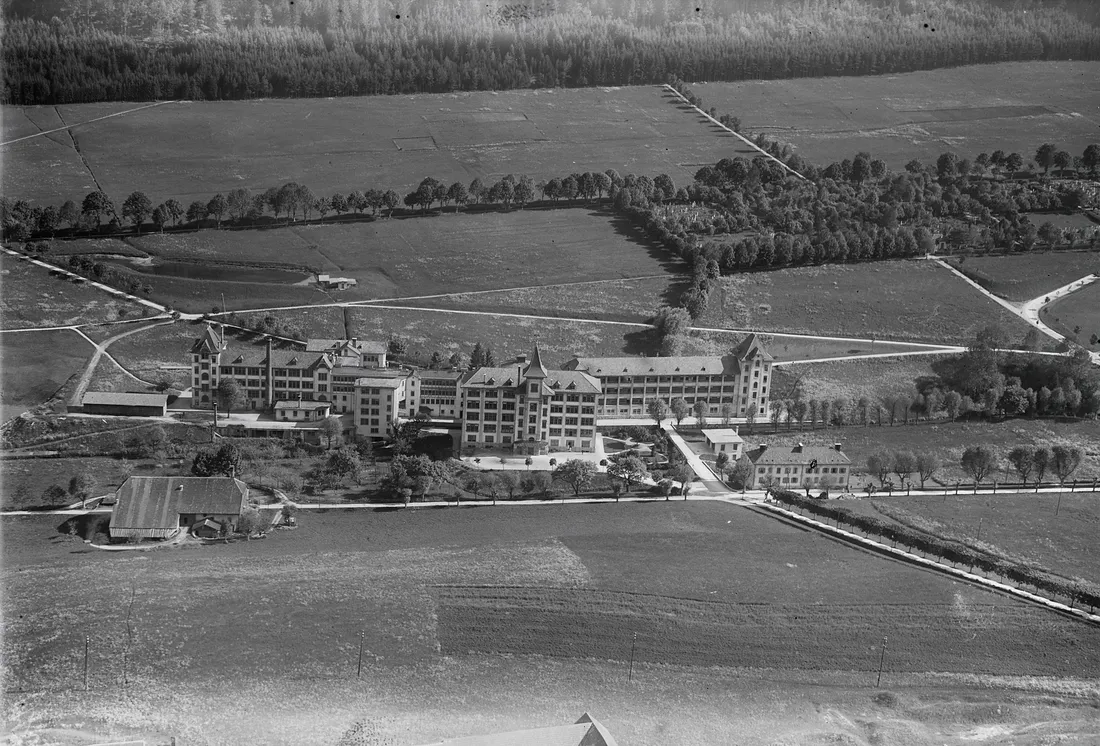
Winter in the Jura mountains is less a change of season than an existential siege. The heavy grey fog that fills the valleys rubs out the boundary between the sky and the ground and presses a person into a narrow space with nowhere to escape but their own inner voice. On the frozen edges of the river Suze, the thin yellow light of a gas lamp leaked out of the windows of a building of wood and stone, raised on a stretch of ground the local people had long called Les Longines, the Long Meadows.
Outside, the wind struck the sheer rock of the mountains and howled; it blew the snow off the branches of the pines into the depth of the valley. Inside the workshop a quite different and almost sacred silence held sway. That silence was woven not out of absence but out of the rhythmic ticking of a mechanical micro-universe made of dozens of wheels, levers and mainsprings.
Master Ernest, squeezing the brass loupe into his eye, took hold of a tiny wheel on the bench with his tweezers. This wheel, which he would seat on an arbor finer than a hair, was the last part of a new mechanism he had been working on for weeks and which would open a new road in pocket watches.
A little way from him sat Jean, barely eighteen, serving his apprenticeship in the workshop through the hard winters of the Jura. Jean had been filing and sanding brass plates for hours, but he could not take his eyes off that pitch dark, impassable fog in the window. For Jean these mountains were no different from a vast prison in which time never moved and a person was caught in a trap.
Jean put down his file on the bench. He drew a deep breath in the air full of flying brass dust. Master, he said, his voice trembling a little, outside it is as if life has stopped; even the river is motionless under the ice. And here we are, labouring over the thousandth part of a millimetre as though we were going to save the world. People die in their fields, trees rot, mountains crumble. While time sweeps everything away, what does it mean that we should line up these little pieces of brass so carefully? Is trying to shut time inside a box not like trying to catch the wind in our palms in a fog?
Master Ernest laid his tweezers slowly on the chamois cloth. He took the loupe out of his eye. With the weariness of years and a lined face hardened by mountain air he looked at the young apprentice. He picked up a glass hourglass filled with fine sand from the edge of the table and turned it over. The thin yellow grains began to run down through the narrow neck in a single line.
Look, Jean, said Master Ernest, pointing at the running sand. What you see here is nature. This sand is earth, it is decay, it is the inevitable end. The going out of the stars, and our own mixing one day with the soil of these mountains, are like these grains falling. Time is a merciless force that wears out, rots and destroys the garment of matter. If we look only at this sand, we can be nothing but victims crushed beneath time.
Master Ernest paused. He took up a blank brass plate and his graver.
But a human being, the master went on, is like no other living thing in nature. A human being is the only creature conscious of its own mortality. While time swallows it, it raises up its mind. Just like these ticking wheels. We are not shutting time inside a box, Jean. We are setting our intelligence, our will and our sense of beauty against that absolute flow that runs on and destroys us. Time may be dragging us along; but by measuring it, by cutting it into slices and by giving it meaning, we establish a dominion over it.
format_quote"We are not shutting time inside a box; we are setting our intelligence, our will and our sense of beauty against that absolute flow."
Hasan Bekmezci
With quick and certain strokes of the graver the master cut a shape into the brass plate. First the silhouette of an hourglass running downwards appeared in the middle of the plate. Then, opening skywards from either side of that hourglass, he cut two sharp and proud eagle wings.
There it is, said Master Ernest. The sand falling is our bond to the earth and to death, which is to say the fate we cannot escape. But these wings we have put on either side of the hourglass are the human consciousness, the human mind, the revolt it raises against time and against the cruelty of nature. We named this factory Les Longines. That is the name of this valley. But what we make is not merely a watch; it is the dignified stand of a human being before time.
That night, the symbol cut in that small workshop in the valley of Saint-Imier became the oldest registered trademark in the history of mankind to have come down to our day without ever being changed: the winged hourglass.
That dialogue in the small workshop in the Jura is in truth the heart of a question humanity has been trying to answer since it existed. What is time? Is time the wheels turning under the dial of our watches, or is it nothing but a perception echoing down the corridors of our minds?
Through the history of philosophy the answers given to that question set out three different layers of the idea of time. The first is objective and destructive time, the flow of matter: the time we see in nature is entropy, decay and ageing. A star burning its fuel, iron rusting, a person growing old are the monopoly of this time. It is linear and it is without mercy; it swallows everything that comes before it. Winter in the Jura is the plainest expression of that flow, and before this time a person is a passive object.
The second is the time of consciousness and awareness; the time a person calls now, in which they come to awareness and show will. What Ibn Arabi called Ibn al-Waqt, the son of the moment, and what Western philosophy calls qualitative time, fall exactly here. What matters is not how many hours the time lasted but how much depth, will and meaning was fitted into that moment.
The third is the answer a human being gives with craft and reason, which is to say mechanical balance. Watchmaking stands exactly where those two planes cross. Making a watch is the art of turning what is abstract and merciless into a mechanism that is concrete and can be controlled. A person takes brass, steel, ruby and sapphire and sets a human order against the disordered flow of nature. They cannot stop time, but they tame it.
format_quote"A person cannot stop time, but they tame it."
Hasan Bekmezci
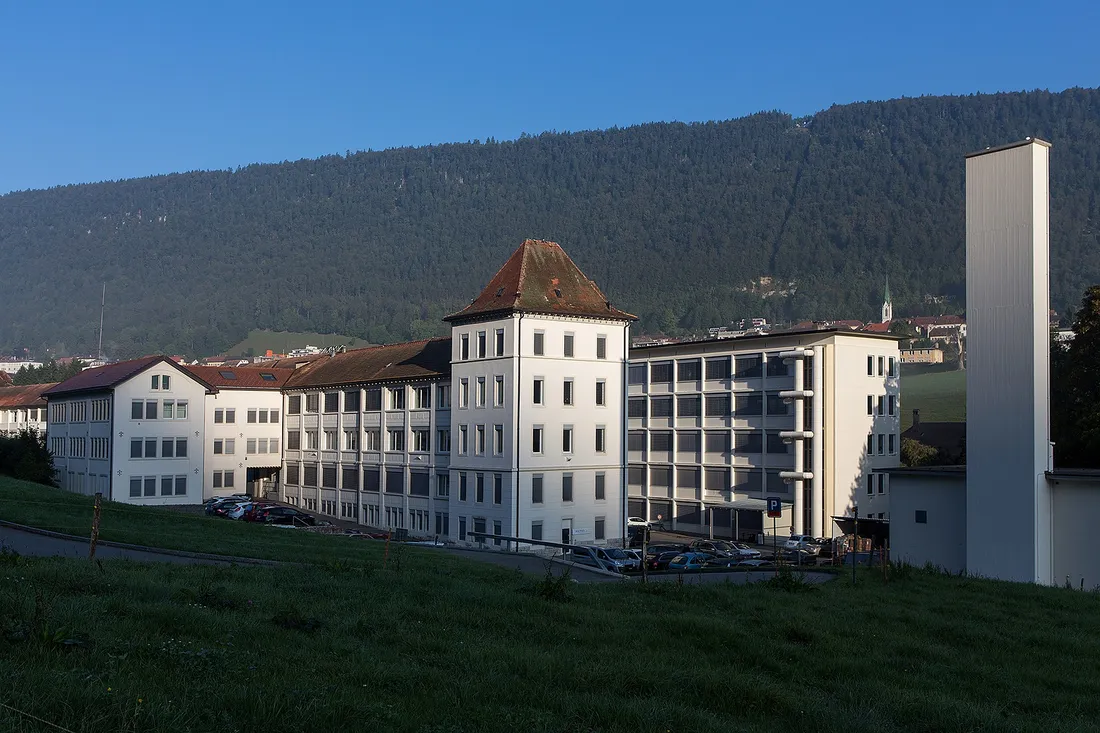
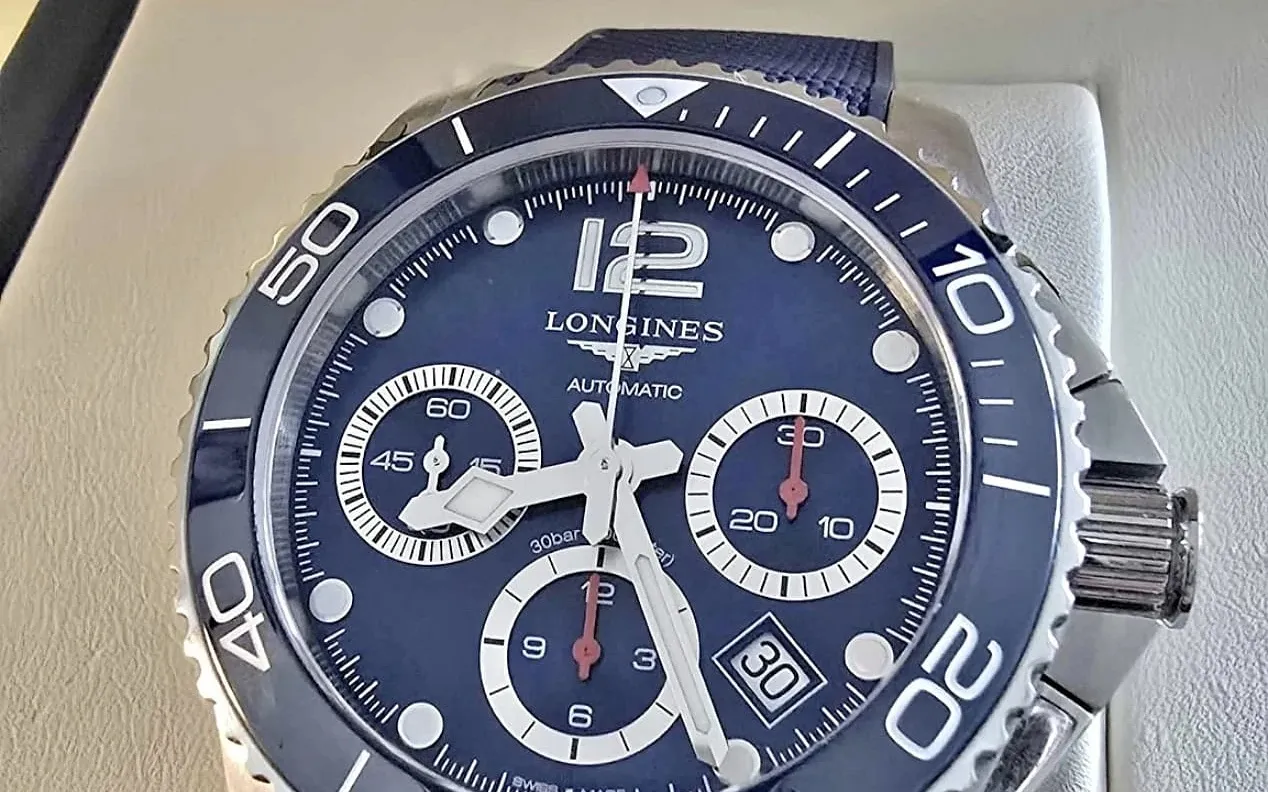
If that existential struggle, whose foundations were laid in the foggy air of the Jura, is to be made concrete in an object we carry on the wrist today, the Longines HydroConquest Chronograph is one of the strongest instruments of that philosophical inheritance. With its forty three millimetre steel case, its blue dial, its blue ceramic bezel and its textured blue rubber strap, the watch is water resistant to three hundred metres and winds itself.
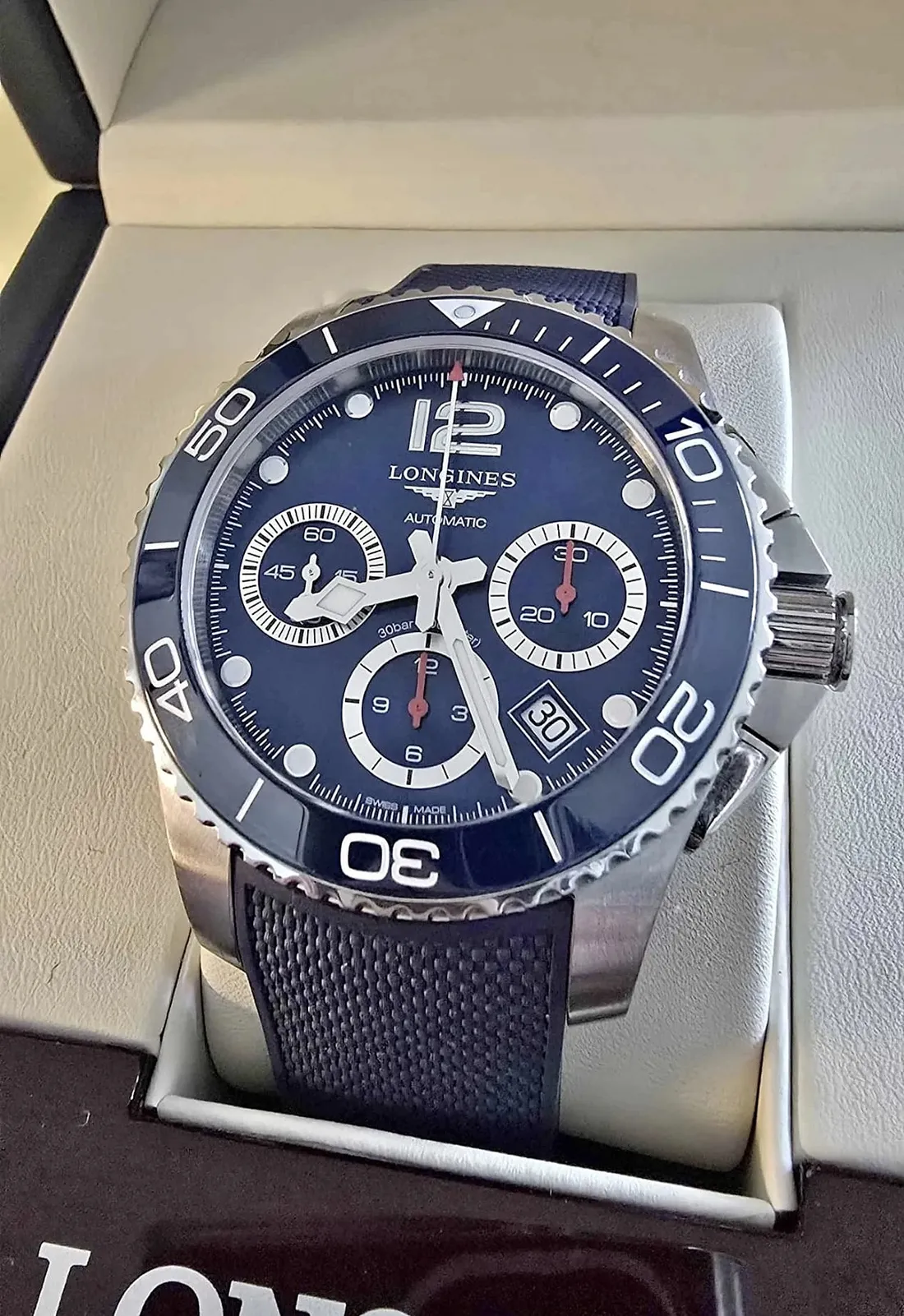
The watch in the picture is not an ordinary accessory, nor merely an instrument that shows the hour. It is the winged hourglass Master Ernest cut into that brass plate, read again through modern engineering.
The first thing is the will to direct time. The subdials set at three, six and nine, together with the central seconds hand with its red detail, turn the passive relationship a person has with time into an active one. The instant you press the chronograph pusher you create a slice of time of your own inside the universal time that flows. Time no longer simply runs on; it begins at your command and it stops at your command.
The second is a shield against wear. Ceramic, used against time, the most destructive force of nature, shows an absolute resistance to scratching and dulling. Like the hard rock that withstands the storms of the Jura, the ceramic bezel of the watch prevents time from leaving its mark on the outer surface.
The third is depth and the balance of pressure. The screwed crown, the screwed chronograph pushers and the textured blue rubber strap integrated into the case turn the watch into an armour that works even in the dark and high-pressure depths of the sea. This is the resolve of a person to keep their dominion over time not only on land and in the air but beneath the water as well.
Looking from the foggy valley of the Jura to the complicated and hurried world of our day, the meaning of putting on a watch deepens. The person of today has become the object of time among digital screens and algorithms; every second batters them as a piece of biometric data, a notification or a rush.
To carry a mechanical watch like the Longines HydroConquest Chronograph on the wrist in such an age is to hold on to the truth Master Ernest whispered to his apprentice in that frozen workshop at Saint-Imier in 1867. Time flows; it crumbles mountains, wears out bodies and lets the sand fall. But inside a human being there is a spirit that does not surrender to that flow, that gives time a direction with its reason and its craft. That winged hourglass on the dial reminds us, at every glance, that we are not helpless mortals but beings with a will, beating our wings above time.
format_quote"The winged hourglass reminds us, at every glance, that we are beings with a will, beating our wings above time."
Hasan Bekmezci
The watch on its maker’s own site: Longines, HydroConquest