A calendar is a settlement reached between people and the sky. One journey of the Earth around the Sun takes about 365.2422 days. The decimal is what ruins everything, because a species accustomed to counting whole days has nowhere to put a quarter of one. The remedy is to add an extra day every four years, though that overshoots slightly. The Gregorian calendar corrects the overshoot by skipping century years, while keeping those divisible by four hundred. So 1900 was not a leap year and 2000 was.
A mechanical perpetual calendar writes the first layer of that rule into metal. There is a cam that turns once every four years, its edge cut to different depths according to the lengths of the months. At the end of each month a lever touches that edge, reads the depth and tells the date wheel how far to jump. One step for a month of thirty-one days, two for thirty, three for February, two for a leap February. The watch will do this without once being wrong until the year 2100. Because 2100 is a century year and is not divisible by four hundred, it is not a leap year; when that day comes the mechanism will need correcting by hand. Almost every perpetual calendar being made today lives with that boundary.
format_quote"A perpetual calendar is a memory that says nothing for four years and gives the right answer at the end of every month."
Hasan Bekmezci
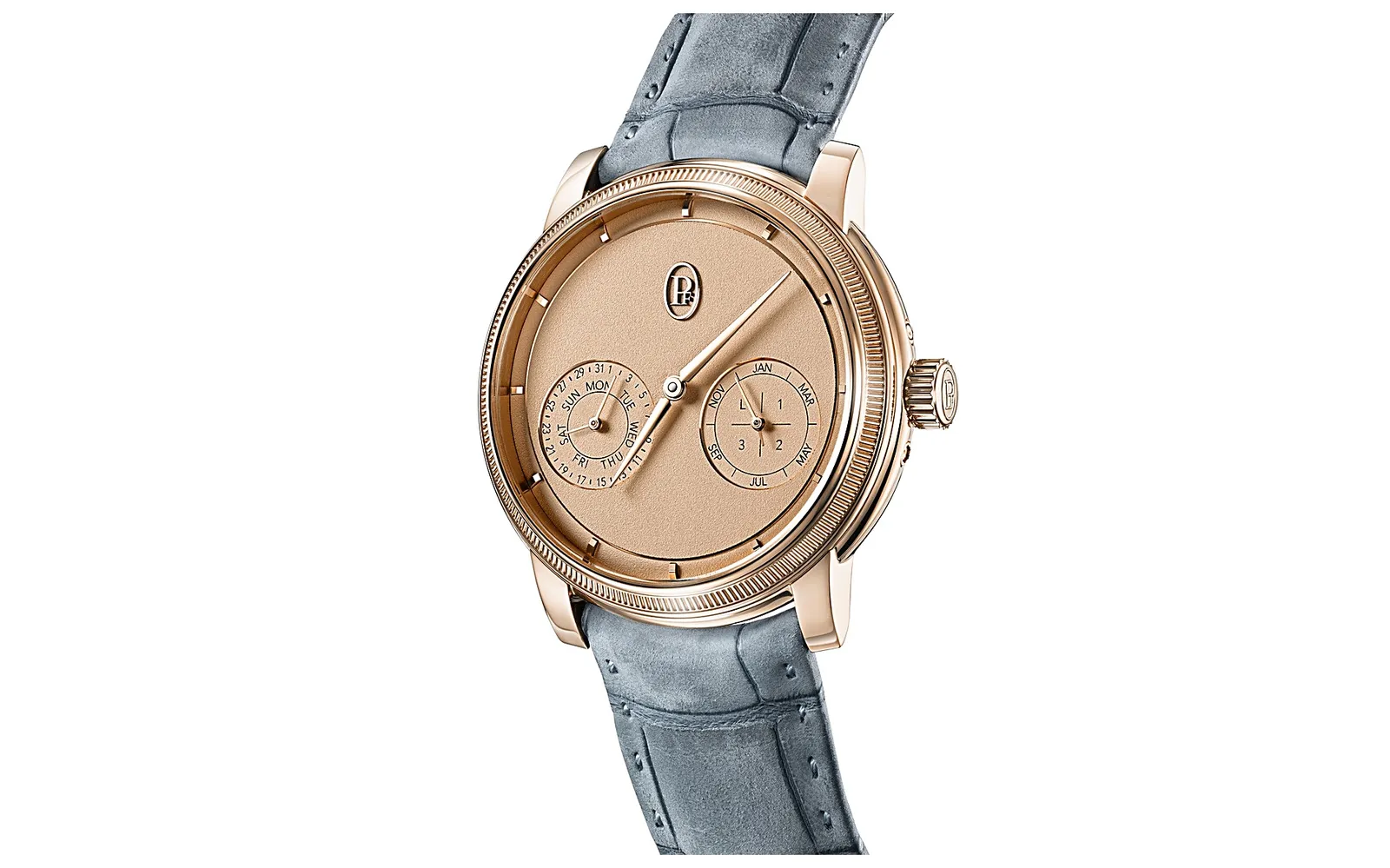
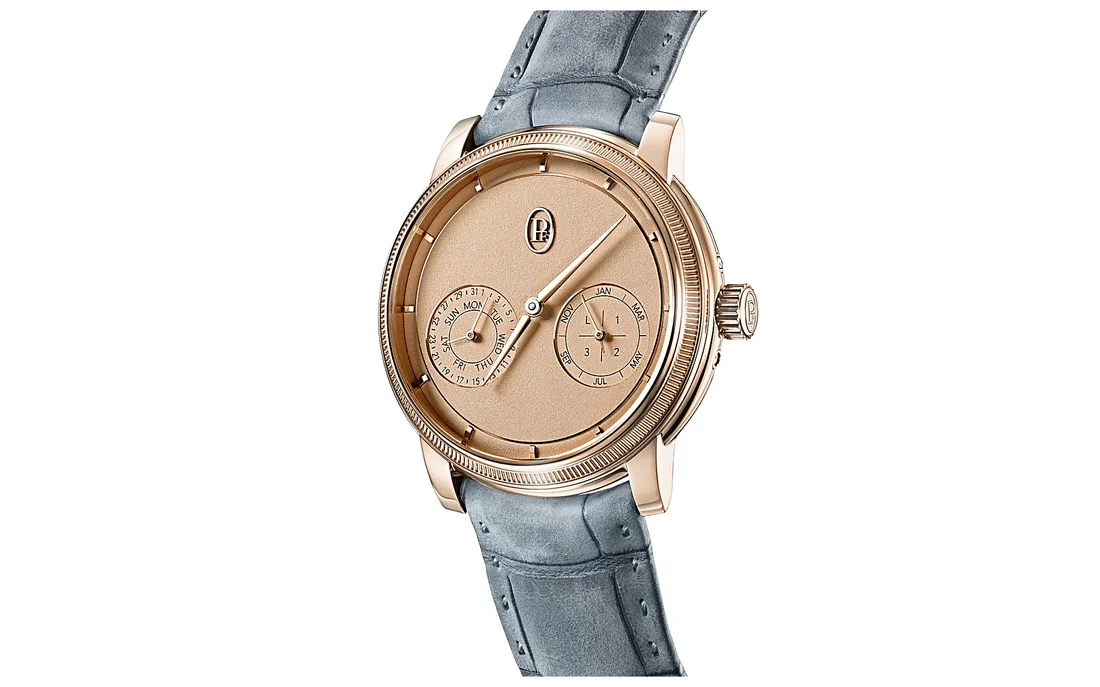
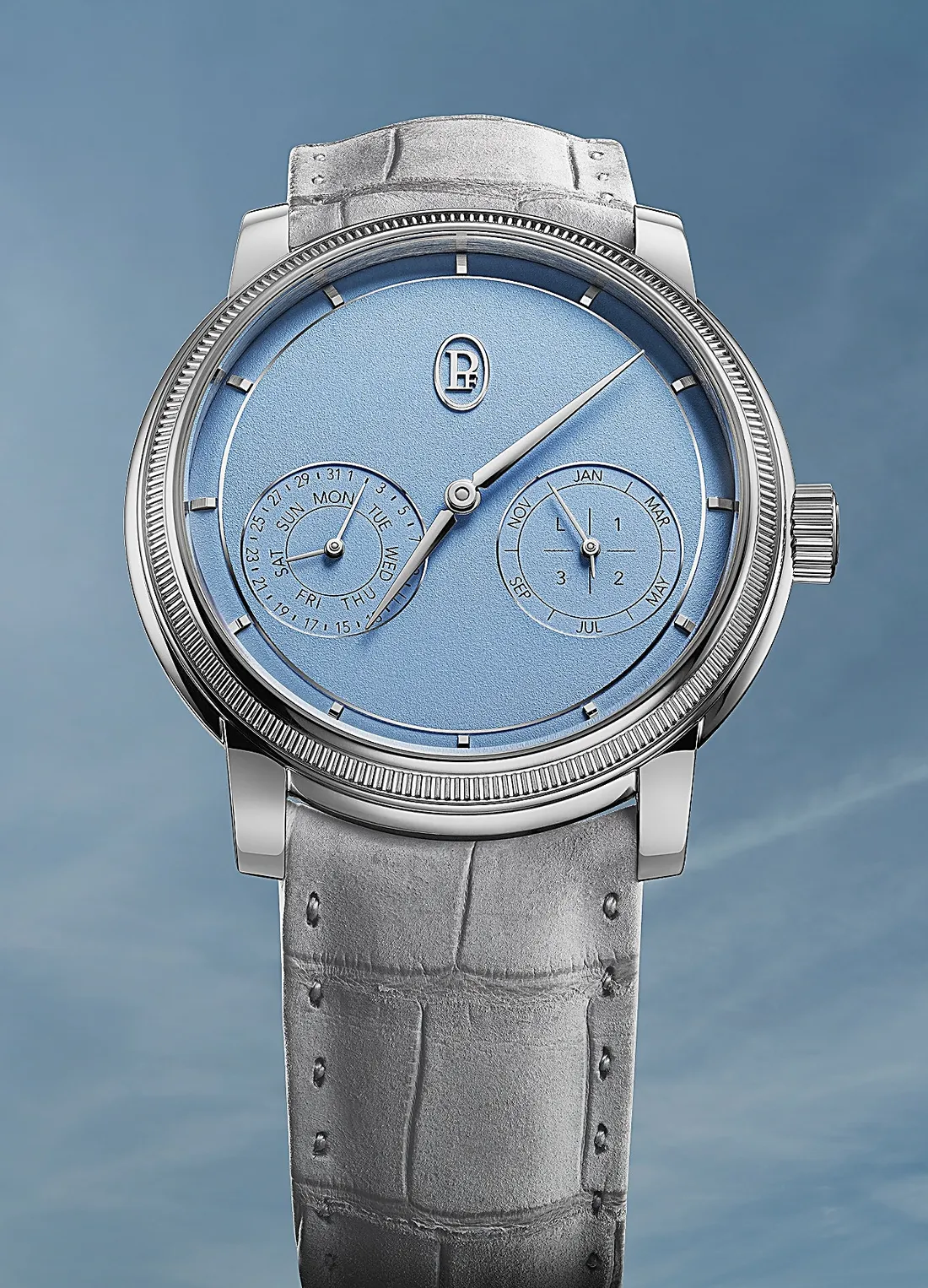
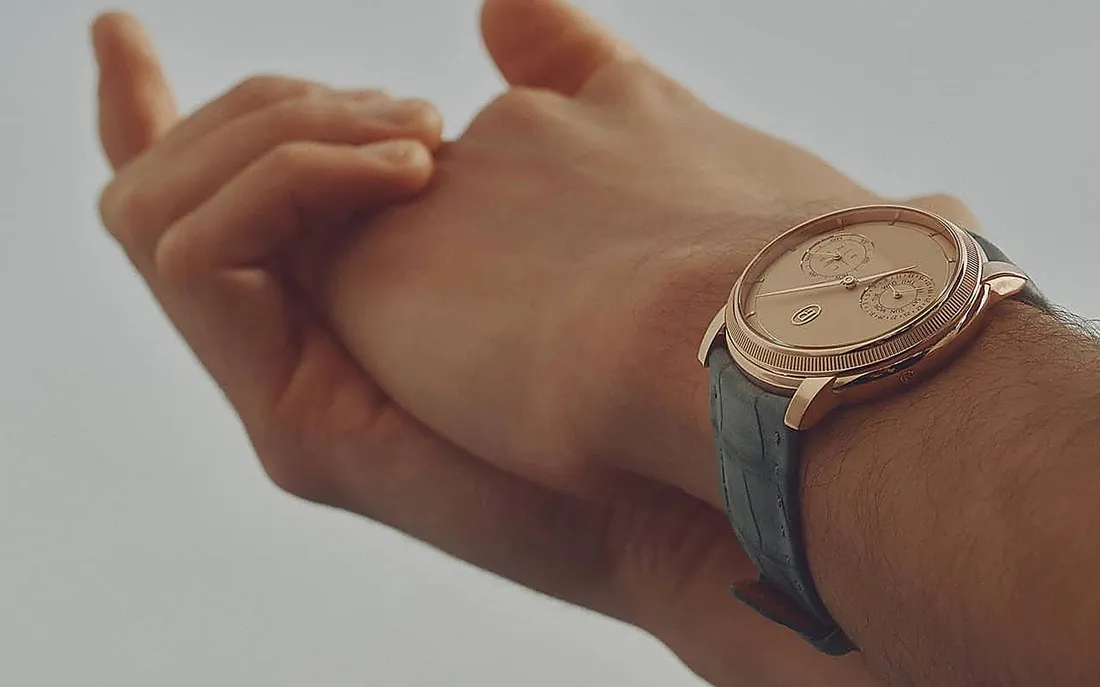
The classic way of fitting all that information onto a dial is to riddle the surface with holes. Day, date, month, leap year and usually a moonphase as well. Four apertures, three counters, and a face that has to be learned like an aircraft cockpit. Parmigiani has done the opposite here: the indications are gathered coaxially, which means more than one reading shares the centre of the same counter. There are only two small circles on the dial, and most of the dial is left empty.
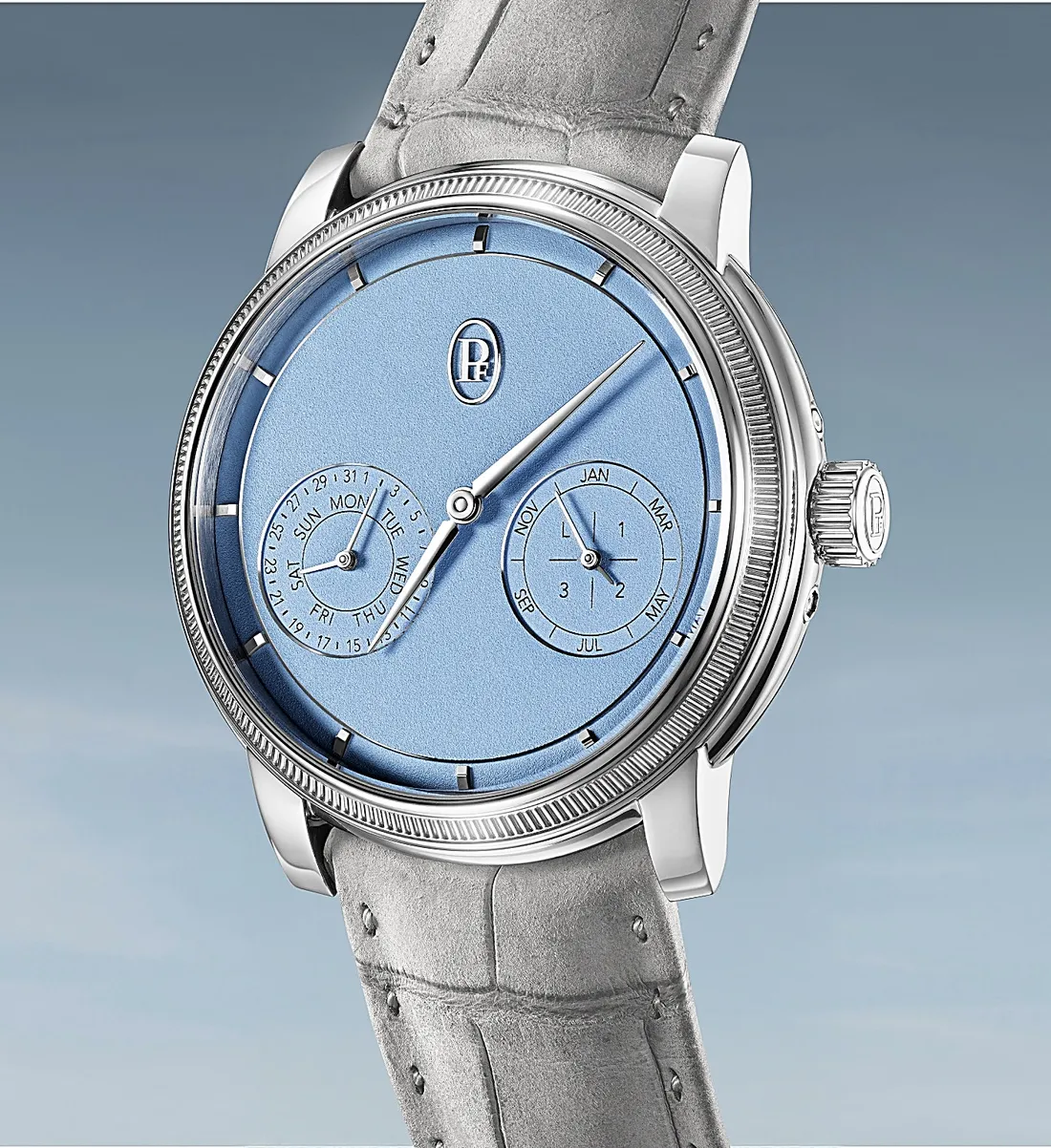
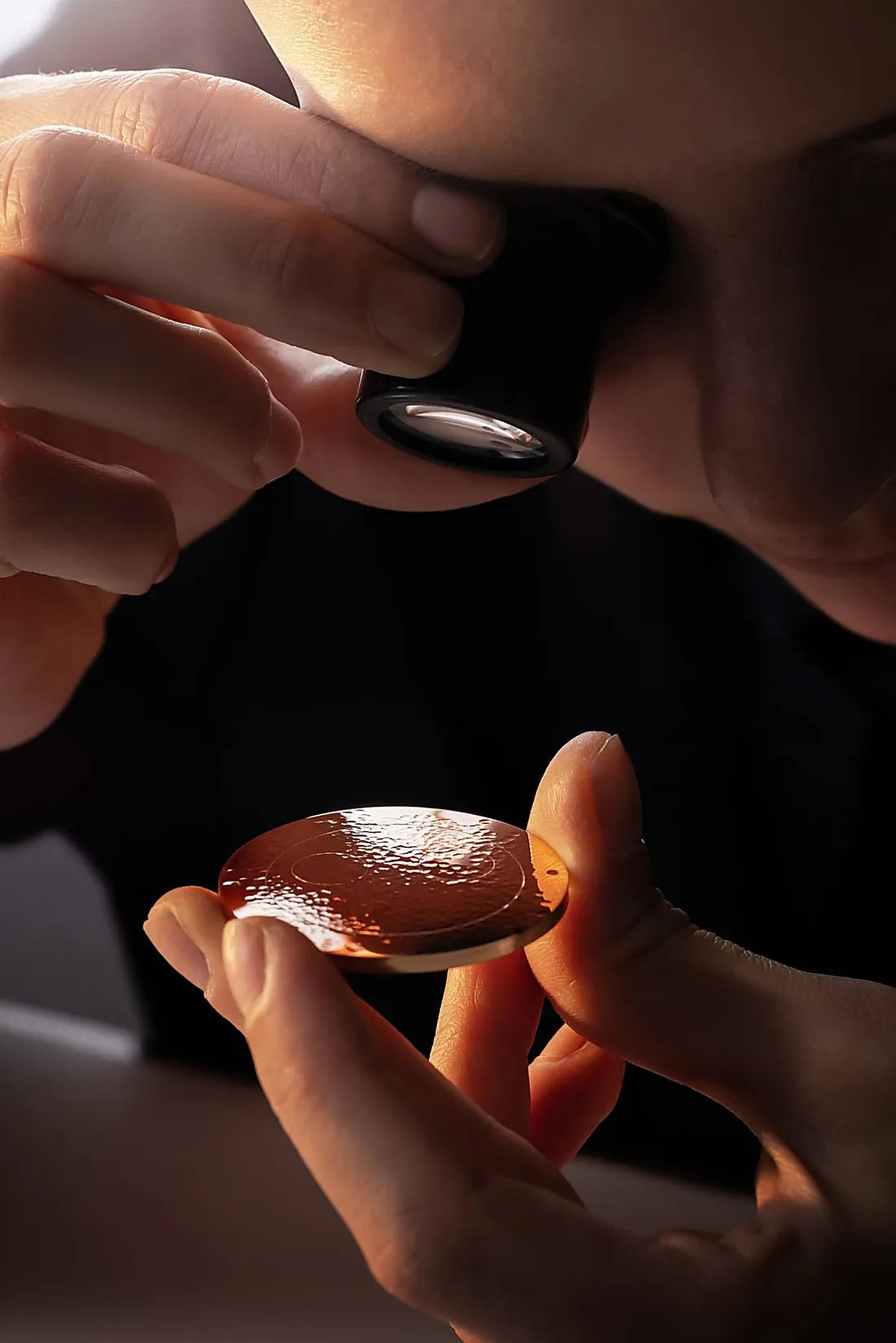
That empty surface is the real subject of this watch. The dial is eighteen-carat rose gold, hammered by hand. In martelage the craftsman strikes a round-ended punch into the surface over and over. Each blow opens a small hollow and leaves a slight ridge at its rim. The surface becomes a living texture made of hundreds of tiny facets, each breaking the light in a different direction. The tone the house calls Bright Peony is the colour of the rose gold itself, underneath that texture.
Hammering looks straightforward, but the difficulty is not in the blow. It is in the order of the blows. Make them identical and the surface sits dead, like machine work. Make them wholly random and it reads as careless. The craftsman has to manage disorder on purpose. Gold also work-hardens a little with every blow, so the punch behaves differently as the surface progresses, and the force in the hand has to change with it.
The argument between the craftsman who makes this dial and the constructor who builds the calendar is the most concrete thing about the watch.
The dial maker wants depth. The deeper the hammer goes, the more the texture comes alive and the more the light moves.
The constructor reminds him of the measurement. The hands and discs of a perpetual calendar turn just above the dial, at a fixed height. The clearance between that height and the dial surface is measured in hundredths. Every hammer blow leaves a ridge at the rim of its hollow, and that ridge grows upward. Strike deep enough and a hand touches the dial, drags, and the calendar cannot make its jump.
The dial maker negotiates. Then let us go deep only where the hands do not pass.
The constructor shakes his head. Then the dial has two different textures in two zones, and the eye catches that at once. The texture is either the same all the way across or it is not there at all.
The settlement is to let the depth of the hammer be set by the clearance the movement leaves. Which is to say that the limit on this dial’s liveliness is drawn not by taste but by the calendar beneath it.
format_quote"Every hammer blow lifts the surface a little, and the hands turn at a fixed height. The depth of a dial is only as much as the movement leaves it."
Hasan Bekmezci
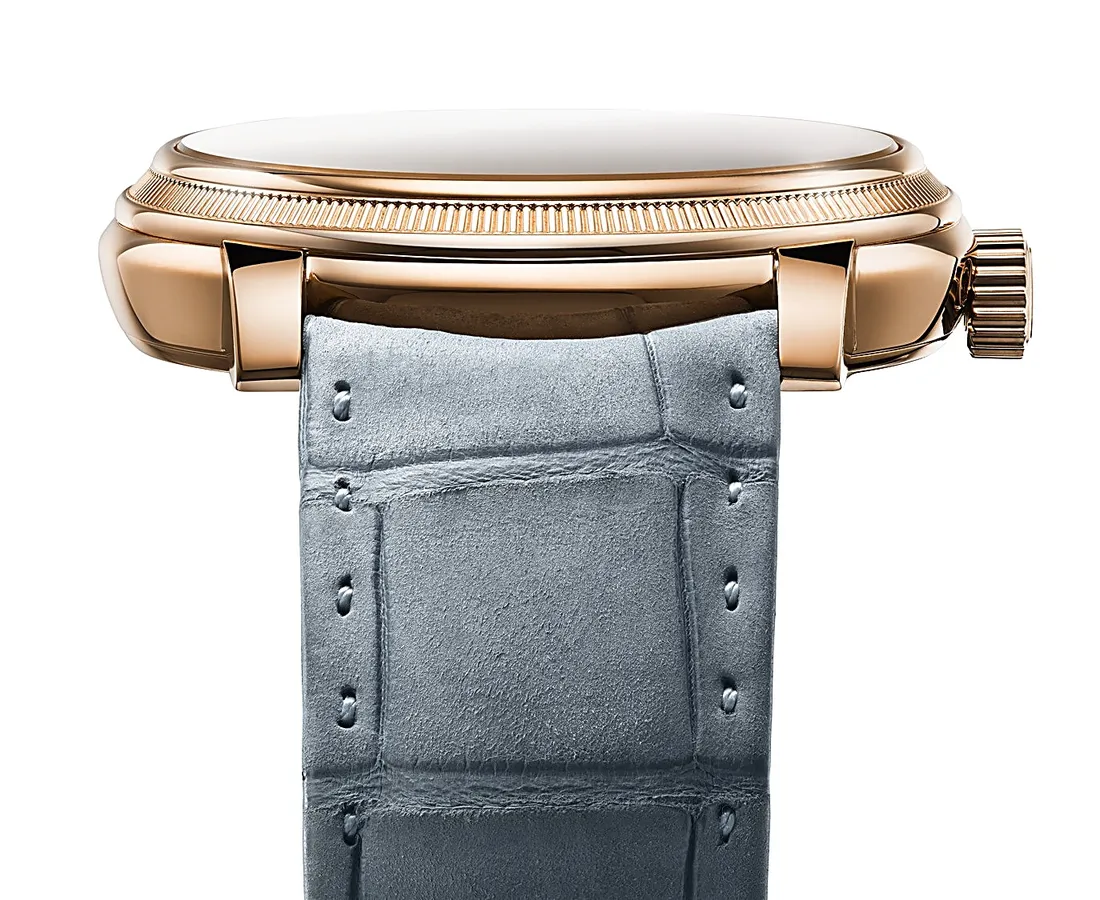
The indices are also eighteen-carat rose gold, and the hands are alpha shaped. The case is rose gold again, forty point six millimetres across and ten point nine deep. The collection’s knurling runs round the bezel and is repeated on the case back. The sapphire crystal carries the ARunic anti-reflective treatment, the back is sapphire too, and water resistance is thirty metres.
Seen from behind, the watch shows its most generous face. The calibre PF733-AN is wound by hand, beats at four oscillations a second and runs for sixty hours. It holds two hundred and sixty-five components and twenty-nine jewels, and measures thirty-one and a half millimetres across. The perpetual calendar is integrated into the movement rather than added on top as a module.
The bridges are solid eighteen-carat rose gold, covered with a double hand-guilloché Clous de Paris. The Clous de Paris pattern comes from two sets of parallel grooves crossing at right angles; the material left between the crossings stands up as small pyramids, and the surface turns into a field of hobnails. Done by hand, the work proceeds on a rose engine with the metal fed slowly beneath the cutter, and both passes have to be exactly the same depth; if the second runs deeper than the first the pyramids lean. On gold it is harder still, because the soft metal drags at the tip of the cutter. At the edge of the pattern a raised, ungrilled band called a filet sauté has been left standing, framing and closing the field. The steel parts are bevelled by hand.
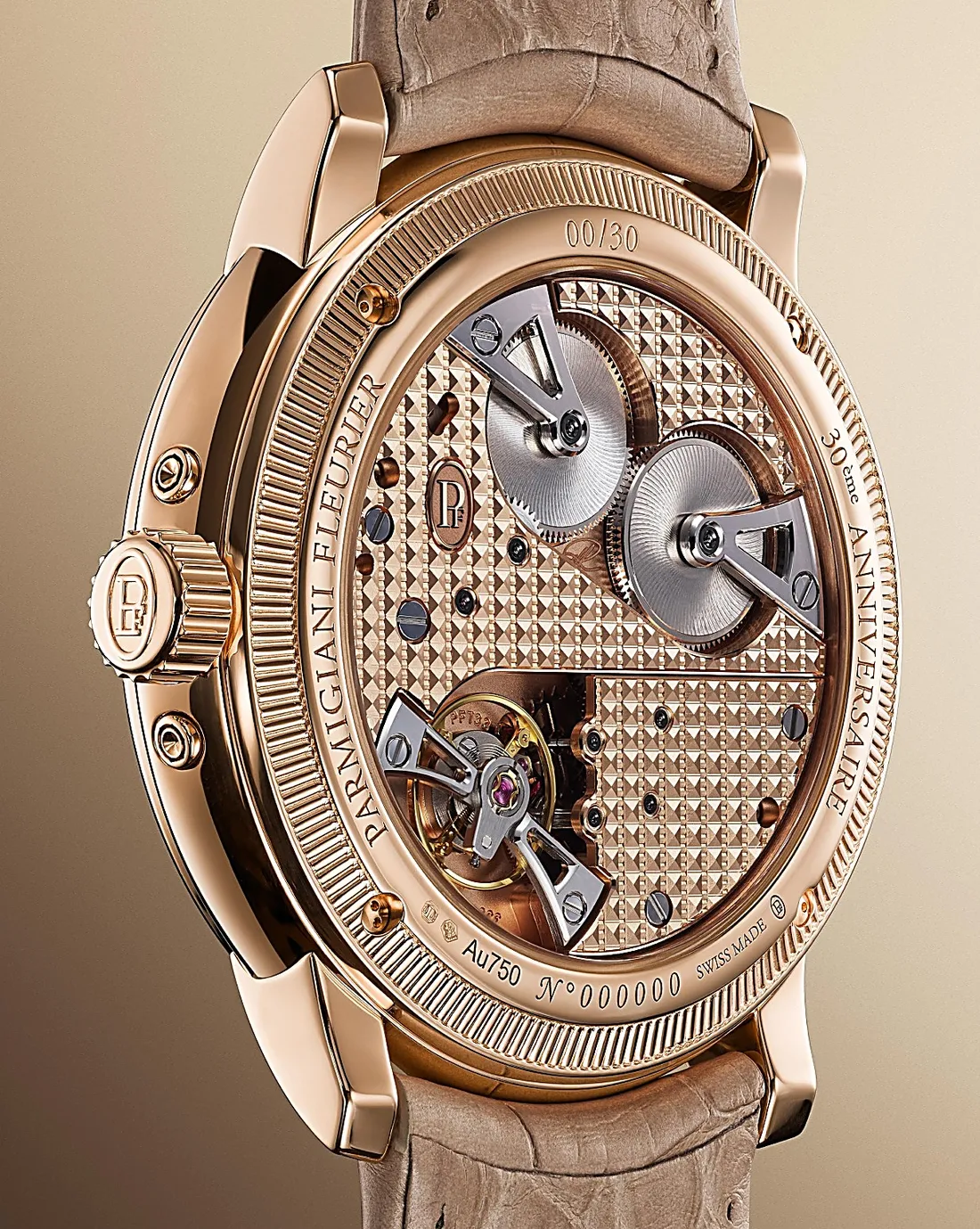
The watch is limited to thirty pieces, each numbered from one to thirty. The number is not arbitrary: Parmigiani Fleurier completes its thirtieth year in 2026. It can be bought on its own or reserved as part of what the house calls the Anniversary Trilogy. The price is 113,000 Swiss francs.
It is easy to say a perpetual calendar is not an instrument anyone needs on a wrist. Your phone gives you the date more accurately and will not ask to be corrected in 2100. But that comparison walks past the point. A perpetual calendar is not a source of information; it is an undertaking. A craftsman sits down, cuts a four-year cam, writes the lengths of the months into metal, and sets that mechanism to keep answering correctly for longer than his own life. Even while it is on your wrist, it is telling you something: someone, a long time in advance, took your today into account.
format_quote"A perpetual calendar is a promise made to a future the maker will not see."
Hasan Bekmezci
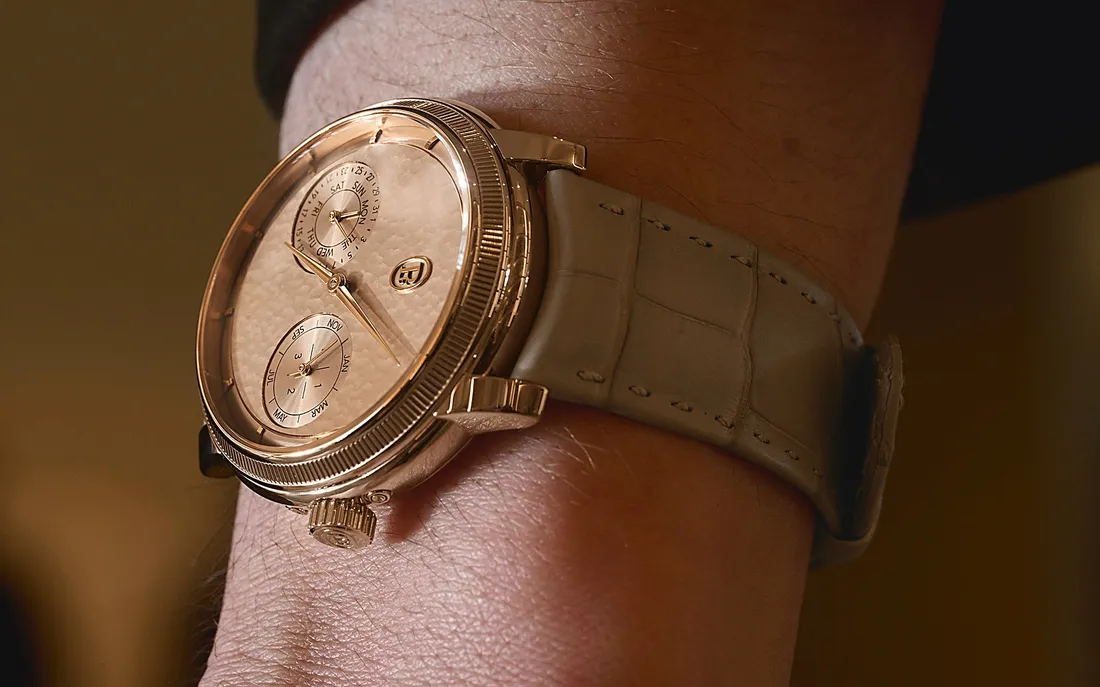
The watch is nominated in the Calendar and Astronomy category at the 2026 Grand Prix d’Horlogerie de Genève. The category is usually contested by watches that bring the sky onto the dial, with moonphases and star charts and a good deal of display. What this one does is the reverse: it does not bring the sky onto the dial, it keeps the sky’s irregularity off it. What you are left holding is two small circles, a hand-hammered gold surface, and behind them a memory working without a word.