It was a pitch black night on the North Sea. Every wave that struck the hull sent a groan up through the timbers and into the whistle of the wind. On deck, a young sailor wrapped in an oilskin soaked through with spray turned to the old astronomer beside him. In the thin yellow light of the lantern the astronomer’s hands were shaking with cold as he trained his brass sextant upward, on the silver disc slipping for a moment between the clouds.
The wind is driving us onto the shore, master, the young man shouted. The chart is no use to us.
Without taking his eyes off the sky the astronomer smiled calmly. A chart shows you the ground beneath, my boy, he said. What will take you off this shoal is the sky above it. Look. The Moon is at its brightest and its highest tonight. The sea will not declare war on us. It will lift us and carry us over.
The sailor’s hands were locked on the wheel. He looked from the darkness to the silver dome the astronomer had pointed at. The water boiling over the deck was uncovering the black teeth of the shoal beneath, each one standing up like a dagger.
But master, he said, his voice trembling under the roar of the wind, the water is draining out from under our feet. The keel is about to touch sand.
The old astronomer lowered his sextant slowly into his pocket. In the lantern light a deep conviction was shining in his eyes.
Be patient, young man, he said. Gravity is the quietest and the most faithful word in the universe. Look, the Sun, the Earth and the Moon are aligned at this moment in the darkness of space. Astronomers call it a syzygy. The sky is shaking hands with the sea. In a few minutes that shoal you can see beneath you will be filled in by an invisible hand.
What the astronomer had said began to happen at that exact moment. The angry water of the North Sea stopped receding. The current below reversed, and an enormous mass rose beneath the keel and lifted the boat into the air with a faint crack of timber. As the killing rocks of the shoal disappeared under the climbing level, the ship crossed the narrow passage like a feather drifting in the hand of the sky.
When the young sailor felt the pressure ease at the wheel and the water carry the ship into safe depths, he drew a long breath and raised his eyes. What he felt at that moment was not only the relief of having turned back from the edge of death. It was a spellbound reverence at having personally witnessed that vast gravitational dance between the sky and the ocean.
format_quote"Gravity is the quietest and the most faithful word in the universe. Nobody watches it, nobody speaks of it, and it has never once failed to keep its appointment."
Hasan Bekmezci
What the astronomer knew was this. Beyond the sidereal cycle of twenty seven point three two days in which the Moon completes one full circuit of space, bringing the phases back into the same alignment demands a patience of exactly twenty nine point five three days. The two day gap between those figures exists because we too have travelled around the Sun while the Moon was finishing its lap.
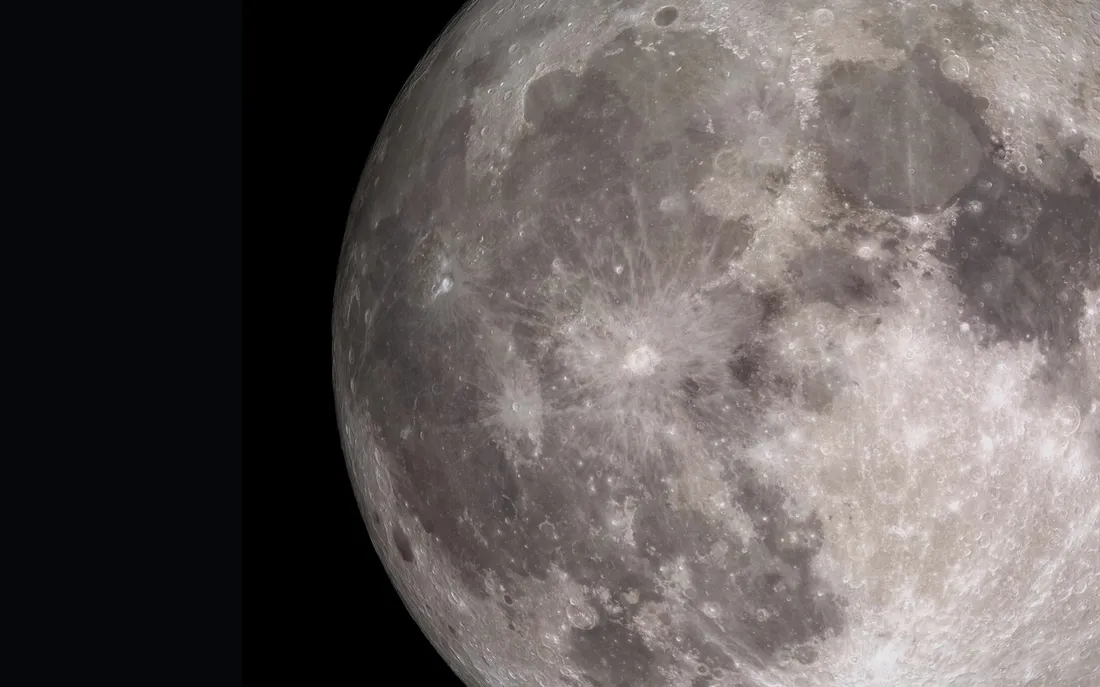
That silver sphere, which shows us the same face forever thanks to millions of years of gravitational locking, filled the shoals of the North Sea with an enormous mass of water that night, floated the ship off the rocks and carried it out to open sea.
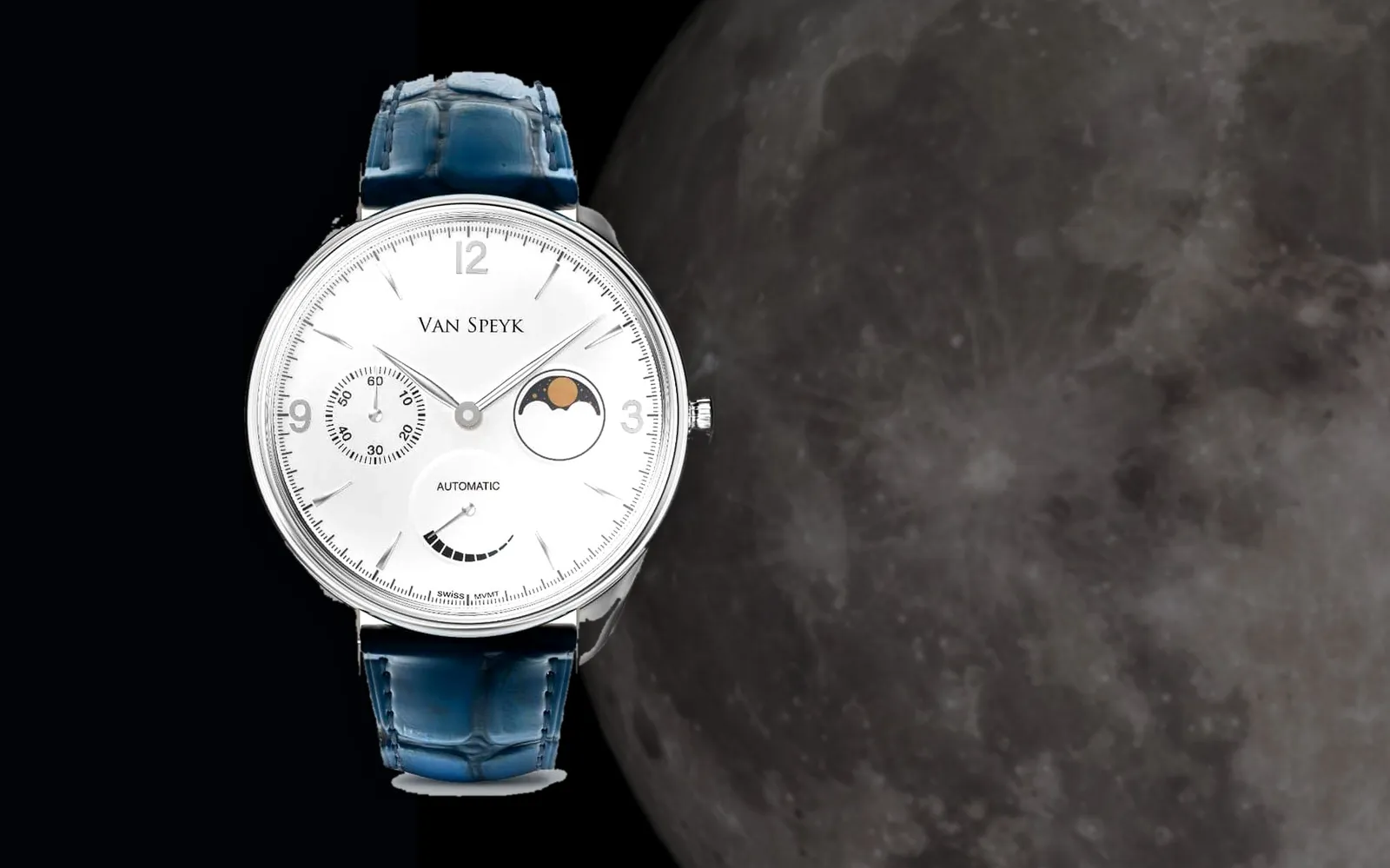
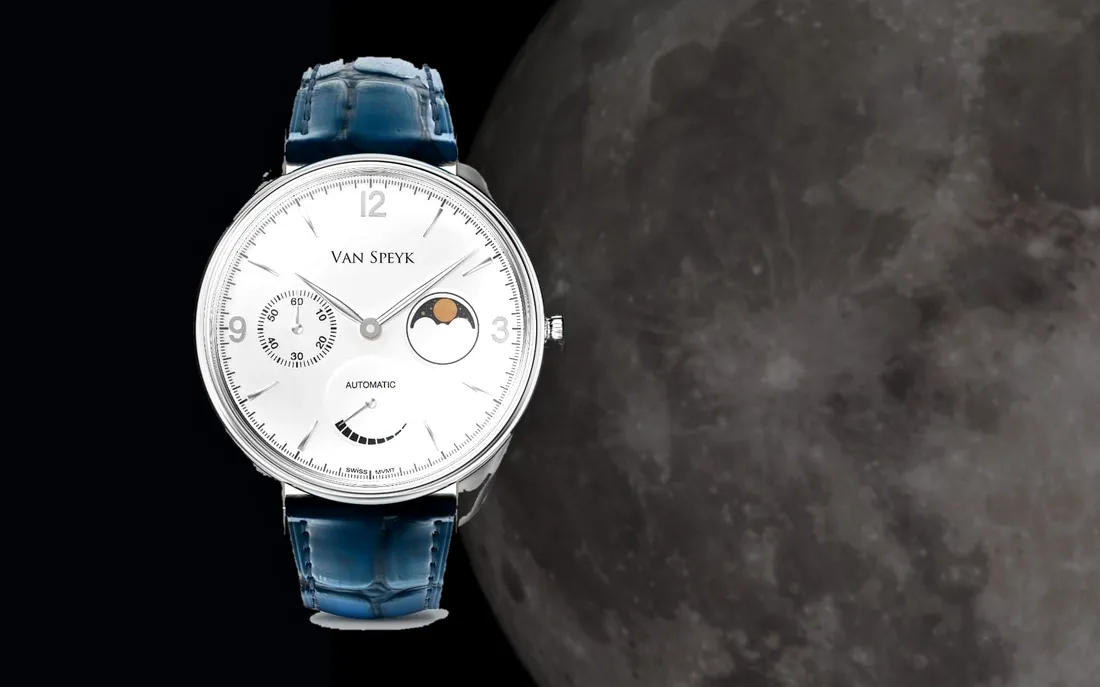
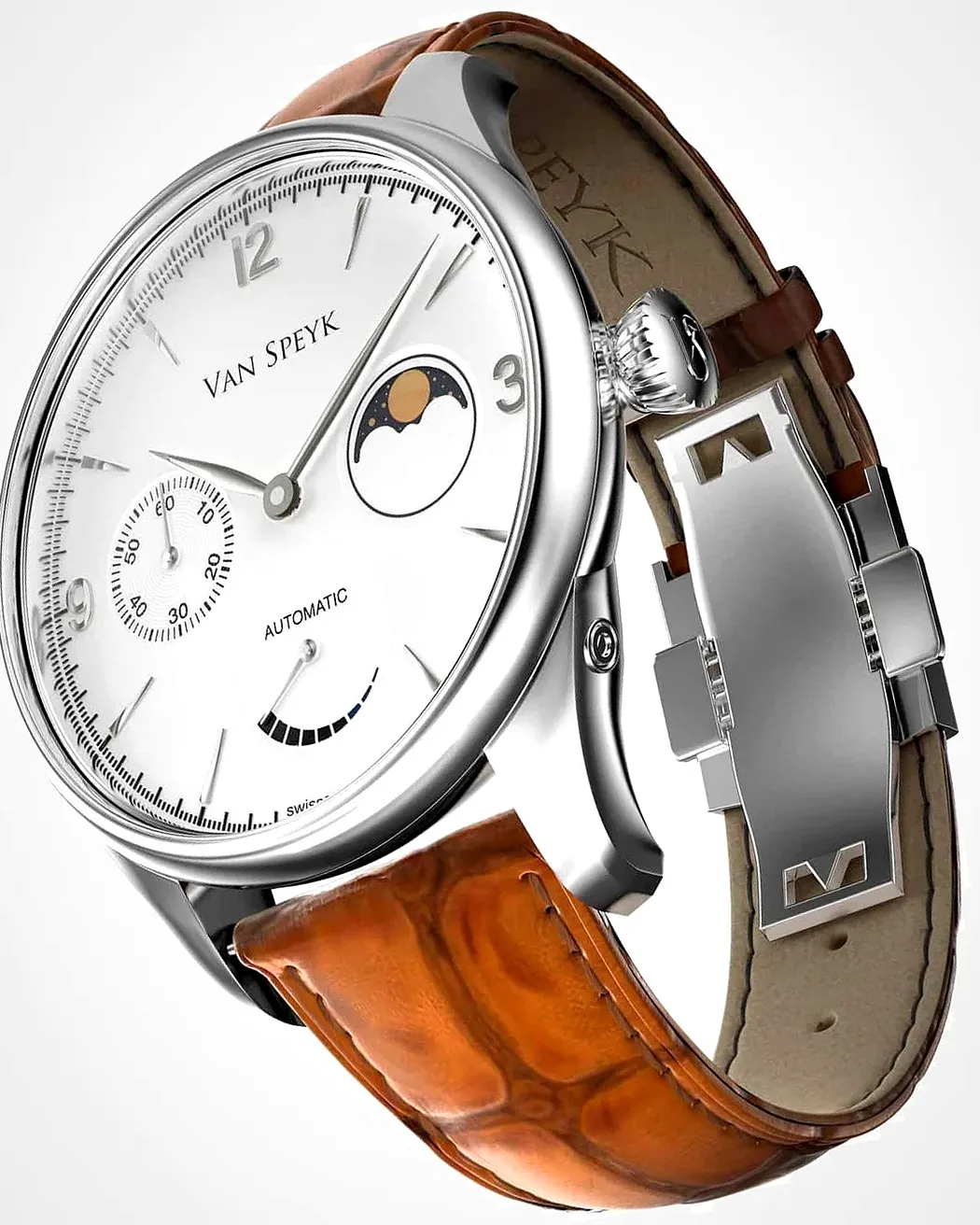
This fate of seamanship and astronomy, written in the merciless cold of the north, comes back to life on the dial of the Van Speyk Courage Phases de Lune.
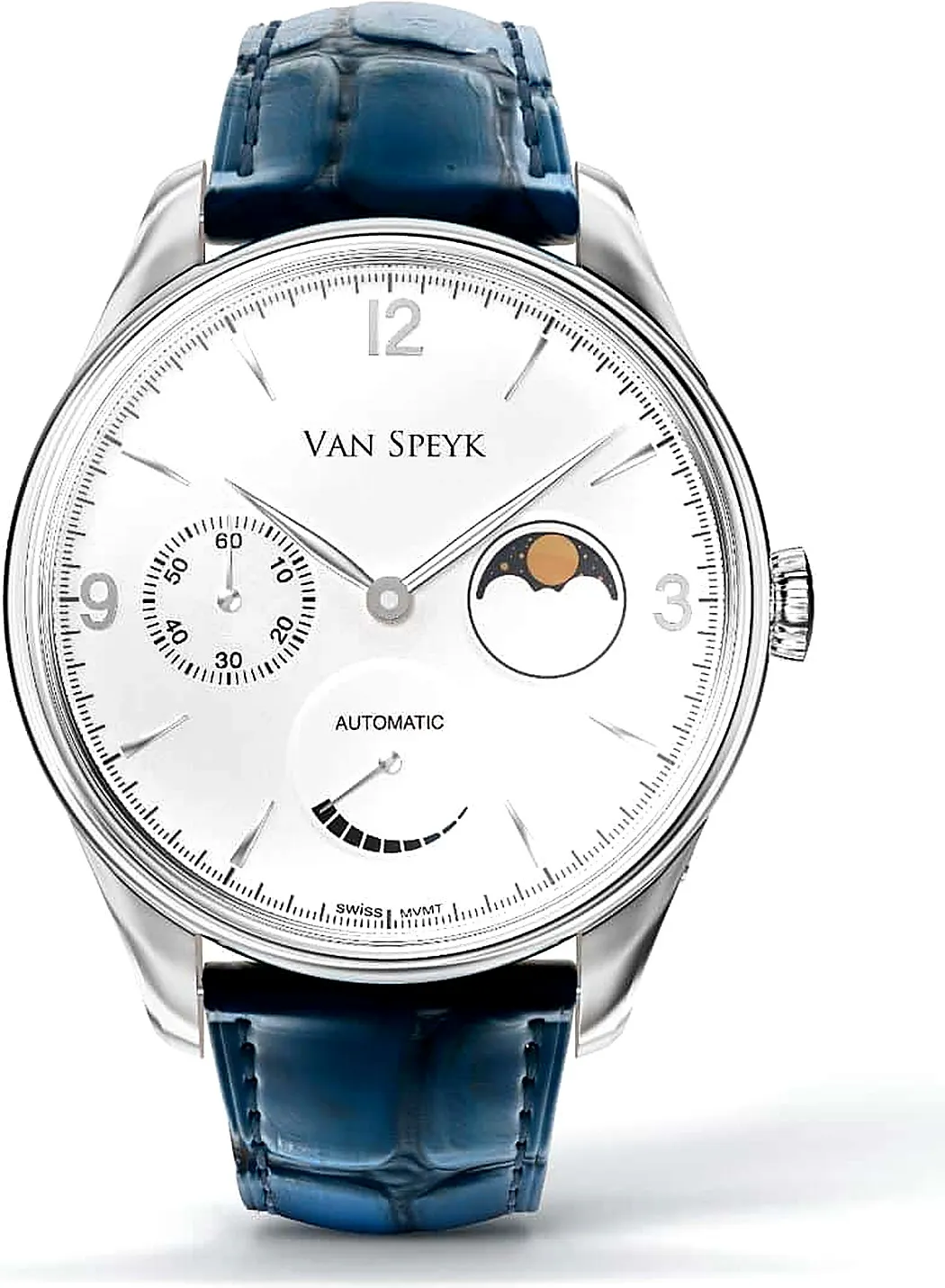
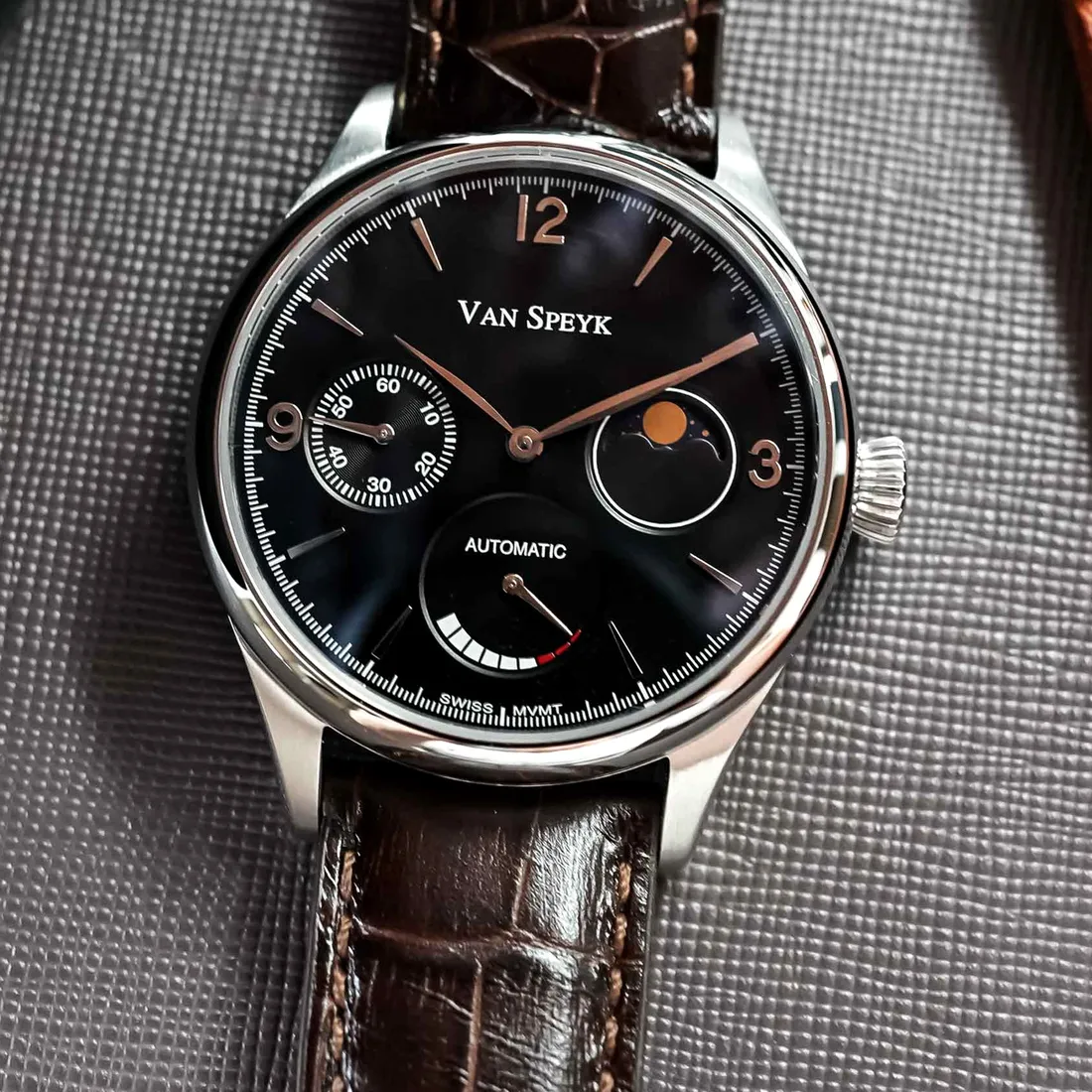
The dial has a symmetrical and remarkably balanced layout, and it is offered in three colours: black, blue and silvered white. A fine minute track is printed at the outer edge, and one step inwards sit polished applied markers and numerals. The central hour and minute hands are cut in a leaf shape. All three subdials are snailed.
The moon phase indication at three o’clock opens onto a deep navy ground representing the depth of the night sky, worked with stars and carrying a moon in a golden tone. The curved edge inside the register opens and closes the visible portion of the disc, from crescent to full.
One point has to be corrected here, because most people get it wrong. That curve does not imitate the shadow of the Earth. The Sun lights exactly half the Moon at all times and never any less. The only thing that changes is how much of that lit half we are positioned to see. Shadow enters the story only when our planet passes exactly between the two, and that is called a lunar eclipse. The curve on the dial animates our point of view, not a shadow.
The small seconds at nine runs independently of the central hands and displays the passage of the second. The register at six reports how much power the mainspring is holding, and it is of the retrograde type. The hand travels along an arc, and on reaching the end of that arc it does not complete a circle but jumps back to the beginning. At this price it is not a common solution.
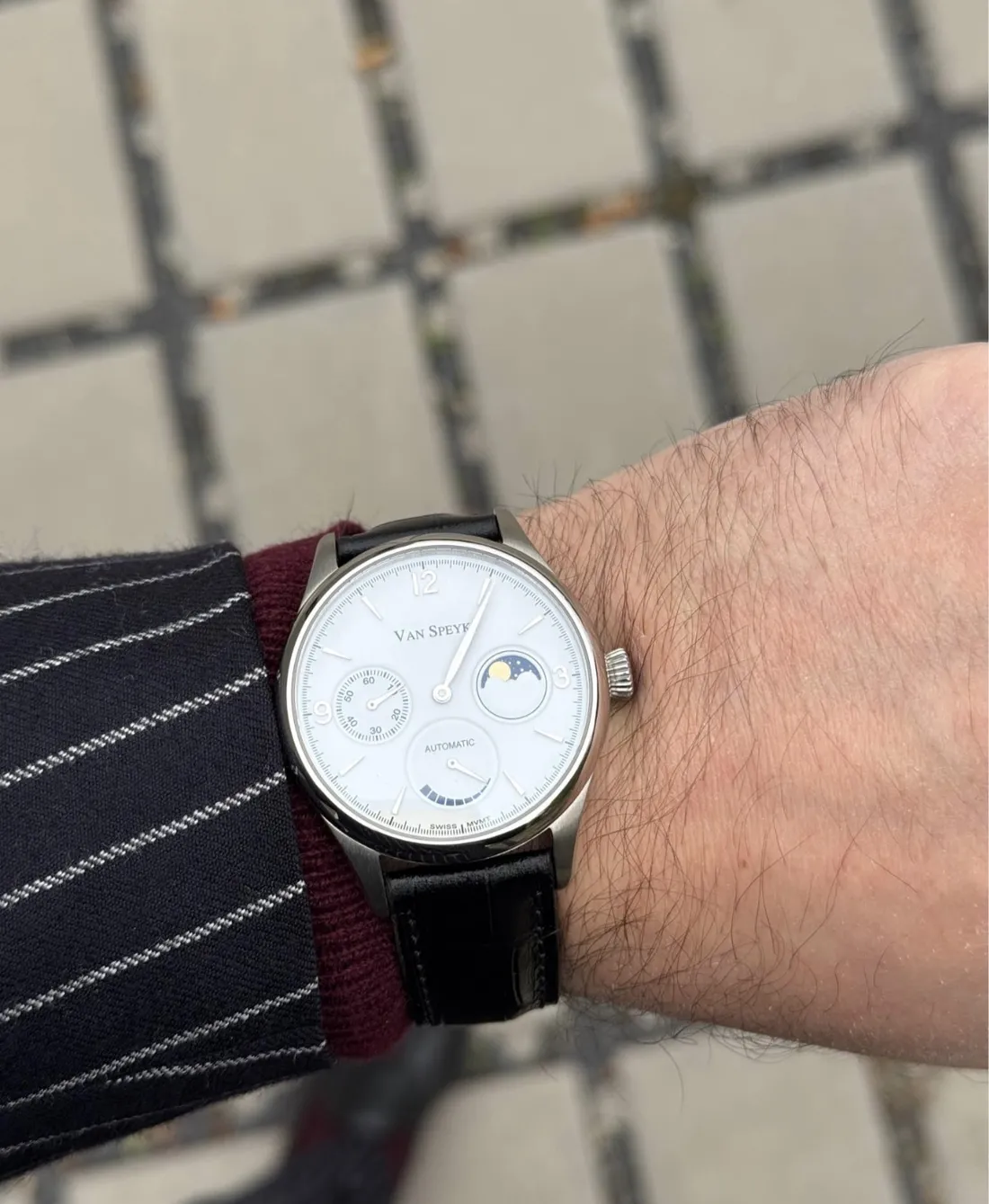
Beneath the indication turns a disc painted with two moons, and its rim carries fifty nine teeth. A small finger on the wheel that turns once every twenty four hours pushes the disc forward by exactly one tooth each day. Because it carries two moons, the disc shows two complete cycles in fifty nine days. In other words the mechanism treats a lunar month as twenty nine and a half days.
The true figure is twenty nine days, twelve hours and forty four minutes. The difference is about half a minute a day, and it accumulates. After roughly two years and seven and a half months the display falls a full day behind.
That is why the watch carries a corrector. Van Speyk has buried it not in the flank of the case but inside the lower right lug. Press it with a pointed stylus and the disc jumps forward by one day. Putting it in the lug is a visual decision, because it leaves the side of the case without a single hole in it.
format_quote"The number in the sky is not a whole number and no gear train can render it exactly. A good watch does not hide the shortfall. It leaves a way to correct it."
Hasan Bekmezci
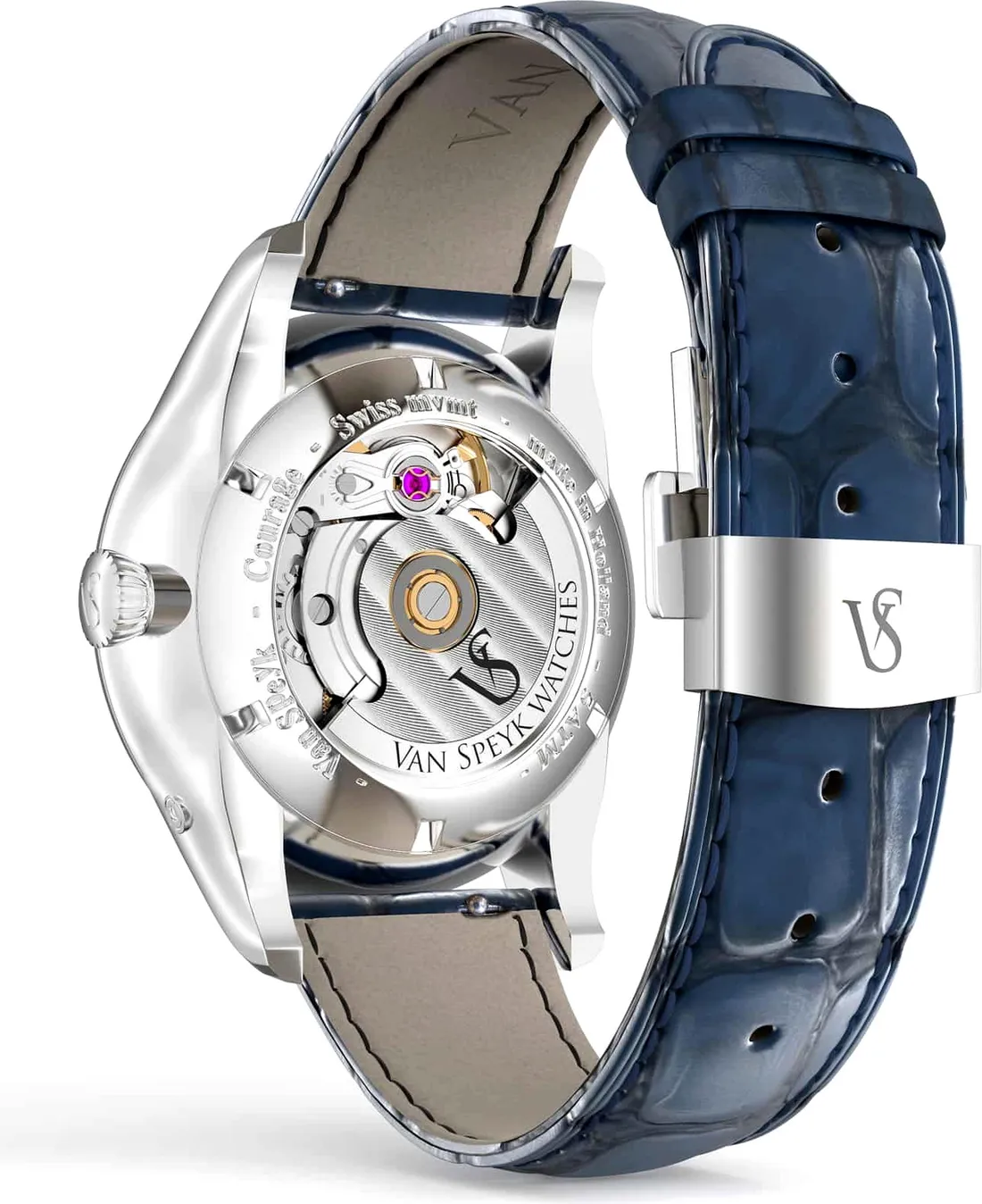
Inside runs the Swiss made STP2-12-63 automatic movement, known for its precision and its durability. It turns on thirty five jewels, beats at twenty eight thousand eight hundred vibrations an hour and offers roughly forty two hours of power when fully wound. The hairspring is Nivaflex, an alloy indifferent to magnetic fields, which is why a watch left beside a telephone speaker or a handbag clasp keeps its rate.
The most important technical feature of the movement is the slipping arrangement inside the barrel. Turn the crown clockwise and the mainspring reaches full tension. Once it does, the flexible steel bridle pressing against the inner wall of the barrel begins to slide. The system entirely prevents the spring from being forced to breaking point and the wheel teeth from being damaged. The soft friction you feel past a certain point when winding by hand is not something breaking; it is that bridle beginning to slip.
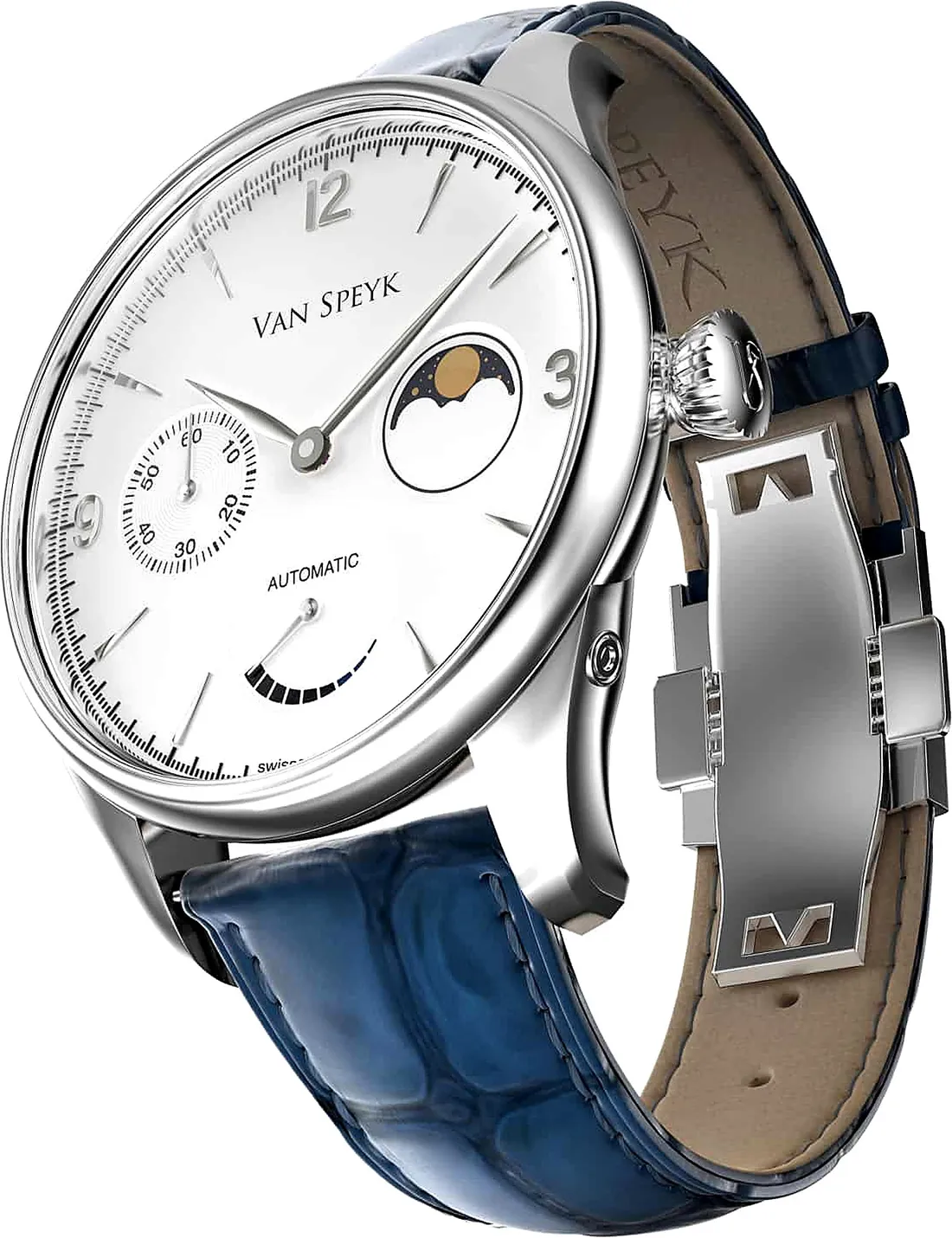
The case is forty one millimetres across and fourteen millimetres deep. A domed sapphire crystal covers the dial, and the caseback is sapphire too, showing the movement. The bowl shaped crown carries the house monogram, and the same monogram repeats on the folding clasp and on the rotor. Water resistance is fifty metres.
The final element that completes the character of the Courage is its leather strap, handmade in Italy. An alligator grain is pressed into the surface, and quick release pins let it come off and go back on without tools. The folding clasp carries the monogram again.
A strap being made by hand is not a romantic detail. The edges of a hand cut strap are filed one by one, dyed and sealed with wax. On a machine cut strap that edge stays open and swells with perspiration after a few months. The strap is the fastest ageing part of any watch, and it is usually the part that provokes the owner’s first opinion. In time, depending on how it is worn, it takes on a patina belonging to nobody else.
The Van Speyk Courage Phases de Lune brings together the astronomical instinct of those merciless North Sea waves, Swiss mechanical discipline and Italian leather craft on one dial. Every movement of your wrist carries that twenty nine and a half day rhythm of the sky along with you.
The collection sells for nine hundred and ninety nine euros including tax, a figure well below what a Swiss made automatic offering a moon phase, a power reserve and small seconds is usually asked to command. The honest criticism exists as well. Fourteen millimetres of height is a great deal for a forty one millimetre diameter and the watch will not slide easily under a fitted shirt cuff.
format_quote"The work done by a nine hundred and ninety nine euro watch is not different from the work done by a two hundred thousand euro one. Both count the same sky."
Hasan Bekmezci
Whoever straps a watch like this on today is neither crossing a shoal nor holding a sextant. The small disc on the right of the dial nevertheless goes on advancing one tooth a day, keeping the same count.
That disc does not visibly move in a day. Look again two weeks later and it is somewhere else entirely. It is the quietest lesson a watch can offer. During the interval when you were certain nothing had changed, everything was patiently moving.
It is also what the astronomer was telling the young sailor. Neither the sea nor we established that order. What fell to us was to learn to read it and to keep its count.