
Daylight saving began as an economy measure. Take one more hour of evening light and you burn less candle, gas and coal. During the First World War, countries short of fuel adopted the idea one after another, and from then on much of the world got used to breaking its own clocks twice a year.
But the idea itself is strange. Unable to move sunrise, we chose to move the measuring stick rather than our habits. It is a little like shortening the ruler and announcing that the room has grown.
And when that strangeness touches an object, it becomes a technical matter. The object is the world timer.

A world timer is built on the assumption that the planet divides into twenty-four equal slices. Twenty-four cities are laid around the dial, each standing for one slice, and a glance gives you all of them. For the arrangement to work there is one condition: the cities must hold their positions relative to one another.
Daylight saving breaks exactly that condition. In April the gap between London and Tokyo is eight hours; in November it is nine, because one of them moved its clock and the other did not. The southern hemisphere does it in the opposite direction. And a significant share of the world never does it at all.
The result is that a conventional world timer is wrong for roughly half the year. Nobody says so out loud, because the owner simply does the arithmetic in his head and moves on.
format_quote"A conventional world timer is wrong for roughly half the year. Nobody says so, because the owner does the arithmetic in his head and moves on."
Alex Mourin
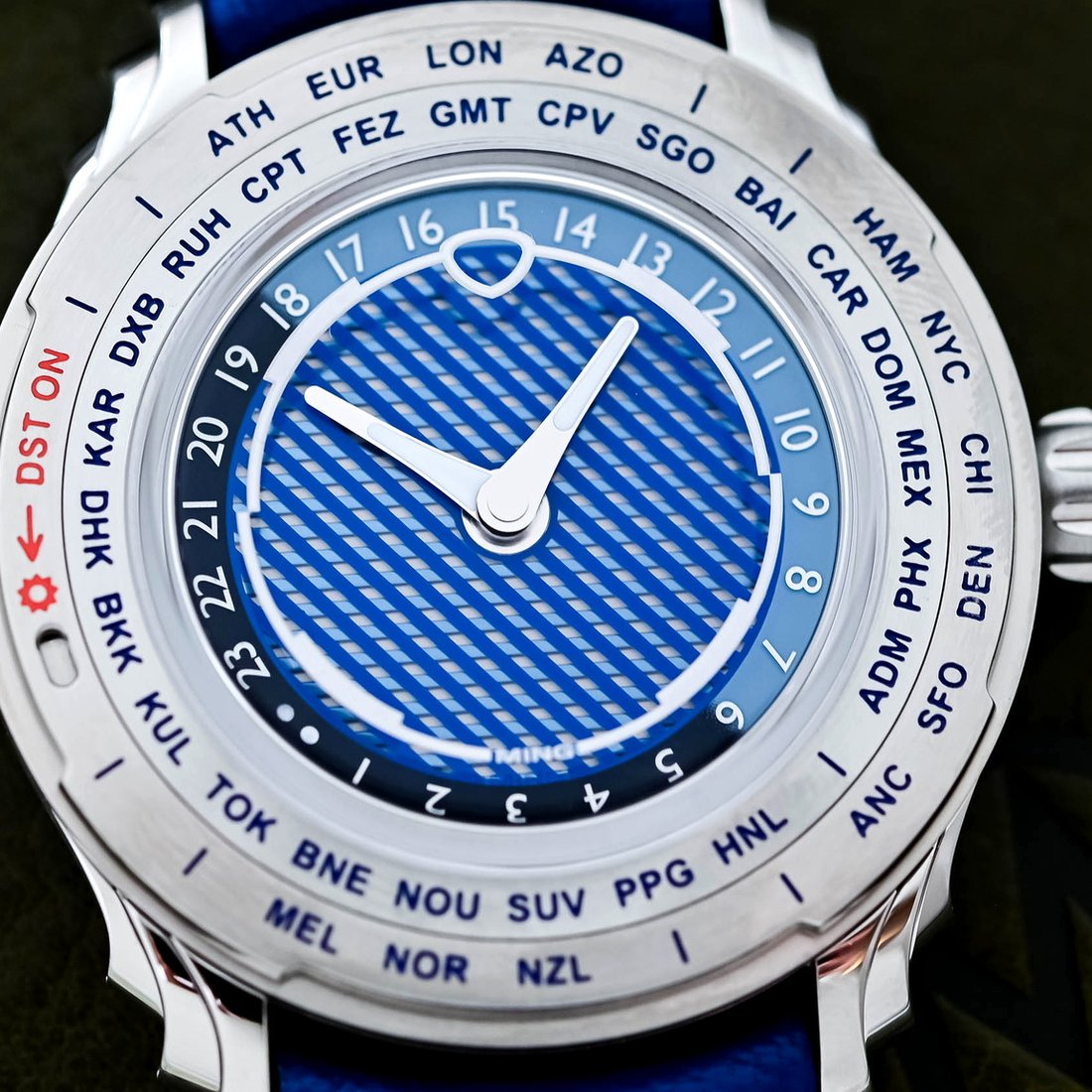
What Ming does on the 57.05 Comet is to solve the problem by redividing it rather than calculating around it. The city ring has been split. Cities that never observe daylight saving sit on the inner ring and stay fixed; those that do sit on the outer ring, and that ring turns.
The amount it turns is not arbitrary: fifteen degrees. One twenty-fourth of a full revolution, which is to say exactly one hour. When November comes you click the outer ring round one step and the map is correct again. The time is not adjusted. The map is.
So that you do not forget which state you are in, a small window sits between eight and nine o’clock: silver on standard time, red on daylight saving. That little window is the safety catch of the whole system, because the greatest risk in a manual adjustment is an owner forgetting whether he made it.
Ming has filed a patent on the arrangement. The simplicity is deceptive; the simple solutions are usually the ones nobody happened to think of for a very long time.


The dial itself carries on Ming’s habits. The blue centre is not a single surface but a layered construction of overlapping raster textures. The point of a ground like that is not decoration but change: what reads as a light blue in the morning goes close to black under a lamp in the evening. A dial with more than one face over a day also changes the hours it spends on your wrist.
The case is forty millimetres across and 10.33 thick, which is slim for a world timer carrying this many indications. In Ming’s design language the sides of the case taper inwards, and that makes the size read smaller than it measures.
format_quote"The time is not adjusted; the map is. Solving a problem by redividing it rather than calculating around it."
Alex Mourin


format_quote"An object carrying its own era that way is the most honest kind of historical record."
Alex Mourin
Comet arrives in Ming’s ninth year. Nine years is still young for an independent, but long enough for a manner to settle. Both sides of that manner are visible here: a visual discipline on one hand, and on the other the habit of taking seriously a small problem everybody else could not be bothered to solve.
Daylight saving is under debate in many countries now and may one day be abolished. On that day the outer ring of this watch will stop moving and stand as a marker of a period. An object carrying its own era that way is the most honest kind of historical record.