Chapter I: A Night in the Atacama and the Place of the Human
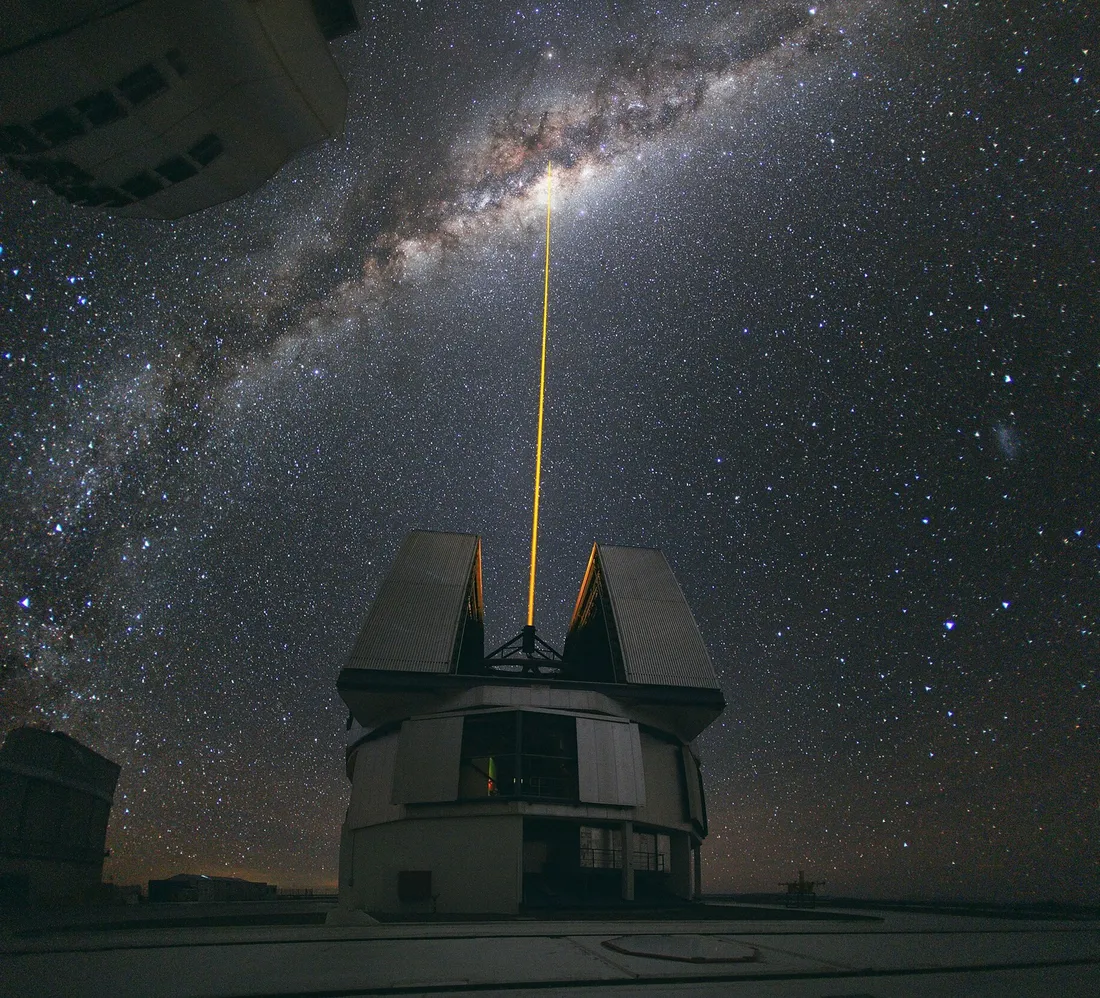
In Chile's Atacama Desert, on the two thousand six hundred and thirty five metre summit of Cerro Paranal, they stood under the clearest sky on Earth. Outside a freezing wind blew, while inside the dome carrying the eight point two metre primary mirror of the Very Large Telescope there was only the whisper of cooling fans.
This place was not chosen by accident. The Atacama is the driest desert in the world; at some stations annual rainfall is measured in millimetres. Because water vapour is the main gas that swallows infrared light, dry air makes the sky transparent. There are more than three hundred cloudless nights a year and the lights of the nearest large city are hundreds of kilometres away.
Julian, a researcher in astronomy and cosmology, was studying the spectra of distant galaxies on the screens. At the next desk Astrid, a philosopher of science, was ordering her notes on the fine tuning of the universe. Their purpose here was not to draw star charts; it was to ask where the human being stands in the face of this extent.
Astrid looked out at the Milky Way covering the sky like a field of diamonds.
"Julian, sometimes when I look at that darkness I feel like nothing at all. But then I think this: if there were no consciousness able to measure this universe, to understand it and to fall into wonder at its beauty, what would be the meaning of these trillions of stars existing at all? Is the human being an extra in this universe, or its heart?"
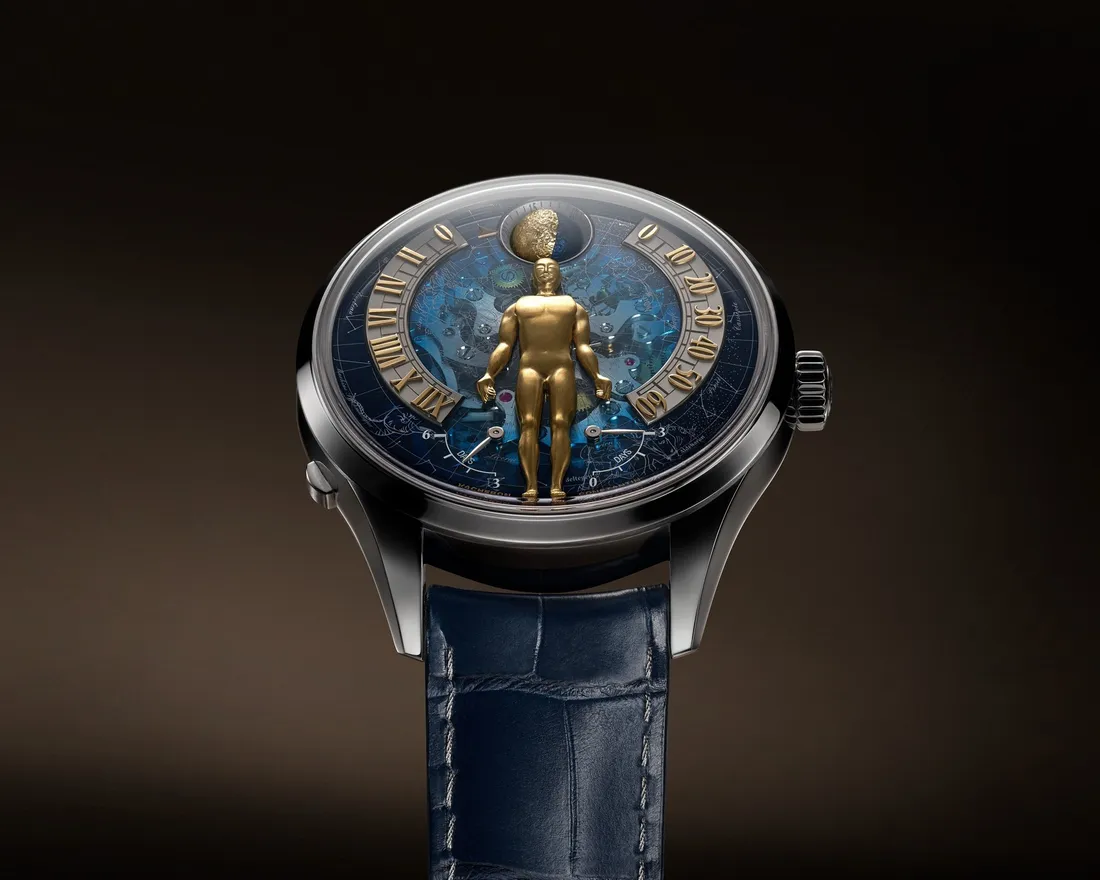
Julian took his hand off the control panel and pushed back his cuff. When the light struck the edge of the white gold case on his wrist and the scene on the dial, Astrid's eyes locked onto it.
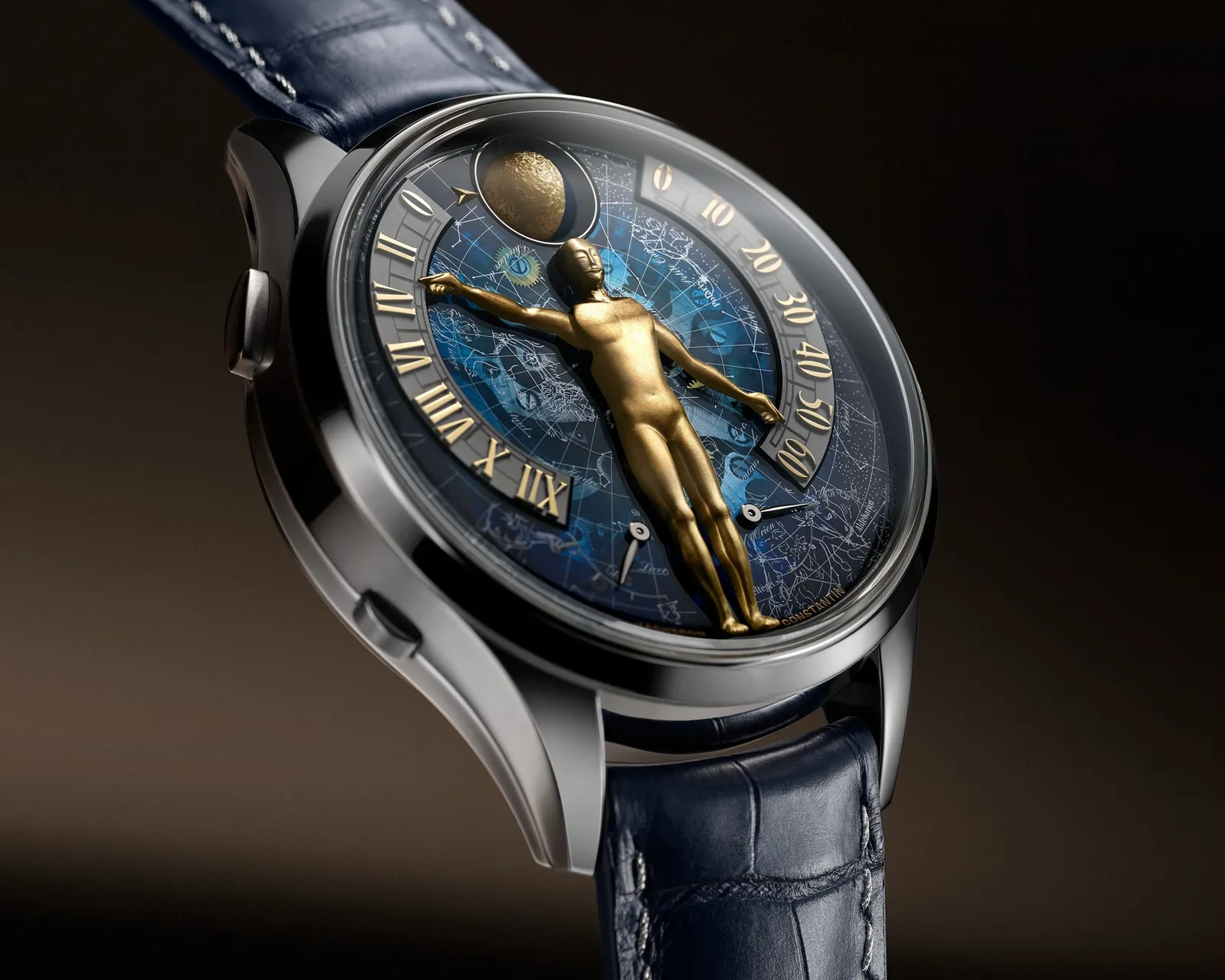
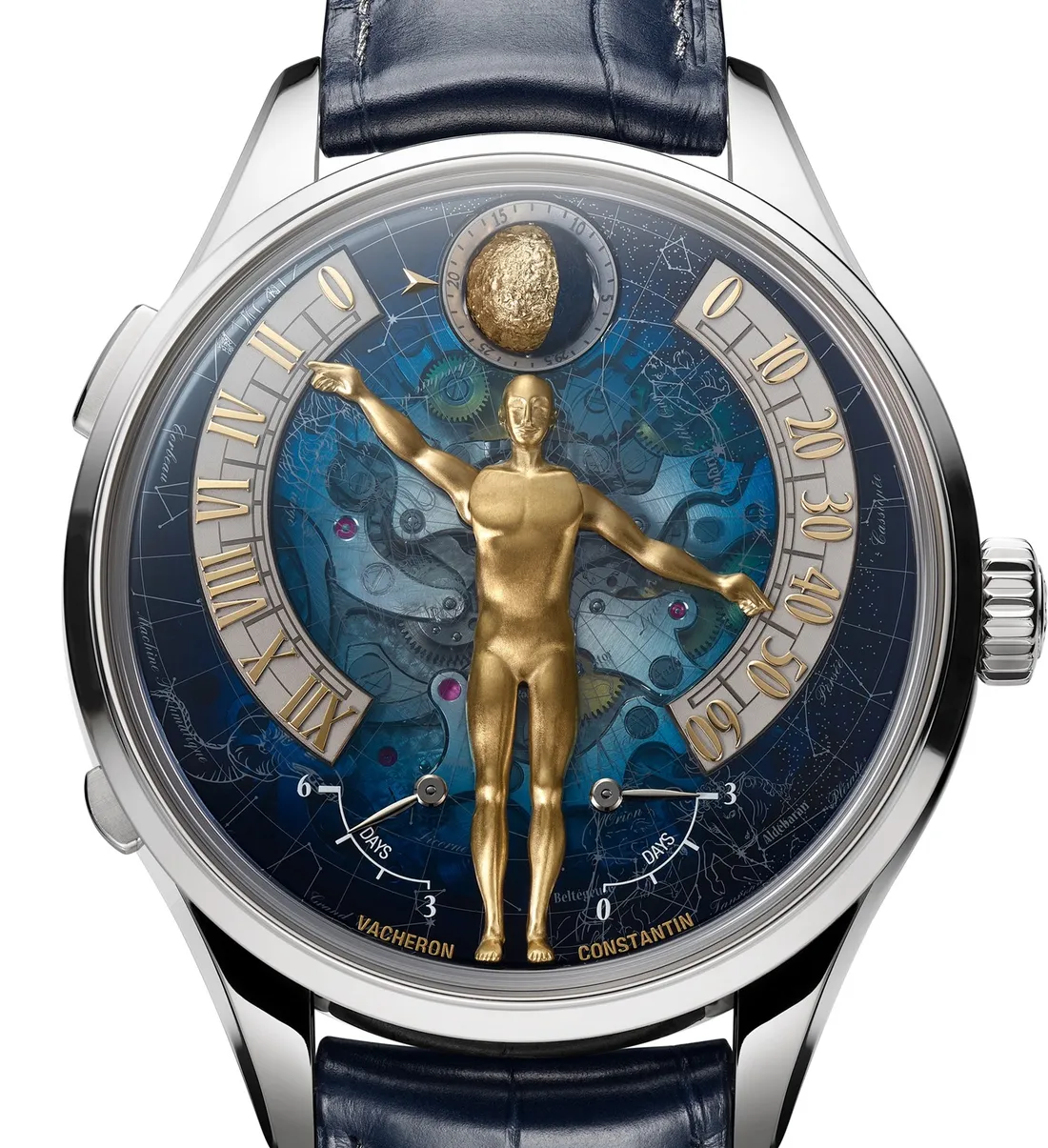
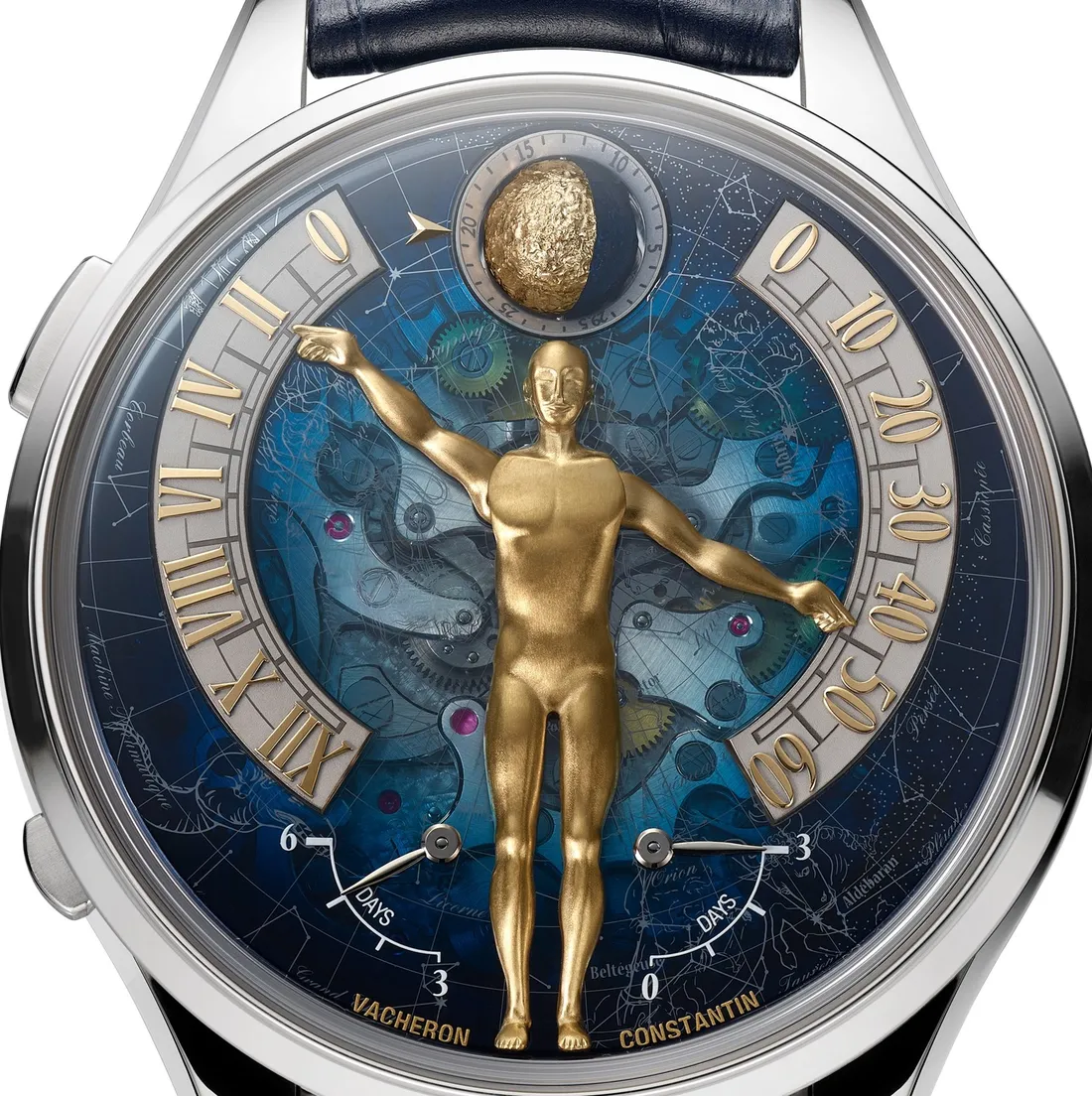
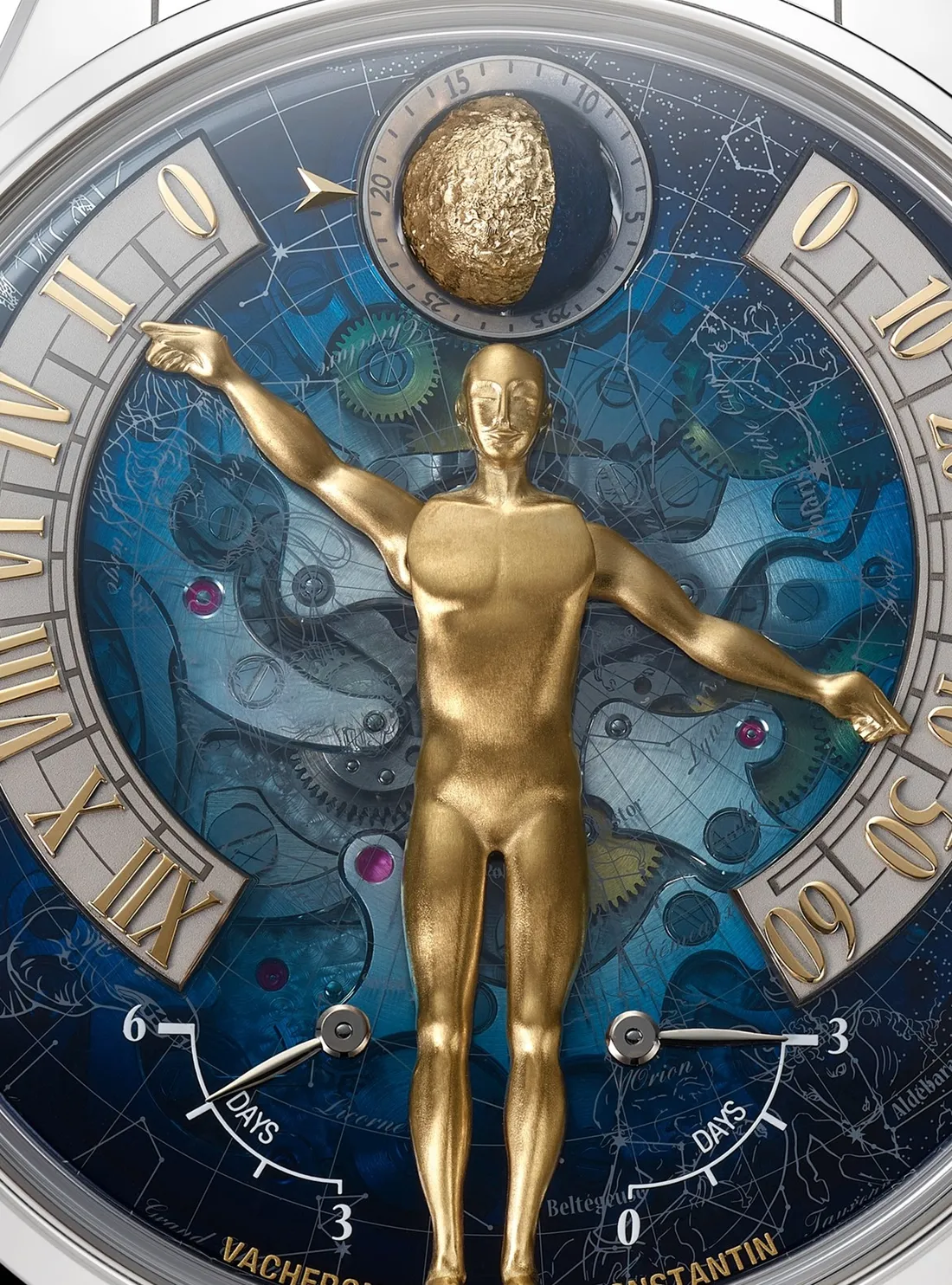
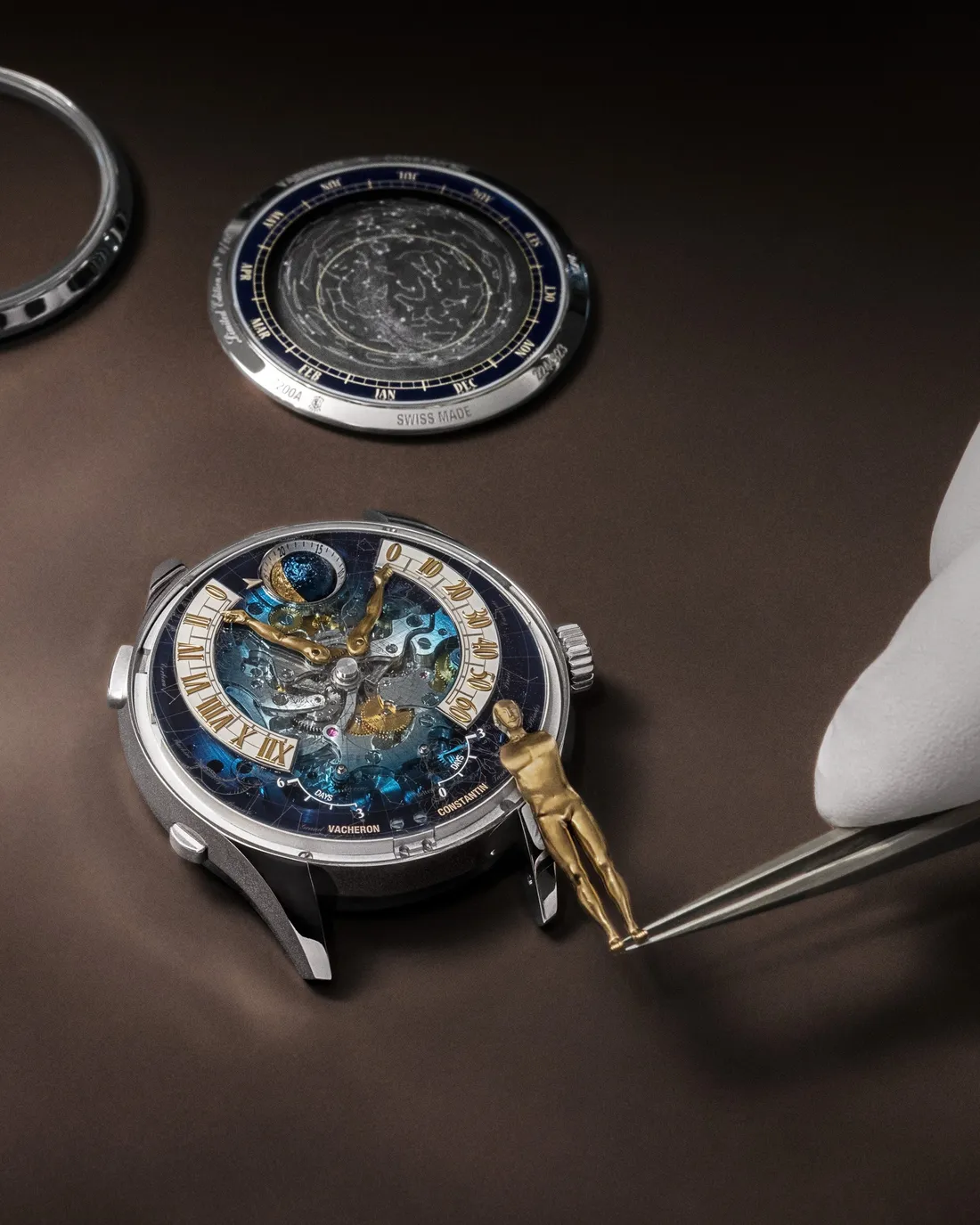
In the middle of the dial stood a gold coloured human figure with its arms open to both sides. Behind it a deep blue star chart, and above its head a three dimensional sphere of the Moon.
Chapter II: What Is on His Wrist Is a Manifesto
"This is not a watch, it is almost a philosophical manifesto," said Astrid. "What is it called?"
"Vacheron Constantin Métiers d'Art, Tribute to the Quest of Time," said Julian. "Reference 7200A/000G-H103. It was made for the Maison's two hundred and seventieth anniversary and limited to twenty numbered examples."
"Vacheron Constantin is the oldest watch manufacturer in continuous production since 1755. Métiers d'Art is French for artistic crafts; it is the name of the collection in which the house gathers enamel, engraving, jewellery work and high mechanics onto a single dial. And this piece carries the Hallmark of Geneva: the Poinçon de Genève, established in 1886 by the Republic and Canton of Geneva and still today the strictest certificate of provenance and quality in the world."
"Who is the figure in the middle?"
"An astronomer. That detail matters, because the figure is not a random human being: it alludes to the Astronomer of the Maison's monumental clock La Quête du Temps. Which is to say the thing on your wrist is the wristwatch sibling of a table piece."
"And the star chart behind it?"
"The chart of a particular night. The sky over Geneva on 17 September 1755. That date is the founding date of the house. So this dial is not a sky but one moment of a sky."
Chapter III: The Human Is a Small World, the World a Great Human
Astrid took a loupe and moved closer to the figure. Its hands reached towards the curved scales on either side of the dial.
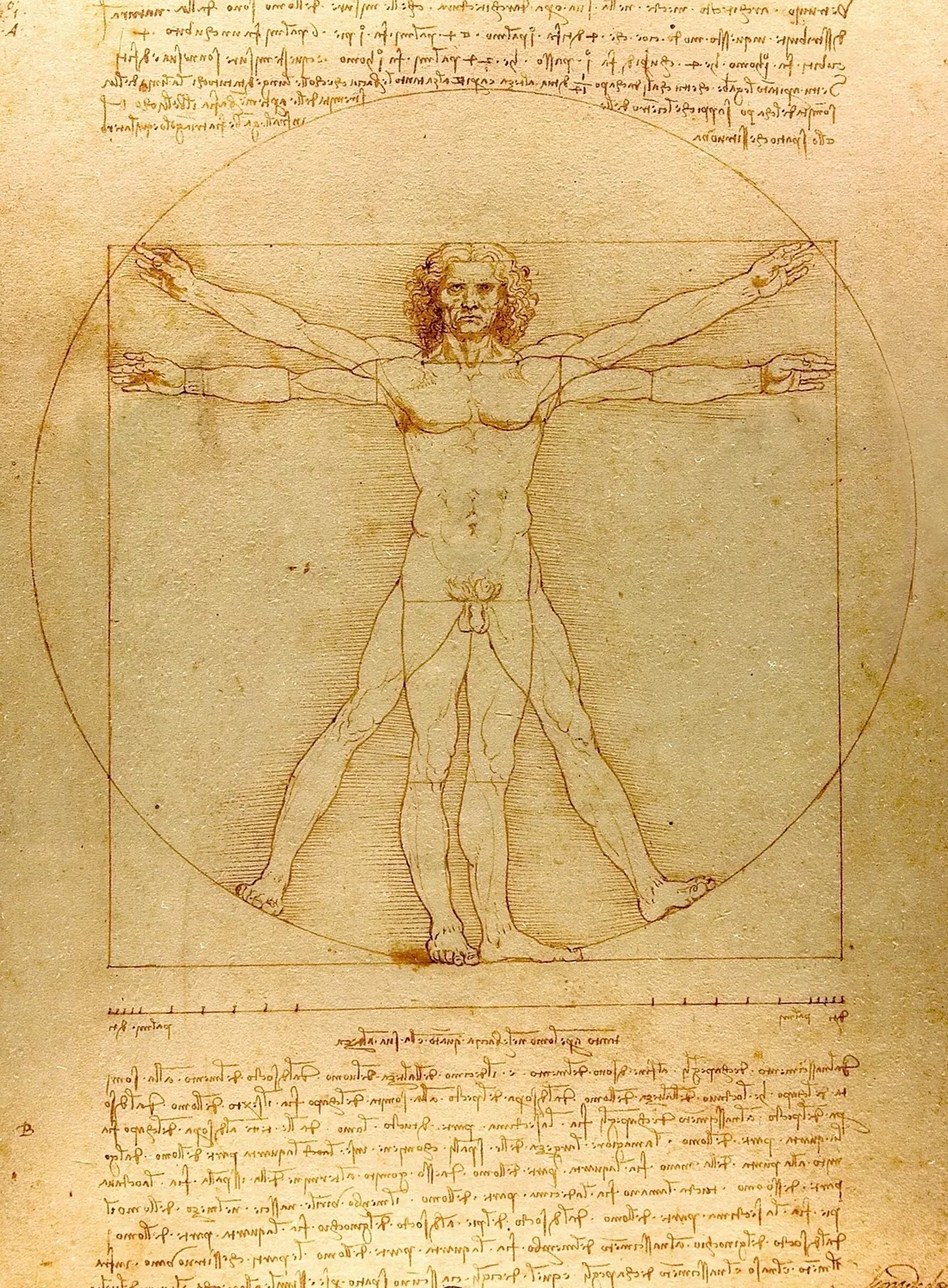
"That posture recalls Leonardo's Vitruvian Man," she said. "But what it really recalls is a sentence: just as the human being is a small world, so the world is a great human being."
"Where does that sentence come from?" asked Julian.
"It is one of the most durable ideas in the history of thought, and it emerged separately in almost every civilisation. In the Timaeus, Plato describes the cosmos as a living whole possessing intelligence. The Stoics called it sympatheia: the universe is one organism, and a change in one place answers in another. Plotinus builds the same idea in layers."
"And in Islamic philosophy?"
"There it finds its clearest expression. In the Epistles of the Ikhwan al-Safa, written in tenth century Basra, the sentence appears almost word for word: the human being is the small world, the world is the great human being. Ibn Arabi deepens it through the human being's function as a mirror; the whole sees itself in the human. Al-Ghazali likens the heart to a polished mirror. Ibn Sina maps the faculties of the human onto the order of the cosmos."
"In the West?"
"Leibniz writes in the Monadology that every monad is a perpetual living mirror of the universe. And Kant closes the Critique of Practical Reason with this sentence: two things fill the mind with ever increasing admiration, the starry heavens above me and the moral law within me. Notice that Kant puts those two side by side, because they are two faces of the same order."
"And your own sentence?"
"Mine is this: this idea is not a poem but a measurable observation. And I can tell it to you in numbers."
format_quote"Just as the human being is a small world, so the world is a great human being. This idea is not a poem but a measurable observation."
Chapter IV: Scale, or Why the Human Stands in the Middle
"Let us draw a scale," said Astrid. "The diameter of an atom is about ten to the minus ten metres. The diameter of a star, take the Sun, is about one and a half billion metres. What is the logarithmic midpoint between those two numbers?"
"Let us work it out," said Julian. "We take the square root: about thirty seven centimetres."
"There it is. The height of a human being sits right beside the geometric mean of an atom and a star. There are the same number of steps upward to the stars as downward to the atoms. That is not a proof, but it is more than a coincidence that puts the human in the middle of the scale."
"And going inward?"
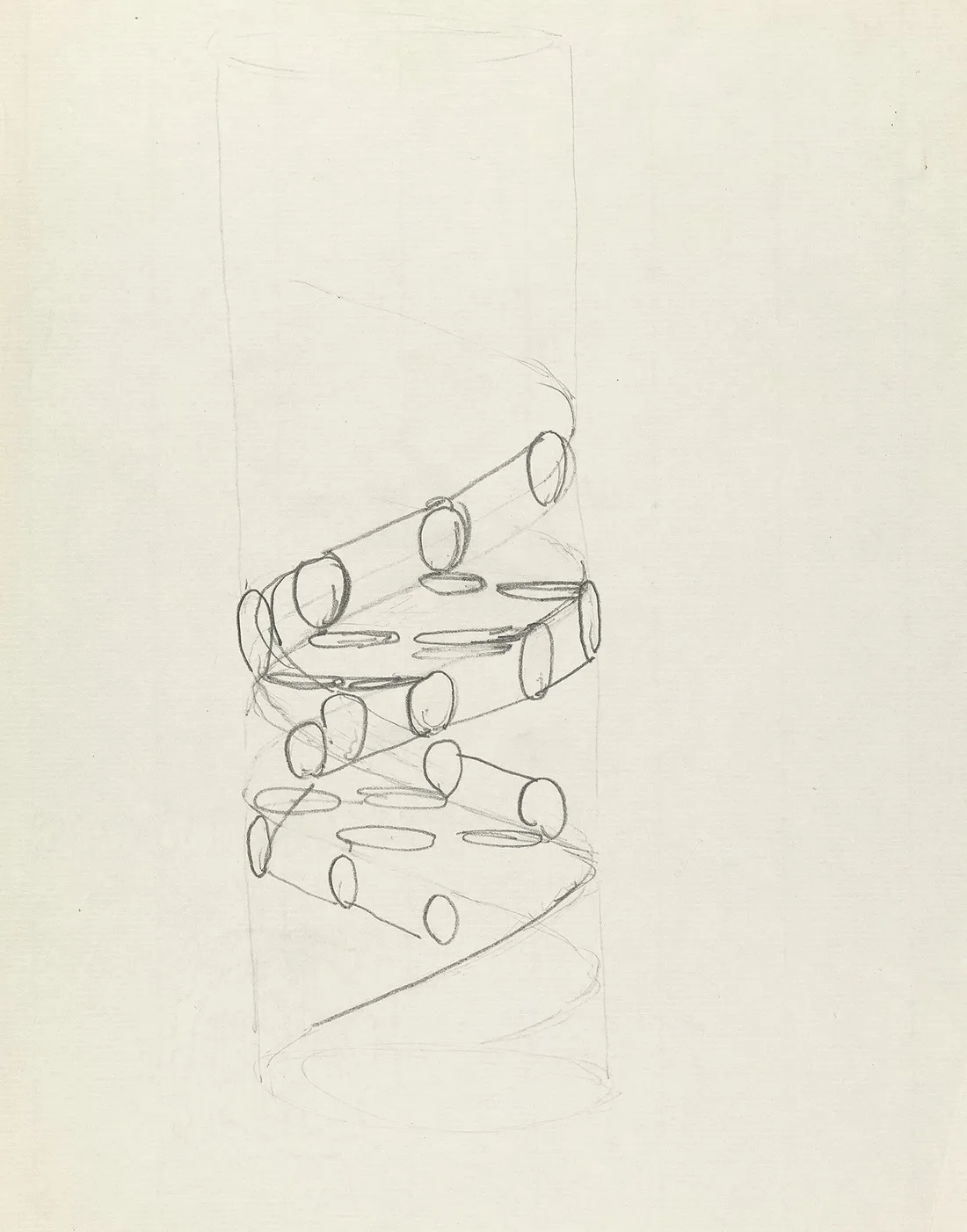
"The numbers turn cosmic at once," said Julian. "There are about thirty seven trillion cells in a human body. Into the six micron nucleus of each of them, two metres of DNA are folded. Two metres in a single cell. Join all the DNA in one body end to end and the length runs to hundreds of times the distance between the Earth and the Sun. Which is to say the thread inside one human being is a length on the scale of the solar system."
"The brain?"
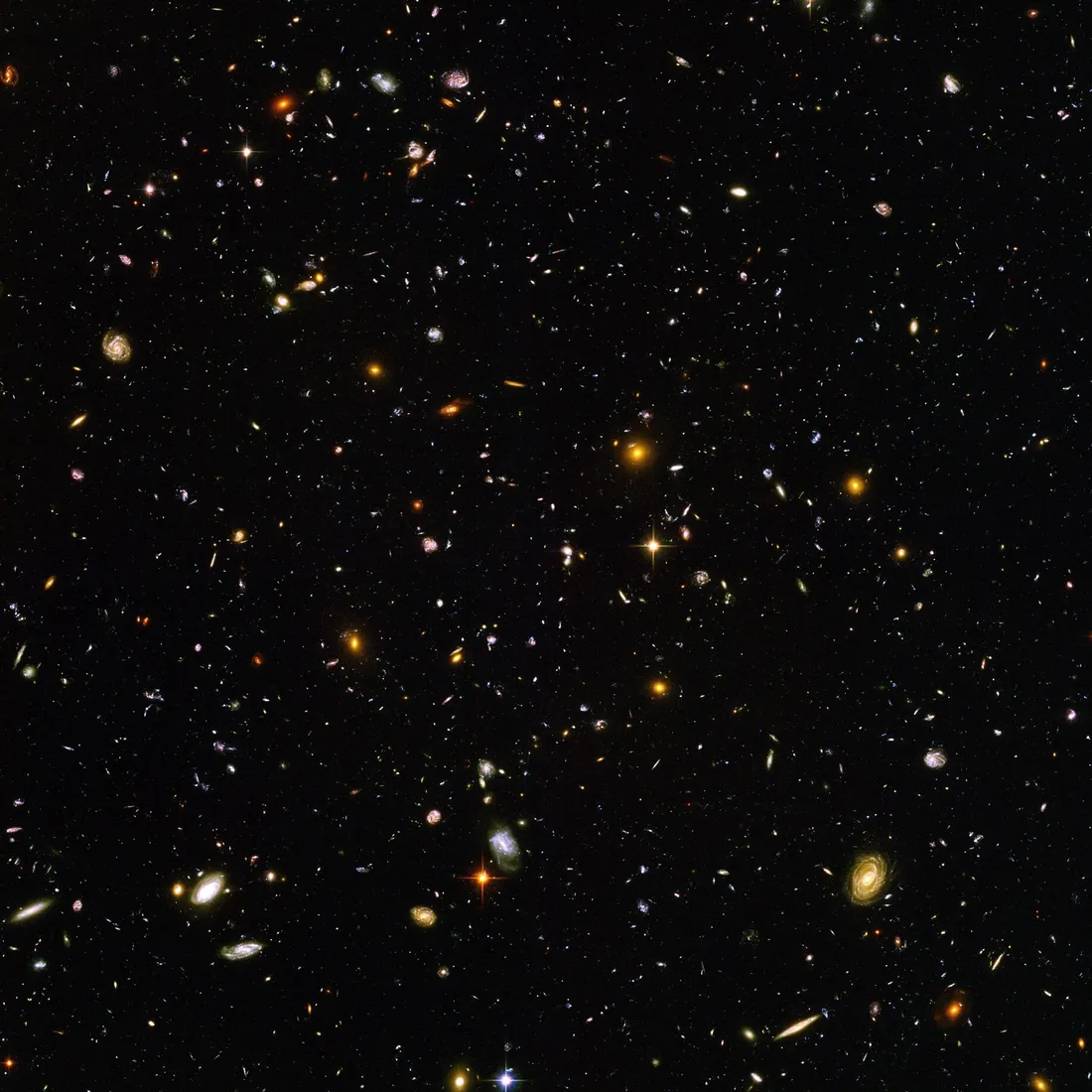
"There are about eighty six billion nerve cells in the brain. In the observable universe the number of galaxies is on the order of hundreds of billions. The same order of magnitude. The number of synapses is around a hundred trillion; the number of stars in the Milky Way is in the hundreds of billions. And these resemblances are not only a game with figures: in a study published in Frontiers in Physics in 2020, Vazza and Feletti compared the power spectra of the neuronal network of the human brain and of the cosmic web, and found strikingly similar distributions over certain ranges of scale. The degrees of connectivity of the two networks also came out close to each other."
"So the same pattern repeats at two scales."
"We must be careful: this does not say the two networks follow the same physics. What it says is more interesting: matter chooses a similar strategy of connection both at the scale of a brain and at the scale of a universe."
Chapter V: The Same Pattern: Branching
"Give me another example," said Julian.
"Branching," said Astrid. "In a human lung the airway divides in two about twenty three times before it reaches the alveoli. The total surface area approaches seventy square metres; a tennis court folded into a circle. The vascular tree branches on the same logic, and the ratio of branching is not random: by Murray's law, the cube of the parent vessel's diameter equals the sum of the cubes of the daughters' diameters. That ratio is the one that carries the blood flow for the least energy."
"And outside?"
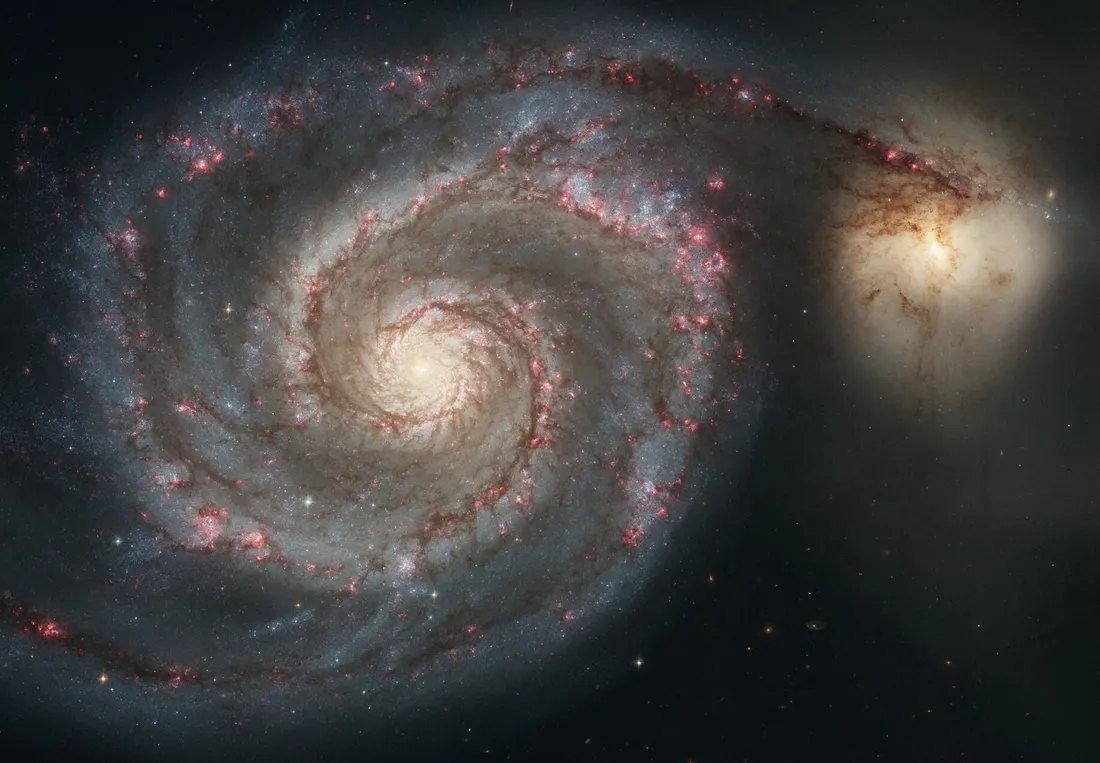
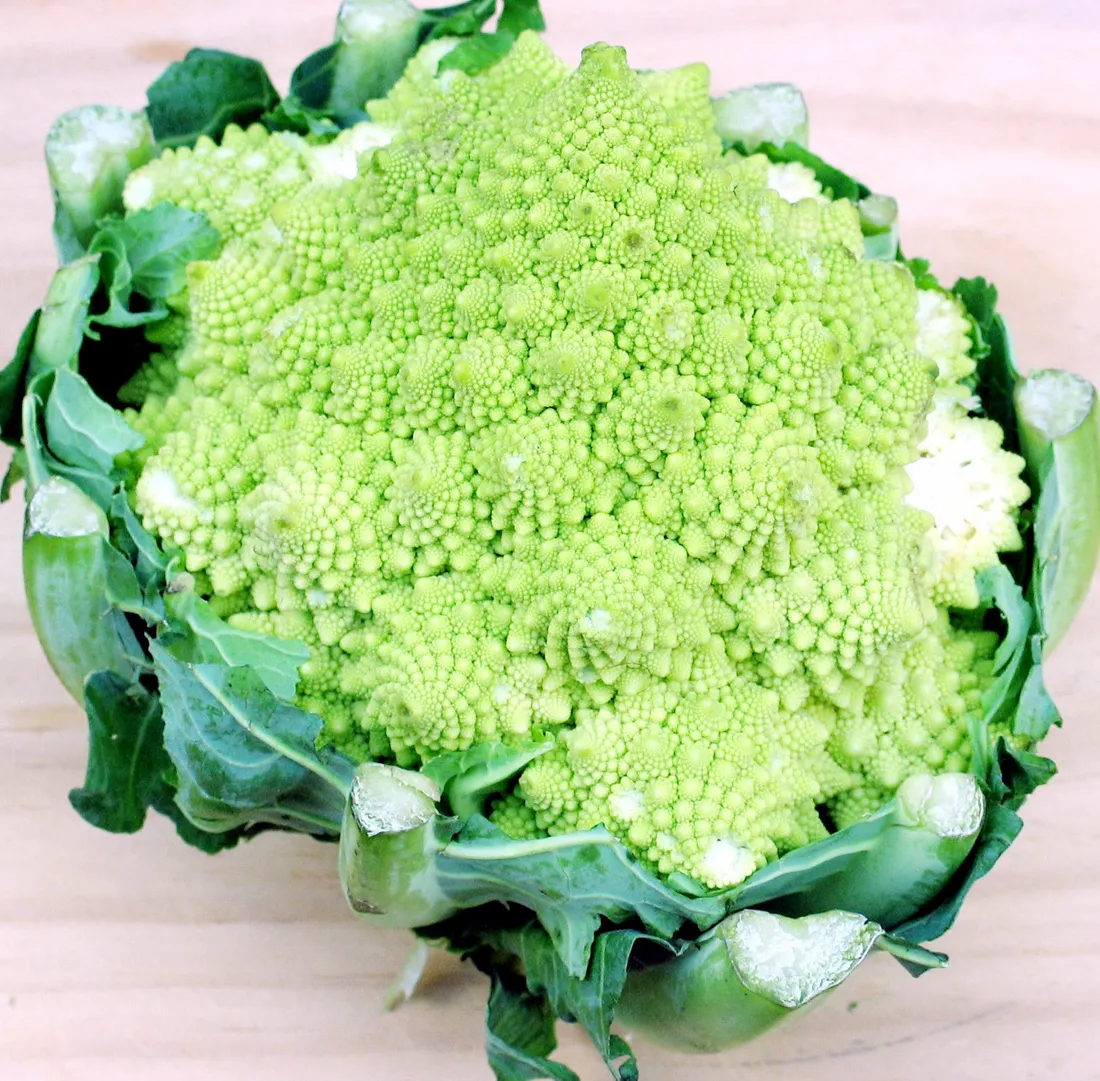
"The same pattern. The dendritic tree of a neuron, a river delta, a channel of lightning, the shadow of a tree, and the filaments of galaxies in the universe. All of them are solving the problem of sweeping a volume efficiently from a single point. And sometimes the pattern is plain enough to see: think of Romanesco broccoli. Each bud is a shrunken copy of the whole; and then that bud repeats the same shape inside itself."
"Let me put in a warning here," said Julian. "These resemblances should not be pushed too far. The spiral of a galaxy is a logarithmic spiral; the arrangement of seeds in a sunflower is a Fermat spiral. Both are beautiful, both are mathematical, but they are not the same equation. The resemblance is real, the identity is not."
"Agreed," said Astrid. "The claim was never that everything is the same. The claim is that the same elegant solutions have been distributed to the same problems."
Chapter VI: Where the Iron in Your Blood Came From
"Shall I give you the firmest bridge between the microcosm and the macrocosm?" said Julian. "The iron travelling in your veins right now."
"Go on."
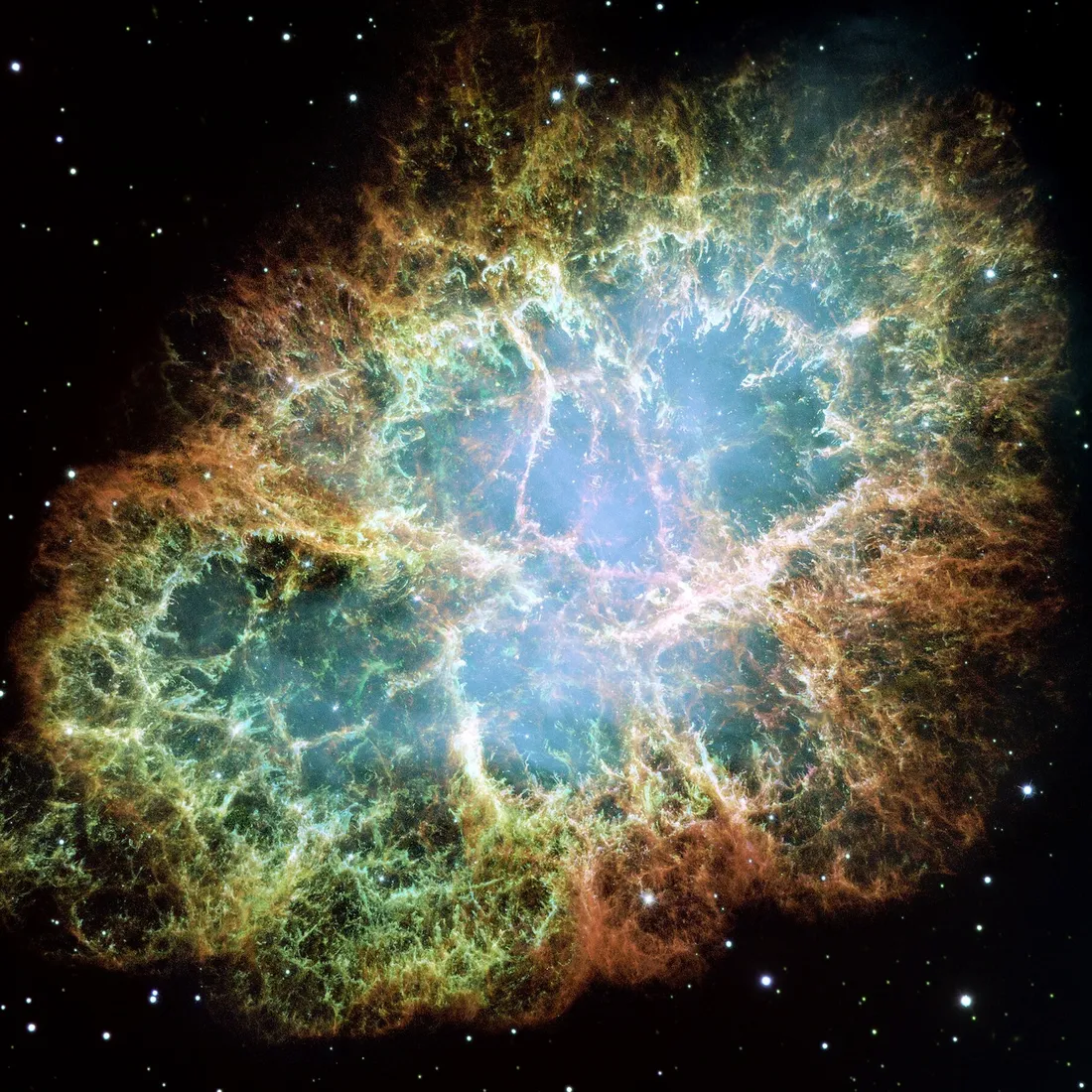
"There are about four grams of iron in an adult body, and most of it is inside haemoglobin, at the place that holds oxygen. But iron was not formed on Earth. Iron was produced in the cores of massive stars and in supernova explosions. So was the kilogram or so of calcium in your bones. Which is to say you are made, quite literally, from the ash of old stars."
"And carbon?"
"Carbon is the finest point in the story and one of the most beautiful predictions in the history of science. Carbon forms in the core of a star when three helium nuclei join; this is called the triple alpha process. But for that reaction to happen, carbon twelve has to possess a particular excited energy level. In 1953 Fred Hoyle reasoned as follows: since I am made of carbon, carbon must have a level at around seven point six five megaelectronvolts. Then the experimenters looked, and the level was exactly there."
"And if that level shifted?"
"That is the point. The calculations show that a change of less than one per cent in the nuclear forces would make either carbon or oxygen almost impossible to produce in stars. Without carbon you have neither DNA nor protein; without oxygen, nothing at all. Which is to say your being able to exist depends on the millimetric position of one nuclear energy level."
"And you are telling me this so that I look at the dial again."
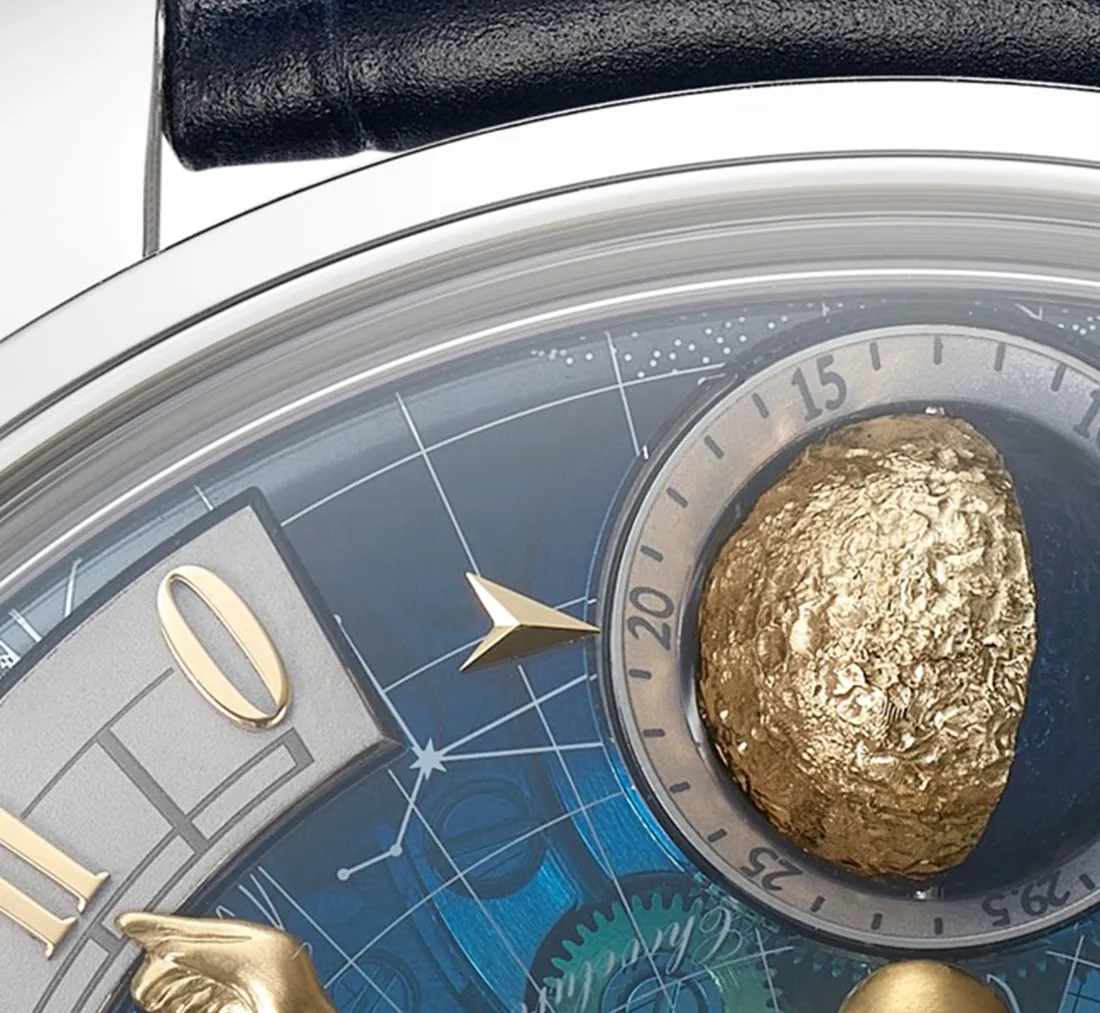
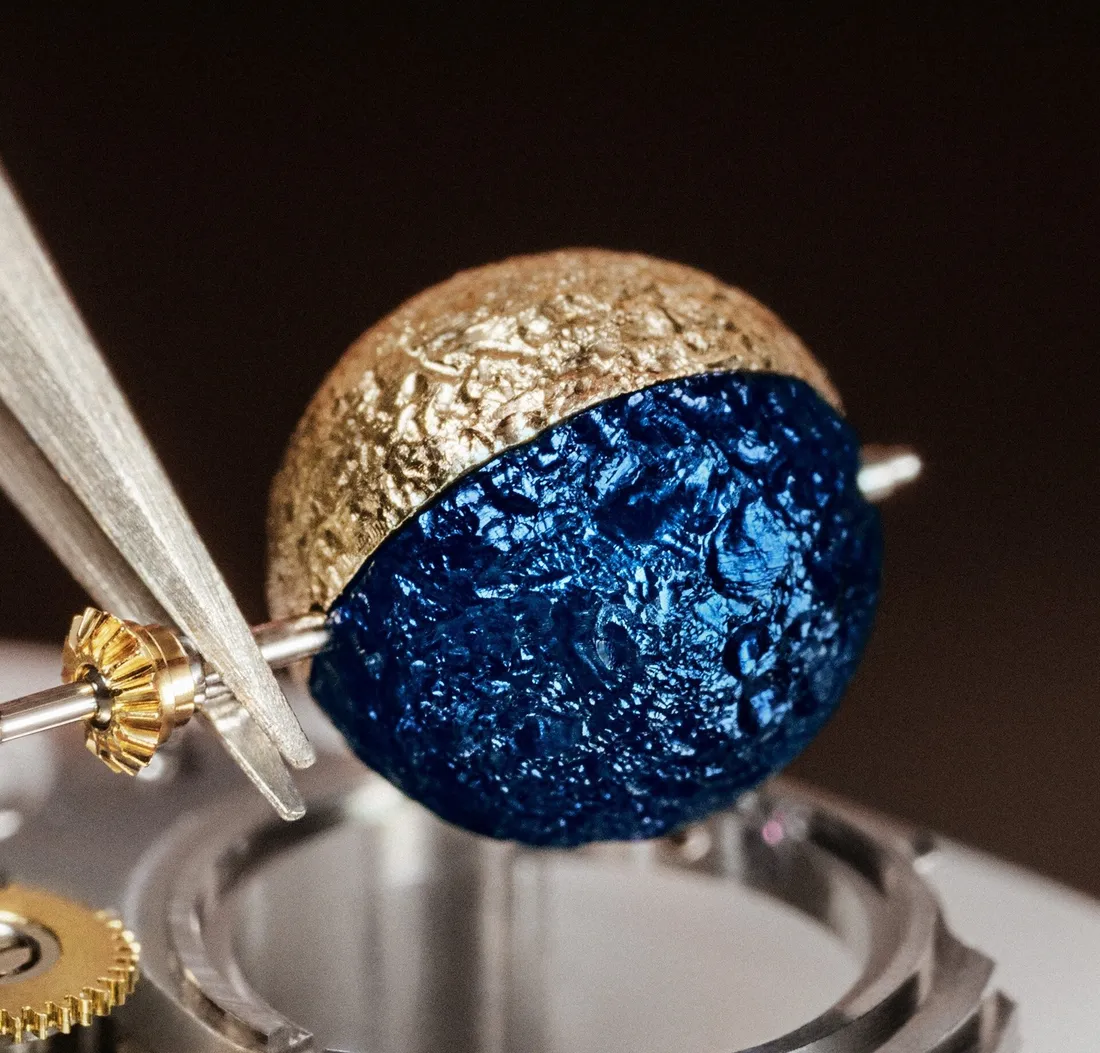
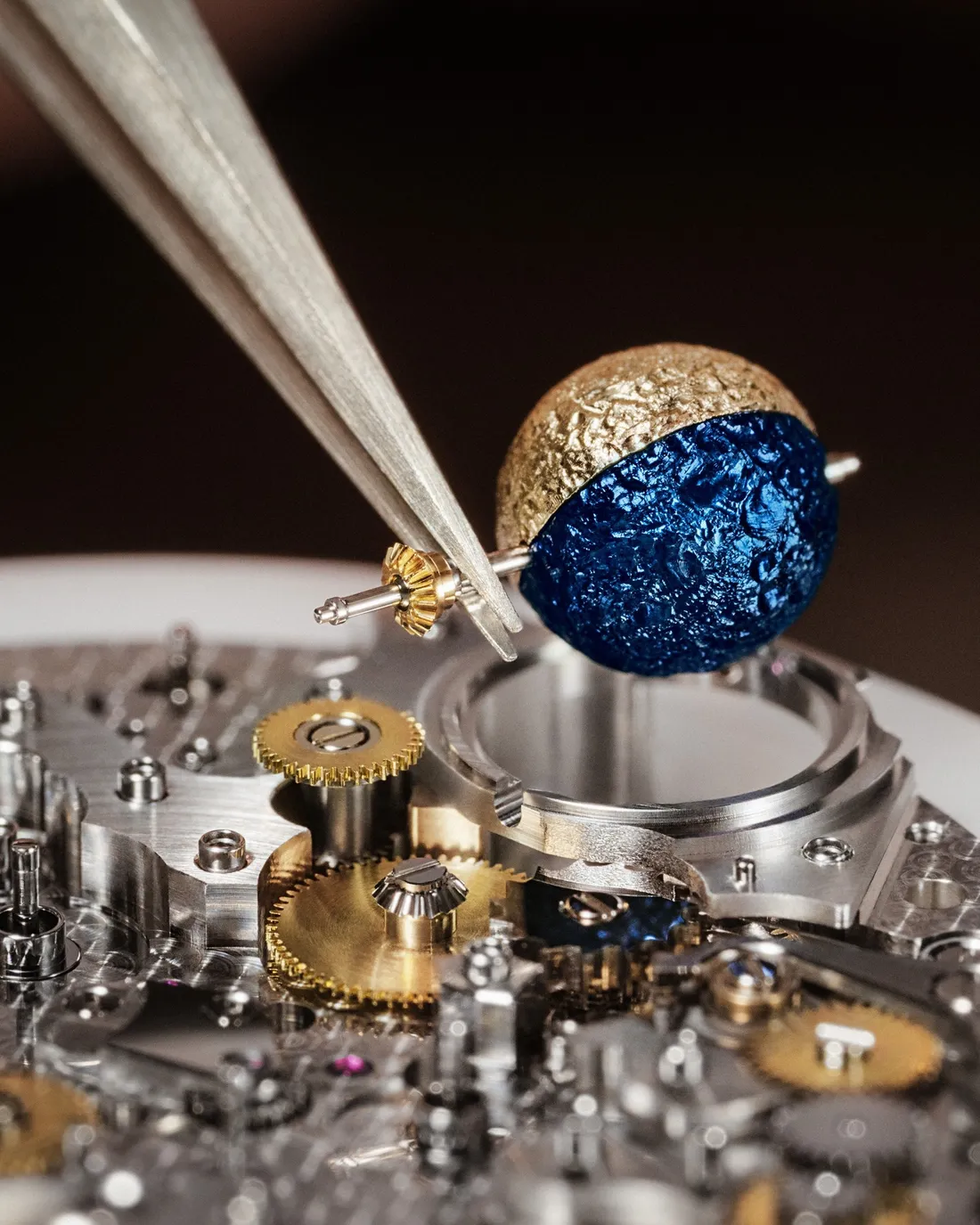
"I am," said Julian, laughing. "Because that sphere of the Moon at the top can also be counted as made from the leftovers of a star. It is in titanium, coated in gold and blue PVD, and the craters on it are engraved by hand. And it turns: because it rotates on its own axis, the face the Moon shows us and the face it does not are in different colours. The ring around it gives the age of the Moon, the number of days since the new moon. And this figure stops me every time: this indication runs for a hundred and twenty two years before it asks for a one day correction."
format_quote"There are about four grams of iron in an adult body, and iron was not formed on Earth. You are made, quite literally, from the ash of old stars."
Chapter VII: Time by the Arms: Bras en l'Air and the Double Retrograde
Astrid looked for the usual hour and minute hands on the dial and did not find them.
"How does it show the time?"
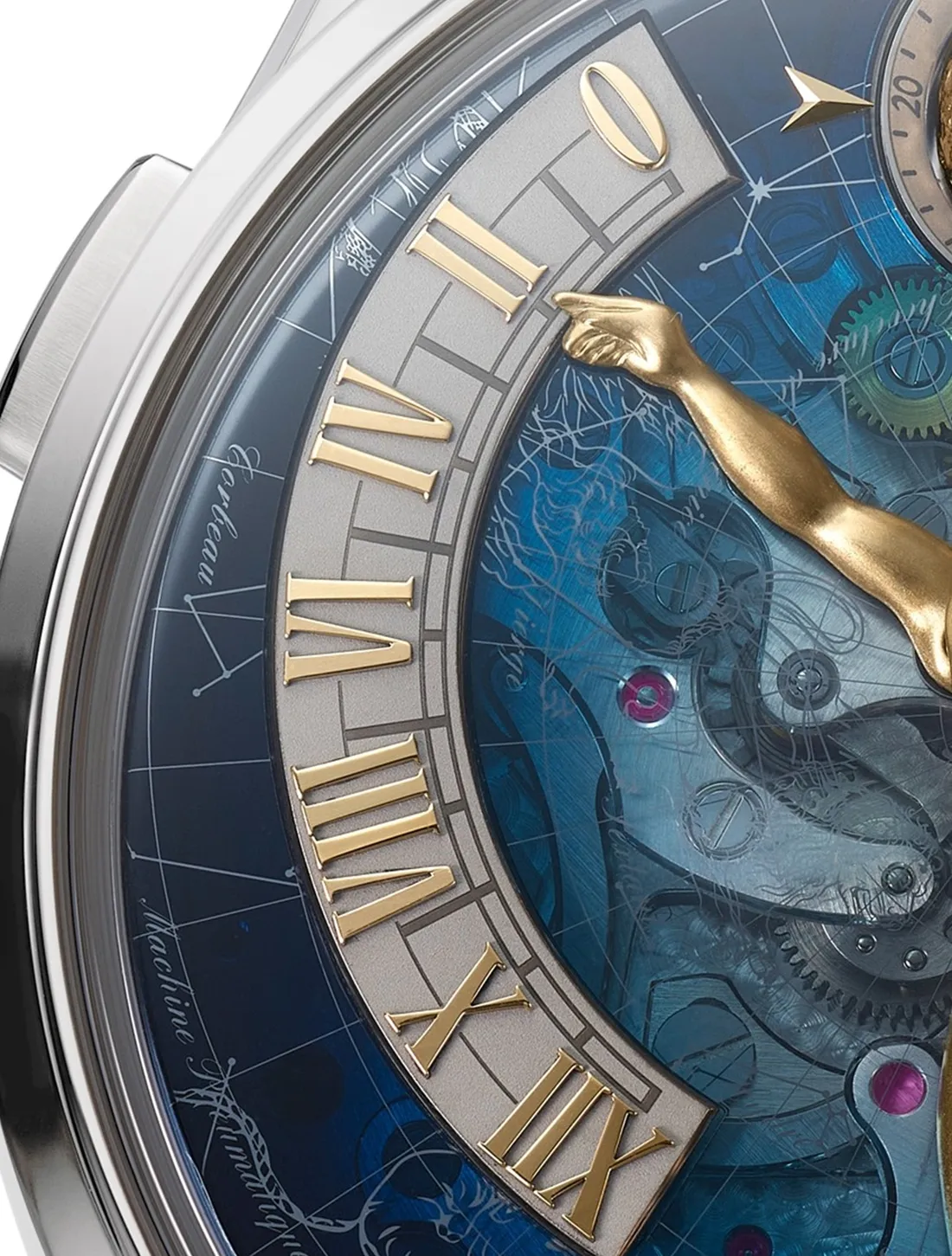
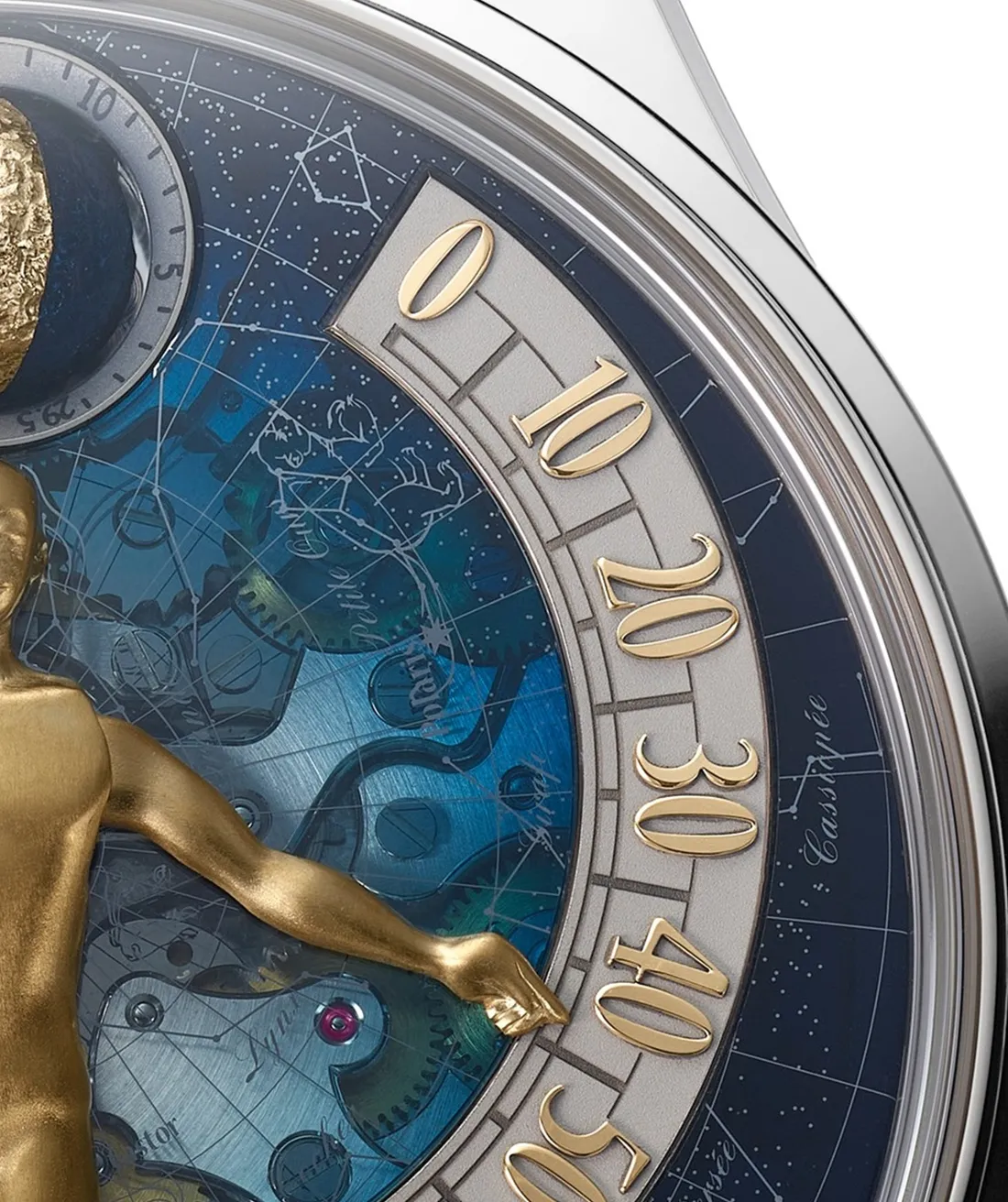
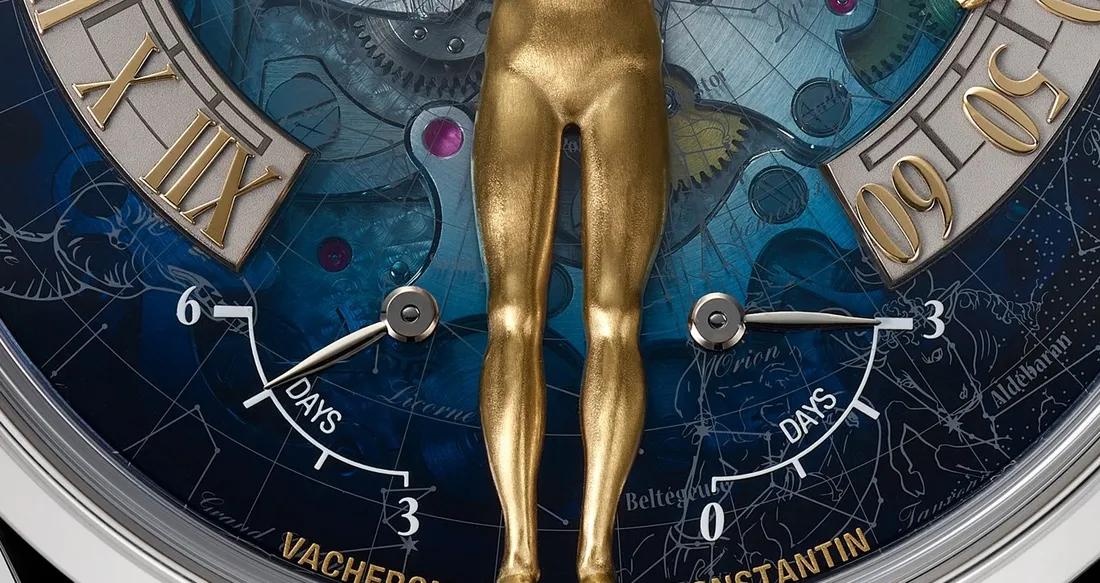
"With the arms of the figure," said Julian. "The left arm shows the hour on the curved scale of Roman numerals on the left. The right arm shows the minute on the Arabic scale on the right. Both sets of markers are made of eighteen carat gold."
"Does it have a name?"
"It has, and an old one: bras en l'air, arms in the air. Vacheron Constantin took the idea out of its own archive; a pocket watch of 1930 has the same arrangement. A classical bras en l'air works like this: the arms normally rest at the sides of the body, and when you press a button they rise, show the time and drop again. Which is to say the time is not read continuously but on demand."
"Is it the same here?"
"And this is where the innovation lies. This watch has two modes. When you press the pusher at ten o'clock, either the arms carry on indicating the time continuously, or they lower to the sides of the body and wait. Which is to say it can work both on demand, like a classical bras en l'air, and continuously, like an ordinary watch. Housing both in one mechanism is the subject of one of this watch's four patent applications."
"And when an arm reaches the end of its scale?"
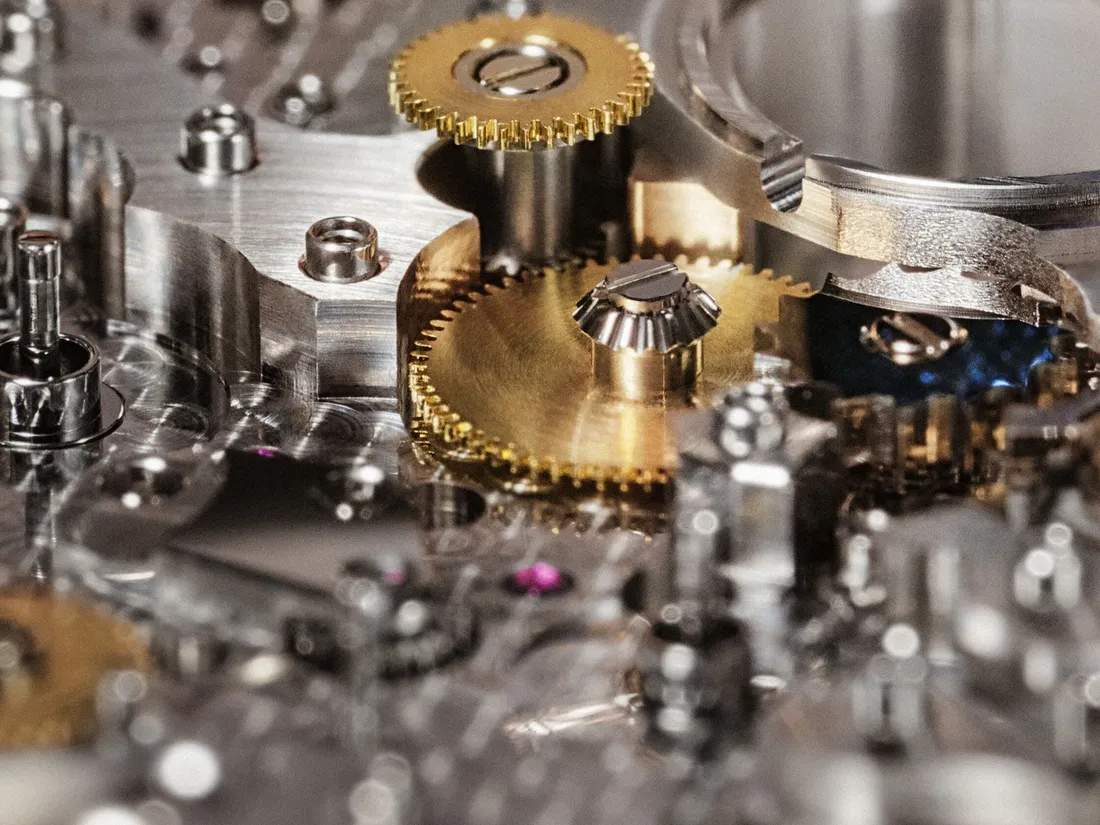
"It springs back like a catapult. This is called retrograde. When the minute arm reaches sixty a tensioned spring is released and the arm returns to the start within fractions of a second; the hour arm does the same when it reaches twelve. The subtlety is this: the two arms have to jump at the same moment and in the same rhythm. If one flies before the other the mechanism is shaken and the balance suffers. Vacheron developed a retrograde governor for it, an arrangement that brakes the jump and keeps the two arms in harmony. That is another of the patent applications."
"There are two small scales at the bottom."
"The power reserve. But instead of one scale it is divided into two sectors: one from six to three, the other from three to zero. Six days in total. The reason for dividing it is simple: fit six days onto one arc and the scale crowds until it cannot be read. Split into two sectors, each day becomes distinguishable by eye. That too is one of the patents."
Chapter VIII: The Dial Is Not Enamel
"That blue surface behind cannot be printed," said Astrid. "It has a depth like glass. Is it Grand Feu enamel?"
"Everyone asks that, and the answer is no," said Julian. "The distinction needs making, because the two techniques do not resemble each other at all."
"Grand Feu enamel is this: glass powder is mixed with mineral oxides, laid onto a metal plate layer by layer with a hair brush, and each layer is fired in kilns above eight hundred degrees. The glass melts and fuses to the metal. Every firing is a gamble; a degree of deviation, or a thermal shock as the piece comes out of the kiln, cracks the dial and the part goes in the bin. Depending on the number of colours the process is repeated eight or ten times. A magnificent art, but it is not what is used in this watch."
"Then what is this?"
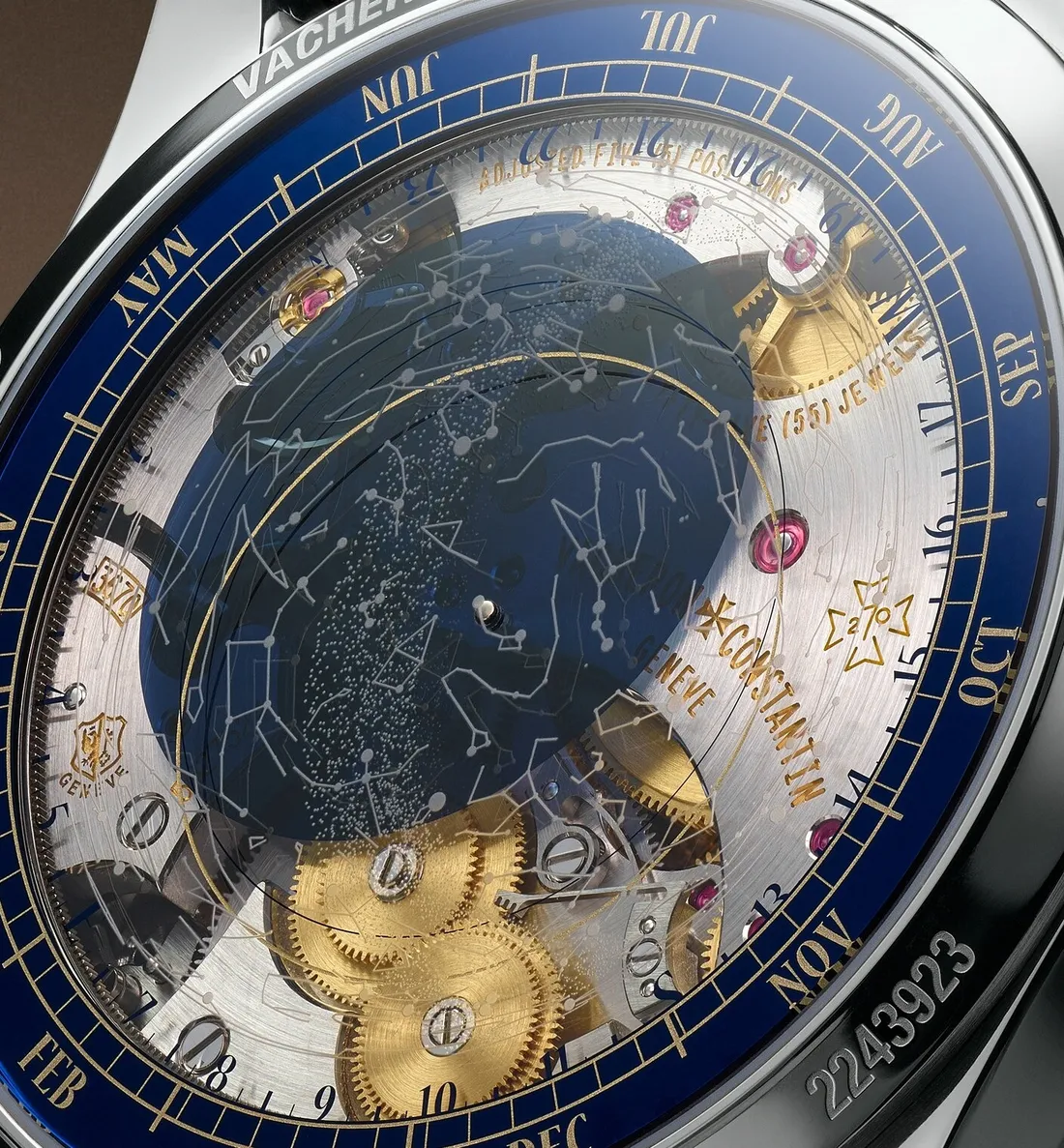
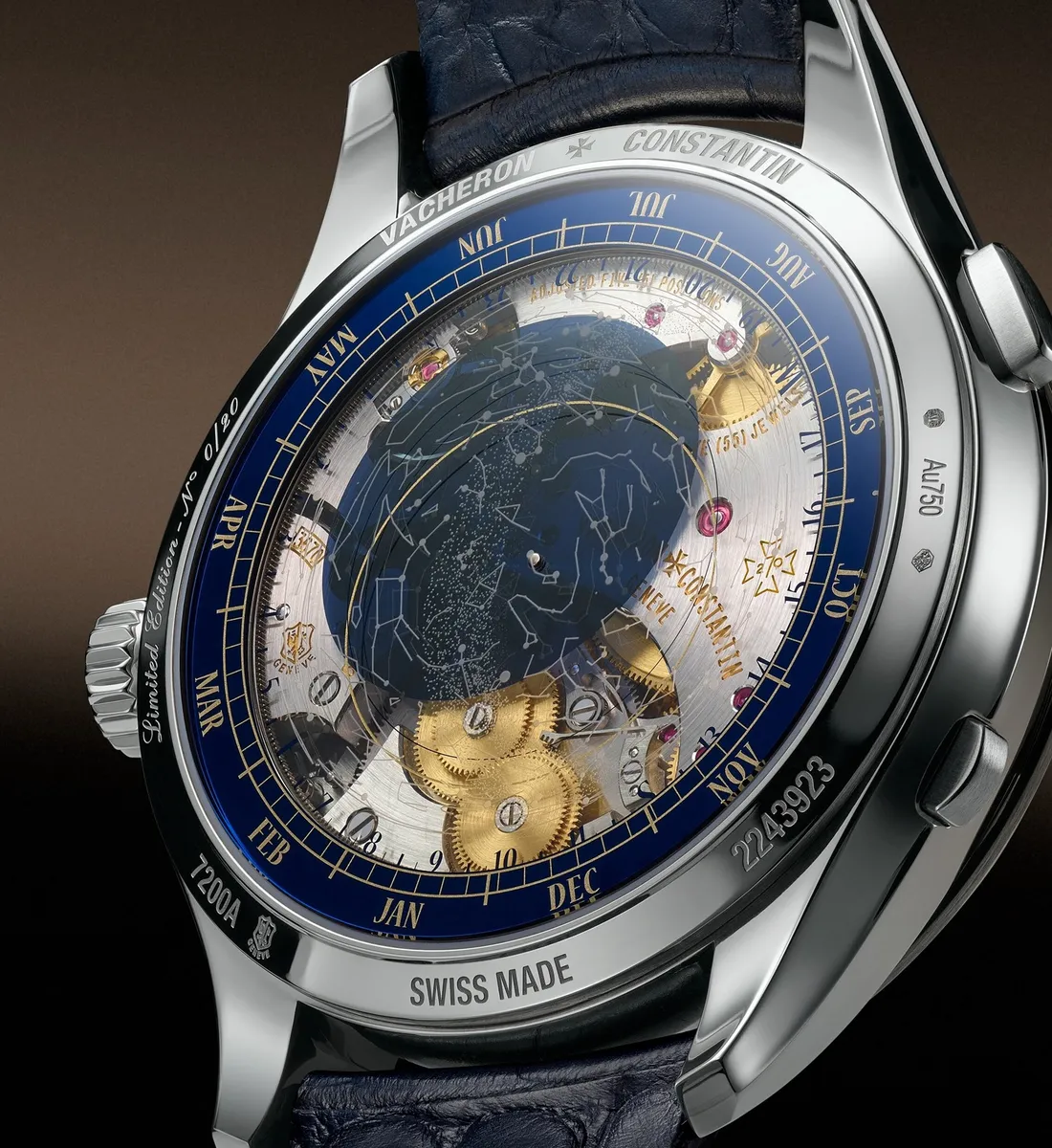
"This dial is made of two sapphire crystals. There are two transparent discs one above the other; one has been given a blue gradient, the other carries the star chart of the 1755 sky applied by metallisation. Metallisation is the deposition of an extremely thin layer of metal onto a transparent surface as a vapour; its thickness is measured in nanometres. That is why the star chart does not look painted but suspended inside the glass."
"What is the difference?"
"In enamel the sense of depth comes from the thickness of the glass; here the depth is real. There is a physical distance between the two discs and the figure and the arms move in that space. Which is to say the sky stands behind the figure, not underneath it. Turn your wrist and you see the chart shift relative to the figure; that is called parallax, and on this dial it is a deliberate effect."
"And the back?"
"There is another sky there. A turning celestial vault showing the constellations of the northern hemisphere and a reading of sidereal time, star time. A sidereal day is one full turn of the Earth relative to the distant stars, and it is about twenty three hours fifty six minutes and four seconds; almost four minutes shorter than a solar day. Because of that difference the same star rises four minutes earlier every night. The precision of this indication on the back is, as reported, on the order of one day in nine thousand one hundred and thirty years."
Chapter IX: Why Does Everything Seem to Serve the Human Being
Astrid put the loupe down. "Now I come to my real question. Why, at the micro, middle and macro scales, does everything look as though it serves the human being? Is that an illusion?"
"Let me try to answer with three examples," said Julian. "All three are physics."
"One: water. Water behaves in the opposite way to almost every other substance. It grows denser as it cools, but stops at four degrees; cool it further and it becomes lighter. That is why ice does not sink but floats. If ice sank, lakes and seas would freeze from the bottom and the life inside them would die every winter. The heat capacity of water is also anomalously high, which is why the oceans act as the planet's thermostat. Its surface tension is high, which is why a tree can pull water a hundred metres up from its roots. All of these properties come from a single cause: the hydrogen bonds between water molecules."
"Two?"
"Light. The band of wavelengths where the Sun's output is most intense is almost the same band in which the atmosphere is transparent. And the point where the human eye is most sensitive, around five hundred and fifty five nanometres, sits right in the middle of that band. Which is to say the light the Sun gives most of, the light the atmosphere lets through and the light the eye sees are the same band. Three separate systems, one window. And the ozone layer cuts off the ultraviolet just above that window, which it must, because those wavelengths break DNA directly."
"Three?"
"That window has an outward facing side too. The atmosphere is transparent again between eight and thirteen microns, and the Earth sheds its excess heat into space in exactly that band. Which is to say the planet has an entrance door and a chimney, and both are in the right place."
"And what is that called?"
"Science calls it fine tuning, and let us be honest: science does not explain why the tuning is as it is, it only measures it. What we call the anthropic principle is not an explanation either but a reminder: of course we live in a universe that harbours an observer, because otherwise there would be nobody to observe. That is true but it is an empty truth; it leaves the why of the question where it stood."
Astrid nodded. "My answer is shorter. If you walk into a room and see that the table, the chair and the lamp have been made to your height, you do not say coincidence. This universe is such a room. And a room has a will that arranged it."
"The scriptures speak of exactly this order," she added. "The fifth verse of Surah Ar-Rahman reads: the sun and the moon move by precise calculation. The fortieth verse of Surah Yasin is more explicit still: it is not for the sun to overtake the moon, nor can the night outstrip the day; each floats in its own orbit. The word orbit is not there by accident, and neither is the word calculation."
Chapter X: The Evidence on the Table
"Let us move from physics to biology," said Astrid. "The place I am most astonished is the dinner table. Why are forest berries so good for us? Why broccoli? Why are the meat and the milk of an animal so complete?"
"Let us take them one by one, because each has its own mechanism," said Julian.
"Forest berries. What gives them their colour is anthocyanins. The plant makes those molecules for itself: as a shield against ultraviolet and a buffer against oxidative damage. But the same molecule is also an advertisement; it calls the bird and the mammal, and the seed gets carried. So the colour has two jobs: to protect the plant and to summon a carrier. That we find the colour beautiful and also benefit from the molecule is the third link in the same system."
"A concrete example?"
"The ellagitannins in fruits like raspberries and pomegranates do very little for us on their own. But our gut bacteria convert them into urolithin A. And a study published in Nature Medicine in 2016 showed that urolithin A stimulates mitophagy, the clearing out and recycling of worn out mitochondria. Notice the chain: a plant makes a molecule, a bacterium in our gut converts it, and what is converted triggers the maintenance of our cells' power stations. Three separate living things, one maintenance line."
"Broccoli?"
"Broccoli is more interesting still, because the useful molecule is not sitting ready inside it. Broccoli contains glucoraphanin, and separately it contains the enzyme myrosinase. When you chew, that is when you break the plant's cell wall, the two meet and sulforaphane is formed. Which is to say the molecule is produced only at the moment it is eaten."
"And what does it do?"
"Sulforaphane presses a switch inside the cell called Nrf2. That switch opens the cell's own defensive genes; phase two detoxification and antioxidant enzymes come into play. Which is to say sulforaphane is not itself a hunter of poisons but a messenger telling the cell to produce its own hunters. Paul Talalay's group at Johns Hopkins established this in the early 1990s, and in 1997 they showed that broccoli sprouts carry twenty to fifty times more of the precursor molecule than the mature head."
"Can we say it fights cancer?"
"Here I have to be honest: no, it is not that simple. The strength of the evidence is at this point: sulforaphane measurably strengthens the cell's protective enzyme system, and in laboratory and animal models it reduces tumour formation. That is not a claim of treatment but a mechanism of protection. But the mechanism itself is elegant: the plant built a defence system to protect itself from herbivores, and when we eat that defence, our own defence switches on."
"Milk?"
"Milk is to my mind the plainest evidence. The lactose in it is a sugar found in the living world almost only in milk; and the mammal's young produces exactly the enzyme to digest it. It contains immune antibodies and lactoferrin; lactoferrin binds iron so that bacteria cannot reach it, which is to say it is an antibacterial. The calcium and phosphorus are packaged inside casein micelles like a transport container."
"The most astonishing part?"
"This: the third largest solid component of human milk is oligosaccharides, and the baby cannot digest them. It has no enzyme for them. So why are they there? Because they are not for the baby but for the Bifidobacterium in the baby's gut. Milk, while feeding the baby, feeds the baby's microbiota at the same time and selects which bacteria will multiply. Which is to say a section has been placed inside the milk that is not for the baby itself, but for the bacteria that will protect the baby."
"Meat?"
"There are two things in meat that are either absent from plants or very scarce. The first is vitamin B12. Neither plants nor animals produce B12; bacteria produce it and it accumulates in animal tissue. The second is heme iron: the iron inside haemoglobin and myoglobin is absorbed at a far higher rate than plant iron. Add creatine, carnosine, taurine and a complete amino acid profile, and what you have in front of you is not a nutrient but a package."
"And your reading?"
"My reading is this: none of these is astonishing on its own. What is astonishing is that all of them face the same way. A colour that both protects the plant and calls us; a molecule that forms only when chewed; a milk with a section in it the baby cannot digest. Separately, each could be coincidence. Together, they are the signature of a design."
format_quote"A section has been placed inside the milk that is not for the baby itself, but for the bacteria that will protect the baby."
Chapter XI: The Air of the Forest and the Soldiers in Your Blood
"I want one more example," said Astrid. "But this time let it be something we do not eat, only stand inside of."
"Then let me tell you about the air of the forest," said Julian. "This is my favourite research."
"Trees continuously release volatile compounds into the air around them. These compounds are called phytoncides; the Russian biologist Boris Tokin coined the term in 1928, and the word means roughly killed by the plant. Chemically they are terpenes: alpha pinene, beta pinene, limonene, camphene, borneol, cineole. The tree releases them to protect itself from fungi, bacteria and insects. That sharp resinous smell that reaches your nose in a pine forest is exactly this defence system."
"And what does it do to us?"
"Here is the astonishing part. Qing Li and his team at the Nippon Medical School in Japan measured it. In a study published in 2007 they took subjects into the forest for three days and two nights and measured the activity of the natural killer cells, the NK cells, in their blood. NK cells are the patrol arm of the immune system: they recognise and kill virus infected and cancerous cells. The result: NK activity rose by about fifty per cent, and the rise lasted more than seven days after the trip. In another measurement the effect was preserved for close to a month."
"But that could be from the walking. Or the scenery."
"They tested exactly that objection, and this is the most elegant part of the experiment," said Julian. "In a study published in 2009 they did not take people into a forest. They put them in a hotel room and vaporised the stem oil of hinoki cypress into the air of the room. Which is to say they gave only the smell, only the molecules; no walking, no scenery, no trees. The activity and the proportion of NK cells rose again, and adrenaline in the urine fell. So the thing producing the effect was the compound in the air itself."
"And the mechanism?"
"NK cells work with killing proteins: perforin, granulysin, granzymes A and B. Perforin punches the membrane of the target cell, and the granzymes enter through that hole and instruct the cell to destroy itself. The measurements showed that the intracellular levels of these proteins increased. Which is to say the molecule a tree releases into the air to protect itself increases the ammunition of the patrol arm in our blood."
Astrid was quiet for a while. "So the tree makes armour for itself, and the smell of that armour thickens ours."
"Yes. And notice: there is no exchange here. The tree gains nothing from it. The benefit runs one way."
format_quote"The tree makes armour for itself, and the smell of that armour thickens ours. And the tree gains nothing from it."
Chapter XII: The Measurable Trace of Wonder
"One last thing," said Astrid. "At the beginning of all this I used the word wonder. Is there a science of it?"
"Astonishingly, there is," said Julian. "A serious literature on awe has grown up in psychology; the work of Dacher Keltner and his colleagues is the backbone of the field. What they find is this: awe shrinks a person's sense of their own importance. They call it the small self effect. Seeing yourself as small here is not a humiliation but a settling into proportion."
"And does it leave a trace in the body?"
"In a study published in the journal Emotion in 2015, Stellar and colleagues measured the relationship between positive emotions and interleukin six, a marker of inflammation. They found that awe showed the strongest inverse relationship of all: people reporting awe had lower levels of that marker. That is not a treatment but a correlation; but it shows this much: looking at the sky and feeling yourself shrink leaves something measurable in your body."
"So looking at the macrocosm opens a trace in the microcosm."
"Exactly. And that may be the shortest summary of our whole conversation."
The Specification
Vacheron Constantin Métiers d'Art Tribute to the Quest of Time, reference 7200A/000G-H103.
Case in 18 carat white gold, forty three millimetres across, thirteen point five eight millimetres tall. Water resistance three bar, that is thirty metres. Sapphire caseback. Dark blue alligator strap.
The dial is made of two sapphire crystals; one carries a blue transparent gradient, the other the metallisation of the 1755 celestial vault. The hour markers are Roman and the minute markers Arabic, both in eighteen carat gold. The astronomer figure at the centre is titanium with a gold PVD coating. The three dimensional Moon is titanium coated in gold and blue PVD, engraved by hand, and surrounded by a ring giving the age of the Moon.
Calibre 3670: hand wound, developed entirely in house over three years. Five hundred and twelve components, fifty five jewels. Frequency five cycles a second, that is thirty six thousand vibrations an hour. Power reserve six days, shown across two sectors. Four patent applications: the sequential double power reserve display, the retrograde governor, the precision three dimensional Moon and a correction system that allows adjustment at any moment.
Certified with the Hallmark of Geneva. Twenty numbered examples. Price on request.
Closing: The Man Who Raises His Arms
The telescope of the observatory turned with a faint sound of motors. Outside the desert wind echoed against the wall of the dome.
Astrid set the loupe aside. "You know, Julian, the truest thing about this watch is not its scales but its posture. They did not put a planet or a star in the middle of the dial. They put a human being. And that human is not watching the sky; he has raised his arms and is keeping time with it."
Julian wiped the crystal of the watch with a fine cloth and closed his cuff.
"That is why the name is right too," he said. "Tribute to the Quest of Time. What is doing the seeking is not time; it is we who seek time. The sky already knows its own calculation. The only being that does not know, that is obliged to ask, and that falls into wonder because it asked, is that small golden figure."