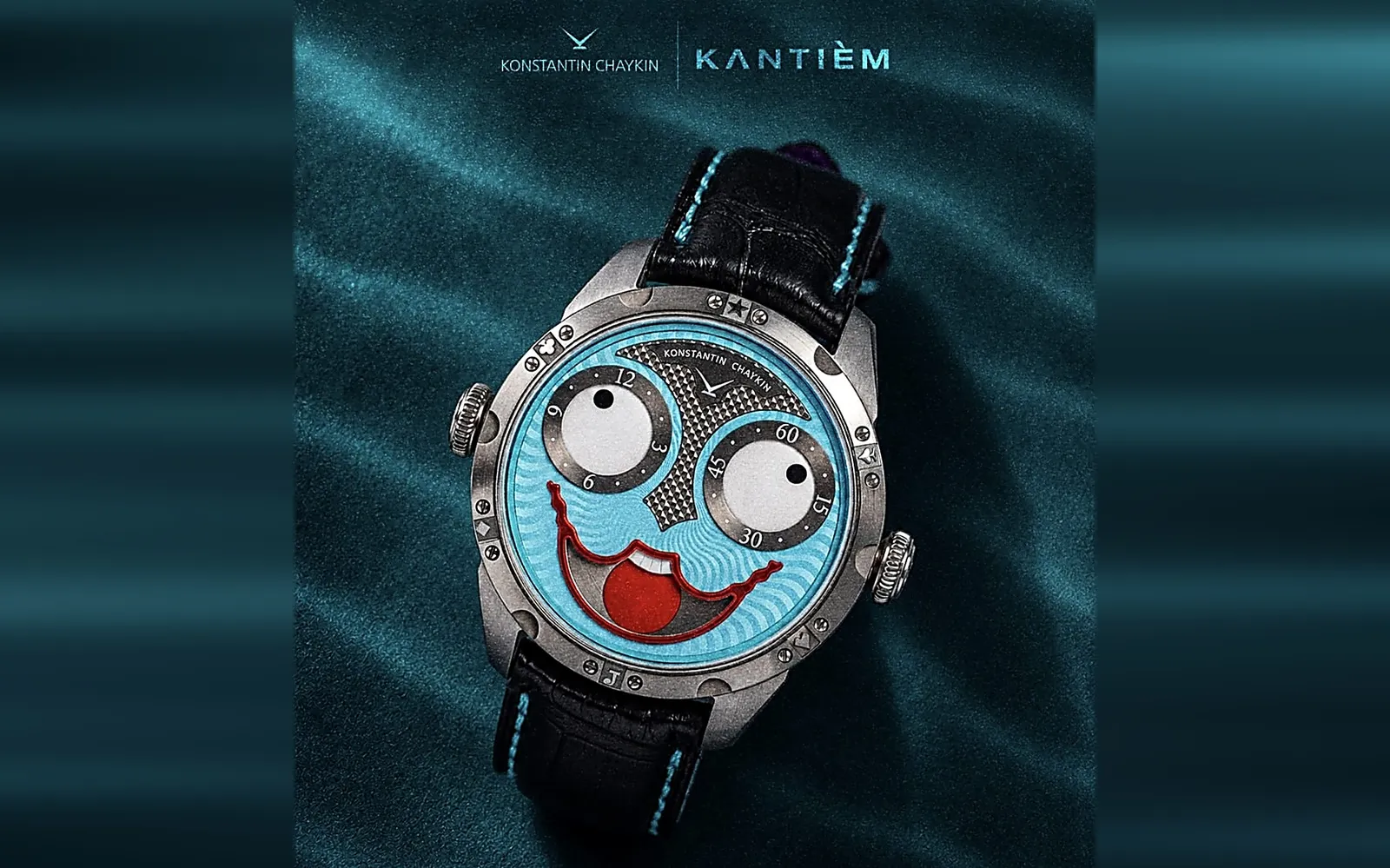
On an Istanbul night where the shadow of the Galata Tower breaks across the Golden Horn, two people are standing on the quay of an old waterside house: a biophysicist and a historian of horology.
Below them, where two different bodies of water meet at the point of the current, turquoise and dark blue rings of moonlight are breaking on the surface.
Look at that line in the current, says the biophysicist. Most people take the Bosphorus for a single river. In fact there are two rivers here and they run in opposite directions. The water of the Black Sea is fed by rivers, so it is less salty and therefore lighter; it runs on top, towards the Marmara. The water coming up from the Mediterranean is far saltier and heavier; it moves underneath, the other way, towards the Black Sea. Between them lies a sharp boundary, in places thirty or forty metres down. A diver crossing it sees the water blur as though through glass.
Nothing fluid in nature moves at random. Water is a living mechanism that feels its own surface tension, gravity and the force born of rotation at the molecular level. Just as more than forty muscles of expression in a human face contract at the same instant to make one frequency we call a smile, nature joins fluidity and architecture in a single hydraulic balance.
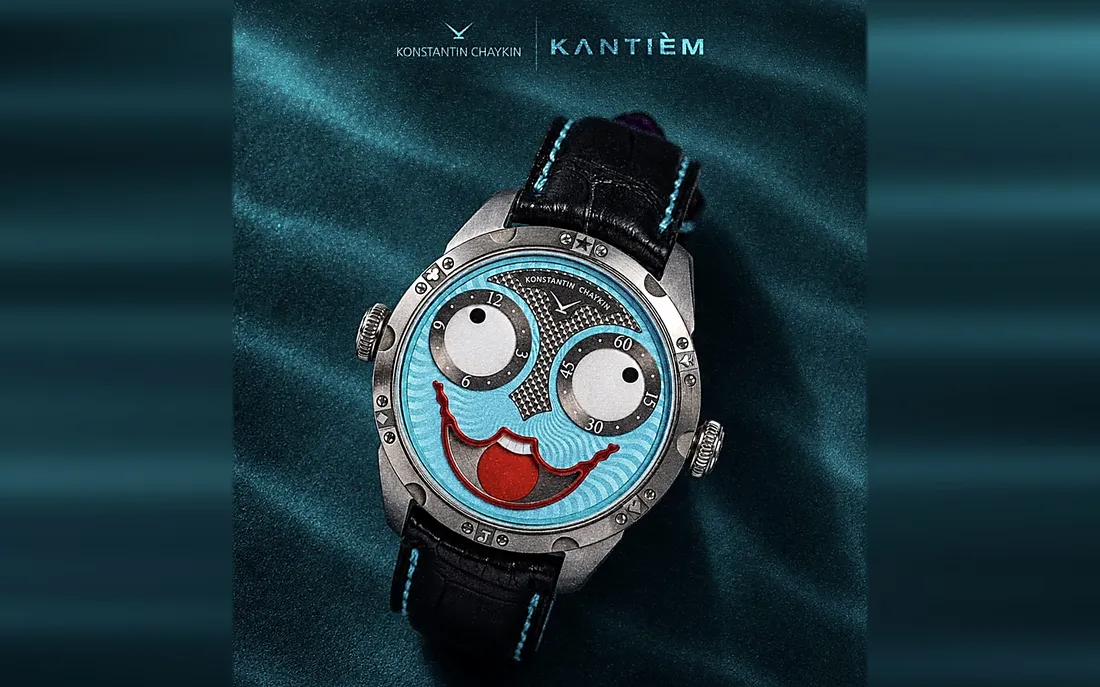
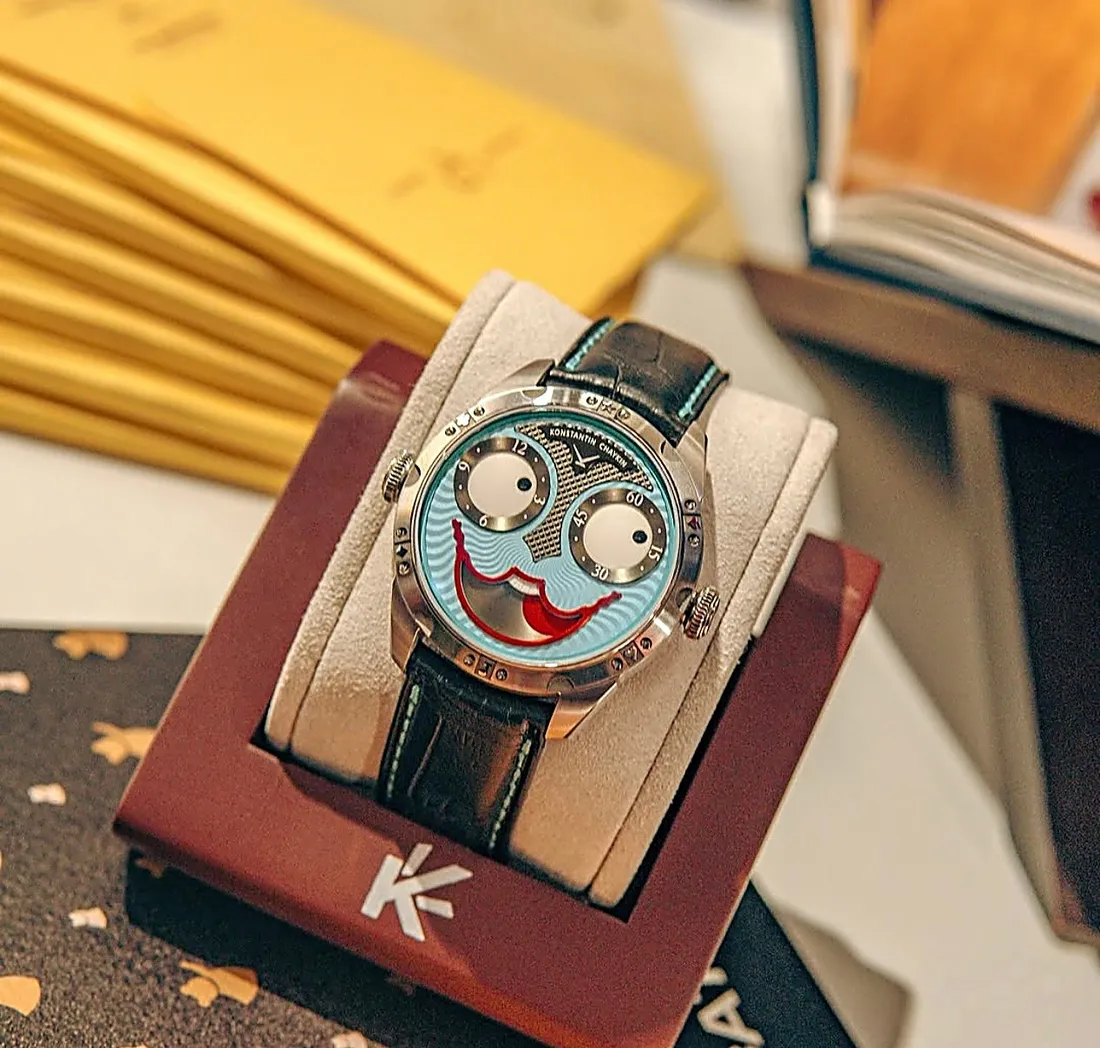
And that is exactly why, for centuries, humanity missed something by trying to measure time only with grave and rigid numerals, the historian replies, watching the moonlight slide across the dial on his wrist. When Konstantin Chaykin, the contrary genius of Russian watchmaking, stood up against the sober Swiss idea of time, what came out was this: time can also be a kinetic game through which human expression and humour run. Look at this dial. Two eyeballs show the hour and the minute and never stop moving. The mouth is a moonphase. The face of the watch changes every minute, like the unstoppable, cheerful, shifting current of the Bosphorus.
format_quote"The Bosphorus is not one river; it is two, and they run in opposite directions."
Hasan Bekmezci
The human face is the most complicated mechanical canvas in nature. A smile, or a mocking look, is formed when electrical signals leaving the brain set networks of micro-muscles in motion.
The human brain is programmed, for the sake of survival, to read every two dots and a line it sees as a human face. This is called pareidolia and it appears in babies within the first weeks. We see a face in the three holes of a socket, in the headlights of a car, in clouds. Because being slow to notice a face in a crowd was, for our ancestors, a fatal delay. Chaykin turned that neurological reflex into a mechanical complication for the first time in high watchmaking.
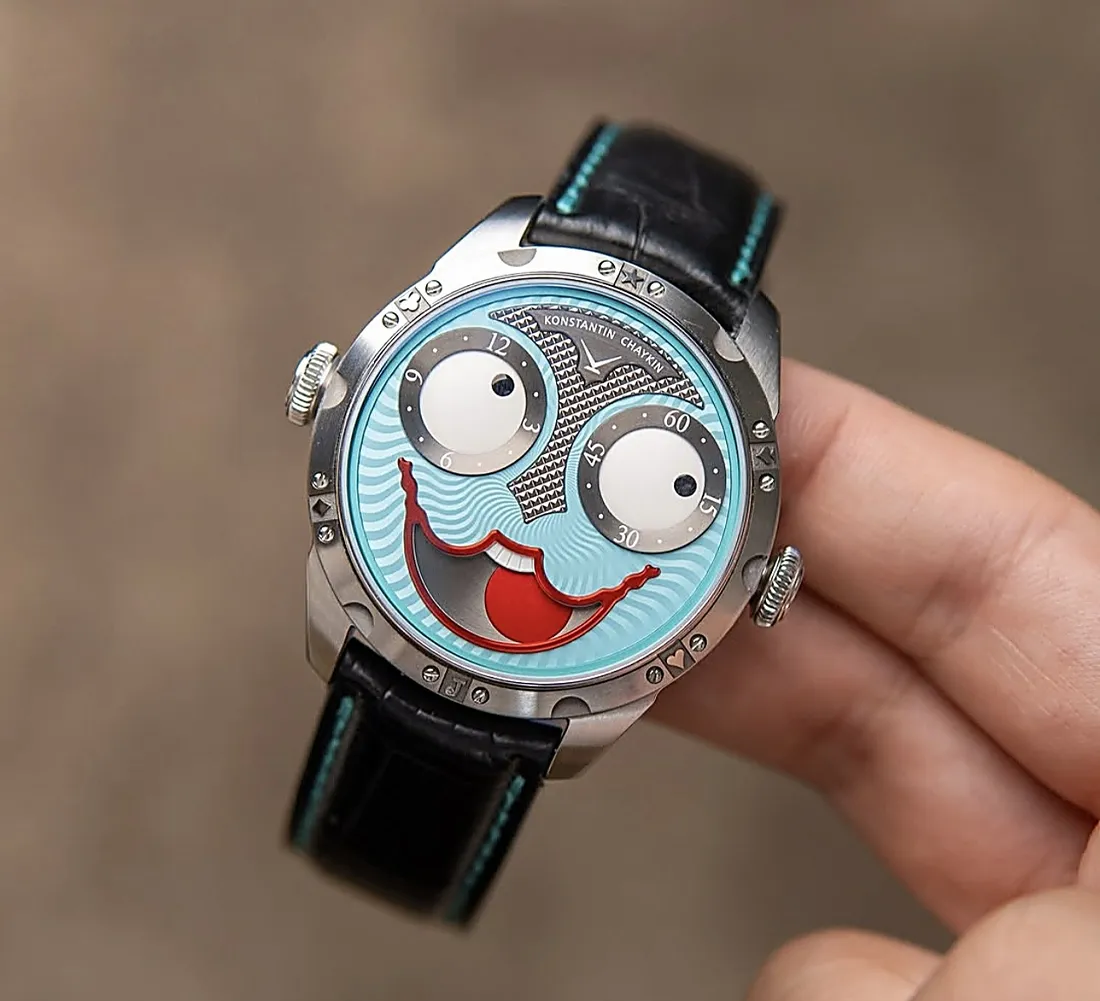
As the two discs on the dial keep turning, the expression of the watch changes one thousand four hundred and forty times a day, because there are one thousand four hundred and forty minutes in a day. Sometimes startled, sometimes mocking, sometimes cross-eyed. At twelve o’clock and zero minutes the Joker looks straight ahead; as the hour moves on, the pupils drift apart and the dial takes a new expression.
format_quote"The face of the watch changes one thousand four hundred and forty times a day, because a day holds that many minutes."
Hasan Bekmezci
The newest member of Konstantin Chaykin’s Wristmons family, the wrist monsters, was made directly for Istanbul and takes its name from the strait: the Bosphorus Joker.
The watch was developed with Salon Kantièm, which represents independent watchmaking in Turkey, and had its world premiere at Contemporary Istanbul, held at Tersane İstanbul from 22 to 27 September 2026. Salon Kantièm was the fair’s official time partner, and Chaykin’s contemporary paintings, drawn from watch mechanisms, were shown in the same space for the first time. Production is limited to fifty pieces.
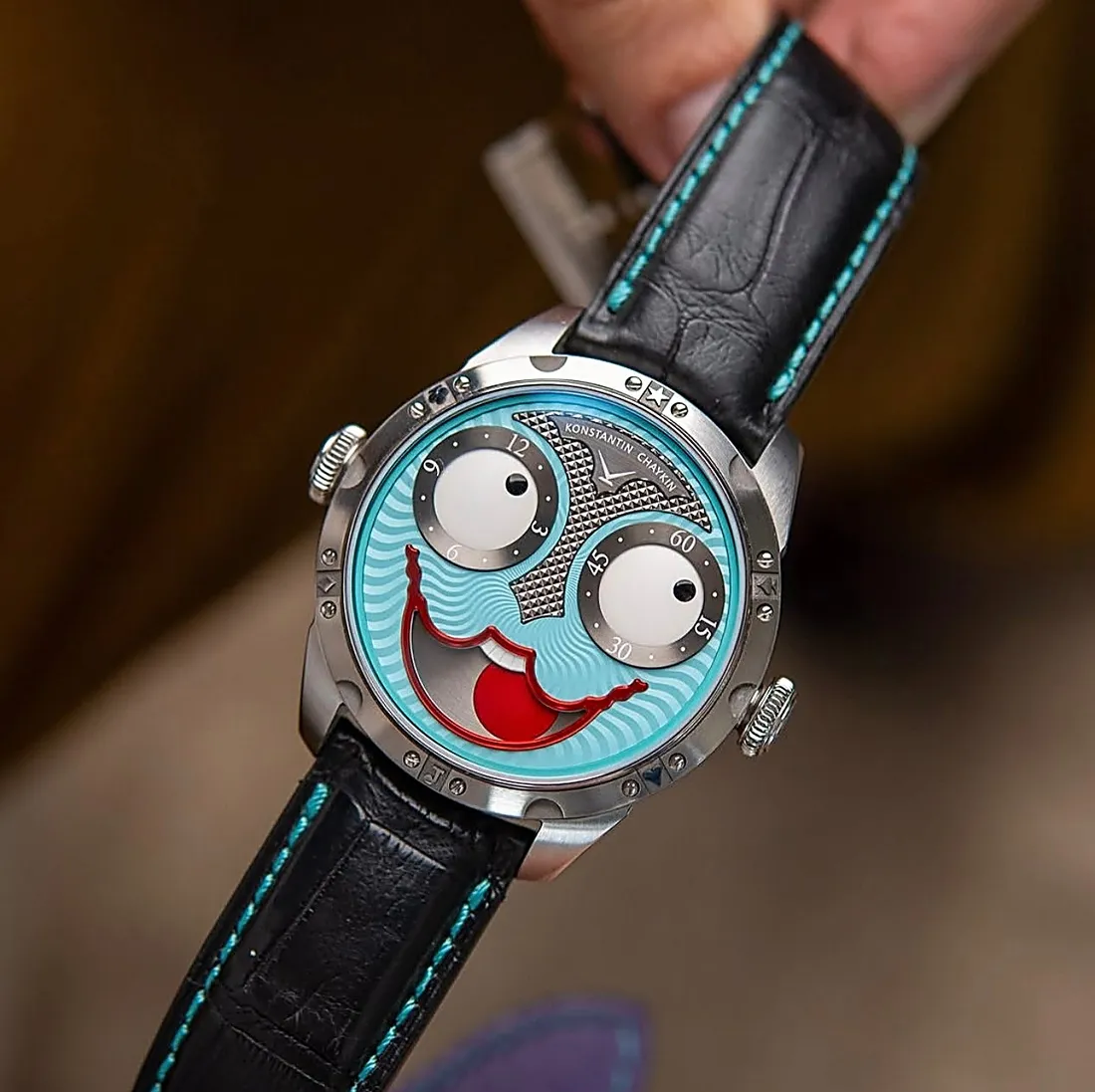
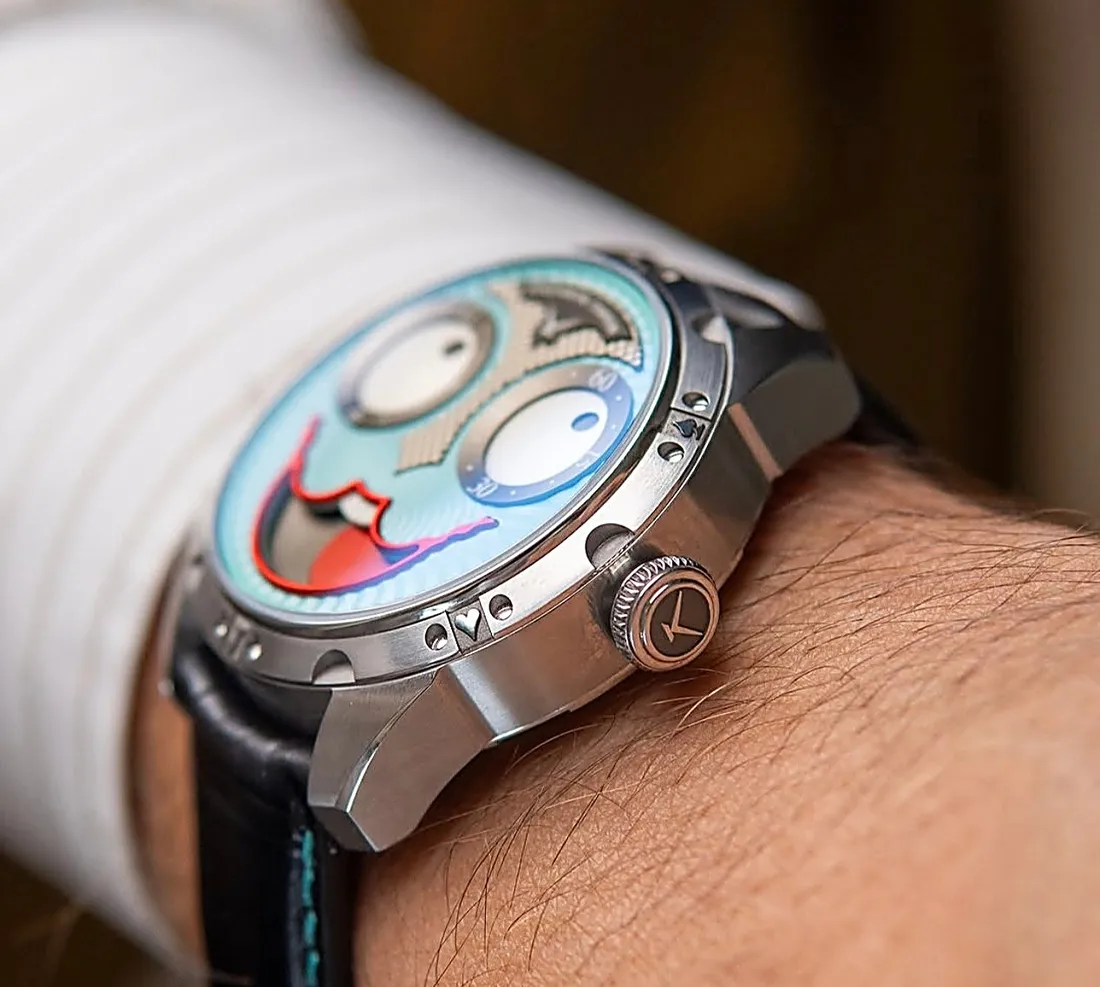
The wave-form guilloché on the turquoise ground of the dial is cut on a traditional guilloché lathe. The work is done on a hand-cranked machine, and the burin scores the surface of the metal to a hundredth of a millimetre; every line throws the light back at a different angle. Turn your wrist and the waves on the dial stir like the surface of water. The colour stays the same; the depth changes.
The left eye shows the hour and the right eye the minute. Hour and minute hands have been dispensed with; in their place black discs shaped like pupils turn on their own axes. The wide, red-framed smile at the bottom of the watch is a moonphase complication tracking the moon’s twenty-nine and a half day cycle. The red disc enters at one corner of the mouth and leaves at the other, forming the tongue and the grin. The face of this watch is not a joke laid on before the mechanics; it is the result of three separate indications running at once.
On the small plates around the bezel, the spade, diamond, club and heart are engraved along with the letter J; the watch’s philosophy of luck and play is cut into the steel. The strap is black alligator, lined in purple and stitched in turquoise.
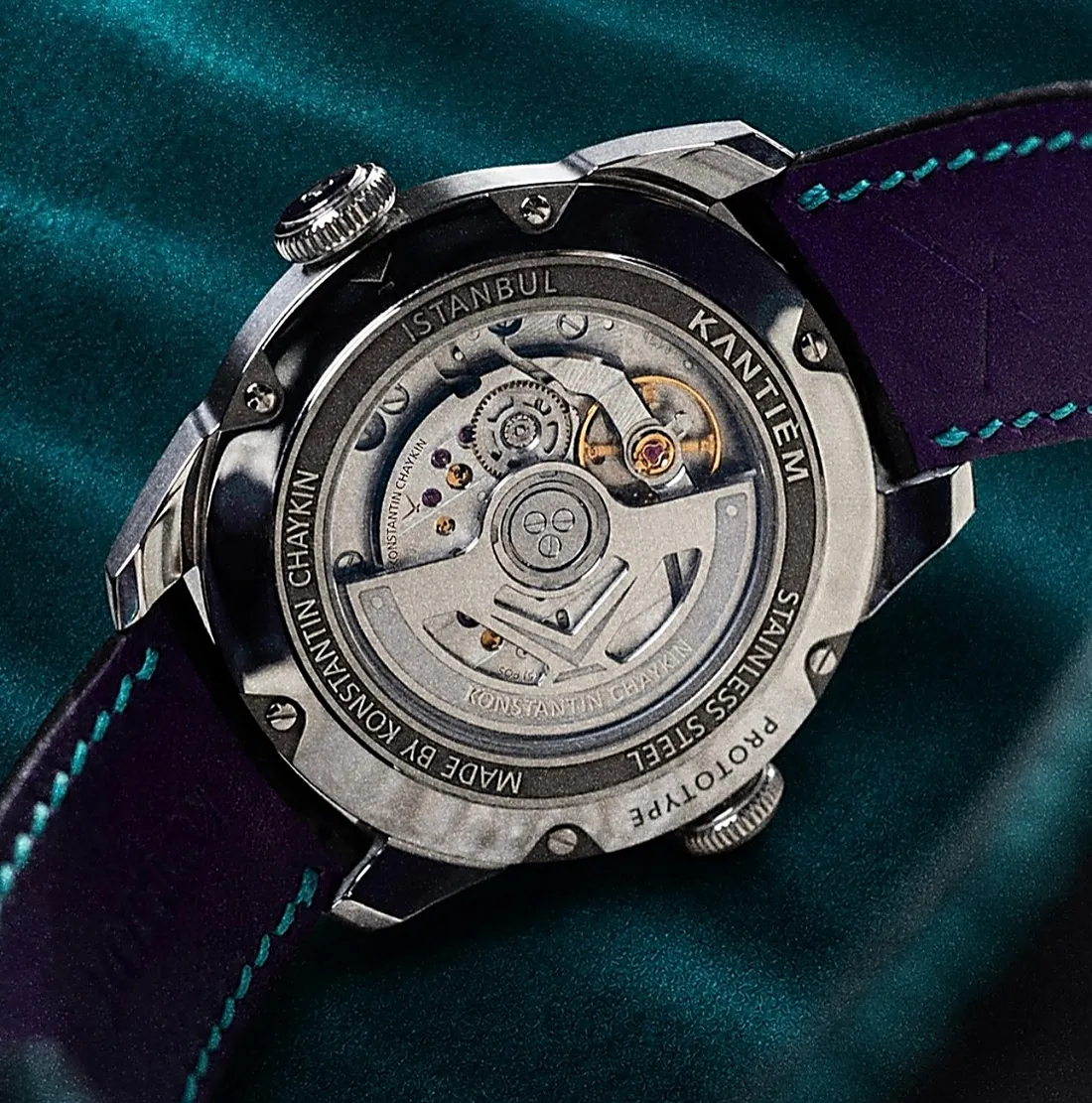
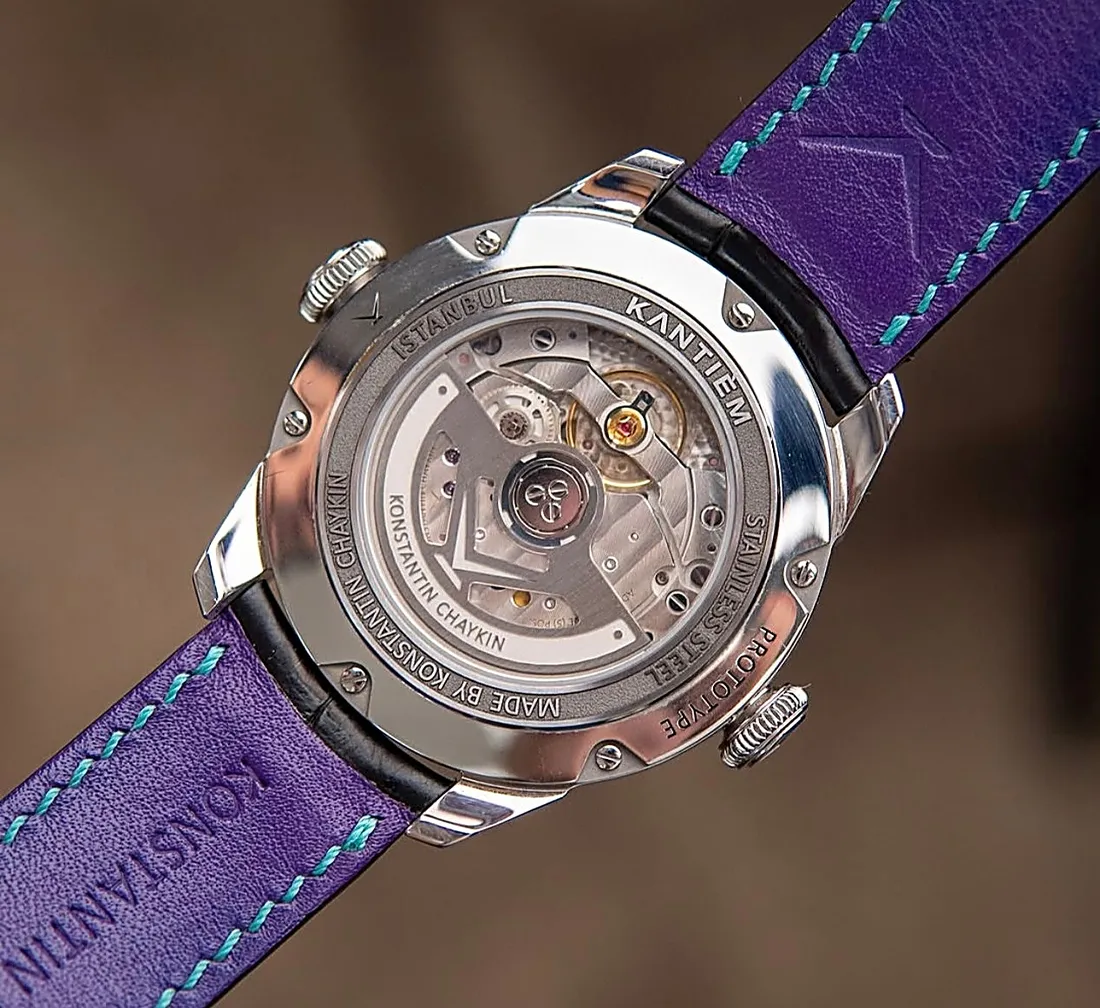
The case is stainless steel, and through the sapphire back the automatic movement and a rotor carrying Chaykin’s signature are visible. Two words are engraved around the back: ISTANBUL and KANTIEM. The name of a city on the back of a watch is not a common thing; here it marks not the party who commissioned the watch but the shore of the water that gave the watch its name.
The Konstantin Chaykin Bosphorus Joker is a cheerful laugh thrown into the middle of the strait at the rigid, solemn, sterile rules of watchmaking. It lifts time out of the prison of grave numerals and ties it to the turquoise current of the Bosphorus, to the anatomy of human expression, and to the humour of being alive.
Humour itself is a gift. We are creatures who catch a joke from the smallest twitch of a muscle in another face, who laugh before anyone teaches us to, who see a face in two dots and a line. Nobody taught us that. It arrived with us. The Creator equipped a human being not only well enough to live but well enough to laugh.
Every time you look at those turning eyes and the cheerful grin the red moon-tongue makes, you understand that the minutes going by are not a loss but an elegant, mechanical smile thrown back at the face of life.
format_quote"The Creator equipped a human being not only well enough to live but well enough to laugh."
Hasan Bekmezci
The Joker page on the maker’s own site: Konstantin Chaykin, Joker