Hundreds of metres below the limestone ridges of the Sierra de El Abra, which run through the Mexican states of San Luis Potosí and Tamaulipas, two researchers are standing beside a pitch-dark cave pool cut off from the outside world hundreds of thousands of years ago.
When they switch off their lamps an absolute nothing takes over. Yet in the water a school of pink-white fish, their eyes entirely gone and skinned over, is gliding between jagged sharp limestone rocks with millimetric precision. Without touching a single rock, a single obstacle.
The fish is called Astyanax mexicanus, and the most surprising thing about it is this: it is the same species as the perfectly sighted fish living in the streams above. Branches of that same species fell into the caves and lost their eyes over generations. An eye is an expensive organ in the dark. It burns energy, it gets injured, it gets infected. Where there is no light at all, carrying one is a loss.
Where a human being could not find his way in this darkness, one of the researchers says, these creatures need no optical sense at all. In place of the eye there is a cellular hydro-radar spread across the body like a net.
Because water is not a still mass, the other answers. Every rock, every obstacle and every current leaves micro-pressure footprints on the molecules of the water. The blind fish reads those molecular micro-vibrations with the neuromast cells along its body. It is not merely swimming; it is processing the fluid map of the water at molecular level like a live frequency chart in its mind.
format_quote"An eye is an expensive organ in the dark; where there is no light at all, carrying one is a loss."
Hasan Bekmezci
The mechanism that lets blind fish swim through pitch darkness without striking the rock is called, in biology, the lateral line system.
Along the line that runs from the head to the tail of the fish there are micro-channels filled with a gel-like fluid. Inside those channels sit hair-like receptors called neuromasts. It is as if you closed your eyes in a violent storm while thousands of microphones the thickness of a hair, set into your body, reported the direction and the force of the wind to your brain on the instant. The fish sees not with an eye but with these tactile ears in its skin.
As the fish swims it pushes the water in front of it. If a rock stands ahead, that pushed water strikes it and rebounds, creating micro-pressure changes across the fish’s body. It is like a bat finding its way in the dark by sending out sound; except the fish does it not with sound waves but directly with the compression and release pressure of water molecules. It does not hear the wall. It pushes the wall and feels what it pushed come back.
The fish must also separate the noisy churn made by its own swimming from the vital pressure signals arriving from outside. Its brain keeps a copy of every command it sends to the tail, works out in advance the water that command will make, and subtracts it from the incoming signal. Today’s noise-cancelling headphones do the same trick: first predict what you do not want to hear, then take it away.
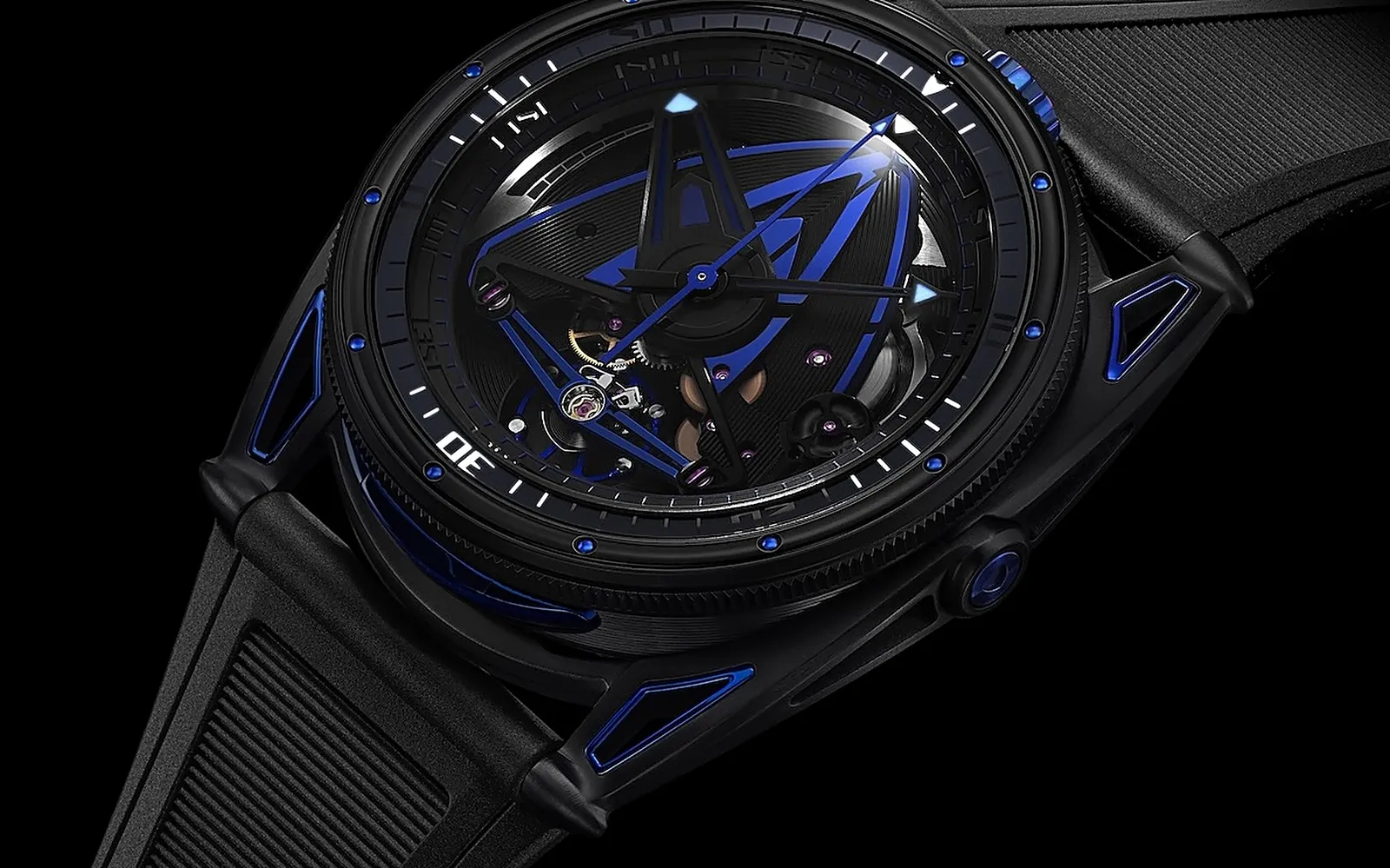
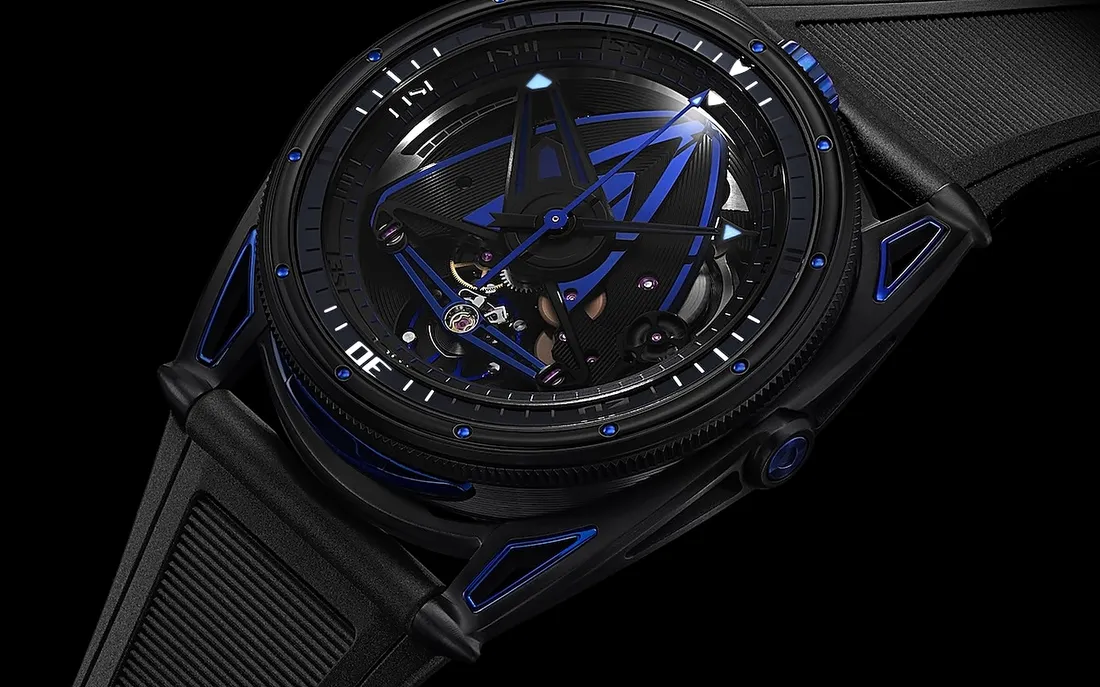
The hydrodynamic bio-radar of those dark pools and the aerodynamic edge of the swordfish, among the fastest hunters in the sea, meet in the DB28GS Swordfish, a masterpiece from De Bethune, the architect of independent high watchmaking.
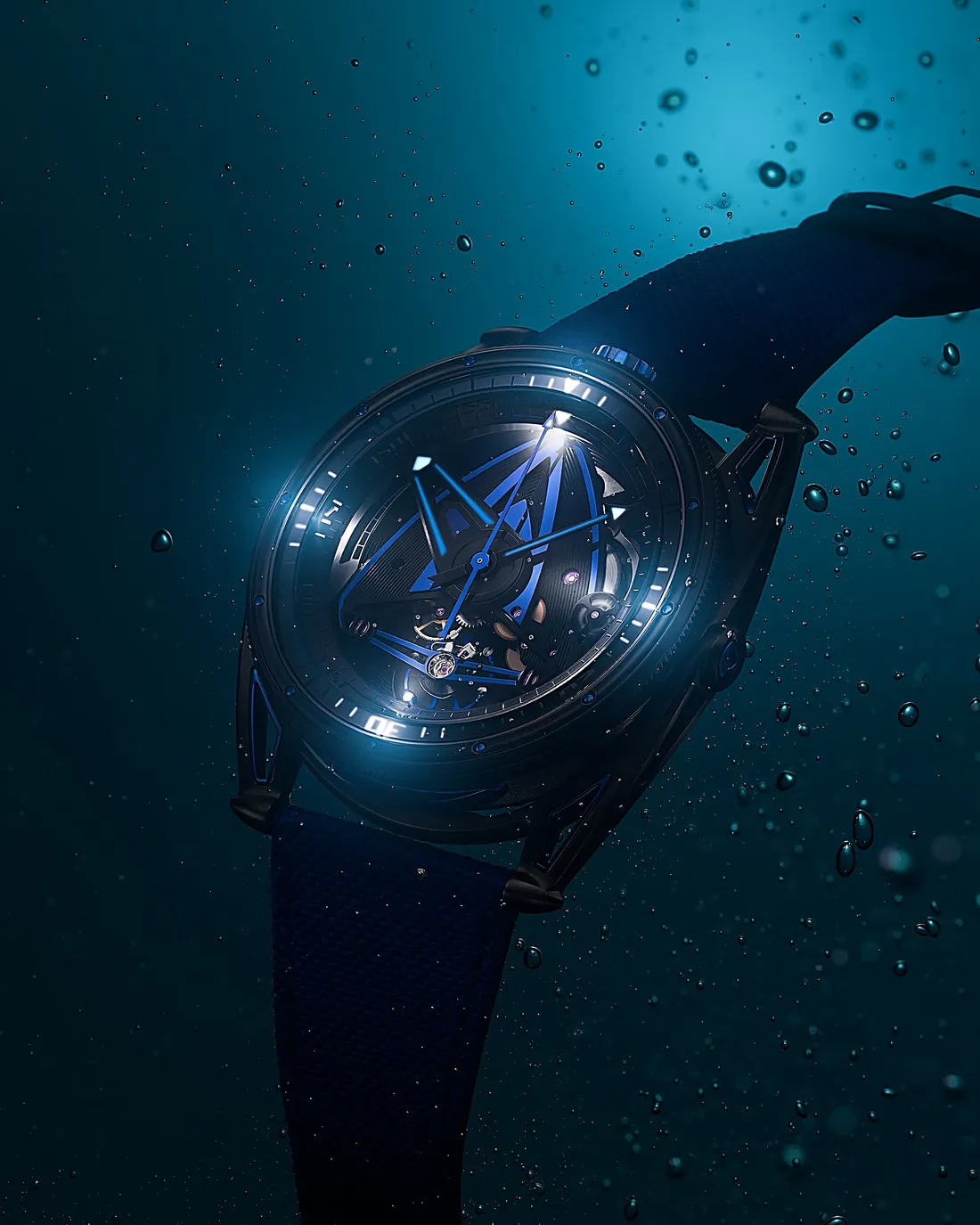
One detail has to be said at the outset, because the whole idea of this watch rests on it: the Swordfish is a diving watch. It continues the sporting line De Bethune began with the Grand Bleu in 2019, and it was designed to make both the time and the duration of a dive readable underwater. It has a unidirectional rotating bezel, built so that time can be read at a depth sunlight does not reach.
Its most surprising feature lives exactly there. The dial is not lit with luminous paint but by a wholly mechanical route. Press the pusher on the side of the case and a small dynamo, fed by the twin barrel, turns and lights the dial with current it makes itself. There is no battery and no stored light; the watch produces the light at that moment. Brought in in 2019, that solution can be read as the mechanical counterpart of what a fish does when it finds its way in total darkness on information it gathers itself.
format_quote"There is no battery and no stored light; the watch produces the light at that moment."
Hasan Bekmezci
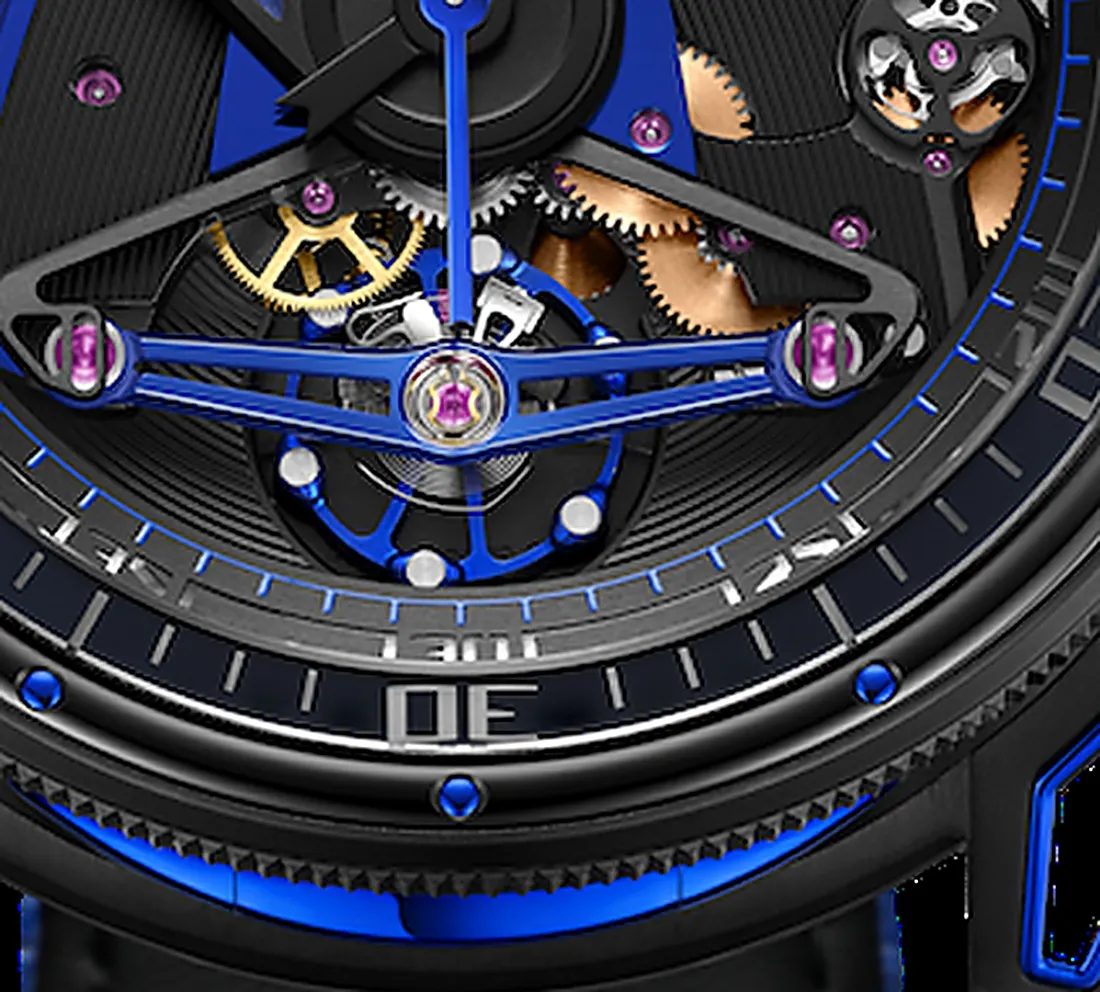
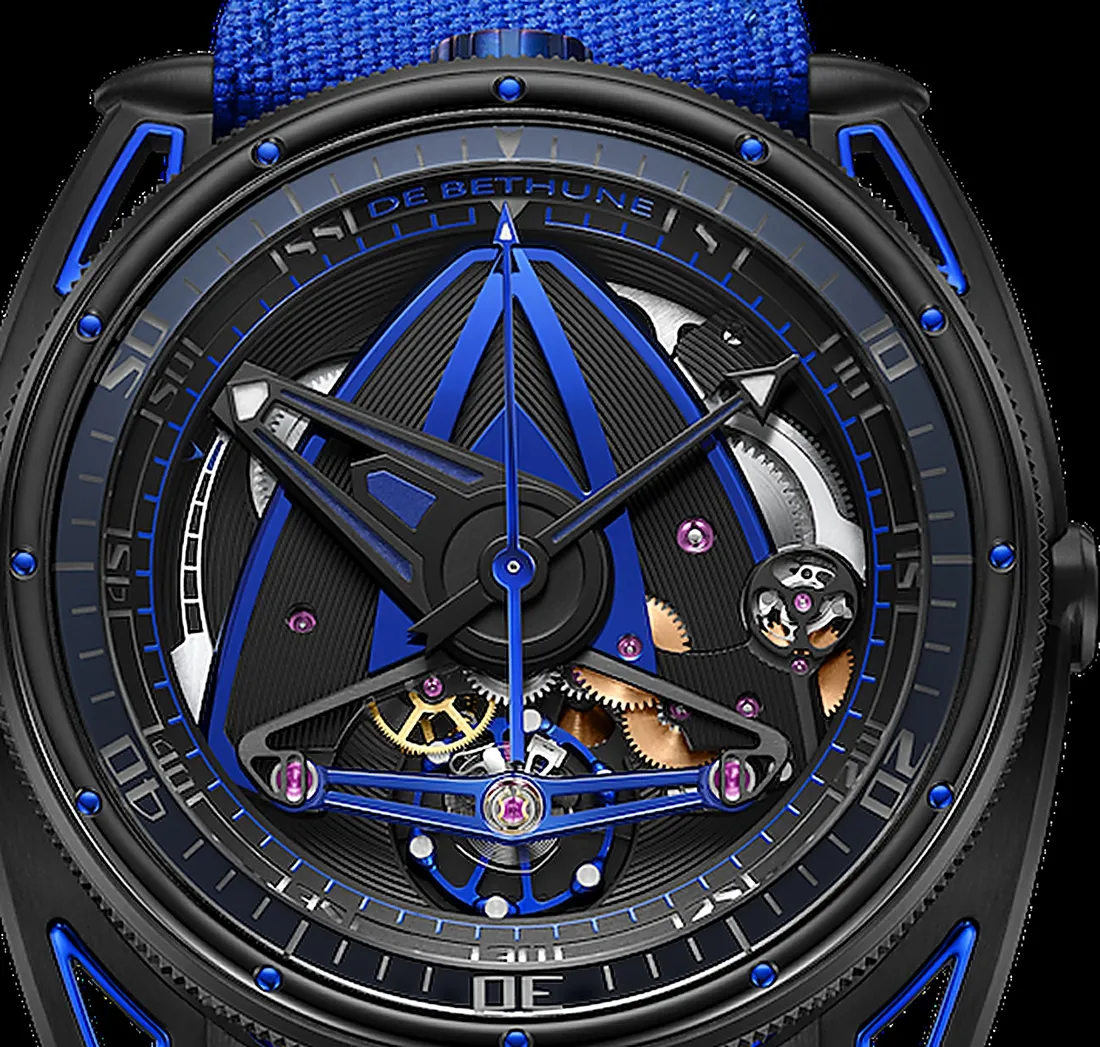
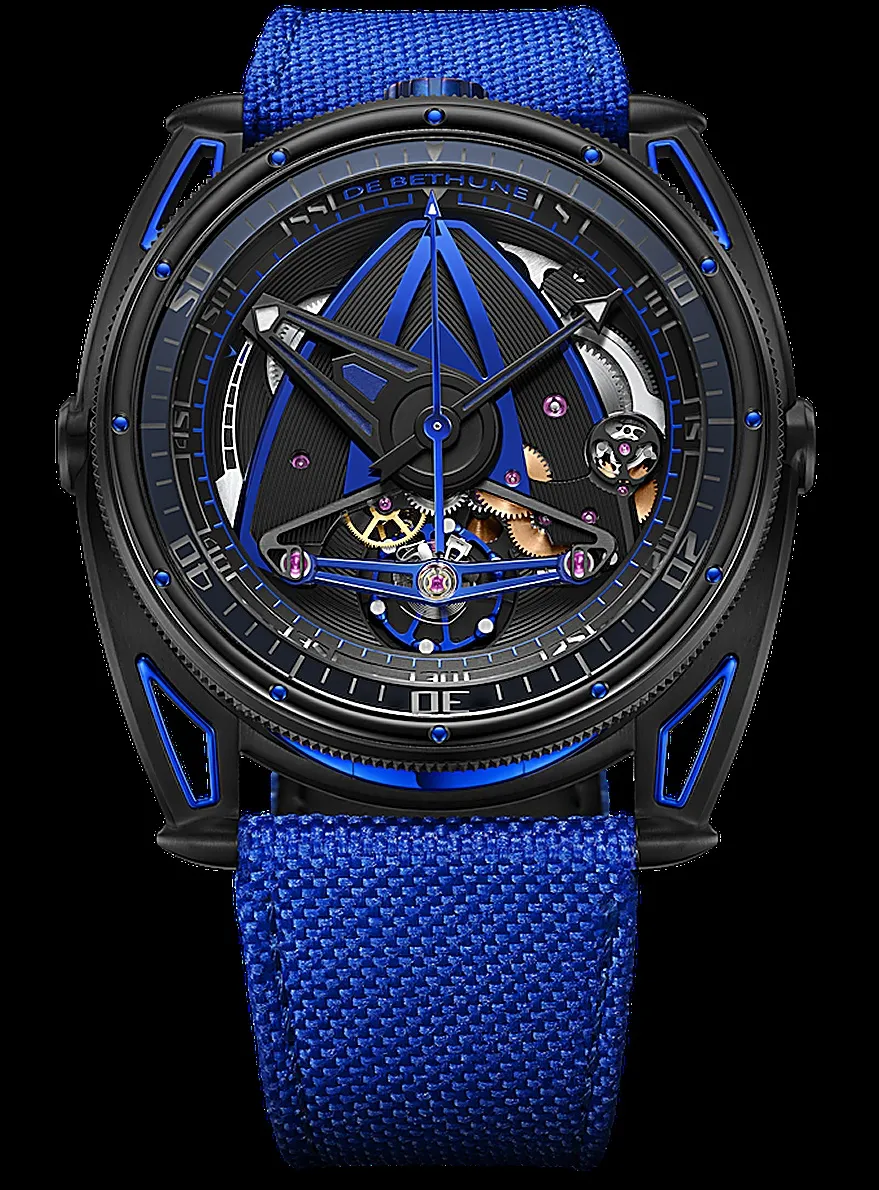
That blue delta rising from the middle of the open dial brings to mind the bill of a swordfish cutting water like a blade. De Bethune’s signature blue titanium is not obtained with paint; the metal is tempered in flame at high heat, and the thin oxide layer that forms on its surface refracts light into that colour. The blue is not something laid onto the metal. It is the metal itself, changed.
The case middle is black zirconium carrying a texture the house calls Microlight, while the bezel and the back are hardened steel. The diameter is forty-four millimetres and the thickness twelve point eight. The lugs are not fixed to the case; De Bethune’s floating-lug system, patented in 2006, works through blued grade five titanium inserts and absorbs the movement of the wrist instead of passing it to the case. The crystal is sapphire, hardened to eighteen hundred Vickers, with anti-reflective coating on both faces.
The minutes dial is satin-brushed black grade five titanium with its numerals cut straight out of it. The hour and minute hands are black titanium with luminescent tips; the seconds hand is polished and blued titanium. A small arc between nine and ten shows the force that is left.
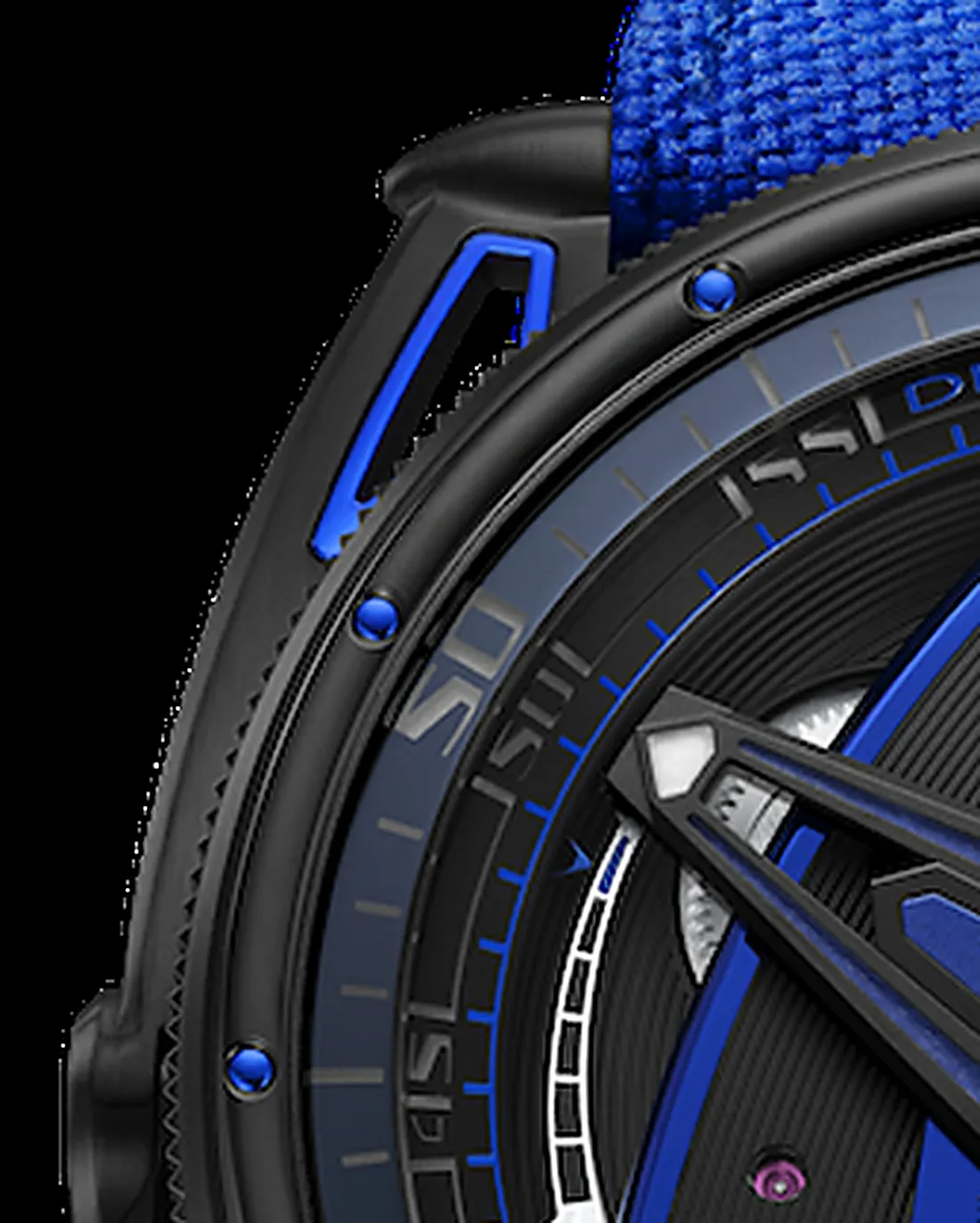
Calibre DB2080 is hand-wound and runs for five days. It draws its power not from one barrel but from two, coupled so that the pair regulates itself; De Bethune introduced that arrangement in 2004. The balance wheel is titanium with white gold weights set around its rim; keeping the light material in the centre and putting the heavy material at the edge works against changes in temperature and against the resistance of air alike. That wheel was patented in 2016.
The hairspring ends in the flat terminal curve De Bethune patented in 2006. The escape wheel is silicon. Against falls and knocks, the house’s triple pare-chute system, introduced in 2005, does the work.
Set all those parts side by side and what appears, like the channels in the skin of a fish, is an arrangement locked together to accomplish one task: to cut out the noise arriving from outside and leave only the information that is true.
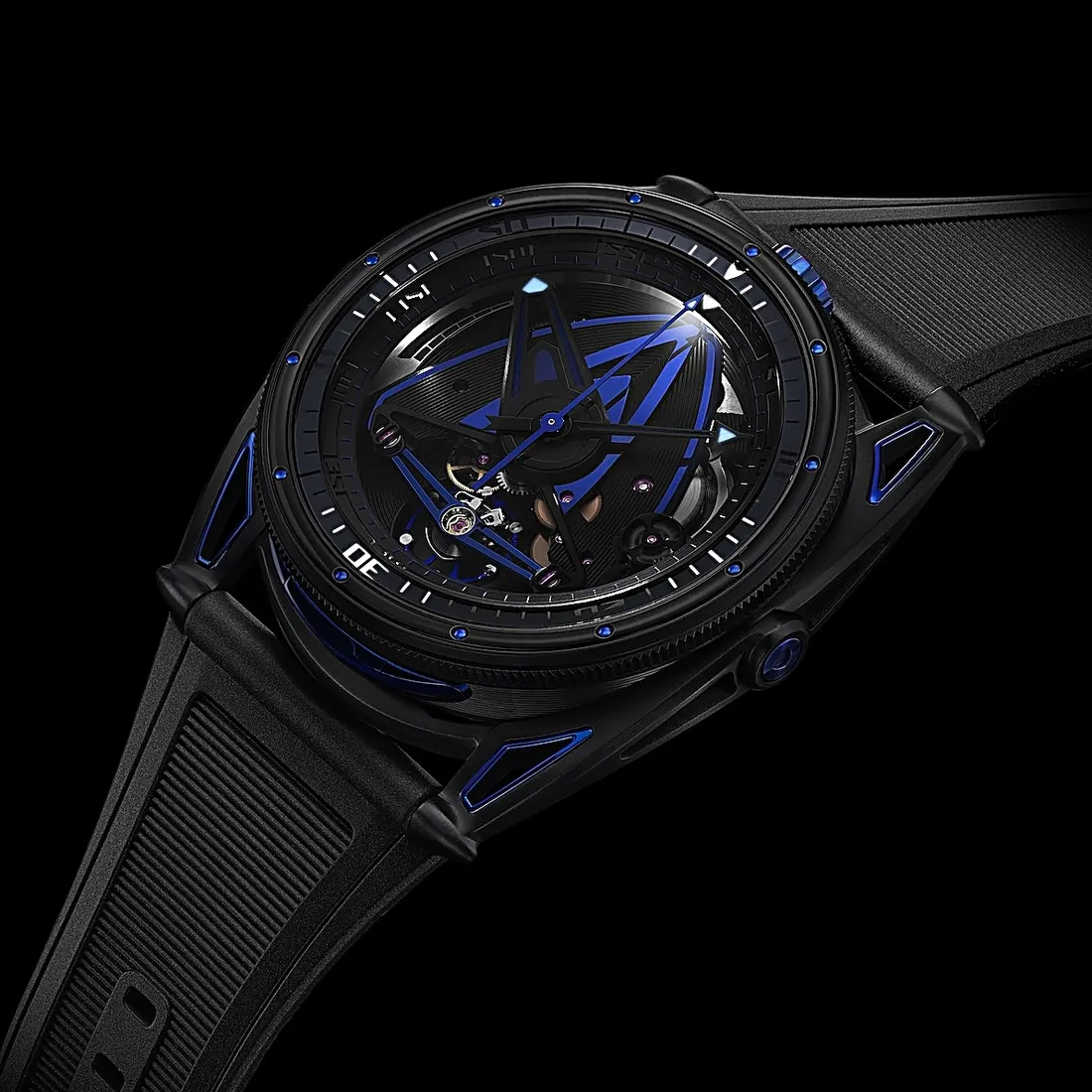
The De Bethune DB28GS Swordfish is not only an instrument for showing the time. It carries on your wrist the cellular precision of a blind fish that maps water at molecular level without needing light, the hydrodynamic power of the swordfish, and the blue soul of titanium tempered in flame.
The fish that lost its eye did not stay blind; it found another way of seeing. It did not invent that way. The measure was given to it. Inside a cave, with nobody watching, the Creator set into the skin of a living thing an arrangement fine enough to read the language of water, and then waited hundreds of thousands of years for a human being to notice it.
Every time you look at that deep blue delta on the dial, and at the balance swinging below it, you see not the seconds passing but the fact that light is not a condition of sight.
format_quote"The fish that lost its eye did not stay blind; it found another way of seeing."
Hasan Bekmezci
The watch on its maker’s own site: De Bethune, DB28GS Swordfish