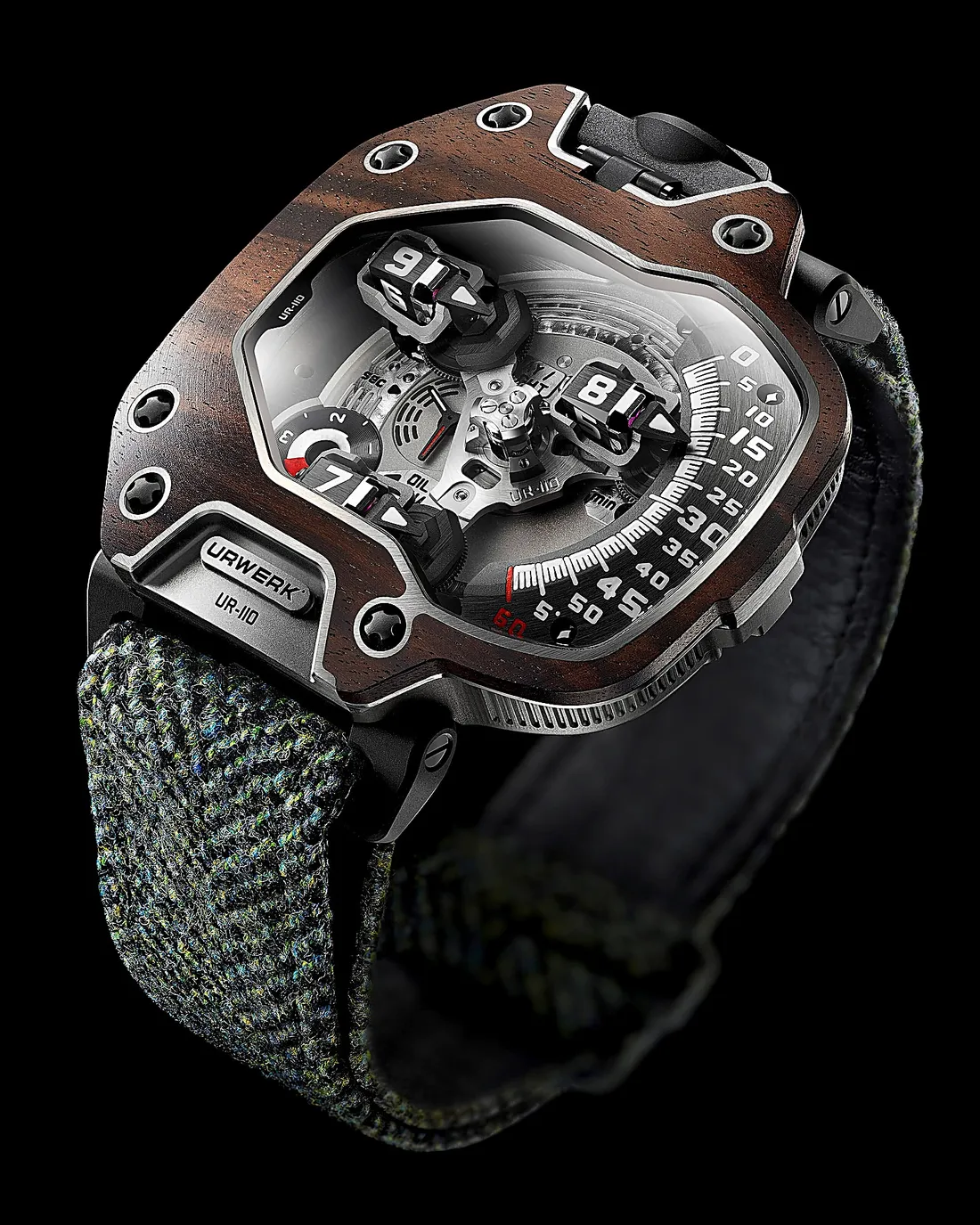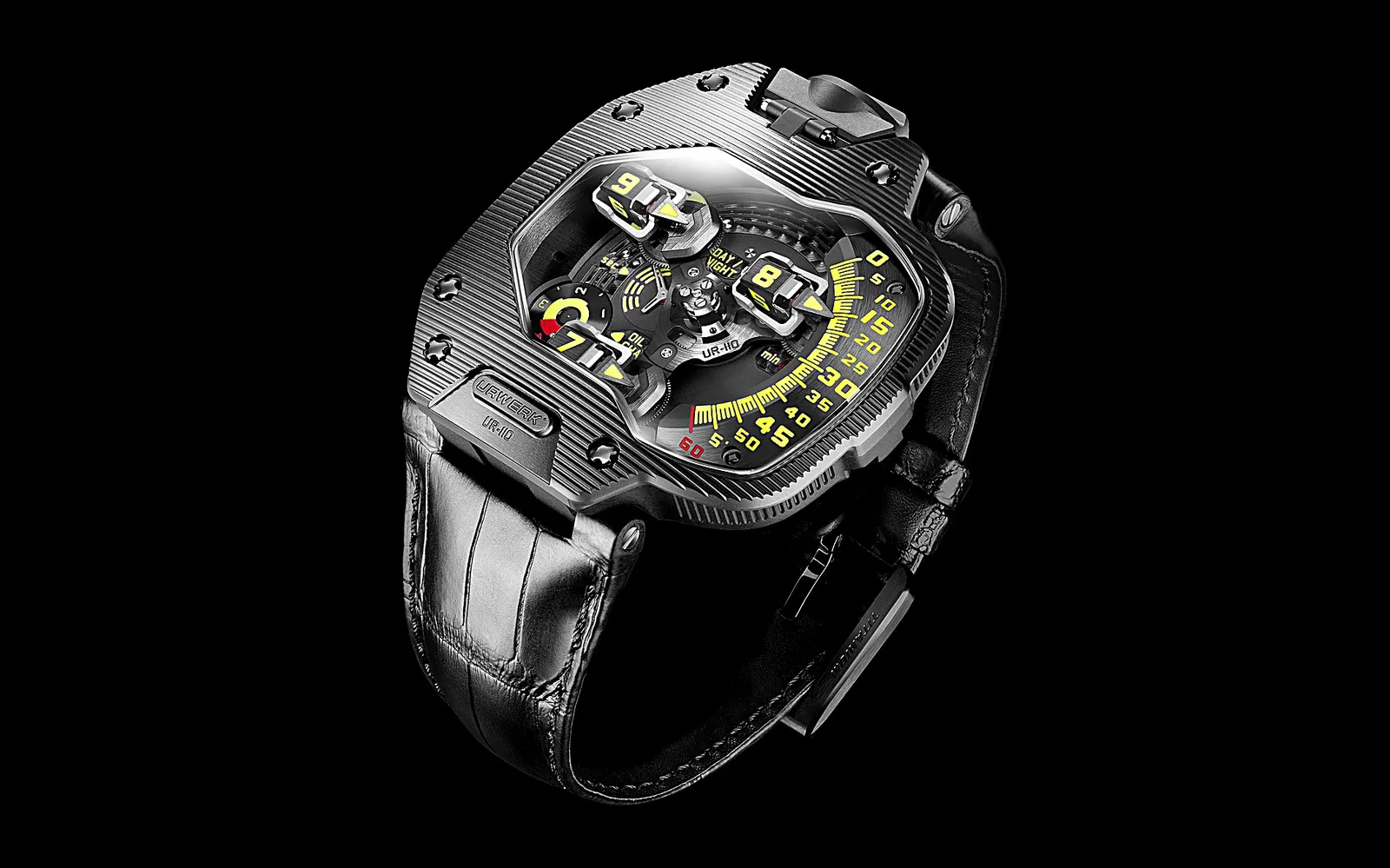
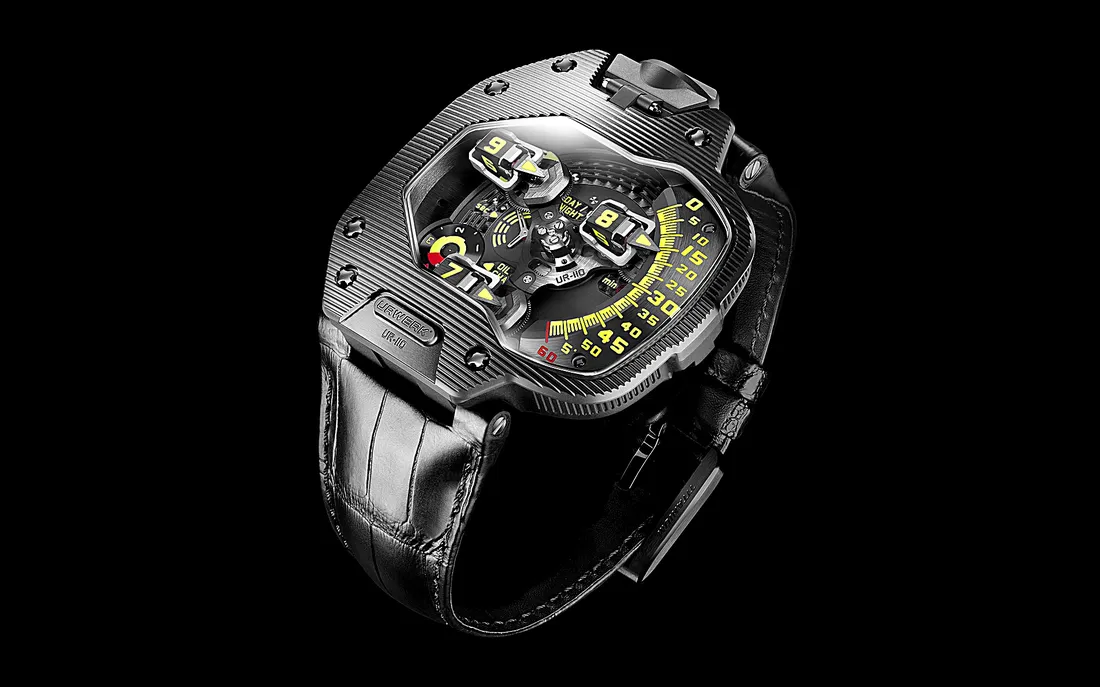
Reading the time is a small gesture in daily life, and most of us never notice making it. We turn the wrist inward, push back a shirt cuff if we must, and look at the dial. In a meeting, at the wheel or in the middle of a conversation, that movement is visible, and the person opposite usually catches it. In 2011 Urwerk treated this detail as a design problem and moved the time from the centre of the dial to the right edge of the case.
The result is a watch that can be read without turning the wrist. With your hand resting on a keyboard or holding a steering wheel, a vertical strip running down the right edge gives you the time. The 2011 Design Watch Prize of the Grand Prix d’Horlogerie de Genève went to that solution.
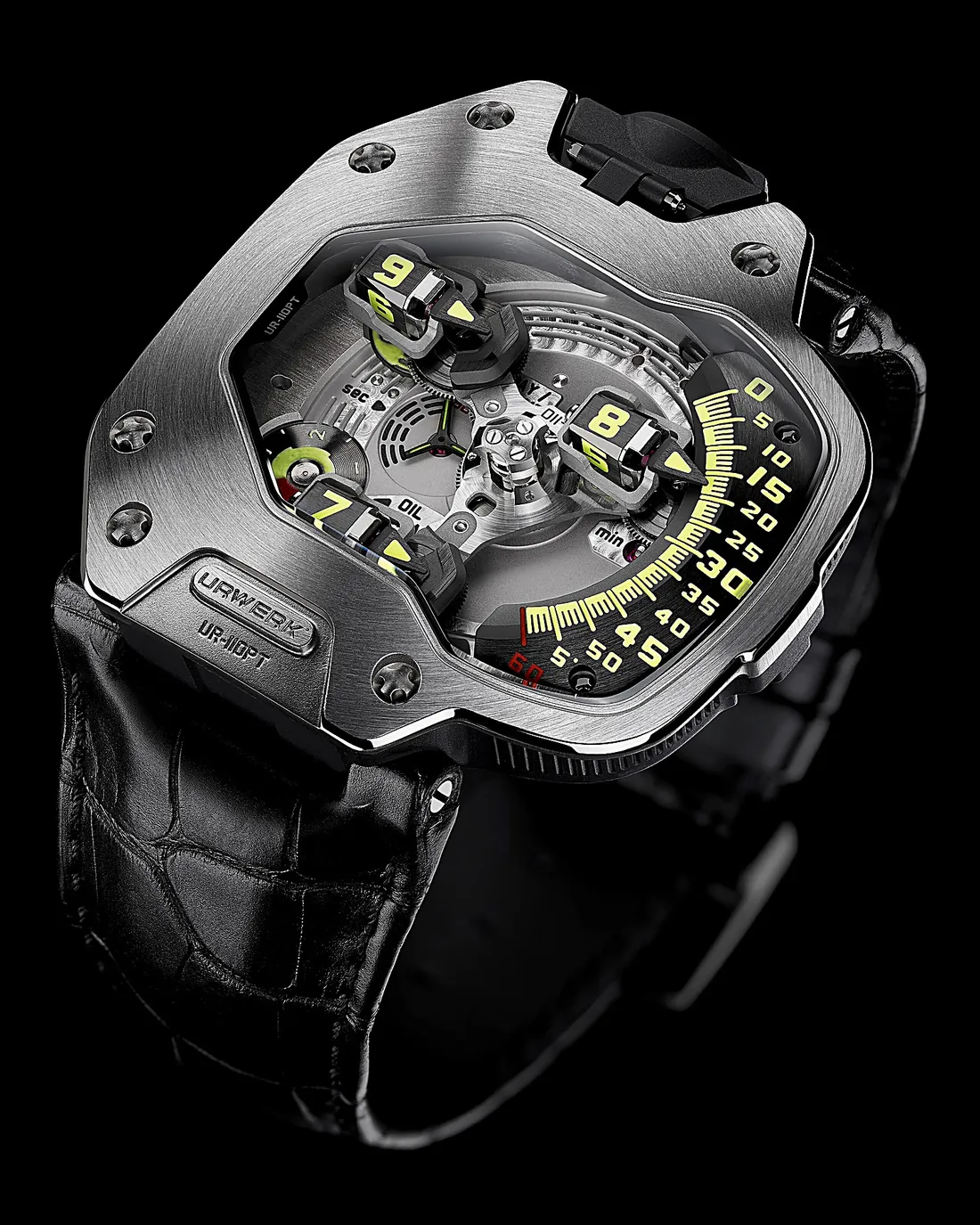
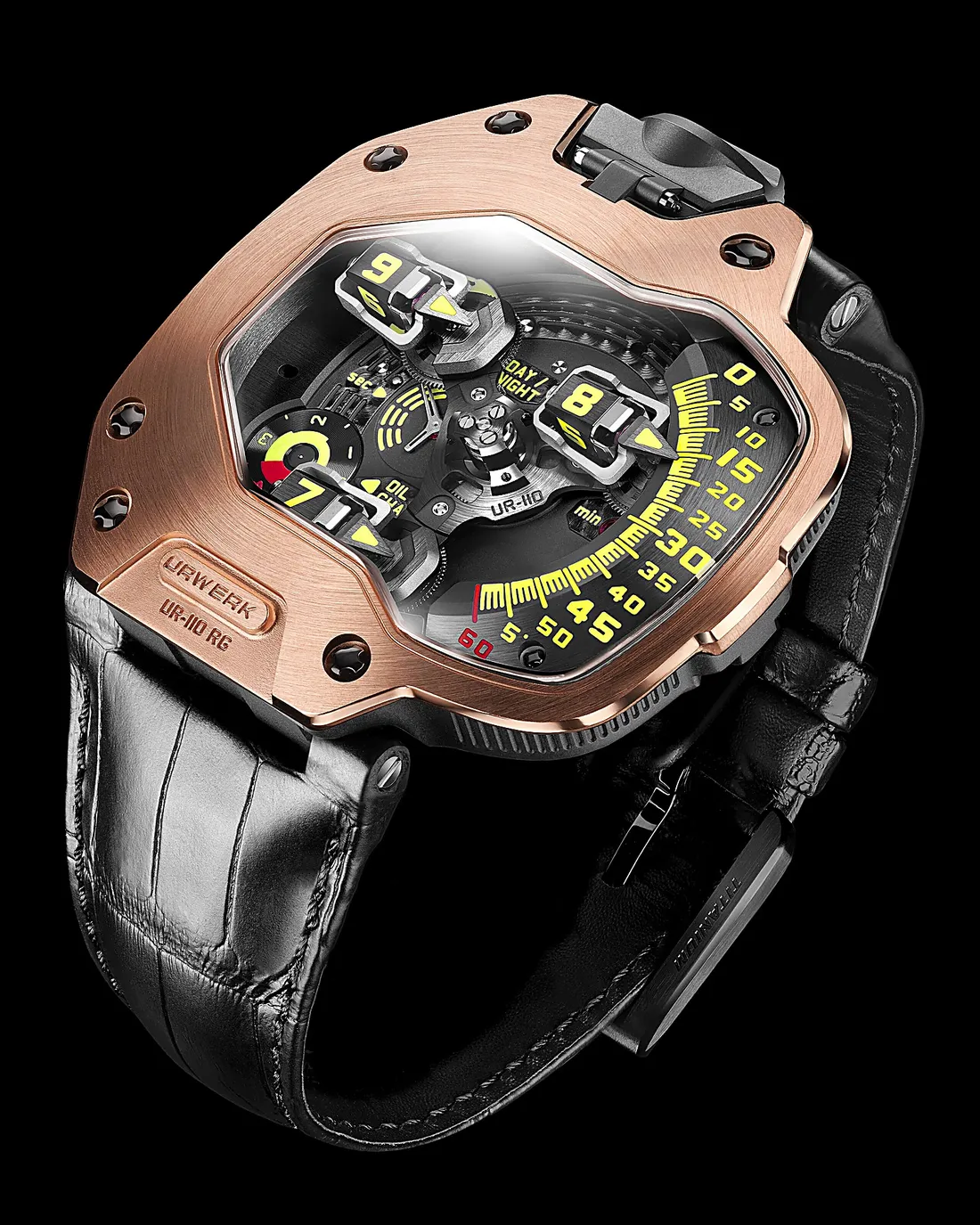
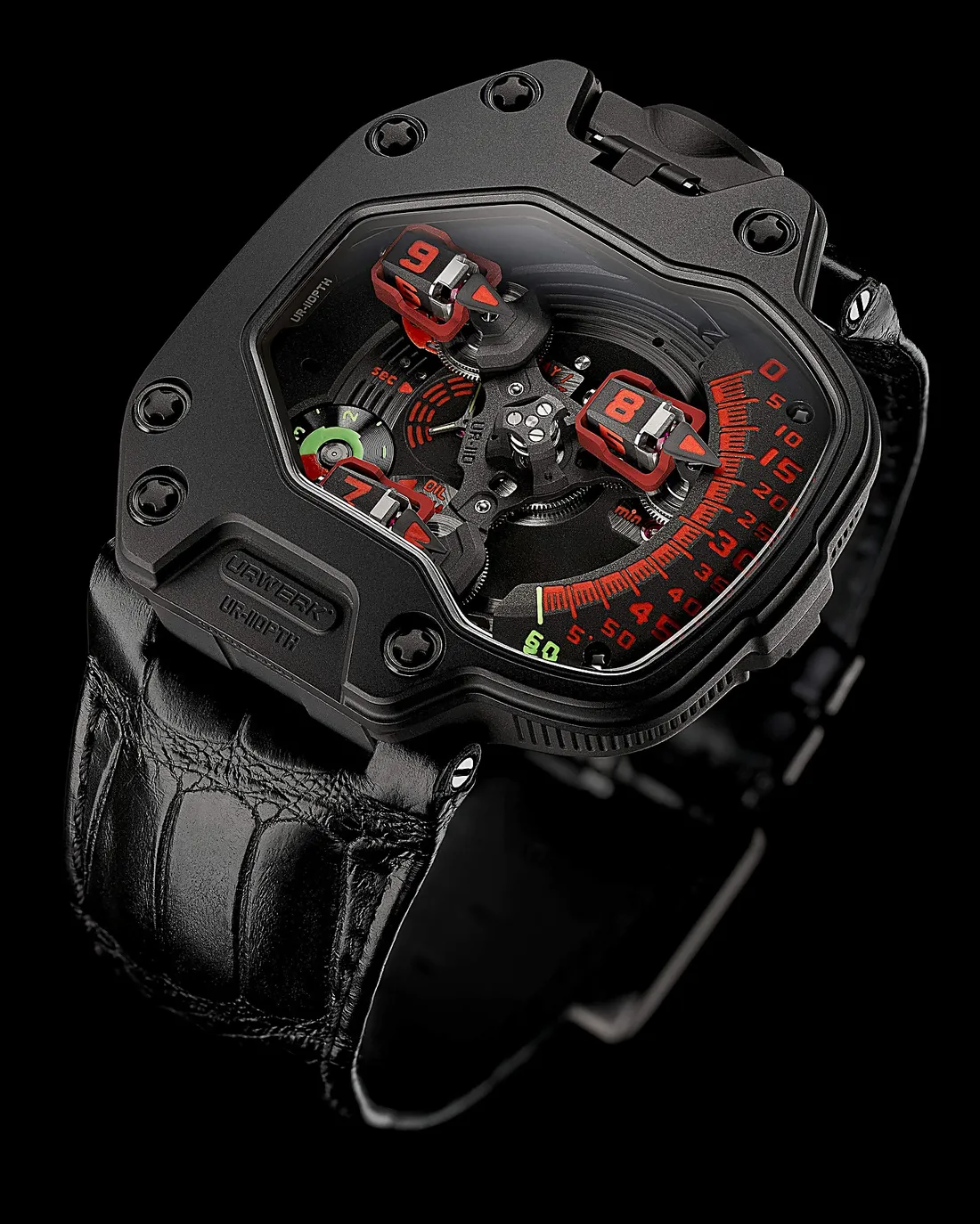
There is no hour hand on the dial, and no minute hand in the usual sense either. In their place are three arrow-shaped satellites. Each satellite carries an hour numeral. They trace an orbit inside the case and, when their turn comes, they enter the vertical strip on the right. That strip is a minute scale divided from zero to sixty. A satellite enters at the top, descends for sixty minutes, leaves at the edge as the hour ends, and the next numeral comes in from above.
Reading the time here, then, is not a matter of looking at the tip of a hand but of watching an object travel. Martin Frei, one of Urwerk’s founders, describes it as a journey and likens the effect to a velvet revolution: the difference between rotation and counter-rotation is invisible at first glance, everything looks normal, and yet nothing is.
format_quote"Urwerk does not offer you a way of reading the time. It offers you the passage of time to watch."
Hasan Bekmezci
Planetary gearing stands behind the arrangement, and it did not take its name from the sky by accident. At the centre of a planetary train sits a wheel called the sun, small wheels called planets turn around it, and a ring encloses them all. The planets both spin on their own axes and are carried around the sun. As with real celestial bodies, two motions happen at once.
And here a problem appears. Carry an object around a circle on an arm and, by the time it has completed the circle, it will also have turned once on its own axis. You can try it with a tray: walk a tray around a table and the writing on it turns upside down halfway and comes back at the end. In a satellite watch this cannot be allowed, because the numeral has to stand upright at every moment.
The remedy is to cancel the carrying motion exactly. While the carrier taking the satellite around turns clockwise, the satellite is turned on its own axis at precisely the same rate in the opposite direction. The two motions consume one another, and the numeral faces the reader squarely wherever it happens to be on its orbit.
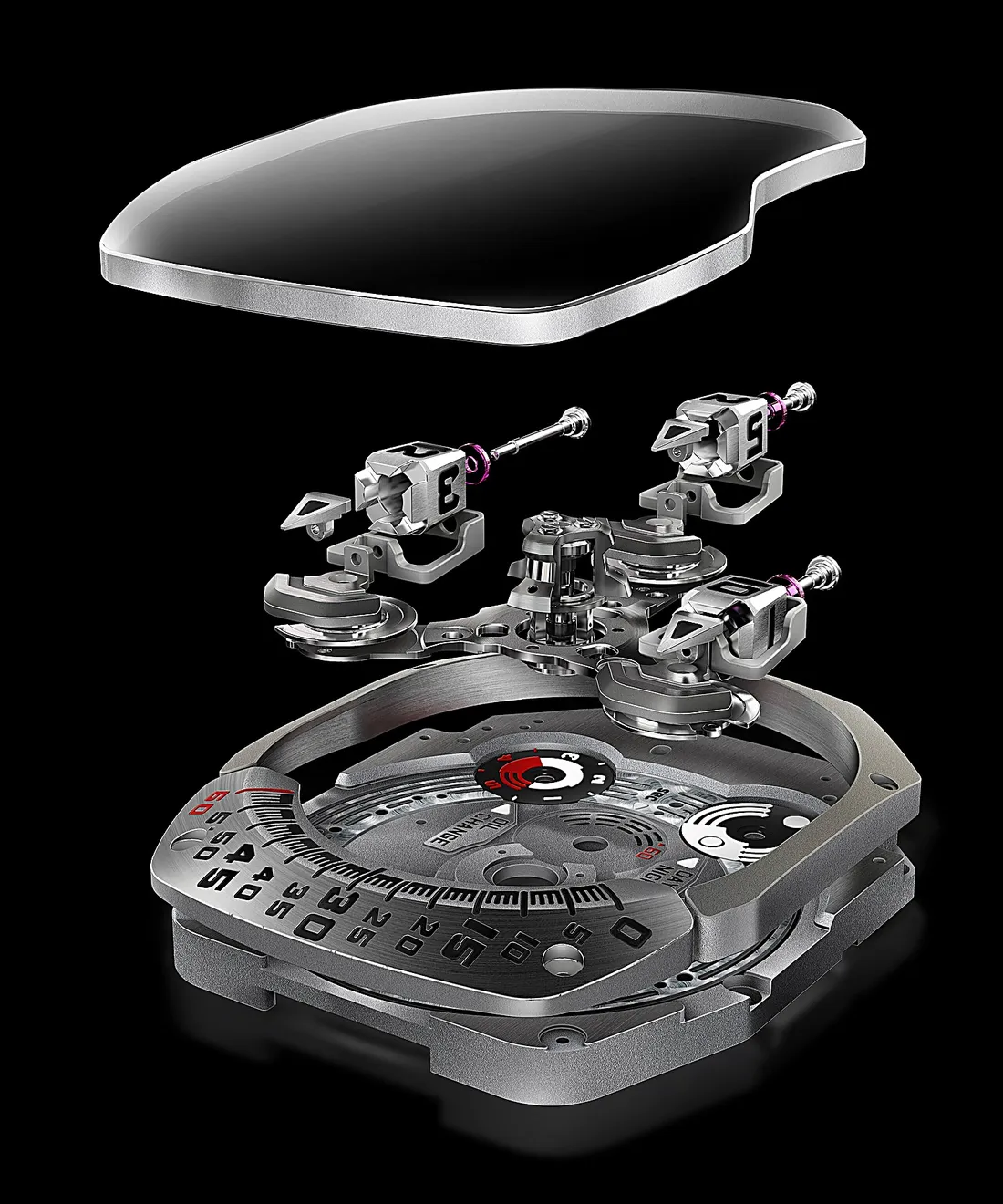
The architecture of the UR-110 builds that idea in three layers. At the bottom is a central carousel, and it provides the stability and balance of the whole assembly. Above it the planetary train works to keep the three hour satellites parallel to one another throughout the orbit. At the top sit three separate hour modules. Each holds an hour satellite, a minute hand and a counterweight; each is mounted on its own planetary gear; and all of them turn constantly against the direction of the central carousel.
The counterweight matters. If the centre of gravity of a turning part does not sit on its axis, a varying load falls on the mechanism with every revolution, and that load reports straight back to the accuracy. Giving each of the three modules a counterweight stops the assembly from disturbing itself as it turns.
format_quote"If you want a satellite to stay upright while you carry it around an orbit, you have to turn it against you at exactly the speed you are carrying it."
Hasan Bekmezci
Picture two people at the bench discussing this architecture: the constructor who calculates the gear train and the watchmaker who will assemble it.
The watchmaker objects first. Let us seat the three modules on ball bearings and cut the friction.
The constructor shakes his head. A ball bearing carries a clearance of its own. On a single module that clearance is invisible, but stack three modules and the clearances add up. Somewhere on the orbit the satellite will wander by a few hundredths of a millimetre, its alignment will slip as it crosses the minute scale, and the numeral you read will no longer match the scale beside it.
So what is the alternative, the watchmaker asks.
The constructor’s answer is radical. Instead of ball bearings we use a single fixed axis running the entire height of the watch. The whole complication is balanced on that axis. Friction rises a little, but rigidity goes to its maximum and play to its minimum.
Describing the development, Urwerk’s founding watchmaker Felix Baumgartner reports exactly this choice. The team spent close to two years looking for the best architecture to support the central carousel and the rotating hour modules, and settled in the end on a solution unlike any of their other creations: instead of ball bearings, a fixed axis running the full height of the watch.
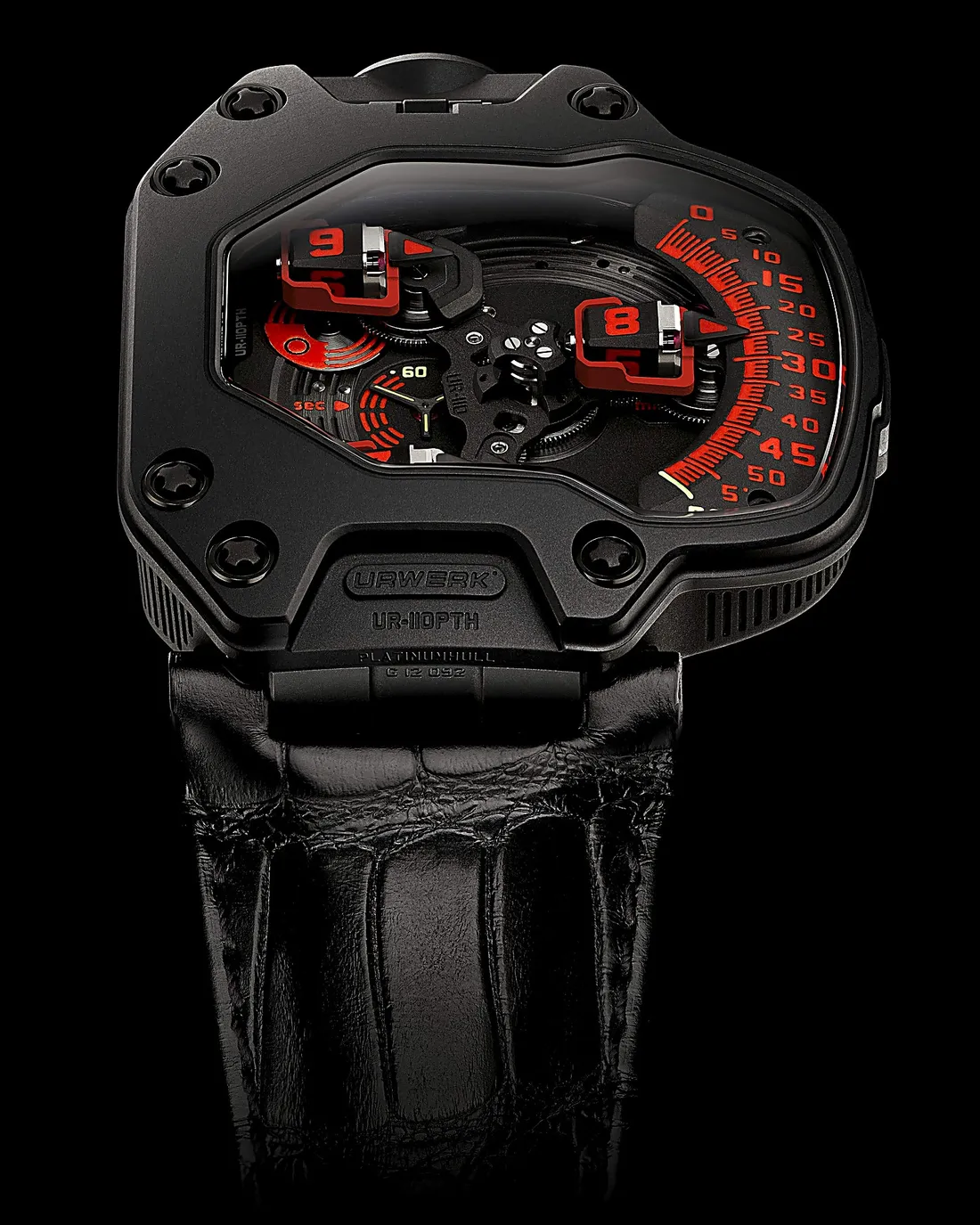
The upper part of the dial carries what Urwerk calls the control board. Three readings live there: a small seconds, an indicator separating day from night, and an oil change indicator. The last of those sounds odd the first time you hear it, and yet it is a rare piece of honesty in watchmaking.
Every mechanical watch runs on oil, and no oil is permanent. In time it thins, collects dust, creeps into corners and begins to raise friction rather than lower it. The industry habit is to say nothing about this to the owner and to leave maintenance as a matter for after-sales service. Urwerk instead put an indicator counting the movement’s running time onto the dial. The watch shows you its own wear.
format_quote"A service indicator is the admission of a flaw, and in watchmaking honesty usually looks exactly like that."
Hasan Bekmezci
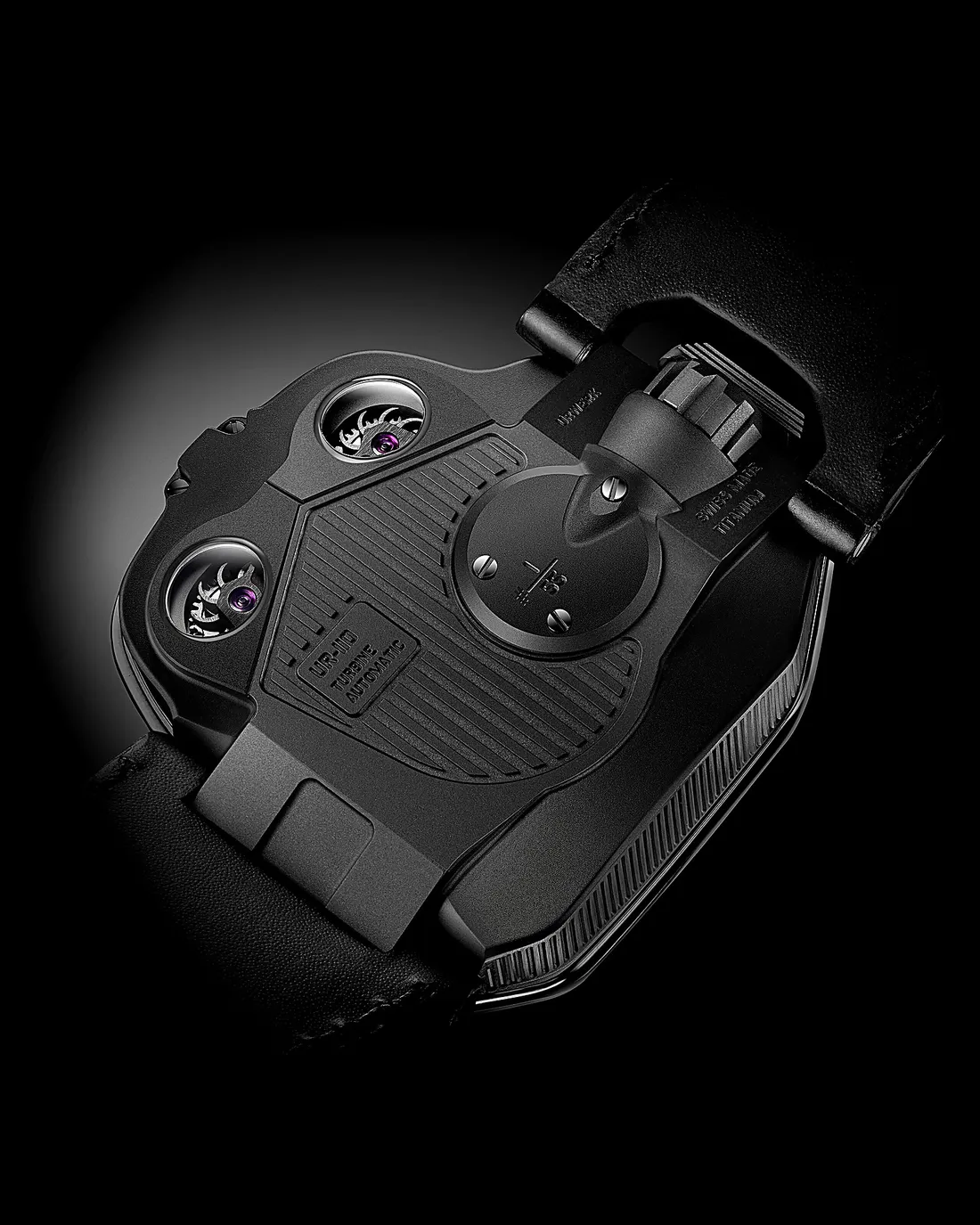
Two turbines sit at the back, and they are there to cut wear in the automatic winding. The logic runs as follows. In an automatic watch the rotor is flung around by every movement of the arm. On a quiet day that is no problem, but on the wrist of someone playing tennis or swinging a hammer the rotor reaches very high speeds and strains the winding wheels for no purpose. The turbines brake the rotor by making it work against air. Because air resistance climbs steeply with speed, the turbine offers almost no resistance during slow movements and comes into play during violent ones. The brake, in other words, regulates itself.
The case is titanium, forty-seven by fifty-one millimetres and sixteen deep. The figures look large, but titanium keeps the weight down and the asymmetrical body settles onto the wrist rather than overhanging it. Water resistance is thirty metres. The movement winds automatically, beats at four oscillations a second and runs for thirty-nine hours. A wide panoramic sapphire crystal lets you follow all of this motion.
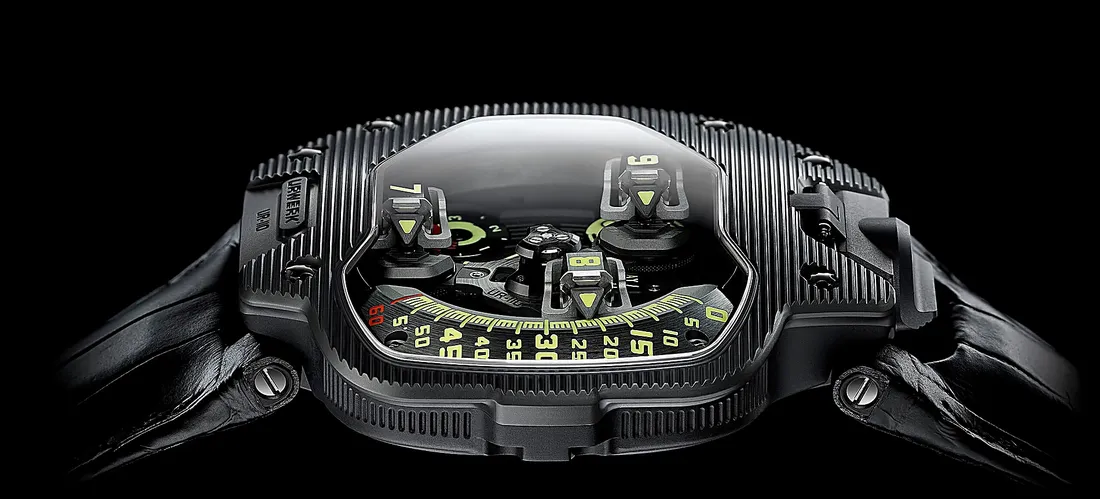
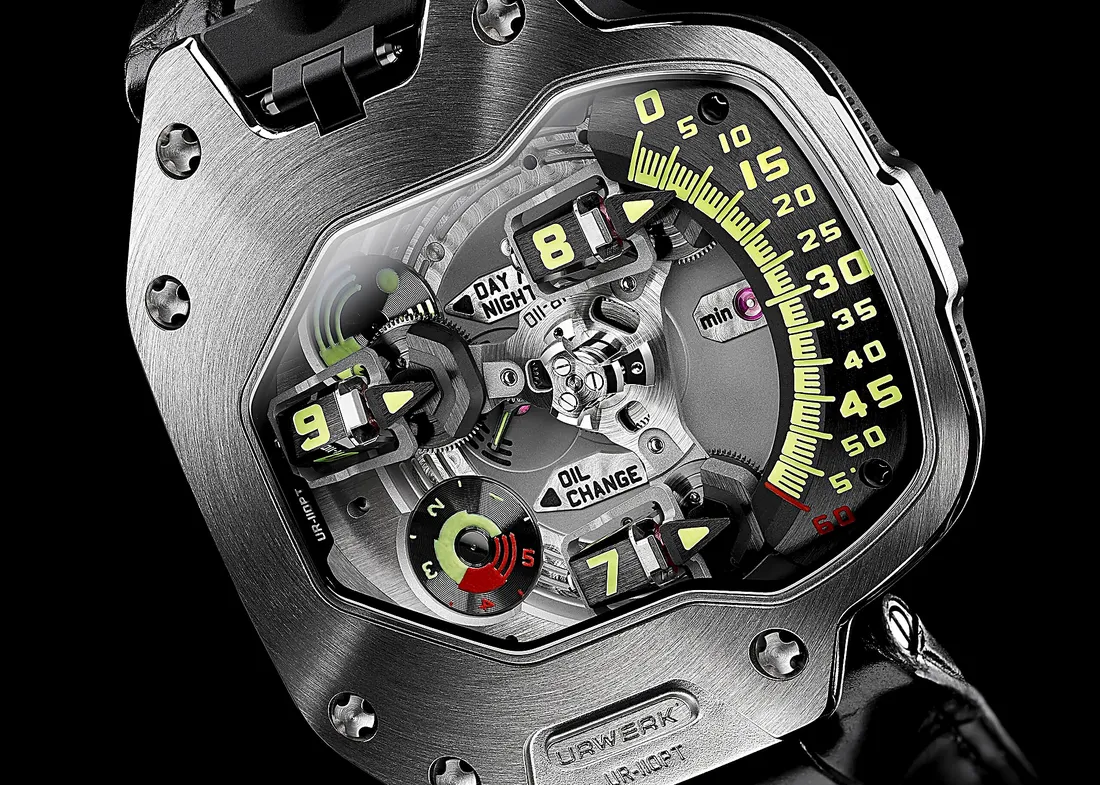
When the UR-110 was launched its price was eighty-seven thousand Swiss francs. Urwerk no longer makes it; the brand gathers pieces of this kind in its own archive under the name UR-LEGENDS and keeps its discontinued work there. What makes a watch a legend is usually not that few were made. It is that an idea was set out complete for the first time.
Look at this watch for long enough and you notice something. We are used to thinking of time as a straight line. The past behind, the future ahead, and the distance between them travelling one way like an arrow. Yet everything we use to measure time is in fact a turn. A day is one rotation of the Earth on its axis. A month is one circuit of the moon around the Earth. A year is one circuit of the Earth around the sun. Every unit we hold has been taken from a motion that returns.
What Urwerk did was put that fact back on the dial. On the UR-110 the hour does not advance along a line; it turns on an orbit. The satellite disappears at the end of the strip and, after a while, enters again from above. This is the oldest lesson people took from the sky: everything measurable returns, and the one thing that does not return is the person watching those returns. That is what is worth remembering while the little satellites turn on your wrist. It is not the mechanism that is counted, but the eye looking at it.