As the air pressed from the leather of the bellows filled the breast of the embers, the dim workshop lit up with a downpour of sparks. The heat had reached an unbearable degree; the yellow-red light rising from the hearth made the beads of sweat running from the brows of Master Davut and his apprentice Yusuf glitter like so many diamonds. The steel, held glowing in the tongs, was laid on the anvil. The master raised his heavy hammer, the apprentice came into the rhythm with his own:
Clang! Clang! Clang!
As the hammer blows tore the cold silence of bronze and steel, the tension in the muscles and the sweat pouring off them cleansed both men’s minds of mortal worries and left in their place a deep mental discharge. Master Davut looked at the curling of the glowing steel and smiled:
“Look, Yusuf. Heraclitus did not say it for nothing: fire is the principle of everything, and the only thing that does not change is change itself. Look at the embers in the breast of that hearth. Matter does not stay in one form; it melts, it transforms, it flows. Time too, just like this fire, flows by burning and transforming everything.”
Yusuf brought his hammer down on the anvil without breaking the rhythm:
“Quite right, Master! Exactly as Aristotle says in his teaching of Matter and Form. That shapeless steel on the anvil is only a potential. With the design in your mind and the hammer blow you are about to strike, that steel arrives at actuality, at its final form. But one has to ask: what is the first force that moves us, who give form to that piece of steel, that moves the muscles that move us and sets the mind in motion? Without that Unmoved Mover Aristotle speaks of, could a single atom in this universe stir from its place?”
Master Davut held his hammer in the air for a moment and, looking at the smoking steel, added the deep wisdom of Plotinus:
“What emanates from that Unmoved Mover is the incomparable order and beauty that overflows from the One Plotinus pointed to, Yusuf. No movement in the universe is a coincidence; beauty and order spread from that Infinite One through the cosmos in waves, in harmony. What falls to us is to keep the rhythm of that harmony.”
Yusuf wiped his sweat with the back of his arm and, smiling, supported his master:
“Did not Ibn Sina, the giant of Islamic philosophy, set his seal on exactly this truth, Master? He calls it Vacib-ul Vucud, the Necessarily Existent. All these possible beings that need another in order to exist; the hammer, the anvil, the fire and ourselves. We all owe our existence to the cosmic order of that Necessary Being.”
At precisely this point Master Davut raised the glowing steel held in the tongs towards the light and opened a door from philosophy onto the immense physics of the universe:
“Look at the physical laws that Necessary Being has laid down, Yusuf. For years we took the iron we put on this anvil and beat for an ordinary mineral, dug out of the breast of the very soil we stand on. And yet we have learned that neither the heat nor the pressure of the Earth is enough to form a single atom of iron! Iron is cooked in the cores of giant stars many times larger than the Sun, at hellish temperatures of billions of degrees; and when that star completes its life and detonates in an enormous supernova explosion, it is scattered to the four corners of the universe. So the iron we are beating is a cosmic guest sent down to Earth out of the void of space, from the heart of collapsing stars!”

Yusuf listened to his master with his eyes widening at the astrophysical truth he was hearing:
“My mind is about to stop, Master! Indeed the Holy Book points to exactly this cosmic phenomenon when it says, And We sent down iron. It does not say created, nor extracted; it says sent down, almost like an interstellar shipment. What is more, iron’s atomic number in the periodic table is 26. In the Holy Book, the name of the section that carries the name Iron, read by the numerical value of its letters, gives exactly 26; read together with the definite article at its head, it gives 57. The place of that section within the text is 57 as well, and so is the mass number of one of iron’s known isotopes. The physics of an atom cooked in the core of a star and the mathematics of the Sacred Text meet in the same divine alignment!”
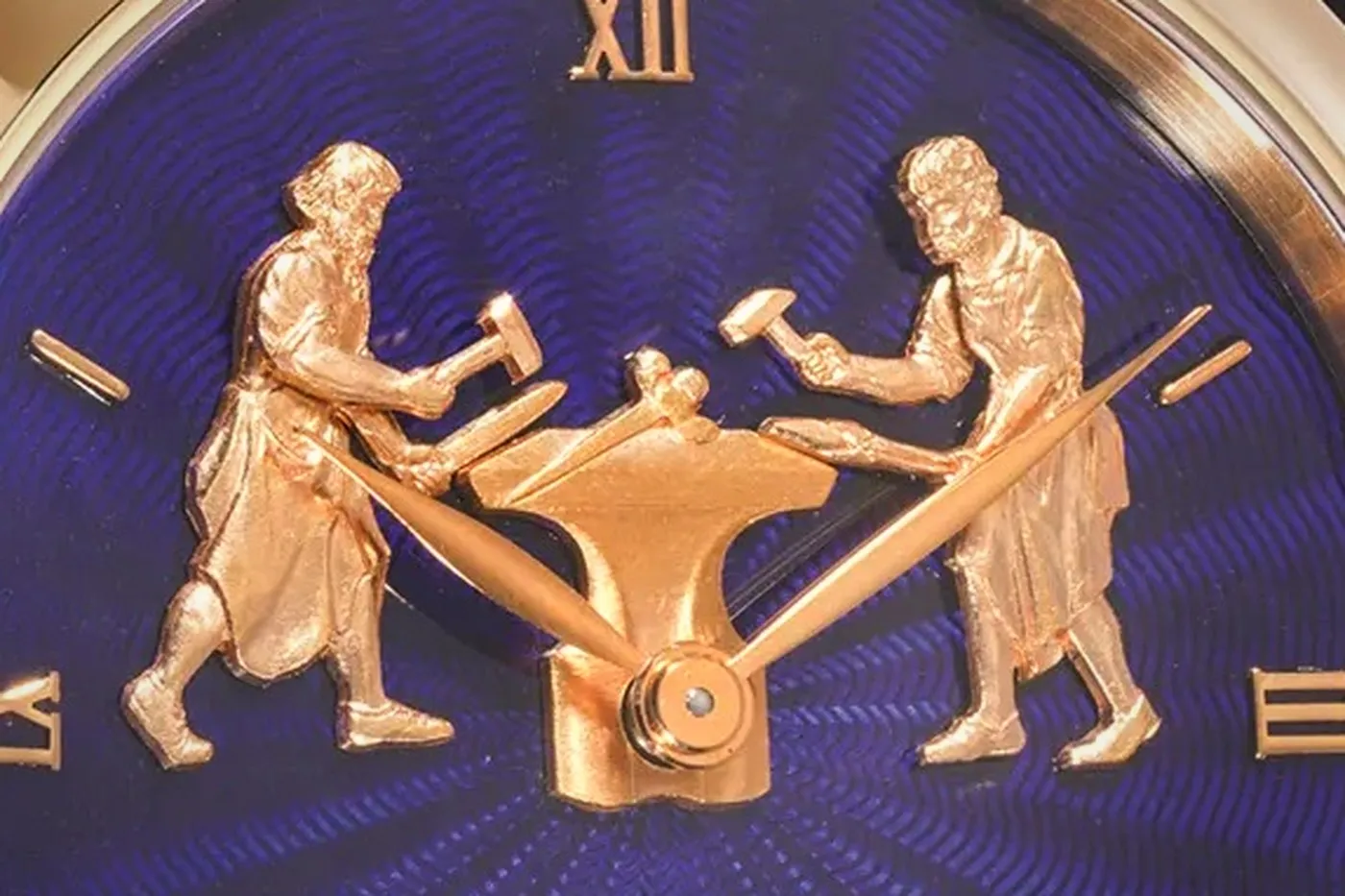
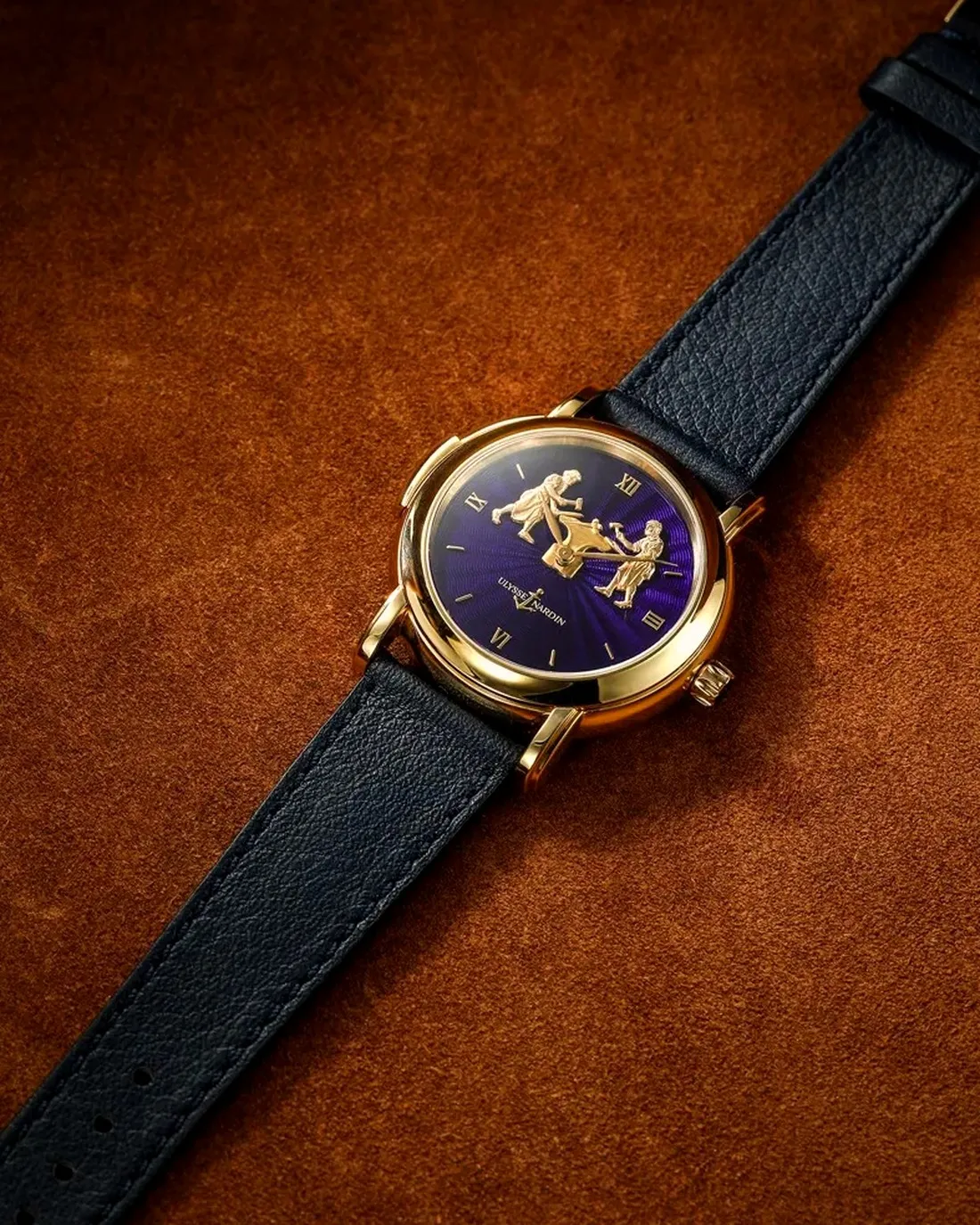
While both of them arrived at a deep station of astonishment before this immense physical and mathematical order, the watch resting in the velvet box at the edge of the bench, glimmering in the yellow light of the gas lamp like a deep blue ocean, came to life. This was the Ulysse Nardin Hourstriker Jaquemarts Forgerons, a masterpiece with its handmade blue enamel dial. The striking mechanism inside the watch engaged; the two hand-worked miniature blacksmith figures on the dial began to raise and bring down the hammers in their hands in perfect time with the ringing of the steel gong inside the watch: Clang! Clang! Clang!
format_quote"A complication tells you the time. This dial shows you the labour the time arrived by: two men, two hammers, one rhythm."
Hasan Bekmezci
Master and apprentice were left breathless before this spellbinding display of automata on the dial, which imitated their own movements and their own act of forging iron exactly. Pointing at the watch, the master went on:
“Look at that dial, Yusuf. Two blacksmiths bring their hammers down at exactly the right moment, on the order of the hidden mechanism behind the wheels. Spinoza’s principle of Deus sive Natura is alive on this dial! The universe and nature are one magnificent mechanism of a single infinite substance, working flawlessly, without deviation, tick by tick. The explosion of the supernova and the chime of the watch are both the result of that single order.”
Yusuf’s eyes shone as he listened to that silvery sound of crystal clarity coming from inside the watch:
“And Leibniz’s Pre-established Harmony! Did Leibniz not give the clock as his very example, Master? Think of two clocks that never touch one another and yet are wound so flawlessly by the Great Architect of the Universe that they chime together in the same second. The striking of these automata on the dial and the turning of the stars in space are the resonance of that same Pre-established Harmony!”
Master Davut dropped the glowing iron into the wooden bucket full of water: Tssssss! Behind the rising white steam both of them reached a high station of contemplation and wonder:
“This is why Immanuel Kant said his famous words, Yusuf: the starry sky above me and the moral law within me. The thing called time is not merely a watch; as Kant said, it is an a priori form of intuition of our mind. As we beat the iron that came down from the stars, it is thanks to that divine architecture in our minds that we grasp the order of the universe and fall into an infinite astonishment.”
Watching the steel unite with the water and take the form of a flawless sword, Yusuf tied the last link:
“And finally Hegel’s dialectic takes flesh and bone on exactly this anvil, Master! The thesis is the unruly iron that came down from the breast of a star, the antithesis is our hammer blows that bridle it; and the synthesis born of the hard struggle between the two is this steel taking form! The Absolute Spirit realises itself in the flow of time in just this way, through action, through reason and through art.”
format_quote"Iron cooked in the core of a star, steel taking form on an anvil, and a gong ringing on a dial: all three are the same order at three different scales."
Hasan Bekmezci
As the steam and smoke in the workshop dispersed, the two blacksmiths on the blue enamel dial of the Ulysse Nardin brought down their last hammer blow. Master and apprentice, drenched in sweat but with their souls washed by the understanding of iron come down from supernovae and of the immense order of the universe, sank into a deep silence in that lofty station of wonder.
The Craft and the Technical Detail
The architecture of a jaquemart automaton. Jaquemart takes its name from the human-shaped figures on medieval bell towers; the Jacquemart of Dijon, which has struck the hour bell since 1383, is the best known example of the tradition. Doing the same job inside a wristwatch means transferring the movement of the arm that produces the sound to the arm of the figure: the figure is not an independent ornament, it is the lever at the end of the hammer arm. That is why there is no lag between sound and movement; the figure’s arm falls at the instant the hammer touches the gong. Ulysse Nardin first fitted this into a wristwatch in 1989 and signed the first jaquemart striking wristwatch. The generations that followed worked from two motifs: the two bell strikers of the San Marco campanile, and the two blacksmiths at the anvil, the forgerons.
The difference between an hourstriker and a minute repeater. These two complications are constantly confused, but they are not the same thing. An hourstriker belongs to the family the French call sonnerie au passage: like a wound striking clock, without you doing anything, it sounds the count of the hour on the hour and a single stroke on the half hour. A minute repeater, by contrast, makes no sound at all by itself; only when you pull the slide does it tell you the hours, the quarters and the minutes in separate tones. Ulysse Nardin’s jaquemart family was produced in both forms. In the repeater version the movement is distributed like this: striking the hours, the left figure moves; striking the quarters, both figures move together; striking the minutes, the right figure brings its arm down. Which means you can read the time off the dial without hearing a thing.
Gong, hammer and the silence setting. The sound comes from a hardened steel wire coiled like a spiral around the movement inside the case; the hammer strikes this wire, the wire vibrates, and the vibration passes into the case and from there into the air. The tone is set by the wire’s section, its length and its hardness; the case works as a resonator, like the body of a guitar. That is why a heavy case such as platinum sounds more muted and gold sounds brighter. In the Hourstriker family a pusher on the side of the case, with an indicator hand tied to it, puts the mechanism into its on or silent position; being able to shut the sound off before walking into a meeting is the most necessary detail of a striking watch in daily use.
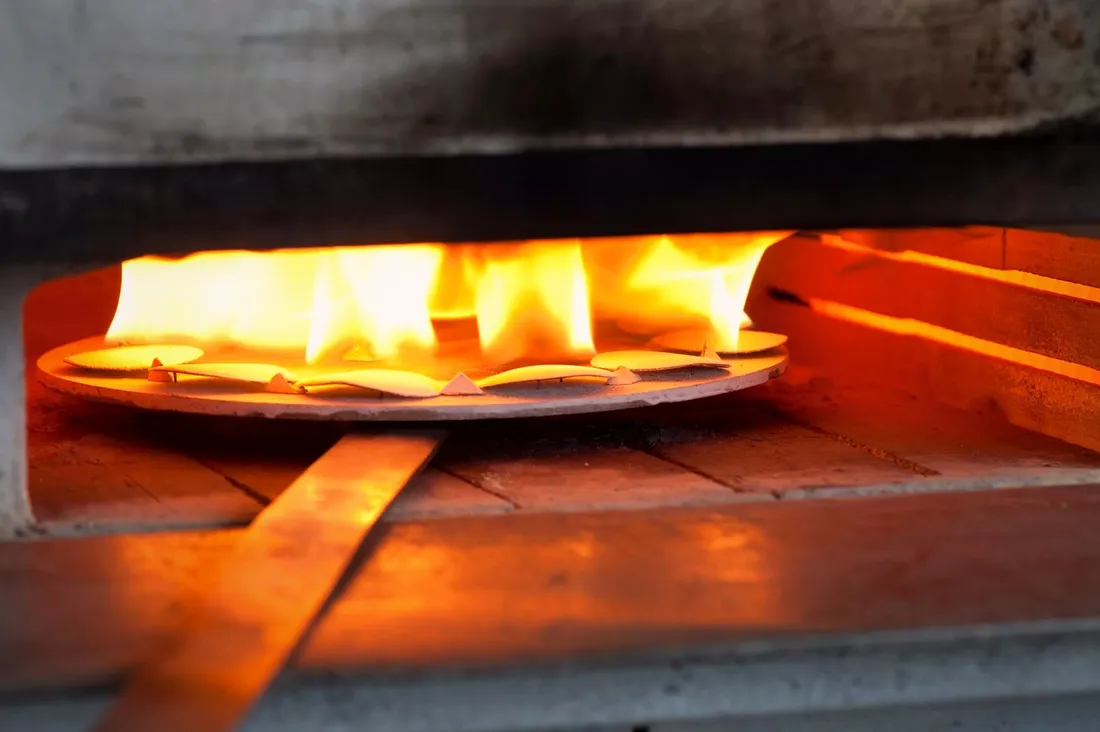
The real name of an enamel dial. The blue of this dial is not paint, it is glass. Enamel powder is mixed with water, spread on a metal plate and fired in a kiln at over eight hundred degrees; the process is repeated layer by layer, each layer fired again. That the sunburst pattern on the dial can be read through the enamel also gives the technique its name: the metal is first patterned on a guilloché lathe, translucent enamel is poured over it, and the pattern shows from the depth of the enamel. This is called flinqué. Champlevé is different: there, cells are cut into the metal, the enamel fills those cells, and the surface is levelled. In cloisonné the outlines of the design are woven with fine gold wires. In 2011 Ulysse Nardin bought Donzé Cadrans, the enamel workshop in Le Locle, and brought all three techniques under its own roof; founded in 1972, that workshop is today one of the most valuable enamel addresses in the industry.
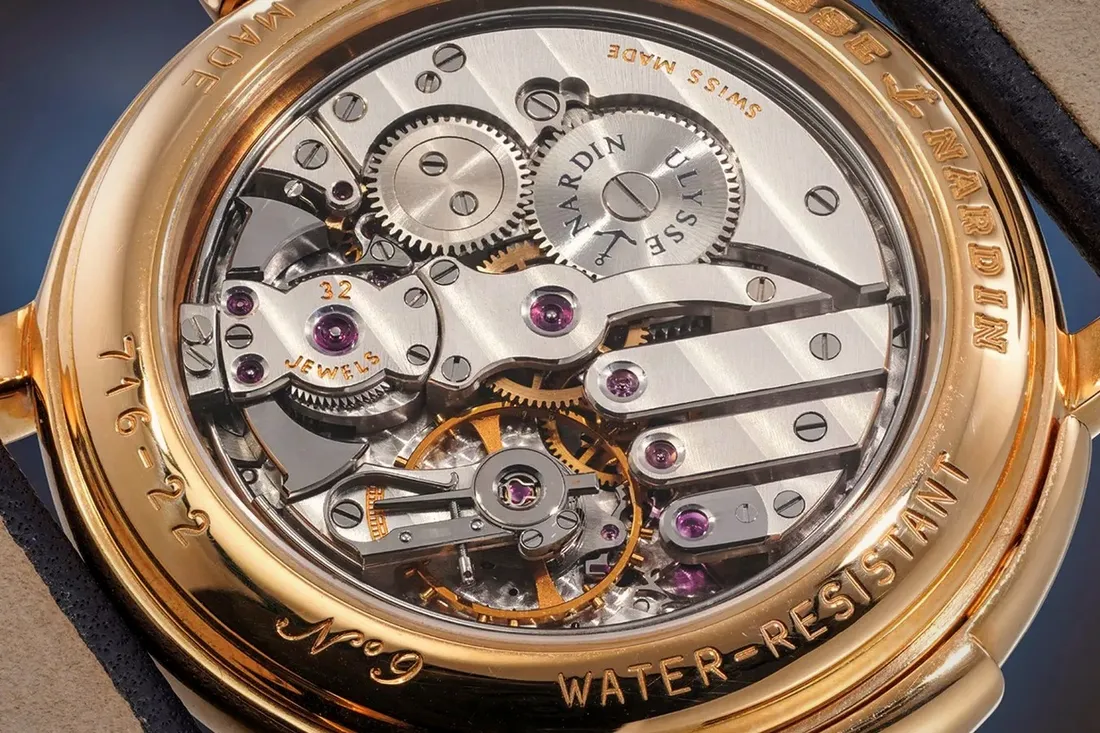
Case and calibre. The jaquemart minute repeater generation was produced in a 38.5 millimetre San Marco case, in platinum and in 18 carat gold, with a hand-wound calibre; the piece in the case back photograph above is the gold-cased reference 716-22, copy number nine, with 32 jewels. The Hourstriker generation went up to 42 millimetres, uses the self-winding UN-610 calibre and its 42-hour power reserve, closes with a sapphire case back, and its dial figures are made of 18 carat gold. The real difference between the two generations is neither size nor winding: one waits for you to give the order, the other announces the time of its own accord.