The name of this coast is not old. The strip between Cassis and Menton was given the name it carries today by a book published in 1887. Its author was a lawyer and poet called Stéphen Liégeard, who came from the country around Dijon, where the department is called the Côte-d’Or. He applied the same formula to the Mediterranean shore and called it the Côte d’Azur.
So this coast bears the name of a colour, and it was given that name by a man missing his own province. People now travel from everywhere to see the colour.
Why is it that colour?
The common answer is wrong. The sea is not blue because it reflects the sky. Reflection plays a part, but the main cause is the water itself.
Water is not a colourless liquid. The vibrations of the bond between oxygen and hydrogen absorb energy at the red end of the spectrum. The consequence is simple: an effect invisible in a glass becomes obvious in a column several metres deep. Red is largely gone in the first five metres, orange by about ten, yellow by twenty, green by thirty. Blue remains, because blue is absorbed least and can scatter back out of the column.
The blue of the sea is therefore not the light that returns. It is the hole left by the light that does not.
format_quote"The blue of the sea is not the light that comes back. It is the gap left by the light that never does."
Hasan Bekmezci
There is a second reason this particular coast is so saturated, and it is not a flattering one.
The Mediterranean is a nutrient-poor sea. In summer especially, the surface layer holds very little nitrogen and phosphorus, which means very little phytoplankton. Less plankton means less chlorophyll, and less chlorophyll means none of the cloudy green cast that comes with it. The greenish, weed-rich, living colour of the northern seas comes from abundance. The crystalline blue of the Mediterranean is a sign of poverty.
The continental shelf here is also unusually narrow. Just off Nice the sea drops away fast, and a kilometre out the bottom already lies hundreds of metres down. No pale sand reflects back into the picture, and deep water brings its colour right up to the shore.
Put those together and you get clear, deep, hungry water. The blue we admire most is the blue with the least life in it.
Anyone who goes under learns this physics through the eye rather than from a book.
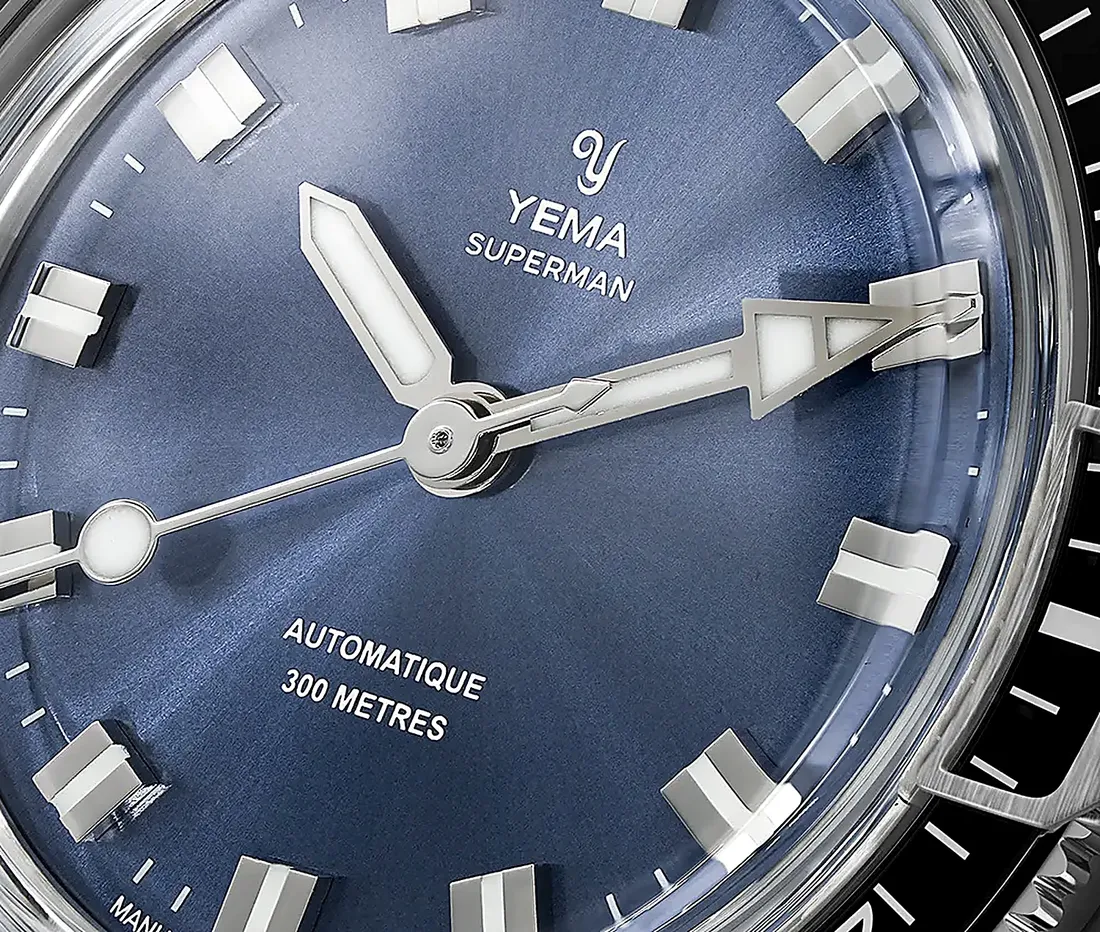
At thirty metres your own blood looks greenish black, because there is no red left to see by. A red glove turns brown. Yellow survives, white survives, but the world of colour has narrowed and what remains is mostly contrast. This is why the dial of a diving watch is a question of legibility and not of taste: a dark ground, large bright markers, thick hands.
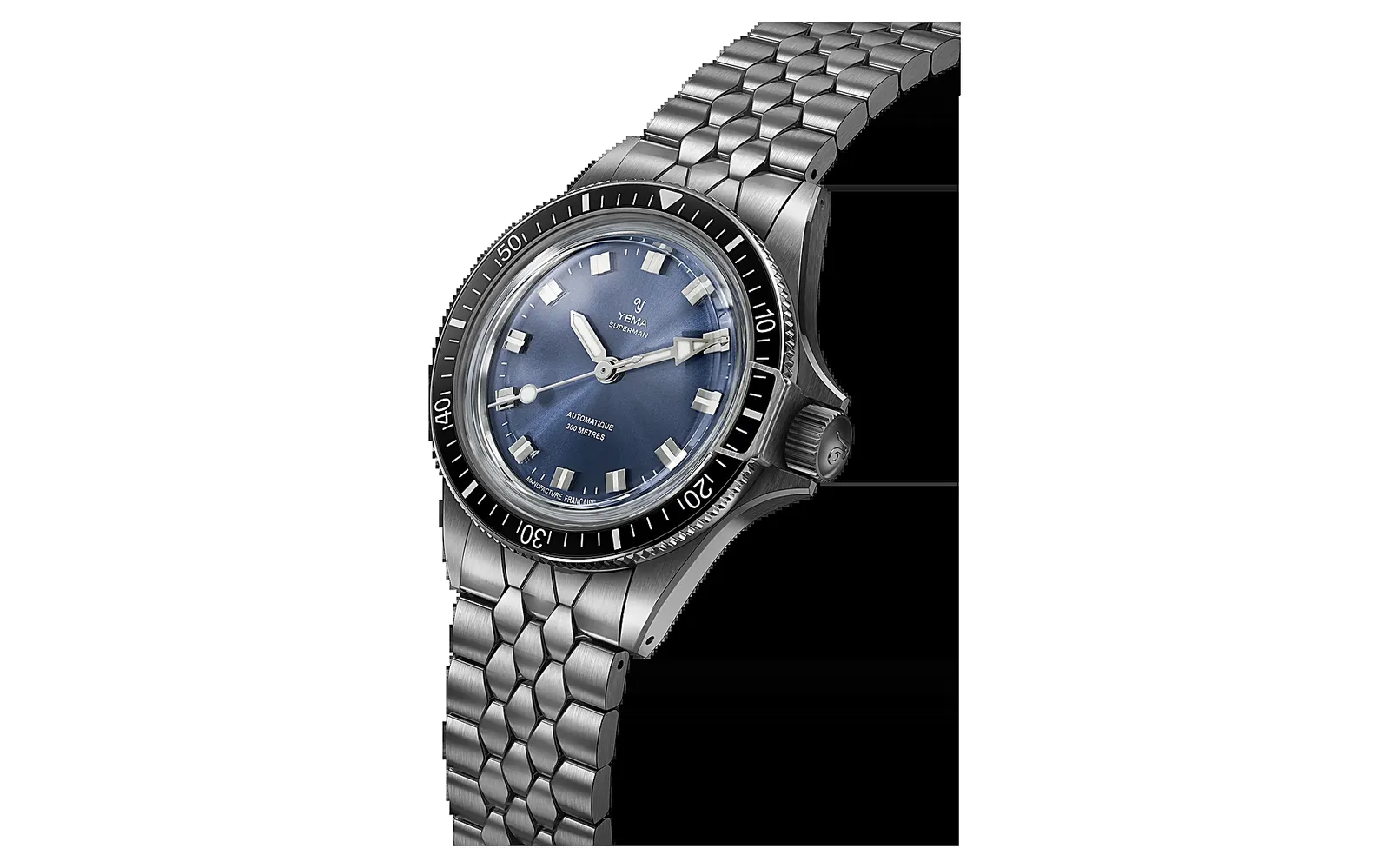
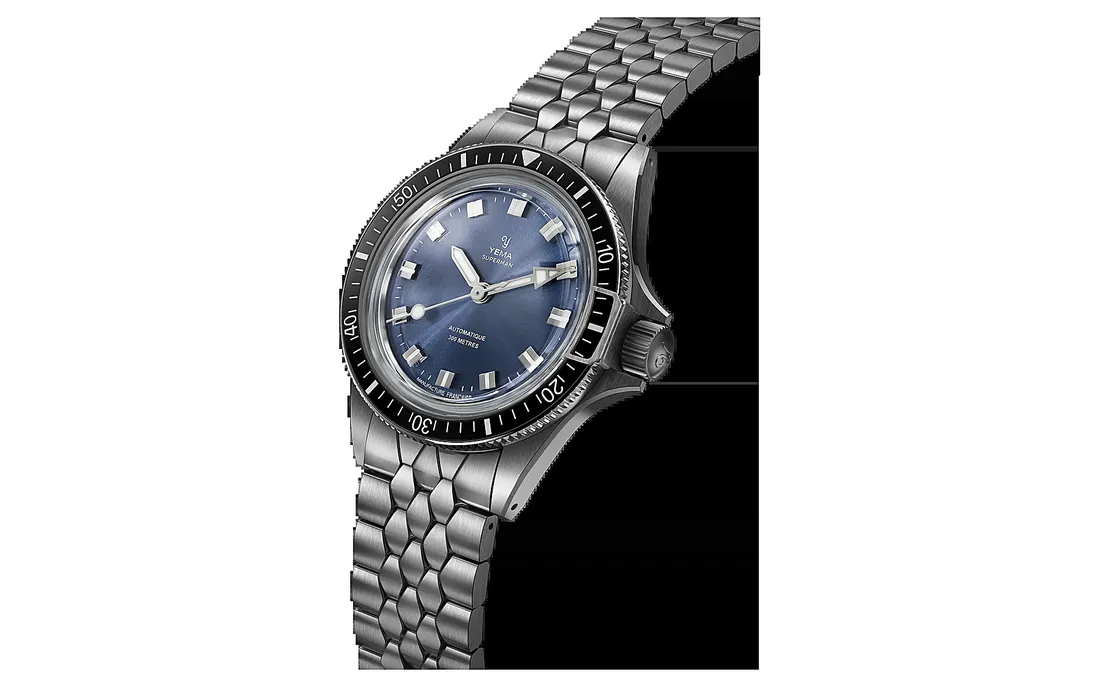
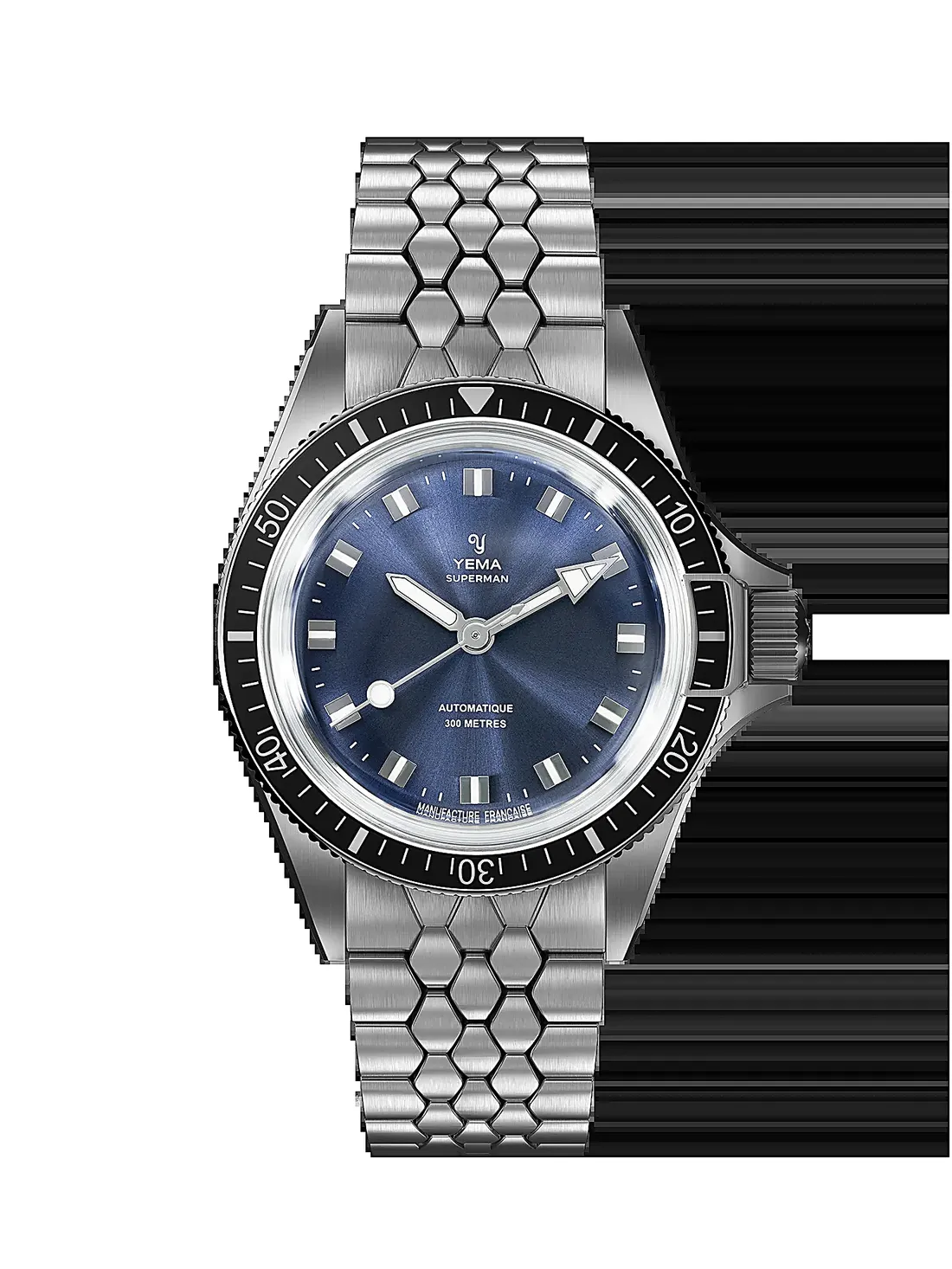
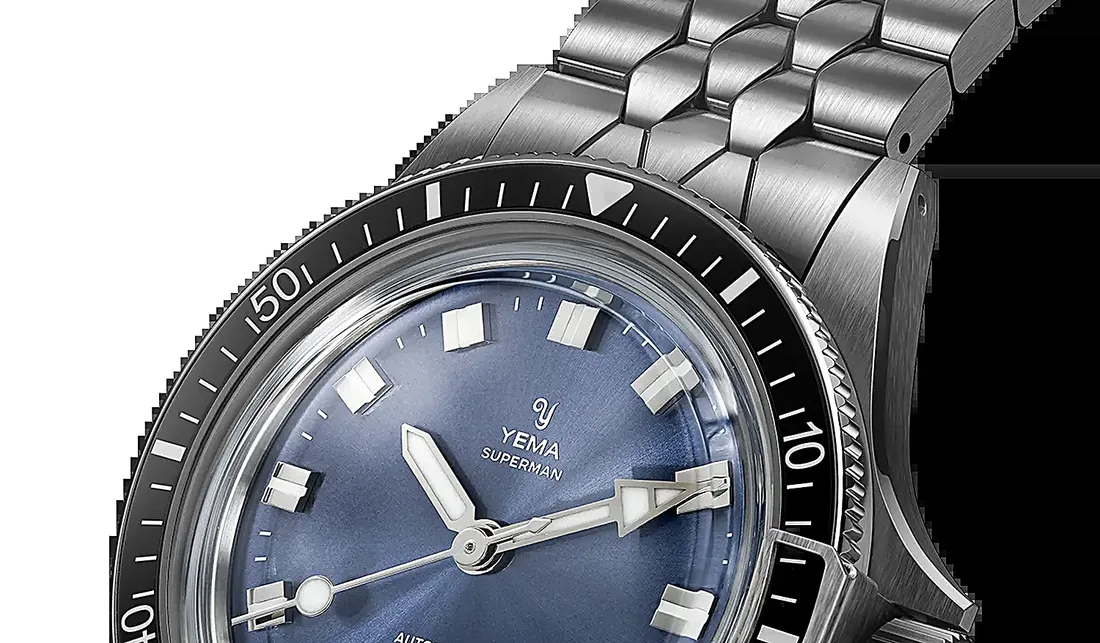
There is a quiet irony in this one. The steel blue dial Yema has used will not look blue in the place the watch was designed for. Yet the markers and hands on that same dial are charged with BGW9 luminescent material, which glows with a blue cast in the dark. When the sea takes the blue out of the dial, the watch makes its own.
format_quote"The sea takes the blue out of the dial. In the dark, the watch makes its own."
Hasan Bekmezci
The watch is called the Superman and the story begins in Morteau. Yema was founded there in 1948 by Henry-Louis Belmont, who had graduated at the top of his class from the watchmaking school at Besançon in 1931. The company is still in the same town, run by a third generation of the same family.
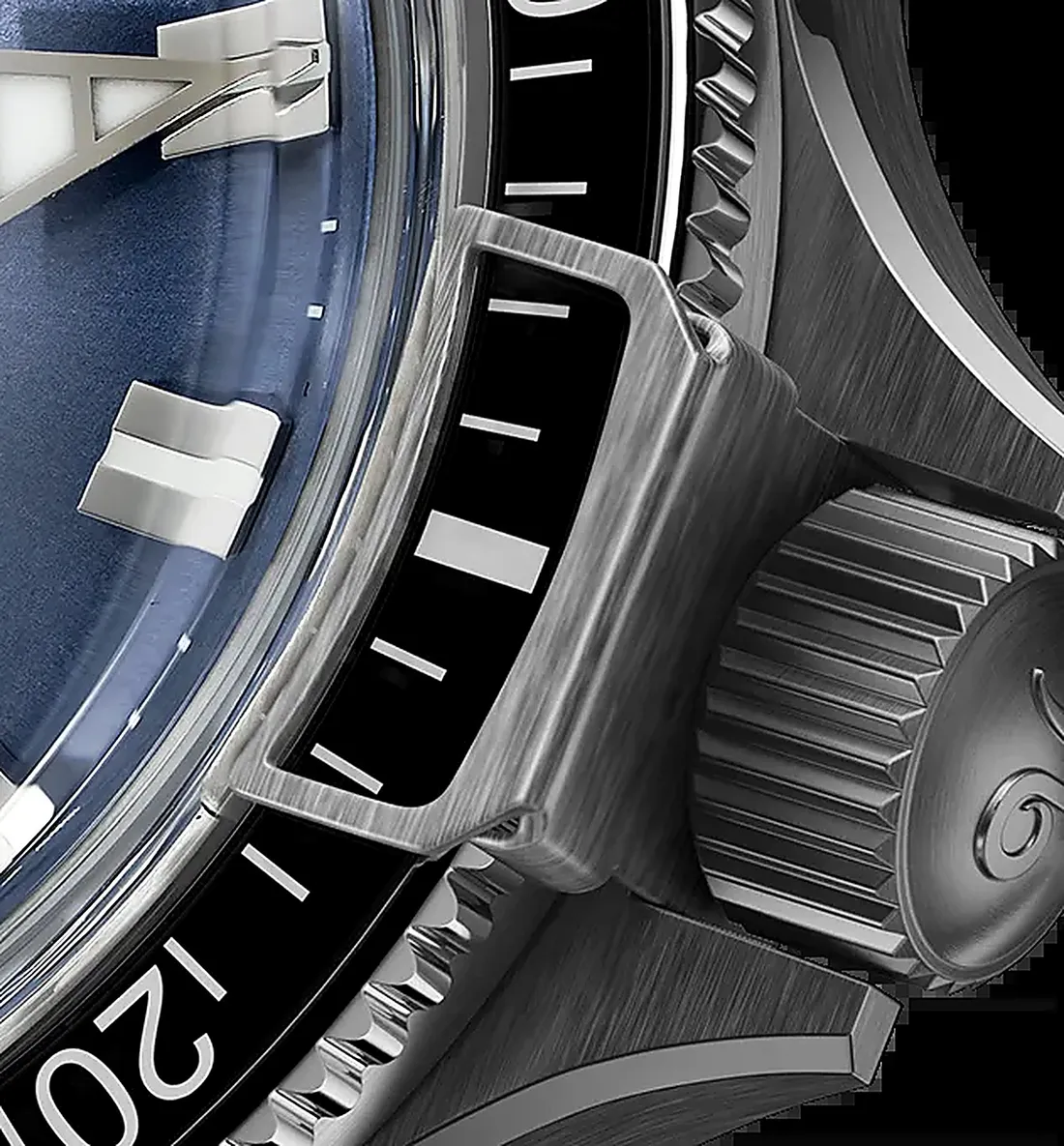
The part that defines the Superman is the bezel lock, patented in 1967. A small arm set beside the crown swings over the bezel and presses it into place. The purpose is plain: to stop the rotating bezel from being knocked out of position under water. Soon afterwards the model became the first French series-production diving watch rated to three hundred metres, and in 1970 the Superman was taken up by the air-sea rescue swimmers of the French Air Force.
To see why the lock matters, remember what the bezel is for. It does not tell the time. As you descend you bring the triangle over the minute hand, and from that moment the figure the hand points to on the bezel is the number of minutes you have spent below. The bezel is a memory. If it turns by accident the watch keeps perfect time, and the memory is destroyed.
format_quote"The bezel does not tell the time. It is a memory, and what an accidental turn destroys is not the time but the memory."
Hasan Bekmezci
Sit a diving instructor down with a watchmaker and the difference between them surfaces quickly.
The instructor would say: down there a person loses the sense of time. The view stops changing, the sound flattens out, the light drops, and as the depth increases attention narrows. What feels like ten minutes can be twenty, and that error is an error about how much air is left. So there is only one question you must be able to answer below: how long have I been here?
The watchmaker would answer: then our job is an instrument that answers that one question perfectly. No unnecessary printing on the dial, a bezel that turns with a glove on, a lock that holds, a crystal that does not break, and all of it visible in the dark. The rest is decoration.
They are saying the same thing. A tool is designed by knowing what is missing in the place where it will be used.
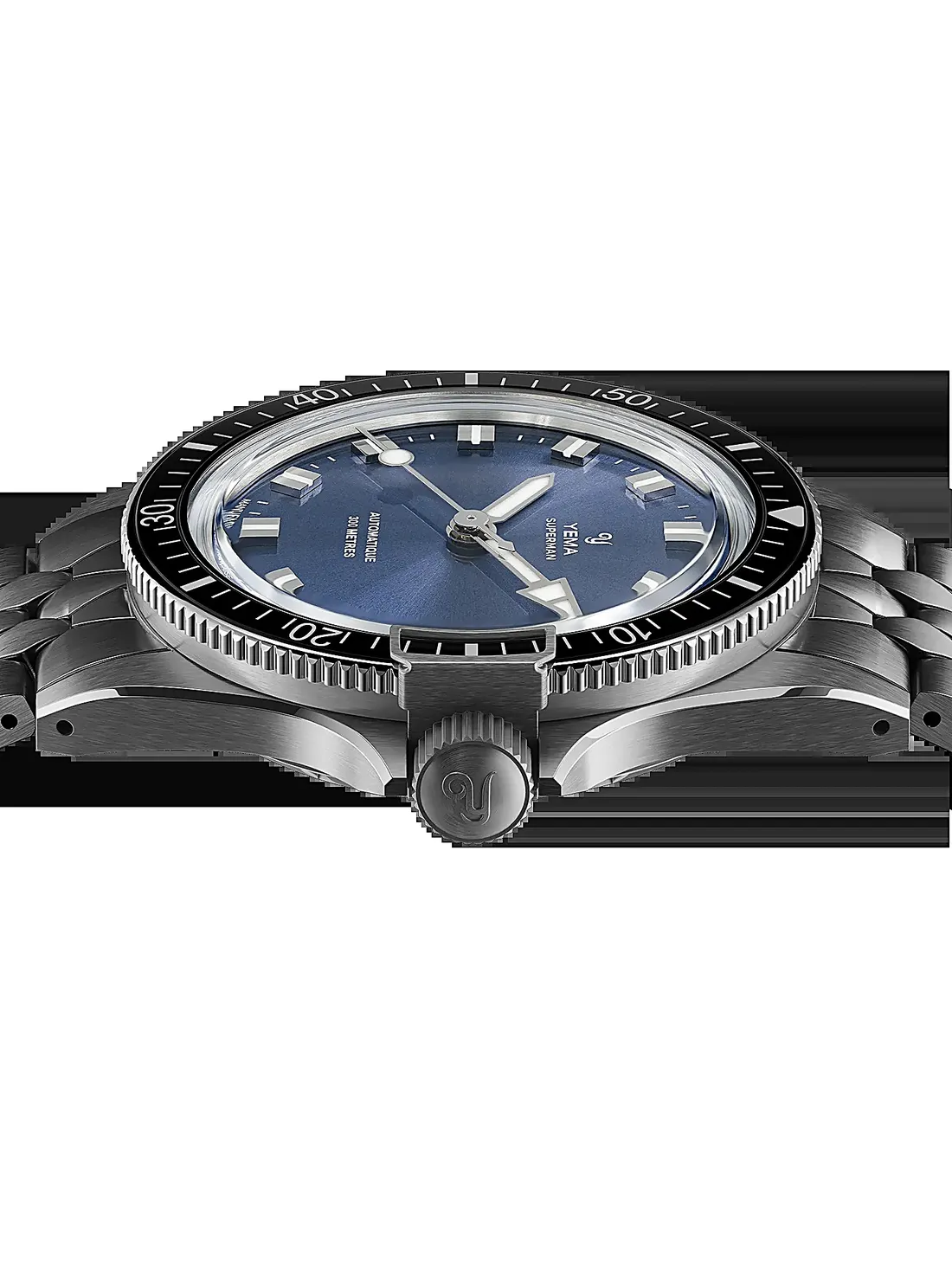
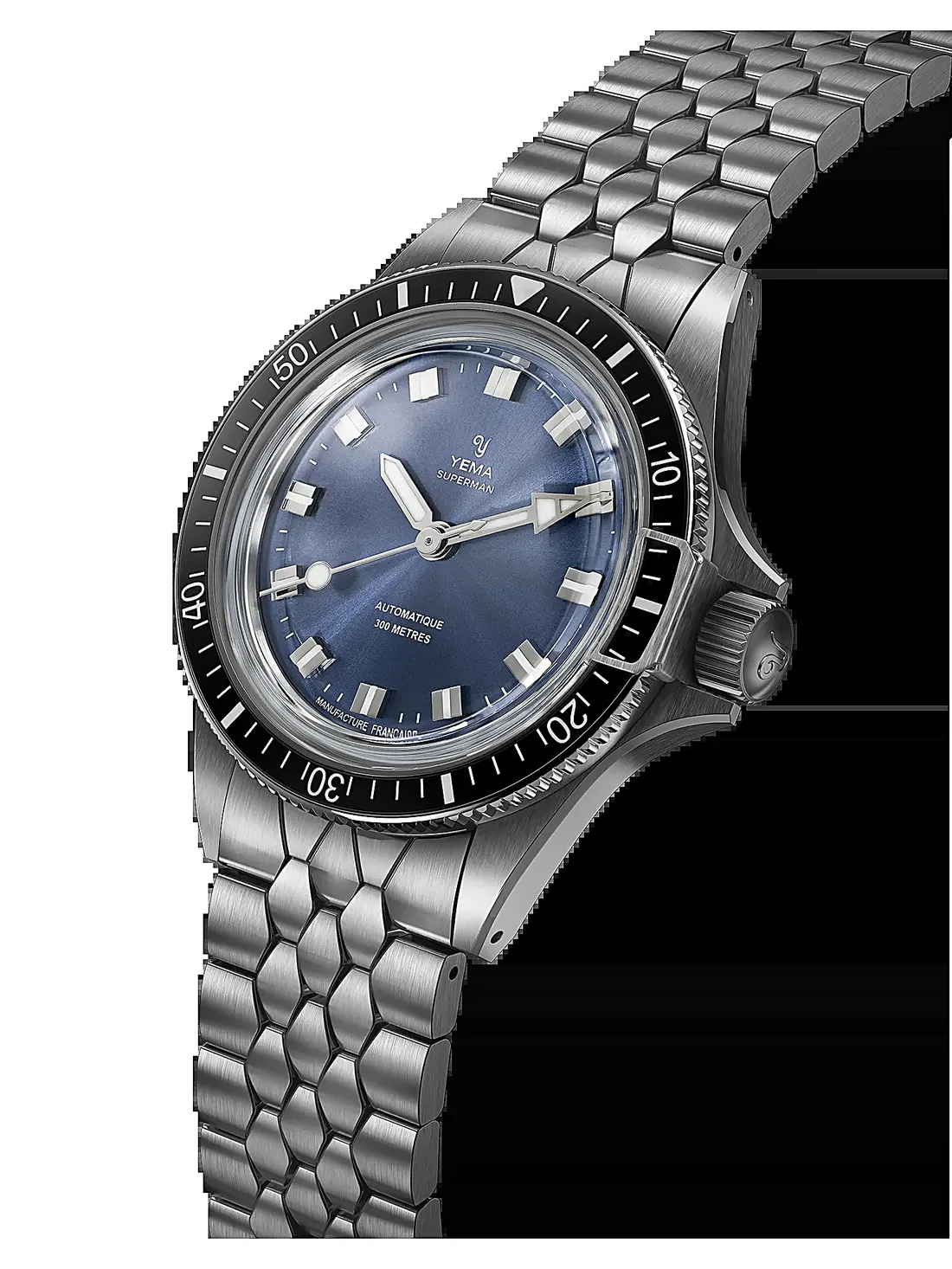
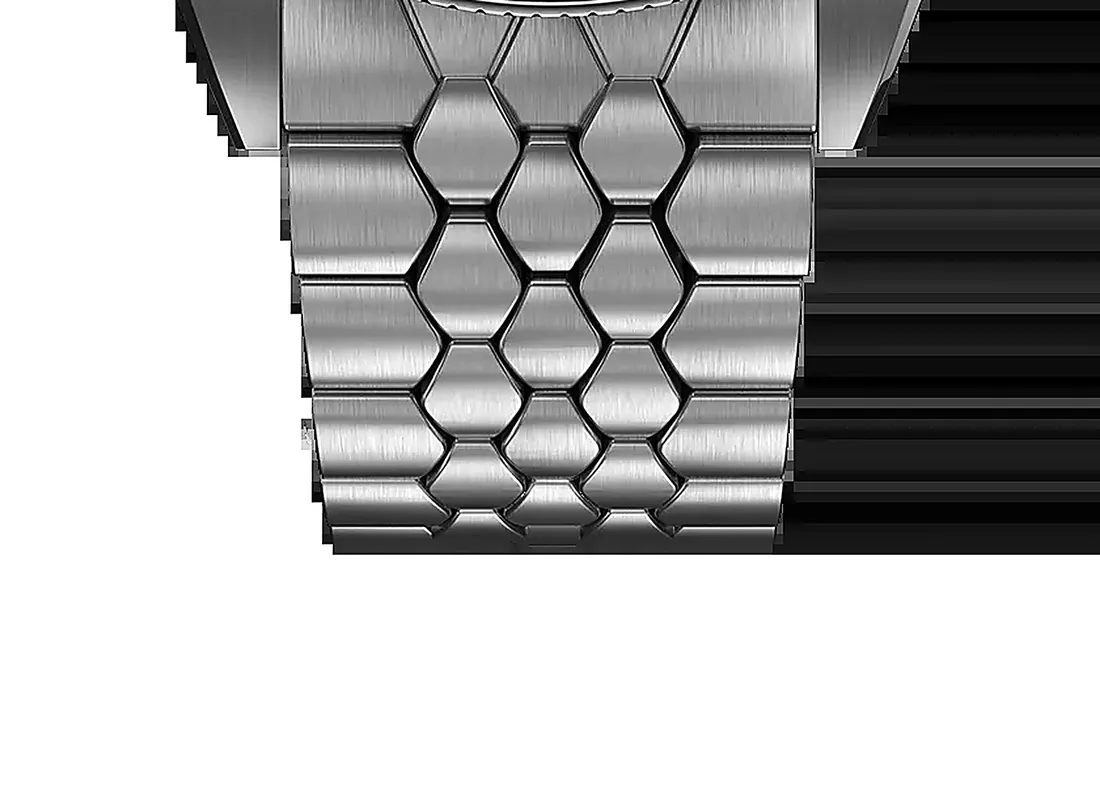
The figures run as follows. The case is thirty-nine millimetres across and eleven point three millimetres thick, in 316L steel, vertically brushed with polished chamfers, and the lugs take a nineteen millimetre strap. The crystal is double-domed sapphire, two point two millimetres thick. The bezel turns one way only, carries a polished ceramic insert graduated from zero to sixty, and the triangle at twelve is luminous. The crown screws down and wears an embossed logo. Water resistance is thirty bar, which is three hundred metres.
Inside runs Yema’s own CMM.10: automatic, twenty-eight thousand eight hundred vibrations an hour, seventy hours of reserve, hours, minutes and seconds. The components are made within a radius of seventy-two kilometres of Morteau, the bridges and mainplate in Yema’s own workshops, where the movement is also assembled.
The figure of three hundred metres is a margin, not an itinerary. Nobody takes this watch to three hundred metres. The number is there so that nothing goes wrong at the depths a person will actually reach.
Standing on this coast, the thought that comes is roughly this.
A person enters a place that was not made for him. Under water he cannot breathe, cannot orient himself, cannot see colour and cannot count time. He can go in only with a cylinder, a compass, a lamp and a watch. Every one of those objects was born from an admission of something he lacks.
And that lack is not a fault. It is a boundary. A man who knows his boundary can build the instrument that measures it, and knowing how long your own breath lasts is the most concrete form of knowing yourself.
The colour of the sea teaches the same lesson. The blue we admire comes from light that does not return and from water that is nearly empty. Here beauty arises out of absence rather than abundance. The Creator set both the colour and the eye able to see it. What is left to us in between is to look, to measure, and to remember our limits.
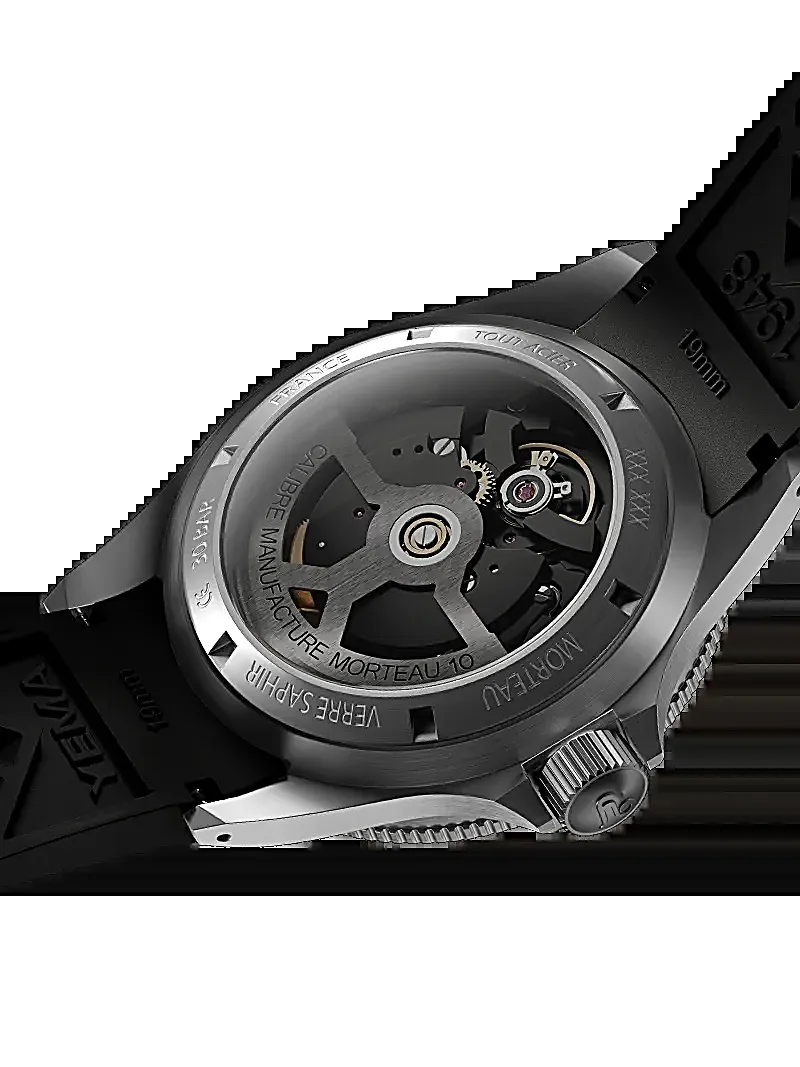
The watch on its maker’s own site: Yema, Superman Steel Blue CMM.10