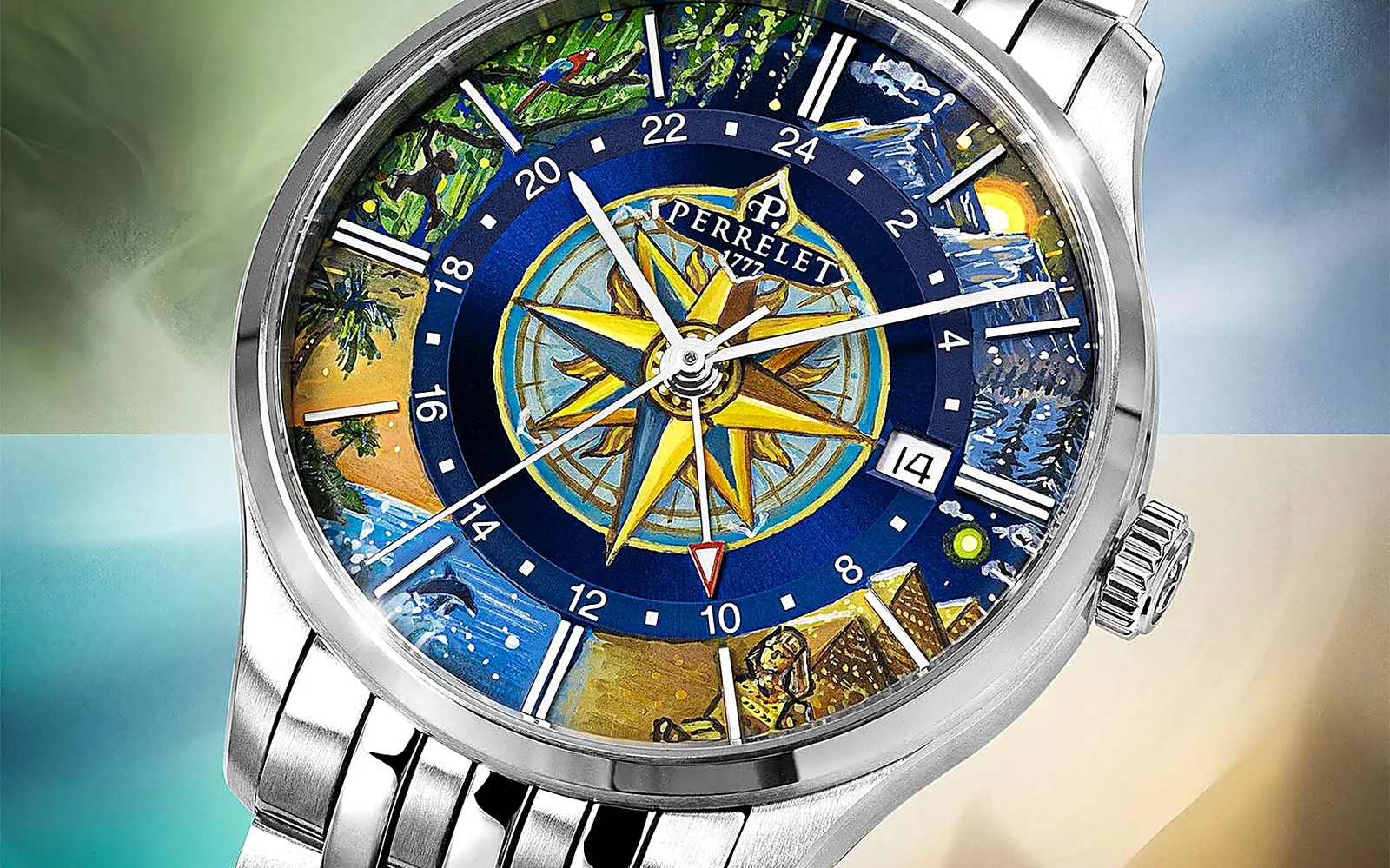
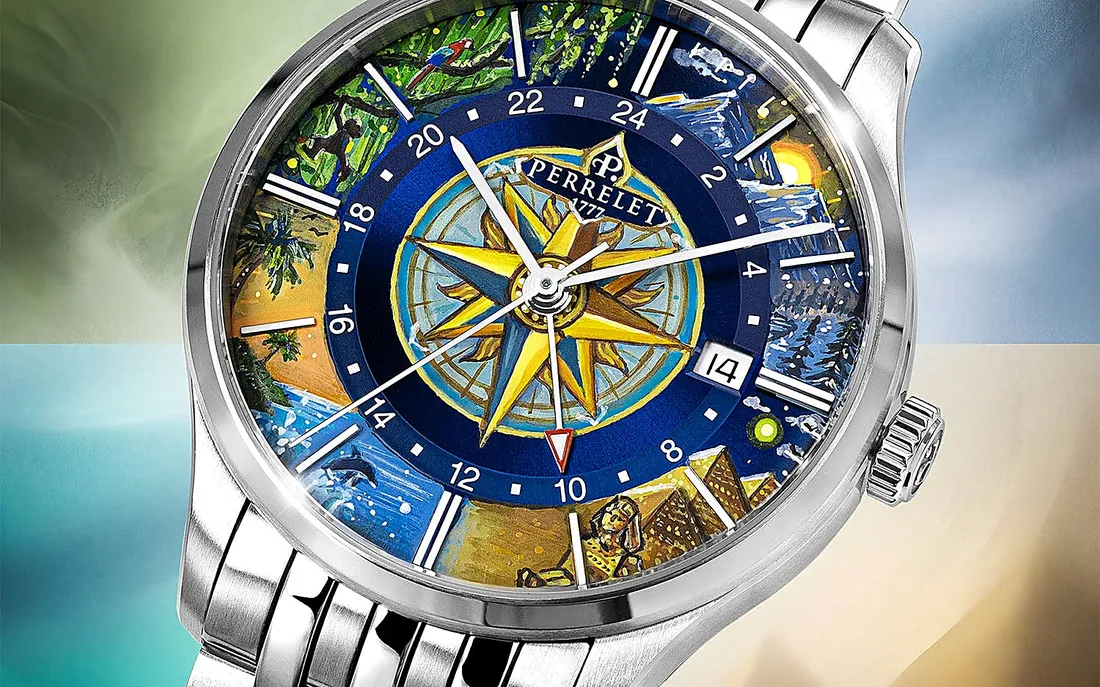
Horology may look, in its plainest definition, like the art of measuring time; in truth it is that deep, philosophical search for alignment which man has conducted with the vast gearing of the cosmos, with the turning of the stars and with the rhythm of the earth. While we try to shut time between mechanical wheels, what we are actually measuring is the flawless, undeviating and tilted dance of our Earth around the Sun.
The first signature Abraham-Louis Perrelet put into the history of horology in 1777, by inventing the self-winding mechanism, becomes today, on the microscopic canvases of IFL Watches, a whole manifestation of the earth in which astrophysics, geography, climate science and the craft of miniature painting intersect. The Perrelet x IFL Watches Weekend GMT Atlas is not merely a travelling instrument that shows two time zones; it is a philosophical and scientific map of the planet, carried on the wrist.
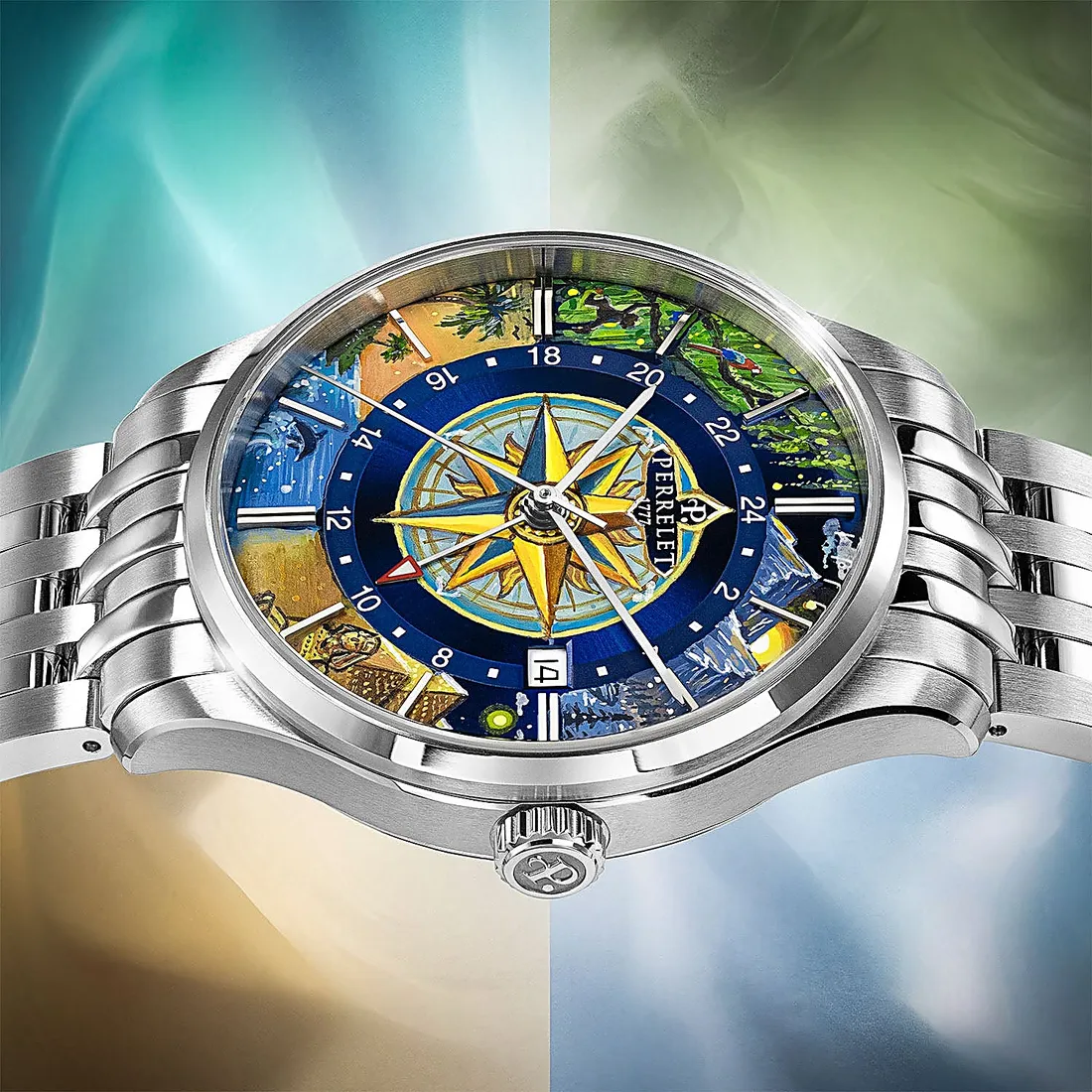
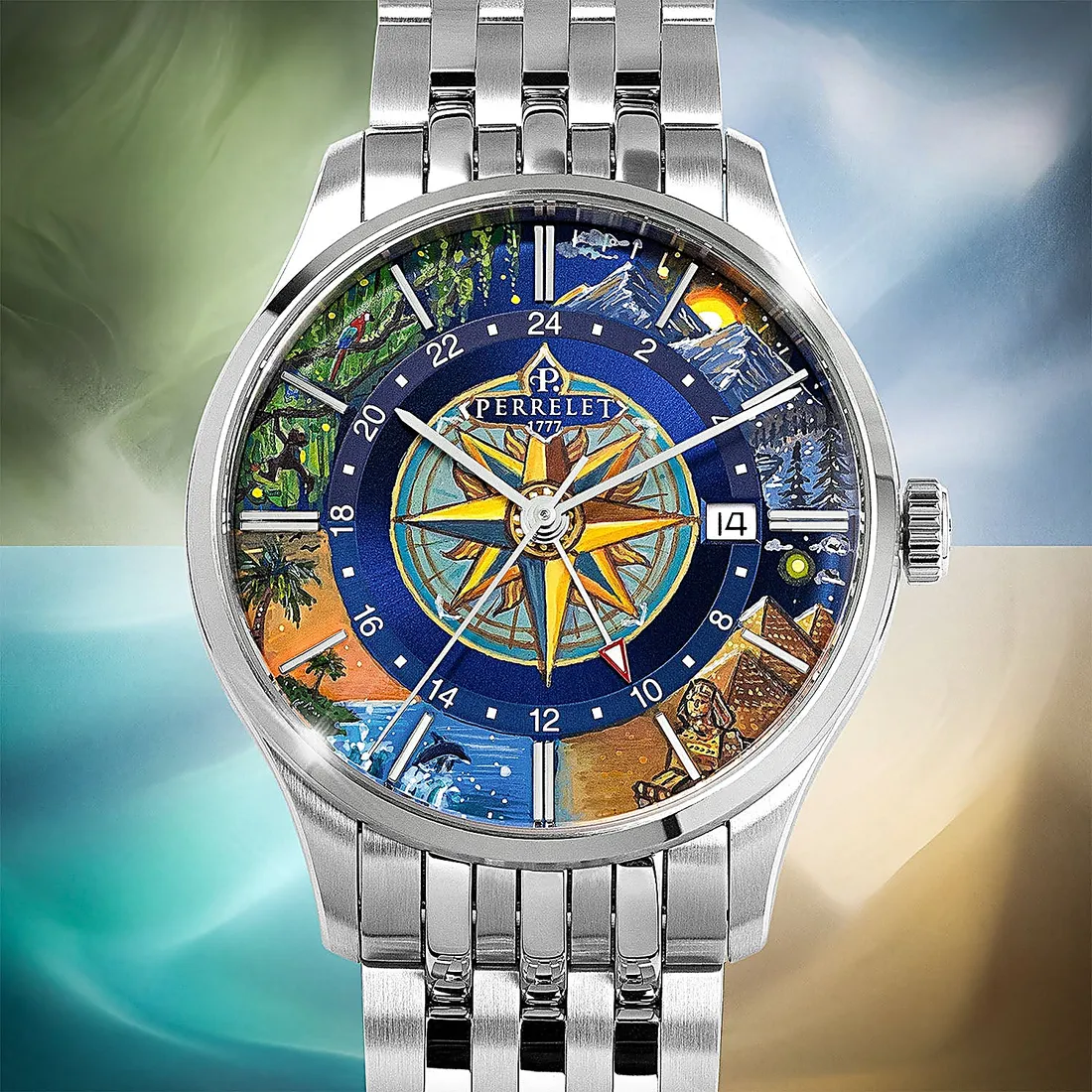
The sixteen-point gold compass rose shining at the exact centre of the dial is the fixed point that carries the entire aesthetic and mechanical architecture of the watch.
Throughout history, in the ages before the compass was invented, the sky was humanity’s only guide. From the Phoenician sailors to the open-ocean navigators of Polynesia, everyone took refuge in that one unchanging nail of the night sky, Polaris. While the Earth turned on its own axis, Polaris, aligned exactly with the north celestial pole, stood still; every constellation around it was in a circular dance.
Imagine a traveller at the end of the fifteenth century, sailing out of the stormy waters of the Mediterranean towards unknown geographies. In the middle of a storm that lasts for days, not one star is visible in the sky and the line of the horizon is not distinct. On a wooden deck beaten by the waves, the traveller has one refuge, taken out of a walnut box: that ancient instrument cast in brass with a sixteen-point compass rose worked onto it. The moment the needle points north, the traveller does not merely find a direction; he fixes again the harbour left behind, the unknown stretching ahead, and therefore his own existential position within the cosmos. For him the compass rose is that unchanging alignment brought down to earth for the moments when the stars are invisible.
The compass rose at the centre of this watch works in exactly that way: a fixed point that ties together all the geographies, climates and time zones on the dial.
format_quote"The compass rose is that unchanging alignment brought down to earth for the moments when the stars are invisible."
Hasan Bekmezci
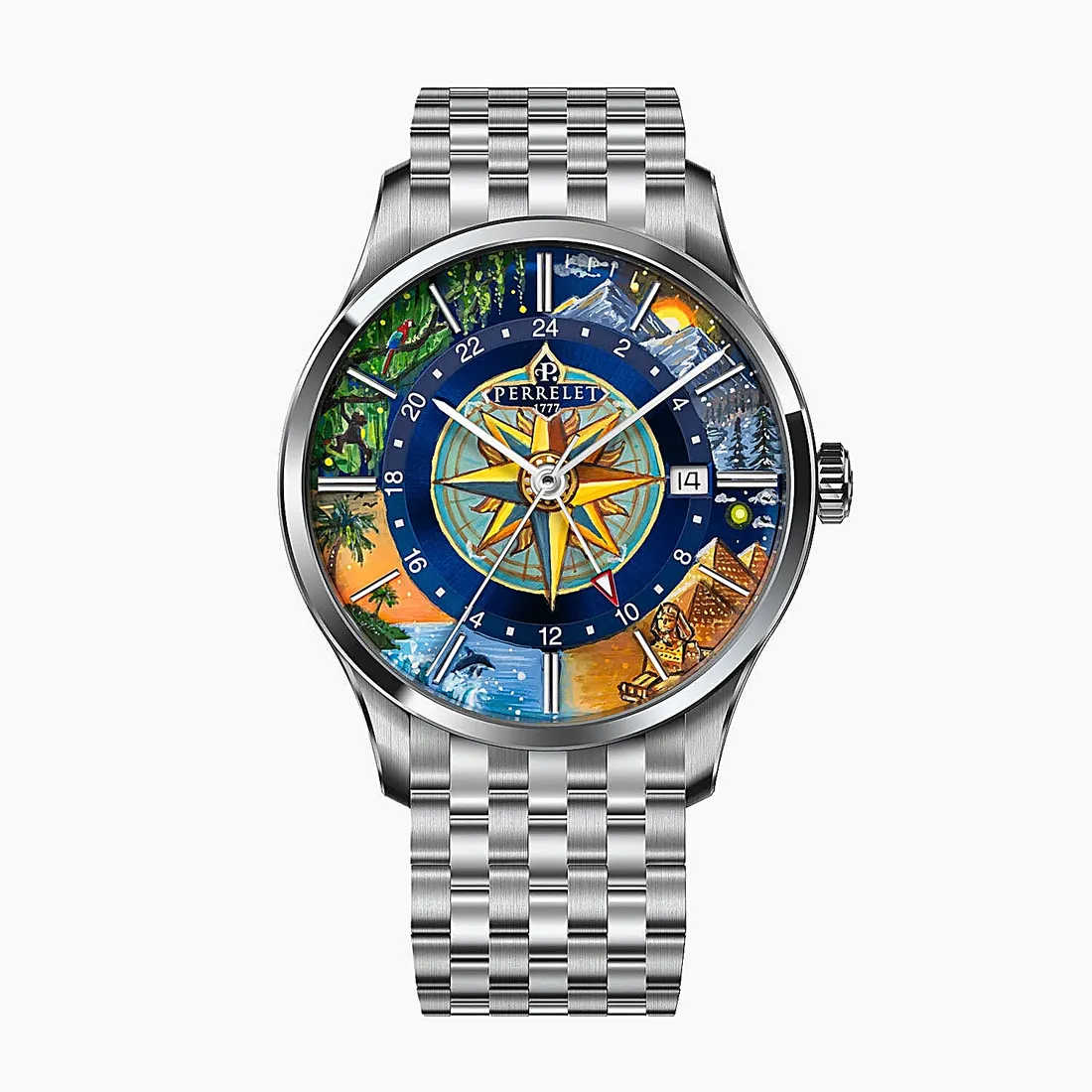
When we turn our eyes from the compass rose to the four main climate regions on the dial, what meets us is not only the craft of miniature painting; one of the most elegant laws of physics in the cosmos is being displayed.
How do these polar summits, rainforests, turquoise oceans and arid deserts come to exist at all? Behind them lies a miraculous astrophysical mechanism that human beings find hardest to grasp and that makes life possible: the twenty-three and a half degree axial tilt of the Earth, and the thermodynamic resonance that tilt creates.
To think of our Earth as a flawless marble rolling around the Sun is a great error. Our planet travels through the void at a tilt of twenty-three and a half degrees, like a spinning top that has begun to slow without falling over, or a ballerina gliding across the stage with one shoulder leant slightly forward.
Had the Earth not held that tilt, the rays of the Sun would always have struck the Equator at a right angle and the poles always at a tangent. Neither the seasons nor the visual biodiversity we watch on this dial would exist. Every point on the earth would be locked into the same dull, monotonous temperature for three hundred and sixty-five days. No leaf would turn, no migrating bird would beat a wing, no monsoon would wake the soil. Life would be deprived of the thermodynamic rhythm by which it renews itself.
That angular deviation of twenty-three and a half degrees begins an enormous cosmic tango between the Sun and the Earth.
Hold a torch square against a wall and the light makes a small, very bright and burning circle. Tilt the torch and the same quantity of light spreads over a wider area, its intensity falls and the surface cools. As the Earth makes its three hundred and sixty-five day tour around the Sun, that fixed tilt of twenty-three and a half degrees means the northern hemisphere sometimes turns its face to the Sun and, six months later, turns its shoulder. The four different regions on the dial are the canvas of that enormous thermodynamic torch upon the earth.
The rainforest at the upper right of the dial, with the parrot among the branches, stands for the equatorial belt. There the torch stays at very nearly a right angle all year; the high density of photons pushes photosynthesis to its maximum, and dense leaves, humidity and heat combine into those vivid colours.
The snowbound and glacial summits at the lower right are the region the torchlight reaches at its most oblique, where photons lose their energy in the layers of the atmosphere and fade. The temperature drops, molecular motion slows, and water passes from the liquid form into crystalline ice. Those mountains are the visual seal of that slowing molecular dance of thermodynamics.
format_quote"Without that tilt, every point on the earth would be locked into the same monotonous temperature for three hundred and sixty-five days."
Hasan Bekmezci
The ocean stretching along the left of the dial, with the dolphin among the waves, stands for the planet’s enormous thermostat. Water is a liquid of very high specific heat; it warms slowly and cools slowly. That blue expanse on the dial speaks of the liquid fluidity and the atmospheric circulation that keep climates from sliding to extremes.
At the lower left rise pyramids, a caravan of camels and sand. The descending dry air over the tropics of Cancer and Capricorn prevents clouds from forming and the rays of the Sun scorch the ground directly. It was by measuring the sharp shadows cast by that burning Sun, with gnomons and sundials, that humanity discovered time. The pyramids stand for a climatic geography and for the birth of horology at once.
At the upper left lies the warm shore beneath the palms: the strip of transition where the equatorial belt touches the temperate one.

Behind this scientific and philosophical depth lies Perrelet’s traditional watchmaking expertise.
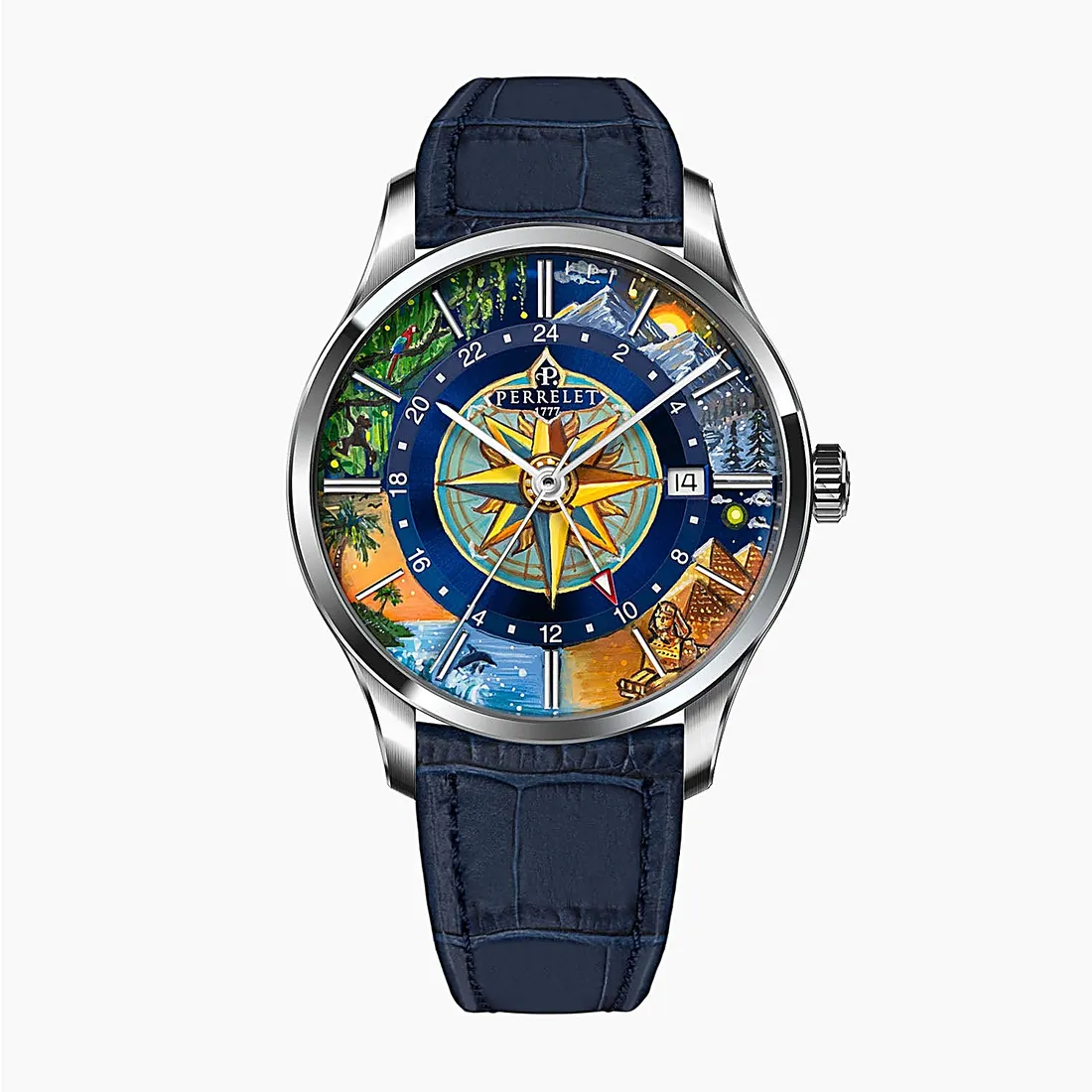
Inside the thirty-nine millimetre stainless steel Weekend case beats the manufacture calibre P-401, running at twenty-eight thousand eight hundred vibrations an hour with a power reserve of forty-two hours. The red-tipped GMT hand rising from the centre lets you read a second time zone against the twenty-four hour scale. There is a date window at six, the crystal is sapphire, water resistance is five atmospheres, and the movement is watched through a display back.
The watch comes on a steel bracelet, and in its box there is also a blue leather strap with a quick-release system. Because every dial is painted individually by hand, no two are the same; the edition runs to fifty pieces.
The mechanical complication does not interrupt the visual story on the dial. On the contrary, just as the Earth turns on its own axis through twenty-four hours, the GMT hand glides over the pyramids, the forests, the summits and the seas of the dial and joins time to place.

The Perrelet x IFL Watches Weekend GMT Atlas is an exceptional work that breaks the monochrome and soulless moulds of series production and marries art to science. This account, running from the compass rose to the axial tilt and from Polaris to the craft of miniature painting, does not merely tell us what the time is.
Every time you look at your wrist, this watch reminds you of our existential position on this old, colourful and flawless planet gliding around the Sun at that miraculous tilt of twenty-three and a half degrees, and of the timelessness of time.

format_quote"Every time you look at your wrist, this watch reminds you of our position on the planet and of the timelessness of time."
Hasan Bekmezci

The watch on its maker’s own site: Perrelet, Weekend GMT Atlas