October 1943. South of Marseille, where the road runs out, there is a small inlet called Callelongue. On one of those autumn mornings a boat went out from it carrying three men: Jacques-Yves Cousteau, Philippe Tailliez and Frédéric Dumas. They called themselves the musketeers of the sea.
They had with them a device that had been in the water only a few months: a regulator that delivered air from a cylinder on the back at the pressure the diver’s own breath asked for. For the first time a man could breathe underwater without a line to the surface, and nobody yet knew how far down that breath could take him.
Dumas was the one who went. On the end of a line he went to somewhere near sixty-two metres. What he described when he surfaced was not the depth. He said that past a certain point his thinking had slowed, that he had forgotten what he had gone down to do, and that he had found himself oddly cheerful about it. The thing had no name that day. We call it nitrogen narcosis now.
So the man went into the dark in order to learn what the dark does to a man. Spinnaker’s Dumas collection carries his name.

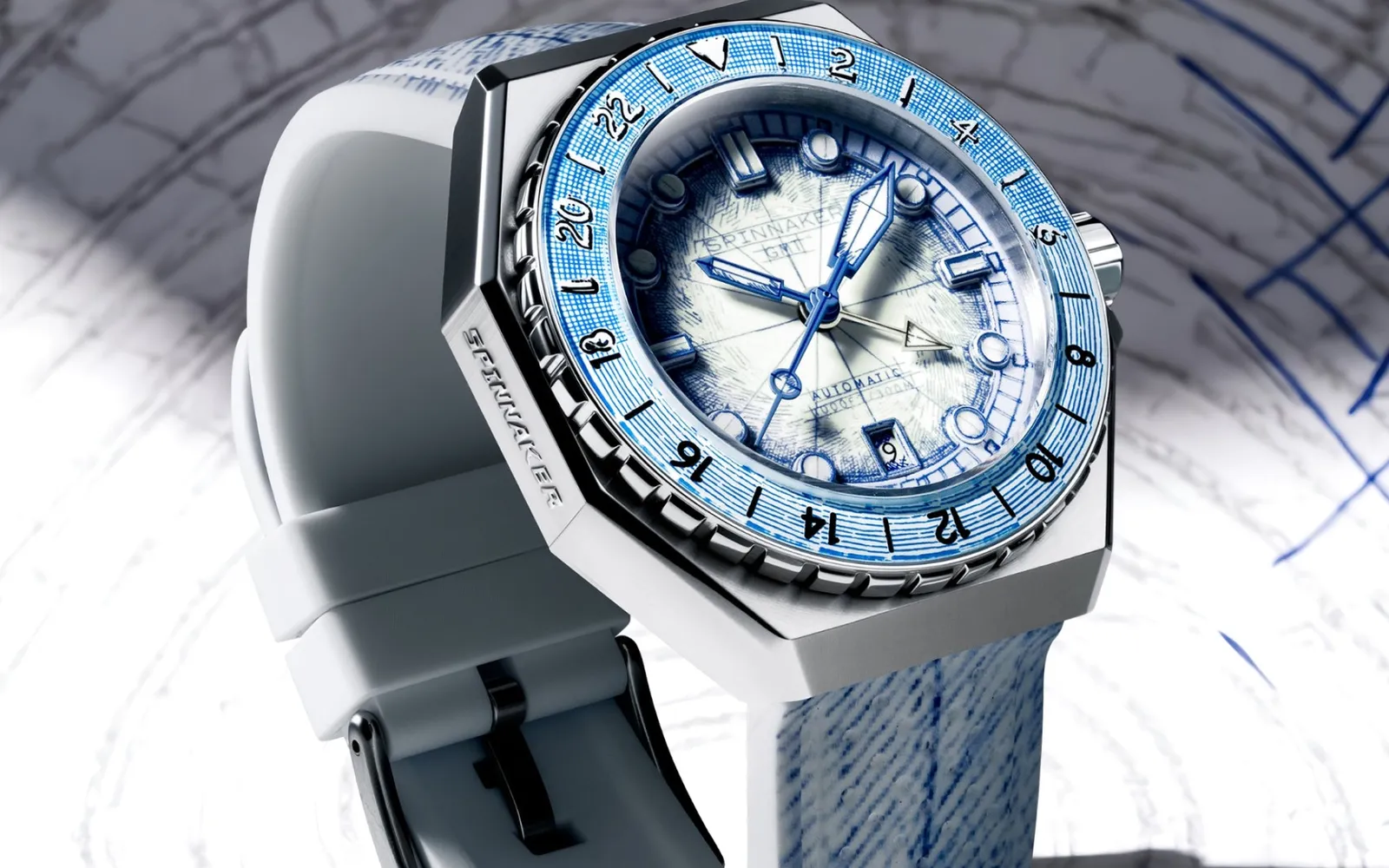
The collection’s second time zone model has just been reissued with a dial drawn by hand. Its name is the Dumas GMT Automatic Inkdial Limited Edition.
The man who drew the dial is Ben Li. He lives in London and read graphic and media design at the University of the Arts London. He made his first wristwatch drawing in 2020, in the lockdown months: he sat down and put a watch on paper in ballpoint and marker. Then he did not stop. Under the name Inkdial he has now made more than eight hundred watch drawings, and the work is his full-time trade.
In the maker’s own phrase, most watches go in one order: they are designed, then drawn. Here the order is reversed. This one was drawn, then built in steel.
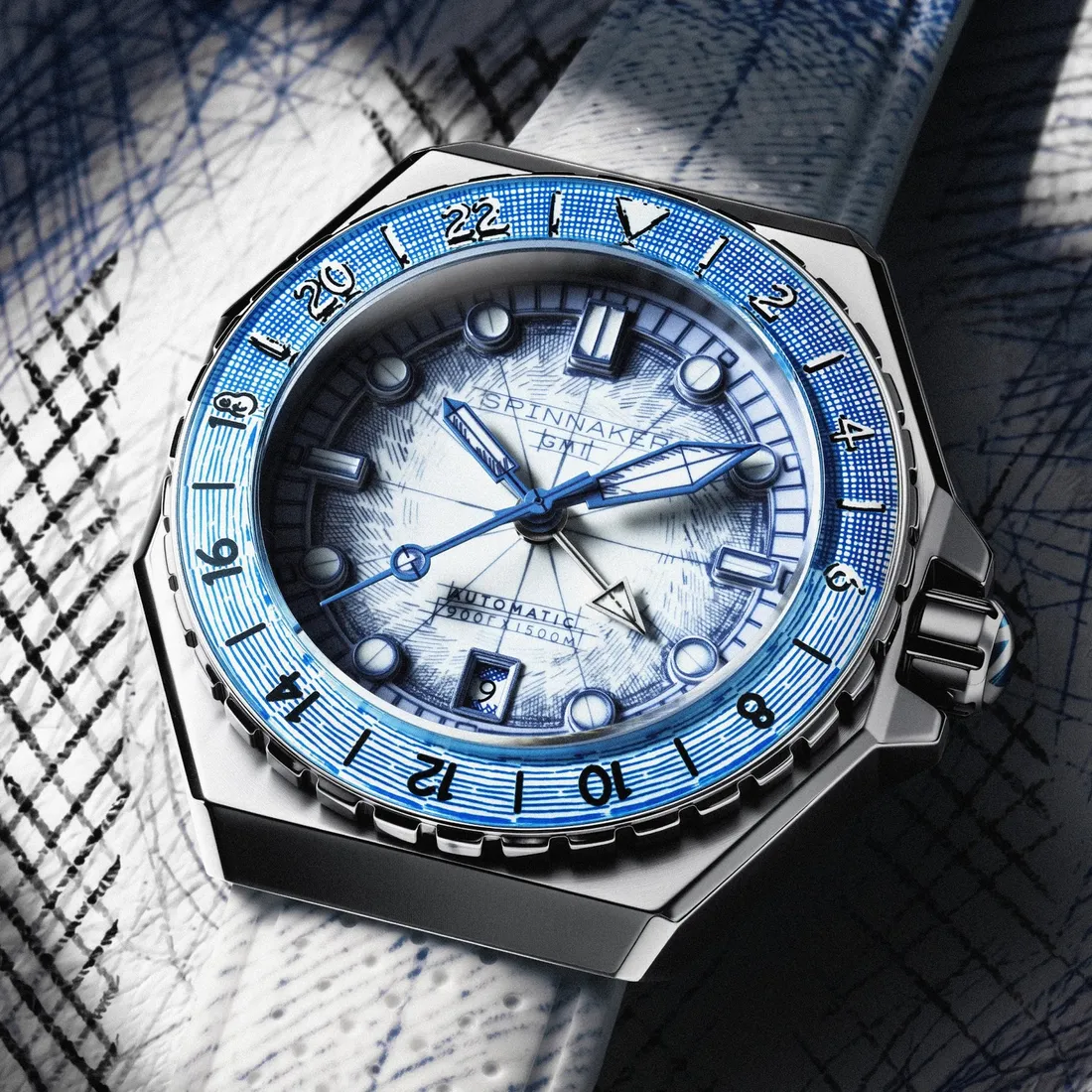
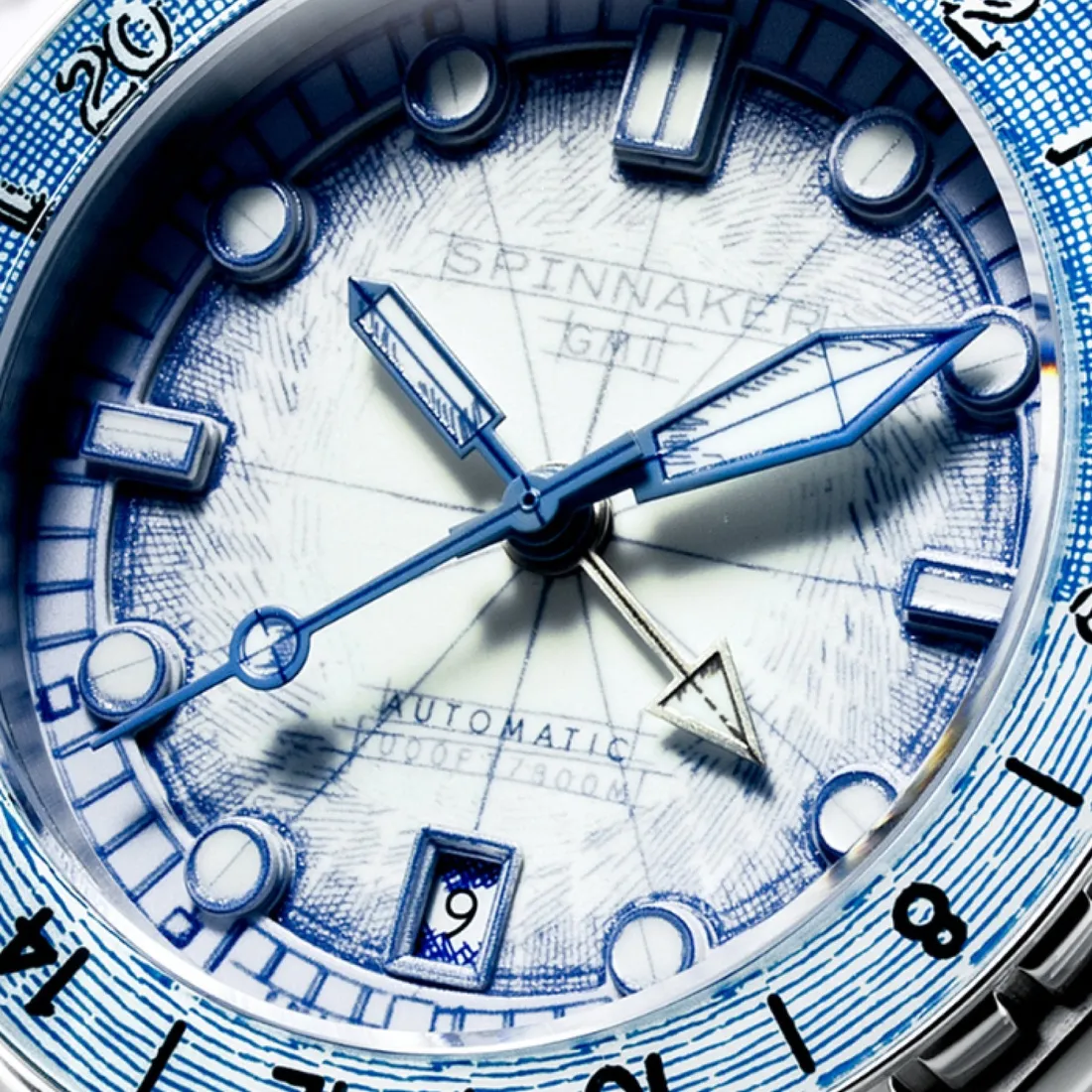
Look closely at the dial and what you see is not a pattern but every stage of a drawing. Over a cream ground the ink runs outward from the centre in cross-hatching. Underneath the hatching are the construction lines the artist did not rub out: fine rays leaving the centre, and ruled boxes drawn under the lettering. Spinnaker, GMT, Automatic and the thousand feet and three hundred metres beneath them are not set in a printer’s typeface; they look written by hand inside those ruled boxes.
It does not stop there either. The date disc turning behind the window at six is itself hatched, so the nine arrives on a drawn ground. The hands are hollow and closed with an outline. Down the spine of the GMT hand runs a broken line, the kind an illustrator puts in to indicate direction. The maker adds its own Ink-made mark at six.
format_quote"This dial does not only show the result. With the construction lines the artist left in, it shows the road to the result as well."
Hasan Bekmezci
The case keeps the angular shape the Dumas family inherited from the seventies: eight-sided, brushed across the top surfaces, polished on the bevels. Spinnaker is engraved into the flank. The bezel turns in both directions and the twenty-four hour scale on it is drawn by hand as well, the numerals standing on the same hatching. The crown screws down, and the crystal is flat sapphire with an anti-reflective coating.
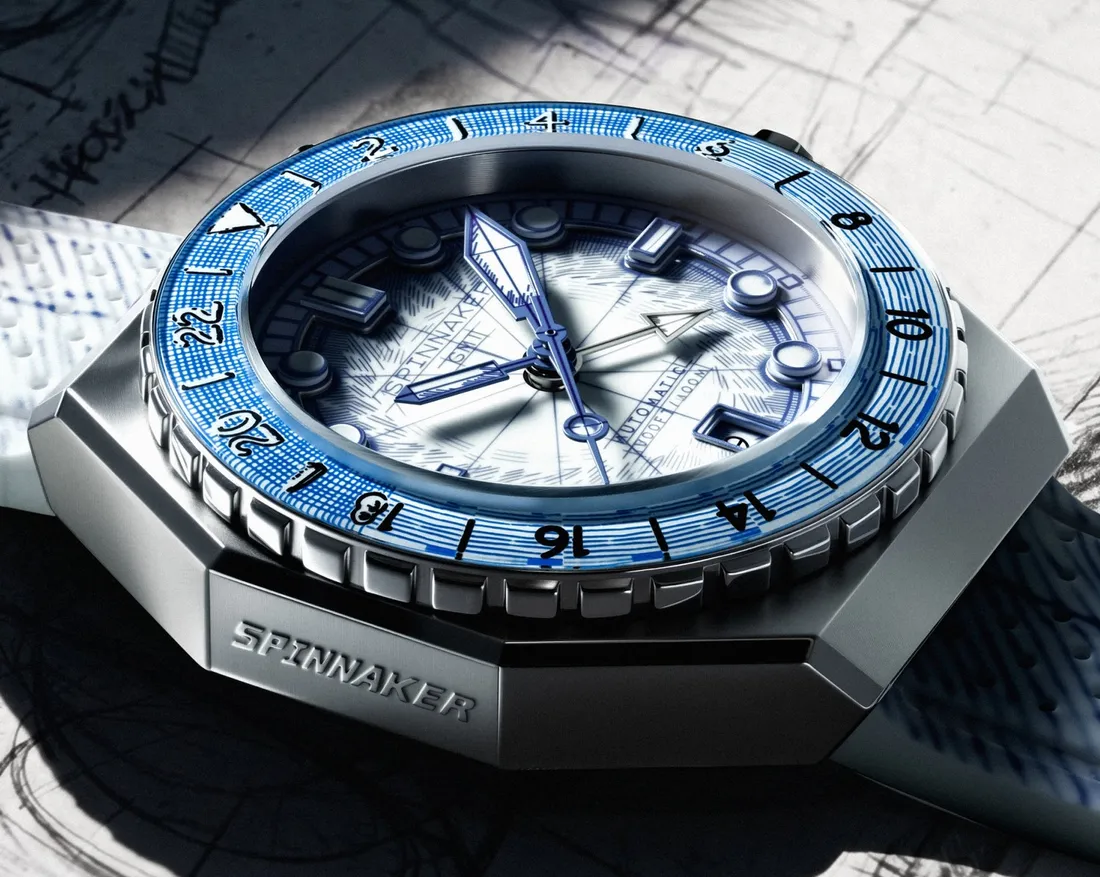
Inside runs the NH34 calibre from the Japanese house TMI. The defining trick of this movement is that it can drive a fourth hand independently. The arrow-tipped hand turning over the dial goes round once in twenty-four hours rather than twelve, and read against the scale on the bezel it gives a second time zone. That is what lets the watch hold time at two places at once.
The back is sapphire, and the rotor you see through it has not been left plain. Ben Li’s blue ink reached that too: the same hand, the same hatching, laid over the rotor. The drawing therefore sits on the one part of the watch that never stops turning.

So what is the thing that glows in the dark?
A luminous compound is not a battery, and it is not a chemical fire consuming itself. The basis of the luminous compound used in watches today is strontium aluminate doped with europium. When light falls on it, electrons in the crystal are lifted to a higher energy level. What matters is what happens next: some of those electrons do not drop straight back down. They are held in defects within the crystal, in what are called traps.
When the outside light is cut off, the traps begin to empty one by one. Every electron that falls back leaves the difference in energy behind as a photon. That is why the glow is not a sudden flash but a slow leak lasting hours. Within this family of compounds the green sits near five hundred and twenty nanometres and the blue-green near four hundred and eighty-five.
The light that fills those traps best is ultraviolet, because it carries the most energy per photon. That is why Spinnaker puts a small ultraviolet torch in the box beside the watch.
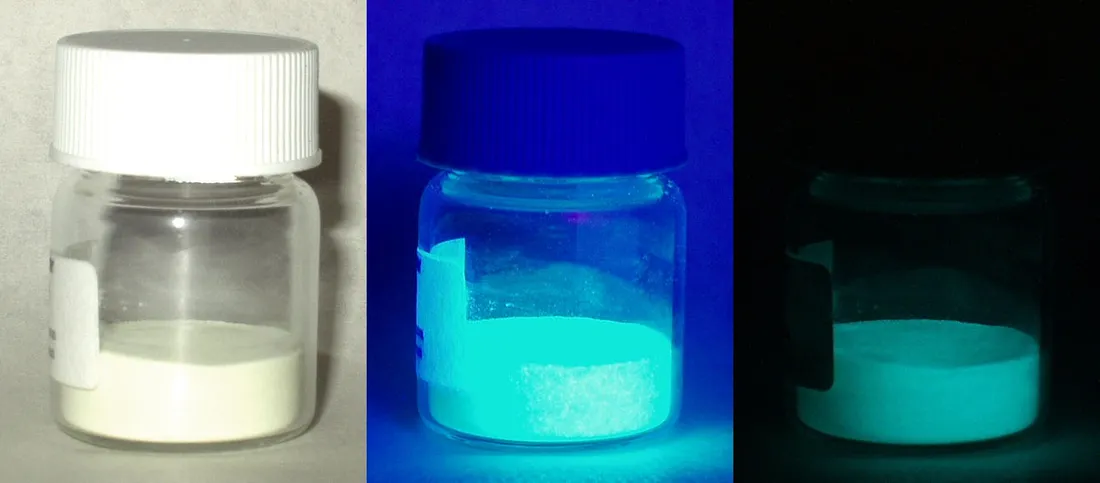
format_quote"The luminous compound makes no light of its own. It keeps what it is given and returns it slowly; what we see at night is the leftover of the day."
Hasan Bekmezci
Here is what happens in the dark. Spinnaker did not put the luminous compound on the hands and indexes alone. It went onto the whole ground of the dial, onto the twenty-four hour scale of the bezel, and onto the upper face of the strap. When the light goes, the hands, the indexes and the bezel burn green while the dial ground and the strap burn blue.
There is a fine reversal in that. By day the ground is pale and the ink is dark. By night the ground lights up and the ink stays dark. The drawing does not disappear; it turns into its own negative and crosses over into the night. The hatching on the strap holds the same way, dark lines standing on blue light.
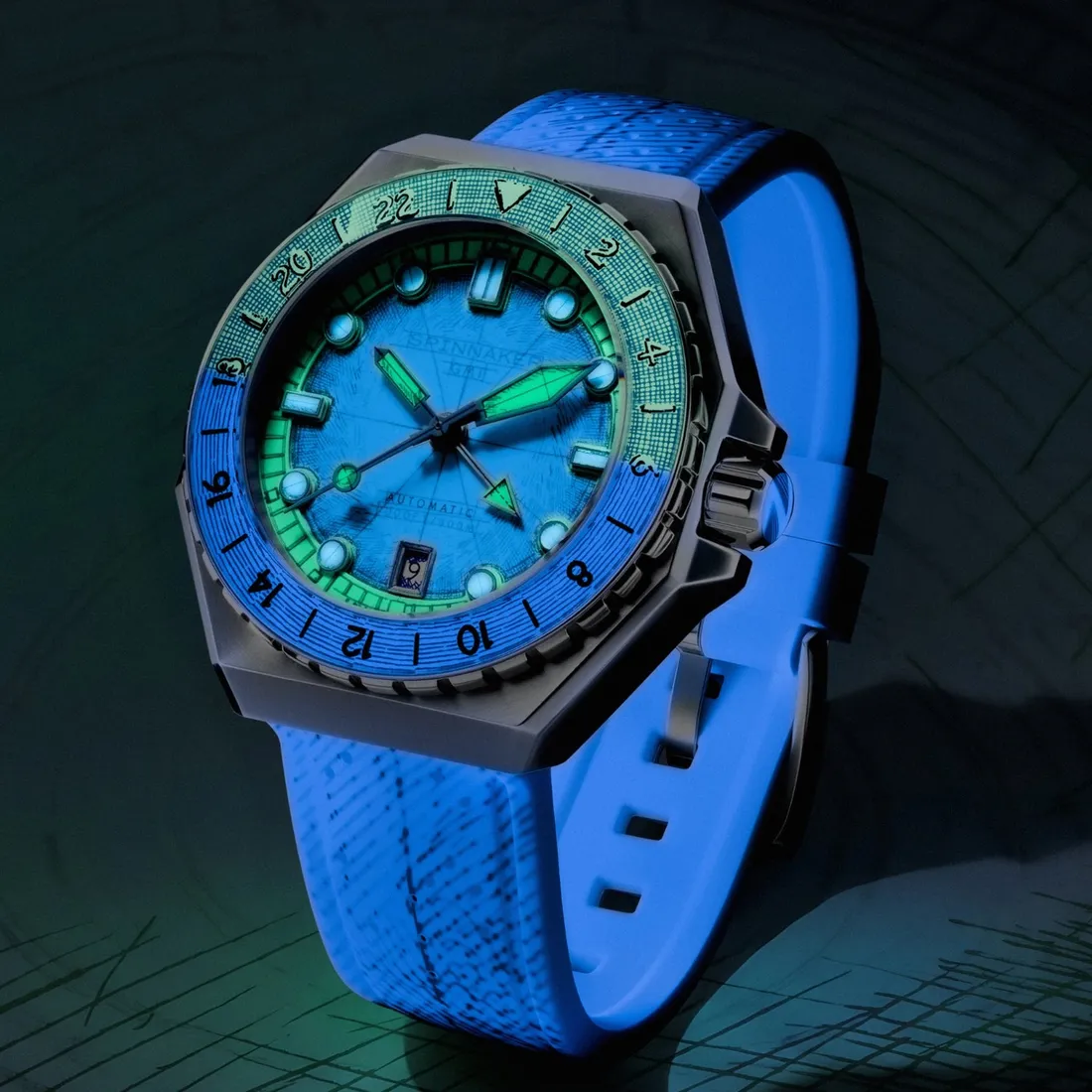
format_quote"By day the ink is dark and the ground is pale. By night the ground lights up and the ink stays dark. The drawing does not disappear, it crosses into the night as its own negative."
Hasan Bekmezci
If a diver and an illustrator talked, it would not take long for it to emerge that the two of them are describing the same thing.
The diver would say this: down there no world of colour is left. Red goes in the first few metres, orange and yellow follow it. At thirty metres a red object in your hand is brown. What remains is not colour but only light and dark. So what makes a marking readable down there is not its colour but how far it stands away from its ground.
And the illustrator would say this: I only ever have one colour to work with. A ballpoint writes blue, and that is all. The shine of metal, the thickness of a crystal, the weight of water, I make all of it out of how densely I lay that one colour on the paper. Draw the lines close and it becomes shadow, thin them out and it becomes light. My whole trade is contrast.
Both arrive at the same place. The diver’s eye and the illustrator’s pen have each learned to work where there is little light.
format_quote"The diver’s eye and the illustrator’s pen learned the same lesson: where light is scarce, the thing that works is not colour but contrast."
Hasan Bekmezci
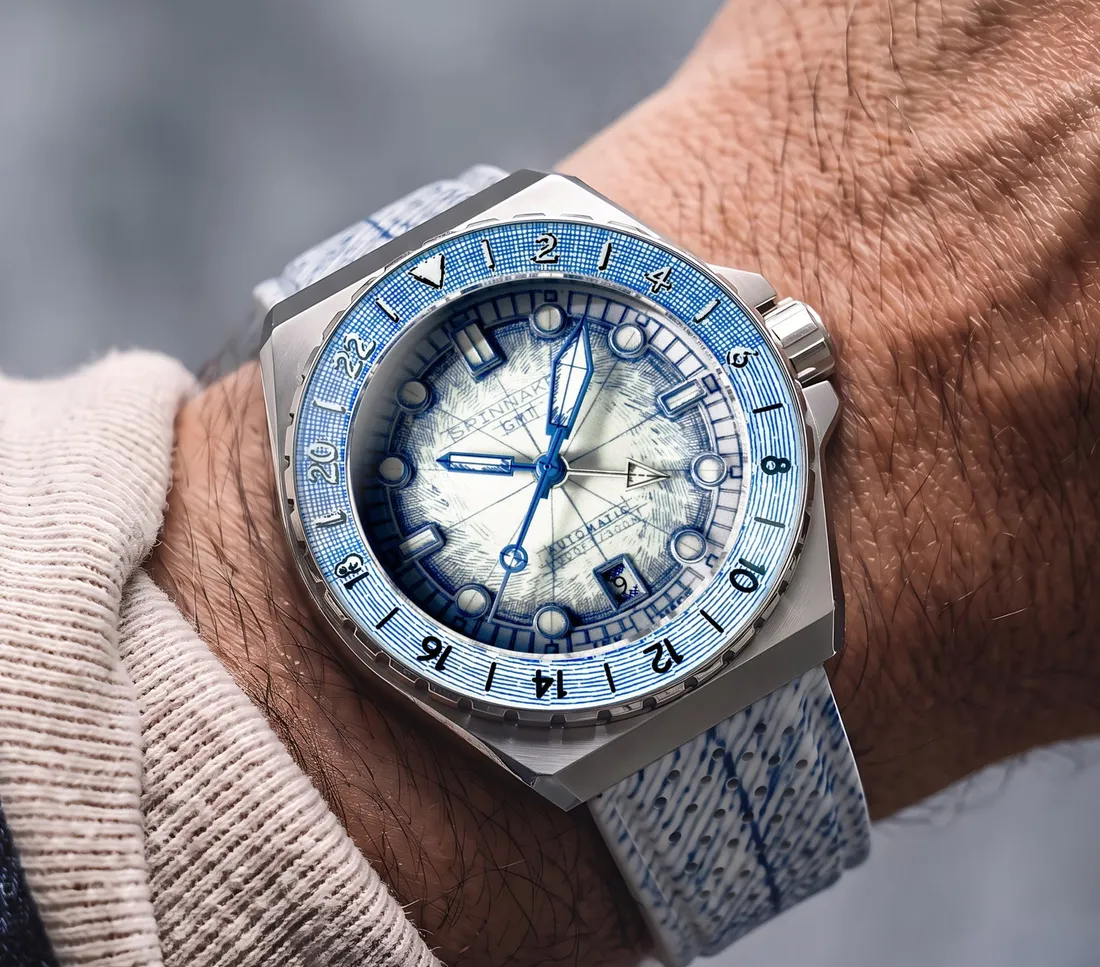
The numbers go like this. The case is forty-three millimetres across, fourteen point nine millimetres thick and made of 316L steel, with forty-eight millimetres from lug to lug. The crystal is flat sapphire with an anti-reflective coating. The bezel turns in both directions. The crown screws down. The strap is twenty-two millimetre rubber with pen hatching printed on its upper face. Water resistance is thirty bar, which is three hundred metres. The watch weighs one hundred and twenty grams and comes with a two-year international warranty.
The Japanese TMI NH34 automatic GMT inside beats twenty-one thousand six hundred times an hour, carries twenty-four jewels, runs forty-one hours and shows hours, minutes, seconds, the date and a second time zone.
The edition comes in two colours, four hundred and fifty pieces of each, nine hundred watches in all. The price is four hundred and fifty-three euros and ninety-five cents. The maker has hidden six envelopes among them: six cards made, signed and numbered by hand by Ben Li to mark Inkdial’s sixth year, sealed into six boxes chosen at random. Which box holds one is not known until the box is opened.
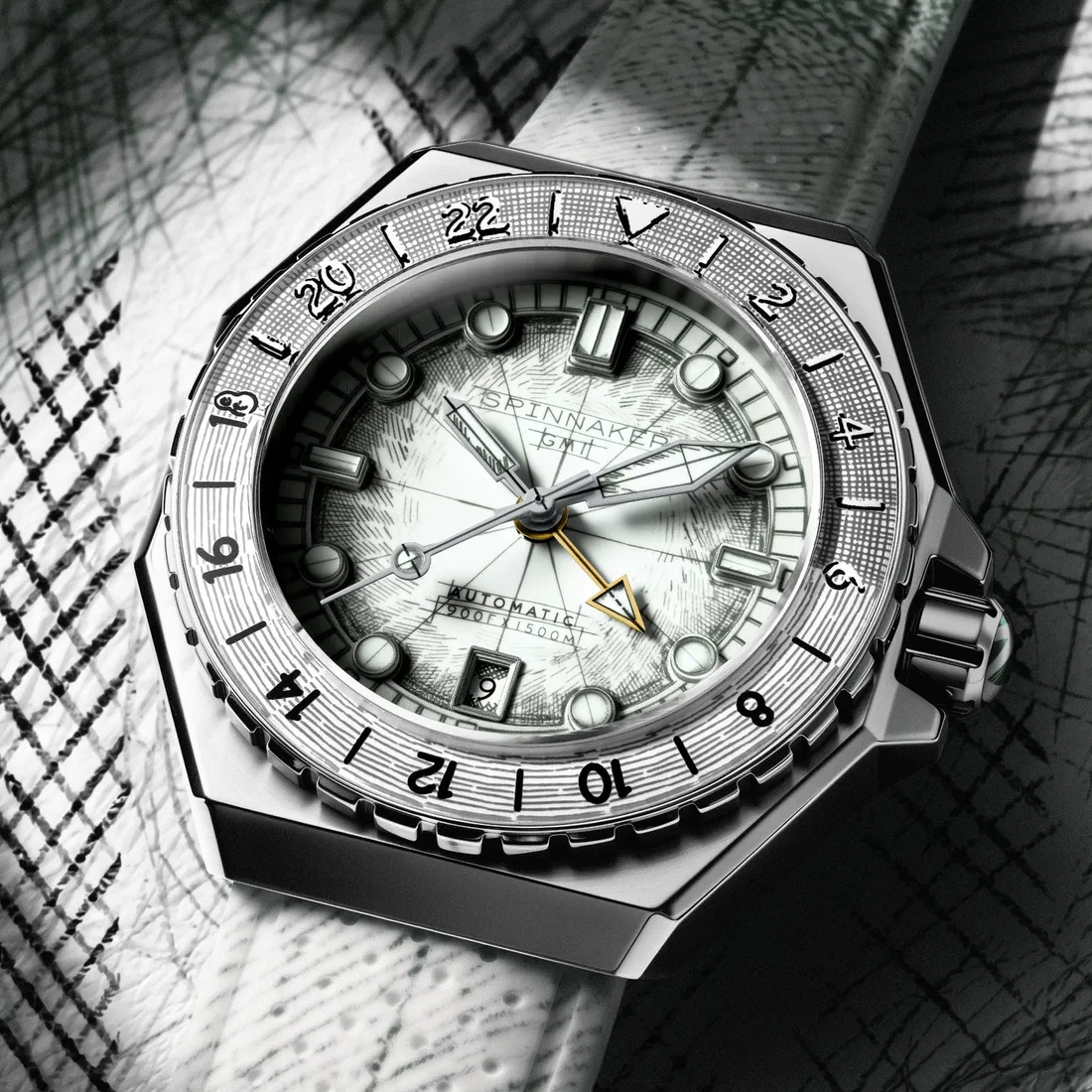
The second colour is Ink White. There the ink turns from blue to graphite, dial and bezel carry the same hatching in shades of grey, and the GMT hand becomes yellow gold. The same drawing, made with another pen.
Looking at this watch, this may be what comes to mind.
When Frédéric Dumas went down, he learned what a man loses where the light runs out: first his colour, then his sense of time, in the end his own attention. A man is a diminished creature in the dark, and he only understands that once he has gone into it.
But the same man also knows how to carry something with him to the place where he is diminished. He lays a compound that keeps the day’s light for the evening over the face of a dial, and he enters the night with that light. The Creator placed both the light and the matter able to hold it; the work of the man in between is to bring the two together and to remember his measure.
The Spinnaker x Inkdial Dumas GMT Automatic is a design that joins toughness on one side, in its eight-sided steel case and sapphire crystal, to elegance on the other, in Ben Li’s hand-drawn art in ink. In daylight it offers the organic truth of ink and line; when night falls it lights the dark with the green and blue of the chemistry of photoluminescence.
Bringing the ink of the day together with the light of the night, this model is a singular statement carried on the wrist for anyone who wants to live time on a canvas that is at once mechanical and artistic.
The watch on its maker’s own page: Spinnaker, Dumas GMT Automatic Inkdial Limited Edition