Remember Carl Sagan's famous line: 'We are made of star-stuff.' This is not poetry but, quite literally, a fact of physics. The iron in our blood, the calcium in our bones, the oxygen we breathe; all of it was forged inside stars billions of years ago and flung across the universe when those stars died. The heaviest elements, gold, platinum and the rare earths, were born in an even more violent event: a kilonova, the collision of two dead stars. So the universe, from the smallest atom to the farthest planet, is kneaded from a single dough.
If that is so, then a person gazing at the sky is in fact gazing at their own origin. And certain souls, as they read those celestial ornaments, crystallise from matter toward meaning; they slip beyond the cage of the body and set out on a journey among the stars. This is the story of such a traveller's journey among eight planets, and of a genius who fitted that journey onto a wrist.
The Sky's Eight Stations
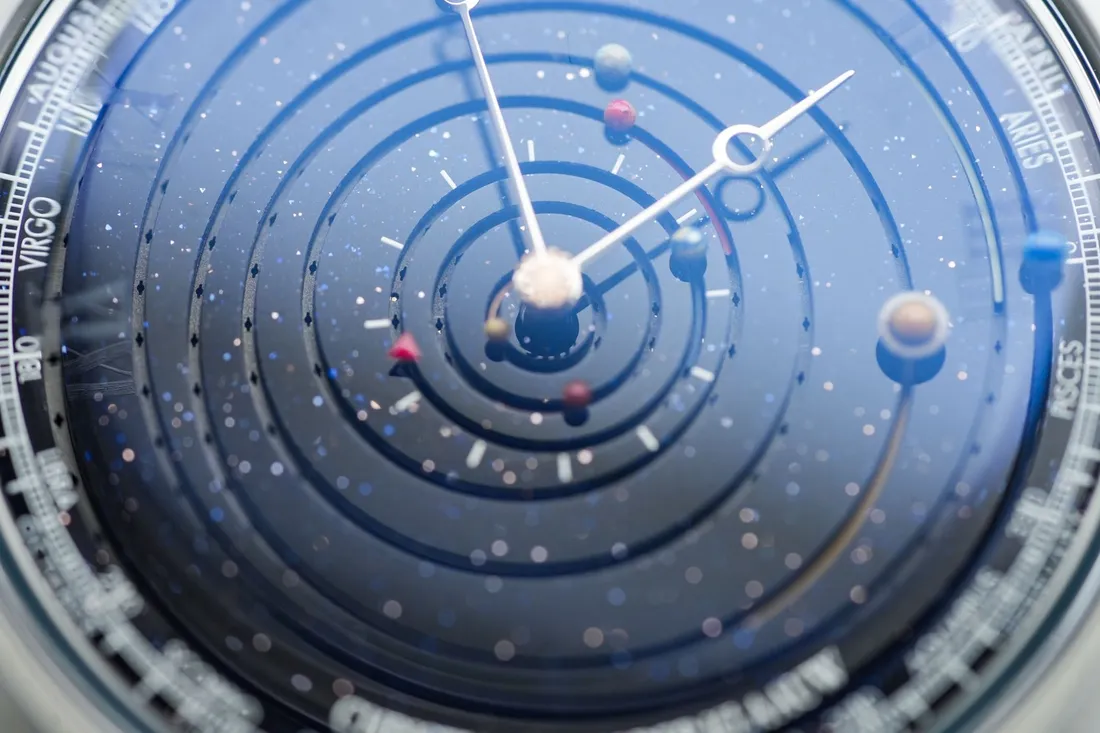
That night the traveller's soul slipped from the cage of the body, became a stream of shimmering light, and wandered one by one the eight worlds turning around the Sun. But what it saw was neither the creatures of fairy tales nor a blind machinery. What it saw was a flawless order and a deep surrender. Every planet turned along the orbit appointed to it, never faltering, as though in a state of devotion.
Mercury, closest to the Sun, was a hurried remembrance completing its round in eighty-eight days; Venus turned in two hundred and twenty-four days, Earth in three hundred and sixty-five. Farther out, Mars, Jupiter and Saturn each swung in its own stately tempo. And the most distant shook the traveller most of all: Uranus completed a single turn in eighty-four years, Neptune in a full hundred and sixty-four. A single year of Neptune was twice the length of a whole human life. The traveller understood that each planet measured its own time by its own orbit; and all of them together were part of a silent yet immense dance. The cosmos was a turning rosary, and each planet a single bead.
The Light Born of Death
When the traveller reached the darkest station, the night of Neptune, it noticed that the dial of the watch in its hand glowed of its own accord. The name of that faint green light was Super-LumiNova, a substance that drinks light by day and gives it back by night. But what truly made it shine were two rare earth elements within it: europium and dysprosium. And these elements were living proof of the truth stated at the outset; for they were forged not on Earth, but billions of years ago, in the fire of a kilonova, in the death of two stars.
So the dial did not merely depict the universe; with that light glowing in the dark, it truly carried a piece of a star's death. This small universe in the traveller's palm had been made from the ashes of the great one.
The Genius of Leiden and 3,338 Teeth
But how does a human being fit this celestial dance, these eight separate times, onto a wrist? The answer is hidden in a child born in 1944 in the Dutch city of Leiden: Christiaan van der Klaauw. Leiden was no coincidence; three centuries earlier, the great Christiaan Huygens, who first drew Saturn's rings and invented the pendulum clock, had also come of age in that city. It is as though astronomy and watchmaking were written into the same name on the same soil. In 1974 the young Christiaan founded the only atelier in the world devoted entirely to astronomical watches; in 1989 he became the first and only Dutchman ever admitted to Switzerland's legendary academy of independent creators, the AHCI, under the same roof as George Daniels and François-Paul Journe.
His great challenge was this: with the power drawn from a single mainspring, to turn eight planets at eight separate real speeds. Each planet's disc had to turn at such a gear ratio that it completed one full turn in exactly that planet's true orbital period. Picture the gears of a bicycle: the smallest sprocket spins like mad (Mercury), the largest barely stirs (Neptune); yet all are joined to one chain. A single error on a single tooth would fling a planet, over the decades, from its true place in the sky. To hit these ratios to a hair, van der Klaauw calculated, even in the age of computers, 3,338 teeth by hand, one by one. The only mechanical watch in the world to show all eight planets in real time is the work of this forest of teeth; every other planetarium stops at six.
But how did scientists find these periods? The answer lies in Johannes Kepler's third law: the square of a planet's orbital period is proportional to the cube of its distance from the Sun. Simply put, the farther a planet lies, the longer its path grows and the more slowly it moves; it is slowed twice over. Picture a giant stadium track: the runner in the outer lane runs a longer loop and at a slower pace, so a single lap takes far longer. Van der Klaauw translated this law, written across the sky, into brass and gears. And the word 'Eccentric' in the watch's name tells that the orbits are not perfect circles but, as in reality, slightly elliptical; which makes it a more honest copy of the heavens.
Harder Than Rock, Coloured by Space
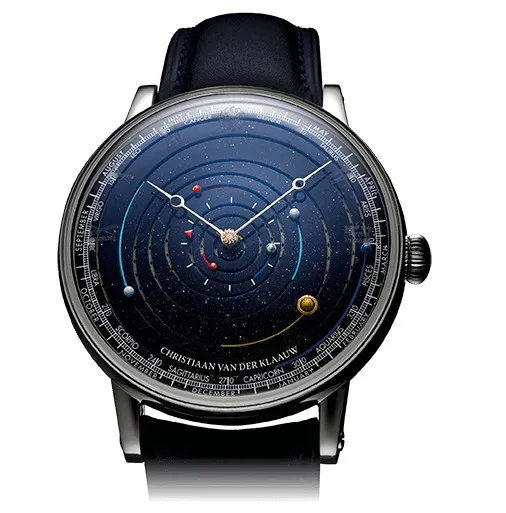
Such a universe could not be guarded by an ordinary shell. The forty-four-millimetre case is first machined from 316L stainless steel, then subjected to low-temperature carbon diffusion; this process seeps carbon atoms into the surface of the steel and turns that surface almost into a ceramic armour, without warping the part. The result is a surface hardness of around 1,200 Vickers, roughly six times that of untreated steel. Finished by bead-blasting, the matte grey surface scatters light and renders any small scratches almost invisible. The watch measures 44mm across and 14.3mm tall.
The dial is a marvel of its own: it is made of nine pieces of oxidised silicon. It draws its colours not from pigment but from light itself; as light passes through this micron-thin oxide layer and reflects, it bends, and through a phenomenon called interference it produces blue-violet tones that shift with your angle of view. You see the same living colours in a soap bubble, a film of oil, or a butterfly's wing. So the dial is not a fixed surface but a living sky; that violet-blue glow evoking the depths of space comes from here.
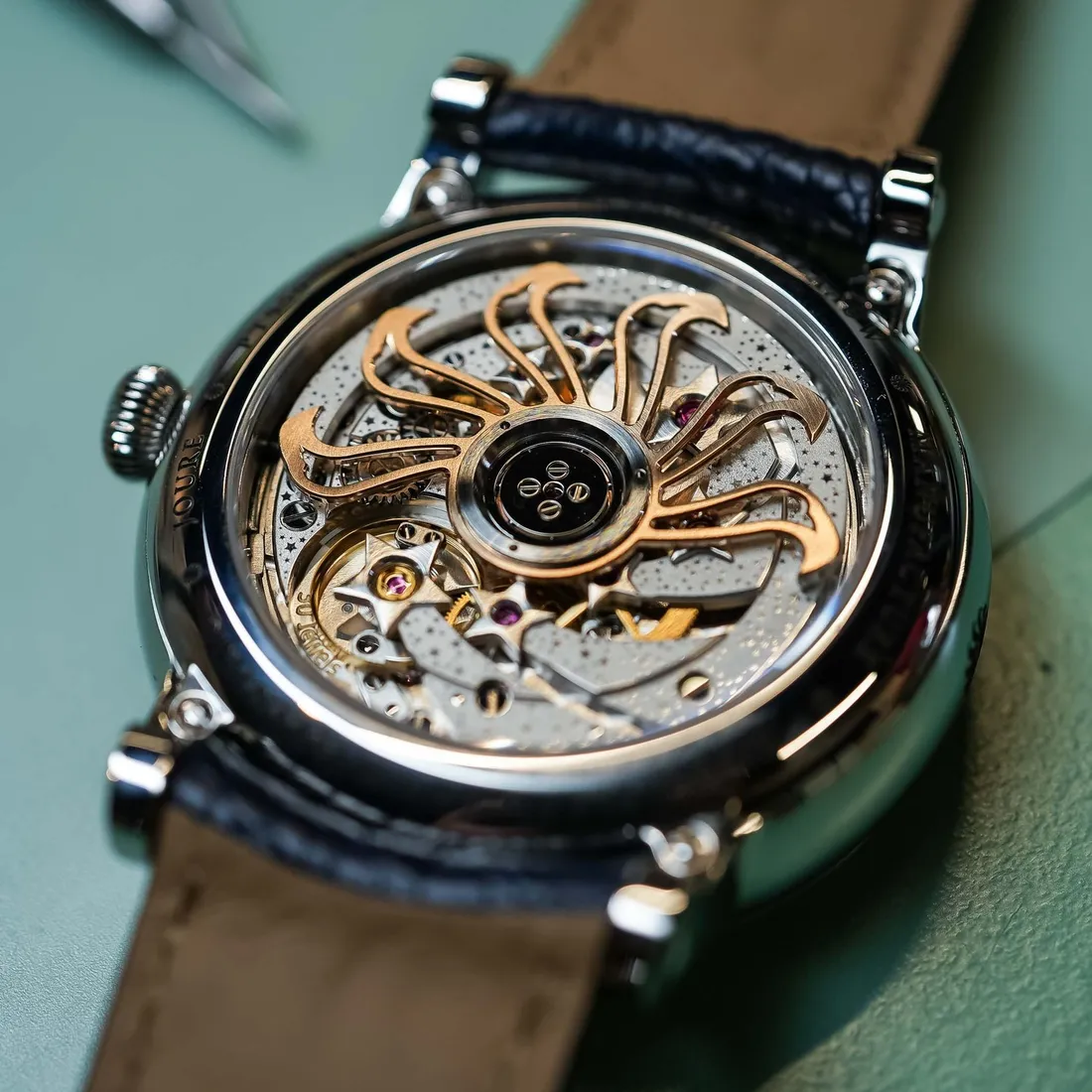
Beneath all this beats an automatic manufacture movement carrying the most refined details of high watchmaking: its base laid down by the great movement constructor of our age, Andreas Strehler, its planetarium module developed entirely in-house. Sixty hours of power reserve, 21,600 vibrations an hour (3 Hz), 32 jewels; and a free-sprung balance whose rate is set not by an index lever but by tiny weights on the balance rim, the quiet signature of high horology. The rotor that winds the watch is shaped as a skeletonised Sun; even seen from the back, a small sun turns on and on.
The Cosmos's Signature Cast onto the Wrist
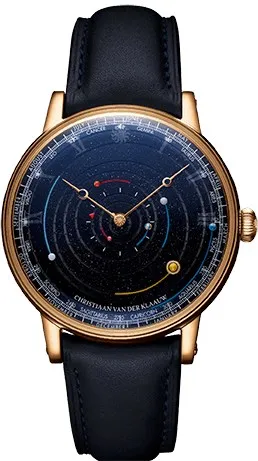
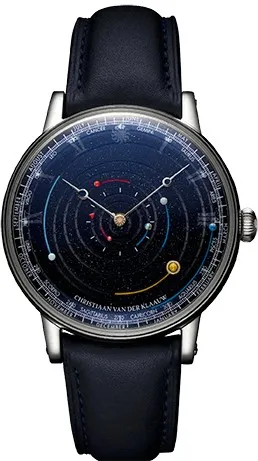
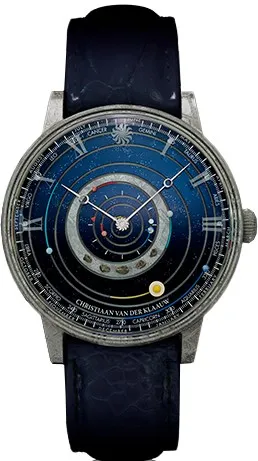
When the traveller's soul returned to its body with the universe's secrets in its pocket, one question remained: how would it convey that vertical, timeless experience to the horizontal world? Here human genius entered. A watchmaker took that celestial journey and breathed it, with his fingertips, into a mechanism. What emerged was an echo of that night in the form of a micro-cosmos: the Christiaan van der Klaauw Grand Planétarium Eccentric.
This watch, in its platinum, rose gold, meteorite and grey steel interpretations, belongs to the permanent collection; but only a few can be made each year, and its price exceeds two hundred thousand euros. What you pay for is not metal; it is a universe calculated by hand by a genius, turning on your wrist. And it is telling that this very atelier is the same hands that made the heart of the famous Van Cleef & Arpels planetarium which also inspired our tale; this watch is the purest, most mature expression of that art. The poem of the stars, this time, is written not in six lines but in eight. And that poem goes on glowing on your wrist, in the dark, with the light of a kilonova.