It was well past midnight at the station on the mountain. The dome was cold and the only light came from the screens. The astronomer sat down at the console and sent out a green pulse of laser light.
The beam left a thin line across the sky and vanished. Two and a half seconds later a few points appeared on the screen.
The astrobiologist, sitting in the chair opposite, leaned forward. Are those them, she asked.
Those are them, the astronomer said. A handful of returns out of the billions of photons we sent. There are mirrors sitting on the surface of the Moon and they have been there for more than fifty years. Astronauts left some of them; remote-controlled rovers carried the others. We send the light up, the mirror sends it straight back the way it came, and we measure the interval.
And what do you learn from that, she asked.
We learn the distance, he said. To within a few millimetres. And every measurement tells us the same thing: the Moon is moving about three point eight centimetres further away from us every year.
She was quiet for a moment. Then she asked why it is leaving.
It is not leaving, he said. We are pushing it.
The Moon pulls our oceans towards itself and raises two bulges on the surface of the water. One of them sits on the side facing the Moon and the other sits directly opposite. That much is the tidal story everybody knows. The real point is this: the Earth completes a turn on its own axis in twenty-four hours, while the Moon completes its orbit in twenty-seven days. Our planet therefore turns far faster than the Moon travels, and as it turns it drags that bulge of water around with it.
The bulge does not stay directly beneath the Moon. It runs slightly ahead of it. And that enormous mass of water, sitting out in front, pulls the Moon forward with its own gravity. It is exactly what you do when you push a child on a swing. The Moon gains speed, and as it gains speed its orbit widens and it slowly climbs away.
Where does that energy come from, she asked.
From us, he said. From the Earth’s rotation. Every push we give the Moon is taken out of our own spin. Our planet is slowing down. A day lasts twenty-four hours now, but six hundred million years ago it lasted about twenty-two. We do not have to guess at this; we read it by counting the growth rings of corals that lived in that period and the layers in sediments laid down by the tides. A year in those days held more than four hundred days.
format_quote"The Moon is moving away because we are pushing it. Every push we give it is taken out of our own planet’s spin."
Hasan Bekmezci
She leaned back against the edge of the console. So we pushed it and it slowed us down, she said. A mutual exchange.
And it paid first, he said.
The Moon once turned on its own axis far more quickly. The Earth’s gravity did the same work on it and raised a bulge in its rock as well, and that bulge braked the Moon’s rotation over millions of years. In the end the Moon’s spin came to match its orbit around us exactly.
That is why the Moon always shows us the same face. Across the whole of human history not one person saw the other side of it. The first photograph of it was taken by a spacecraft in 1959.
She repeated the phrase: always the same face. Then she added that a body having its rotation locked to the thing pulling on it reminded her of a mechanism.
It should, he said. The principle is identical. In the sky and inside a watch alike, every part sets the speed of its neighbour, and nothing turns on its own.
She brought the conversation round to her own field. That is not the question that matters to me, she said. What matters to me is what would have happened on this planet if that Moon had not been there.
The Earth’s axis of rotation is tilted about twenty-three and a half degrees relative to the plane of its orbit. That tilt is the only reason we have seasons. When the northern hemisphere leans towards the Sun we get summer, and when it leans away we get winter. Without the tilt there would be no seasons at all.
The trouble with that tilt is that it is not stable on its own. The Sun and the other planets pull constantly at the axis of any planet and drag it in different directions. Without the Moon, the tilt of the Earth would swing widely and erratically over millions of years. Mars is the closest example we have, and because it has no large moon its tilt has wandered across a very wide range over time.
The Moon damps that swing with its mass. The tilt of our planet moves by only about two degrees, and it does so on a slow rhythm spread across forty thousand years. That falls inside the limit a climate needs in order to stay stable.
So the existence of the seasons depends on the Moon, he said.
It goes further than that, she said. A stable season means a stable plant cover. A stable plant cover means it becomes possible to know when to sow a seed. Agriculture was born there. Because agriculture was born, a calendar became necessary. And because a calendar became necessary, human beings began to measure time.
The astronomer closed the measurement window and sat back. There are also the tides, he said.
The tides are the most important part for me, she said.
A shoreline is a strip of land that goes under water twice a day and is exposed twice a day. Wetting and drying alternate along that strip on a fixed schedule. During the drying, whatever liquid is left behind becomes concentrated and the molecules in it are pushed closer together. During the wetting, everything is dispersed and mixed again. That regular cycle prepares the conditions simple molecules need in order to build longer chains.
No such rhythm exists in a still ocean, she said. Without tides a shoreline would be nothing but water. The Moon gave that shoreline a rhythm, and the rhythm set the chemistry moving.
The tides are themselves variable. At new moon and at full moon the Sun and the Moon lie along the same line and their pulls are added together, so the water rises highest. At the first and last quarters the two stand at right angles and their effects partly cancel, so the water is at its calmest. The rhythm of the sea is therefore tied directly to the shape of the Moon. A fisherman looking at the sky knew what the sea would do without looking at the sea at all.
format_quote"A fisherman looking at the sky knew what the sea would do without looking at the sea. The shape of the Moon was the timetable of the water."
Hasan Bekmezci
The wind had risen outside the dome. The astronomer was silent for a while, then said there was one thing they had to be careful about in all of this.
The Moon does none of it. The Moon makes no decision, pursues no purpose and has no wish to protect our planet. The Moon is a mass, and it holds the orbit it was given. That it keeps our axis steady, stirs our seas and hands us the seasons is not the result of any intention on its part. It is the result of the measure it was given.
She nodded and offered a comparison. The balance wheel inside a watch does not know what it is for either, she said. It simply swings back and forth. It has no idea that its swinging divides a span of time, or that the time it divides sets the hour of somebody’s appointment. The function of a part does not depend on the knowledge of the part.
That is exactly it, he said. The measure was given and the part carries it out. Had that measure been set less precisely, there would have been nobody here to have this conversation.
format_quote"The Moon makes no decision and pursues no purpose. That it holds our axis steady is not the result of its will but of the measure it was given."
Hasan Bekmezci
This is why the first calendar humanity kept was a lunar one. The Sun gives you the hour but never the day. You can read noon off the length of a shadow, but you can never read the date. The Moon does the opposite. It says nothing about the hour, but by changing shape a little every night it hands you the date. A thin crescent marks the beginning of the month and a full disc marks the middle of it. The Moon was the only calendar that could be read without an instrument.
That calendar carries one difficulty. The Moon completes its circuit of the Earth in about twenty-seven days and eight hours. But to see the same shape again in the sky you have to wait twenty-nine days, twelve hours and forty-four minutes.
The reason for those two extra days is this. While the Moon was going round, the Earth did not stand still; it moved about twenty-seven degrees further along its own path around the Sun. When the Moon returns to where it started, the Sun lies in a different direction and the light falling across the Moon arrives at a different angle. To catch the same phase again, the Moon has to close that drift, which means travelling a little further.
That figure of twenty-nine and a half days is not a whole number either. Twelve of them come to three hundred and fifty-four days, while a year runs three hundred and sixty-five. A gap of eleven days is left over. The whole business we call a calendar is the effort to close that gap by hand. It is also why some months run thirty days and others thirty-one.
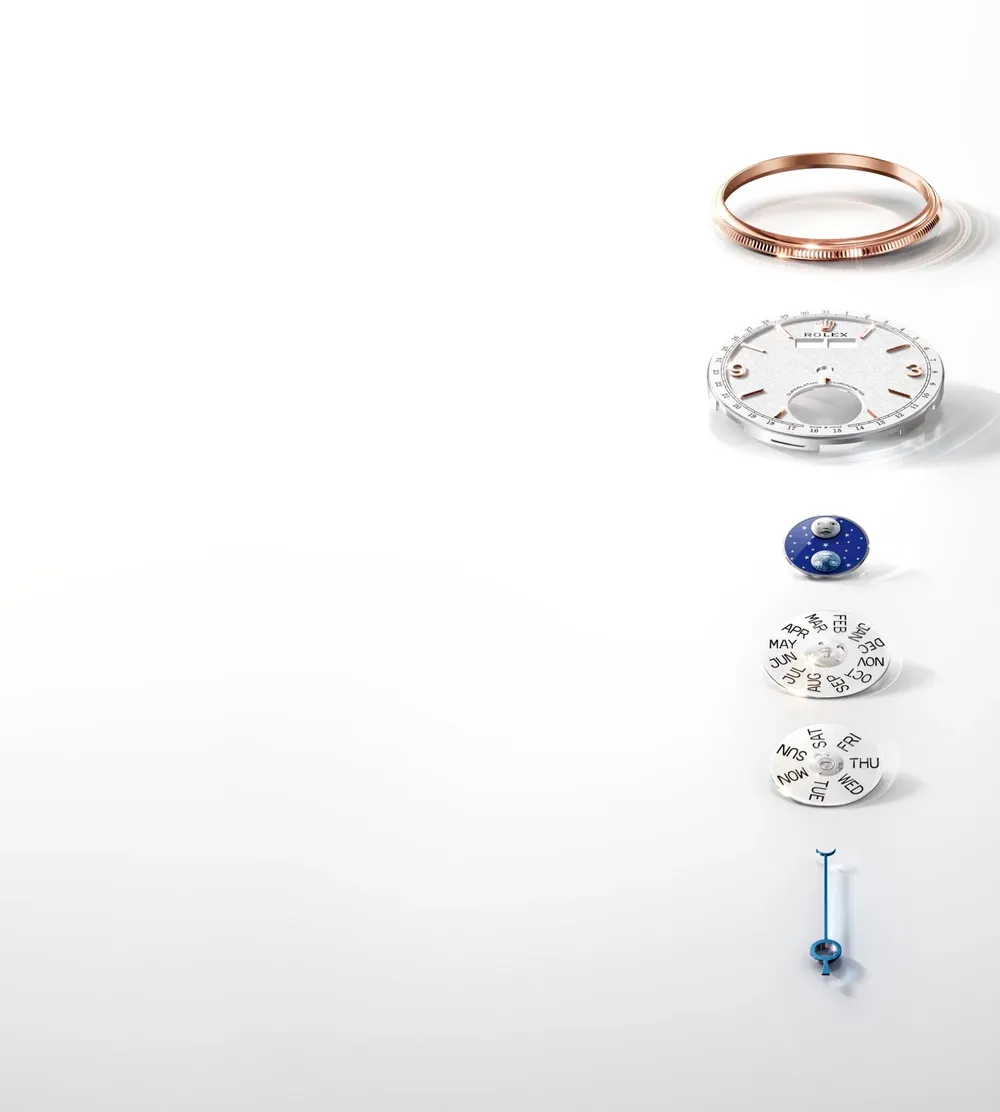
The question of when a human being first put this cycle inside a machine has a known answer, and that answer is far older than most people expect.
At the beginning of the twentieth century, divers working on a wreck in the Aegean brought up a lump of bronze that had gone green. There were traces of gears on it. Decades of study established that this object, more than two thousand years old, was a calculator for the sky. It held around thirty bronze wheels, and those wheels computed the positions of the Sun and the Moon.
Two details in it are the most striking. The first is that it took account of the fact that the Moon does not move across the sky at a constant speed, and imitated that variation through a sliding connection between a pin and a slot. The second is that it carried a small sphere. One half of the sphere was dark and the other light, and as it turned it displayed the shape of the Moon on that day.
The moonphase display, in other words, was built roughly two thousand years before the wristwatch.
The next stop is the cathedrals of Europe. The great astronomical clocks raised in England and in Italy during the fourteenth century showed the phase of the Moon on their tower dials. These were public instruments from which people read both the hours of prayer and the calendar of the fields. From the sixteenth century onward the same indication shrank and moved into pocket watches. The arrangement that gives the date, the day, the month and the phase of the Moon together still goes by the same name in watchmaking today.
The classical solution for that indication rests on a very plain piece of arithmetic. Two moons are drawn on a disc and the disc is carried by a wheel with fifty-nine teeth. If the wheel advances one tooth a day, one moon takes exactly twenty-nine and a half days to give way to the other.
The real cycle is a little over twenty-nine days and twelve hours. The difference comes to roughly forty-four minutes a month, and it accumulates. A classical moonphase therefore falls a full day behind after about two years and seven months. A refined train using a greater number of teeth pushes the same error out to one day in a hundred and twenty-two years.
To a watchmaker these are technical details. The truth behind them is this: no cycle in the sky is a whole number, and no gear ratio can meet one perfectly. The watchmaker does the best that can be done and brings the ratio as close to the real figure as possible. The small remainder waits patiently, accumulates, and one day makes itself known.
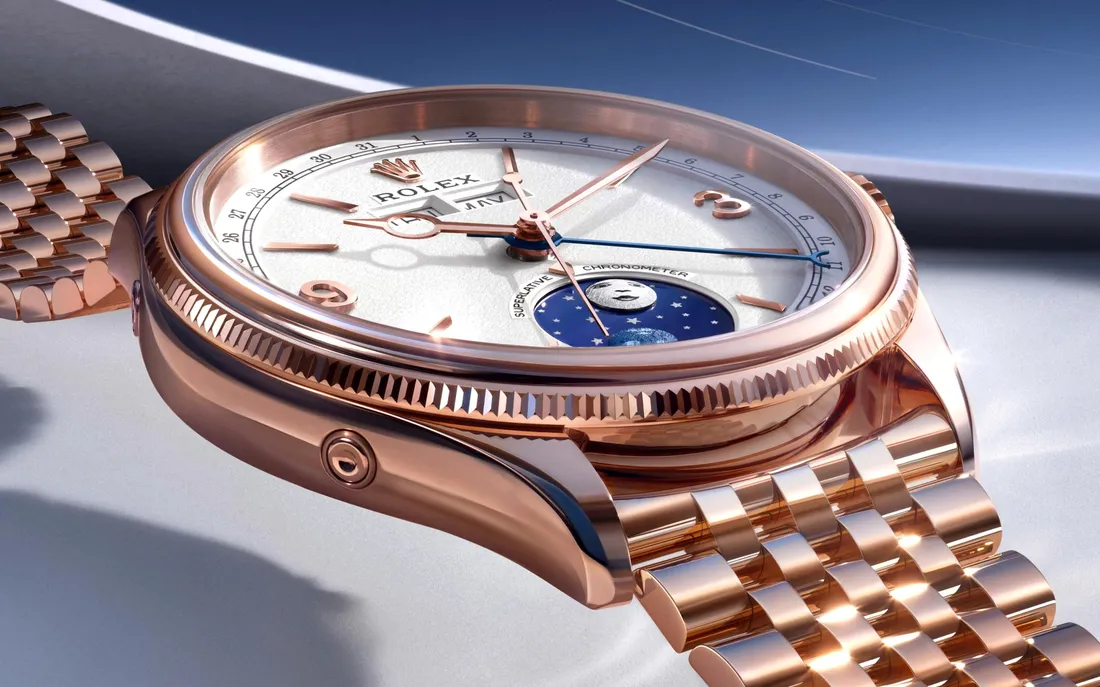
Rolex placed this indication in one of the most remarkable watches of its own history in 1949. Reference 8171 arrived in a thirty-eight millimetre case, considered large at the time. Its dial carried day and month apertures at twelve o’clock, a long hand around the rim for the date, and a moonphase at six. Inside it ran the self-winding, chronometer-certified calibre A295.
The watch also had a shortcoming. Its caseback snapped on rather than screwing down, which placed it outside the waterproof case family that carries the brand’s own name, and that was unusual for Rolex. The model left production in 1953. The total came to somewhere between a thousand and twelve hundred pieces.
It did not name itself either. In those years Italian retailers and collectors, looking at that wide, flat case, reached into the kitchen for a word. Padellone means big frying pan in Italian. The brand never used the word and never printed it in a catalogue. The name survived seventy years all the same.
This September, presenting the new model, Rolex formally took that nickname on, and made the presentation in Milan, because Milan is where the name was coined. A brand adopting the word the public gave its own product is a rare kind of surrender in watchmaking.
format_quote"The brand did not give it the name; the people who wore it did. Seventy years later what survived was their word, not the maker’s."
Hasan Bekmezci
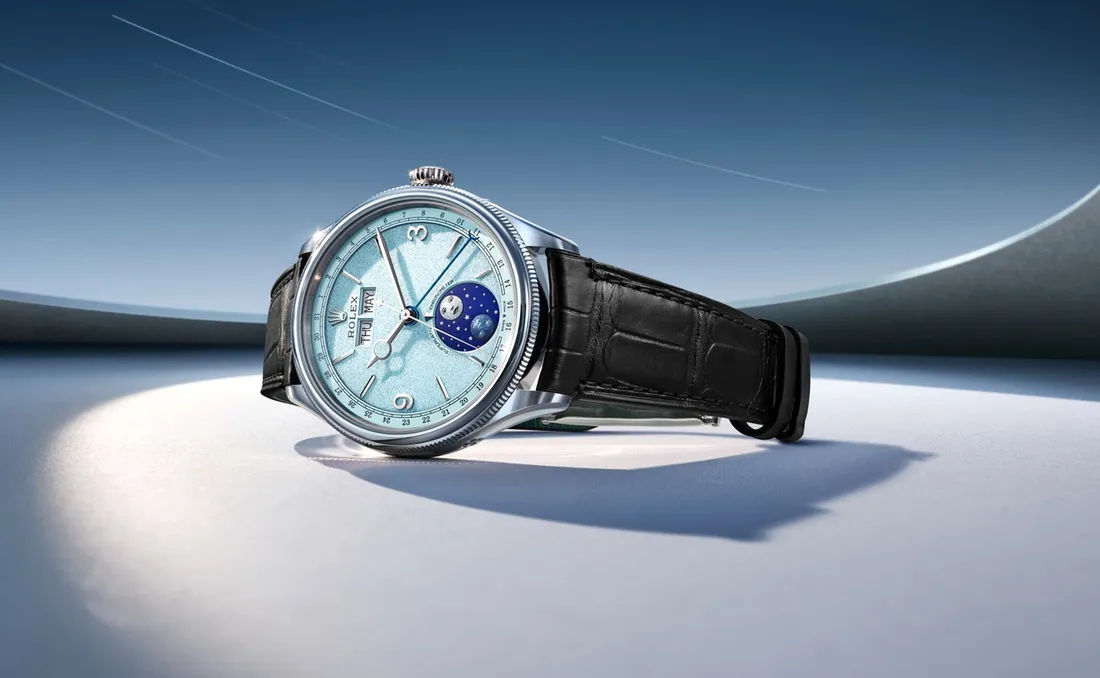
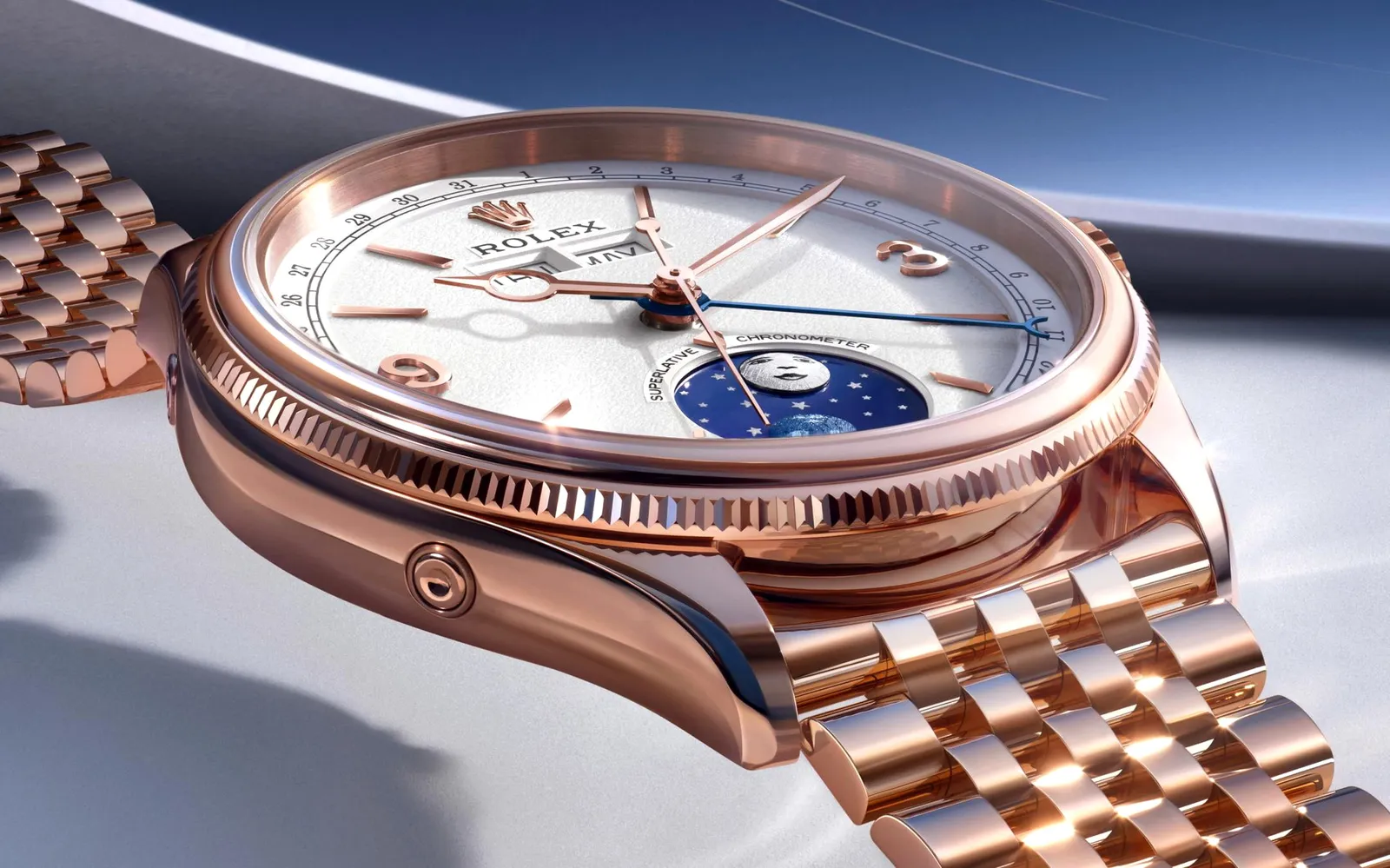
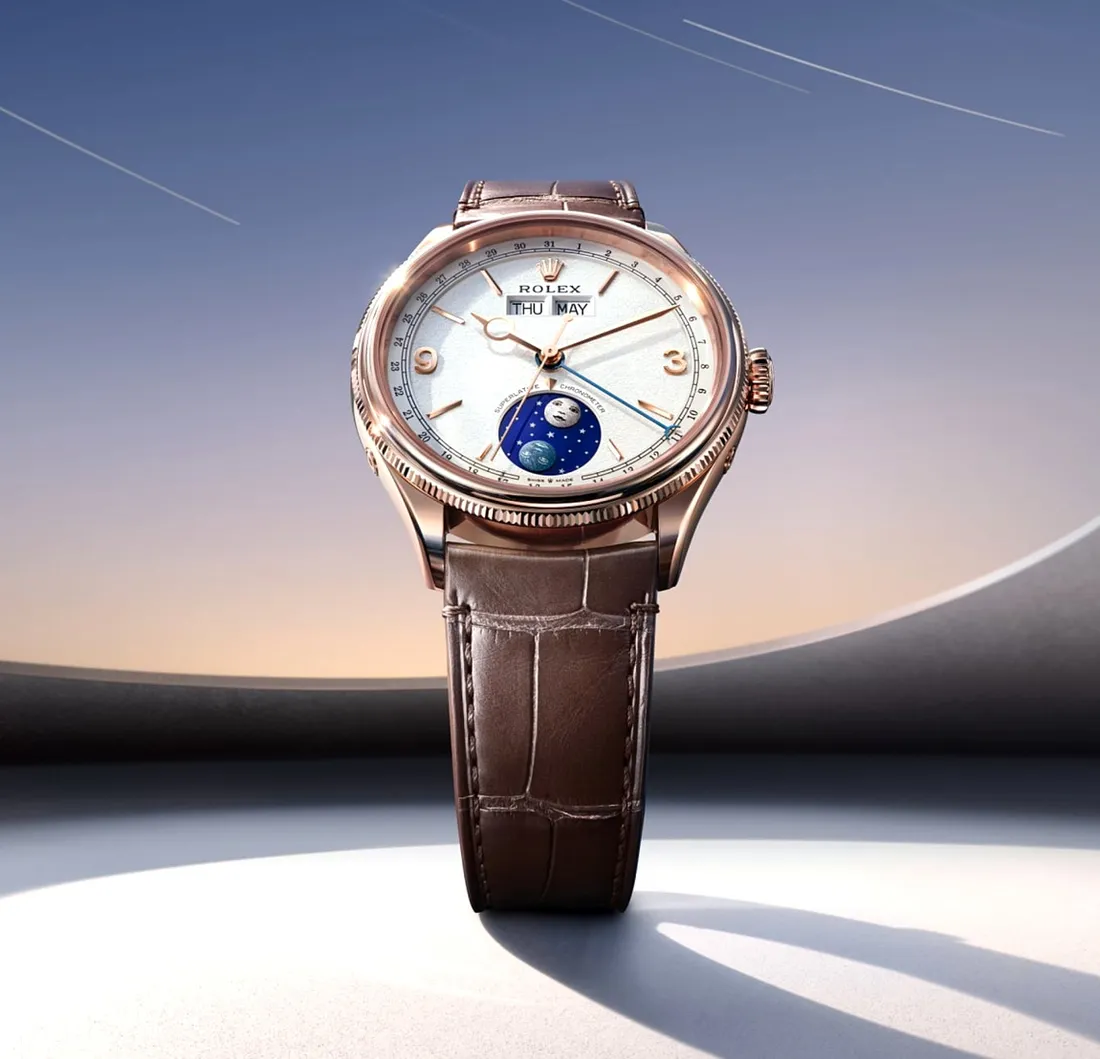
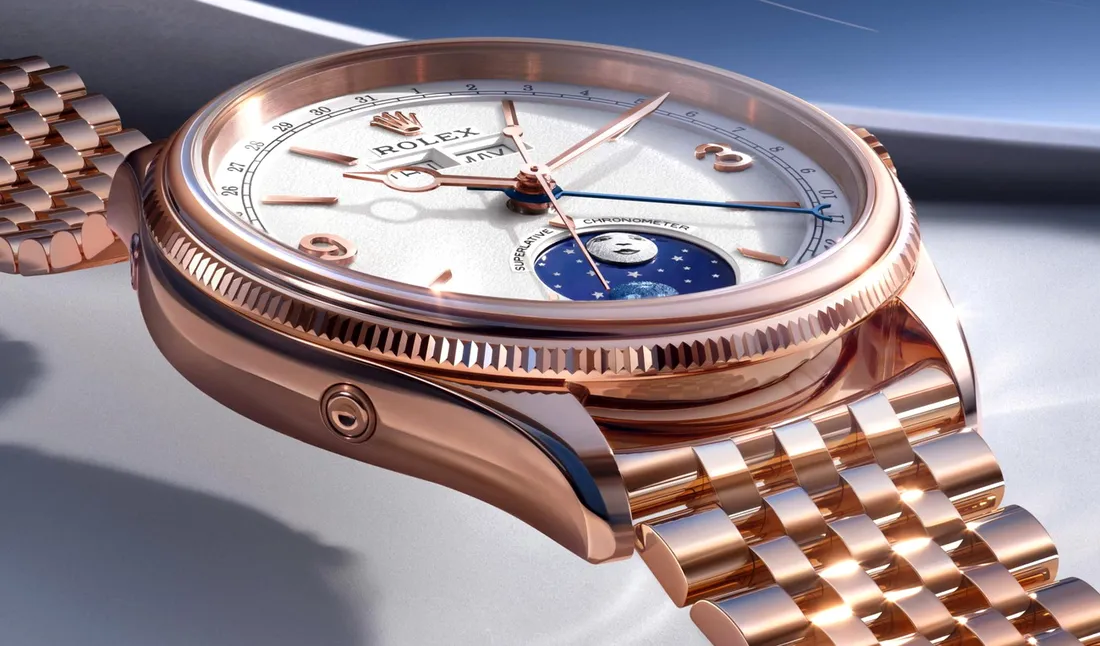
The new Perpetual Padellone measures thirty-nine millimetres across and 12.20 millimetres deep. It runs about forty-five millimetres from lug to lug, so it sits smaller than the figure suggests. The case is made in 18 ct Everose gold or in 950 platinum and is polished throughout. The bezel is domed and finely fluted, and the crystal is domed sapphire.
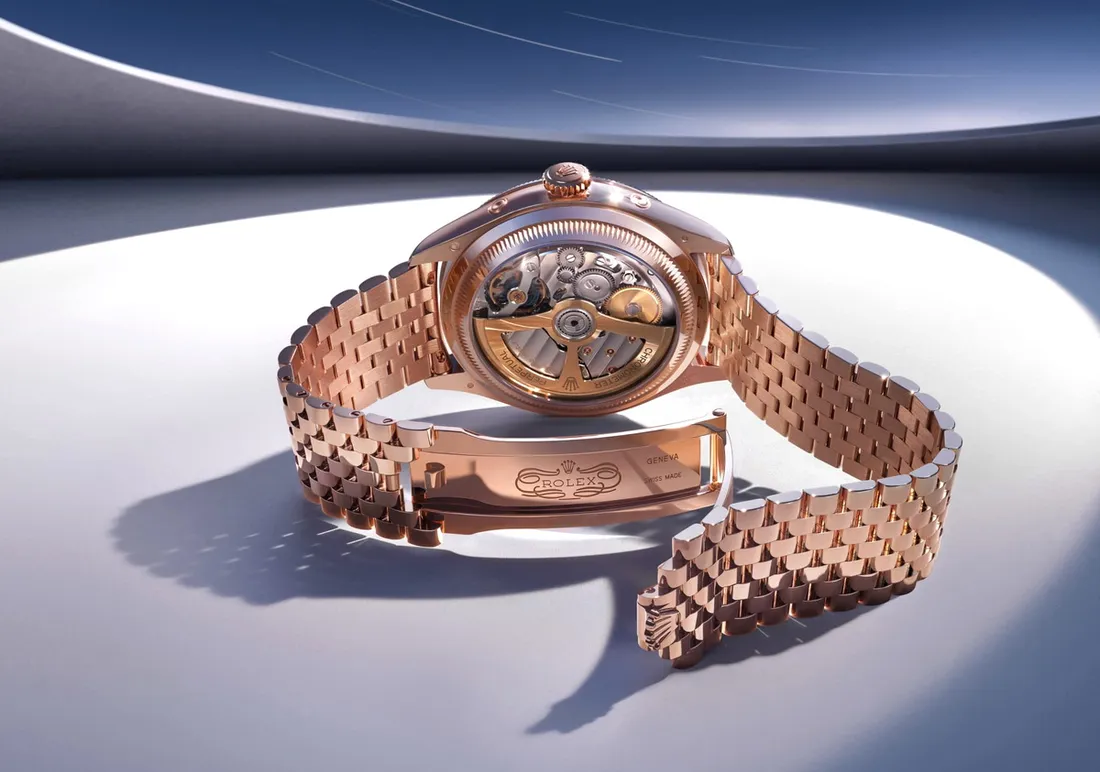
This time the caseback screws down, and it carries a sapphire at its centre through which the movement can be seen. The greatest shortcoming of the first model has been closed seventy-seven years later.
The crown is push-pull and the water resistance is fifty metres. Both values look modest for a Rolex, but the reason is plain. The calendar correctors are recessed into the flanks of the case at two, four, eight and ten o’clock. On a case carrying that many openings, a higher rating would mean nothing. This is not a diving instrument.
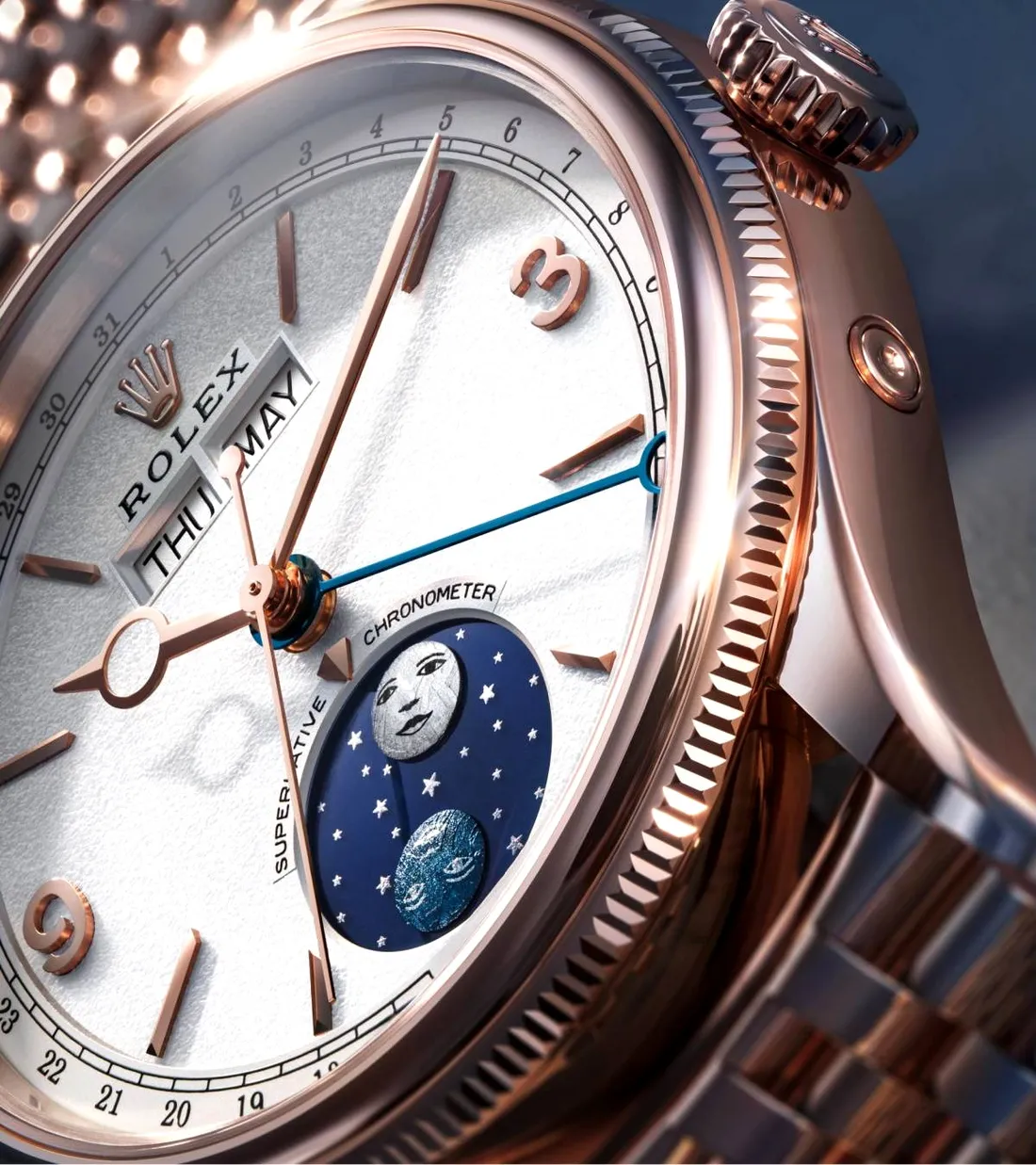
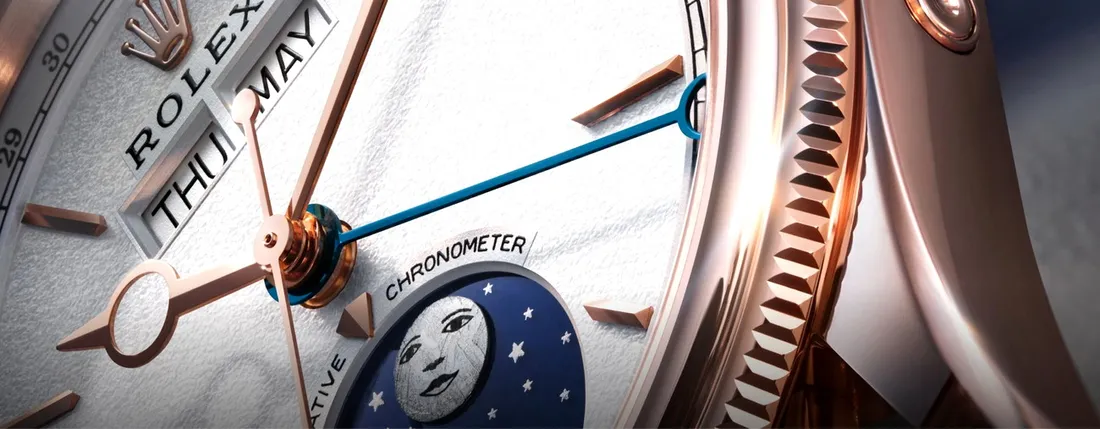
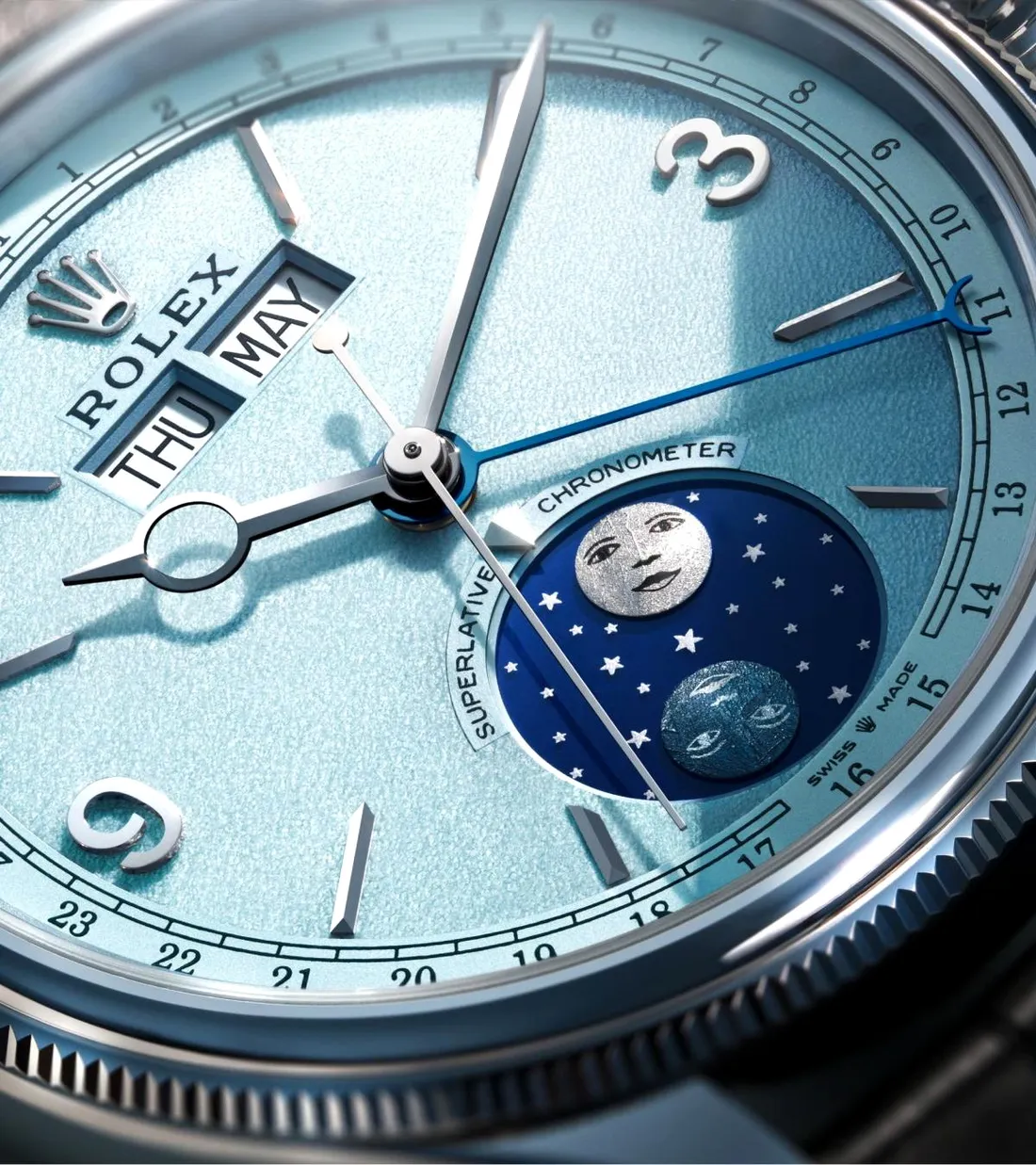
The dial comes in two colours. The Everose case carries an intense white surface and the platinum case an ice blue one. The centre is matte and grained while the date track is raised and finely satin-finished. That separation exists for legibility. A bright ring beside a matte centre reads to the eye as two distinct layers, so the date hand never sinks into the dial. Applied numerals sit at three and nine, and faceted markers cut from the same gold as the case occupy the remaining positions.
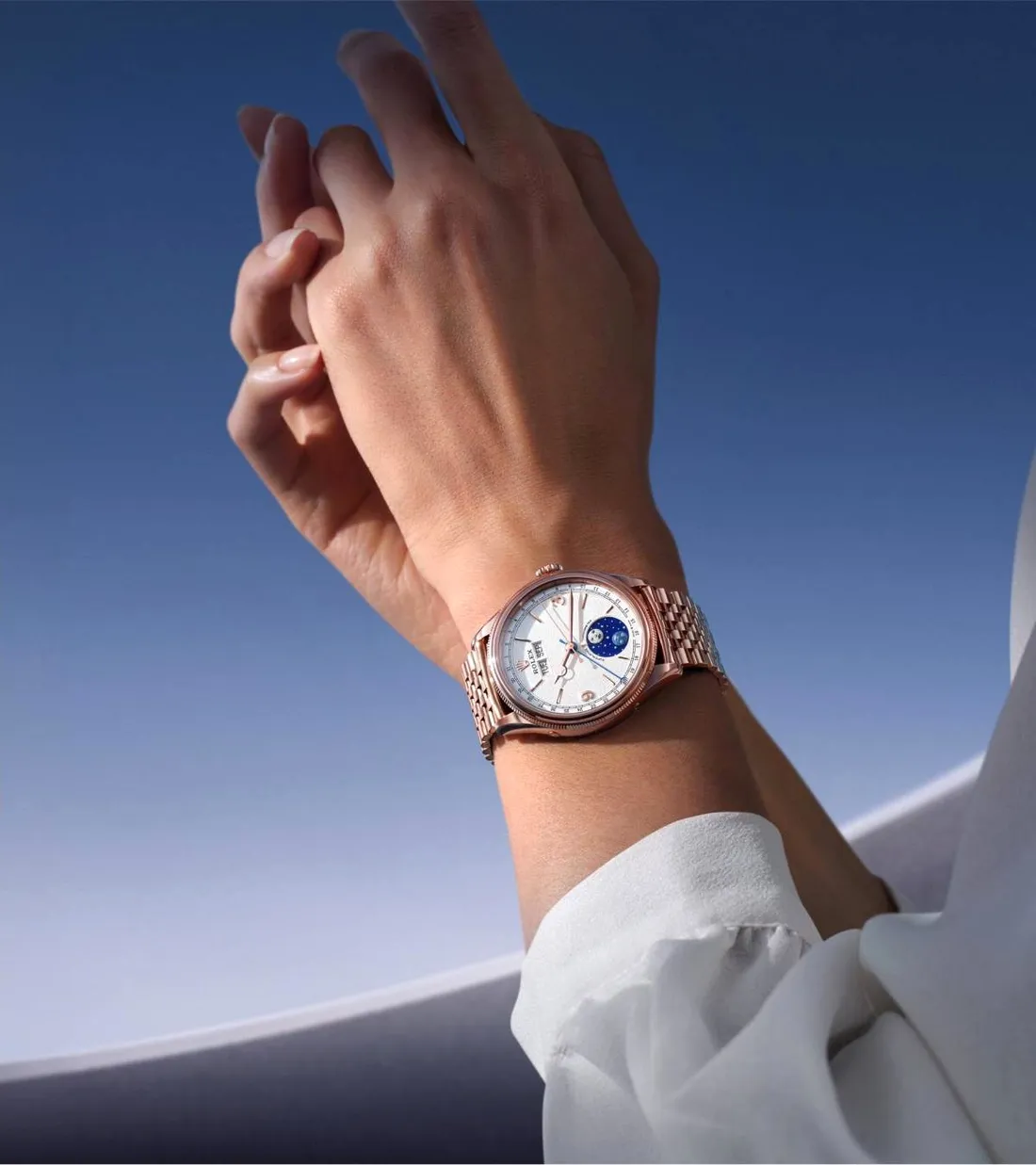
The date is again read not through a window but from a long hand travelling around the rim. The choice comes straight from the 1949 watch and it has a practical consequence. A window tells you only what today is, while a ring shows you where in the month you stand. In one you read a number; in the other you see a position.
The hand is blue and carries a small crescent at its tip. That crescent is not decoration. A sharp arrow can leave you arguing about which of two numerals it points at, whereas the open curve of a crescent encloses its target and removes the doubt.
The day and the month sit in two small apertures at twelve o’clock. What is new here is when those apertures change. On most calendar watches the discs creep towards midnight and the word stands half visible for an hour. On this watch the change is instantaneous, and at midnight all three indications fall into place in a single movement. An instantaneous change means a spring is charged in advance and released in one instant. Preparing that energy without stealing it from the rest of the movement is the most laborious part of calendar work.
The greatest difference from the first model lies in the calendar itself. The 1949 watch carried a simple calendar, and at the end of every thirty-day month the date had to be pushed forward by hand. That was repeated five times a year. The new model carries an annual calendar and removes four of those five corrections. Only February is left.
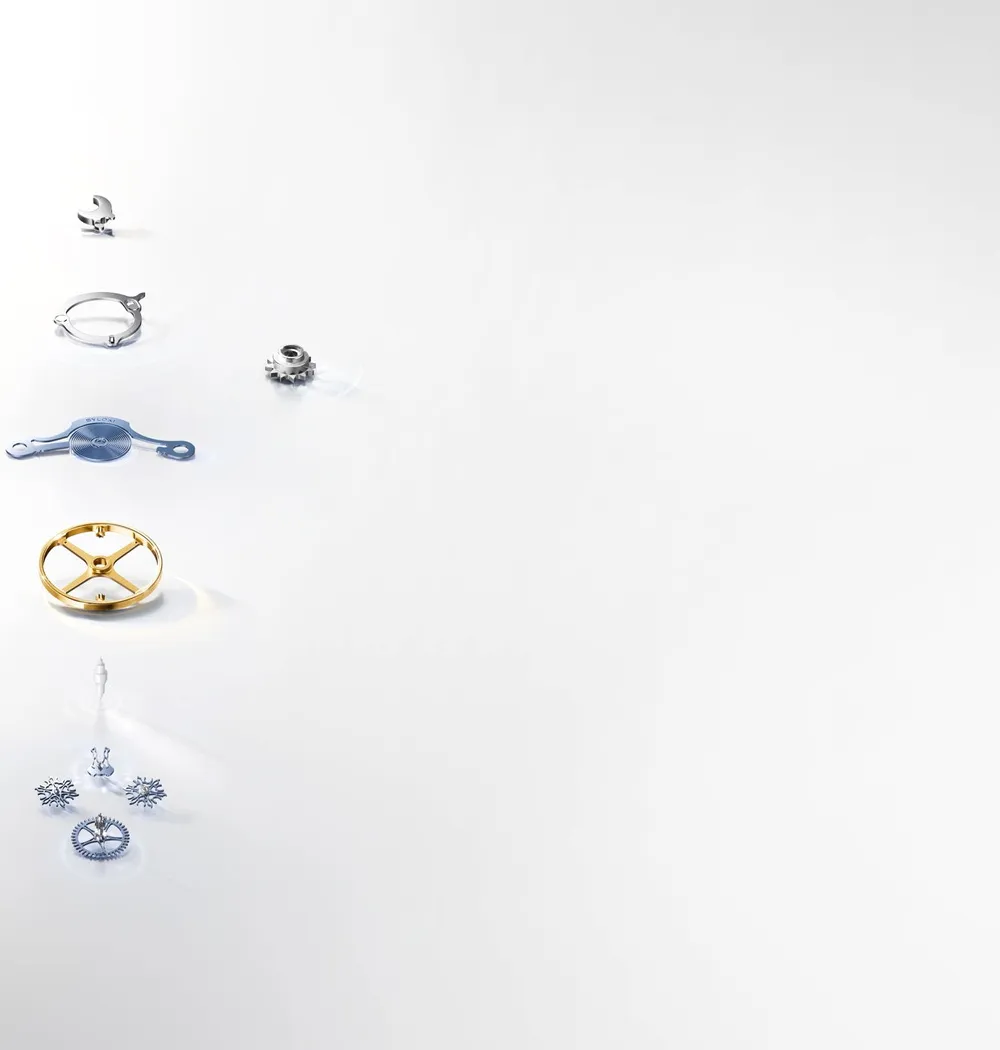
Rolex solved this with a mechanism it calls Haplos, on which a patent is pending. Two parts have been added to the date train: an additional carrier finger and an annual lever. The information about which months are short has been worked into the reverse of the month disc. The watch does not calculate the length of a month. The month disc carries that knowledge on its own back as it turns, and brings the extra finger into play on the right night.
This is the oldest and most durable way of storing information in watchmaking. The memory has been written not into software but into the shape of a part. The notches on that disc are a table, and the table cannot be corrupted, because it is the metal itself.
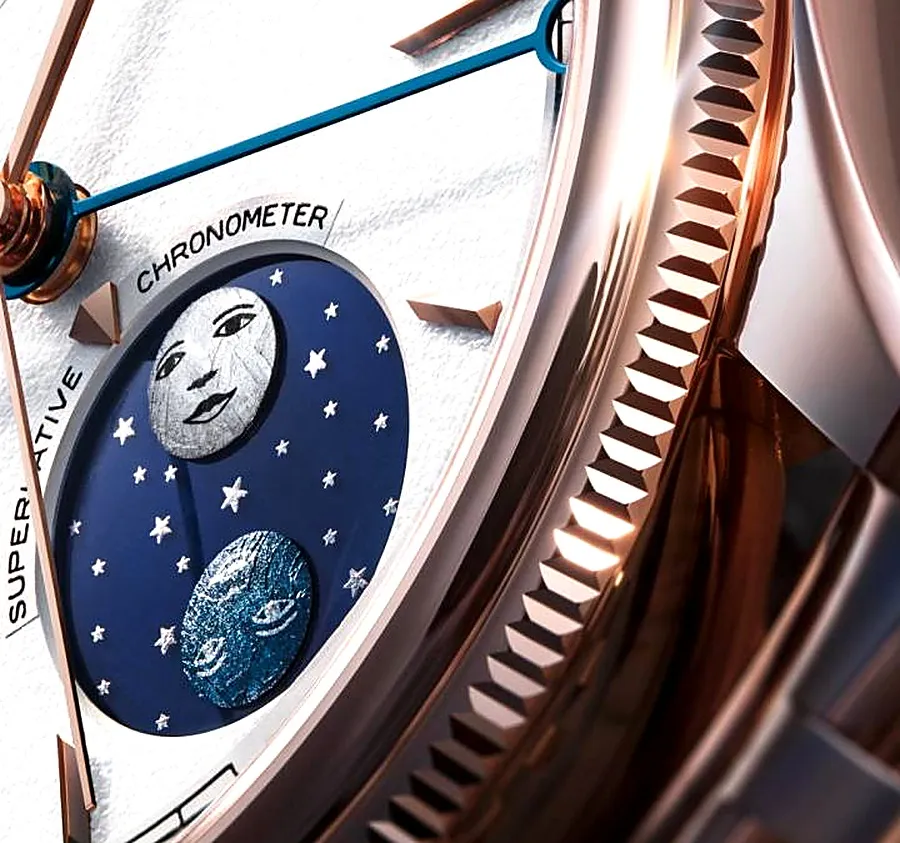
The disc at six o’clock completes one full turn every twenty-nine and a half days. The two small bodies on it, the full moon and the new moon, are cut from meteorite. The full moon is silver in colour with a black face printed on it. The new moon is coated in blue and its markings are silver. Both turn across a deep blue ground scattered with stars.
Using a substance that fell out of the sky to depict the Moon looks at first like a poetic gesture. It is not. That fragment is left over from the same formation as the body it represents. As the solar system was assembling, some bodies never reached the size of a planet and others were broken apart in collisions and scattered. The Moon and that meteorite are remains of the same morning.
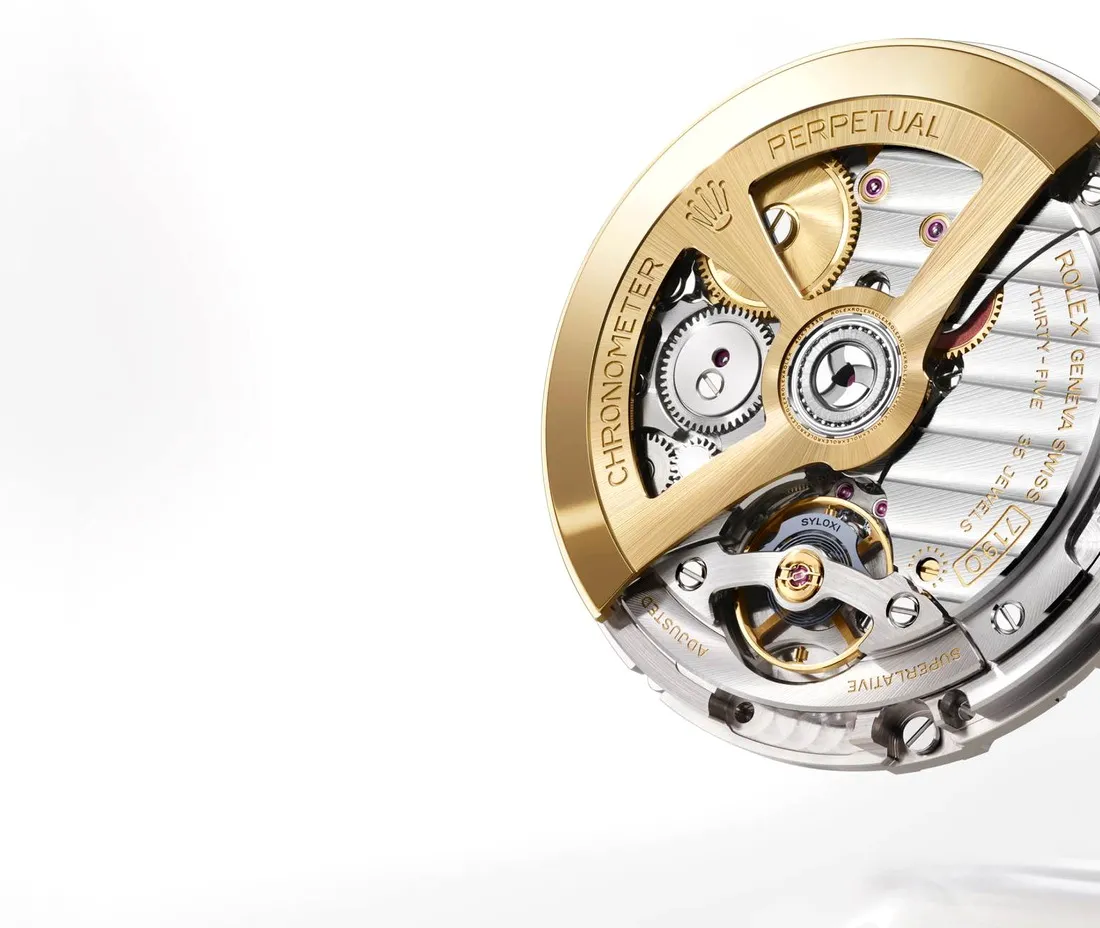
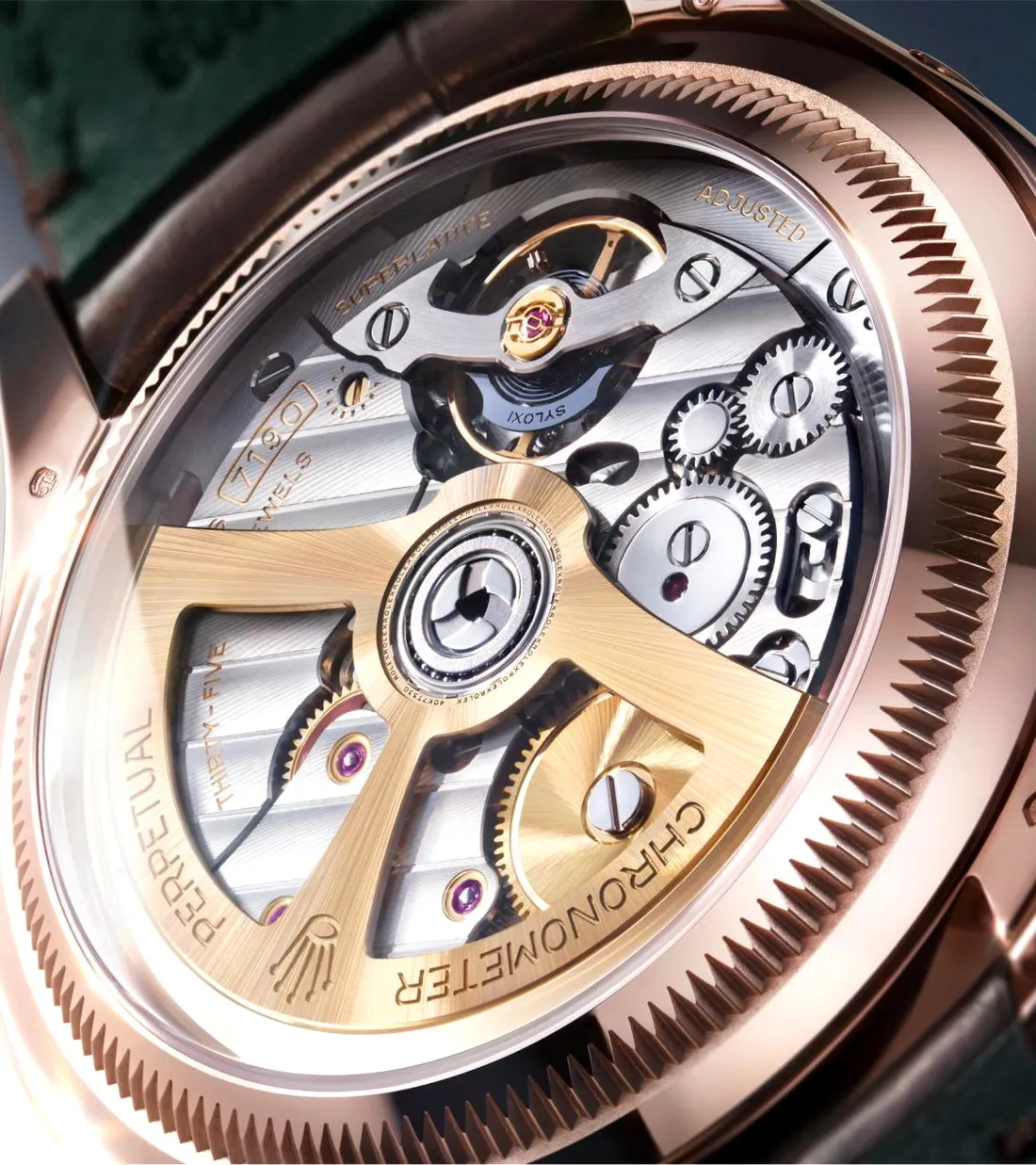
The movement driving all of it is called 7190. It runs on thirty-five jewels, oscillates five times a second and holds sixty-six hours of power. Those two values standing side by side are the hardest achievement in this watch.
The faster a balance wheel oscillates, the better it resists outside disturbance. A knock upsets the rhythm of a fast balance less than that of a slow one. But speed consumes energy. A movement beating five times a second empties its mainspring far quicker than one running a third slower. This is the equation watchmaking has accepted for a long time: either high precision or a long reserve.
Rolex solved that equation at the escapement. The arrangement it calls Dynapulse does not work like a Swiss lever, whose pallet jewels rub against the teeth of a wheel. It works through two distribution wheels made of silicon and an impulse rocker. The difference is friction. Every rubbing surface turns part of the energy into heat, and that energy never comes back. The figure the brand gives is a gain of around thirty per cent over a conventional escapement. The bill for five oscillations a second has been paid with energy that is no longer lost.
The hairspring in the same movement is silicon as well. Silicon is not magnetic, so a telephone speaker or a bag clasp will not affect it. It is also unusually steady against heat, because the thin oxide layer grown on its surface works against the material’s own tendency to soften. The balance staff is ceramic. None of these decisions shows on the dial, but a watch holding to within two seconds a day is the sum of them.
The Everose case is offered two ways. One is on a matte brown alligator strap, the other on the brand’s new bracelet, called Settimo. That bracelet is built from seven rows of polished, rounded links, meets the case with curved end pieces and closes on a concealed clasp. The platinum case comes on a matte black alligator strap lined in green calfskin. Swiss prices, tax included, are fifty-two thousand five hundred, fifty-nine thousand and sixty-four thousand eight hundred francs. The watch reaches retailers in November.
As the night was ending the astronomer took one last measurement and shut down the console. Walking towards the door, the astrobiologist stopped and asked whether this retreat would affect us one day.
In the long term, yes, he said. As the Moon moves away the tides will weaken, our days will lengthen and the stability of our axis will decrease. But we are talking about hundreds of millions of years here. Within your lifetime and mine the Moon will move only a few metres.
Then the order we see today is a temporary balance, she said.
Every balance is temporary, he said. The difference here is that this one lasted long enough for us to come into being.
To carry a moonphase on your wrist is to carry a record of that balance. The small disc beneath the dial turns once every twenty-nine and a half days and has been set to that number. But even that number is not fixed. As the Moon recedes, the length of the month is very slowly increasing. The ratio a watchmaker calculated was therefore built on a figure that is itself quietly drifting.
Tonight the Moon will hang in the sky in the same shape it held on the night the first shepherd read it as a date. The only thing that has changed is that we now carry a machine on the wrist that keeps its count. We supplied the number. We did not supply the cycle.