Under the pitch dark, foggy and stormy sky of the polar circle, two researchers are following robins that fly their migration route with unerring precision without a single landmark or beacon: the astrobiologist Dr Julian Vance and the biophysicist Dr Kaan Vural.
When the cryptochrome proteins in the birds’ eyes, and Cry4 in particular, are excited by photons of blue light, a radical pair appears: two electrons bound to each other at the quantum level. On the strongest explanation available to us today, the way that pair responds to a magnetic field is laid over what the bird sees like a fine pattern. The bird perceives the invisible field lines rising from the molten iron core of the Earth as a light and dark texture mixed into its own sight.
To classical perception, Kaan, crossing continents in the dark with no visual map, no stars and no scent trail is impossible, says Dr Julian, pointing at the storm above them.
Because humanity assumed that finding one’s way depends only on external physical marks, Julian, answers Dr Kaan Vural. But the Architect placed in the eye of these creatures a global compass that works at the quantum level. The magnetic field of the Earth enters into resonance with the radical pair of electrons in the bird’s eye. Pitch darkness turns into a faultless course by the invisible map the Architect has drawn.

format_quote"The bird perceives the invisible field lines as a light and dark texture mixed into its own sight."
Hasan Bekmezci
A few plain comparisons help to grasp the invisible compass of nature.
The first is the entanglement in the eye. It is like two electrons sharing a single state even with distance between them. In the bird’s eye the pair excited by a photon is tipped towards a different chemical outcome depending on the direction of the Earth’s magnetic field, and that outcome in turn alters what the bird sees.
The second is navigation without marks. It is like knowing where every object stands in a pitch dark room without turning on a light, by feeling only the slope of the floor and the set of the walls. The bird has no map; it has a sense of inclination.
The third is scale. Thanks to magnetoreception, billions of animals migrating between continents hold insect populations in balance, carry seed and keep the chain of the world’s plants alive. Two electrons inside a protein govern the ecology of the planet.
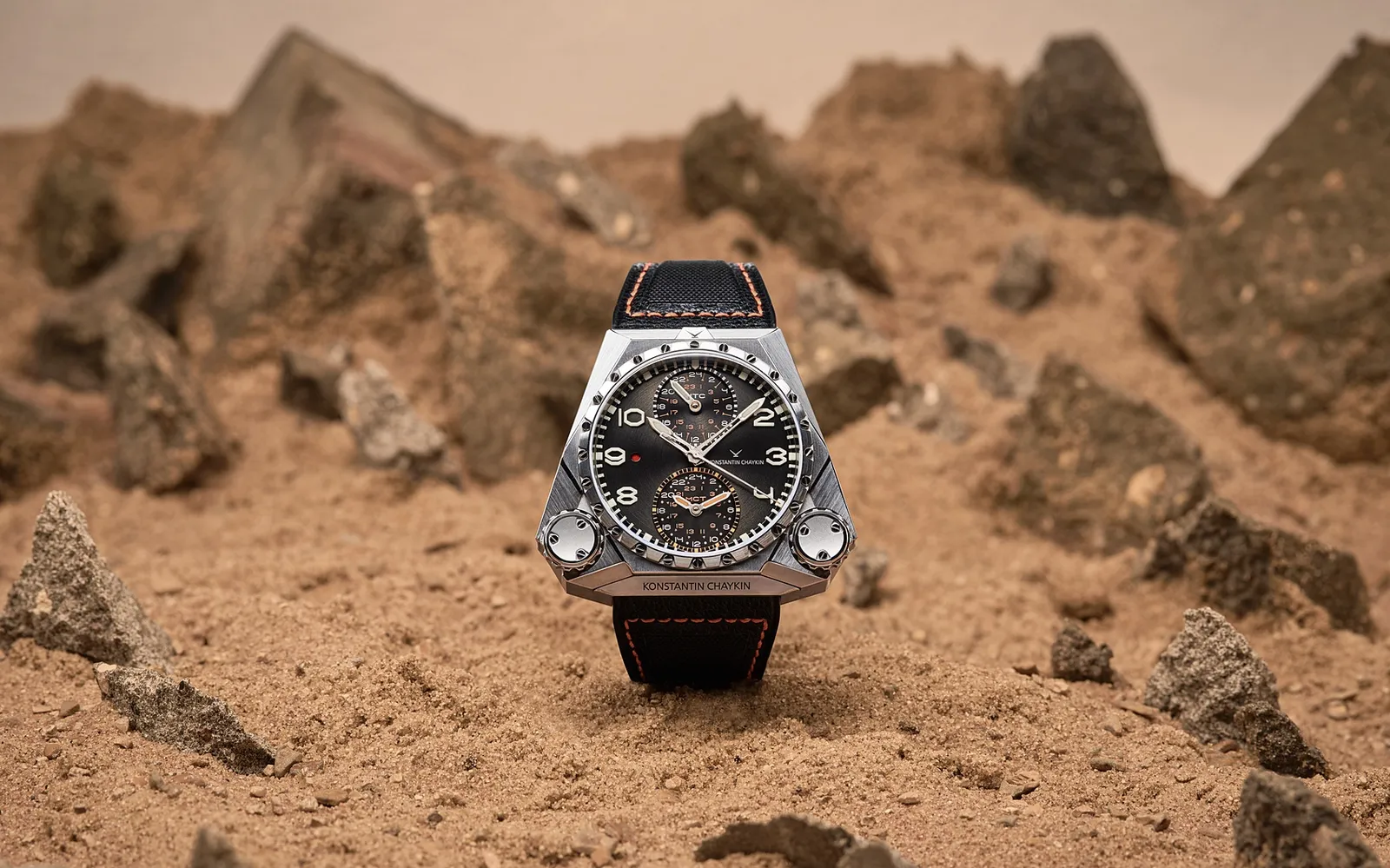
The avant-garde work that brings the hours of the Earth and of Mars together on one wrist is the Mars Conqueror Mk3 Fighter, by the independent genius Konstantin Chaykin. Only eight were made.
The case is titanium, fifty five point eight two millimetres long, forty eight wide and fifteen point three thick. Its trapezoidal body, dominated by triangular edges, carries a bezel held by twenty four functional screws that recall the locking mechanism of a spacecraft docking collar. The crystals front and back are sapphire, and it is water resistant to thirty metres.
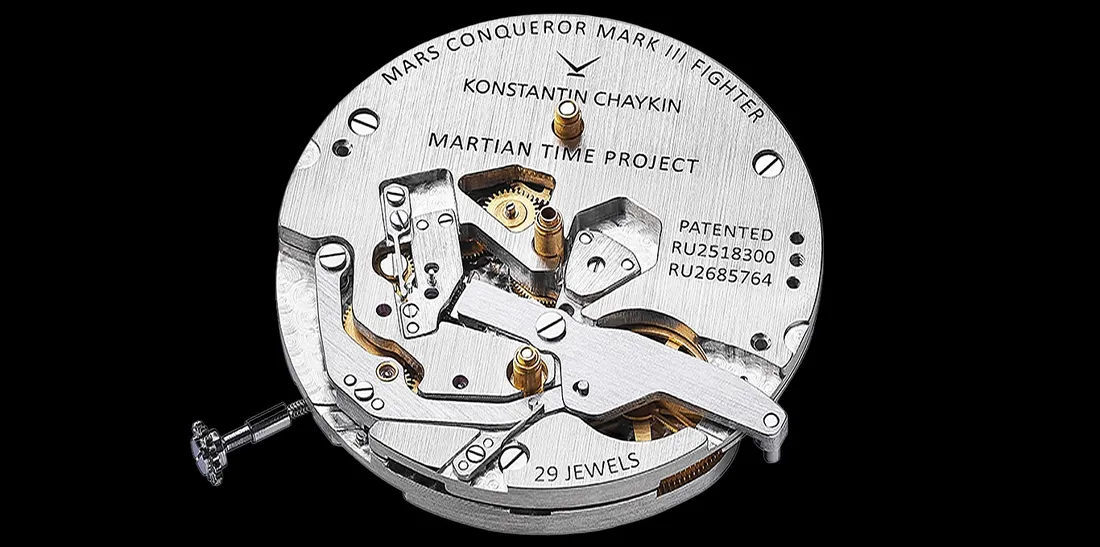
The calibre K.15-0 inside was developed in the Chaykin workshop to bring Martian and Earth time into a single movement. It measures thirty five point six millimetres across and six point six high; it has a lever escapement, beats twenty eight thousand eight hundred times an hour, carries twenty nine jewels and runs forty two hours. Its daily rate is within four to six seconds.
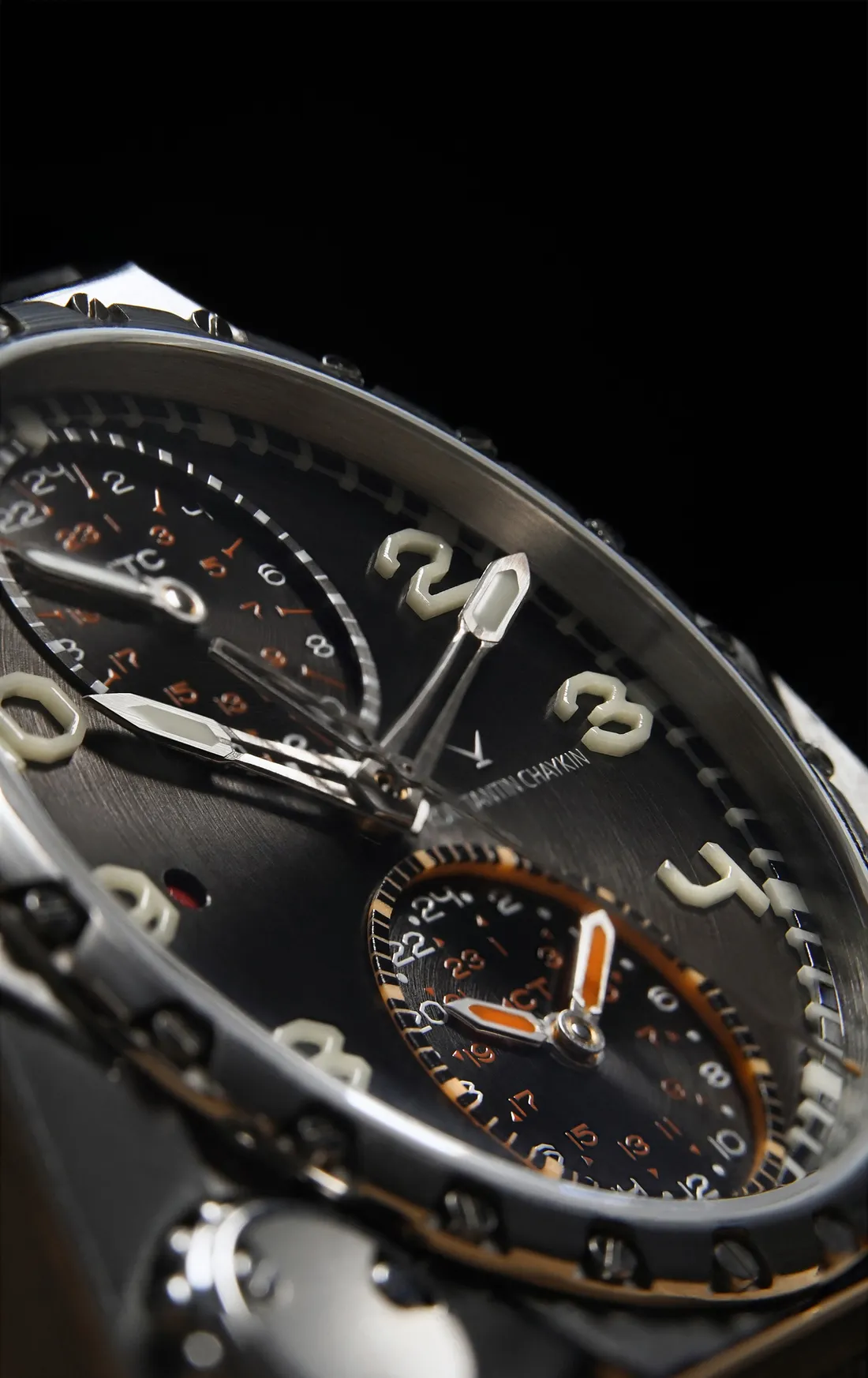
Three separate times stand on the dial at once. The central hands give the local Earth time, hours, minutes and seconds. A twenty four hour hand from the centre gives a second Earth time zone, universal time. And the twenty four hour subdial at six holds Martian time.
The heart of the thing is in that subdial. A day on Mars, a sol, lasts twenty four hours, thirty nine minutes and thirty five seconds. To solve it, Chaykin designed a twin level gear: one hundred and nine teeth on one level, one hundred and twelve on the other. The Martian day that ratio produces runs a little past eighty eight thousand seven hundred and seventy seven seconds, only two point seven seconds longer than the true mean Martian solar day.
Setting is done through the double vertical crown system Chaykin developed and patented for aviator watches. One of the crowns selects the mode, switching between winding the movement, setting universal time and setting Martian time. A small indicator on the dial tells you which mode you are in.
format_quote"Two electrons inside a protein govern the ecology of the planet."
Hasan Bekmezci
The hands were drawn to the same story. Chaykin left classical shapes behind and designed his own Starship hands: large, clearly legible on the dial and luminously coated. He took their shape from the heavy carrier rockets that will go to Mars. Those that give Earth time are marked with greenish blue phosphor, those that give Mars time with orange. In the dark, anyone looking at the wrist tells the two planets apart by two colours.
Glowing in different colours through the night, these indications call to mind the light and dark texture that appears in the robin’s eye in pitch darkness. This is not a claim about what was designed; it is the reading of the person looking. But once made, it does not come undone.
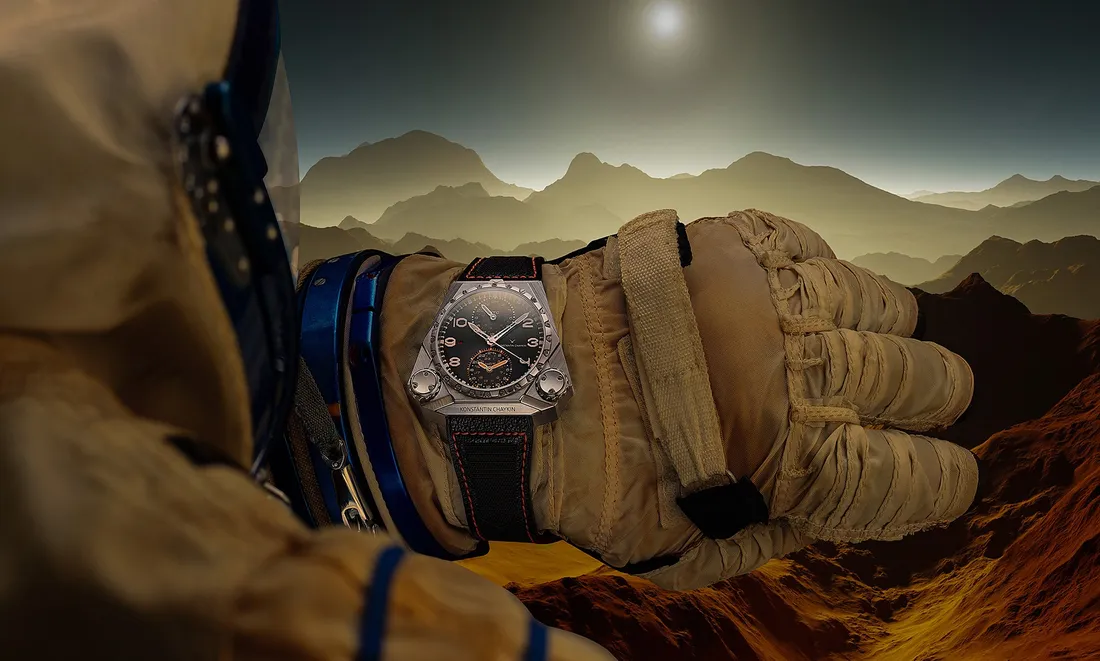
format_quote"In the dark, anyone looking at the wrist tells the two planets apart by two colours."
Hasan Bekmezci
The Mars Conqueror Mk3 Fighter places the day of a planet nobody has yet set foot on inside a movement that works today. Like the compass in the robin’s eye it is a mechanism that makes the invisible visible; the difference is that one was placed there by the Creator, and the other was built by a craftsman out of two wheels with a hundred and nine and a hundred and twelve teeth.
The watch on its maker’s own site: Konstantin Chaykin, Mars Conqueror Mk3 Fighter