An apple comes loose from the branch and falls. Everything on the face of the earth, the mountains, the oceans, the clouds above us and the breath in our lungs, is drawn downward by an invisible hand. Newton saw that the fall of the apple and the turning of the Moon around the Earth are governed by the same invisible arms. Two masses face each other and want to pull, whatever the distance between them.
But when Newton wrote the formula he ran into a wall. The force of attraction was proportional to the product of the masses and inversely proportional to the square of the distance between them. So what was the enormous problem, and why did they have to put a letter, a multiplier, into the middle of it?
The first reason was to tie the units together. In physics mass is measured in kilograms, distance in metres and force in newtons. On the left of the equation stands force; on the right, kilograms squared over metres squared. Those two different worlds cannot be set equal to each other directly. Just as you need an exchange rate between one currency and another, you need a universal conversion coefficient to turn mass and distance in nature into force.
The second reason was to know the absolute strength of the pull. Saying that something is proportional is not enough; you also have to know how strong it is. Two coins in your pocket are masses too, and they attract each other, yet they do not fly together and stick. Because gravity, as forces go, is feeble beyond belief. Without that coefficient we would think two one-kilogram masses a metre apart pulled on each other with one newton of force. The coefficient enters the equation and says: no, that pull is not a newton, it is about a billionth of one. That number is what turns a proportion into a real equality.
format_quote"Standing on the soil under his feet, a man never notices that he is walking a rope he cannot see."
Hasan Bekmezci
On a freezing, damp London evening in 1798, Henry Cavendish stood in front of the wooden shed in his garden. Even the apparatus inside was not his own: a wooden arm six feet long, suspended from a slender wire forty inches long, with a small lead ball hung at each end, the whole thing shut inside a narrow wooden case to defend it from the wind. The man who built it was Cavendish’s friend the Reverend John Michell; Michell died before he could run the experiment, and the instrument passed first to Francis John Hyde Wollaston and then to Cavendish.
Why did Cavendish have lead blocks of three hundred and fifty pounds cast, some hundred and fifty-eight kilograms, instead of using spheres of five or ten? Because gravity is unbelievably weak. The attraction between two small balls is smaller than the weight of a speck of dust in the air; with small spheres the force twisting the wire would have stayed so faint that neither the wire would have turned nor the measurement been possible. The hundred-and-fifty-eight-kilogram blocks produced the greatest gravitational pull that could be brought to bear on the little balls at the ends of the arm. The point was to get ahead of the vibrations in the air and the trembling of the ground, which is to say the noise, and to turn the faint voice of gravity into an angle of twist you could actually see. Lead was chosen because it is the densest heavy metal that is also easy to cast.
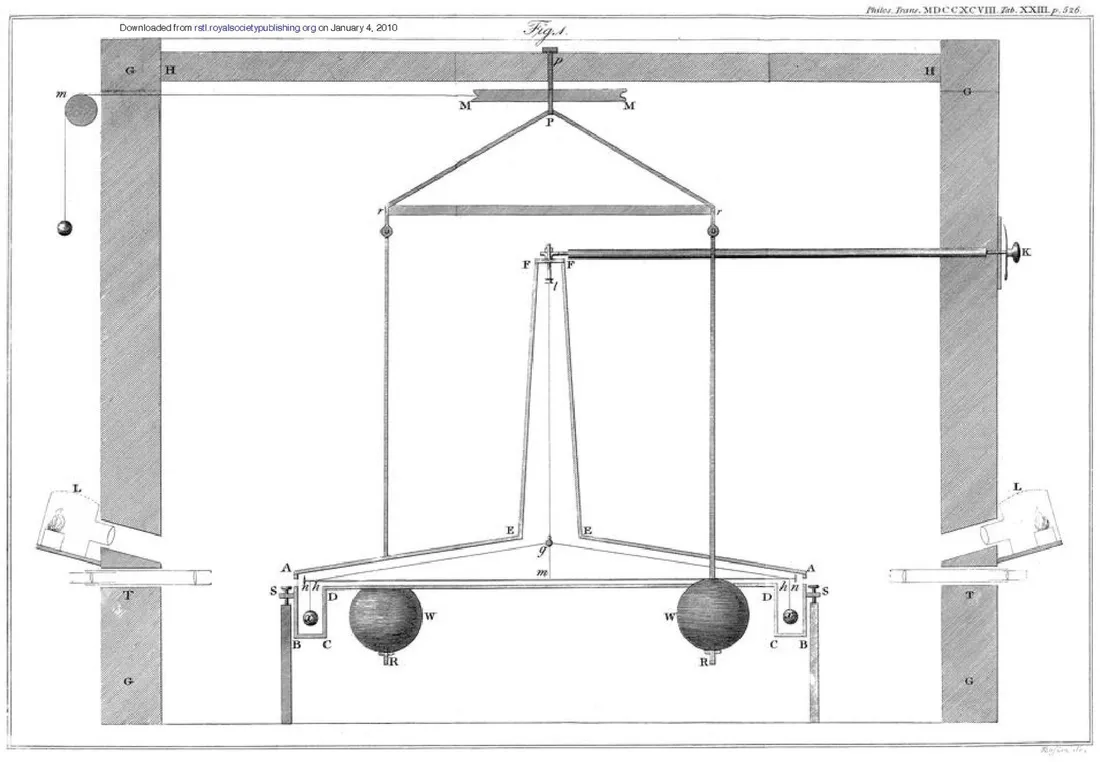
The number did not come out of sitting at a desk and imagining it. It came from setting two physical measurements equal to each other. First, without the great spheres in place, Cavendish nudged the arm and let the wire swing like a pendulum; by timing that swing he found the torsional stiffness of the wire, which is to say exactly how much force the wire needs in order to turn by one degree. Then he brought the hundred-and-fifty-eight-kilogram spheres up beside the little balls. The spheres pulled, and the arm turned through a very small angle. Cavendish read that angle from outside the room, through telescopes, so as not to disturb the apparatus. By his own reckoning the attraction was less than one fifty-millionth of the weight of the balls.
He multiplied the stiffness of the wire by the angle of rotation and so found how many newtons the invisible force between two spheres came to. Now he had everything: the force, the seven hundred and thirty grams of the small balls, the hundred and fifty-eight kilograms of the great ones, and the twenty-two centimetres between them. He turned Newton’s formula inside out. Dividing a microscopic force by enormous masses laid out ten zeros after the decimal point.
One nicety deserves attention here. Cavendish published no constant in his paper; he gave the mean density of the Earth, five point four eight times that of water. The number we write today with the letter G was derived afterwards from the values he measured. What was measured in that shed was not the constant itself, but everything needed to arrive at it.
format_quote"The universe is an immense poem whose letters are masses; gravity is the one measure that gives the poem its metre."
Hasan Bekmezci
And what does that precision mean? No vast changes to the number are needed; the smallest fractional deviation is enough to finish the universe off.
You are in a bakery with tonnes of flour and yeast in your hands. But in the draught of the room a micro weakening of one part in a billion creeps into that flawless balance; gravity falls off so faintly that the grains of flour cannot settle on the bench and become dough, and hang in the air of the room instead. Had there been the smallest downward slip in the last digits of the constant, the immense clouds of hydrogen that spread out after the Big Bang would never have found enough pull to gather at a centre. The outward pressure born of the gas’s own heat would have beaten that minutely weakened gravity at once. The clouds would never have compressed to fifteen million degrees, and the nuclear fire would never have caught. The result: not one star born, the Sun never lit, and the universe left as a freezing desert of gas.
The opposite is every bit as merciless. You reach out to knead the dough in the oven, and the smallest excess of pressure, not even a millimetre’s worth, comes down, and a vast iron press crushes the dough to its molecules. Had the constant risen by the smallest fraction, the gas clouds would have collapsed at a speed beyond control. Every star born would have burned its fuel in a few days and exploded, or turned into a black hole on the spot. Before there was time for planets to form, for water to stay liquid, for life to take root, the universe would have become a field of black holes collapsing in on itself at birth.
format_quote"The last digit of a constant decides whether there is to be a universe at all."
Hasan Bekmezci
The steady light of the Sun, the orbit of the Earth and the pulse at our wrists are sealed to the sharpest decimal of the value Cavendish measured in his shed. Now we take our minds and our eyes from that fundamental balance and turn them to one of the most radical mechanical objects the human hand has produced: the Horological Machine N°9 of MB&F, the house founded by Maximilian Büsser.
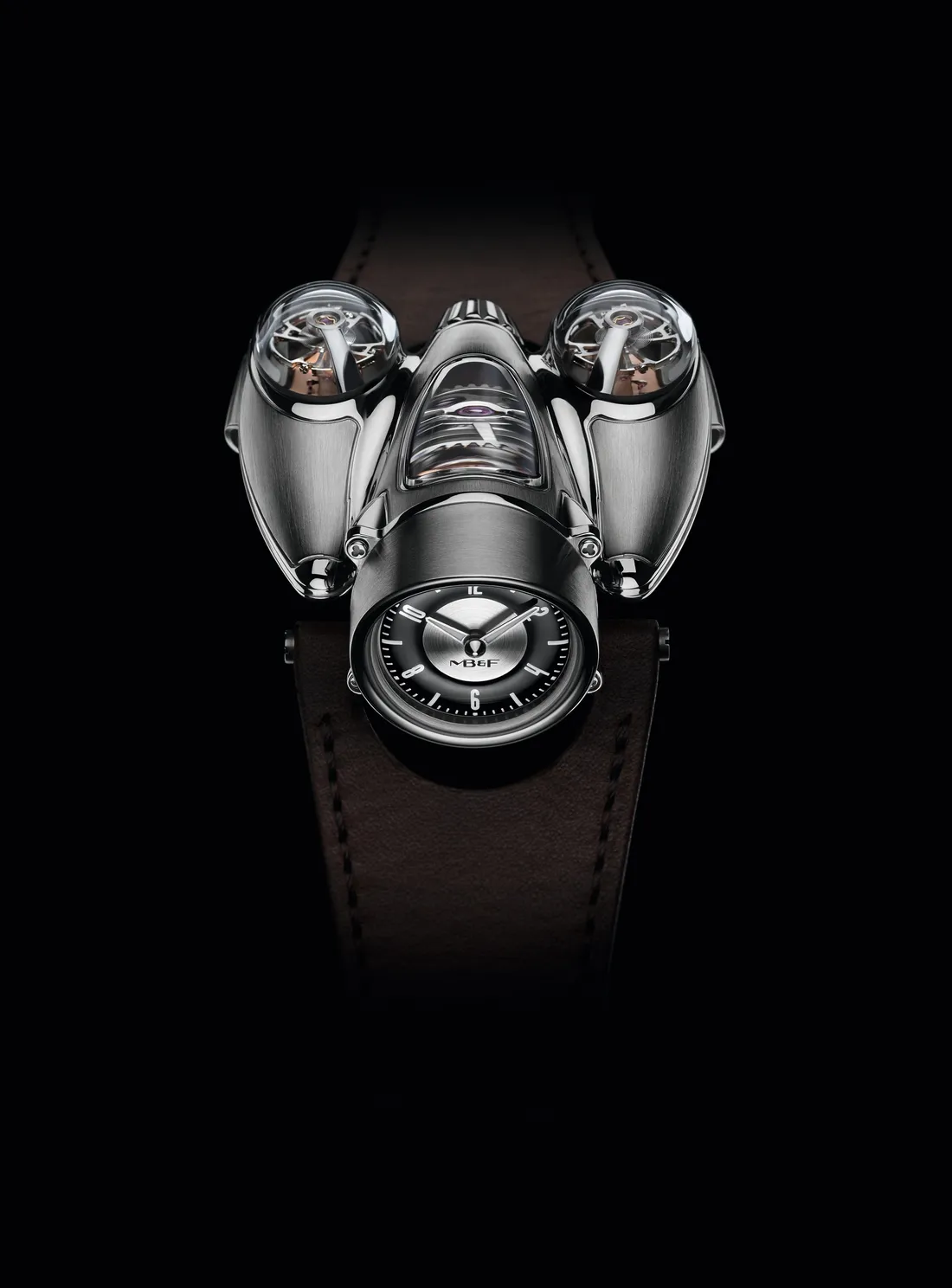
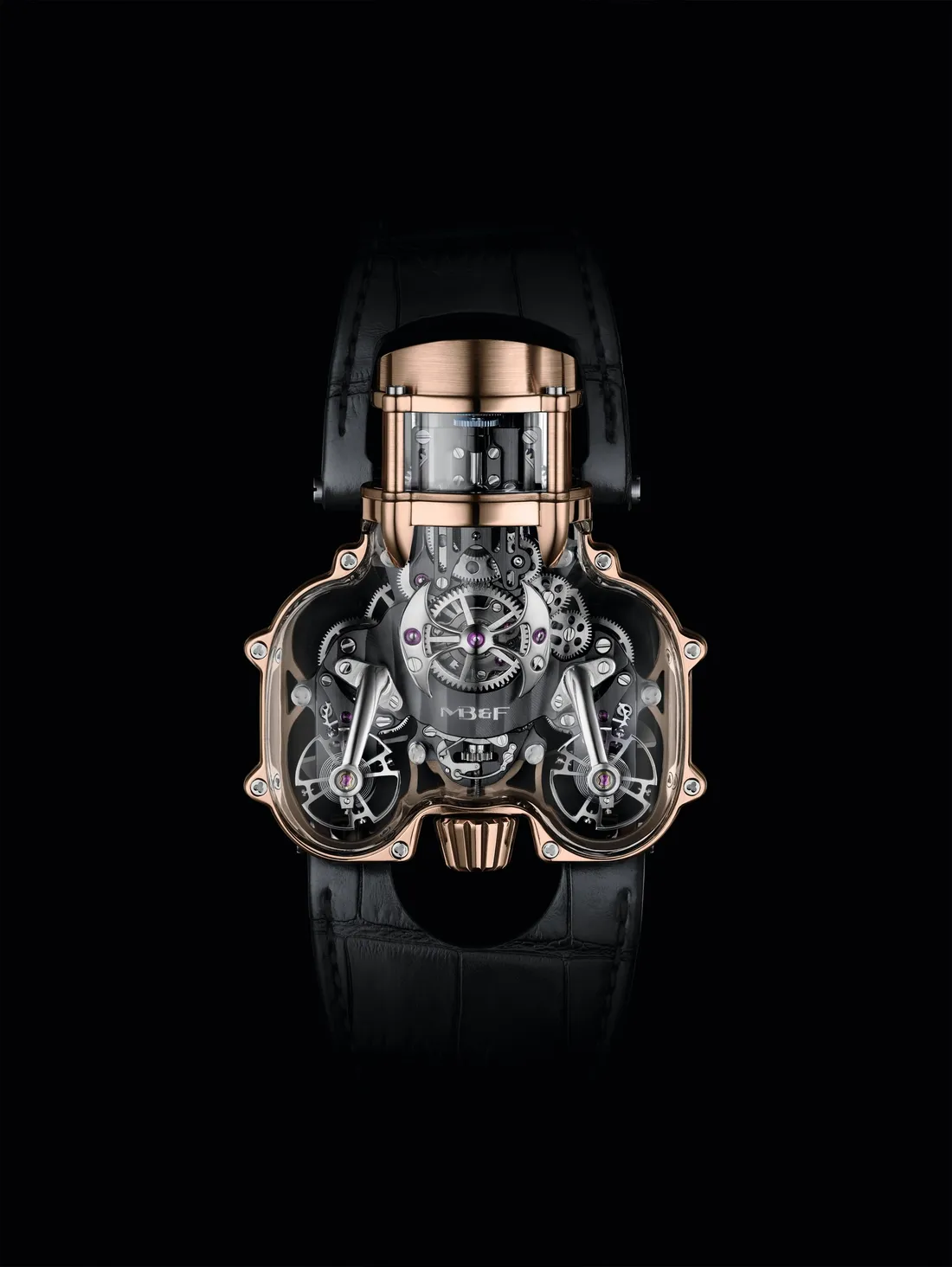
The HM9 Flow takes its inspiration from the aviation and automotive design of the 1940s and 50s. Engineers then were shaping bodies into flowing, curved lines that cut the wind, in order to deal with the invisible resistance of air; they had neither computer modelling nor wind tunnels, and were guided more by aesthetic instinct than by scientific precept. MB&F took that spirit and carried it to the wrist, and the house names the three objects it drew on: the Mercedes-Benz W196, the 1948 Buick Streamliner, and the snub-nosed De Havilland Venom that patrolled Swiss airspace for thirty years. The watch calls to mind a jet gliding through the sky, or a racing car shaped in a wind tunnel.

What the delicate balance between gravity and expansion is for the universe, the movement of the HM9 sets up inside itself. Inside the aerodynamic jet-engine pods on either flank of the watch sit two balance wheels running completely independently. Each is impulsed separately and set apart from the other in space, so that each beats at its own cadence. The movement of your arm, gravity and outside influences affect the two wheels differently. And this is exactly where the planetary differential in the middle comes in: it gathers the chronometric data from both wheels, takes their average, and passes one single, stable reading of time to the vertical dial. Just as Cavendish balanced his spheres, the mechanism sets up a centre of balance within itself.
format_quote"Two wheels each go wrong on their own; their average tells the truth."
Hasan Bekmezci
The movement itself is the product of three years of development and the fifteenth calibre of the house. Three hundred and one components, fifty-two jewels, eighteen thousand vibrations an hour, which is two and a half hertz, and forty-five hours of power reserve. It is wound by hand. Büsser has called the engine inside the HM9 the most beautiful movement the house has ever created.
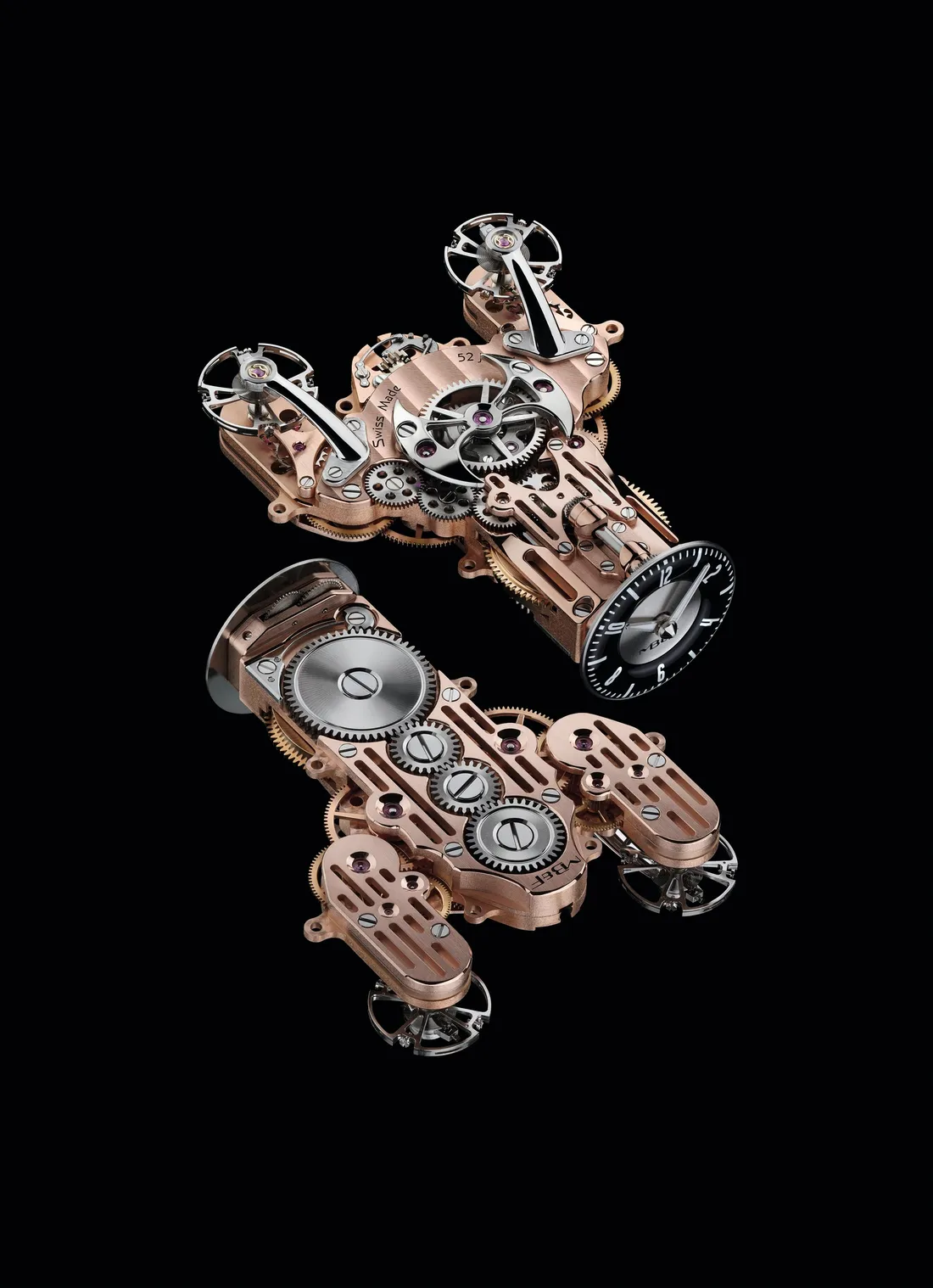
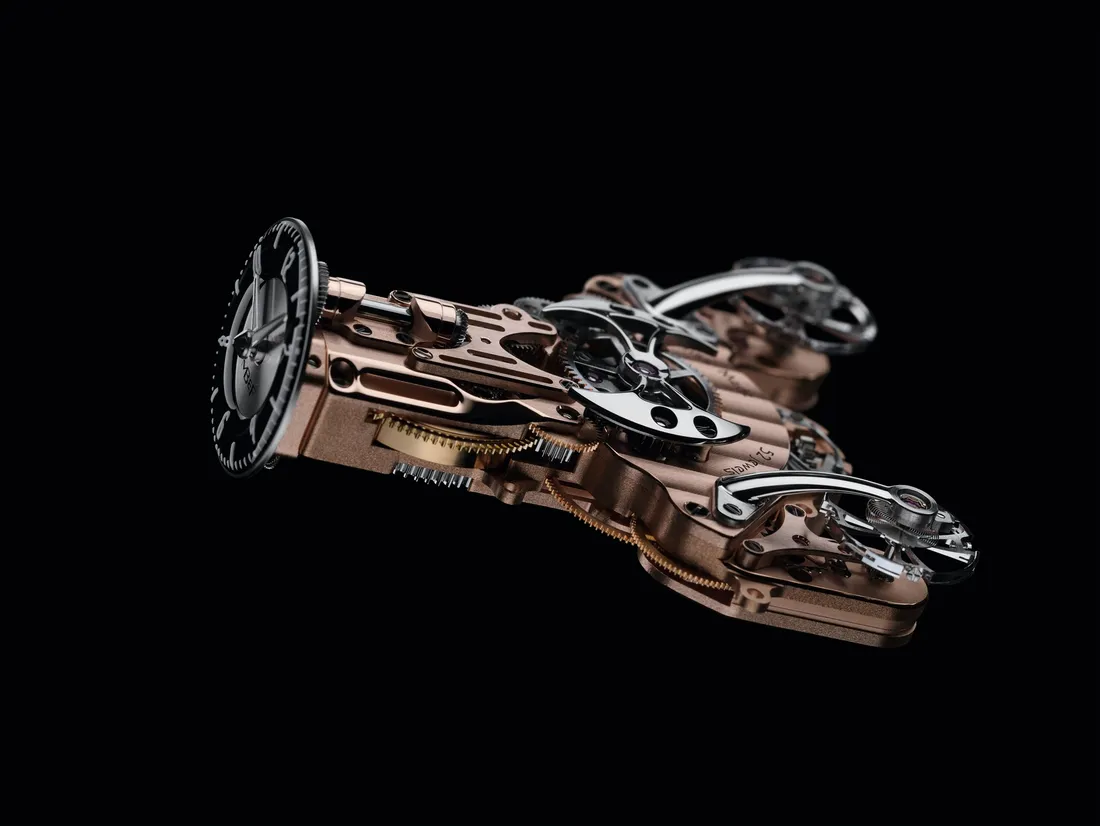
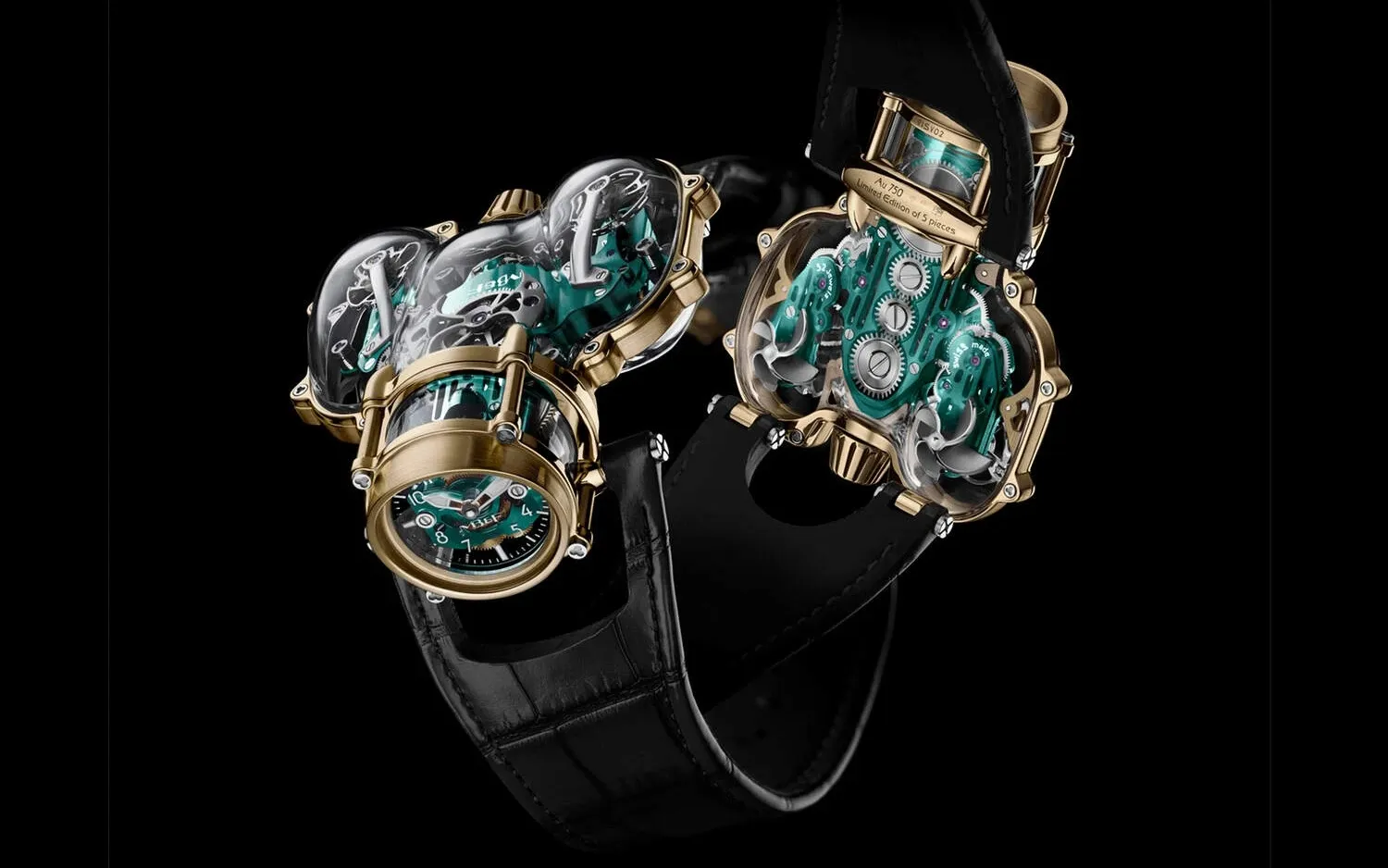
The case is an engineering story of its own. The HM9 Flow is a geometrically complex combination of milled sapphire crystal with grade 5 titanium or eighteen-carat red gold: fifty-seven millimetres by forty-seven, twenty-three millimetres thick, five separate sapphire crystals. The alternating wide and narrow volumes of the body forced the case to be divided along two axes, and forced the development of a three-dimensional patented gasket for water resistance, a thing without precedent in the industry, which allows the case to be assembled in three segments.
Having called that engine the most beautiful one, Büsser had only one logical step left: to put it inside a transparent shell of sapphire. That is how the Sapphire Vision editions were born. In those versions almost the entire case is sapphire, with only the frame in eighteen-carat white, yellow or red gold. Among the materials a case could be cut from, sapphire sits immediately below diamond for hardness; working it into a form as flowing, as three-dimensional and as curved as an aircraft body takes days of microscopic labour. In return, the running of the wheels and of the twin-balance mechanism inside becomes visible from every angle.
The microscopic twist Henry Cavendish watched through a telescope in that wooden shed in 1798 is the central pillar that allows the universe to exist. The MB&F HM9 Flow is a flawless proof of how those invisible universal laws take concrete form in the human mind and in the art of mechanics.
One of them stands for the gravitational majesty the Creator placed in every particle; the other for the summit of a human genius that read that order and gave life to cold titanium and sapphire.
The watch, as its maker describes it: MB&F, Horological Machine N°9