The first face of the universe was pitch dark and freezing empty space. In the stillness of minus two hundred and sixty degrees, immense molecular clouds drifted, ninety-nine per cent hydrogen and helium gas, one per cent dust as fine as soot. Those orphaned materials, their own internal pressure paralysed, were nowhere near able to stage an existence by themselves.
Then, by the law the Creator set into the world, an enormous star that had finished its life exploded: a supernova. That annihilation was a destruction, an undoing, and at the same time the seed of a new existence. The shock wave the supernova sent out shook and squeezed that sleeping cold cloud, and the iron, carbon and calcium scattered by the blast mixed into it. Mass gathered where the cloud compressed, and as mass gathered the pull grew stronger. The short-lived nuclei found inside meteorites are the strongest evidence we have for this scene; not a sworn record, but the firmest trace in our hands.
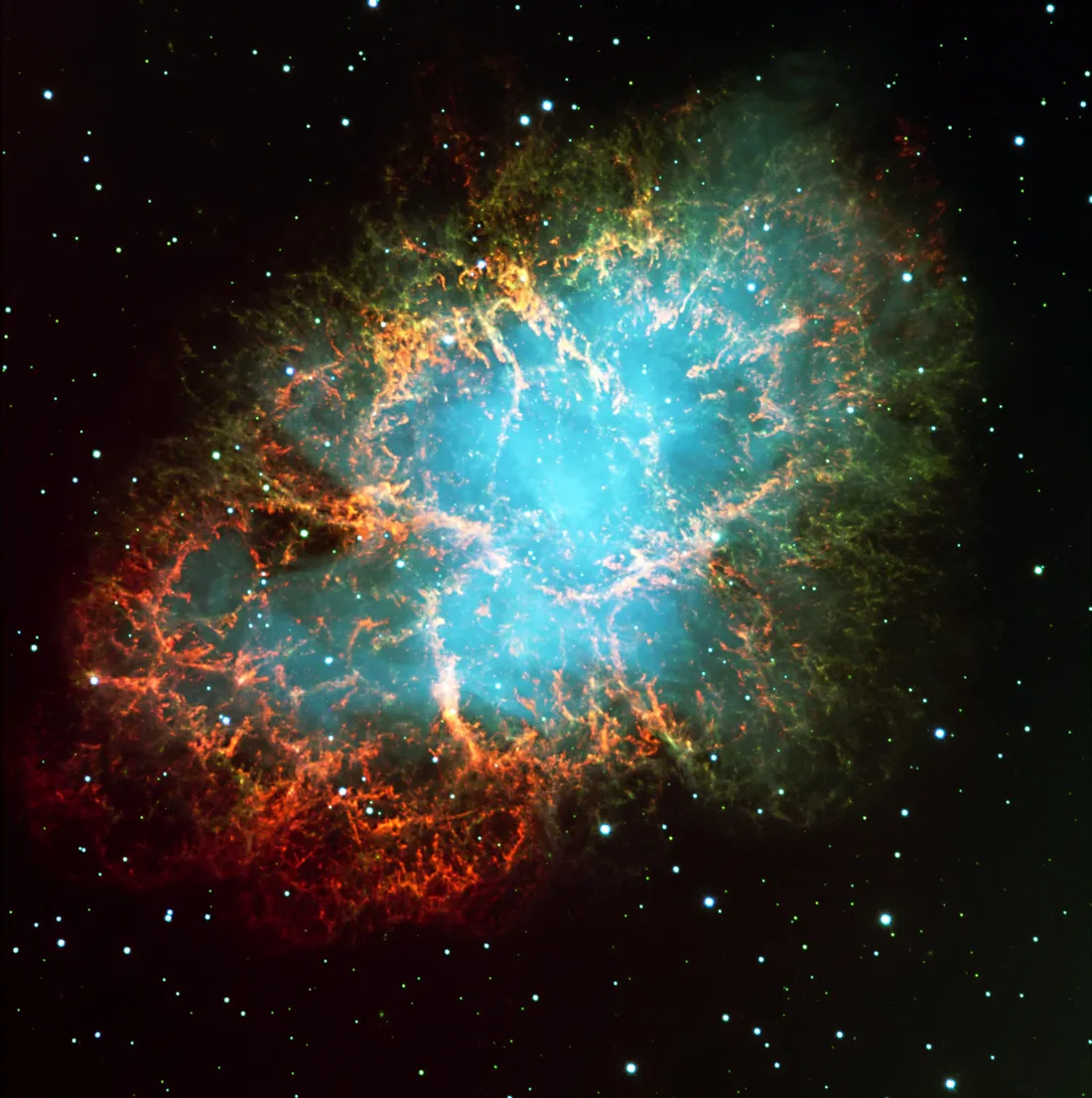
This is exactly what those who look at science with an inward eye have called chemical love, and what the mystics called rapture: the unconditional leaning of particles toward what is greater than themselves, toward the command to gather at a centre.
But this immense birth did not happen by blind accident. It happened through a fine tuning measured to the last decimal, through numerical constants, through things that should by rights be impossible.
The first of them is the gravitational constant. In 1798 the English natural philosopher Henry Cavendish, trying to measure the density of the Earth with two lead spheres and a torsion balance he set up for himself, in fact handed us the mysterious architect beating at the heart of the universe, the constant we now write as G. That number is a tightrope walker with a deep ravine on either side.
Had the constant been even slightly smaller, we would have had flour and an oven and no way to light the fire; clouds of gas would never have gathered at a centre, they would simply have dispersed, and no star would ever have been born. Had it been even slightly larger, it would have crushed those clouds like a giant kneading dough without mercy, and the stars that formed would have blown apart at birth or collapsed at once into vast black holes and swallowed the universe. The Sun stands balanced exactly between those two ravines because of that one measured value.
The second is the strong nuclear force. Protons with the same charge live together inside the nucleus, and just as two magnets with like poles push each other away, protons repel each other with terrible force. The strong nuclear force that locks them into the nucleus is a universal superglue holding those furious magnets together. A deviation of half a per cent, of one per cent, in the binding energy of that glue would have been enough to paralyse everything: a shade weaker and the protons would have scattered, and not one complex atom, no carbon, no oxygen, no iron, could have formed; a shade stronger and every proton would have locked onto its neighbour at once, no hydrogen would have been left, and the Sun would have run out of fuel before it started.
The third is permission to pass through a wall. For the hydrogen in the heart of the Sun to fuse, an enormous electrical wall of steel stands in the way. Fifteen million degrees at the centre and a pressure of two hundred and fifty billion atmospheres are still not enough, by the rules of classical physics, to get over it. This is exactly where quantum tunnelling arrives: like a man who, instead of running at the concrete wall in front of him and striking it, passes through it like a ghost, the protons open a tunnel through that steel wall and come out the other side.
format_quote"The leaning of particles toward what is greater than themselves is the oldest obedience in creation."
Hasan Bekmezci
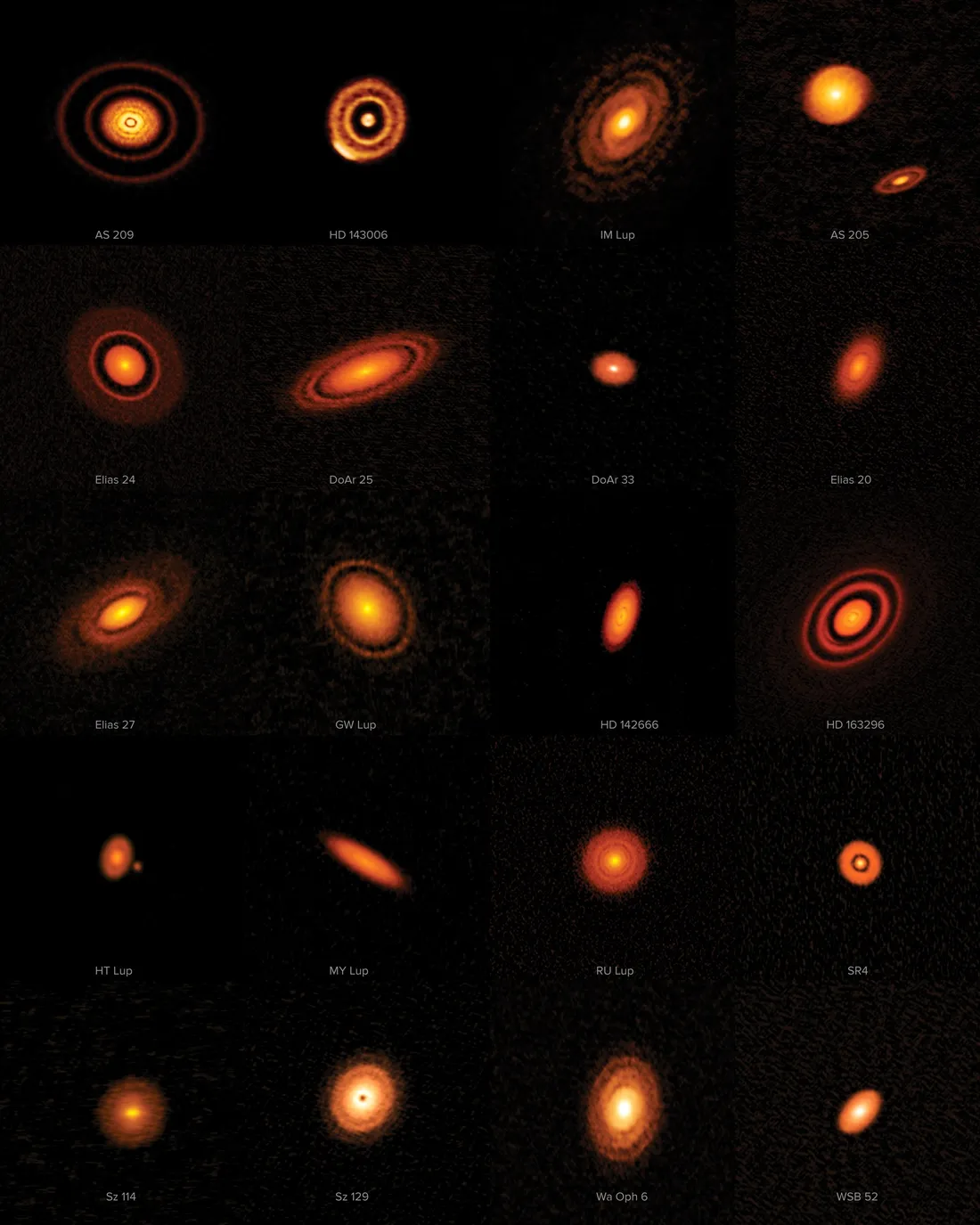
Spinning faster as it flattened into a disc, the way a skater speeds up by drawing in their arms, the matter fell inward and grew hot. Four hydrogen became one helium, and the seven thousandths of mass that went missing turned, by the secret that mass and energy are two faces of one thing, into an immense light and heat. The Sun caught fire.
In that instant a flawless balance was struck between the gravity that wanted to crush it and the fusion heat that wanted to blow it open. While the Sun was lit by that balance as a steady source of life, the heavy rock and metal left in the warm part of the disc came together to make our Earth, and the ice further out made the gas giants.
format_quote"Darkness is a veil only for those who do not know the worth of light; the Sun is the first fire of love, lit at the heart of the universe."
Hasan Bekmezci
While the Earth was still an ocean of molten rock, it was struck a glancing blow by Theia, a body the size of Mars that shared its orbit. The violence of that collision threw the outer layers of the Earth into space and formed a glowing ring. Out of what looked like catastrophe came a great gift: the particles in the ring locked together quickly and became the Moon.
The Moon was a piece broken from the Earth’s own breast. Like a reed cut from its bed, it has turned around the Earth ever since, looking at it, moving three point eight centimetres further away every year, keeping up that deep longing.
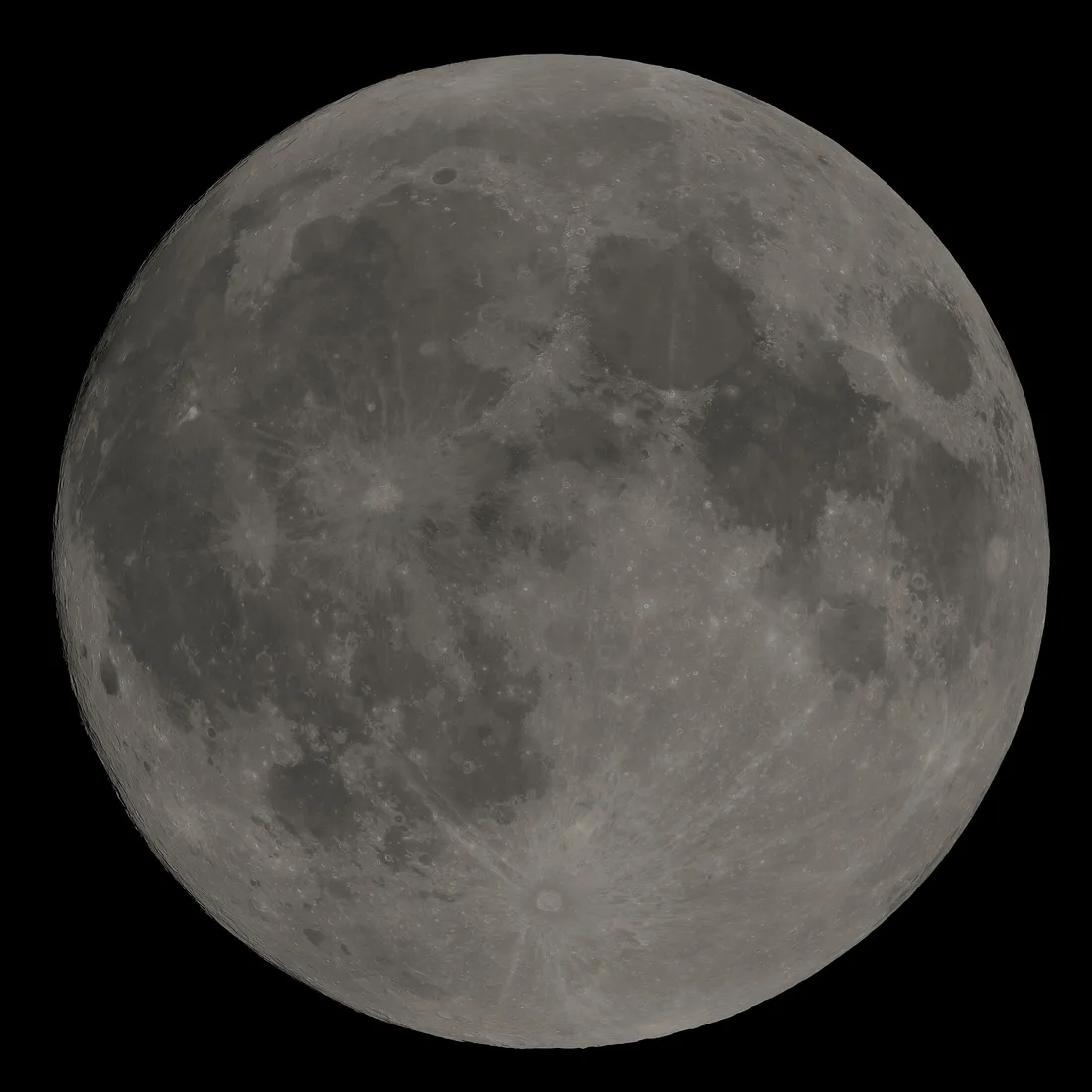
format_quote"The Moon is a longing that keeps turning around the body it was torn from."
Hasan Bekmezci
The real spell of the Moon, though, is hidden in its light. In the ancient centuries, when humanity knew nothing of celestial mechanics, nothing of optics, nothing of cosmology, when there was not even a word for a telescope, the qualitative difference between the Sun and the Moon was sensed and put into words.
Its sharpest expression is in the Kur’an, sent down fourteen centuries ago to the Prophet Muhammad in the Arabian desert. In an age when it was natural to take both great bodies in the sky for lamps that give off light, the Kur’an uses for the Sun the words sirâc and ziyâ, which describe a lamp burning with its own energy, while for the Moon it insists on nûr and münîr: that which takes its light from another source and reflects it, that which is lit. One is a lamp, the other a mirror. To draw that distinction before the telescope had a name is a nicety worth pausing over.
format_quote"A lamp and a mirror: the whole story of the sky stands in those two words."
Hasan Bekmezci
The Sun is the majestic face of existence, of heat, of action, of that first nuclear ignition that gives the soil its life; it is a lamp burning with its own energy. When it rises the seed cracks, water evaporates, provision is sought, and existence begins to move. The Moon has no light of its own; it is a pure mirror that takes the burning radiance of the Sun and returns it to the earth with a silver grace. The dark old lava seas on its face, which are its wounds, do not block that light; they give it a deeper beauty. The rise and fall of the oceans under its pull is the sea kept in unbroken remembrance by the nearness of the beloved.
The changing of the guard between these two bodies, kept for thousands of years without slipping by a second, is the most magnificent universal clock there is, and it orders our sleep, our breath and our time.
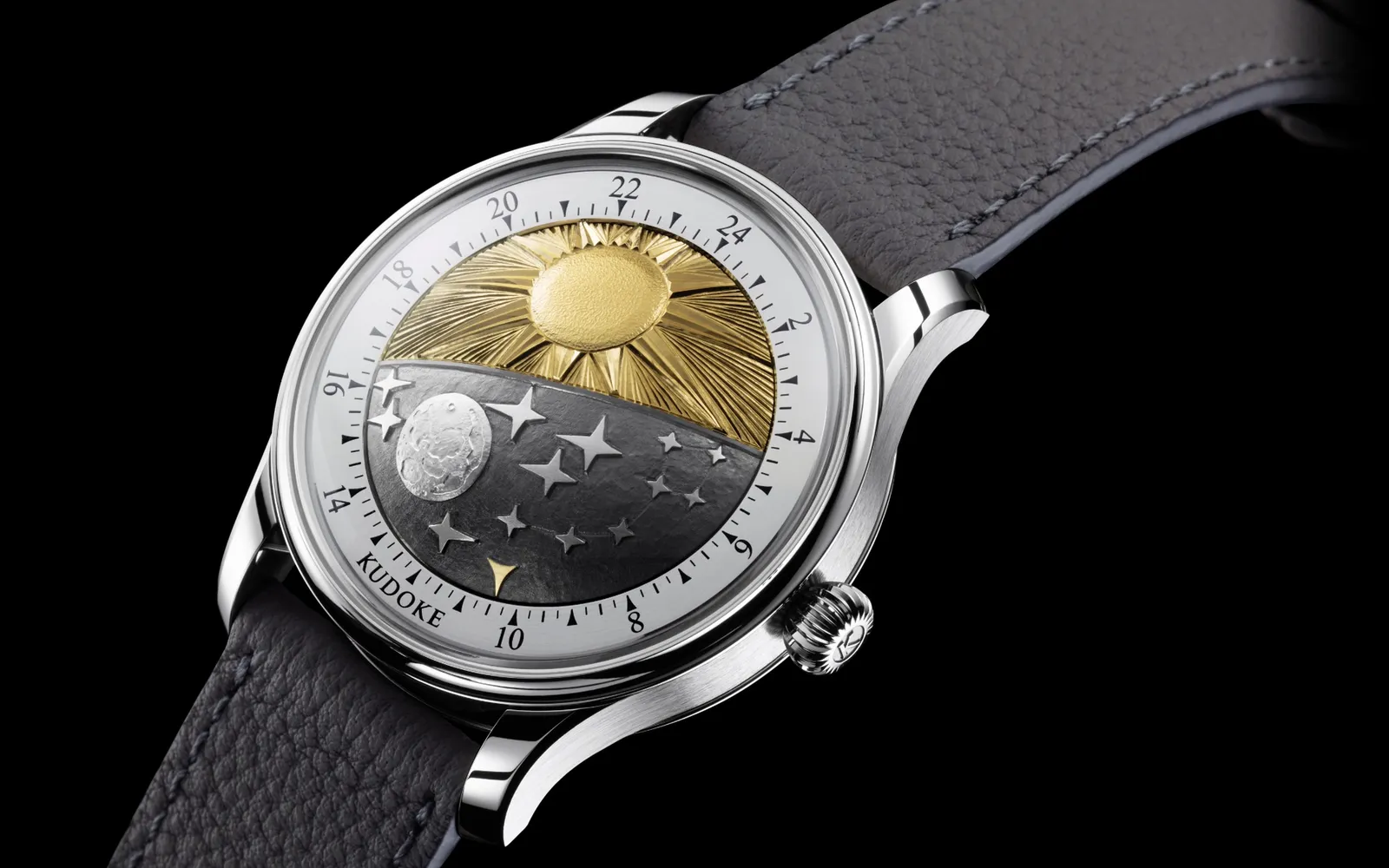
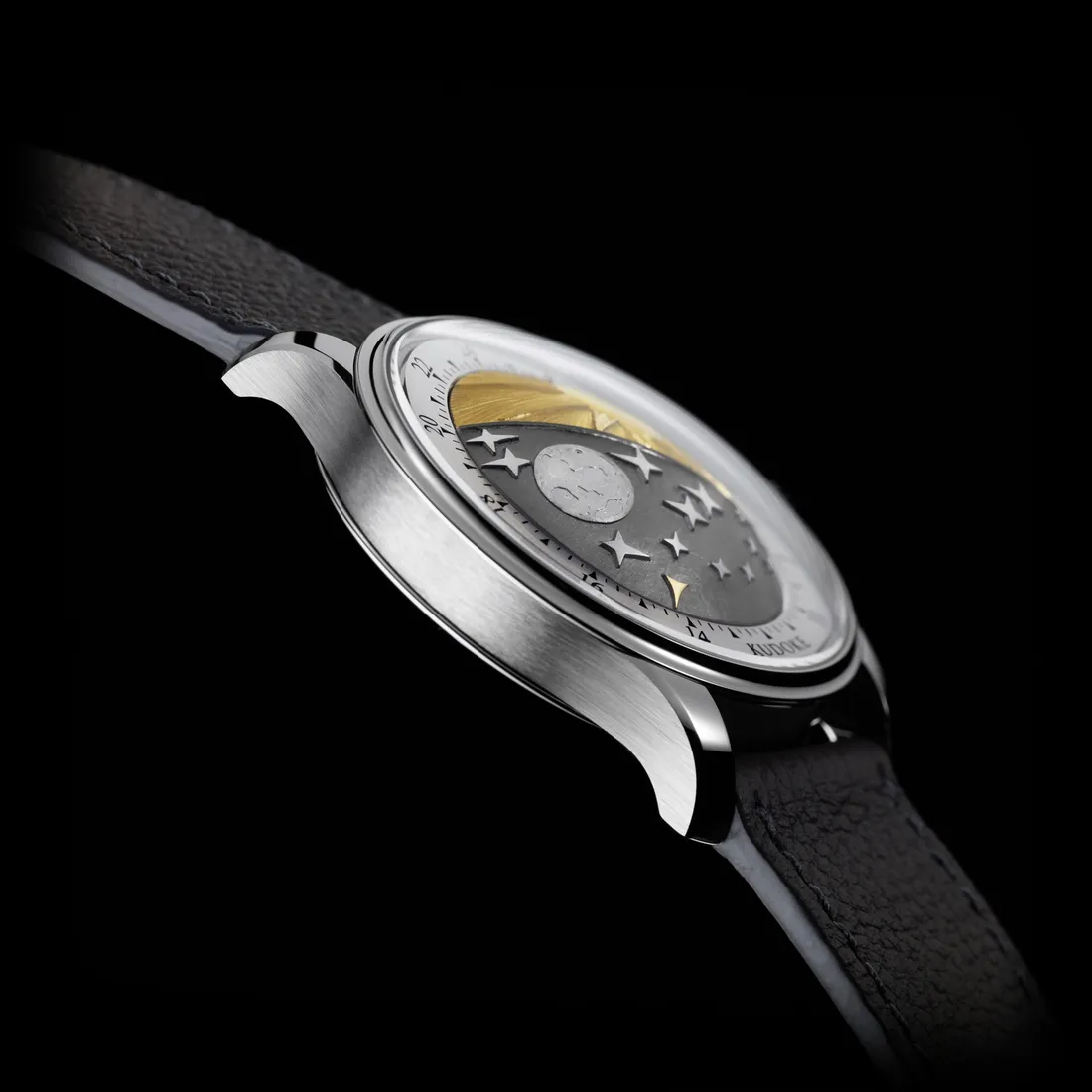
Stefan Kudoke, the German independent, takes that order in the dome of the sky and sets it at the heart of the Kudoke 5, a watch of thirty-eight millimetres. The celestial disc that sat in a small window at twelve o’clock on the Kudoke 2, which took the Petite Aiguille prize in Geneva in 2019, moves this time to the very centre of the dial, and the main stage is handed over entirely to the changing of the guard between the Sun and the Moon.
The domed disc at the centre makes one full turn every twenty-four hours and presents the flow of night and day as a living picture in miniature. One half of it is day: a sun worked in relief, each of its rays engraved one at a time, carrying onto the dial the heat of that first ignition at fifteen million degrees. The other half is night: a silvered moon with its craters cut into the surface, and around it, not stars scattered at random but the constellation of Ursa Minor together with Polaris, its brightest star, the point that anyone looking for their way in the northern hemisphere has looked to for centuries.
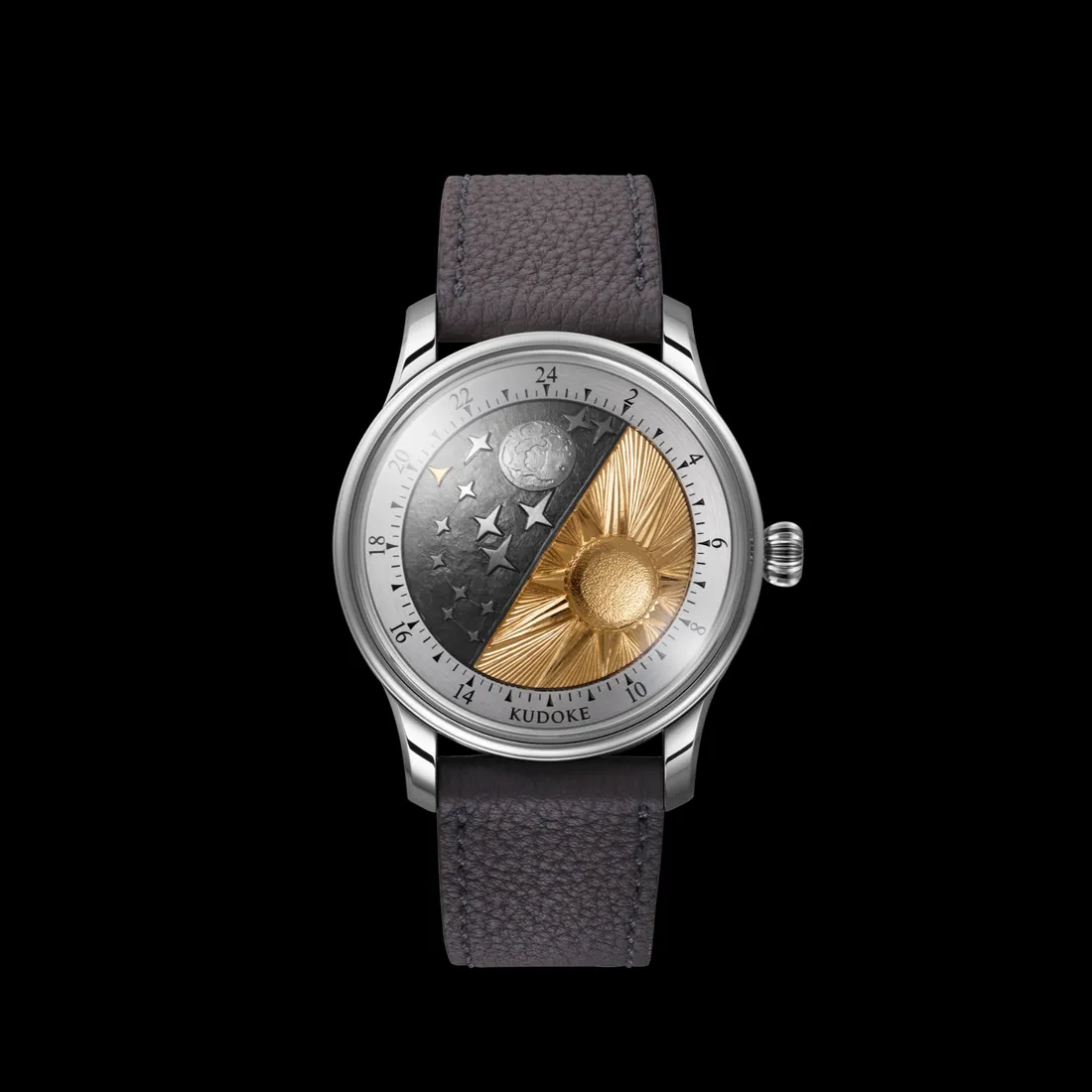
The gold, the white and the black of the disc are not paint. They come from galvanic baths applied in sequence: yellow gold, white rhodium, black rhodium. The engraving is cut first and the plating follows, so that every hollow takes its own colour and the relief grows deeper still. The time is read like this: the small gold triangle on the night side gives the hour against a two-part outer ring divided into quarter-hour steps. A single glance tells you not what the hour is but, first, whether you stand inside the day or inside the night.
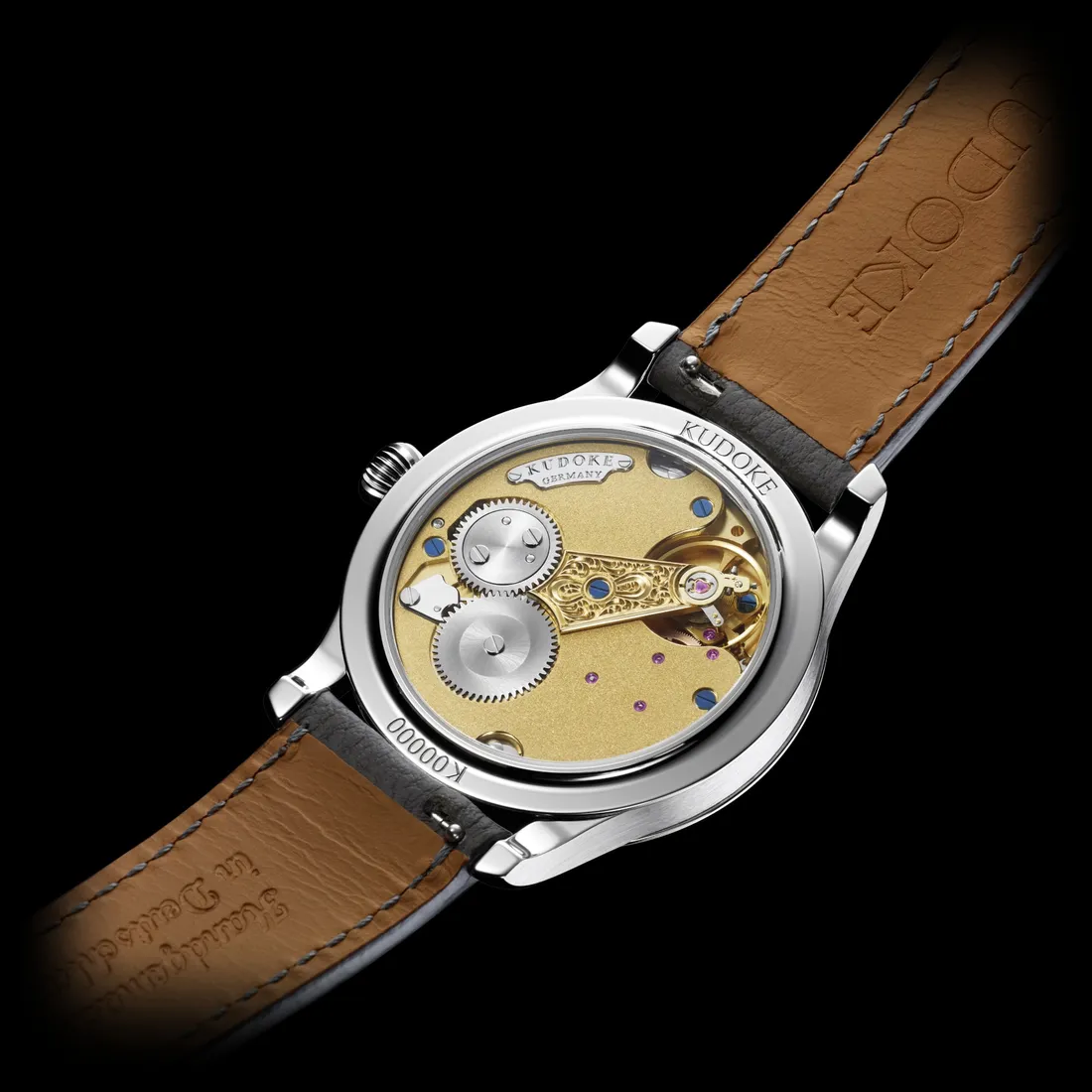
At the heart of the watch beats the hand-wound Kaliber 1-24H_L, which carries the house philosophy of doing everything by hand. Thirty millimetres across, four point three millimetres thick before the disc mechanism is added on top; eighteen jewels, forty-six hours of power reserve, twenty-eight thousand eight hundred half oscillations an hour. The twenty-four-hour mechanism is built onto the dial side, running on a ball bearing. Turn the watch over and a hand-engraved balance cock and the smooth German surface work are waiting for you.
A person looking at this dial does not simply measure time; on their wrist they contemplate how molecular clouds were shaken by an exploding star and lit by chemical love and by constants measured to the last decimal, and how the Moon reflects the radiance of the Sun.
The Kudoke 5 is not for those who see time as nothing but numbers to be spent. It is a microscopic masterpiece made for whoever wants, every time they look at the dial, to contemplate how the universe was lit by a chemical love born out of the ruin of a supernova and by the divine balance of constants measured to the decimal, and to contemplate that immense equilibrium in the sky in which the Sun is a lamp and the Moon a mirror of light.
By adding the warmth of the human hand to cold steel and gold, Stefan Kudoke has turned the magnificent story of the cosmos into a work of literary, scientific and artistic contemplation that we can carry on the wrist.
The watch, as its maker describes it: Kudoke, KUDOKE 5