The meridian room was narrow and long. A thin slit ran the whole length of the ceiling from one end to the other, and through it only a single strip of sky was visible. Directly beneath it, on a stone pier driven into the ground, stood a telescope that could move nowhere but up and down. The pendulum clock on the wall was the only sound in the room, cutting the seconds apart.
The historian of astronomy bent towards the eyepiece and began to speak.
This room had one job, she said. To write down the moment a star crossed the exact middle of the sky, meaning an imaginary line drawn from right here. Know that and you can set your clock. Set your clock and you can find your longitude at sea. Find your longitude and your ships do not go onto the rocks. The trade of an entire empire hung on the pen of the man sitting in this room.
The experimental psychologist looked around him. And how did that man do it, he asked.
With his ear, she said.
She went on.
Fine wires are stretched inside the eyepiece and the star crosses them. The observer watches that crossing while listening to the pendulum clock behind him. The clock counts the seconds, and the observer estimates where on the wire the star stood between two beats. He divides a fraction of a second inside his own head.
The method was called the eye and ear method, and for well over a century it was used in every observatory on earth. Its single foundation was the assumption that a human being can combine the instant he sees with the instant he hears, without error.
The psychologist looked up. That assumption is false, he said.
It is false, she said. But somebody had to lose his job before anyone worked it out.
The episode took place at Greenwich in 1796. The Astronomer Royal noticed that the transit times written down by his young assistant differed from his own by roughly half a second. He warned him first. The gap did not close; if anything it widened slightly. A year later the young man was dismissed and went into the record as a careless observer.
More than twenty years afterwards a German astronomer working at Königsberg read an account of the affair in one of the volumes Greenwich had published. He did not let the matter go, and he compared his own measurements with those of colleagues at other observatories.
What came out is one of the most unsettling findings in the history of astronomy. Every observer has a delay of his own, constant and measurable. One man’s delay differs from another’s, and the difference is not a failing but the speed of that person’s nervous system. The interval between the eye that sees and the hand that writes varies from human being to human being.
The difference was named the personal equation. From then on observatories measured each astronomer’s own delay and corrected his readings by that number.
The dismissed young man had not been careless. He had simply been somebody else.
format_quote"Every observer carries a delay of his own, constant and measurable. That delay is not a failing. It is the speed of a human being."
Hasan Bekmezci
The psychologist was quiet for a long moment, then pulled the subject into his own field.
What you treat as a problem of measurement is the starting point of my profession, he said. Astronomers measured human reaction time for the first time there, while trying to write down the passage of a star. That measurement was the first serious attempt to express in numbers how long the mind takes to complete an operation.
A stimulus has to reach the eye, travel along the nerves, be recognised in the brain and return to the hand as an instruction. Today that interval runs to roughly a fifth of a second in an average person for a visual stimulus. For sound it is slightly shorter. For touch it is shorter still.
So by the time an observer sees a star cross the wire, the star has already crossed it. The gap is a few hundredths of a second, and when the thing you are measuring is the position of a planet it is not a small gap at all.
The historian nodded. The sky slides past at about fifteen arcseconds for every second of time at the equator, she said. So an error of one second means writing a star’s position fifteen arcseconds out of place. In that period, that is enough to shift an entire chart.
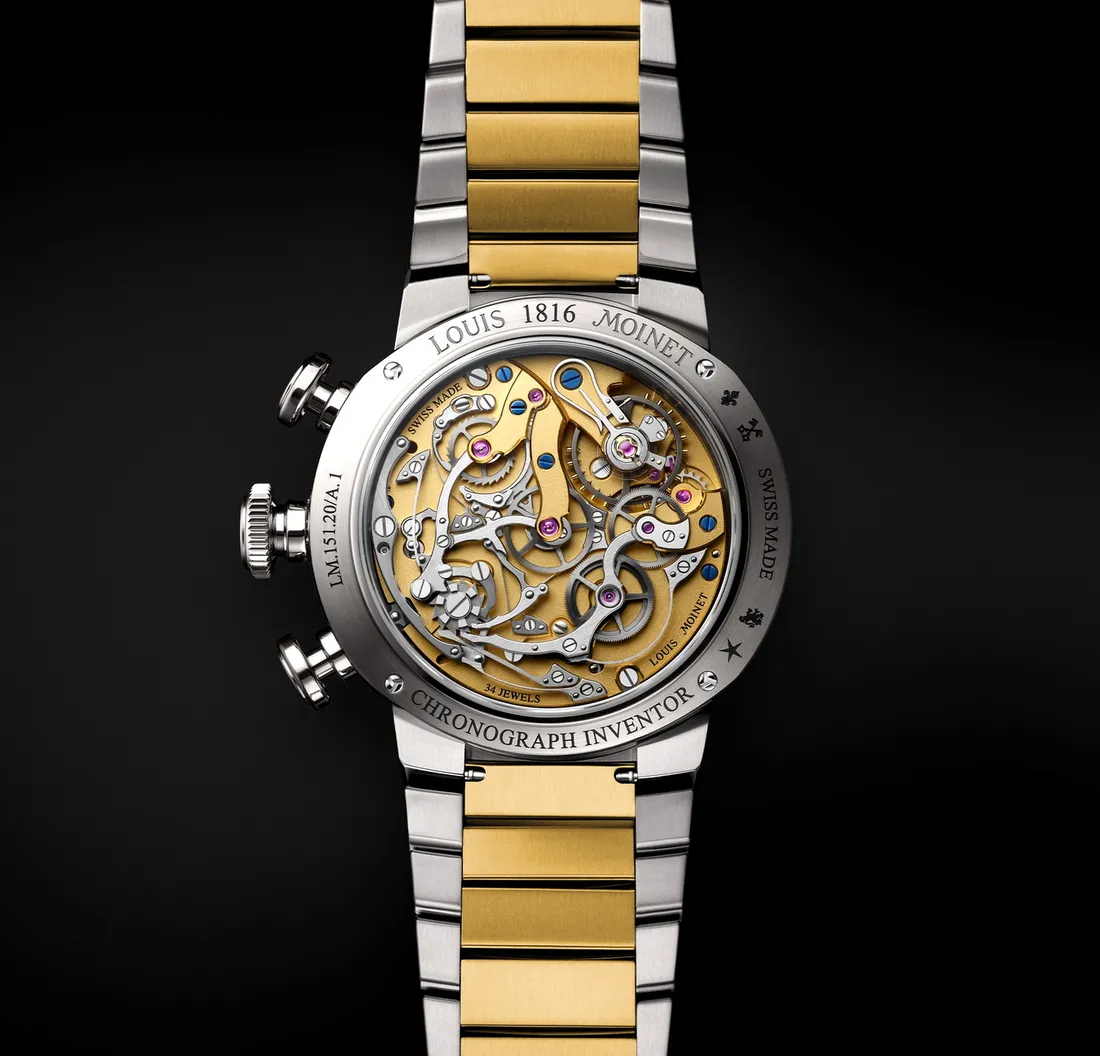
Which is why, at a certain point in the history of instruments, somebody asked the question. How do we take the human ear and the human guess out of the equation.
The answer was a machine that starts a hand the instant a button is pressed and stops it the instant the button is pressed again. Such a machine requires no estimate from the observer. It leaves him one job only: to put his finger down at the right moment.
The first example of that machine was built by Louis Moinet in 1816. It took its name from the sixtieth of a second and it was designed precisely to calculate the speed of celestial bodies. That the instrument is still preserved today in the museum at Saint Blaise means this story has kept something you can put your hands on.
The psychologist smiled. So the thing was built to compensate for our own slowness, he said.
Every measuring instrument is built for that, she said. A ruler exists because the hand shakes. A balance exists because the eye is fooled. A chronograph exists because a human being cannot divide a second.
format_quote"A ruler exists because the hand shakes. A balance exists because the eye is fooled. A chronograph exists because a human being cannot divide a second."
Hasan Bekmezci
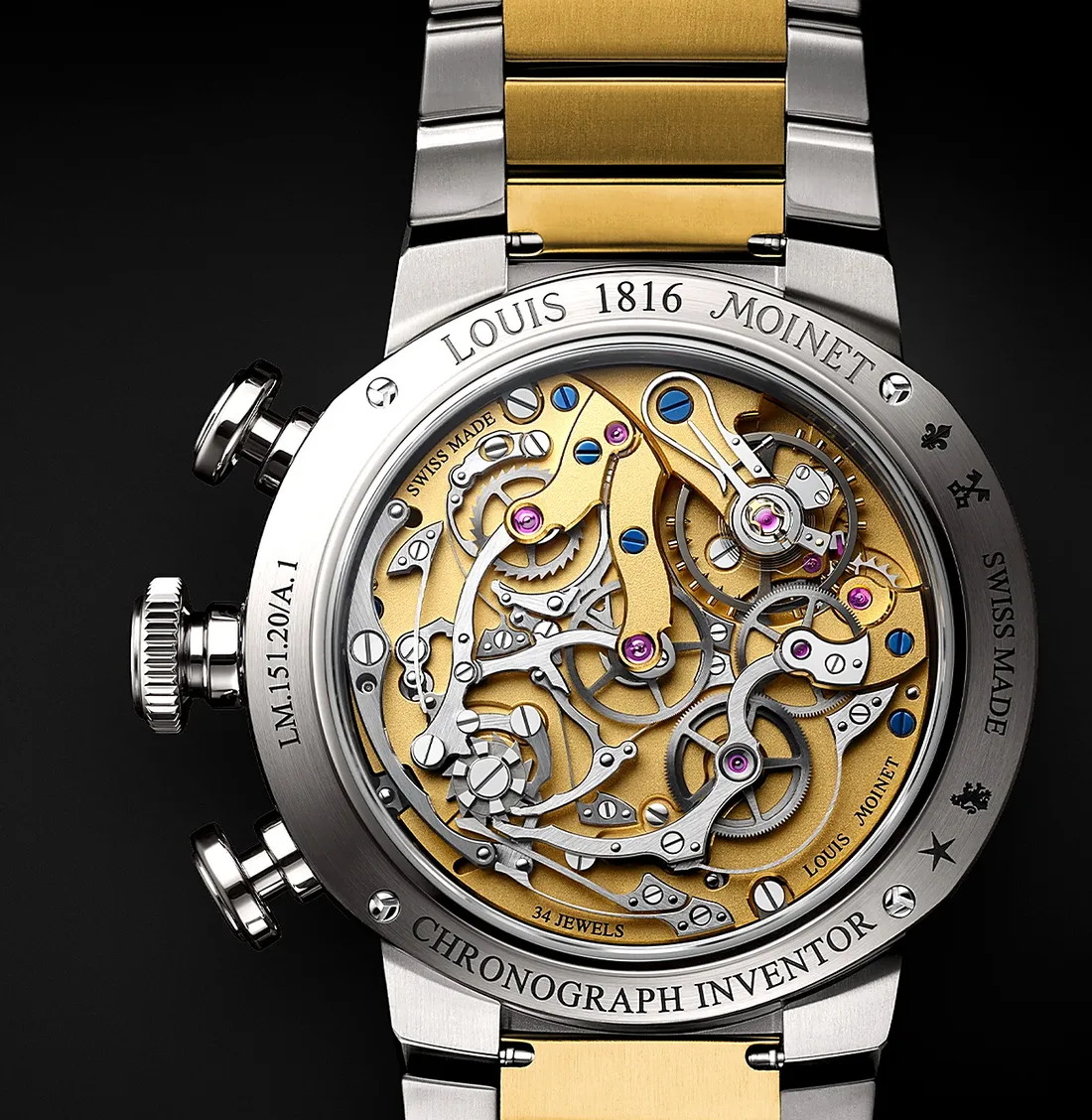
Two centuries later the same house has rebuilt the logic of that first instrument to the standards of today.
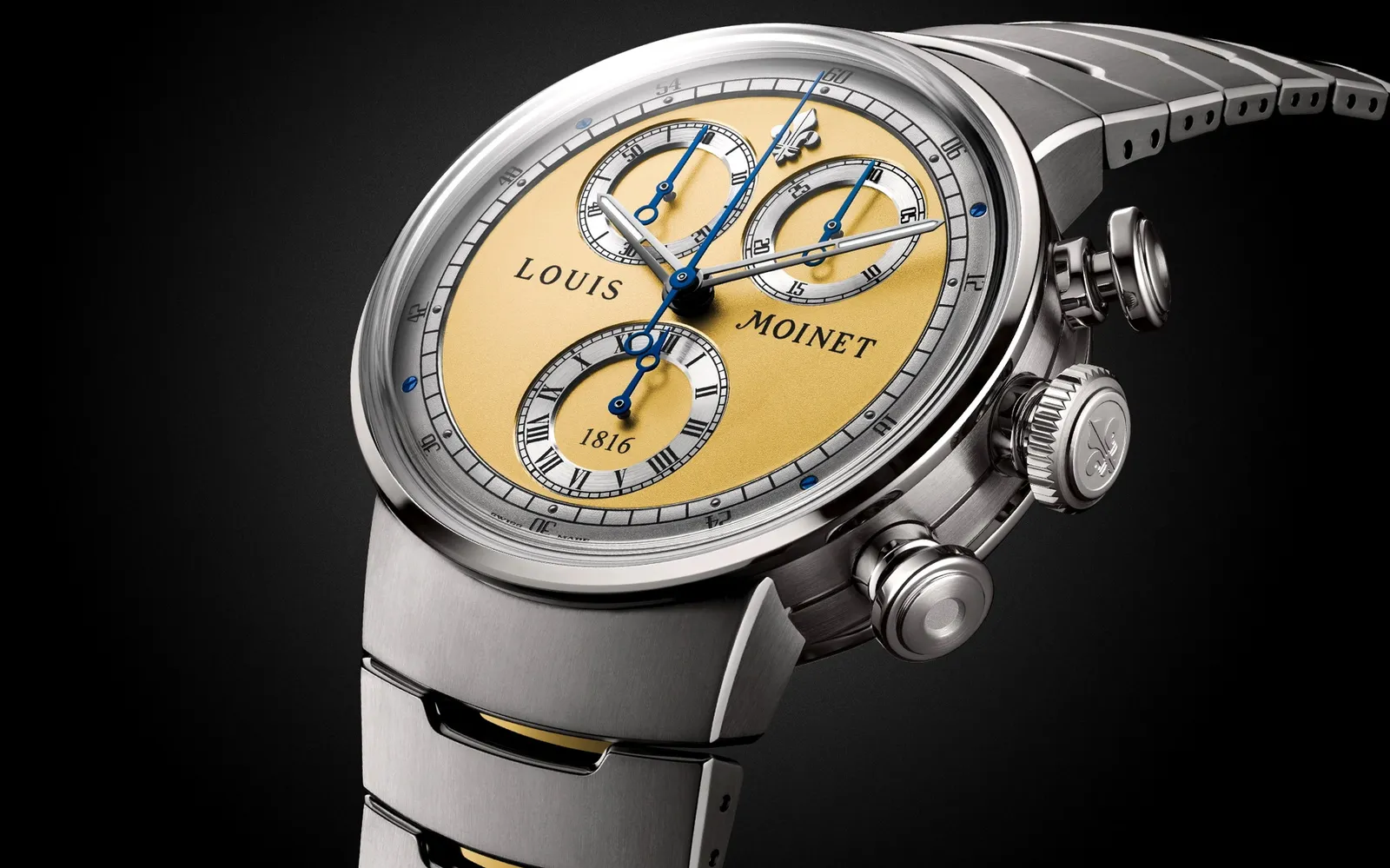
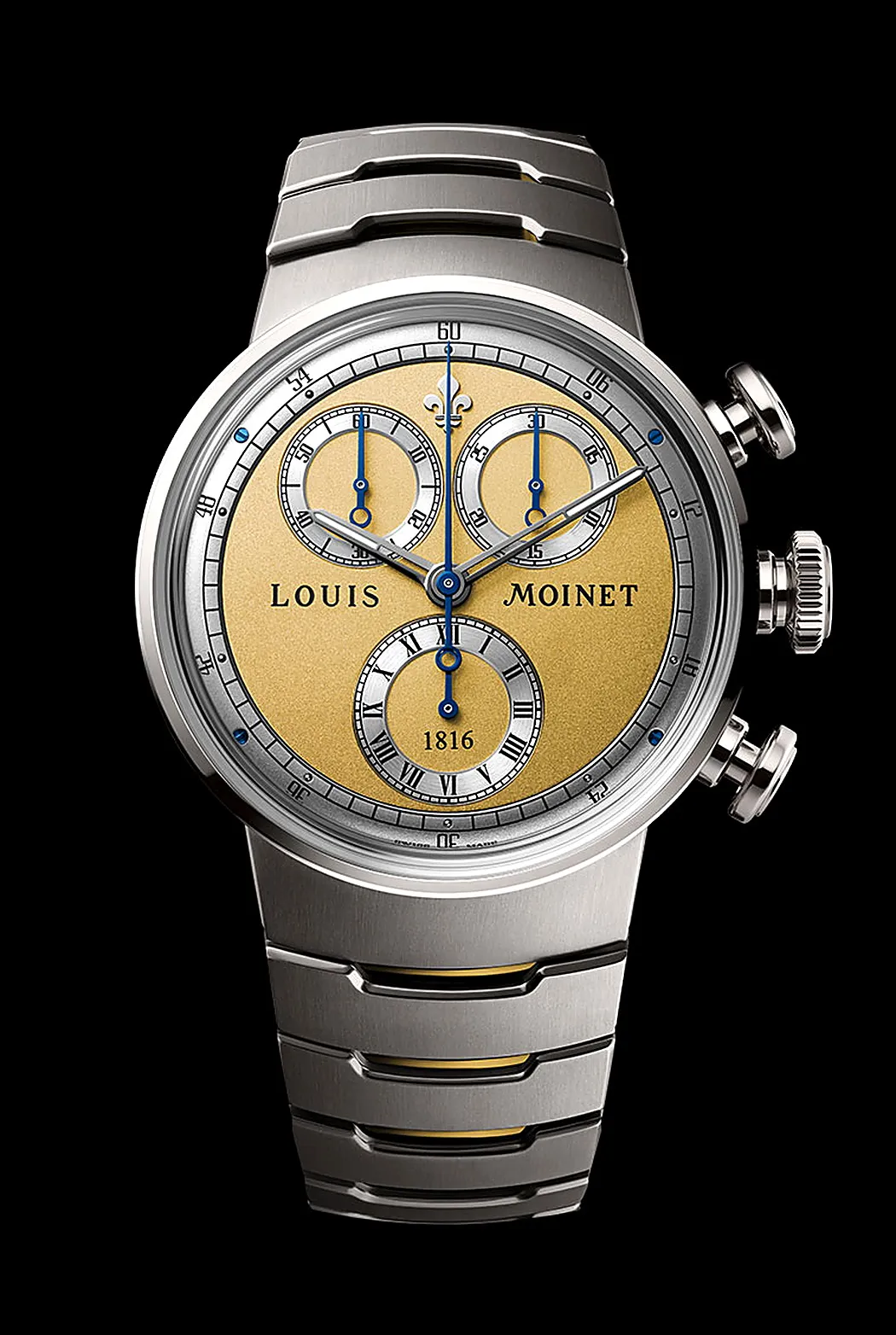
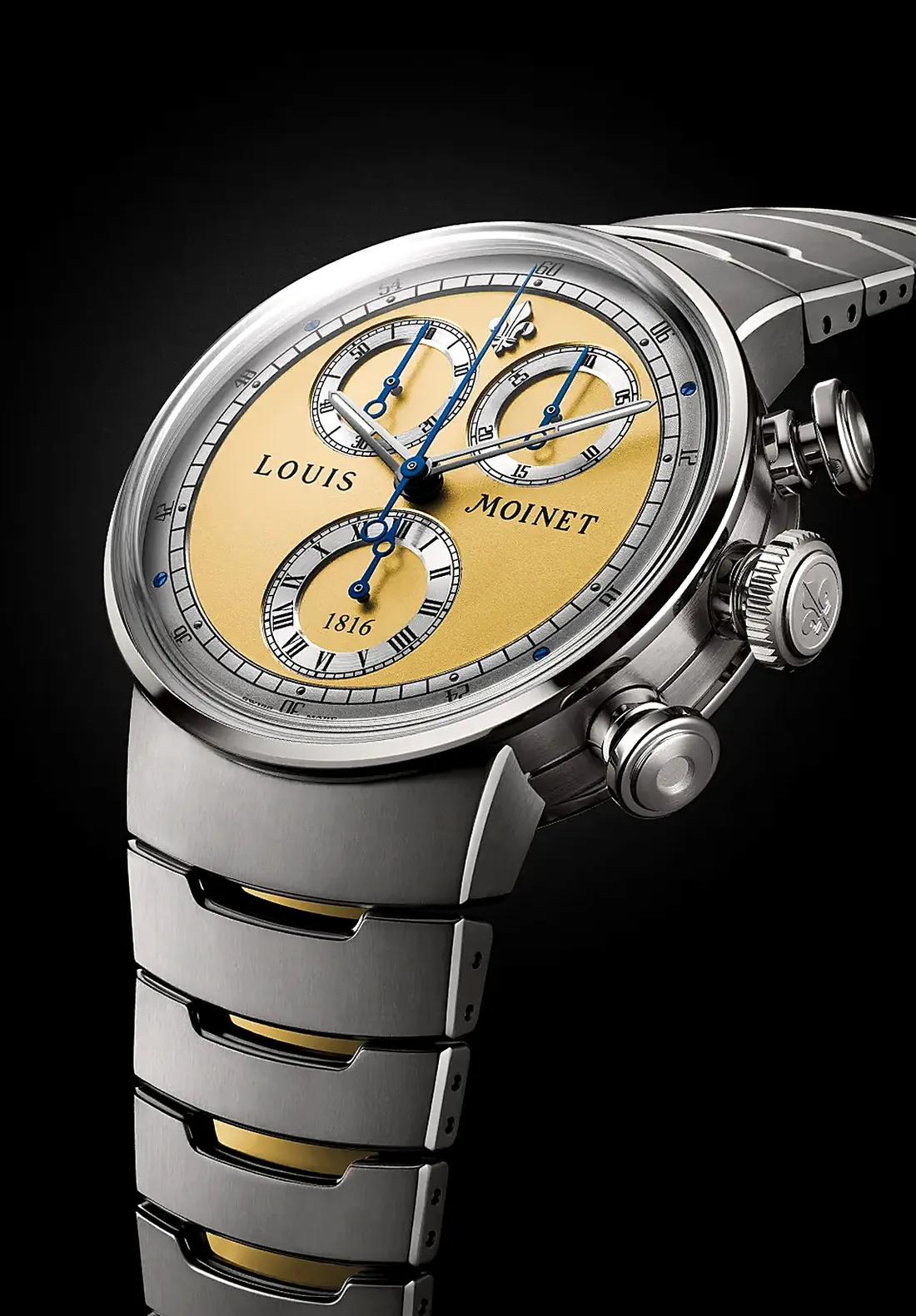
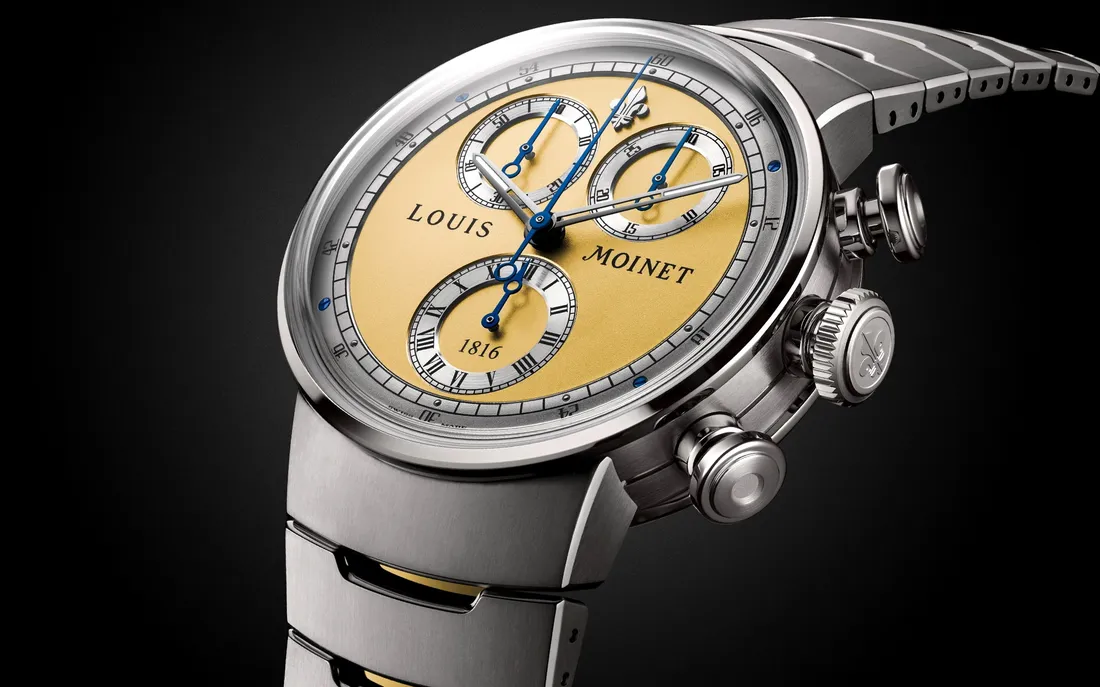
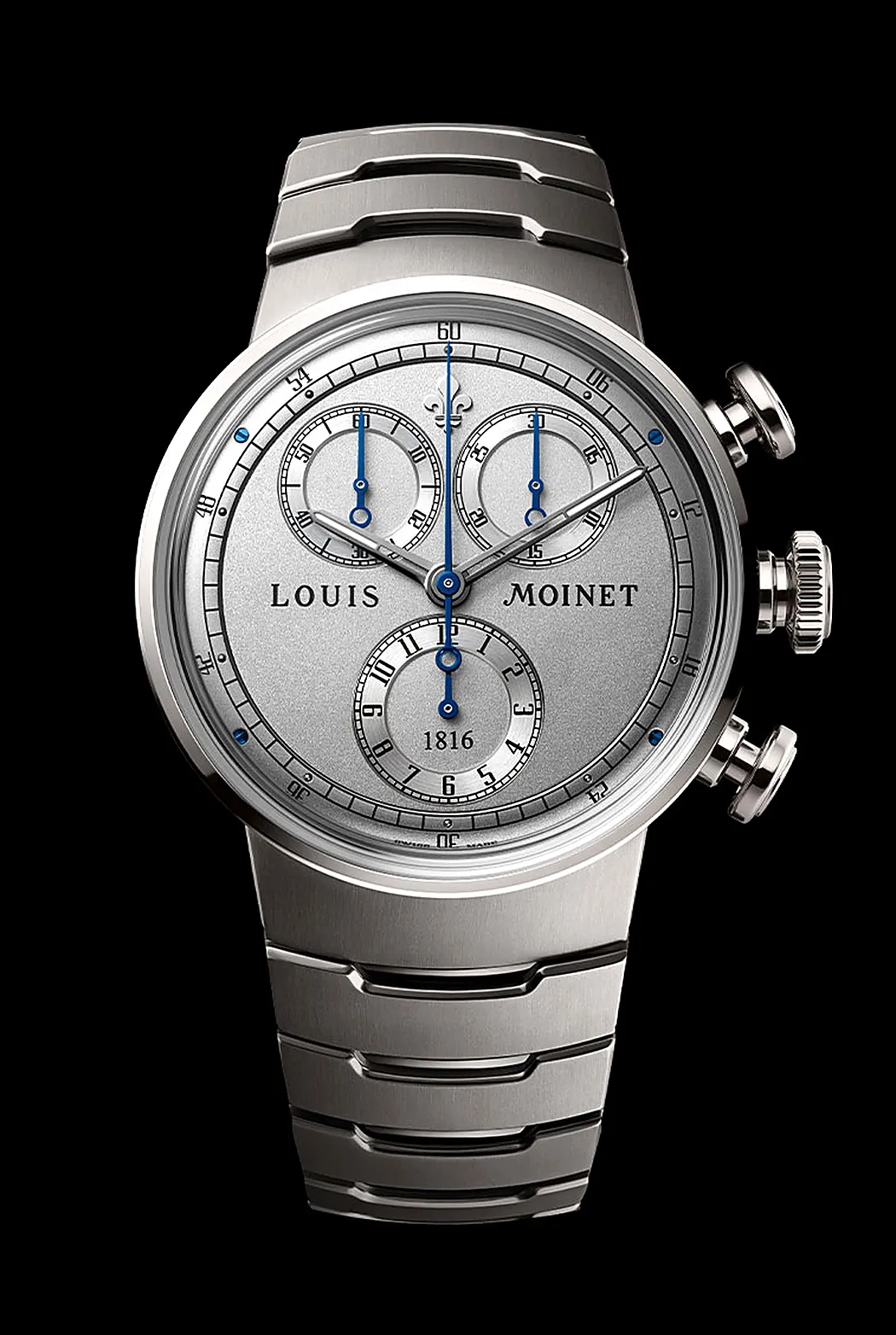
The case is forty point six millimetres across and machined from grade 5 titanium. It is assembled from fifty one parts on its own. The flank carries a paired fluting known as a double gadroon, and the section of the case keeps the half domed shape of the original. Polished and satin finished surfaces alternate throughout. Water resistance is fifty metres.
A pusher stands on either side of the winding crown. One starts and stops the chronograph, the other resets it. The crown itself is decorated with a fleur de lys, the arms of Bourges, the town where Louis Moinet was born in 1768, and the same motif reappears at twelve o’clock on the dial.
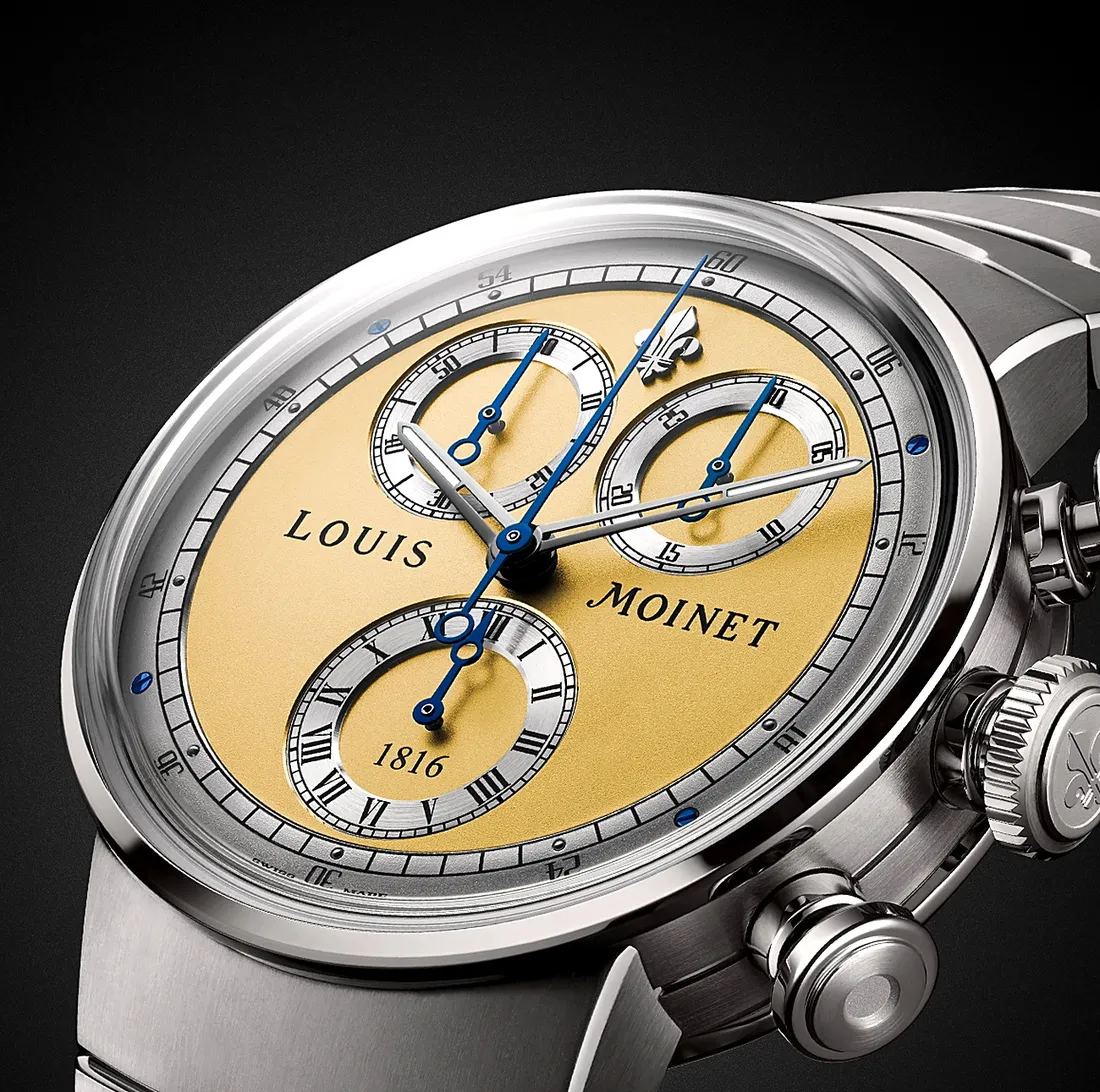
The dial is slightly vaulted and champagne in colour, and it carries twenty three separate components. The small seconds and the thirty minute counter are laid out horizontally on either side of the central chronograph hand, with the twelve hour counter below them. That arrangement is not arbitrary; it is the arrangement of the original instrument. Moinet established the layout twentieth century chronographs would adopt two hundred years before they did.
The minute scale at the outer edge is divided in increments of six, recalling the scale on the original that indicated sixtieths of a second. Ten cabochons in blackened nickel are set along it. Every mark and numeral on the dial is engraved rather than printed, and the inscription 1816 together with the name Louis Moinet is rendered in the typography of the original work. True to that original, the dial plate is fixed to the case with four blued steel screws.
The central chronograph hand and the counter hands are made of blued steel. That blue is not a paint. Heat steel to around three hundred degrees and an extremely thin oxide layer forms on its surface. The layer is so thin that part of the light reflects from its upper face and part from its lower face, and the two reflections interfere with one another. Certain wavelengths cancel, and the wavelength that survives reaches the eye as colour. An oil film on a puddle looks coloured for exactly the same reason. The blue of a hand is therefore the measurement of a layer less than a micron thick, and the craftsman’s job is to lift it from the flame at the right instant.
The hour and minute hands are openworked in the house style with luminous material applied to their tips. Against a champagne ground, blued steel gives the highest contrast available for legibility.
Inside runs the manufacture calibre LM1816. It is hand wound, built from three hundred and thirty parts and thirty four jewels, beats four times a second and holds forty eight hours. The movement was designed for this watch and for no other.
There is no plate on the back, meaning no flat sheet of metal covering the works, so everything inside is directly visible. The brass tone of the bridges, the white of the steel, the blue of the screws and the deep red of the jewels stand side by side.
Three details separate this movement from an ordinary chronograph.
The first is the instantaneous minute counter. On an ordinary chronograph the minute hand creeps forward continuously. As it approaches the sixtieth second it sits somewhere between two marks, and whoever is reading has to decide which number to write. On an instantaneous counter the hand jumps to the next mark in a single movement at the sixtieth second. There is no position to be caught between. A small quantity of energy, stored in a spring and released at exactly that moment, is what makes it happen.
The meaning of that detail in this particular watch is specific. The entire problem at the start of this piece was a human being trapped between two marks and forced to guess. The instantaneous counter exists to abolish the guess.
format_quote"An instantaneous counter never lets the hand rest between two marks. That hesitation is precisely what cost a man his job two hundred years ago."
Hasan Bekmezci
The second detail is the column wheel. A chronograph has three separate jobs: to start, to stop and to reset. Those three have to happen in the right order and the transitions between them must never overlap.
A column wheel is a small wheel carrying vertical columns, and it turns in one direction only. Every press of the pusher advances it one step. The gaps between the columns and the tops of the columns raise or lower the levers of the mechanism in sequence. It is a sequencing device that runs mechanically, a logic circuit built a century before electronics, and the soft, definite feel under a finger on the pusher comes from that wheel.
The third detail is the swan neck regulator. The rate of a watch is adjusted by changing the working length of the balance spring. It is possible to do that with a plain lever, but a plain lever can be knocked out of position. In the swan neck arrangement a curved spring presses against that lever and its position is changed with a micrometre screw. Every quarter turn of the screw produces a very small change, and the spring stops the lever drifting back. It takes its name from the shape of that curved spring. It was patented in the second half of the nineteenth century and is still considered the most elegant answer available.
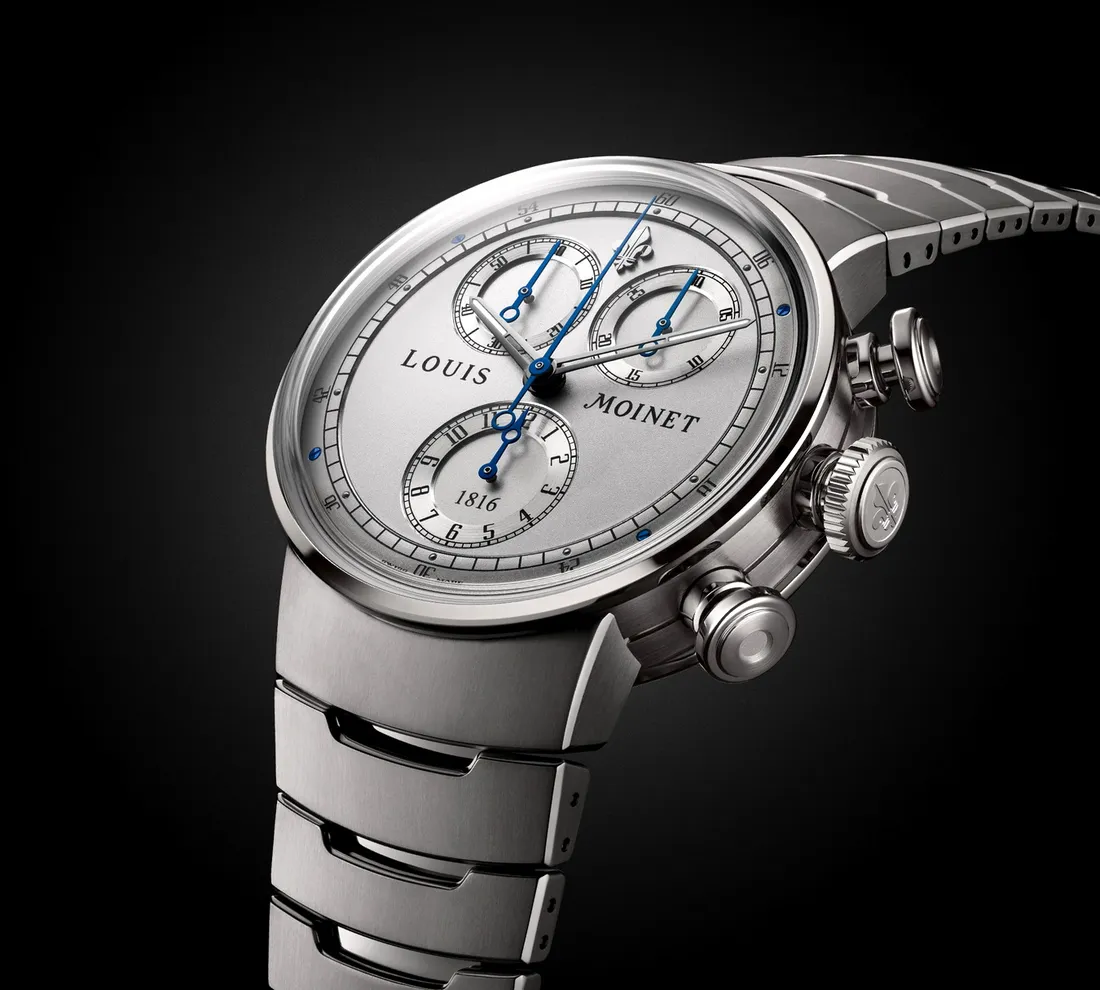
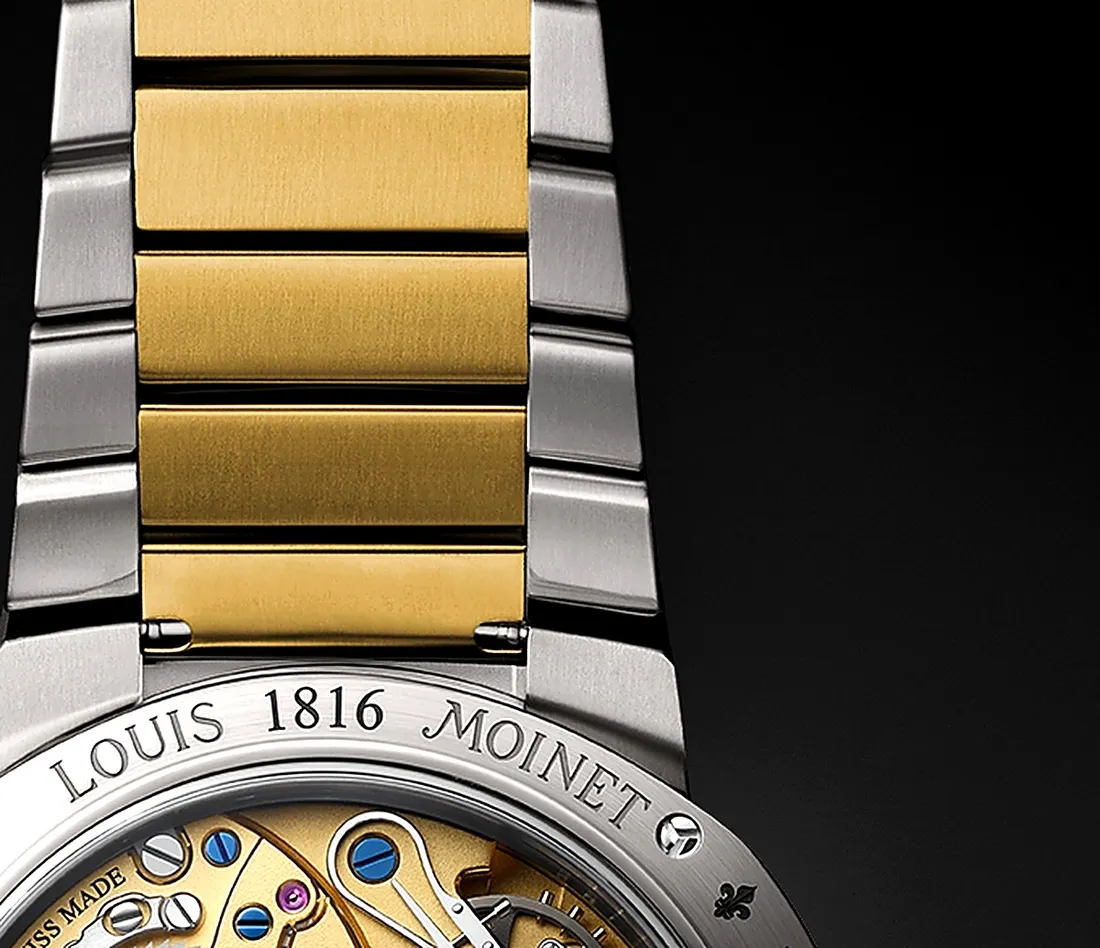
The bracelet is titanium too and was conceived as a continuation of the case. Its intermediate links are covered with a champagne coloured diamond like carbon coating. That coating is neither paint nor gold. Carbon atoms are deposited onto the surface in a plasma and settle into an order resembling the bonding inside diamond. The resulting layer is extremely hard and its coefficient of friction is low. Its colour comes from the thickness of the layer, exactly as it does on blued steel.
The links taper progressively towards the wrist and satin and polished surfaces alternate across them. The clasp is a folding type.
The same model is also offered with a silvered dial and a bracelet in plain titanium. The choice between the two is entirely a matter of tone; the case and the movement are identical.
As the conversation in the meridian room was ending, the psychologist asked one last thing.
Do we know the name of the young man who was dismissed, he said.
We do, she said. But what was done to him matters more than his name. He made no error. There simply was not yet an instrument capable of measuring him.
The psychologist stepped away from the telescope and walked towards the door. The whole history of science is a little like that, he said. A thing does not exist for as long as you cannot measure it. The moment you begin to measure it, you see not only the thing but yourself.
She turned off the lamp and looked at the thin band of light coming through the slit in the ceiling.
That was the whole business in this room, she said. They were trying to measure the sky, and in the end they measured the speed of their own nervous systems. What they were looking for was above them. What they found was inside them.
A chronograph strapped to a wrist today has no observatory duty. Nobody records the transit of a star by pressing a button any more.
What you hold at the instant you press it, however, has not changed. A human being decides that an event has begun and puts a finger down. The short interval between the decision and the finger is the same interval that was measured two hundred years ago, and it still differs from person to person.
So this watch reminds you of the one thing it cannot take from you. The machine now divides a fraction of a second perfectly. But you are still the one who starts that fraction, and you are standing inside the thing you are measuring.
Two hundred and ten years ago a man noticed this and built an instrument that removed the guess. Today the workshop carrying his name makes that instrument’s grandchild in titanium. The whole difference is material and finishing. The question stands exactly where it stood: can a person write down the instant he saw something pass at the instant it actually passed?