It was past midnight in the furnace hall and you had to raise your voice a little to be heard. Inside the cylindrical crucibles ranged along the wall the temperature stood above two thousand degrees, and through the observation ports you could see an orange lake.
The crystal growth engineer checked the figure on his screen. Three millimetres an hour today, he said. Pull any faster and you leave stress inside the crystal, and that stress comes back as a crack when you cut it. You pay for impatience several months later.
The cosmologist beside him leaned towards the glass and looked into the melt. What is the material, she asked.
Aluminium oxide, he said. A white powder in its pure state. Melt it and cool it slowly and the atoms fall into a single order on their own, and you get one enormous crystal. We call it sapphire. It does not have to be coloured; the blue you see in nature comes from a handful of foreign atoms.
She was quiet for a moment, then smiled. What you do in this room has a precedent on the scale of the universe, she said. The oldest one there is.
She began to explain, and the hum of the furnaces settled underneath her sentences.
When a star reaches the end of its life it scatters the elements forged in its core, she said, and aluminium is one of them. That material drifts for millions of years inside a cloud of gas and dust. When the cloud begins to collapse under its own weight the middle heats, the edges spin, and a disc forms.
At first that disc is so hot that nothing solid exists inside it. Everything is gas. Then it cools. And the first substance to solidify out of a cooling gas is whichever substance can condense at the highest temperature.
Which means the thing in our crucible, the engineer said.
Precisely that, she answered. The oxides of aluminium and calcium. They turn solid at somewhere around seventeen hundred degrees, and at that temperature iron is still a gas, silicates are still gas, water is nothing but vapour. So the first solid grains of our solar system were corundum and its relatives. We are not guessing. The evidence is in our hands. Certain meteorites contain pale, irregular patches extraordinarily rich in calcium and aluminium, and when they are dated with radioactive clocks they come out at four billion five hundred and sixty seven million years. They are the oldest solid matter anyone has ever held.
The engineer turned back to the crucible and looked at it for a long time. So what we are doing here is a repetition, he said.
A repetition, she agreed. Simply a far more impatient one.
format_quote"The first matter to turn solid in our solar system was aluminium oxide. Hublot built the case of a watch named for the beginning out of exactly that substance."
Hasan Bekmezci
Sapphire is transparent for a reason most people get wrong. It is not purity. Whether a material lets light through depends on how much energy an electron needs in order to jump to its next available level.
Visible light carries between two and three electronvolts. Inside an aluminium oxide crystal, moving an electron requires more than three times that. The arriving photon enters the crystal, finds no door it can open, and leaves on the other side having lost nothing. Glass is transparent on the same principle. A metal is bright rather than clear because its electrons are free and the photon is absorbed and thrown straight back at the surface.
The blue sapphire of the natural world is the work of a few foreign atoms that slipped into that perfect order. When an iron atom and a titanium atom happen to sit side by side in the lattice, an electron can move between them, and the energy that transfer requires falls exactly in the red. The red is absorbed and the blue is what remains. The colour of a stone is born from the neighbourly arrangement of a few atoms in a million.
Making a watch case from the material is another matter entirely. Sapphire stands at nine on the Mohs scale and the only natural substance harder than it is diamond. It is therefore not cut but ground away. Every surface is worked for hours with diamond charged tooling. A single component of a complicated case can consume hundreds of hours, and one microscopic crack at any point in the process condemns the whole piece.
The cosmologist changed the subject, took out her phone and opened an image. A classical marble bust stood on the screen, and on its shoulder, without any explanation, sat a mirrored blue glass sphere.
Why are you showing me that, the engineer asked.
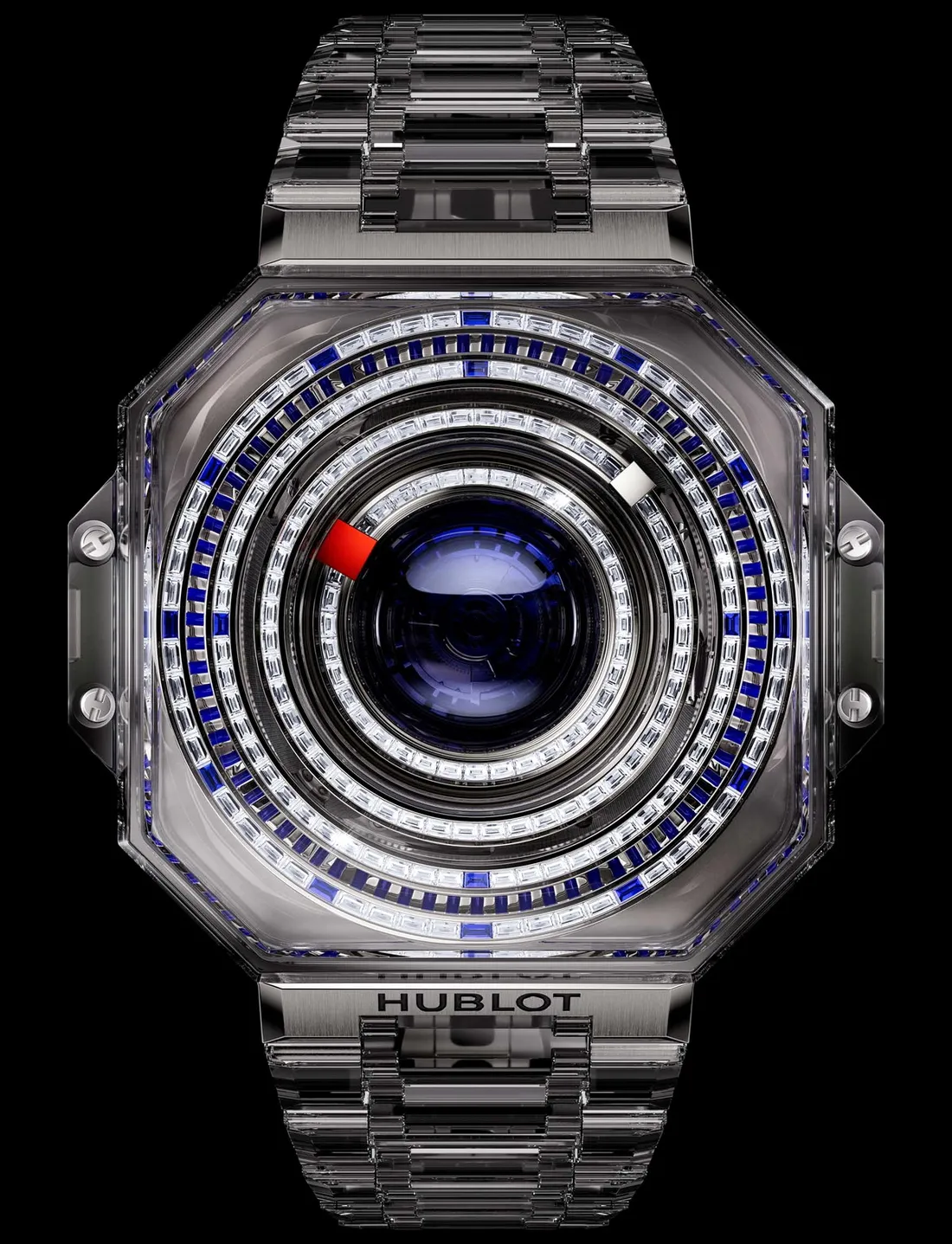
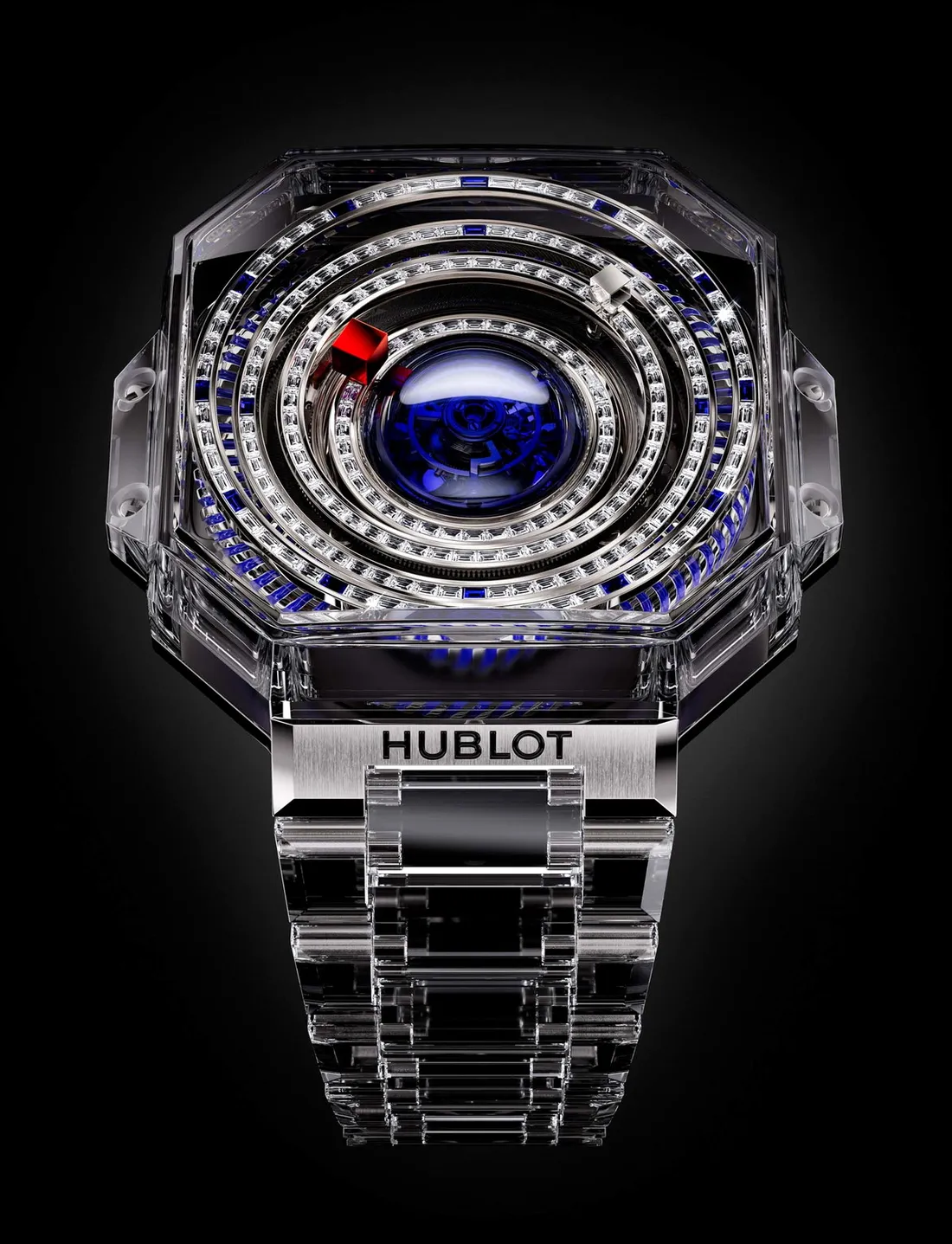
Because the same sphere sits at the centre of this watch, she said.
That object is a garden ornament. For well over a century, in America and in Europe, mirrored glass spheres have been set in the middle of flower beds. Jeff Koons saw a great many of them in the town where he grew up, and years later he moved them to the centre of his art, placing a blue sphere in front of classical sculptures and old master paintings.
The sphere is not there to obscure art history. It is a mirror, and it reflects whoever stands in front of it, so that looking at a painting you also find yourself inside it. Koons puts the idea simply: in front of a work of art a person is not only a spectator but part of the work. The blue, for him, recalls a planet, the single blue point visible from space.
The engineer nodded. And now that sphere has been placed at the centre of a watch, he said.
With a mechanism turning underneath it, she said.
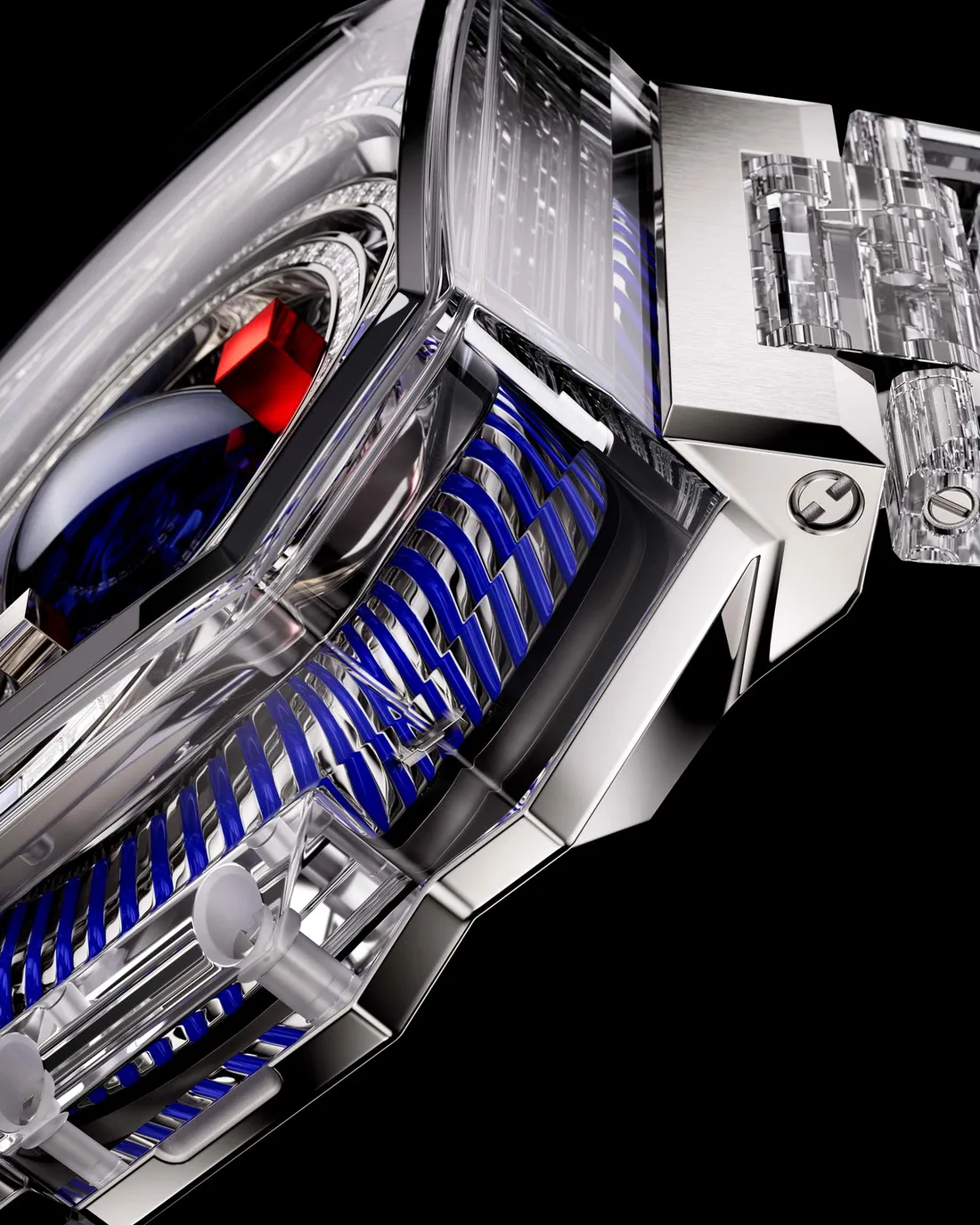
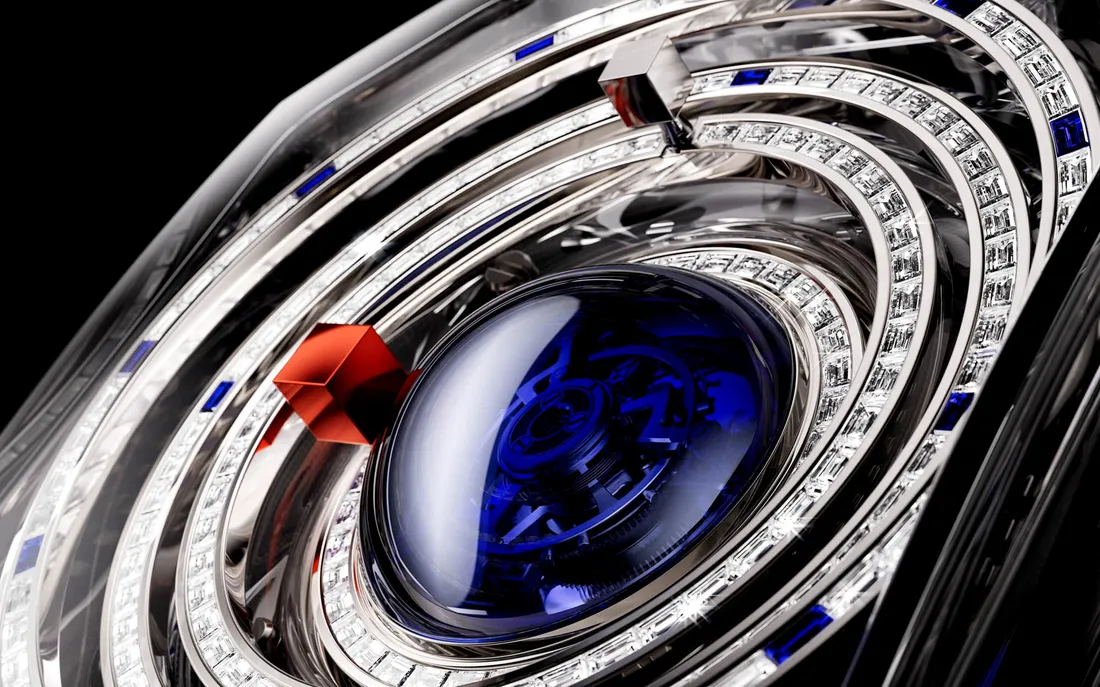
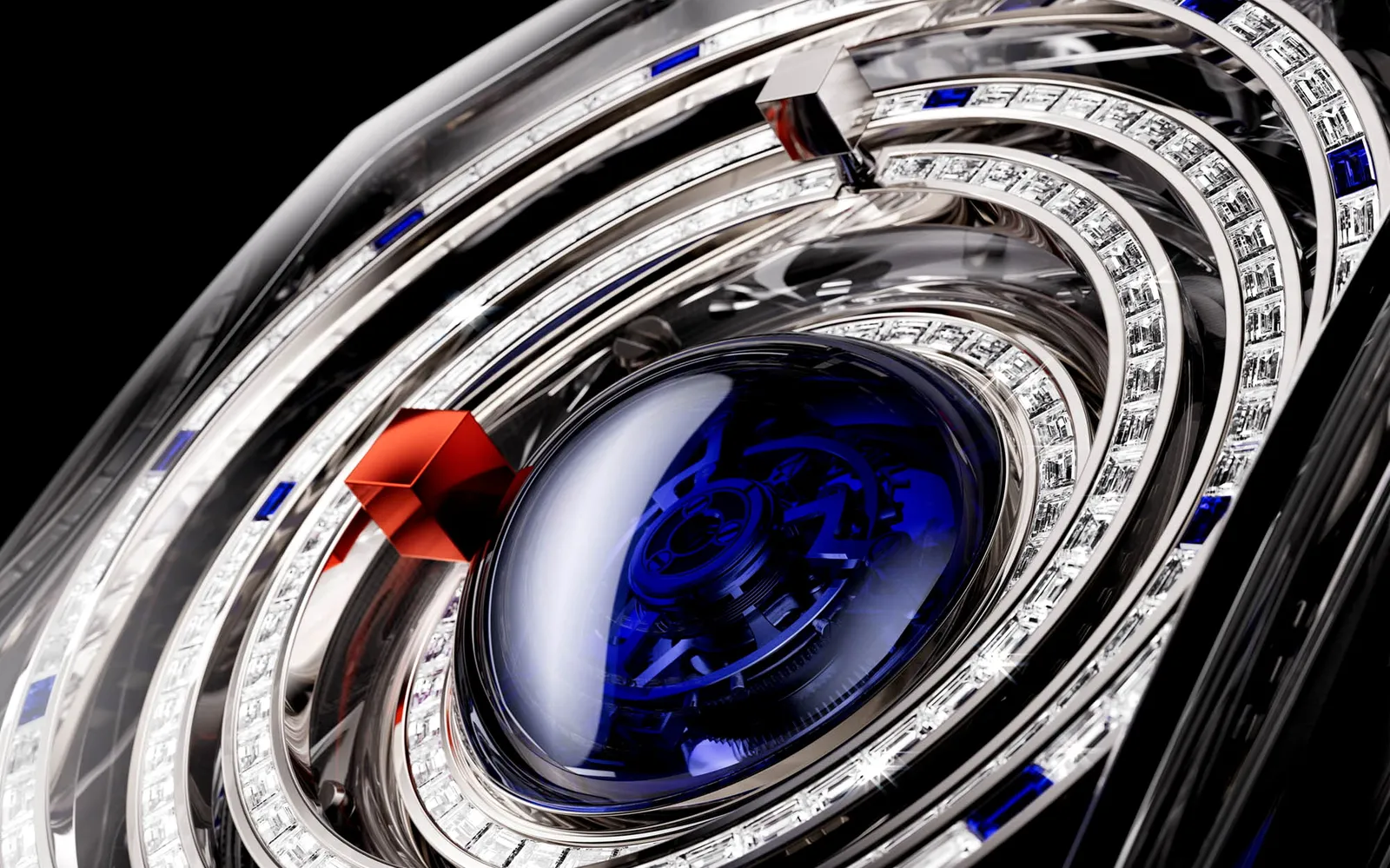
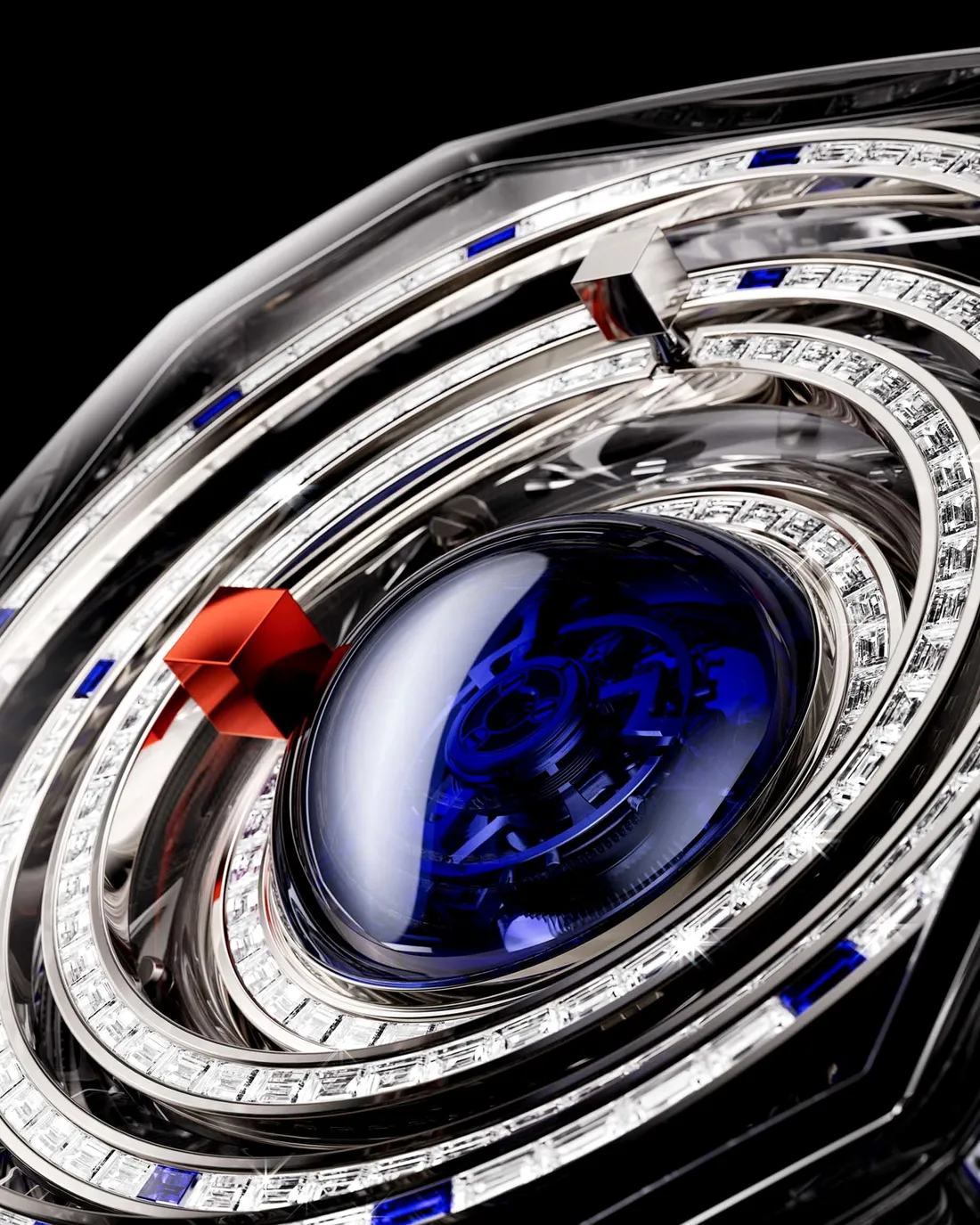
The thing at the centre of the dial is a tourbillon, patented by Abraham Louis Breguet some two hundred and twenty five years ago. The problem it was built to address is this: however perfectly poised the balance and hairspring at the heart of a watch may be, gravity makes them swing at different rates in different positions. A watch upright runs at one rate and a watch flat runs at another.
Breguet did not try to defeat the problem. He chose to average it. He placed the escapement and the balance inside a rotating cage, and once that cage completes a turn every minute the errors gravity introduces cancel one another out within the turn. A tourbillon does not beat gravity. It shows gravity every direction in sequence.
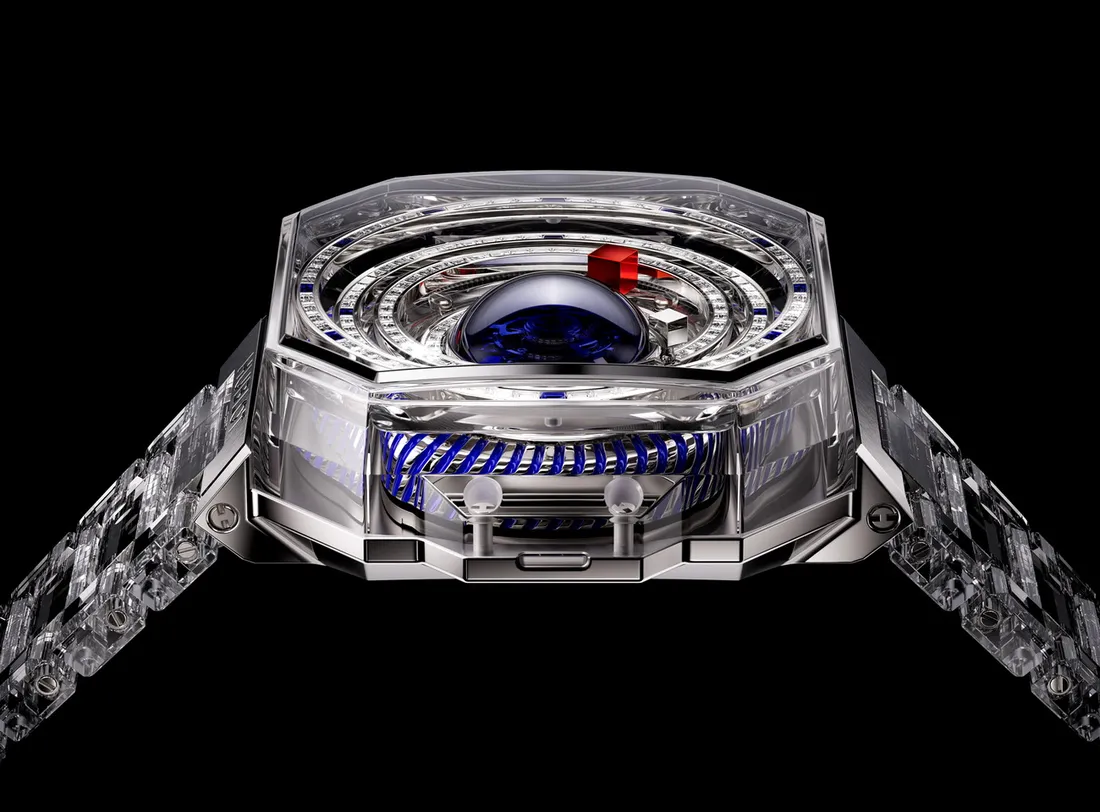
The real difficulty of this particular tourbillon lies in its address. It sits at the exact centre of the dial and it is of the flying type, meaning there is no bridge holding it from above, only a support beneath. The centre of a movement is traditionally where the hand arbour sits. If that address is occupied, there is nowhere left for hands.
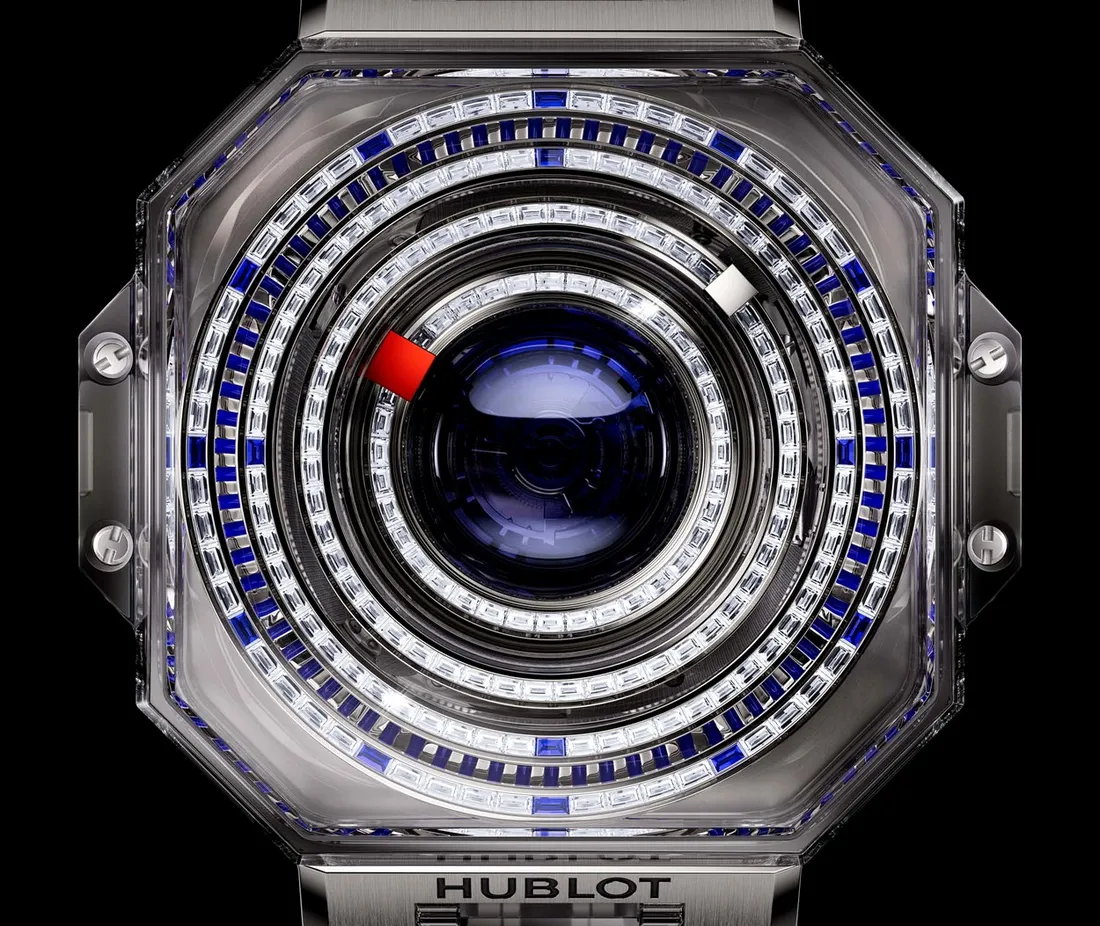
Hublot solved it by removing the hands altogether. Four concentric rings turn around the dome. The two inner rings carry the hours and the minutes, the two outer ones form the markers. All of them are made from 18k white gold and set with baguette cut diamonds and blue sapphires. You read the time not by the tip of a hand but by which mark on a ring has come round to which point.
format_quote"A tourbillon does not defeat gravity. It shows gravity every direction in turn and waits for the errors to cancel. It is engineering in its most patient form."
Hasan Bekmezci
If a tourbillon occupies the centre and rotating rings carry the time around it, one question remains: how is the thing wound and set.
The usual answer is a crown on the flank of the case. But on a case ground from sapphire the flank is where the visual integrity of the whole object lives, and planting a piece of metal there spoils the argument for transparency.
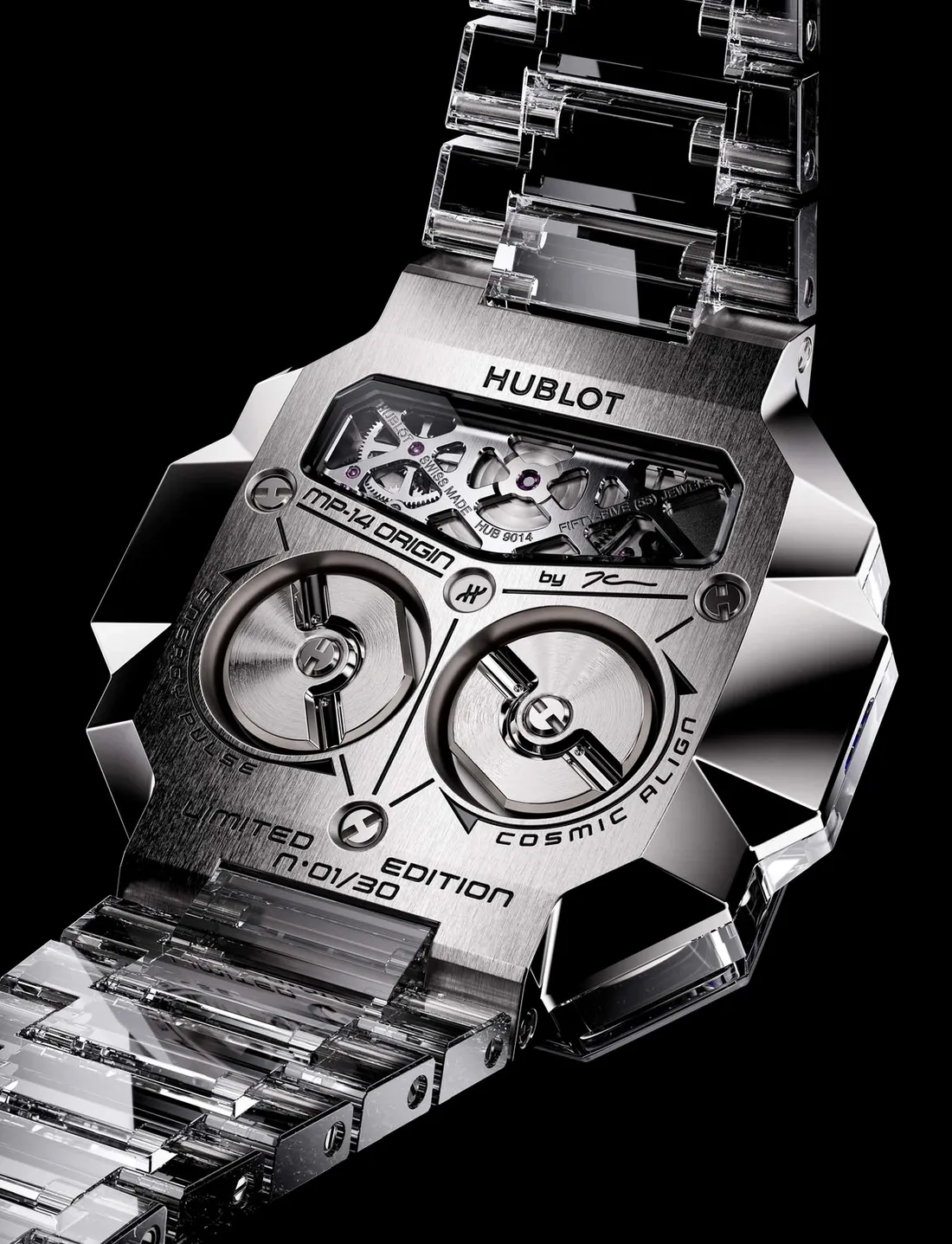
So the crown moved to the back. The caseback, machined from grade 5 titanium, carries two fold out levers side by side. Raise one and the movement winds by hand; raise the other and the time can be set. When you are done both fold flat again and the surface closes.
The calibre is the HUB9014, and it is the first automatic movement in the house to carry a central tourbillon. The winding mass does not turn in the middle of the movement but around its rim. The single purpose of that peripheral arrangement is the view: a conventional rotor hides half of a movement, while a mass riding at the edge hides nothing. The balance beats three times a second and the barrel holds sixty hours. Water resistance is thirty metres, which is about as much as anyone should expect from a sapphire case of this size.
The numbers do not describe what this watch is so much as how hard it was. The case measures forty four millimetres across and twenty millimetres deep. The bracelet is sapphire too, built in three rows of links and closed by a titanium folding clasp. Production is limited to thirty pieces and the price sits around four hundred and eighty eight thousand dollars.
Most of that figure comes not from the stones on the dial but from the scrap you never see. A sapphire bracelet means dozens of components, each to be ground individually and then hinged to the next, and every link goes through the same abrasive process. One crack in one link holds up the whole set. The price of an object like this is the sum of the ones that could not be made.
The engineer had already said as much in his own language inside the furnace hall: you cannot negotiate with a crystal while it is growing. You give it the time it asks for. Whoever hurries does not lose the crystal. He loses himself.
Towards the end of the night the two of them stepped out of the hall and stood in the cold. The sky was clear.
Let me tell you something, the engineer said. I have stood at these crucibles for years and I have never once looked at the work this way. I thought I was producing a material.
You are producing a material, she said. But the first example of it was produced four and a half billion years before you, and the thing that produced it was not a furnace. Inside a cooling gas, atoms reached a temperature threshold set for them, came together and fell into order. Neither the atoms chose that order nor did we impose it. All we learned to do was rebuild the same conditions.
He looked up at the stars. So the case of a wristwatch is the same compound as the first solid matter in this universe, he said.
The same compound, she said. And at the centre of that watch a small cage turns, trying to average out gravity. Gravity is the very force that gathered all the matter in this story together in the first place. The object carries a mechanism that reckons with the force that made it possible.
format_quote"A small cage turns at the centre of the object, averaging out gravity. Gravity is the very force that first gathered all the matter in this story together."
Hasan Bekmezci

Before going back inside she added one last thing.
The first instrument a human being used to measure time was the sky, she said. Then shadow, then water, then sand. Eventually we cut wheels out of metal and strapped them to our wrists. And where we have arrived is an object whose case is the same compound as the first solid in the universe, whose central dome comes from a garden ornament an artist remembered from his childhood, and whose inner cage comes from a trick a watchmaker devised against gravity two centuries ago.
I have always found it strange that so many different scales of time can gather inside one object. Four and a half billion years, a childhood memory, and one revolution a minute. All three sit on the same dial.
He opened the door and answered as he went in. Perhaps that is the real work of a watch, he said. Showing the time is easy enough. The hard part is reminding whoever looks at it how many different kinds of time they are living inside.