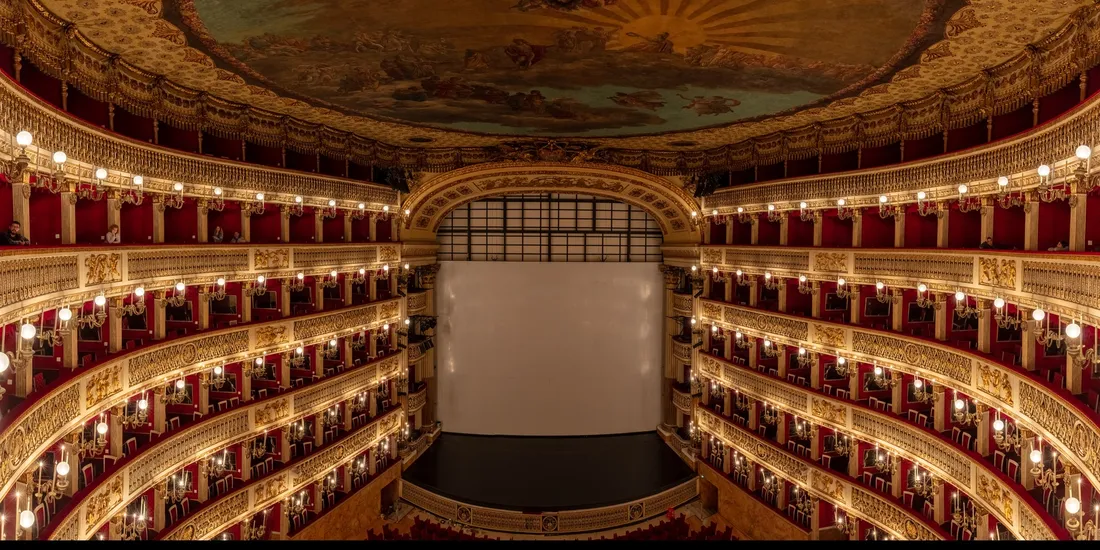
Naples, 26 September 1835. That evening, in the six tiers of boxes at the Teatro di San Carlo, Donizetti’s new opera was given, and Lucia was sung by Fanny Tacchinardi-Persiani. The best known passage in the work is the scene in which the girl loses her mind. For that scene Donizetti had written a glass harmonica to accompany the soprano, that strange instrument of turning glass bowls played with a wetted finger. At the premiere the part was given to the flute, and that is the form the world has listened to ever since. Two separate voices chase one another on stage: the soprano sings a phrase, the flute repeats it, then the two lie over one another and run on at two different pitches at once. The same thought always occurs to a listener. Birdsong. Yet there is something upside down in it, because a bird needs no two performers to do this.
Birds have no vocal folds. What answers to those two folds in a human throat lies somewhere else entirely in a bird: deep in the chest, at the fork where the windpipe divides and becomes two bronchi. The organ is called the syrinx, and it is found in birds alone. The importance of its position lies here. The windpipe is a single tube, but below the fork there are two tubes, and the syrinx sits exactly upon that division. The sound-producing structure, in other words, is not single but double; each of the two branches carries its own membranes, its own muscles and its own flow of air.
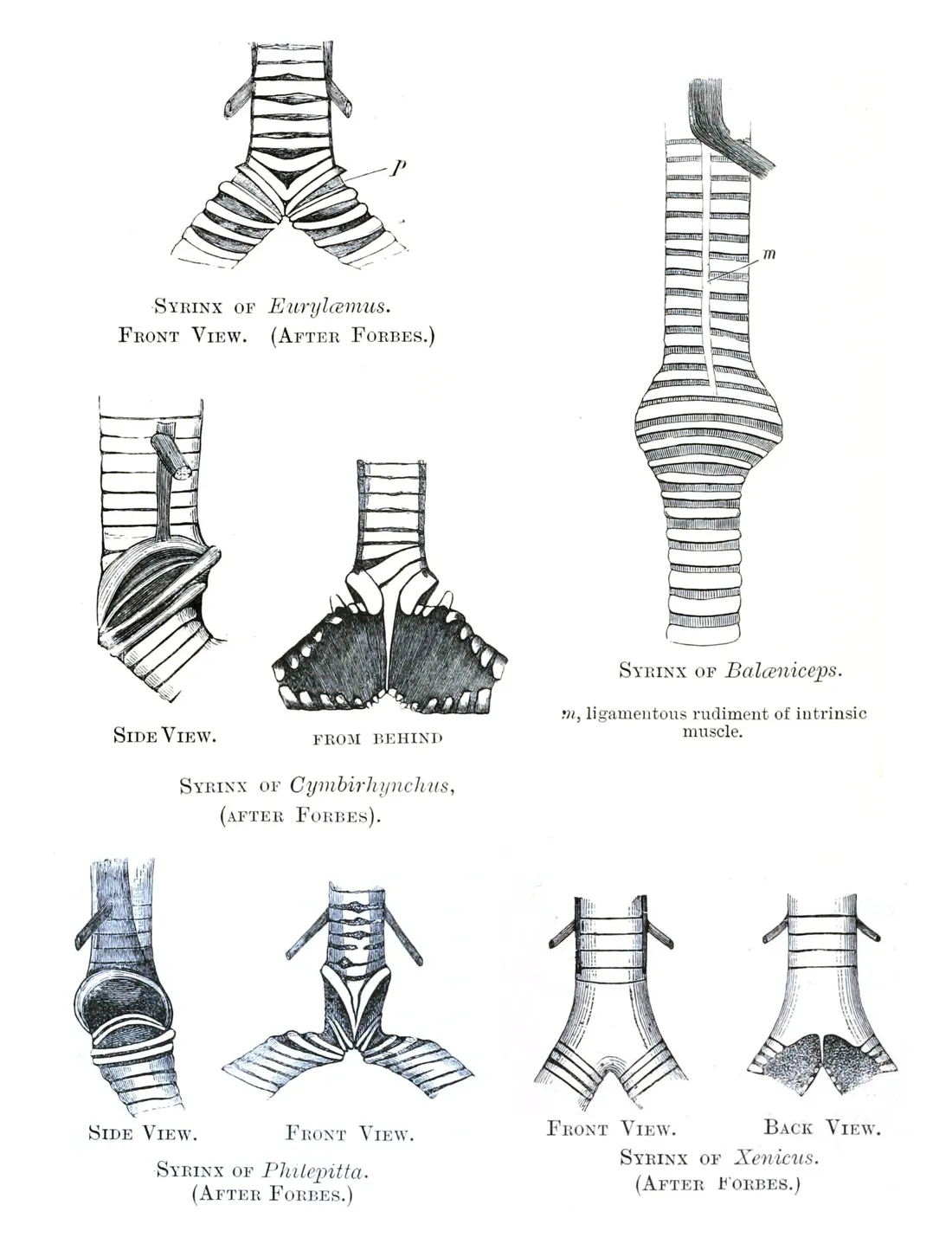
In songbirds those two branches can be driven independently of one another. The consequence is that a single bird can sound two different pitches at the same moment. The effect was first documented in 1947: when the song of Toxostoma rufum, one of the mimic thrushes of North America, was set down on a spectrogram, two separate lines appeared at once in the voice of one bird. The best known example is the wood thrush. Hylocichla mustelina, as it closes its phrase, holds a low trill and lays over it a high, gliding line; which is to say, it accompanies itself. The syrinx also sits within an air sac, so the pressure around it is part of the instrument too. With very short breaths taken between the syllables, the bird carries a long phrase through without running out of air.

format_quote"The duet Donizetti built from two performers, a wood thrush builds alone."
Hasan Bekmezci
Christopher Ward’s Bel Canto family takes its name from that school of beautiful singing in Italian opera, and it does one thing: on the hour, with nobody pressing anything, a small hammer strikes a gong and a single D sounds. Watchmaking calls this a sonnerie au passage, a chime that sounds in passing. This model is called the C1 Bel Canto Lucia, straight from Donizetti’s heroine. Its dial was made together with Mr Jones Watches of London.

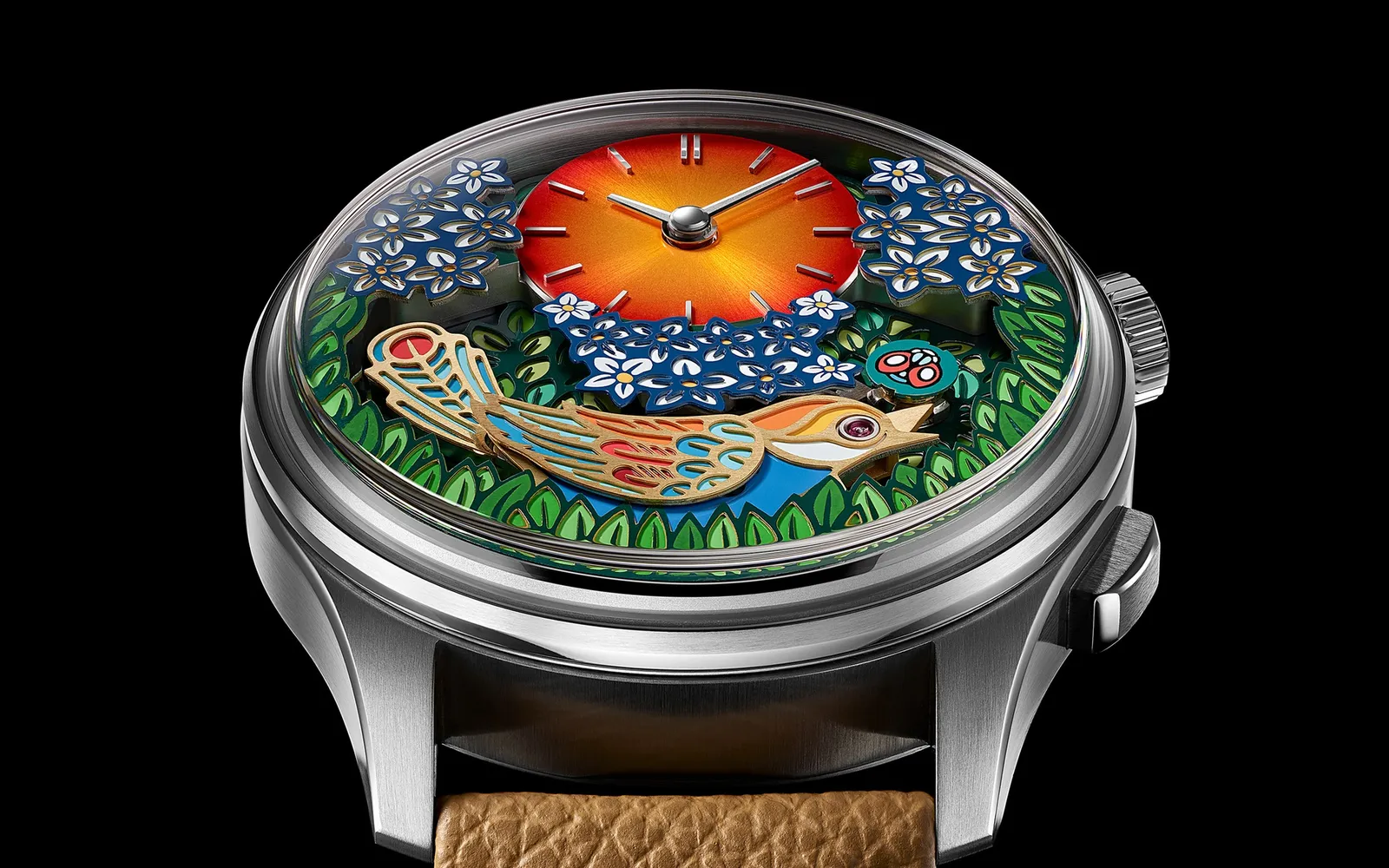
The bird on the dial is not decoration. Its tail is the very hammer that strikes the gong on the hour. Its beak shows whether the chime is switched on or off: when the pusher at four is pressed, a ladybird mounted on the column wheel turns, and the beak opens or closes. With the beak open, the bird sings. Here the drawing is not a cloth laid over the mechanism afterwards; the parts of the drawing are the parts of the mechanism.
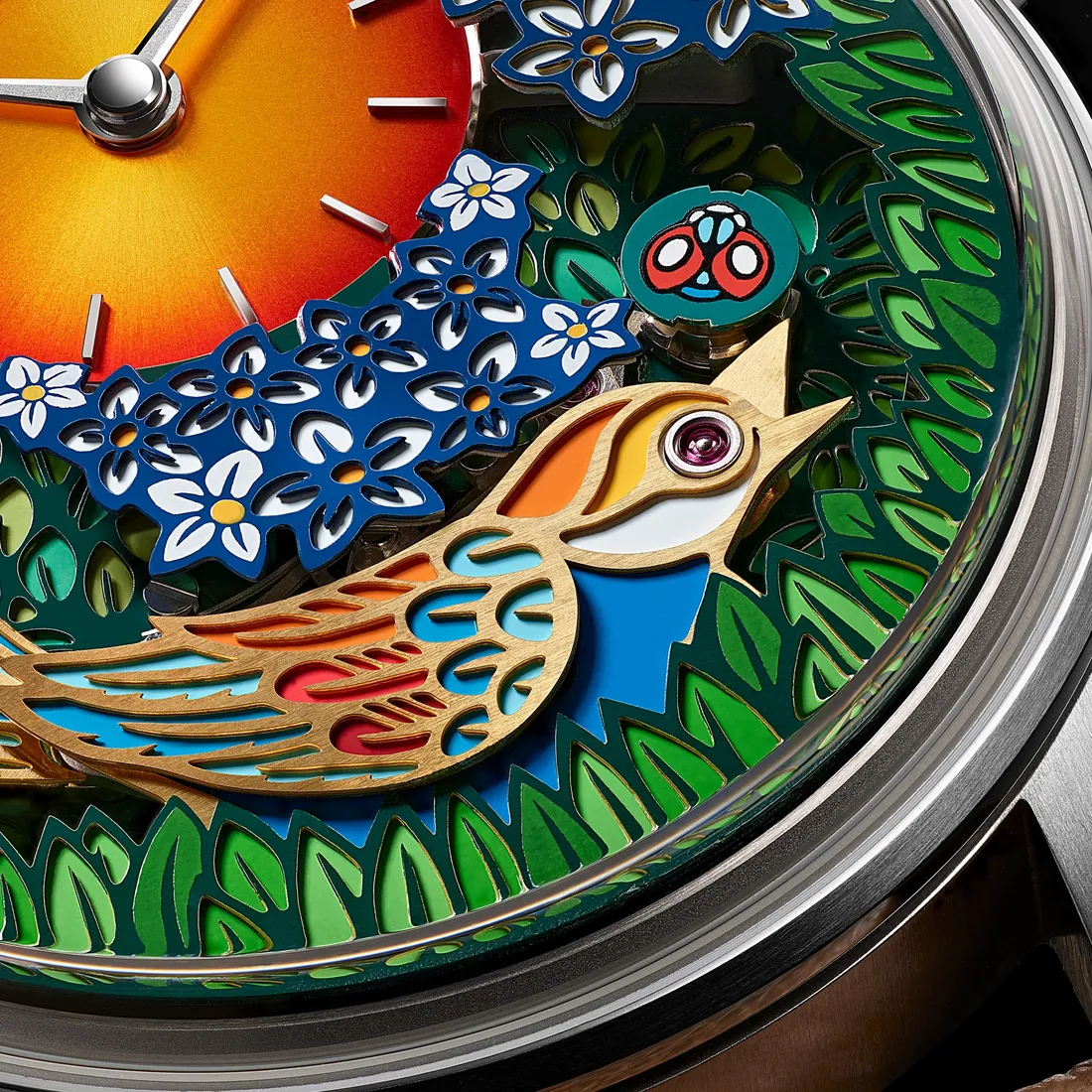
The surface of the time dial is fumé: light at the centre, darkening towards the rim, finished with a radial pattern. It carries applied indexes and two polished hands, and no seconds. A rising sun comes to mind whether one wants it to or not. Around it are clusters of white-petalled, yellow-hearted flowers on a blue ground; below, grass in two shades of green; to the right, a little above the bird’s head, that ladybird. The bird’s beak, feathers and tail are separated from one another by gold-plated outlines, and it is those outlines that catch the light as it turns.
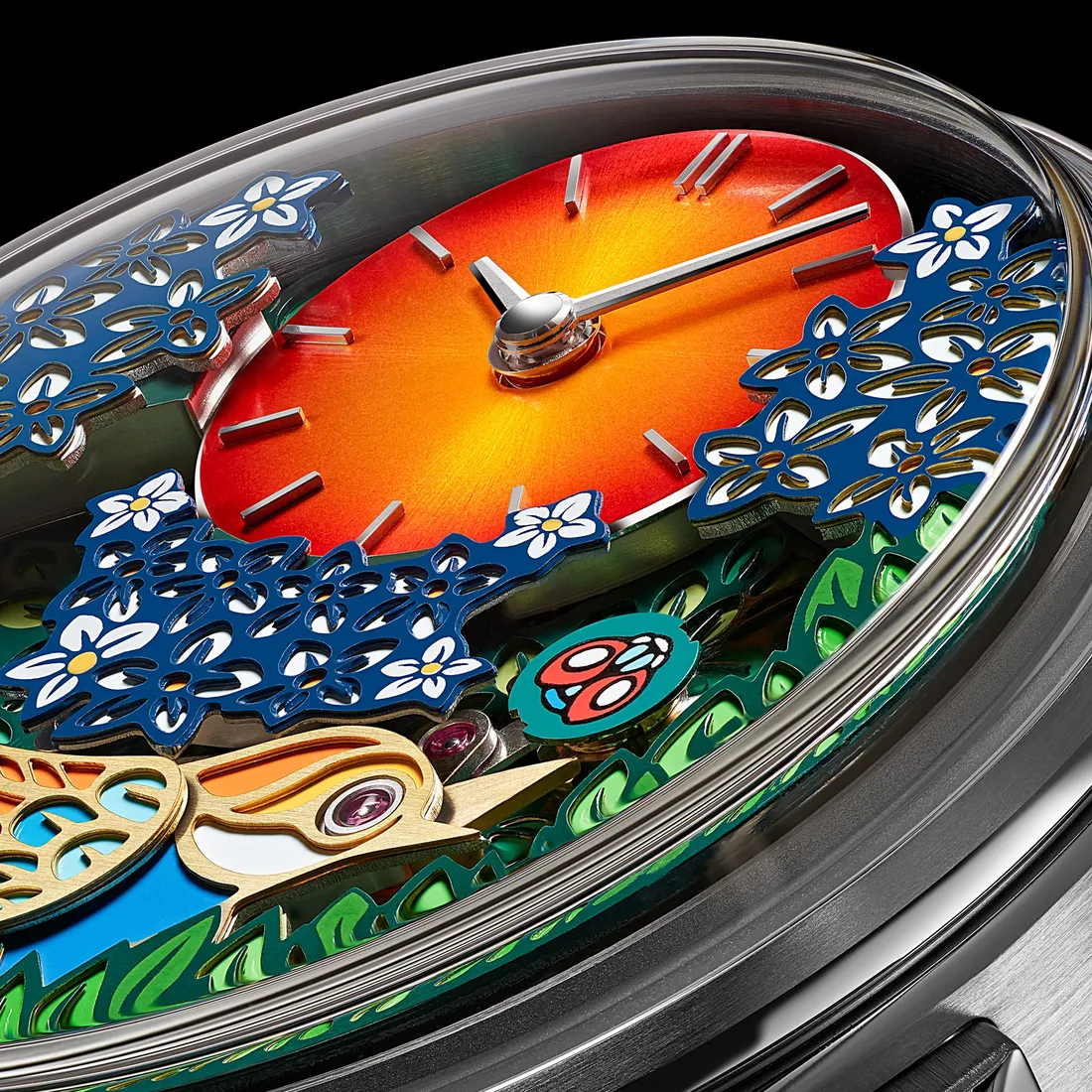
format_quote"On this dial the parts of the drawing are the parts of the mechanism."
Hasan Bekmezci
The scene was drawn by the illustrator Andy Wilx. He says he wanted to make a world you could peer into, and that with so much space between the mechanism and the crystal he was able to build a design with real depth. The resulting scene is made of six separate brass components. They travel to London, to the workshop of Mr Jones Watches, and the colours are given there by pad printing. There are nineteen individual colours on Lucia; each colour has its own plate and its own separate application, so the scene is built up layer by layer across components a few millimetres across. The outlines that frame the bird are gold-plated. The printed parts then return to Biel, to Christopher Ward’s own Atelier, and are assembled onto the movement there.

Sit the printer from London and the watchmaker from Biel at the same table, and the conversation would probably run like this. The printer would state his limit first: each of the nineteen applications has to land on the one before it to a hair, because a single slip and the bird has its eye in two places and the part is scrap. The watchmaker would set out his own in reply: the part you have coloured, I am hanging on the end of a hammer; that tail will strike a gong on the hour for years, and it will deliver the same force at every stroke. The printer would complete the thought: so my colour has to survive your blow. And the watchmaker would have the last word: and my blow must not spoil your colour. The two are saying the same thing. In a watch, ornament and function are not two separate matters; most of the time they are two separate responsibilities of one part.
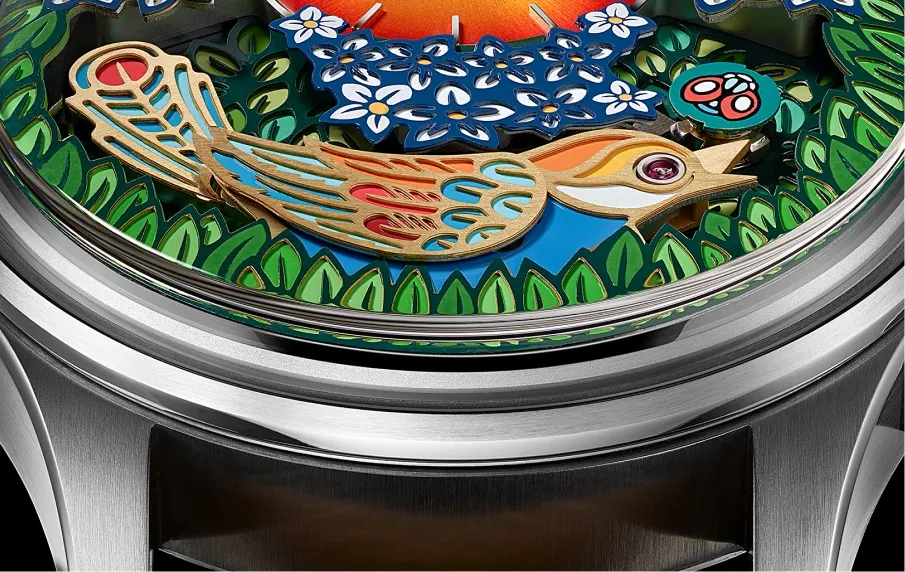
format_quote"Nineteen colours, nineteen plates, nineteen separate applications, all of them on components a few millimetres across."
Hasan Bekmezci
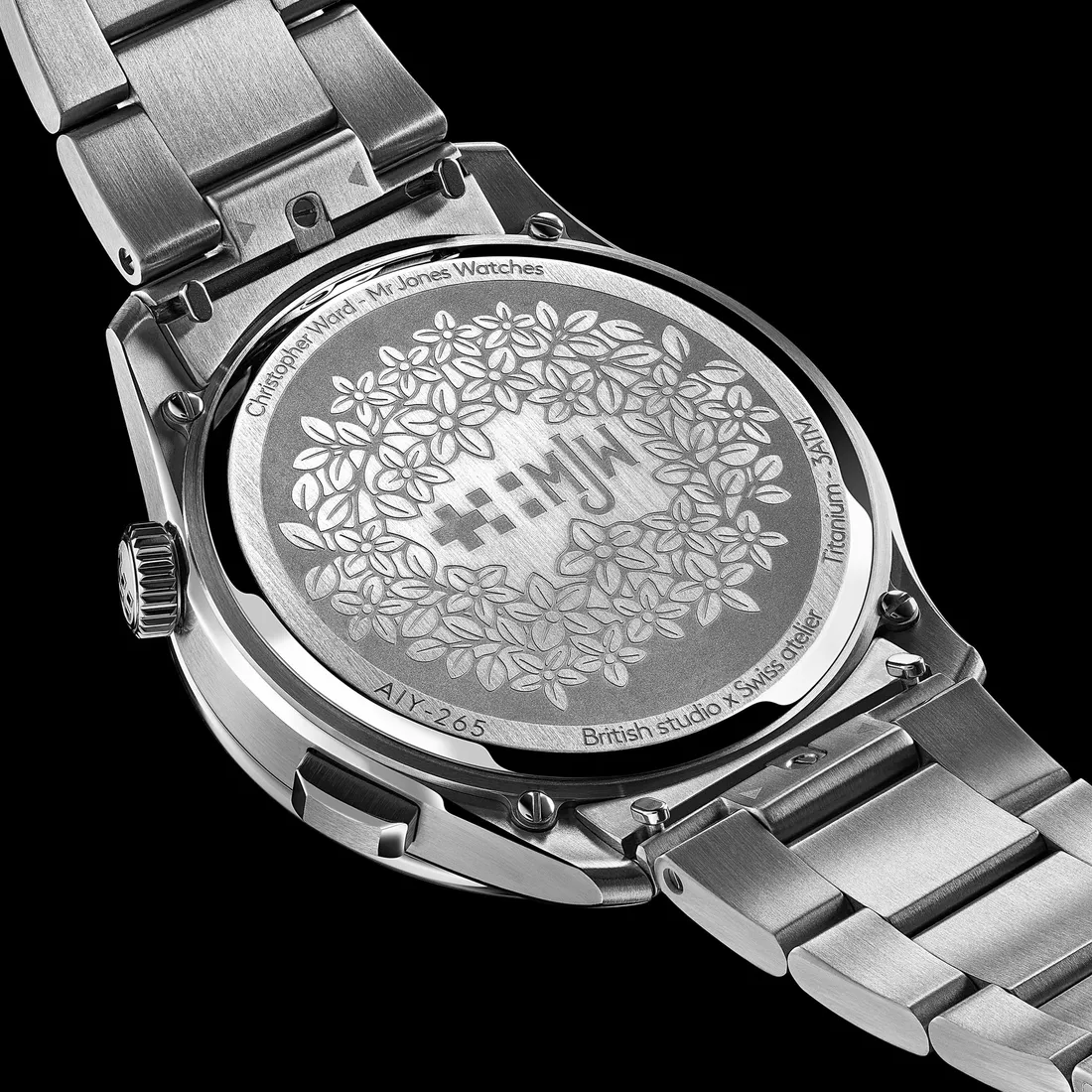
The figures run as follows. The calibre inside is the FS01-2, and it came from the hand of the brand’s technical director, Frank Stelzer. Stelzer’s insight was to see that the sudden motion Christopher Ward’s jumping-hour mechanism makes on the hour could be turned into a chiming mechanism. The FS01-2 is this time built upon Sellita’s new SW200-2 Power+ base; the power reserve rises to sixty-five hours, the frequency stays at four oscillations a second, and the daily rate is held between minus five and plus twelve seconds. The gear train has been recalculated, the barrel and mainspring redrawn, the automatic winding system and the balance assembly renewed. The case is forty-one millimetres, in Grade 5 titanium and in the form the brand calls Light-catcher; forty-eight millimetres from lug to lug, fourteen point three one millimetres high. Above it sits a box sapphire crystal, which is to say not a flat glass but a thick dome with walls that drop straight down, and that is why the scene can be looked at without being cut off anywhere. The caseback carries a Christopher Ward x Mr Jones Watches engraving. The brand says the case is designed to amplify the chime. The price is 5,195 euros on camel fine Italian leather, and 5,615 euros on the Consort bracelet.
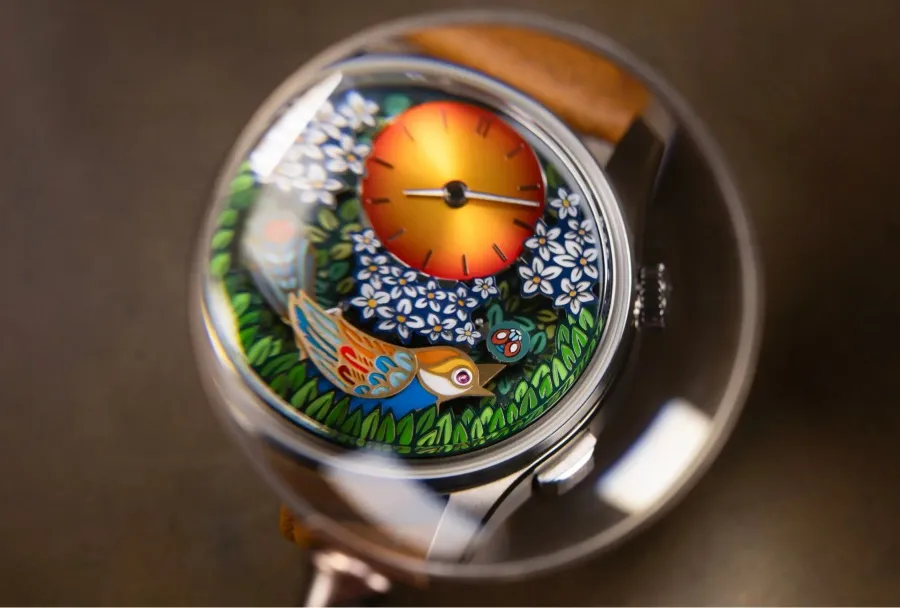
A bird needs no gong in order to sing. The fork in its chest, that small two-branched organ, is enough for it; and the one who designed that fork is not the bird but the Creator. The watch, in order to sing, needs the shape of the bird: a tail of steel, a gong, and a mechanism that finds that gong by itself on the hour. The human being who stands between them can make neither alone. What he can do is look, count and imitate; and then carry his imitation on his wrist and be reminded of the original on every hour.
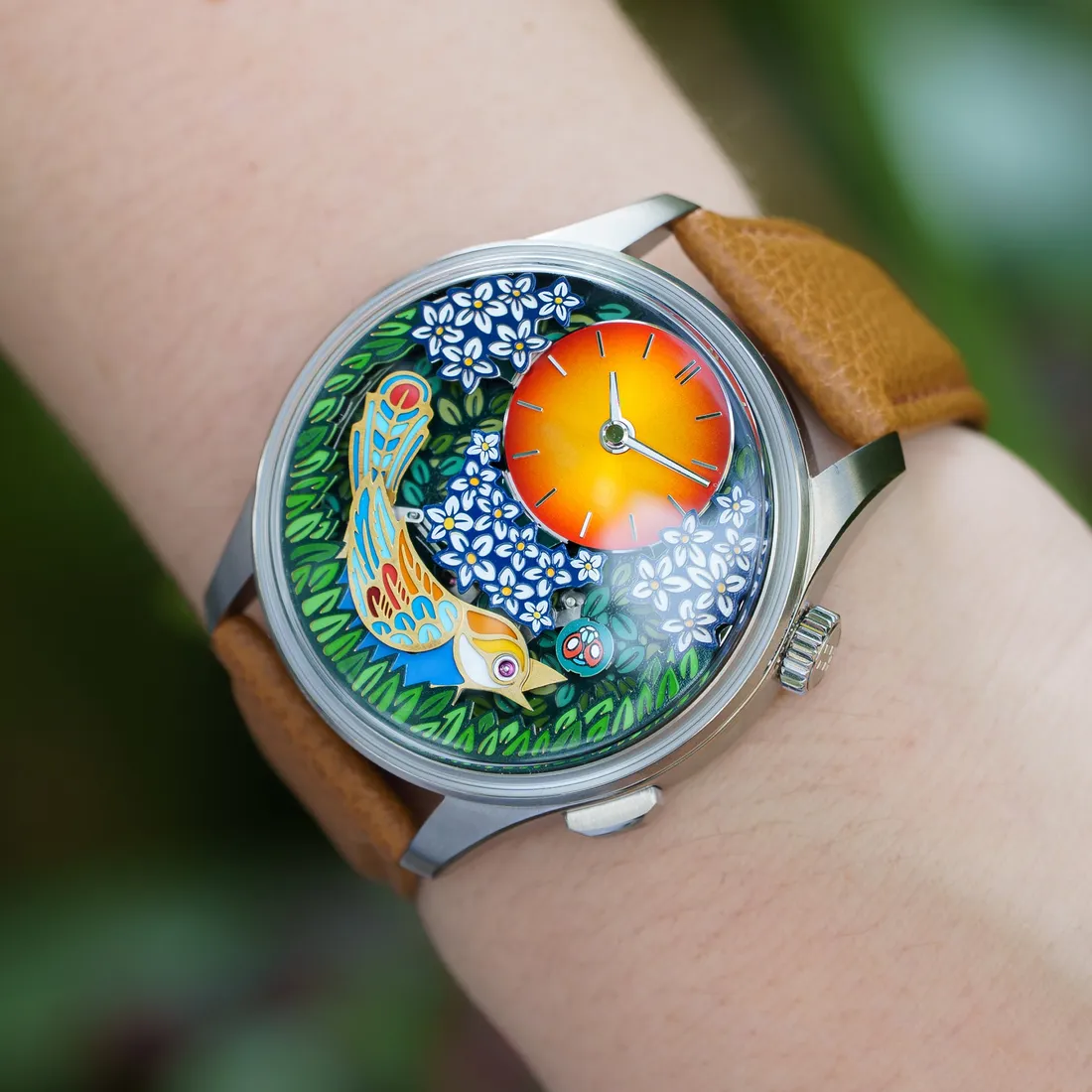
The watch on its maker’s own page: Christopher Ward, C1 Bel Canto Lucia