Turn your eye upwards and look: can you find a crack in the sky, a fault, one thing too many? Then look again. That eye will come back to you tired, but it will not come back empty-handed.
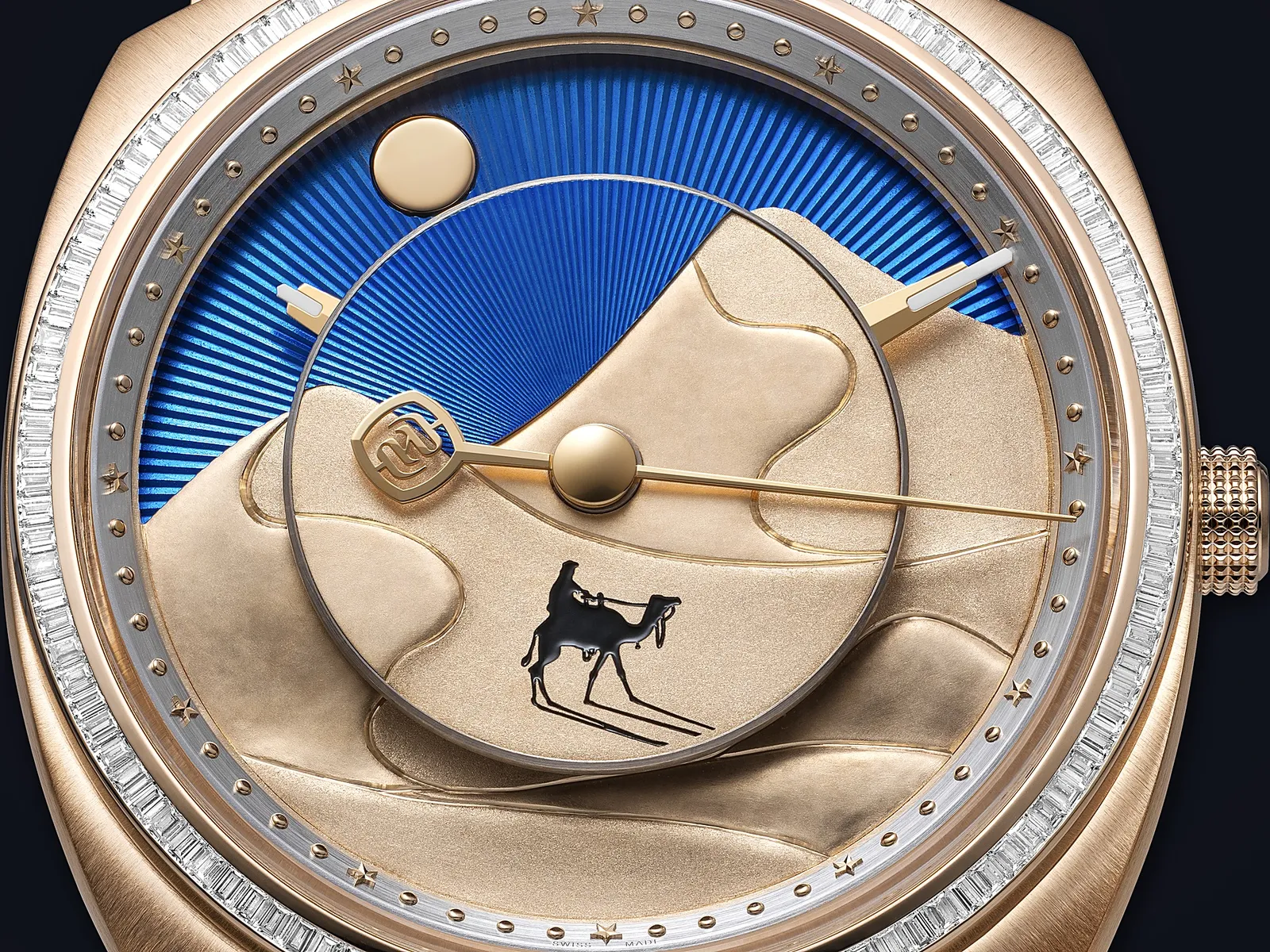
When the philosopher opened with that, looking down at the dial of the AKHOR Nour La Lumière in the middle of the Geneva table, at that deep blue sky and that golden disc, every murmur in the room stopped. He went on by leaning on the argument from order as al-Ghazali and Ibn Rushd framed it: that where there is an order, there is also one who ordered it.
This single source of light on the dial, this nour that takes its name from Arabic, is one of the seals of the universal order. Everything, from the orbit of a star to a single grain of sand in the desert, has been established by a will and by a knowledge. Whatever the law is that keeps billions of stars in the Milky Way turning without colliding, it is the same law that stands behind the existence of the camel stepping across the middle of this dial. One is the splendour of the macro world, the other the miracle of the micro. Had they not carried the same signature, neither would the vault of heaven have held its order nor would that desert animal be alive.
Then he fell silent and added this: order is order only because it could be broken. The value of perfection comes from the fact that imperfection was possible.
The biologist put down his coffee and spoke from the other end of the table.
You have been speaking of the great art in the heavens, my friend; I am looking at the traces of that same art as they fall into the anatomy of the camel. However carefully every star in the Milky Way has been placed, the camel’s stomach, its cells and its place in the food chain have been calculated just as carefully. And let me put it this way: what really describes an animal is not what it eats, but how it was built in order to be able to eat it.
The desert is the ecosystem in which the vegetation is at its hardest and thorniest and in which water is all but absent. The camel’s mouth is made so that it can crush that thorn; the tissue of its palate and lips grinds a plant no other mammal will go near. Nor is its stomach a single chamber: with a ruminant’s digestive order, it turns that fibrous scrub, which looks impossible to digest, into energy by way of bacterial colonies. So the animal does not eat the grass; it eats the micro world inside the grass.
Its blood is another matter. The red cells that are round in every other mammal are oval in the camel; even when thirst thickens the blood and its volume drops, it keeps flowing without clogging the vessel. And when the animal drinks more than a hundred litres of water at a single standing, those same cells take that flood in by swelling to something like two hundred and forty per cent of their own volume without bursting. The same quantity of water would tear the cell membranes of most mammals apart within minutes. The endurance of the camel does not begin in its muscles; it begins in the shape of its blood.
The hump, meanwhile, is not the water tank people imagine but a store of fat. When that fat is burned, the hydrogen inside it combines with the oxygen taken in through the lungs and metabolic water is left behind. But the real subtlety of the hump is not in the chemistry; it is in the architecture. That the fat is not spread over the whole body but gathered on the back alone builds a heat shield on the surface facing the sun and leaves the rest of the body free. To put the load exactly where the sun strikes: that is the signature of a design. And the animal further allows its body temperature to swing between thirty-four and forty-one degrees across the day, which is to say it waits for the evening before it begins to sweat.
Without that stomach and that blood, the ecological balance of the desert would collapse; the ring that turns plant tissue into energy would snap. The delicate chemistry inside the camel’s stomach and the law of gravitation that holds a galaxy upright have to be parts of the same design. Because without one the other is left incomplete: the ecosystem and the cosmos are two scales of a single whole.
format_quote"What really describes an animal is not what it eats, but how it was built in order to be able to eat it."
Hasan Bekmezci
The third voice had not spoken at all until then. The man who cut the dial set his loupe down on the table.
The two of you are looking at the flawless art in the sky and in the living creature; I am looking at what falls of that architecture onto human work on a dial. A craftsman is an inadequate artist trying to imitate the art in creation. And to know that you are imitating is already where humility begins.
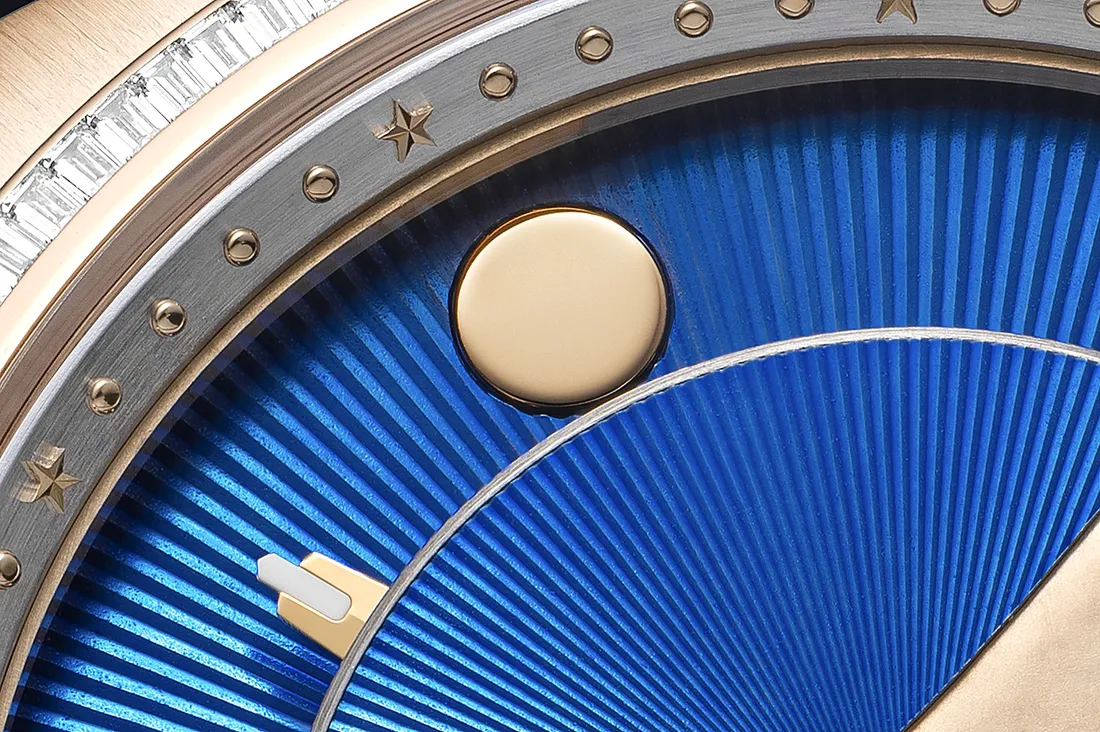
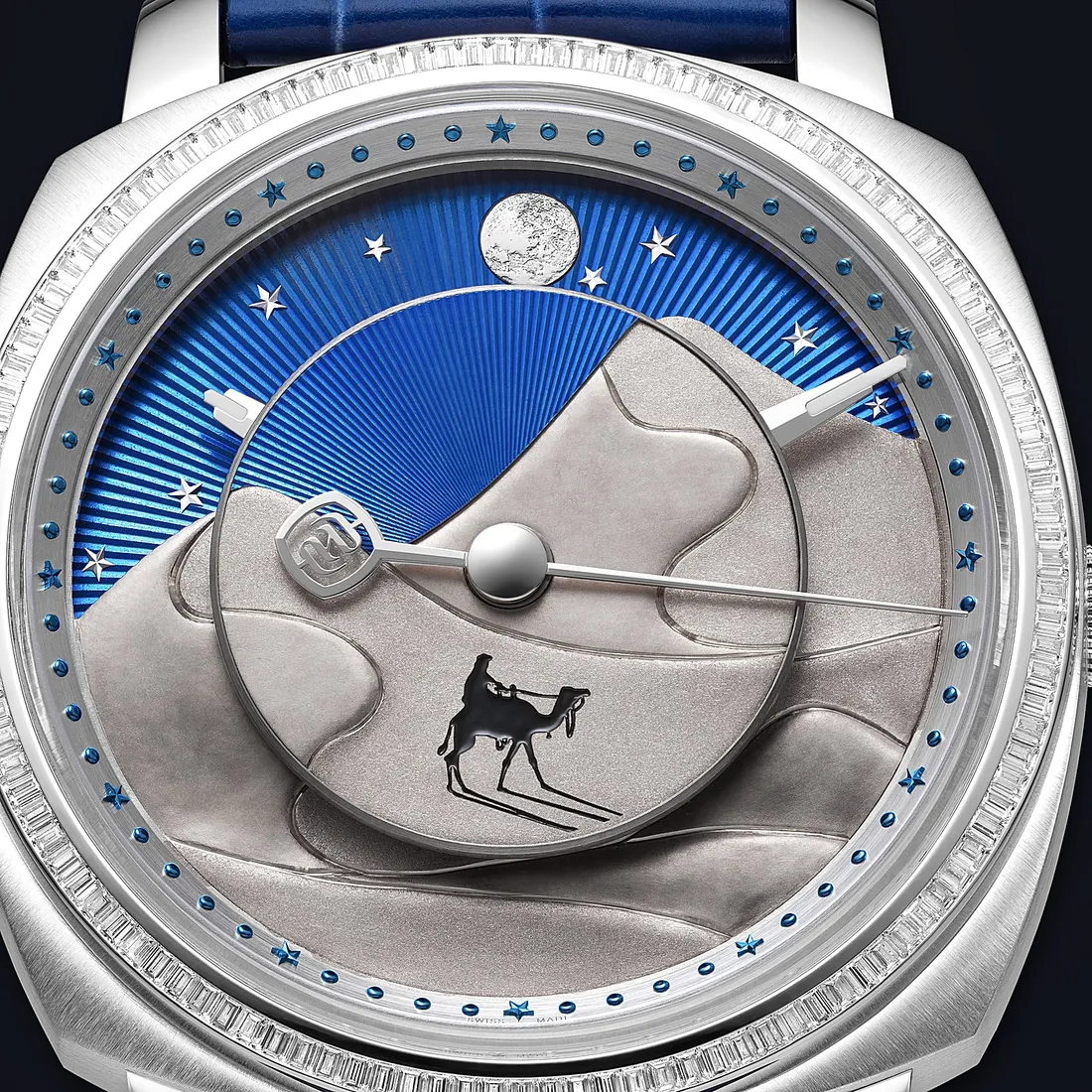
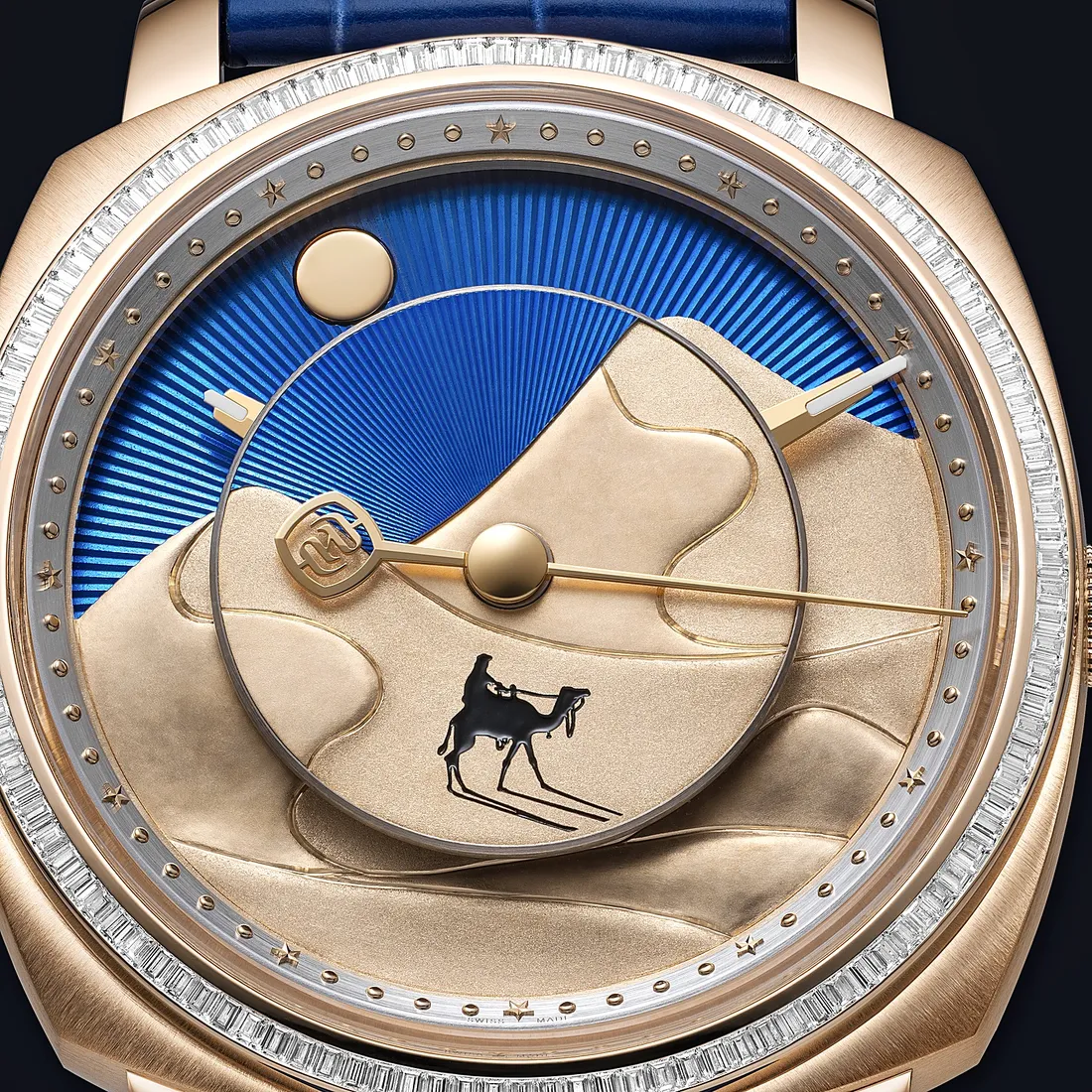
Look at these dunes in the lower part. They were worked in relief, with a graver, over days, onto a disc of 5N eighteen-carat gold or of platinum. When the light strikes, those dunes come alive, because what is there is not paint but material genuinely lifted away. Engraving is the only craft that gives form by subtraction rather than addition: you do not put something down somewhere, you take something out of it. And gold and platinum do not give the graver the same answer; the same pattern asks for two different hands in the two metals. Which is why each version has a depth of its own.
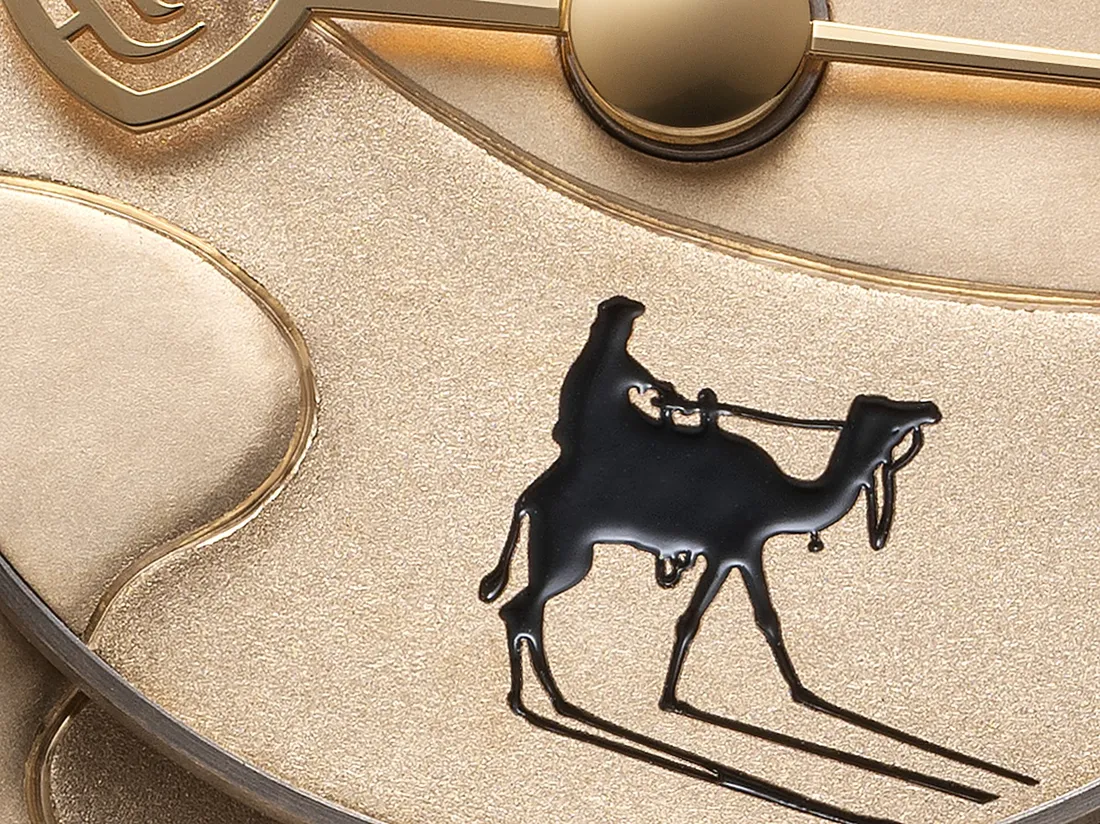
The moon and the stars on the side of the night were raised the same way, in relief. But the camel and the rider crossing over that dune are not engraved: a specialist miniaturist painted them layer by layer with brushes of a few hairs, on a surface measured in millimetres, complete with the shadow they cast on the sand. On one side a craft that gives form by taking away, on the other a craft that gives life by putting on. If those two can stand side by side on one dial, then that dial is no longer a surface but a stage.
format_quote"Engraving is the only craft that gives form by subtraction rather than addition: you do not put something down somewhere, you take something out of it."
Hasan Bekmezci
The philosopher cut in: and why is this stage standing still? The craftsman smiled.
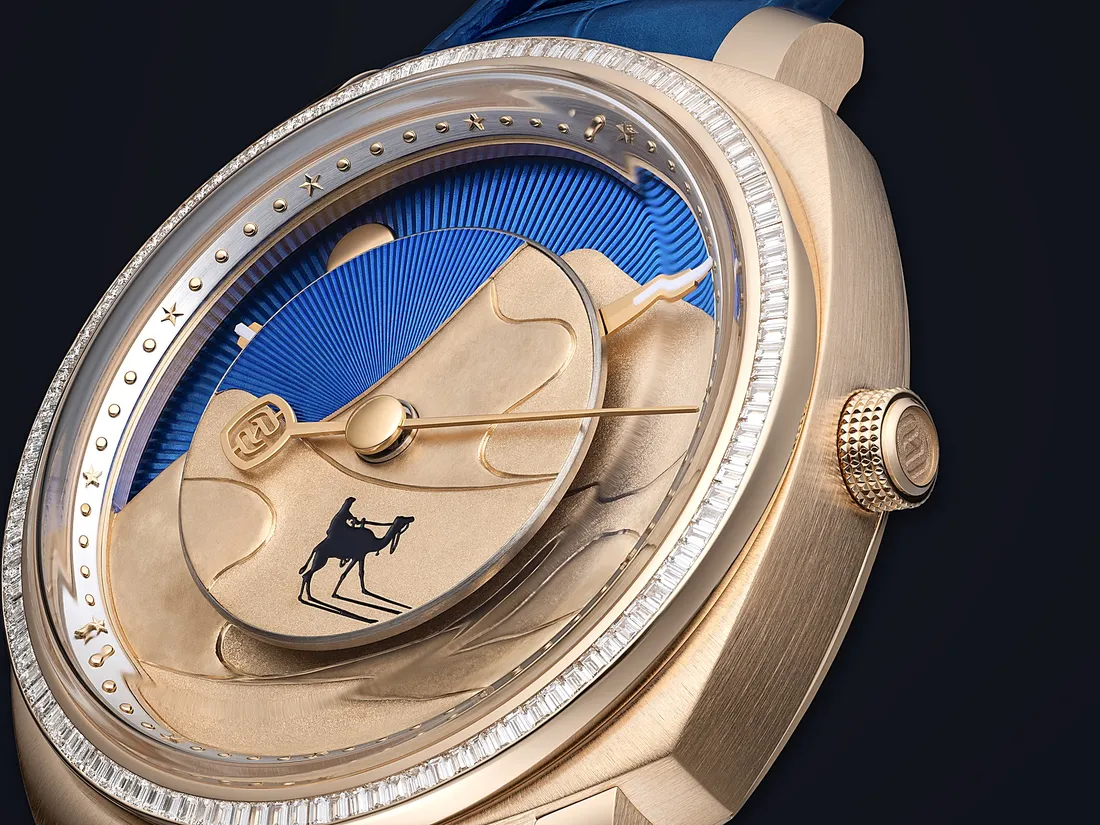
It is not standing still. That is the heart of the matter. This dial is built from three separate discs, and the upper disc is held in the air by the patented suspension of our sister company Clamax. Nour La Lumière adds one more disc to that order: a day and night indication that makes a full turn every twenty-four hours. So the desert you are looking at is not a fixed illustration; it is a landscape travelling on while you sleep, turning the day into night. The stage stays the same, and the light falling on it changes. Exactly as in a real desert.
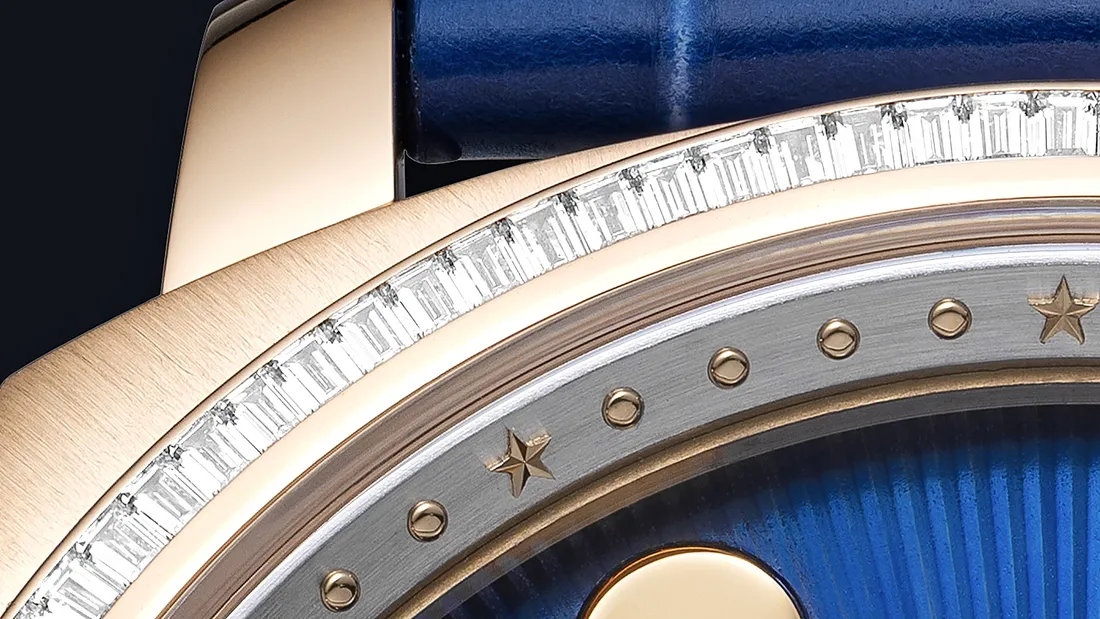
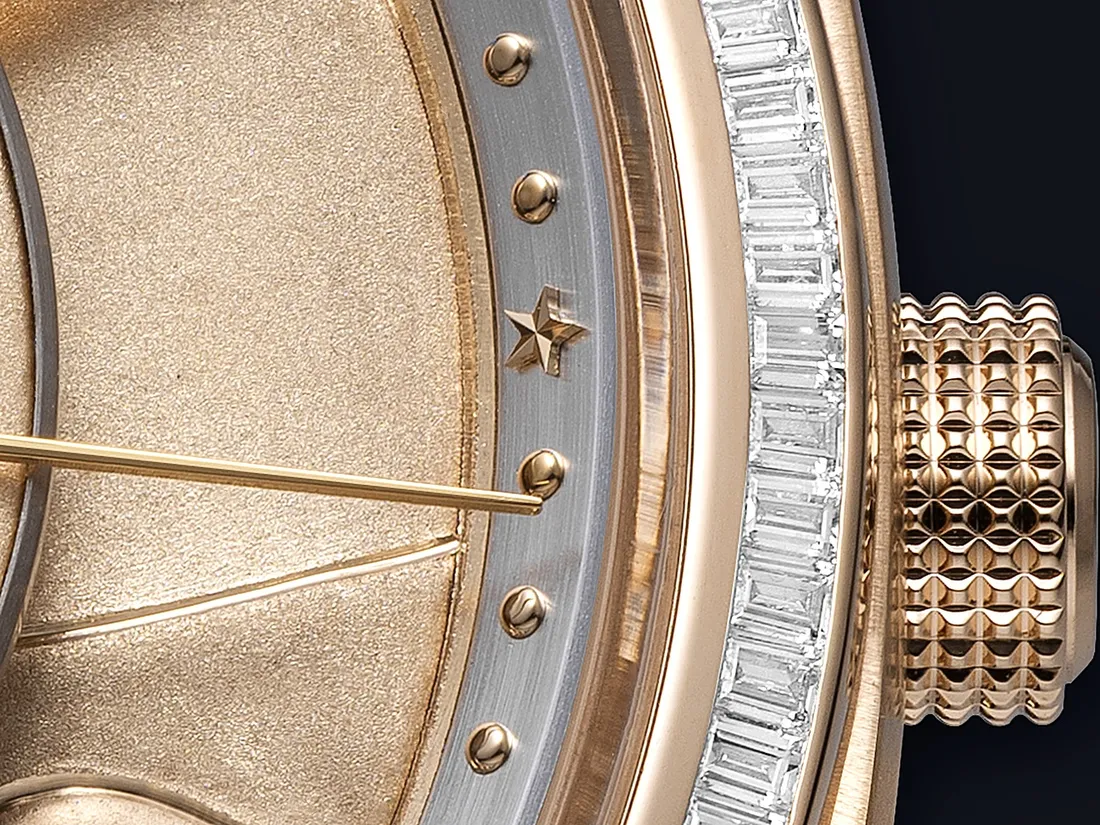
The case is a cushion, forty millimetres across and twelve and a half deep, in gold or in platinum. A hundred and twenty baguette-cut diamonds totalling 4.85 carats are laid along the polished bezel. They are not there to be ornament but to be light put in a row: the first shafts rising off the burning sand at dawn, translated into stone. The anti-reflective coating on the crystal is on the inside, so no layer cutting the light comes between the eye and the scene. And the word that gives the watch its name is engraved by hand on the back of the case in Arabic script, without display: a signature put there to be known rather than to be seen.
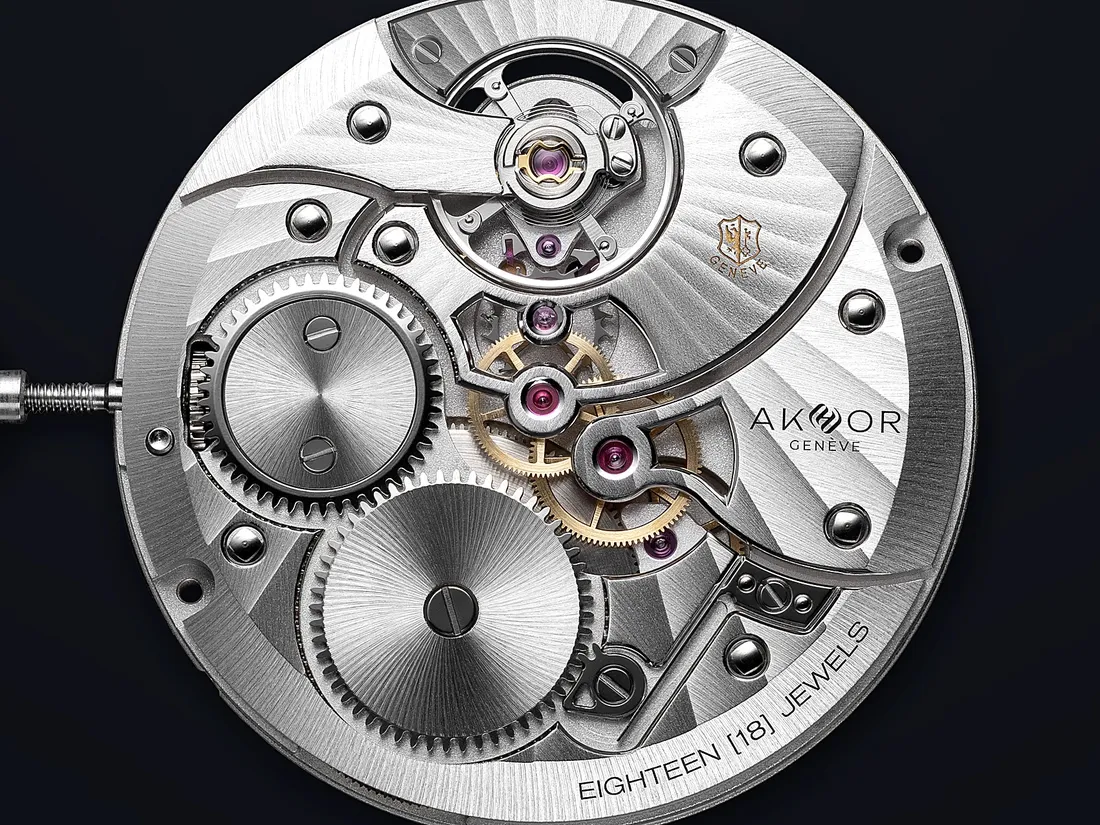
And what is working under this dial, asked the biologist. The craftsman turned the caseback over.
The hand-wound AK10. A hundred and twenty-six parts, 28,800 vibrations an hour, sixty hours from a full wind, and a stop-seconds. Its decoration is finished by hand: hand-bevelled edges, ray-shaped Geneva stripes, hand-worked wheel surfaces, a variable-inertia balance and cushion-headed screws that repeat the form of the case. For the form of a case to reach as far down as the screws of a movement is not styling but character.
The heaviest sentence, though, stands in the certificates: this calibre carries the Poinçon de Genève and has been certified as a chronometer by both COSC and the Geneva Observatory. Very few houses carry the Geneva Seal across their entire collection; for a house founded in 2025 to take that on at the first step is a different kind of courage. The gold reference is a hundred and ninety-eight thousand francs, the platinum two hundred and eight thousand.
The three minds at the table were quiet for a while. Nour La Lumière had gone past being a jewellery watch and brought the philosopher’s order, the biologist’s stomach and the craftsman’s graver together inside a single circle of forty millimetres.
And what all three of them wanted to say was probably the same sentence, only from different scales: whoever the hand belongs to that holds the stars of the Milky Way in their orbits, it is the same hand that designed the stomach of the camel and its place in the food chain. One signs in the sky, the other on the wrist of an animal. What is left to the craftsman is the work of trying to imitate that signature.
format_quote"Whoever the hand belongs to that holds the stars of the Milky Way in their orbits, it is the same hand that designed the stomach of the camel. One signs in the sky, the other on the wrist of an animal."
Hasan Bekmezci