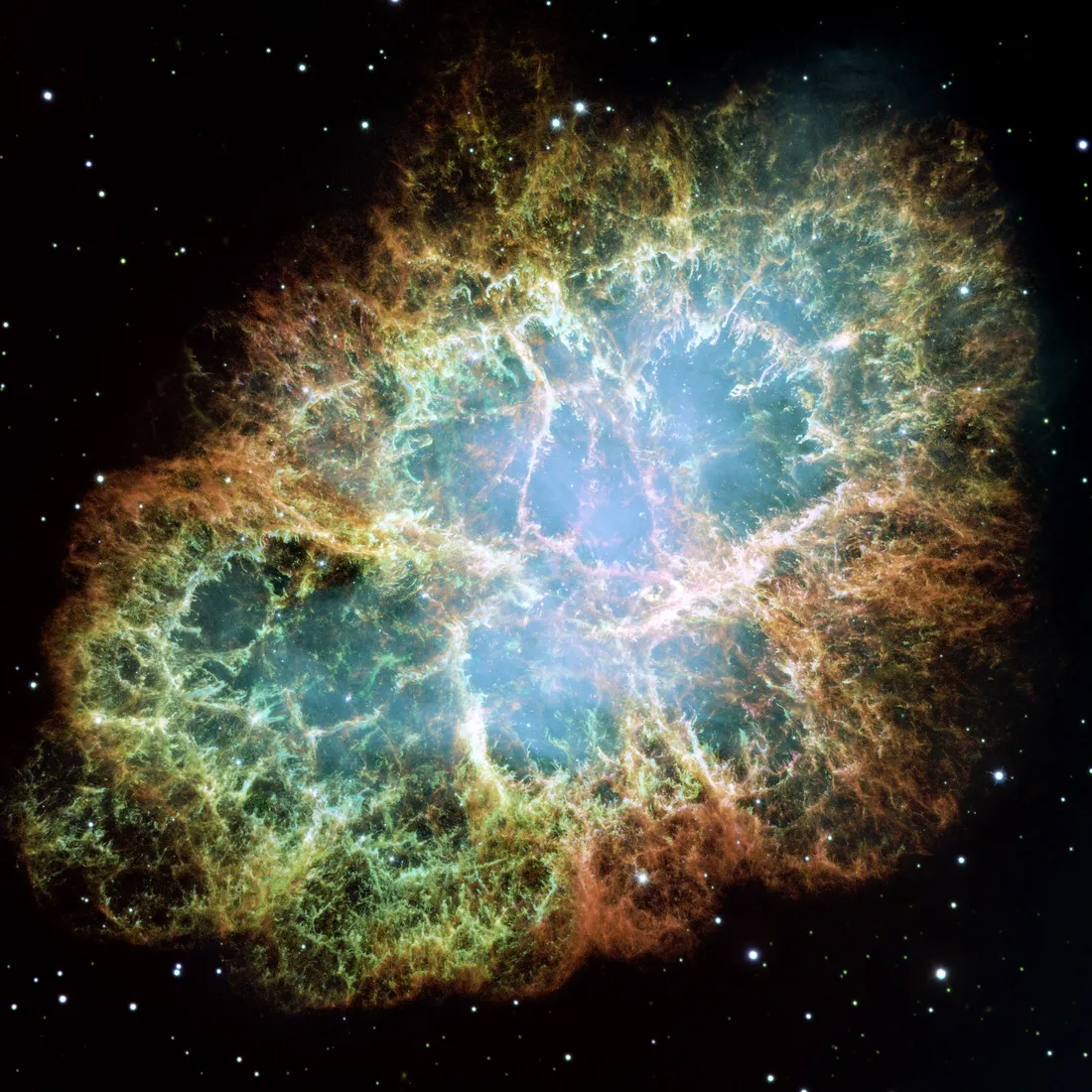
The deep blue dome we see when we lift our heads at night is the oldest and the largest canvas in the universe. The glitter of the stars is not merely a set of points of light decorating the sky; it is a story of origin, written in the iron that circulates in our veins, the calcium in our bones and the silicon in the rock that covers our world. All the heavy elements in the universe were formed in the nuclear syntheses at the cores of enormous stars and in the explosions of supernovae. Which is to say that a human being, and life itself, is a living dial woven directly out of celestial stardust.
That immense order in the dome of the sky, the paths of the constellations, the precision of the turning of the planets and the flawless symmetry of deep space, have through history turned the human being towards contemplation, and towards representing that celestial mechanism again on the earth at a smaller scale. The domed table clocks of high watchmaking are a concrete expression of the wish to carry that order and that beauty into miniature.
format_quote"A human being, and life itself, is a living dial woven directly out of celestial stardust."
Hasan Bekmezci
The turning of the sky, the hazy glow of the Milky Way and the constellations that take the stage season by season are not ordinary decoration nor accidental groups of stars. In the flawless rhythm with which the stars and the constellations of the four seasons turn there is a purpose and a mercy worked out for the human being and for the whole ecosystem.
The constellations that appear in the sky along the Sun’s journey through the year are the unchanging markers of the seasons on the earth. Ancient civilisations joined the groups of stars overhead with imaginary lines and loaded them with symbols that stayed in the memory, and with deep stories.
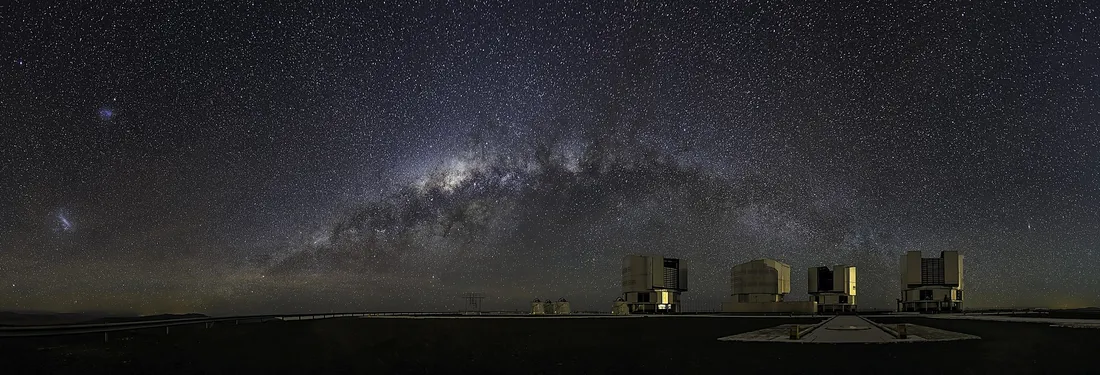
The marker of spring is the Great Bear. That unmistakable form in the northern sky never sets at all through the year, but on spring evenings it rises directly overhead. In the old story, Callisto, whose beauty dazzled everyone, was turned into a bear; years later her own son Arcas, out hunting, failed to recognise the bear that came before him in the forest and drew his bow, and so that the grief of a son killing his mother might be prevented, the two of them were taken up into the sky and made constellations for ever. It is this constellation that tells of the earth waking, of the seed about to fall and of the springs of life about to run again.
The herald of summer is the Swan. In the story the Swan stands for a delicate friend who kept diving into the river in search of a companion who had drowned in it; that unshakeable loyalty was written into the middle of the dome of the sky in the shape of a swan. On summer nights, when you lift your head, the Swan beating its wings in the lit river of the Milky Way tells you that the most fertile and abundant season has arrived.
The herald of autumn is Pegasus. In the old tales Pegasus is the winged horse that struck the ground with its hooves and made springs of inspiration run wherever it stepped; a hero named Bellerophon rode that horse and defeated the fire-breathing Chimera. When you look at the sky, the enormous Great Square of Pegasus rises in the east on autumn evenings and announces the time of harvest and the lengthening of the nights.
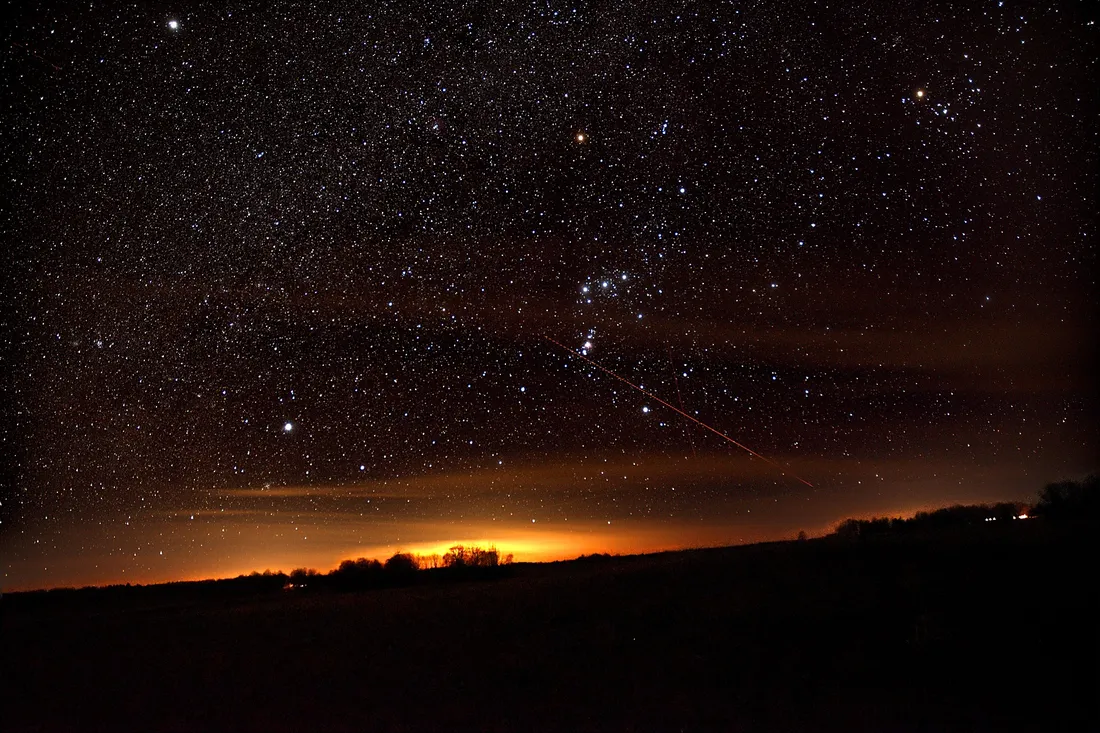
The guardian of winter is Orion. The most magnificent and the brightest constellation in the sky, Orion stands for a giant hunter with a belt of three bright stars: Alnitak, Alnilam and Mintaka. In the story Orion was raised into the sky after the sting of a scorpion, and on winter nights he glitters like the guardian of the heavens. He is the celestial lantern announcing that the ground will be covered in snow, that the seed will stay asleep, and that the discipline of winter has begun.
The purpose here is plain. If the sky were fixed, or confused, humanity would not know when to sow, when to harvest, or when to prepare for winter. The stars were written into the dome of the sky as an enormous seasonal clock and as a cosmic calendar told in stories.
format_quote"The stars were written into the dome of the sky as an enormous seasonal clock and a cosmic calendar told in stories."
Hasan Bekmezci
Thousands of years before the compass and satellite navigation were invented, the human being found his direction in pitch dark oceans and trackless deserts by reading the sky.
Setting a course on the open sea, a sailor first follows the two pointer stars at the back of the bowl of the Great Bear, Merak and Dubhe, along an imaginary line. Extended about five times, that line reaches Polaris, the Pole Star. Because Polaris stands almost exactly over the axis on which the Earth turns, it holds its place through the night inside an arc of about a degree, and shows true north.
Then, with a sextant, the sailor measures how many degrees above the horizon Polaris stands. If Polaris is thirty six degrees up, the ship is on the thirty sixth parallel north. It is that simple, and for centuries it was enough. To hold an east-west course the belt of Orion served; because those three stars sit on the celestial equator, they rise due east and set due west wherever you happen to be.
And in the desert, when sandstorms wiped out every track, the Bedouin looked to the zenith, the top point of the sky, to draw the routes that led to the oases. The ground changes and the tracks are erased; the point overhead stays.
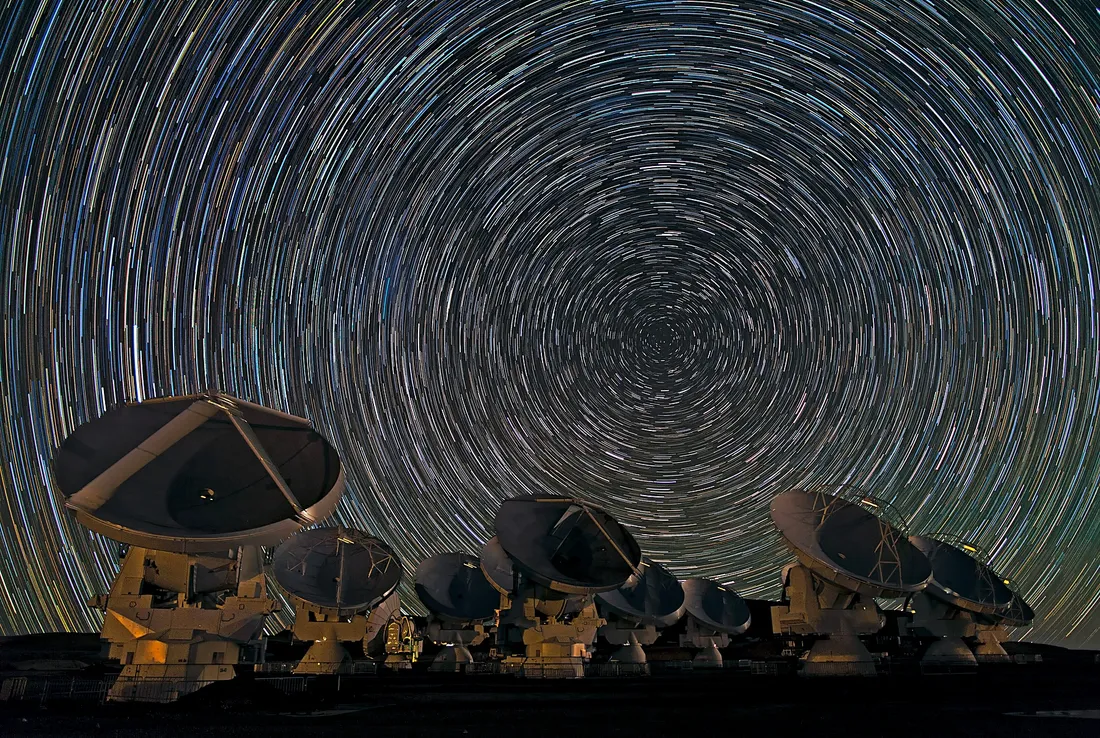
This turning mechanism overhead governs not only the outside world but the microscopic clocks inside the human body as well. It is called the circadian rhythm. Just as the wheels inside a watch touch one another and turn the hour and minute hands, the molecular wheels inside a human cell turn in step with the rhythm of light in the sky.
In the human cell, protein complexes called CLOCK and BMAL1 form the core of the biological clock. When the sky brightens and light reaches the photoreceptors in the retina, the suprachiasmatic nucleus in the brain is stimulated. With that signal the cells shift into their daytime mode, the processes of repair and division are reordered according to the hour of the day, and body temperature rises.
When the sky darkens, the pineal gland begins to secrete melatonin. Melatonin is the signal that tells the body that night has come and that the cells should rest. It is a powerful antioxidant; it has been shown to lower oxidative stress at the level of the mitochondria, to protect neuronal DNA and to support cellular repair. How far that protective role extends in the face of disease is still being studied.
Work in chronobiology confirms that melatonin rises with the darkness and peaks in the later hours of the night. For sleep to break in the night and for the mind to pass into contemplation falls in the stretch where that peak of cellular repair crosses mental clarity. It gives the body a biological rest and the mind a deep openness.
The worth of reading the book of the universe, and of contemplating at night with a deep understanding, is a common emphasis of the sacred texts.
In a saying reported from the prophet Muhammad, an hour of contemplation is held to be better than a year of supererogatory worship. The Kur’an says that in the creation of the heavens and the earth, and in the succession of night and day, there are signs for people of understanding, and describes them as those who think upon that creation standing, sitting and lying down. The Psalms tell that the heavens declare the glory of the one who made them, and that day passes word to day and night to night. And the Torah records that Isaac went out into the field towards evening to meditate, and lifted his eyes, and looked.
To contemplate at night under the dome of the sky is for the hour in which the cells enter their own time of repair to meet the hour in which the soul opens to that thought. The human cell turns into a miniature dial, running in synchrony with that enormous clock of the universe.
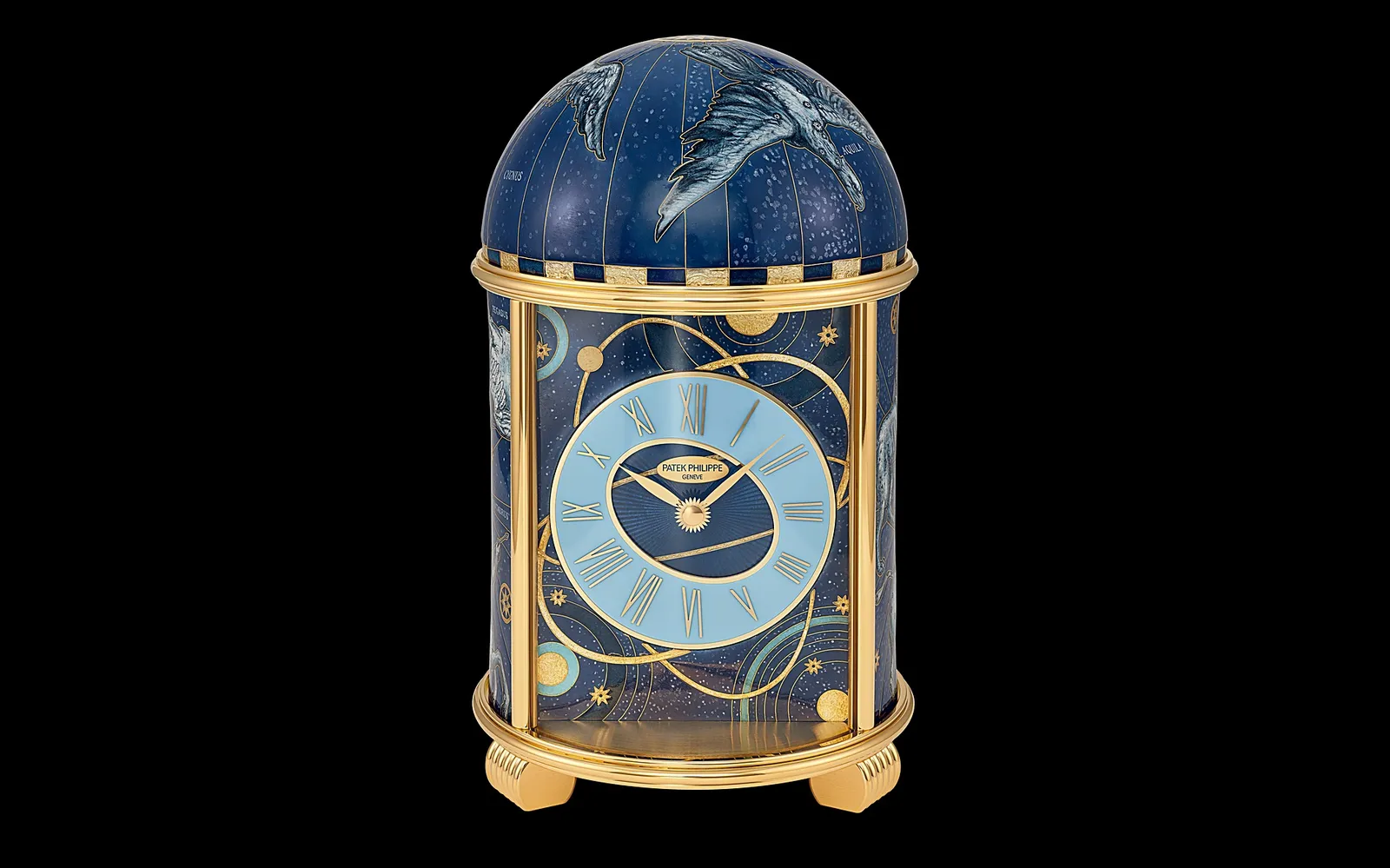
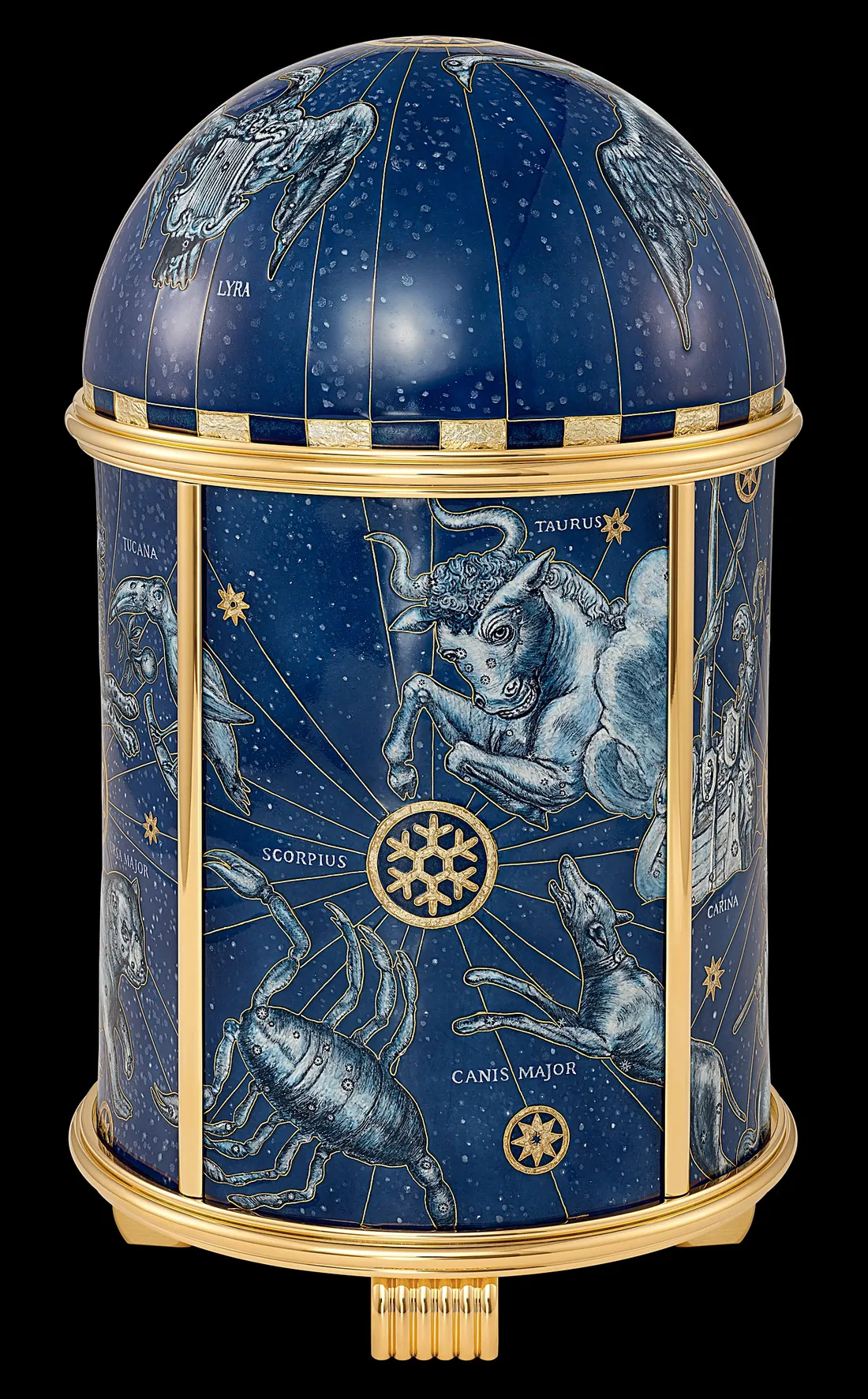
The most concrete expression of this celestial depth in high watchmaking is the Ref. 20206M-001 Celestial Globe in Patek Philippe’s rare handcrafts collection. In the maison’s own catalogue it is listed as a unique piece at three hundred and seven thousand six hundred euros, and it stands two hundred and thirteen and a half millimetres high.
By the maison’s description, the piece depicts the four seasons by means of the constellations visible in the sky at different times of the year, together with imagery of the solar system. On the dome stand the Swan and the Eagle, Cygnus and Aquila, with Lyra a little further round. Around the cylinder the names Pegasus, Leo, Ursa Major, Scorpius, Taurus, Canis Major, Centaurus, Carina and Tucana can be read. Which is to say that the northern and the southern sky are on the same piece; the Great Bear that announces spring stands beside the stars of winter, and the Swan of the summer sky beside the Pegasus of autumn.
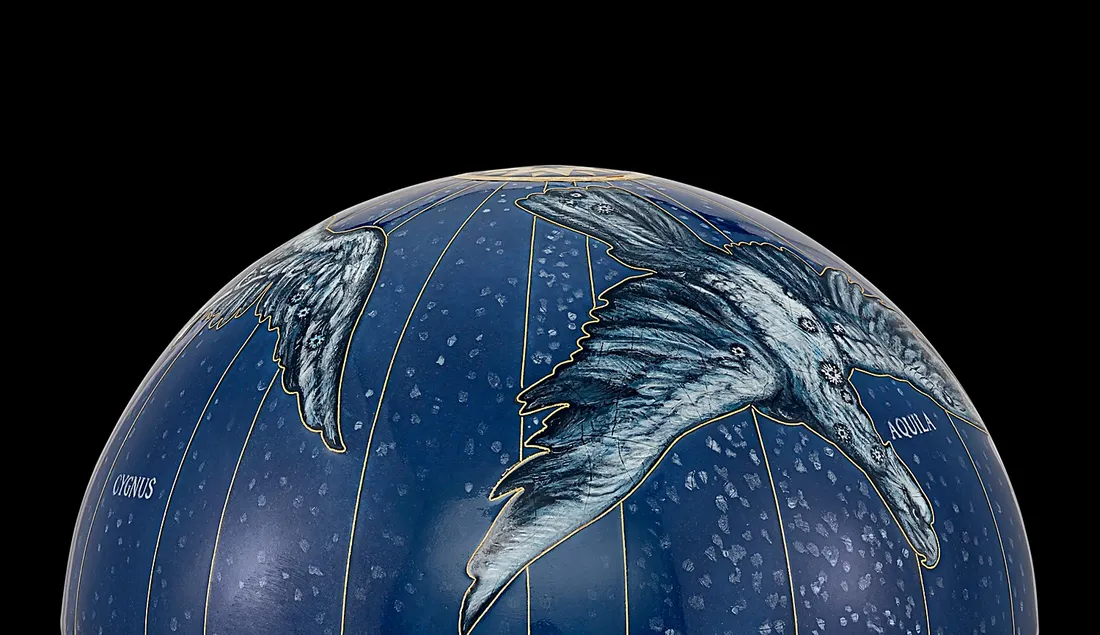
To trace the contours of the orbits of the celestial bodies and the figures of the constellations onto the curved enamel surface, about seven point two six metres of gold wire, weighing eighteen point six six grams, was bent with tweezers and laid down. Every gold line is the counterpart on the dome of an imaginary orbital line in the sky.
To get those hazy, deep reflections of the Milky Way in a night sky, the enamellers blended transparent and opaque enamels in ten colours. The finest detail of the night sky and of the astronomical features was worked in three colours of miniature painting, with micro brushes under a microscope.
The technique that makes the figures stand out in relief is the old grisaille enamel, the white of Limoges. Laid coat by coat over a dark enamel ground, that white enamel creates a three-dimensional monochrome relief through the play of light and shadow. The constellation figures all but step out of the surface.
And then there is the silver leaf. By the technique called paillonné, fine leaves of silver are buried beneath the layers of translucent enamel. When light strikes them, these leaves glittering up through the transparent enamel illuminate the symbols of the seasons and of the stars, and imitate the real glitter of the night sky.
Each curved enamel plate carrying all of this was fired fourteen times at about seven hundred and seventy degrees. On a curved plate that has been through a kiln fourteen times, a single crack or shift of colour means the loss of the whole work.
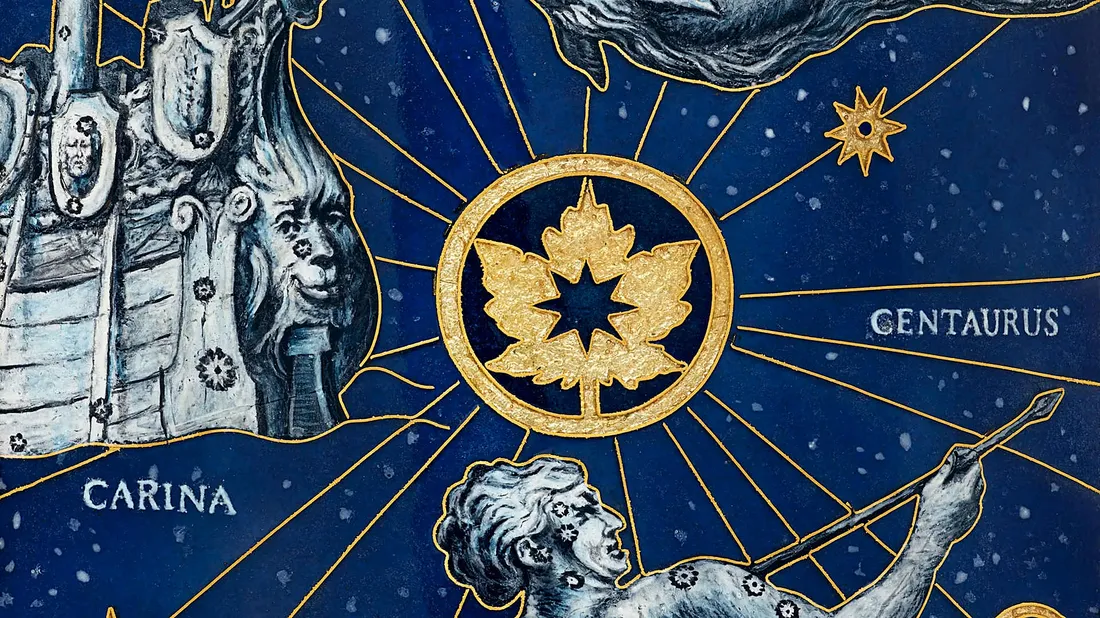
One detail keeps the claim about the four seasons from staying a claim: gilt season medallions are set into the cylinder, right in the middle of the constellations. The snowflake is the mark of winter, and around it stand Taurus, Scorpius, Canis Major and Ursa Major. The maple leaf is the mark of autumn, with the lion-headed prow of Carina on one side and Centaurus with his lance raised on the other. Gold rays spread out from each medallion and run all the way to the names of the constellations.
So the piece is not only a map of the sky but a map of the year. Climbing to the top of the dome and coming down the other side, you pass through the seasons.
At the centre of the clock there is an hour circle laid in light blue lacquer. The Roman numerals on it and the leaf-shaped hands are gilt. The oval ground inside that circle is guilloched by hand in a pattern drawn from the rays of the sun, and incrusted with cloisonné enamel. A gold band of orbit crosses it, and exactly where the hands meet stands a small sun throwing out rays.
So while the map of the night sits on the dome, the source of the day stands at the centre of the dial. The eye that looks at this clock sees first the sun, then the hours around it, and then the night sky behind it.
Inside runs the calibre 17 lignes PEND; it is mechanical, and its winding is done by an electric motor. The movement itself is thirty eight point six five millimetres across and three point seven millimetres thick.
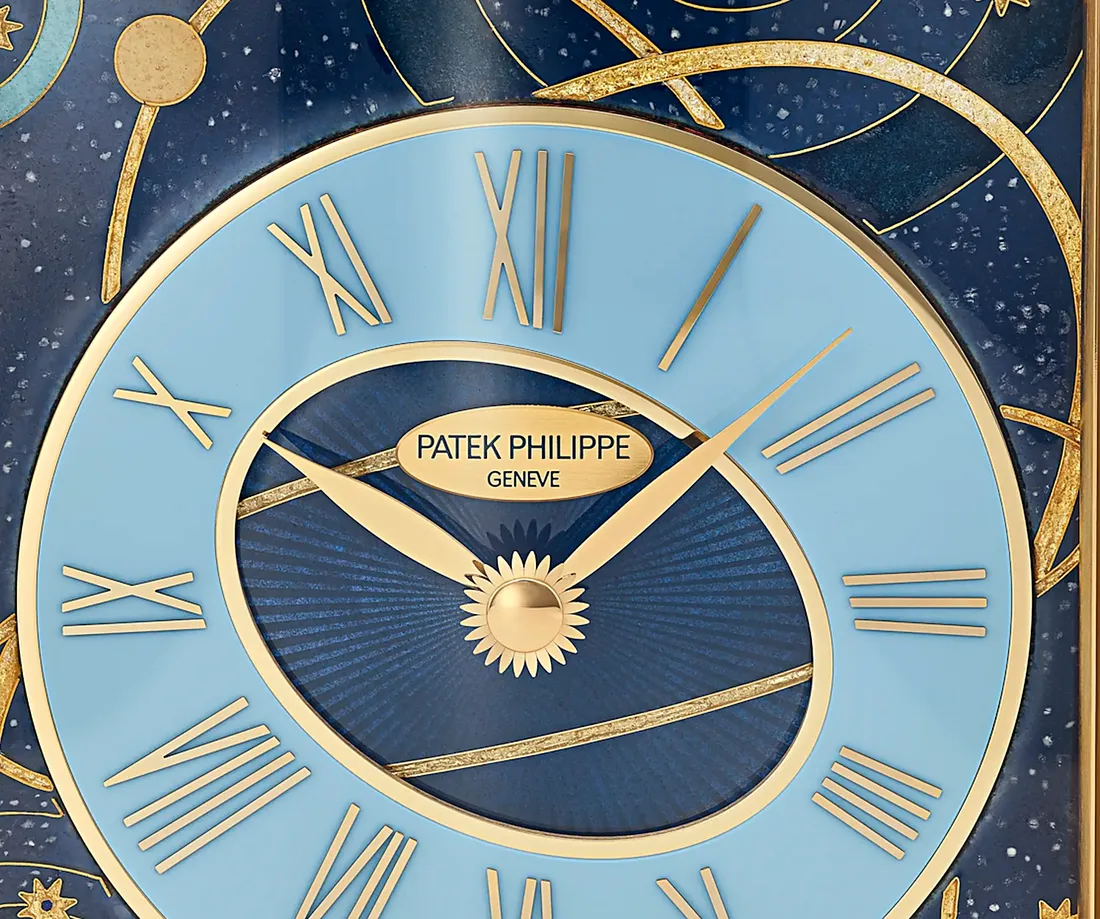
The Patek Philippe artisan works for months to bend eighteen grams of gold wire, to fire the piece fourteen times at seven hundred and seventy degrees and to bury silver leaf beneath translucent enamel, in order to make a micro model of the sky. One crack ends everything.
And the one who built the original of that model, with no need of a kiln or of wire, hung trillions of stars in the void, made the constellations unfailing lanterns in the dome of the sky so that humanity would not lose its way, and set the same turning inside the human cell as a rhythm. The artisan makes a picture of the sky; the sky itself is already turning.
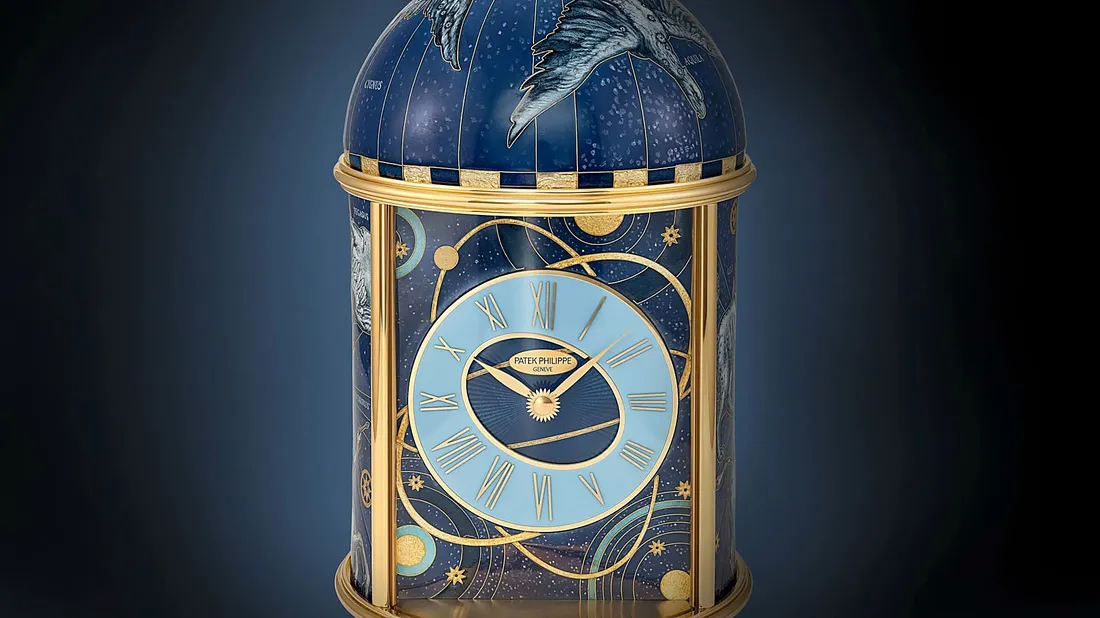
Looking at this piece, and then lifting our heads to run our eyes over the real dome of the sky, this is what should light up the mind: art is not the enamelled star map drawn onto the dome of a table clock through fourteen firings; it is the universe that gave that map its subject, that orders the four seasons, that draws our course across the ocean and that whispers to our cells, in the contemplation of the night, the order to rest.
Just as the silver leaves and the gold lines on Patek Philippe’s Celestial Globe could not exist without a master enameller, so the one who furnished the sky with constellations, who turns the seasons and who gave the human heart this sense of beauty is the Infinite Artist.
However magnificent the instruments that measure time may be, they are only servants of a created time. The real applause and the real contemplation belong to the Great Artisan who raised the heavens like a ceiling, who lit the stars like lanterns, and who made time.
format_quote"Art is not the star map fired onto a dome fourteen times; it is the universe that gave that map its subject."
Hasan Bekmezci
The clock on its maker’s own site: Patek Philippe, Ref. 20206M-001 Celestial Globe