The sky over Medina looked like diamonds scattered across black velvet. On the flat mud roof of one of the houses an old man sat perfectly still, his eyes fixed on a single point of light among thousands. He did not blink. He did not shift his weight. He had stepped outside the circle of the hours and joined himself to that one star.
A neighbour passing in the street below noticed his friend standing there like a statue at that hour, climbed the stairs, touched his shoulder and asked him quietly what he was doing, what he was looking for in all that darkness.
The old man answered without lowering his head. Our friend loved to contemplate the sky, he said. He loved to watch the stars turn. He could neither read nor write, and yet the heavens were opened to him verse by verse. He used to recite to us that the stars were set in place so that we might find our way through the darkness of land and sea.
And now, the old man went on, I am looking at this star. He must have stood somewhere near this very spot on some night and lifted his head to it. Do you know what I am doing? I am trying to find the angle. I want to look at the sky from where he looked, with the acceptance he felt. I am looking for his trace in the light of a star.
The two of them stood side by side on the roof, watching the same star, and understood that time is not made only of hours. It is made of memory, of love, and of the attention we are willing to pay.
format_quote"I am looking for the angle at which he once looked. Time is not made of hours; it is made of memory, of love, and of attention."
Hasan Bekmezci
That habit of attention began in the silence outside Mecca. It moved to Medina, where the night prayers were said on a beaten earth floor and the sky seemed to lean low enough over the city that people felt the stars were the ceiling of their houses. And it ended up anchored in Jerusalem. Mecca, Medina and Jerusalem: a triangle drawn in the sky and held together by angles.
Over the following centuries the same attention hardened into a scientific tradition. Muslim astronomers needed to fix prayer times and lunar months, so they transferred the sky into machinery. Al-Biruni worked out geared astrolabe designs that tied the roughly twenty-nine and a half day synodic cycle of the moon to the motion of the sun, and cast the mathematics of the sky into brass. Al-Jazari, in Cizre, built water clocks that married celestial mechanics to feedback wheels and became the first great engineer of the automated hour. Taqi al-Din, at the observatory in Istanbul, built instruments that chased the second itself in astronomical observation.
Nine hundred years later that inheritance surfaced again on a bench north of Moscow.
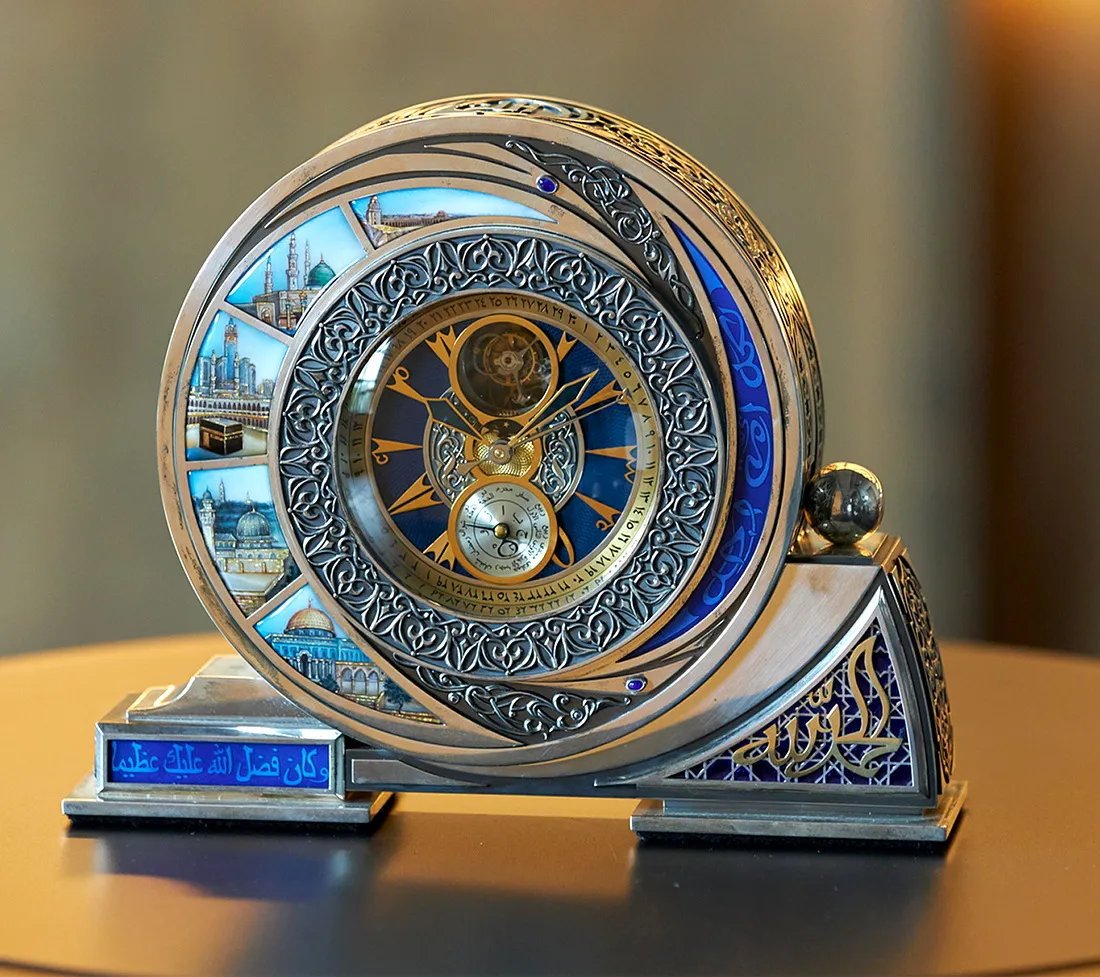
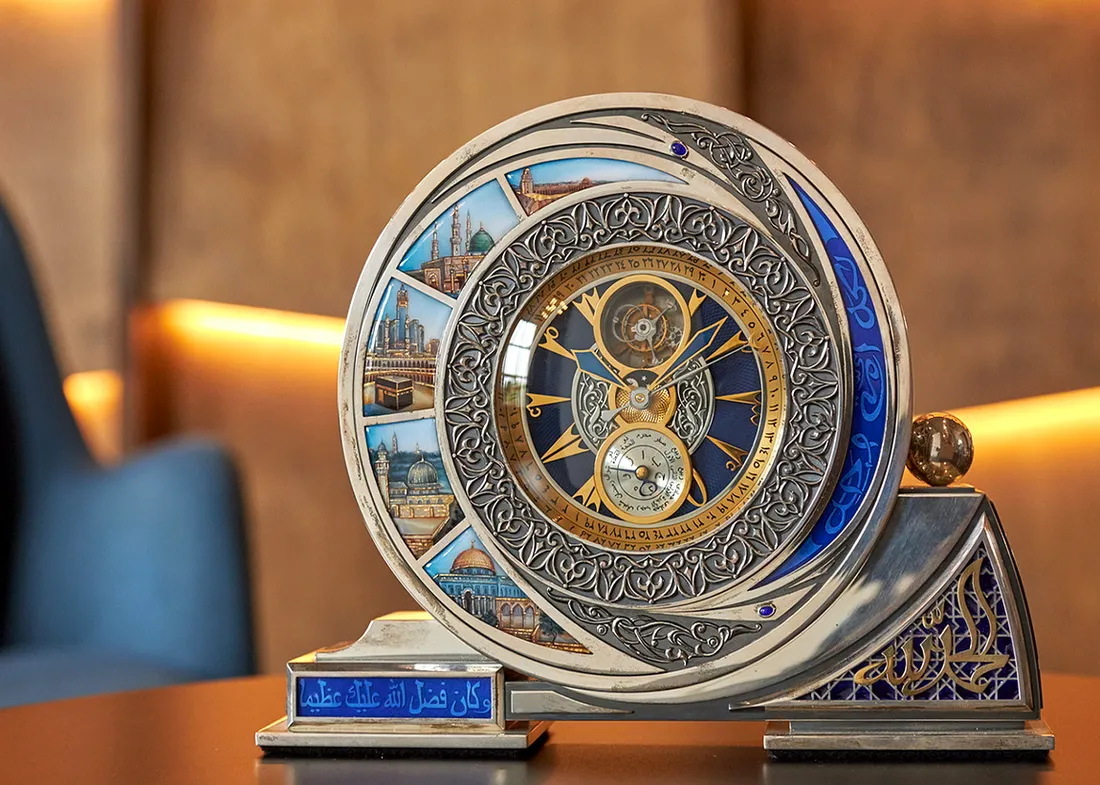
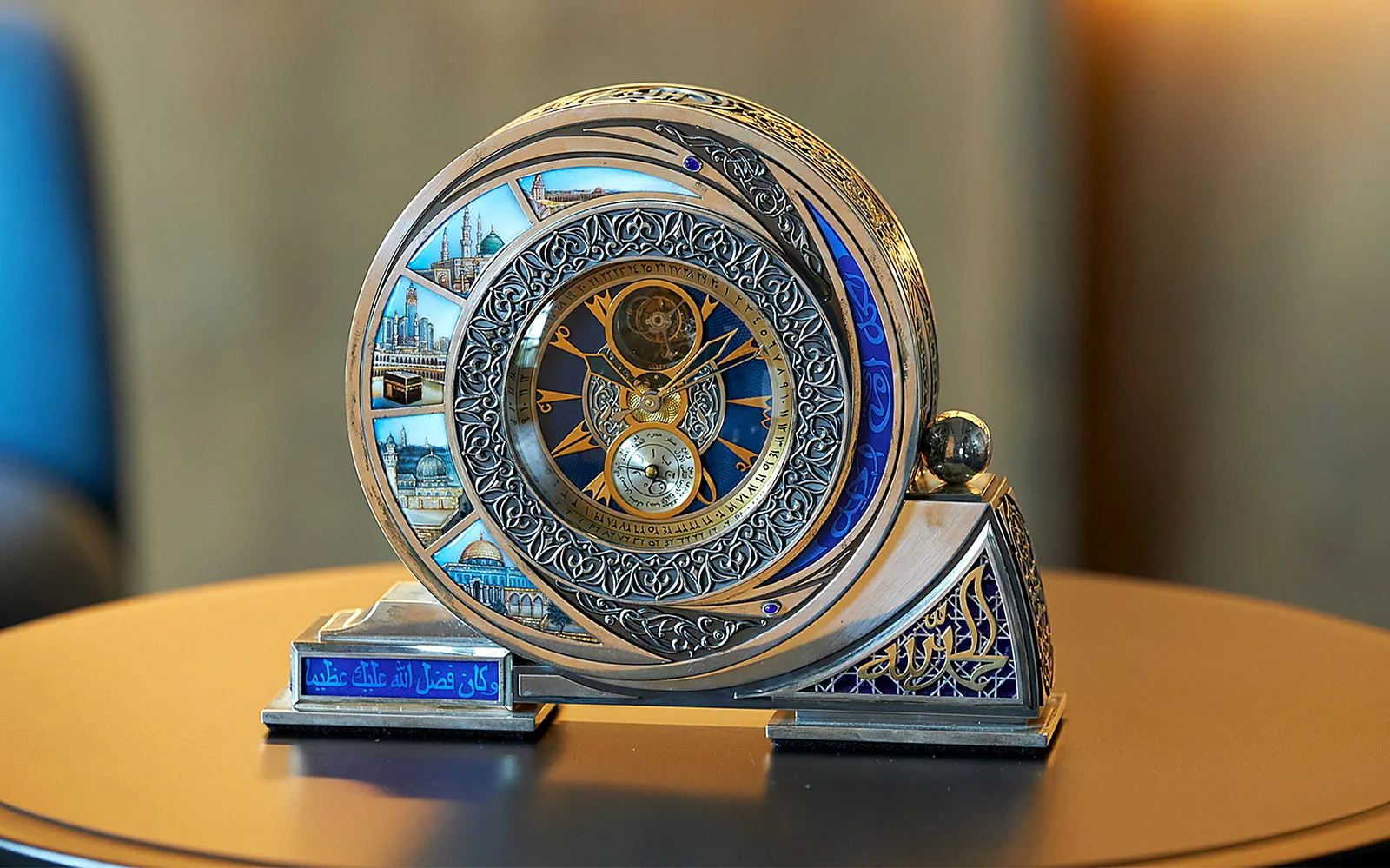
Konstantin Chaykin works under his own name rather than a house, and draws his own patents. He developed Al-Muqaddasi over eighteen months and finished it in October 2010. What emerged reads less like a table clock than an architectural model: a curved body drawn from Central Asian architecture, every surface carved by hand into arabesque relief, roughly twenty-five centimetres across and twelve deep. Its bill of materials belongs to a builder rather than a watchmaker, listing brass, mineral glass, precious woods, steel and natural stone.
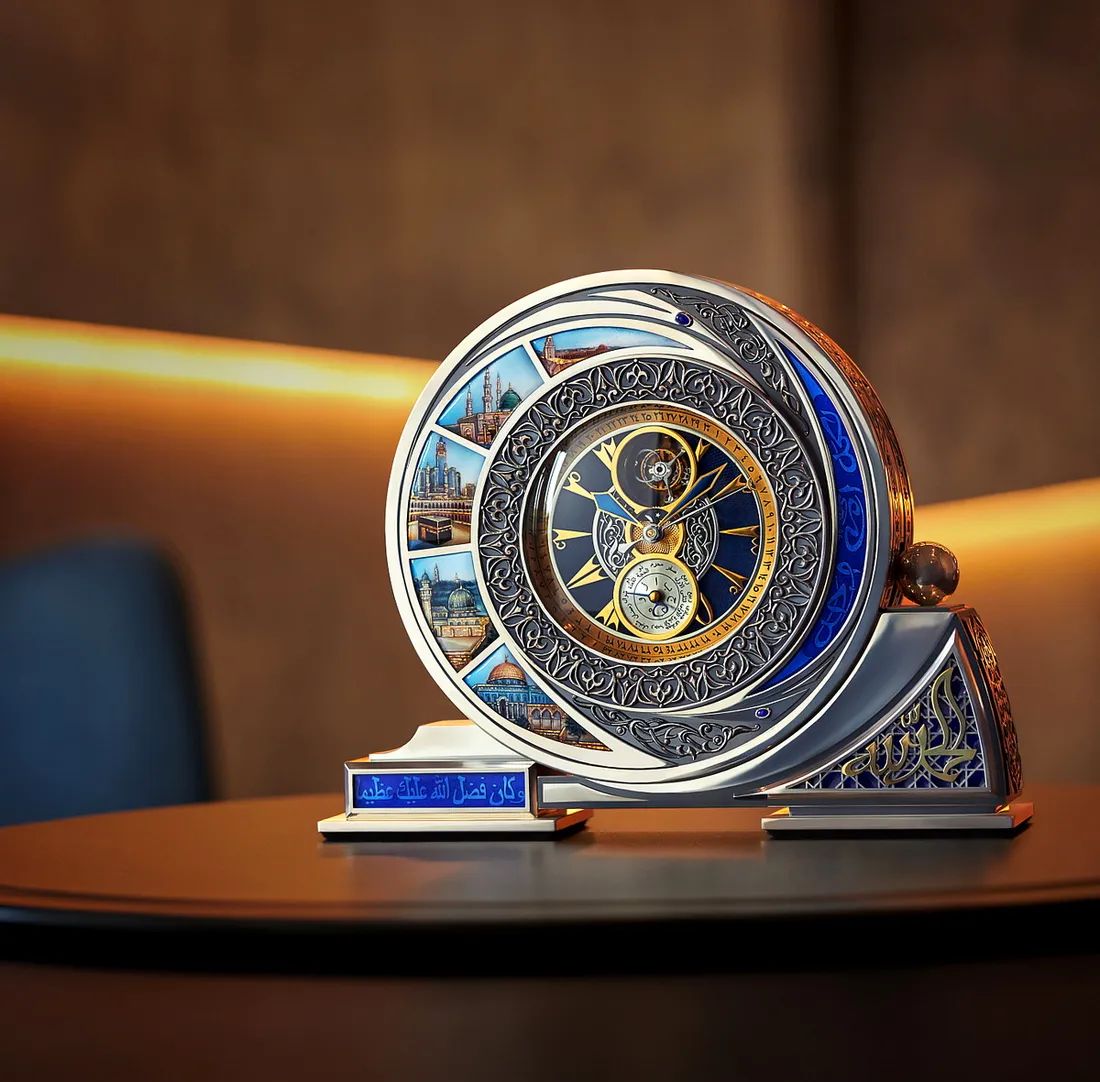
The dial is 150 mm in diameter, gold-plated and nickel-plated brass, with blued brass hands. But what separates Al-Muqaddasi from a well-made clock is not its scale. It is what runs around the dial: a row of hand-painted enamel miniatures set into the curved panel. The Prophet’s Mosque with its green dome and minarets, the Kaaba inside the enclosing sanctuary, the Dome of the Rock under its gold cap. The triangle the old man was tracing from his roof is rebuilt here in brass and vitreous enamel.
Across the deep blue enamel of the base runs a line of gold calligraphy, a verse about the magnitude of what has been granted. On the lower right panel a gilt inscription rises out of a silver lattice. Chaykin does not seem to have treated these as decoration. They read as a colophon: a signature that points away from the maker’s own cleverness and towards what was given to him.
format_quote"A triangle is rebuilt around this dial. Mecca, Medina, Jerusalem, this time in brass and vitreous enamel."
Hasan Bekmezci
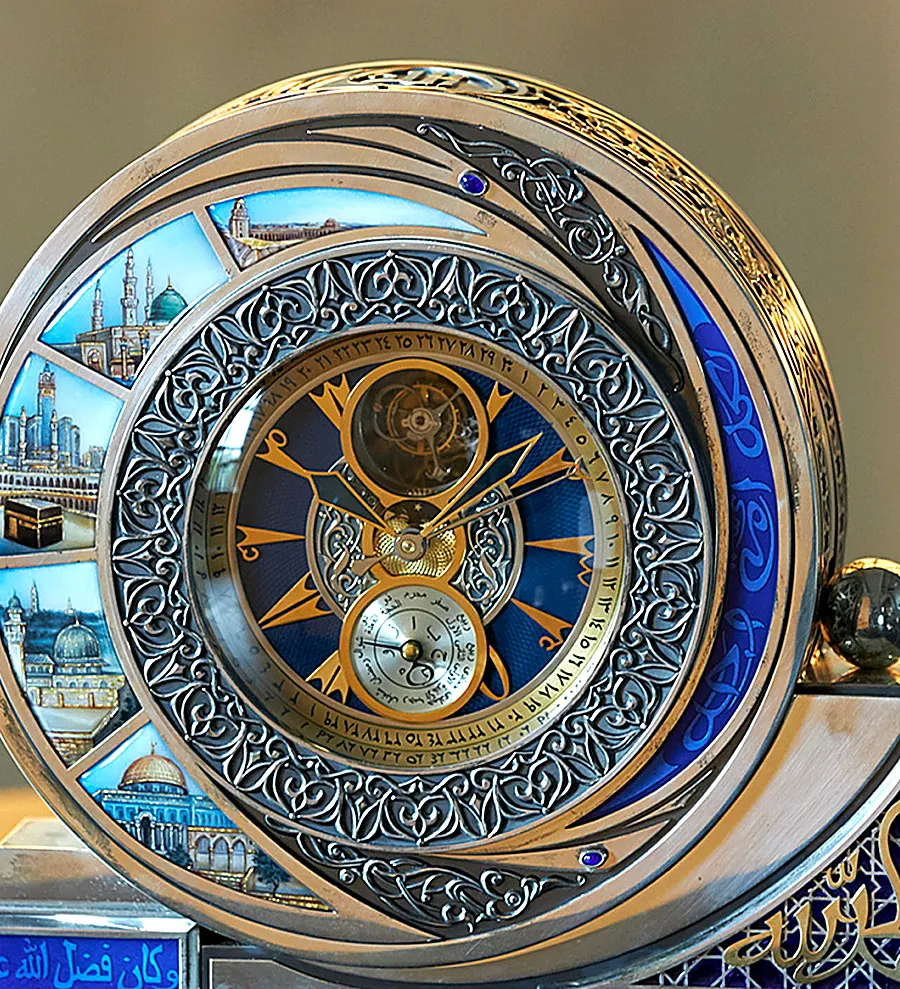
Inside runs calibre TAHJ.02-1, developed entirely in Chaykin’s own manufacture, wound with a key, good for eight days. At the centre a one-minute tourbillon turns inside the Alpha-shaped cage that has become the maker’s handwriting. But the tourbillon is not the difficult part of this clock. The difficult part is the small silvered disc immediately below it.
That disc drives a mechanical Hijri calendar showing the date, the weekday and the month. One number explains why this is hard. The synodic month runs twenty-nine days, twelve hours, forty-four minutes and roughly three seconds. It cannot be expressed in whole numbers, and the comforting correction the Gregorian calendar makes every four years is no help here. A Hijri month is either twenty-nine or thirty days long, and which one arrives is settled by arithmetic. Without software the only way to perform that arithmetic is to find a train of gears whose tooth counts land as close as possible to that decimal. That is precisely what Chaykin did: he turned a calendar into a multiplication, and the multiplication into brass.
The same movement also carries a moonphase, and that is not ornament. The Hijri calendar is the moon. On a Gregorian watch a moonphase is a poetic addition; here it is the operating principle.
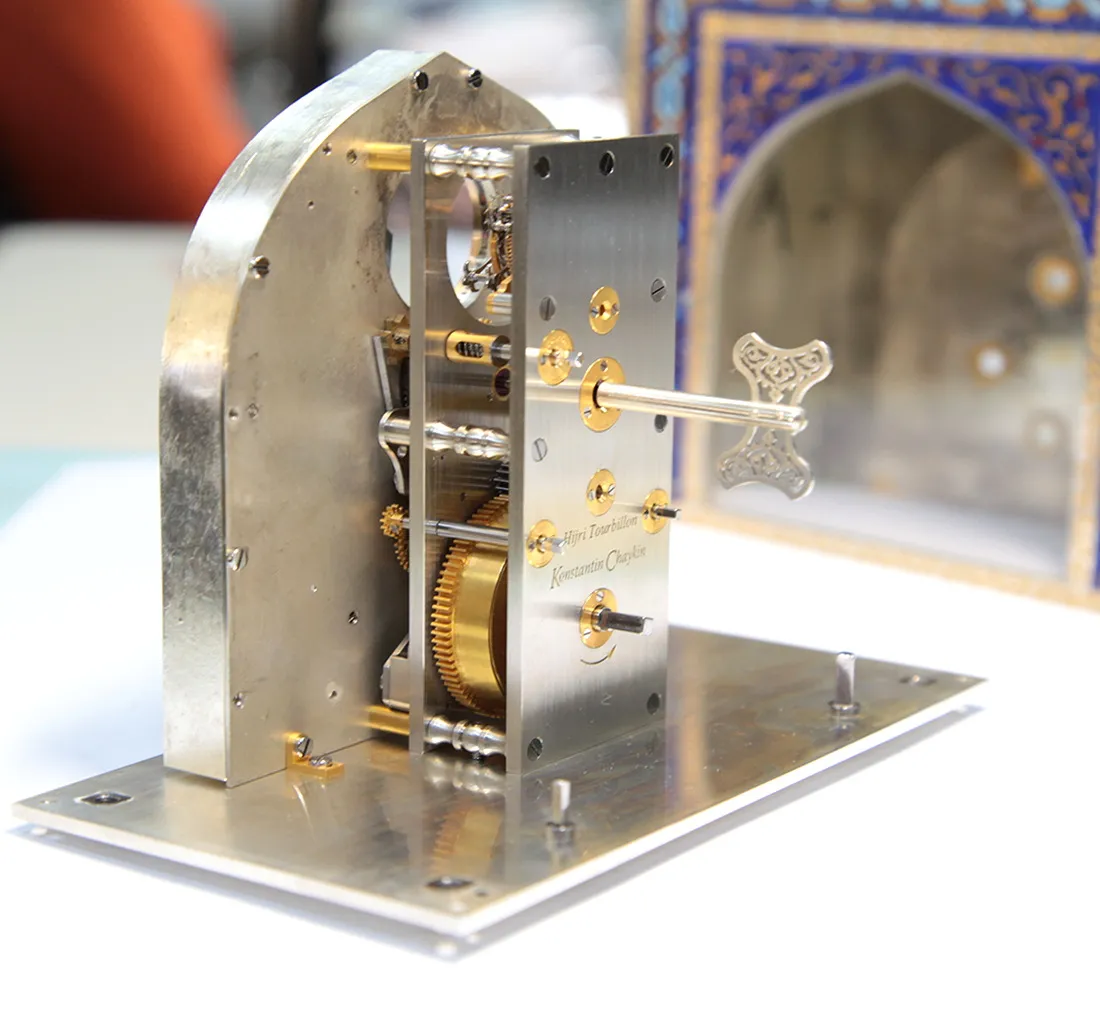
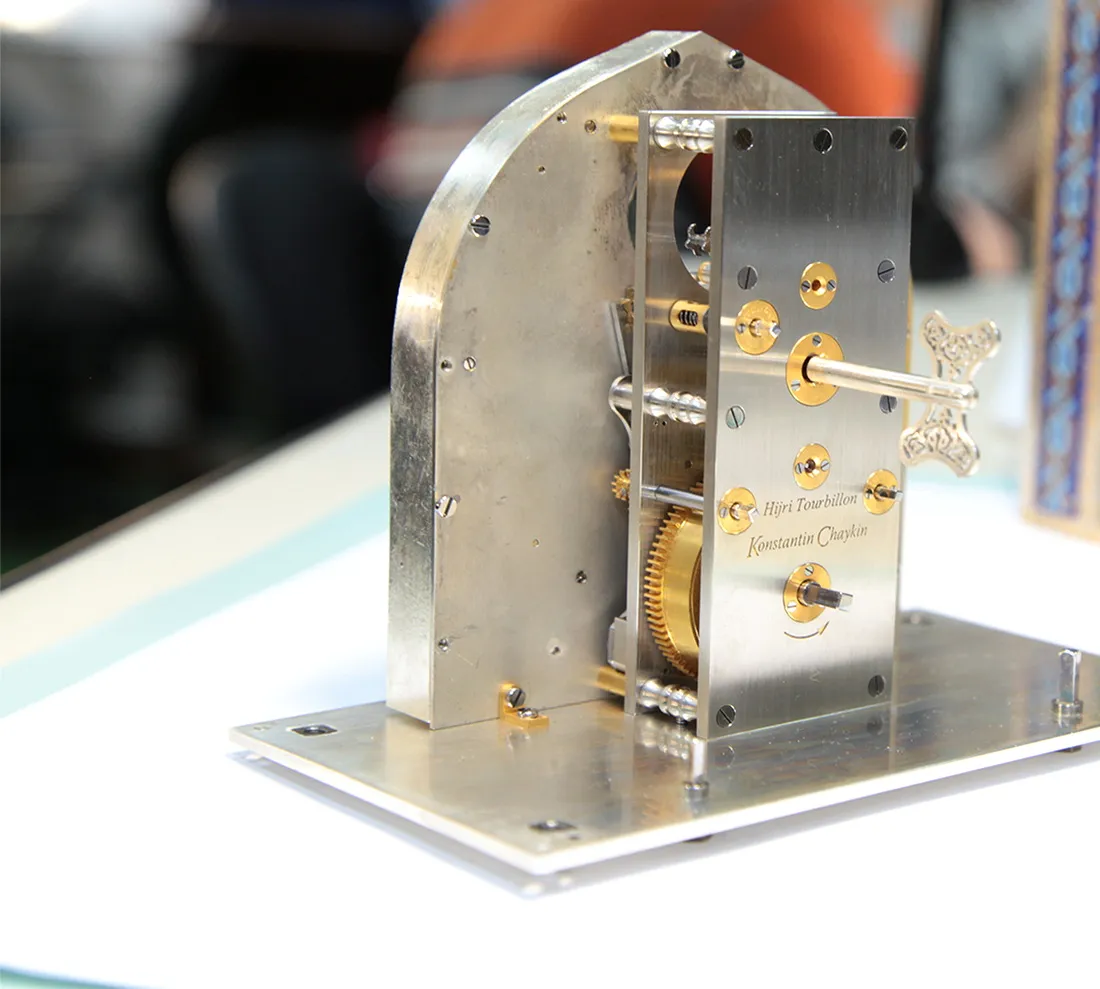
A distinction is worth drawing here. Al-Biruni’s geared astrolabe, al-Jazari’s water clocks and Taqi al-Din’s observatory instruments were all built to measure the sky. They were tools. Al-Muqaddasi was not built to measure anything. Nobody will fix a prayer time by it. Its function is to demonstrate that the calculation is possible, and to say out loud whose inheritance that calculation is.
The most expensive quality an object can have is sometimes the one that does no work at all. The three miniatures around the dial contribute nothing to the running of the clock. The calligraphy on the base does not change a single gear ratio. Remove them and what is left is a very good table clock. That is exactly the distance between craft and art: the stubborn presence of what was never required.
format_quote"The most expensive quality an object can have is the one that does no work. The stubborn presence of the unnecessary is what separates art from craft."
Hasan Bekmezci
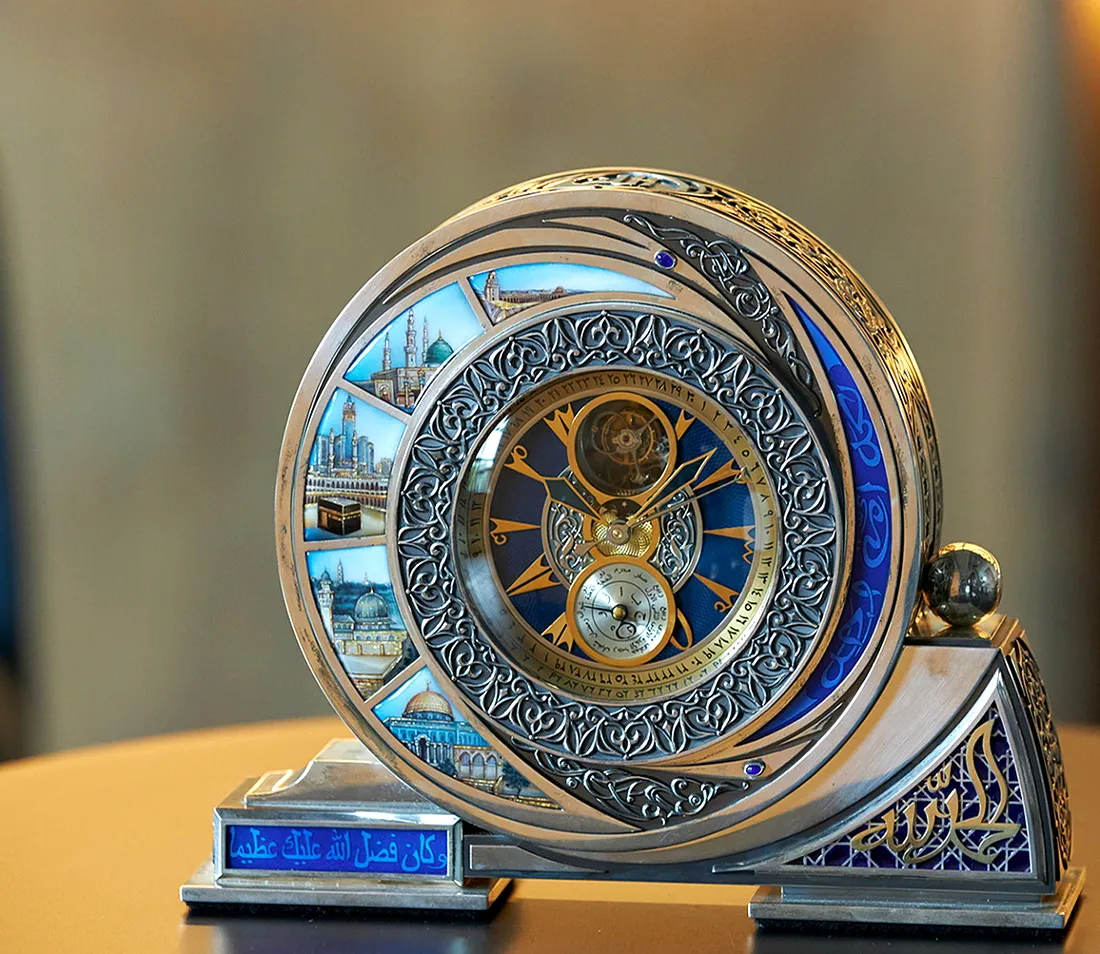
Chaykin patented his mechanical Hijri calendar, and the mechanism went on to live in later pieces from the same family. But Al-Muqaddasi carries the weight of being first, and an idea is at its most honest the first time it is cut into metal.
Its name says as much. Al-Muqaddasi was a tenth-century geographer, born in Jerusalem, who walked across almost the entire known Islamic world and wrote down what he saw. Naming a clock after him is a way of insisting that it is not an instrument but a travel account.
The old man on the roof was looking for the angle of a star. He never found it, and nobody could. But the angle was never the point; the looking was. Al-Muqaddasi does not hand you a calendar either. It tells you that a cycle of twenty-nine and a half days can be resolved into brass teeth, and that somebody thought this worth eighteen months of his life.
The wheels turn quietly and the three miniatures stay where they are. Time passes. What is made inside that passing is the only part of it that stays.