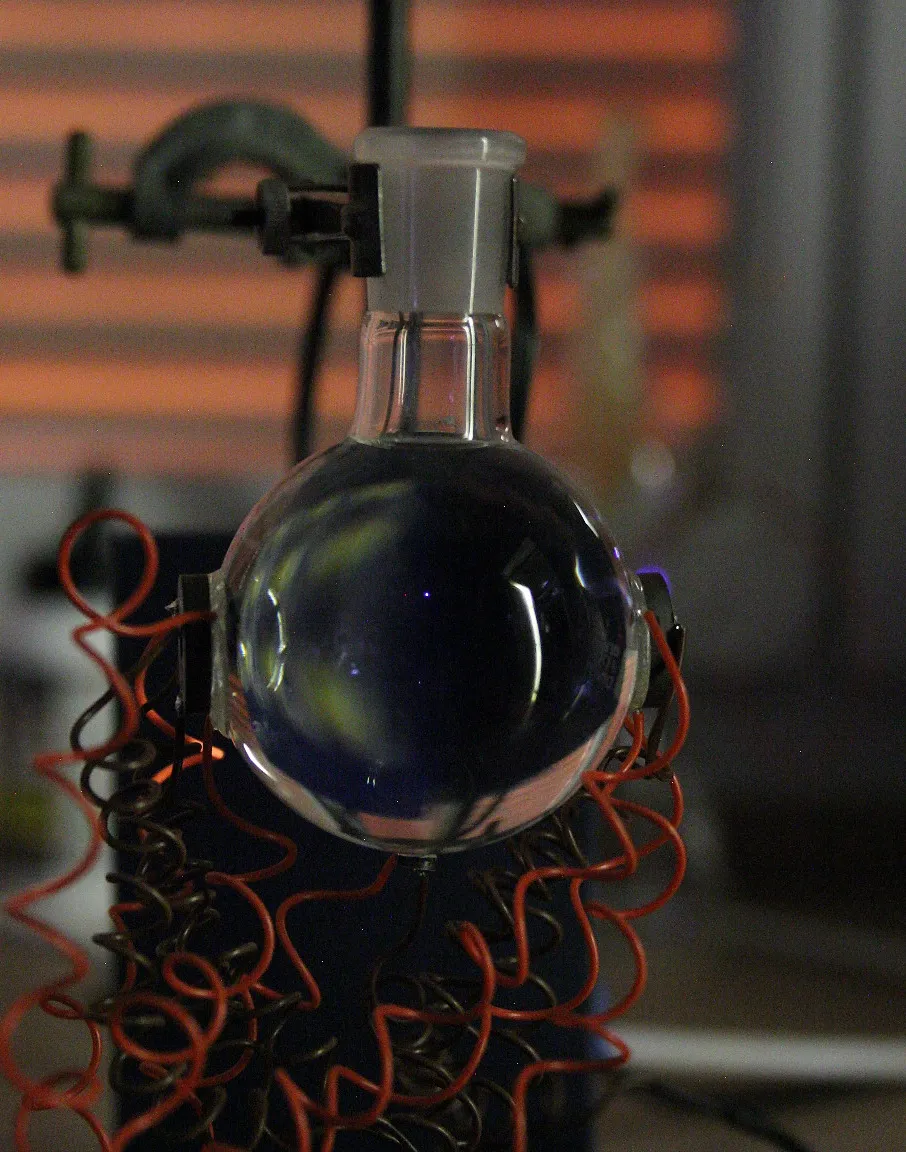
In the acoustic isolation chamber of a laboratory, two researchers stand at a tube of freezing liquid: Dr Harun Soylu, who works on quantum optics and fluid dynamics, and Dr Nevin Derin, a researcher in acoustic spectroscopy.
When high-frequency sound waves are applied to the liquid, the microscopic gas bubble the sound creates runs out of control and suddenly collapses in on itself. In that nanosecond of collapse, the temperature inside the bubble climbs, by the measurements, into the tens of thousands of degrees, leaving the roughly five and a half thousand degrees of the Sun’s surface far behind. And in the middle of the freezing water a dazzling flash of light, born of a sound wave, lasts for a nanosecond.
For classical physics, Harun, sound is no more than a mechanical vibration of molecules in air or liquid, says Dr Nevin, pointing at the shock wave analysis on the screen. That a mechanical vibration on its own should produce the temperature of a star and send light out of the heart of freezing water shakes the patterns of causality at the root.
Because the Architect has set hidden doors of resonance that turn kinetic vibration into the fire of photons, Nevin, answers Dr Harun Soylu. Sound becomes light, mechanical vibration becomes the heat of a star. The chain of causes breaks; mechanical motion becomes the mother of an optical flash. In nature no form of energy is condemned to a single mould.
format_quote"In the middle of the freezing water a dazzling flash of light, born of a sound wave, lasts for a nanosecond."
Hasan Bekmezci
A few plain comparisons help to grasp how mechanical sound turns into enormous heat and a burst of photons.
The first is striking a star with an invisible hammer. Imagine the sound of a clap in the air flaring for an instant into starlight. As the sound wave compresses the bubble, the kinetic energy of the molecules is gathered into a single point and the pressure becomes a plasma that throws out light.
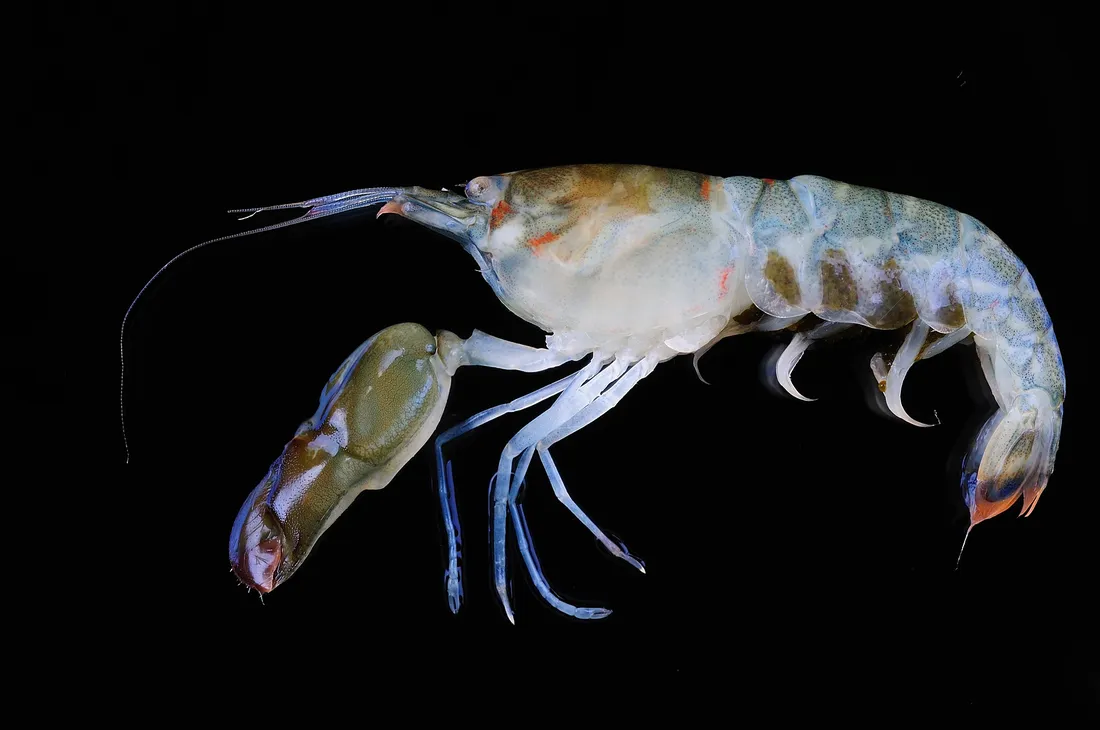
The second is the sea’s own weapon. The pistol shrimp, Alpheus heterochaelis, closes its claw at such speed that the jet of water it makes leaves a cavitation bubble behind it. When that bubble collapses, the shock wave stuns the prey; and as a by-product of the same collapse a flash of light appears, too faint for the naked eye but measurable. Researchers put the temperature behind that brief glow above four thousand degrees. A mechanical movement becomes, for an instant, a source of light.
The third is the assumption itself. The idea that producing light requires an electrical circuit or a fire falls apart; with a sound at the right frequency, light can be born out of water.
format_quote"The idea that producing light requires an electrical circuit or a fire falls apart; with a sound at the right frequency, light can be born out of water."
Hasan Bekmezci
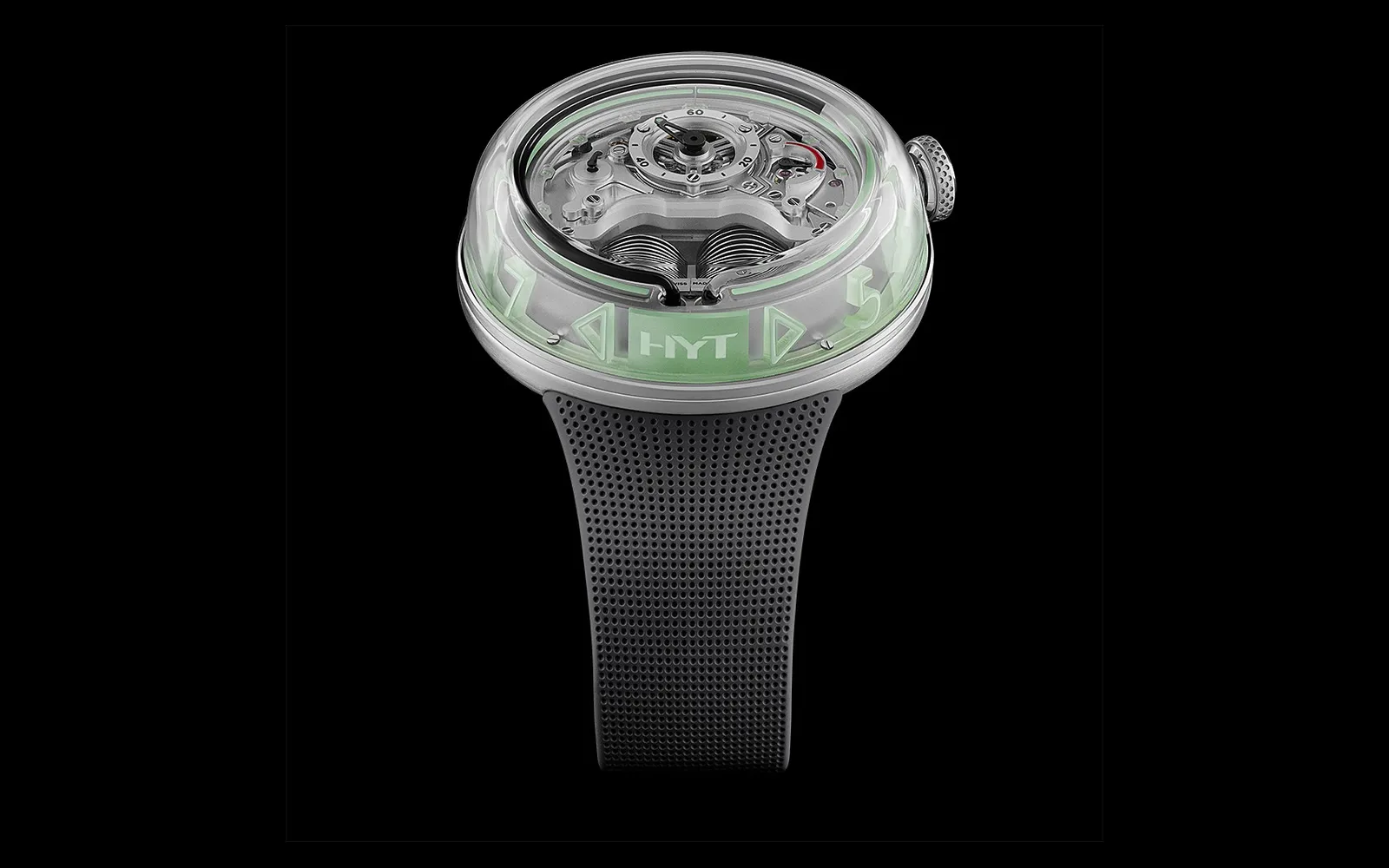
The watch that carries the force of mechanical wheels into coloured liquids inside capillary glass tubes, and tells the time by the movement of a fluid, is the HYT H5. It was presented in twenty twenty and made in twenty five pieces.
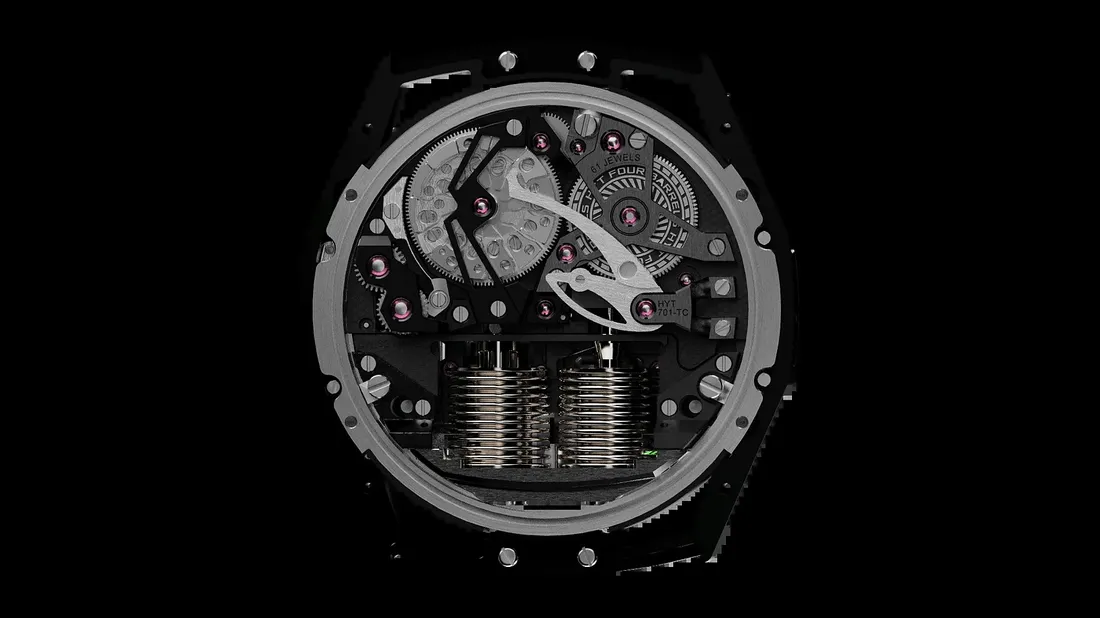
Over its forty eight point eight millimetre stainless steel case rises a sapphire crystal in a high dome; the back is sapphire too, and it is water resistant to fifty metres. The calibre 501 inside it was developed with TEC Group, belongs entirely to the house, and is wound by hand. It beats twenty eight thousand eight hundred times an hour, has forty one jewels and runs sixty five hours.
It works like this. The kinetic energy of the calibre is carried to two electroformed bellows beneath the movement. Exactly as a sound wave compresses a bubble of gas, these bellows push two immiscible liquids along the capillary glass tube; what shows the hour is the meniscus, the line where the two liquids meet. The wall of the regulating bellows is four times thinner than a human hair. And a specially shaped cam with thirteen positions locks the hour and minute displays together, keeping the two in step.
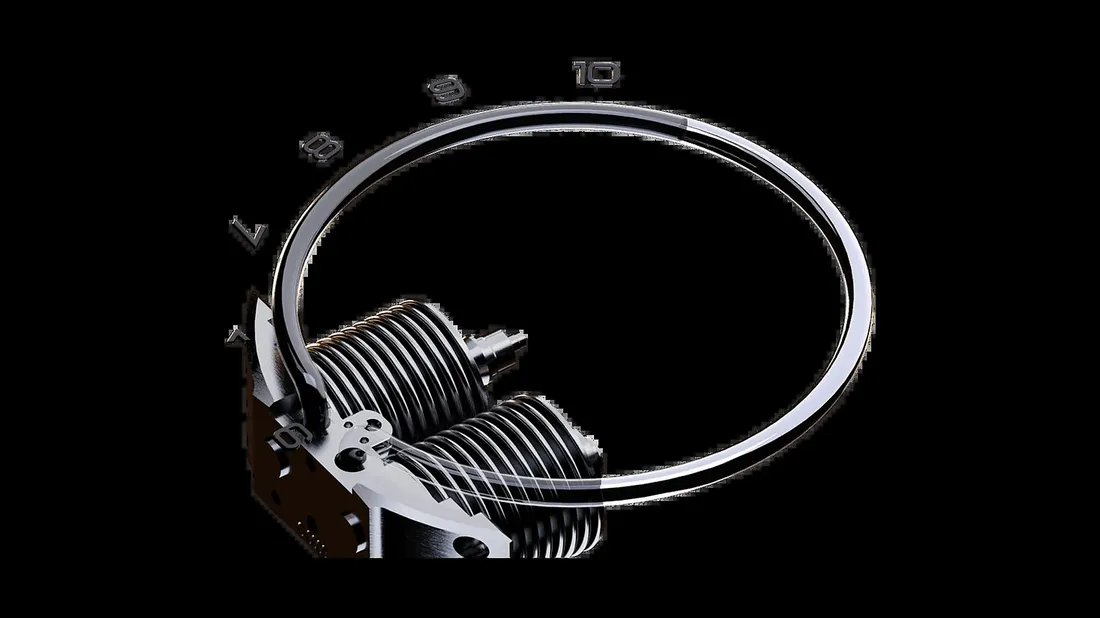
The dial is laid out to the same logic: the fluid hour is read on the outside, along the capillary, while the minutes turn at twelve, the power reserve at three and the seconds at nine.
What happens in the dark is a display of its own. White Super-LumiNova laid under the capillary tube carries the light it has swallowed all day into the night and lights the liquid from beneath. The watch becomes, in effect, its own plasma tube. That optical performance of mechanical force upon a liquid calls to mind what sonoluminescence does when motion turns into light.
And when the fluid reaches six o’clock, the bellows release their pressure and it flows back to its starting point at once. The second half of the day begins again.
format_quote"In the dark the watch becomes, in effect, its own plasma tube."
Hasan Bekmezci
The HYT H5 is an extraordinary instrument, proof that mechanical watchmaking is not made of wheels and hands alone, and that with fluid dynamics and an optical display time can be made to flow like a plasma.
Watching the bright liquid pressed through the capillary tube inside the watch, and the rhythmic work of the bellows, you feel what you feel when a mechanical vibration and a sound turn into the light of a star: that divine knowledge has limitless manifestations it can draw even out of the coldest water.
The watch on its maker’s own site: HYT, the H5 on the house’s own timeline