In the early twentieth century, on the shore of a Swiss lake, a boy would watch the surface of the water for hours. He observed the patient, graceful dance of the carp gliding among the shadows; he committed to memory how a fish's body bends in the water, how the scales break the light. The name of this boy was Édouard Marcel Sandoz.
Born in Basel in 1881, the son of the founder of the famous Sandoz pharmaceutical company, Sandoz pursued not wealth and industry but form and living movement. As a sculptor and painter, he carved animals in such a style that he seemed to breathe life into bronze and stone. Fish and birds above all. In his hands, a carp was no frozen metal but a living creature that, an instant later, would flick its tail and dive into the deep. When he died in 1971, he left behind one of the most elegant interpretations of the animal form.
More than half a century passed. And a watch house under the patronage of the Sandoz family, Parmigiani Fleurier, resolved to pay a debt of devotion to this great artist ancestor. The aim was simple yet almost impossible: to bring the carps of Sandoz back to life upon the tiny dial of a wristwatch.
A Family's Devotion and the Designer with a Painter's Eye
Parmigiani Fleurier, founded in 1996 by the restoration master Michel Parmigiani, is one of the purest and most independent houses in Swiss watchmaking; and the blood tie between the Sandoz Family Foundation behind the brand and Édouard Marcel Sandoz gives this work an intimate meaning that lifts it above an ordinary watch. For the piece, the brand's founding collection was chosen, the Toric: proportioned by the golden ratio, with its knurled bezel and those elegant teardrop-shaped lugs.
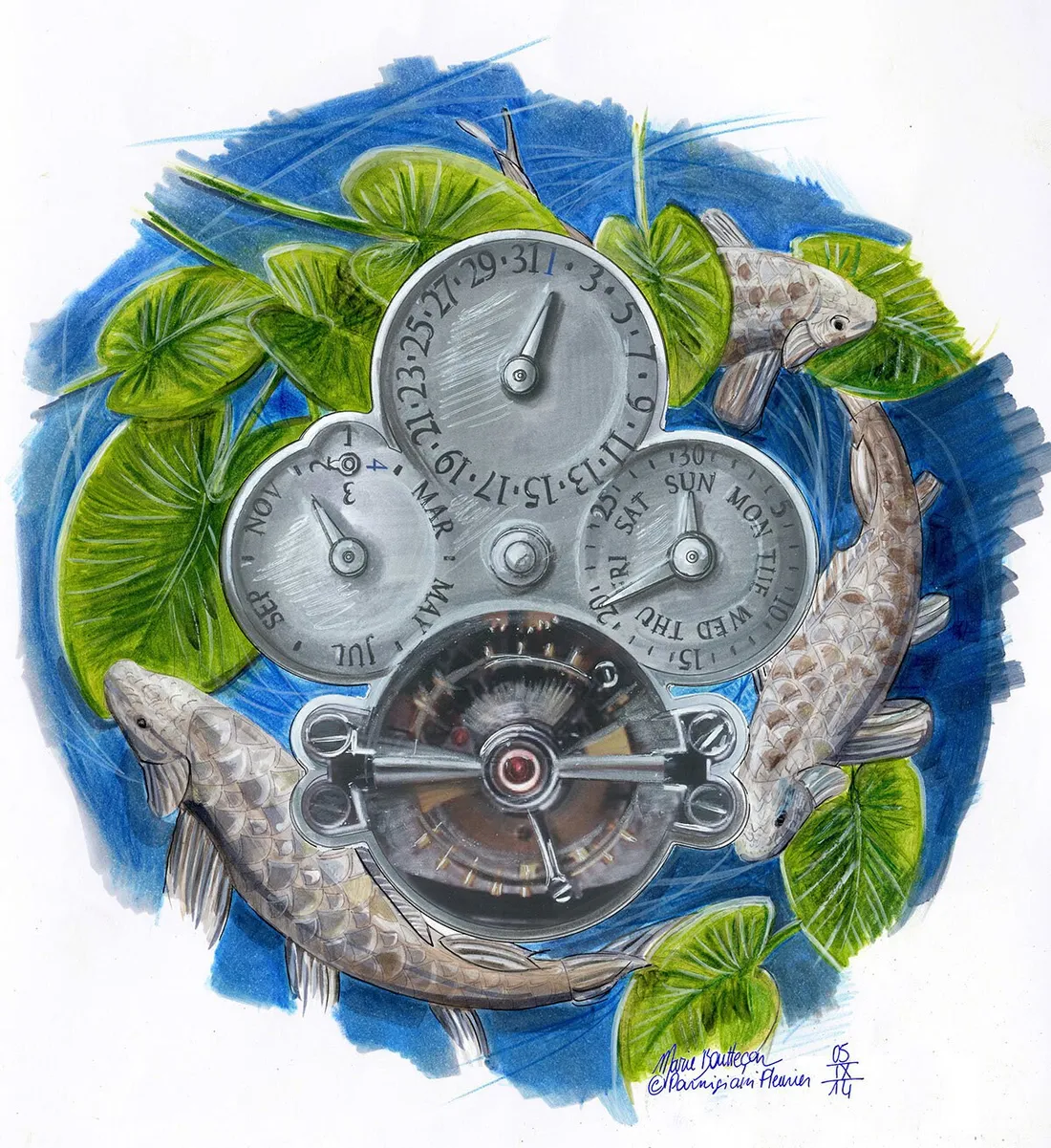
The one who designed this celestial project and orchestrated the harmony of all the crafts was Marie Bouttecon. With a painter's eye, she took the flowing line of Sandoz's sculptures and turned it into a dial composition; on a watercolour, she plotted out where each carp would glide, how the water-lily leaves would divide the water, and where in the pond the tourbillon would turn. The design sketch below is the first form of this dream on paper.
The Pond on the Dial: Three Carp and a Whirlpool
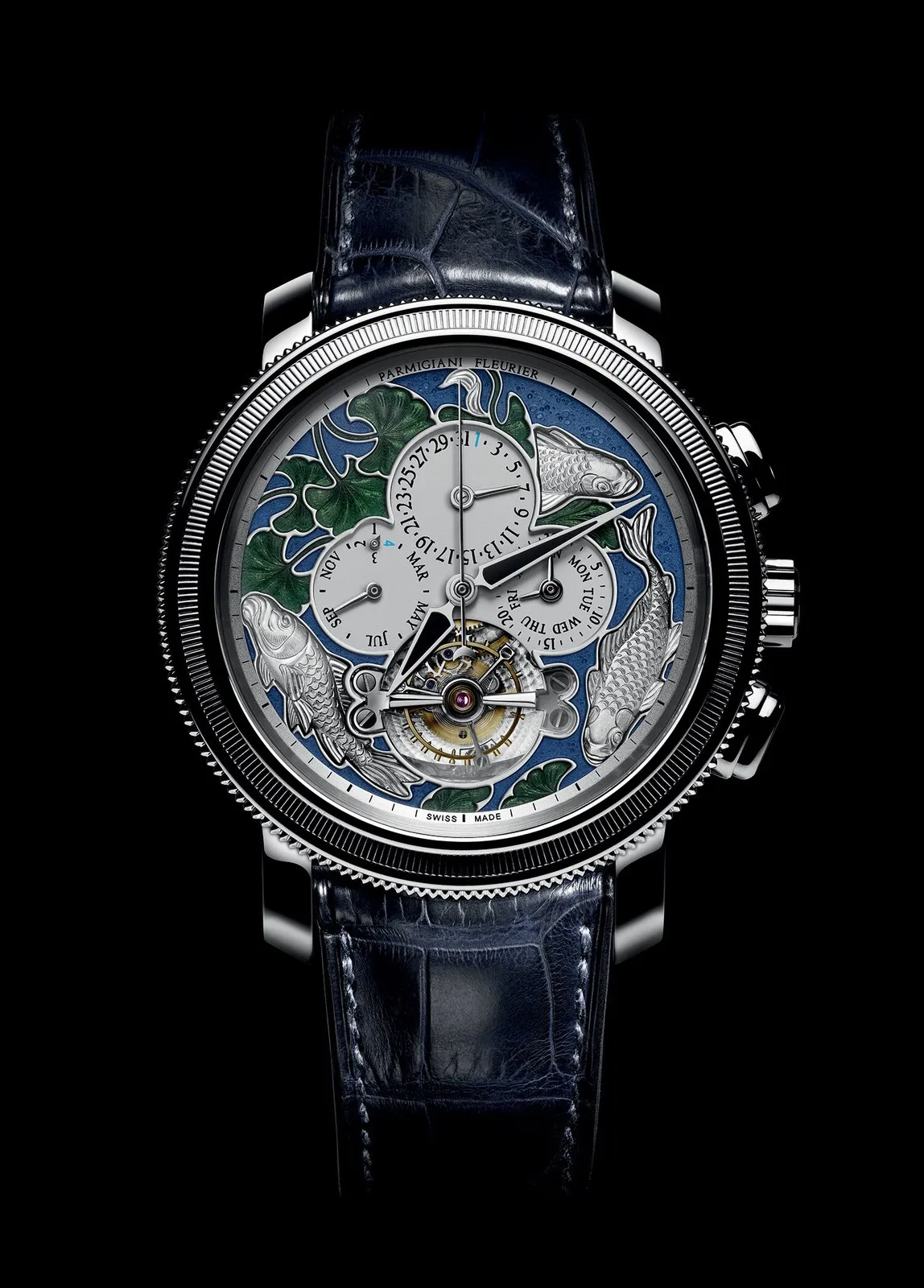
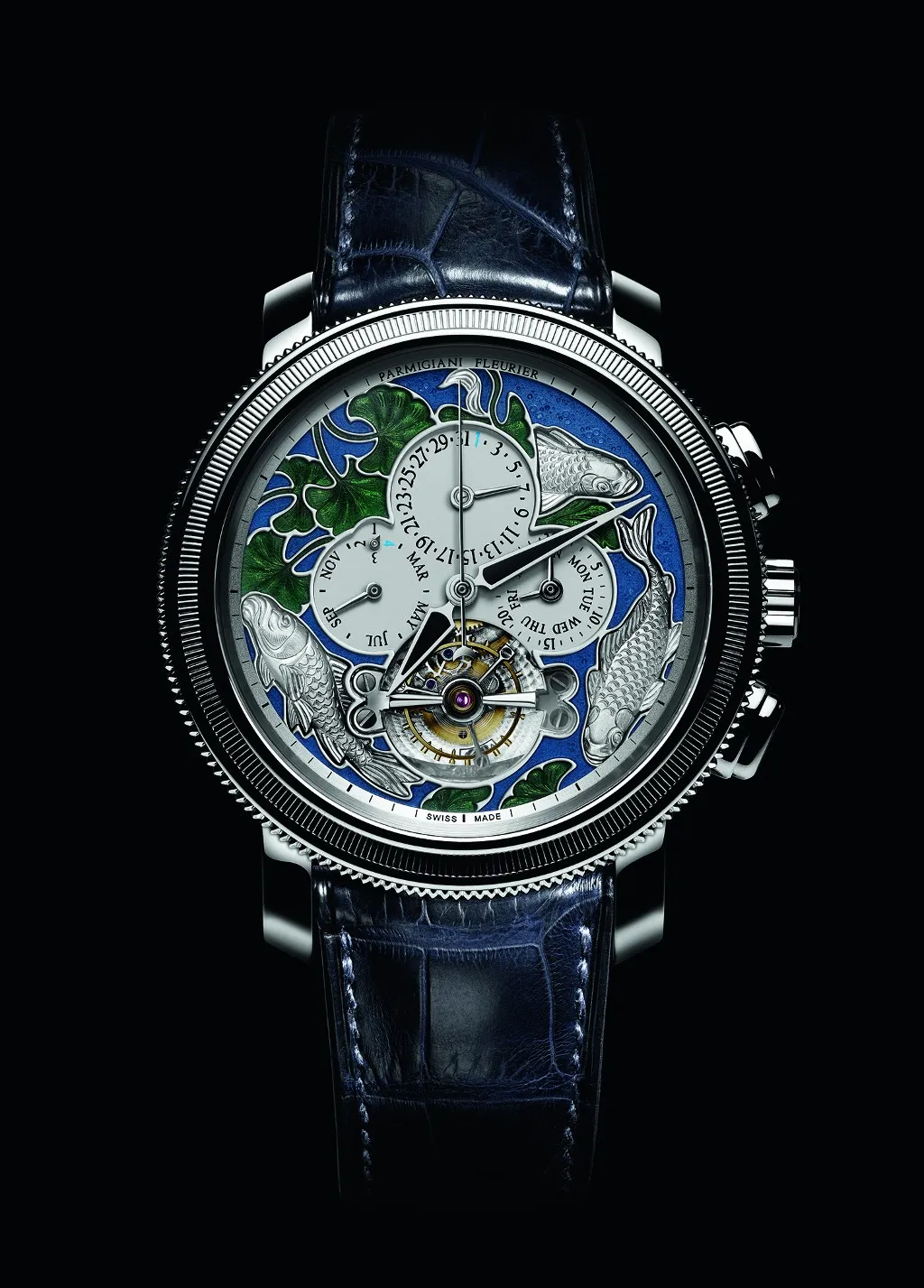
And the dream came true. When you look at the dial you no longer see a watch; you look down upon the clear water of a pond. Three carp swim, gliding among the water-lily leaves; one turns toward you, one dives deep, one hangs suspended in the shade of the leaves. And at the heart of the pond, the ceaselessly turning tourbillon is the living whirlpool of the water; the mechanical heart that counts time has become an eddy.
This scene was not merely painted; it was engraved, cut, hammered and fired. To bring it into being required the meeting of three separate masters and three separate arts.
Water Engraved into Metal: Eddy Jaquet
The first master was the maître-graveur Eddy Jaquet, whom we have hosted on these pages before. Jaquet engraved the water and the water-lily leaves as champlevé zones, that is, as hollow basins to be filled with enamel, and into the floor of these hollows he worked fine patterns that would catch and break the light. The carp he treated one by one: he cut each out, engraved it in relief, and set it into its own bespoke housing on the dial, so that the fish acquired a depth as though they were truly swimming above it.
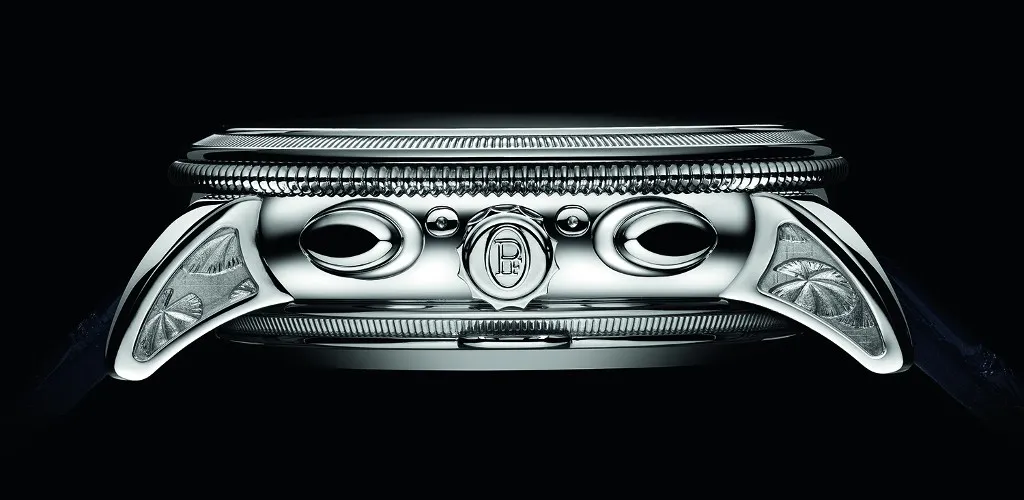
Jaquet's carving was not confined to the dial. Onto the flanks of the case, the three movement bridges and the loop of the buckle he worked half-relief water-lily leaves; and the hunter cover over the caseback he turned into a garden of repeating aquatic-plant motifs. Every centimetre of the metal was filled with the memory of water.
The Queen of Fire: Grand Feu Enamel
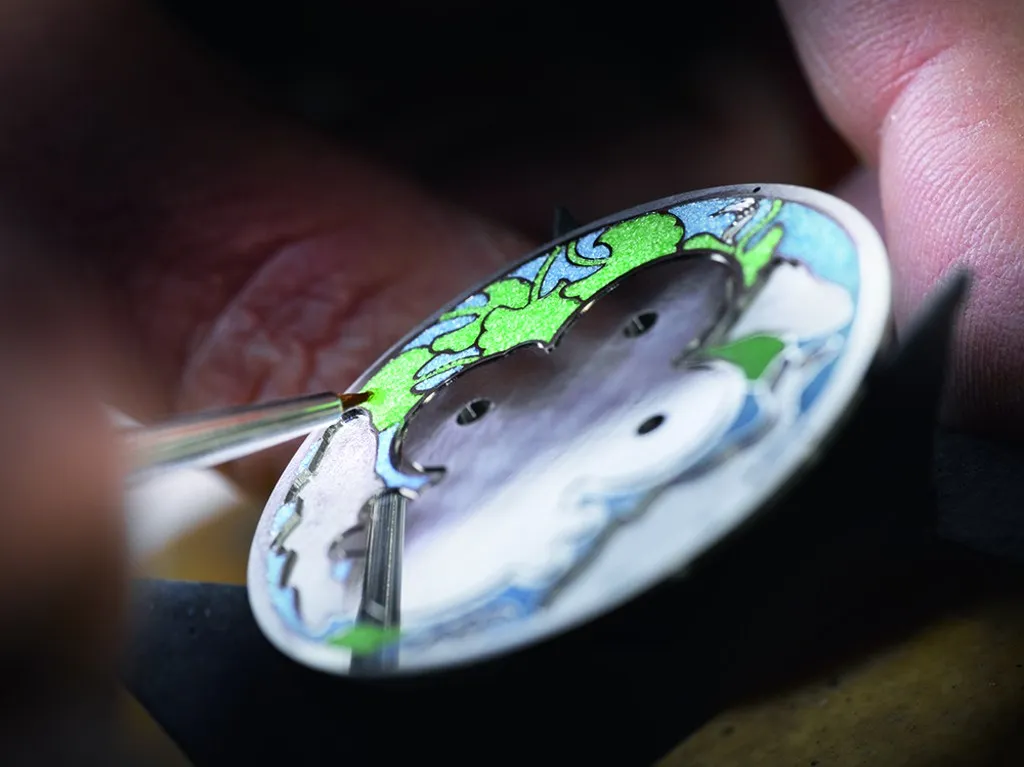
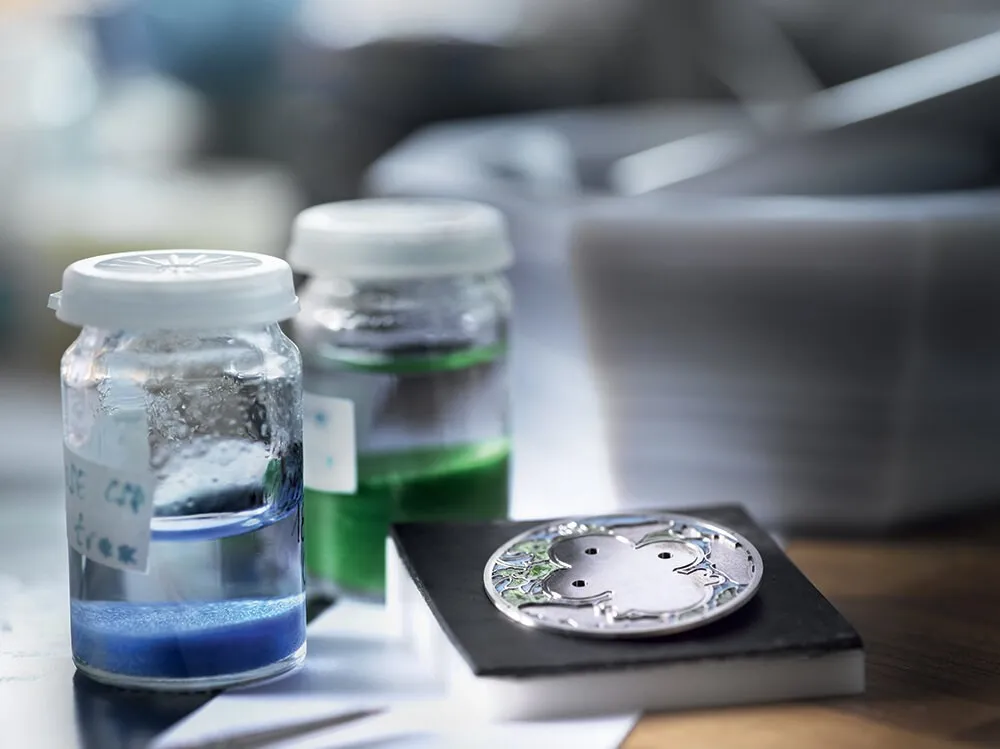
The second art, which gave the dial its colour and its light, was grand feu, great-fire enamel. This delicate and dangerous work was undertaken by one of Switzerland's most masterly ateliers, L'Officina de l'émail (Vanessa Lecci). Enamel is in truth nothing but coloured glass reduced to powder; its real secret lies in the relationship that glass strikes up with metal and with fire.
When enamel was laid into the champlevé basins Jaquet had engraved, two separate magics came into play. The translucent enamel spread over the engraved floor of the water revealed the pattern beneath exactly as it was; in this technique, called flinqué, the light rising from beneath the enamel gave the water a real depth and movement. The bodies of the carp, meanwhile, were coloured layer upon layer with a tiny brush, just like a miniature. And the secret of colour lies in chemistry: each colour is born of a different metal oxide; cobalt gives blue, copper gives green, and iron gives the tones of the earth.
A Gamble at Eight Hundred Degrees
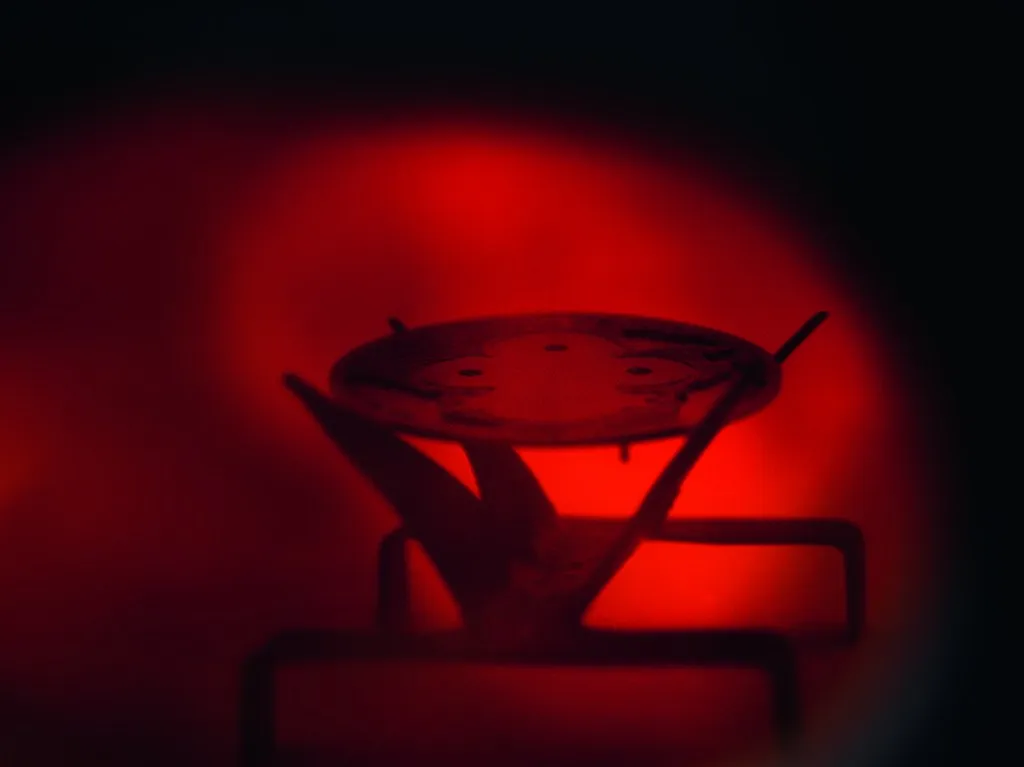
But laying the enamel is only the beginning of the work; the true trial is in the kiln. The dial is placed in a furnace of eight to nine hundred degrees, and that powdered glass melts into a brilliant, glassy surface. Because each colour fires at a different temperature, the process is repeated many times over; the most robust colours first, the most delicate last of all. Sometimes a single dial enters the fire dozens of times before it is complete.
And every firing revives the risk that months of labour will vanish in an instant: a single air bubble, a tiny deviation in temperature or an invisible crack can ruin everything. This is why grand feu enamel is the most courageous art in all of watchmaking; each time the master opens the kiln door is like watching the outcome of a wager.
The Giant Beneath the Pond: The PF352 Caliber
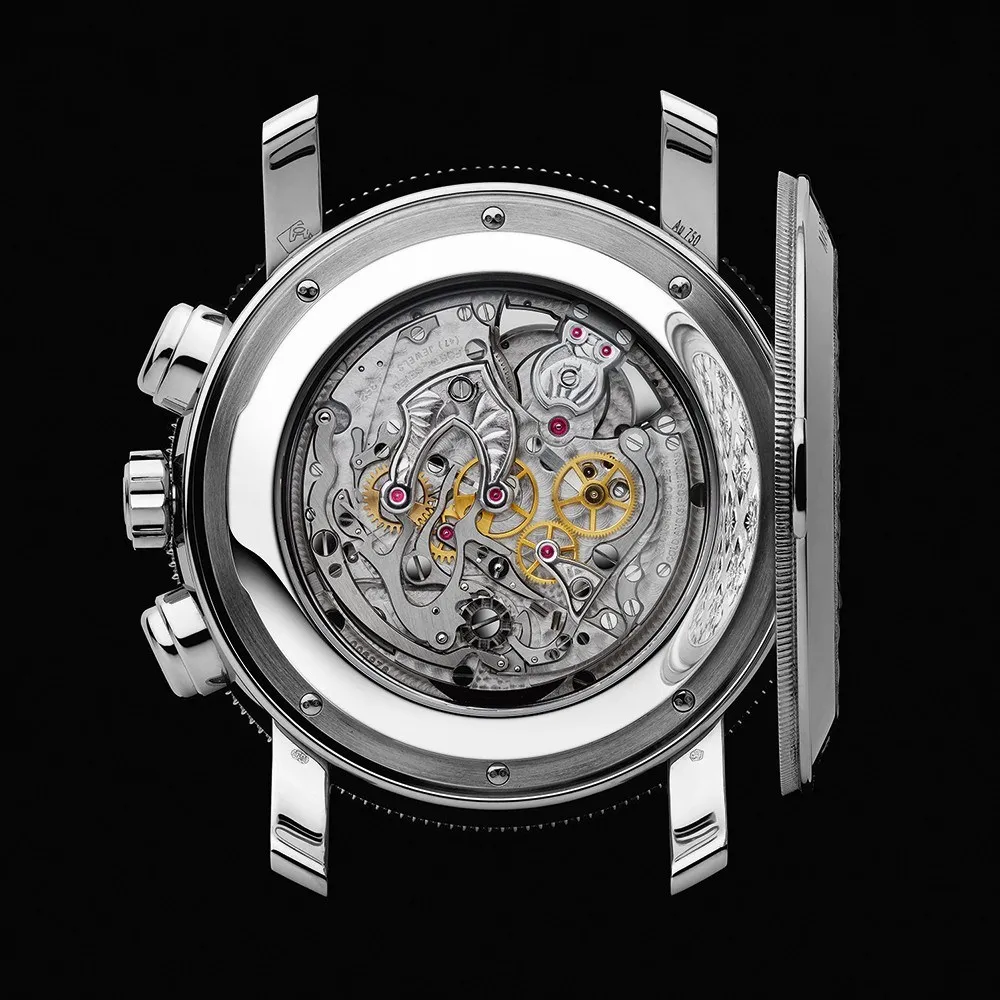
And beneath all this art beats an engineering monster. The hand-wound PF352 caliber brings together four grand complications in a single movement: a minute repeater, a tourbillon, a perpetual calendar and a chronograph. Made of five hundred and eighty-six components and forty-seven jewels, this movement beats at a rhythm of 3 hertz and holds a forty-hour power reserve.
The most elegant detail is hidden in the minute repeater. Most striking watches have a side slide to set the sound going; Parmigiani did away with that slide. To hear time struck in chimes on this watch, you need only turn the knurled bezel of the Toric a quarter turn clockwise. Thus the watch's most technical function merges with the most elegant part of its design. This entire universe is fitted within a 46.7 millimetre case of 18-carat white gold.
Modèle Unique: One and Only
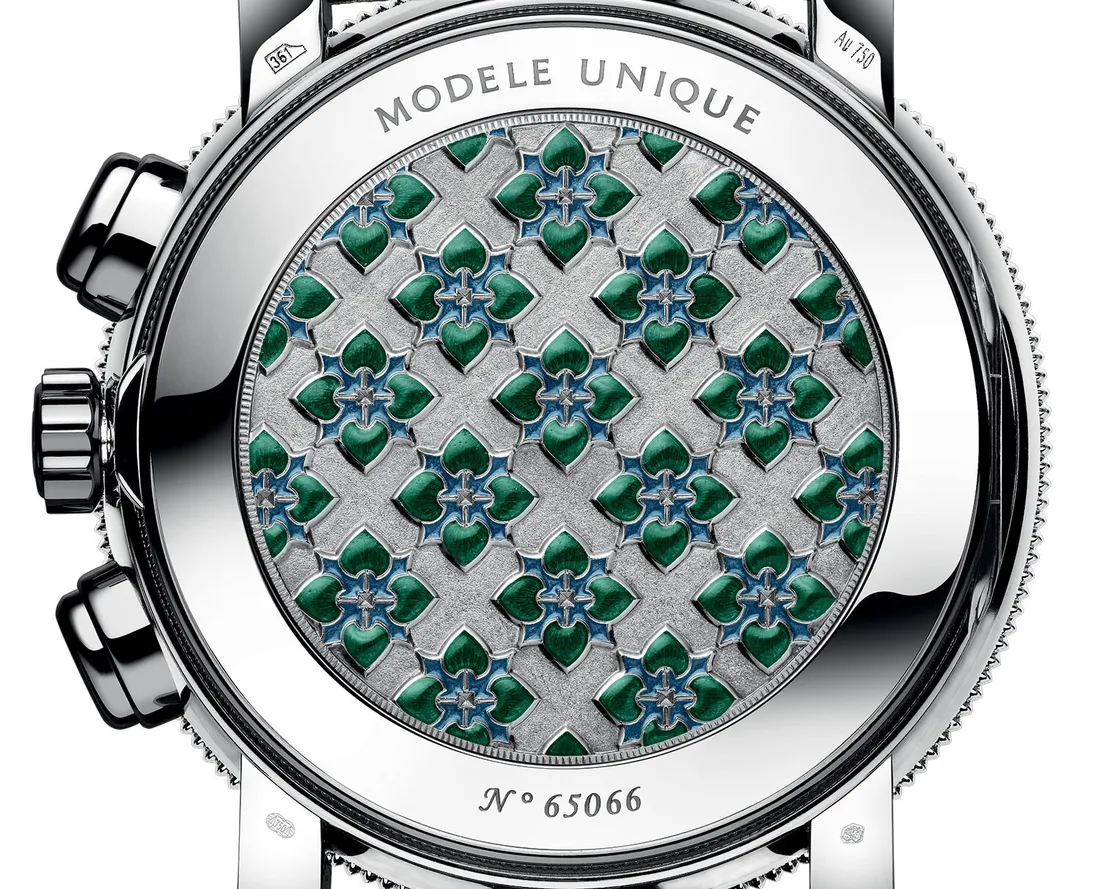
When you turn the watch over, you see that the art continues on the reverse. The hunter cover Jaquet engraved is adorned with a lattice woven of green and blue cabochon enamel drops; upon it are written two words: Modèle Unique. And beneath them, a number: N° 65066. This watch is one of one in the world; it has no equal, and never will.
The Memory of Water
In the early twentieth century, a boy watched carp on the shore of a lake. That boy grew up and cast those carp in bronze; and half a century later, four masters imprisoned his dream once more within gold, enamel and fire.
The Parmigiani Toric Tecnica Les Carpes de Sandoz is not a watch worn on the wrist but the art of stopping a fleeting moment. As the carp on its dial go on swimming forever and the tourbillon goes on turning forever, you are in truth beholding the beauty that Édouard Marcel Sandoz saw on the shore of that lake. The water flows on, but its memory remains, forever, within the gold.