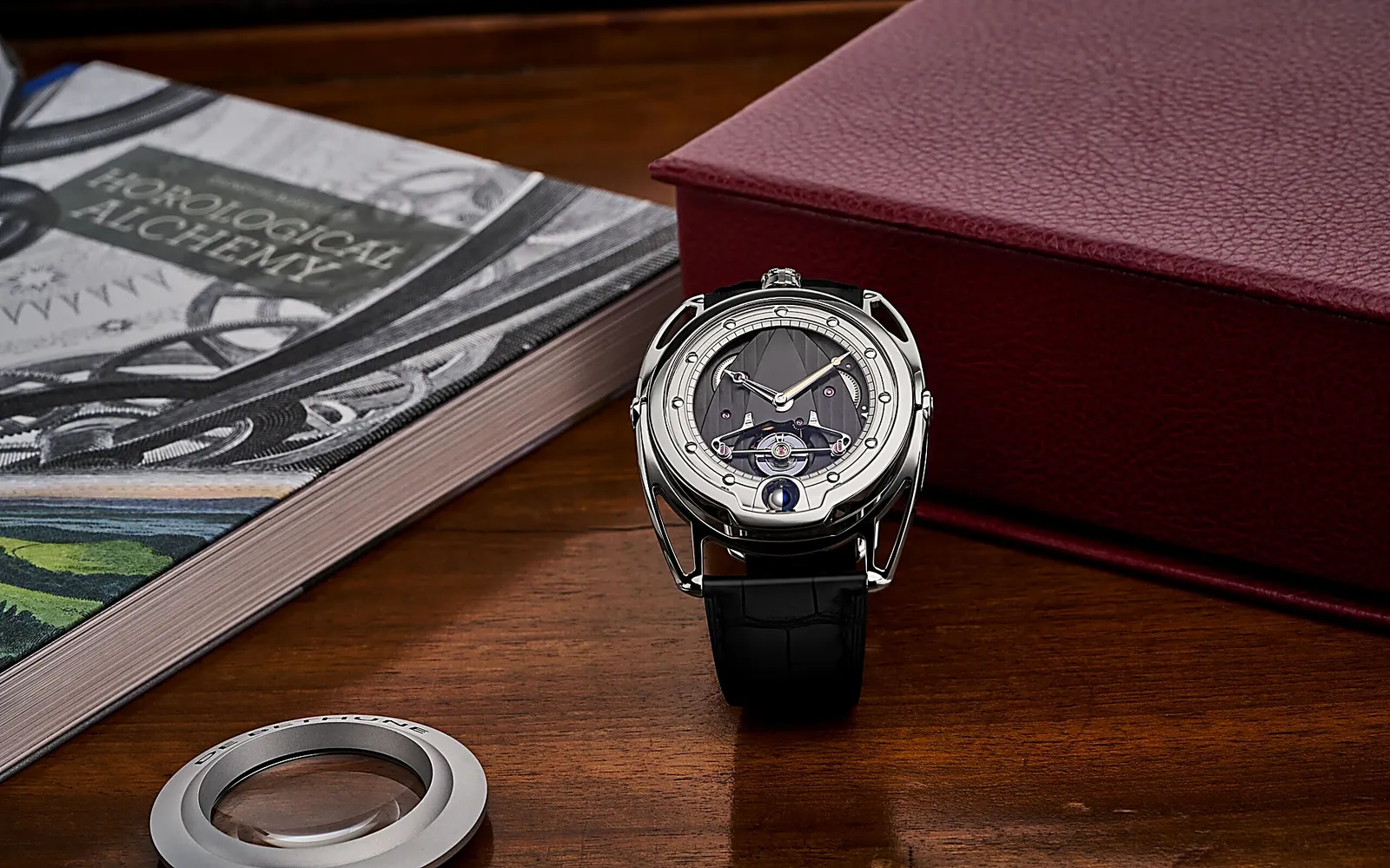
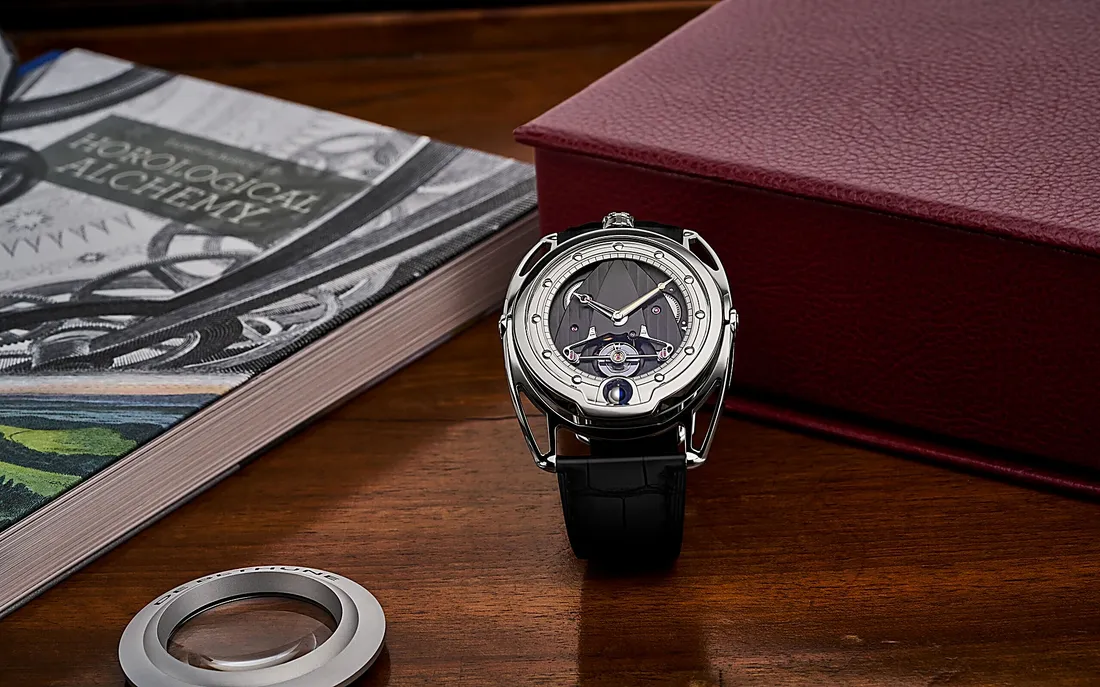
In Geneva, on the evening of 19 November 2011, the Aiguille d’Or, the highest award of the Grand Prix d’Horlogerie de Genève, went to this watch. It was not new that night; the first DB28 had been presented a year earlier, in 2010. The prize did not create it, it merely noticed it. That is usually how a good watch and a prize are related: the prize is not a beginning but a confirmation.
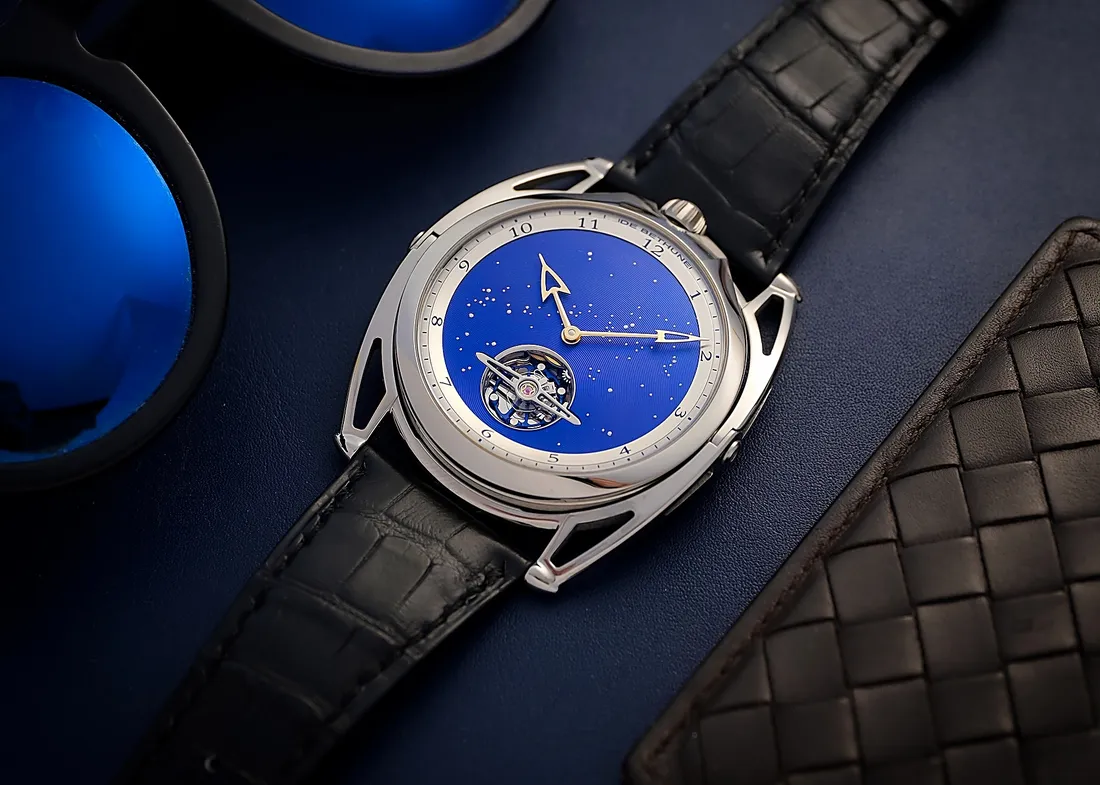
There is no race of complications at the centre of this watch. The dial carries no calendar, no chime, no chronograph. Low down, at six o’clock, sits a small sphere divided between silver and deep blue. It shows humanity’s first clock, the moon.
The moon is the first thing people learned to count in the sky. The sun gives the day and the stars give direction, but the phases of the moon set out a calendar that even a shepherd who could not read was able to check by stepping outside and looking up once. Farming, sailing, harvest and migration all ran on that calendar for a very long time.
And the hardest thing about so useful a measure is this: the moon does not move in the whole numbers people would like.
format_quote"The moon was our first clock. It has never once moved in the whole numbers we would have preferred."
Hasan Bekmezci
The interval between two full moons is called the synodic month, and it lasts 29.530589 days. Roughly twenty-nine and a half, and that word “roughly” is what sets the whole problem. The classic solution has been the same for two centuries: a wheel with fifty-nine teeth, advanced one tooth a day, completes two lunar cycles in fifty-nine days. One cycle therefore takes exactly twenty-nine and a half days.
The gap looks small. Each cycle accumulates 0.030589 of a day, about forty-four minutes. After thirty-three cycles that error reaches a full day, so your watch falls one day behind the sky within two years and eight months. Owners correct it by hand and nobody is surprised.
De Bethune built the calculation from somewhere else entirely. The spherical moon mechanism the house patented in 2004 follows the true synodic month so closely that a full day of error takes a hundred and twenty-two years to accumulate. The figure is worth opening up. A hundred and twenty-two years is roughly one thousand five hundred and nine lunar cycles. Divide one day of total error by that, and the error gathered in each cycle turns out to be under a minute. What is forty-four minutes on the classic wheel becomes fifty-seven seconds here.
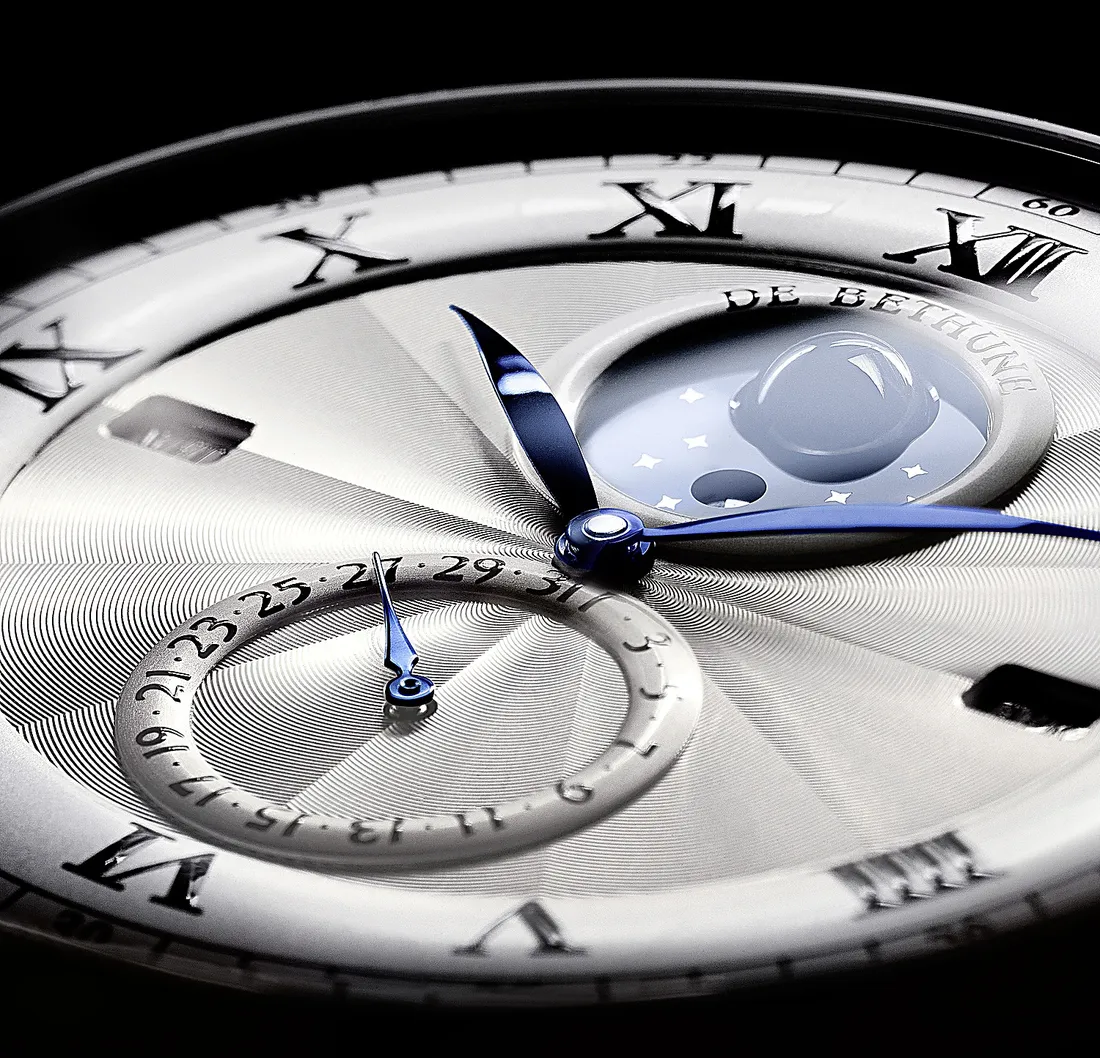
More interesting than the figure is how De Bethune shows the moon. A conventional moon phase is a disc. Two moons are painted on it, the disc turns beneath the dial, and it is seen through an aperture cut in the shape of a half moon. What you are looking at, then, is not a picture of the moon but as much of it as a window allows. The edge of the crescent is the edge of the window: sharp, exact, and not a line that exists in the real sky.
De Bethune threw away the disc and put a sphere in its place. Half of it is palladium, half blued steel. As the sphere turns on its axis, the boundary between the dark half and the lit half travels slowly across the dial. That is precisely what happens overhead. The moon is not a disc but a sphere lit from one side, and what we call the crescent is the shadow boundary on that sphere. Astronomers call this boundary the terminator, and the real terminator is not sharp but soft. A spherical display can imitate that softness. A disc behind a window cannot.
format_quote"A disc shows you a picture of the moon. A sphere imitates the moon itself. The difference lies in where the shadow comes from."
Hasan Bekmezci
Picture two people making that sphere: the turner who cuts and balances it, and the craftsman who colours its blue half in the furnace.
The colourist wants the easy version. Give me the sphere finished, and I will get the blue right.
The turner objects. Blue on steel is an oxide layer formed by heat; as the temperature climbs, the colour walks from straw yellow through purple into deep blue. Metal expands while it is heated and contracts as it cools. On a sphere that means a change in diameter measured in hundredths. If I hand you the sphere at its final size, it will be out of size when it leaves your furnace, and it will rub in its housing.
So what do we do, the colourist asks.
Colour first, size second, the turner answers. I leave the sphere slightly oversized, you make the blue, and I come down to the final measurement afterwards. But then the last cut has to be fine enough not to scrape the colour away.
That argument alone explains why a moon phase is expensive. Nothing here is mere decoration; heat, expansion, balance and tolerance all meet in one small component. The sphere also has to turn in balance on its own axis, because an unbalanced sphere loads the mechanism with its own weight.
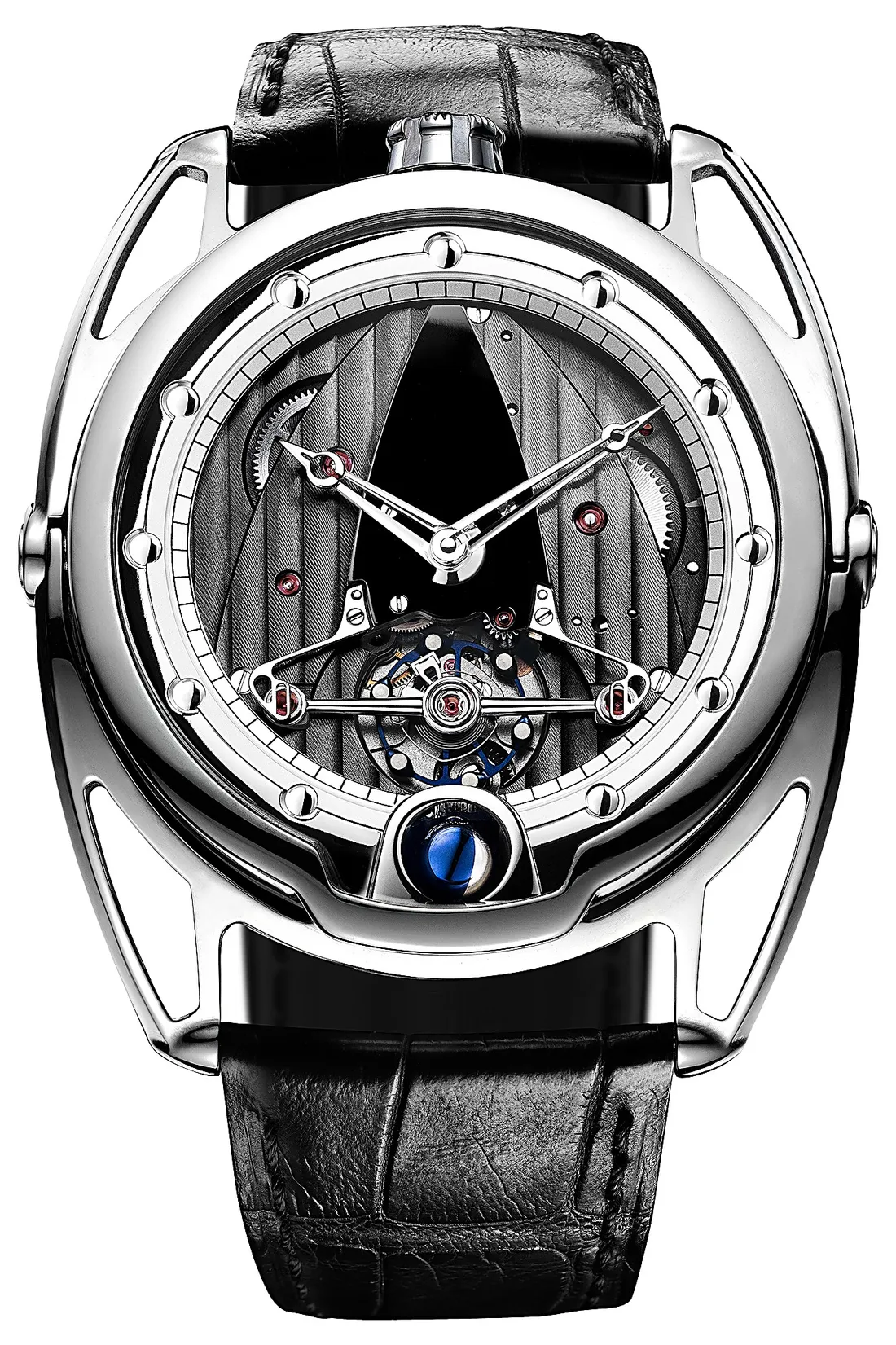
The case is titanium and forty-two point six millimetres across. Titanium has a density of about four and a half grams per cubic centimetre, against nearly eight for steel. A case of the same volume therefore falls to roughly half the weight. That sounds like a detail of comfort, yet it bears directly on the mechanics: a light case on the wrist passes less inertial load into the movement during a sudden movement.
The crown sits at twelve o’clock. That is where the bow of a pocket watch used to be, and De Bethune has deliberately carried it there. The flanks of the case stay clean as a result, and the crown does not press into the wrist bone beneath it.
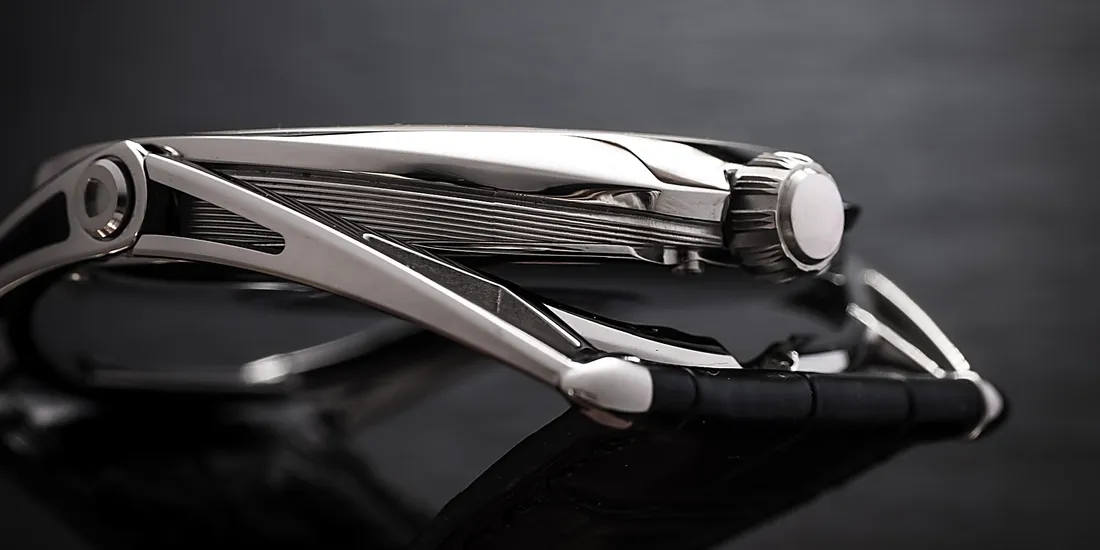
The real detail is in the lugs. On a conventional watch the lugs are two fixed horns growing out of the case, and they decide the angle at which the strap drops onto the wrist. If the wrist is thin or thick, that angle is wrong, and the watch presses on a single point. Rather than fix those horns to the case, De Bethune made them move, and patented the result. The floating lugs adjust themselves to the curve of the wrist, the contact area grows and the pressure spreads.
The physics is simple here, but the consequence is not. Pressure is force divided by the area it acts on. Spread the same weight over twice the surface and the pressure the wrist feels is halved. That is exactly what the floating lugs do.
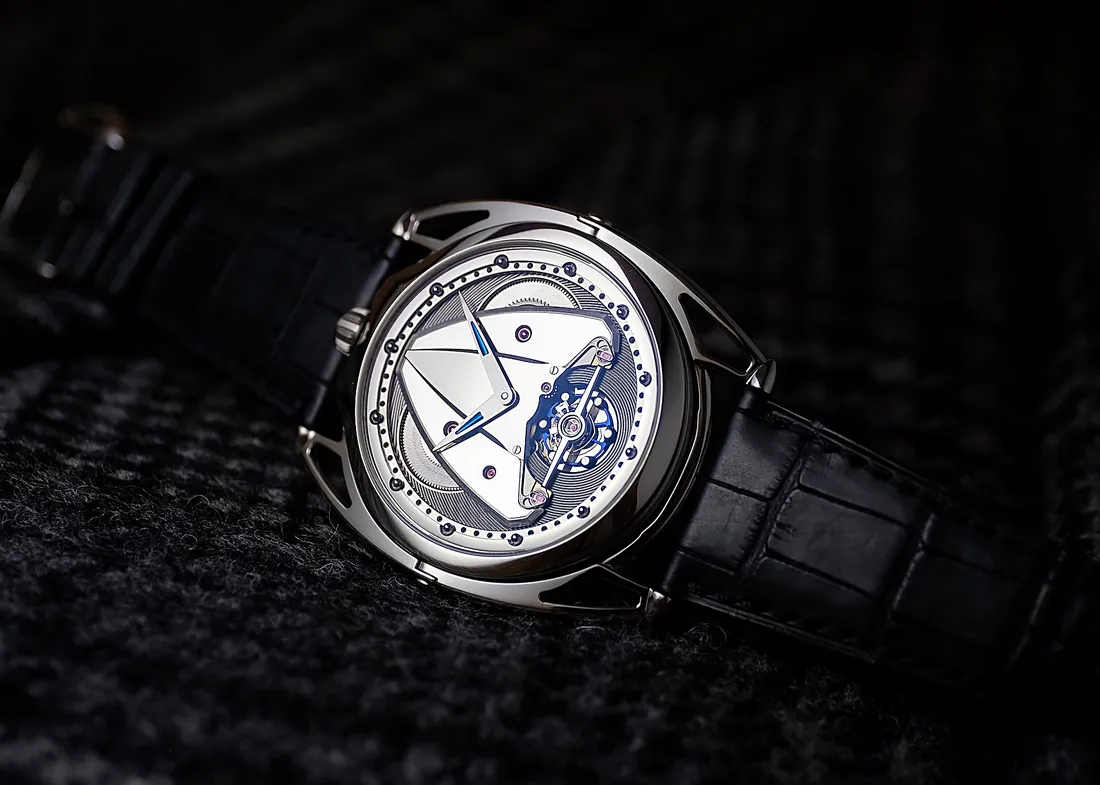
The same logic continues inside. The mainplate is shaped like a delta and counts as one of the house signatures. Its surface is polished until it returns the light of the room unchanged, a process that can take up to three hours on a single component. Polish is not decoration here but a measuring instrument: a surface that is not genuinely flat will never become a mirror, it will ripple. The mirror image is the proof of the flatness.
Power comes from twin barrels and the watch runs for six days. Those six days were not obtained simply by making the mainspring bigger. De Bethune reduced friction and energy loss through its work on the balance spring, and lifted the reserve by twenty percent.
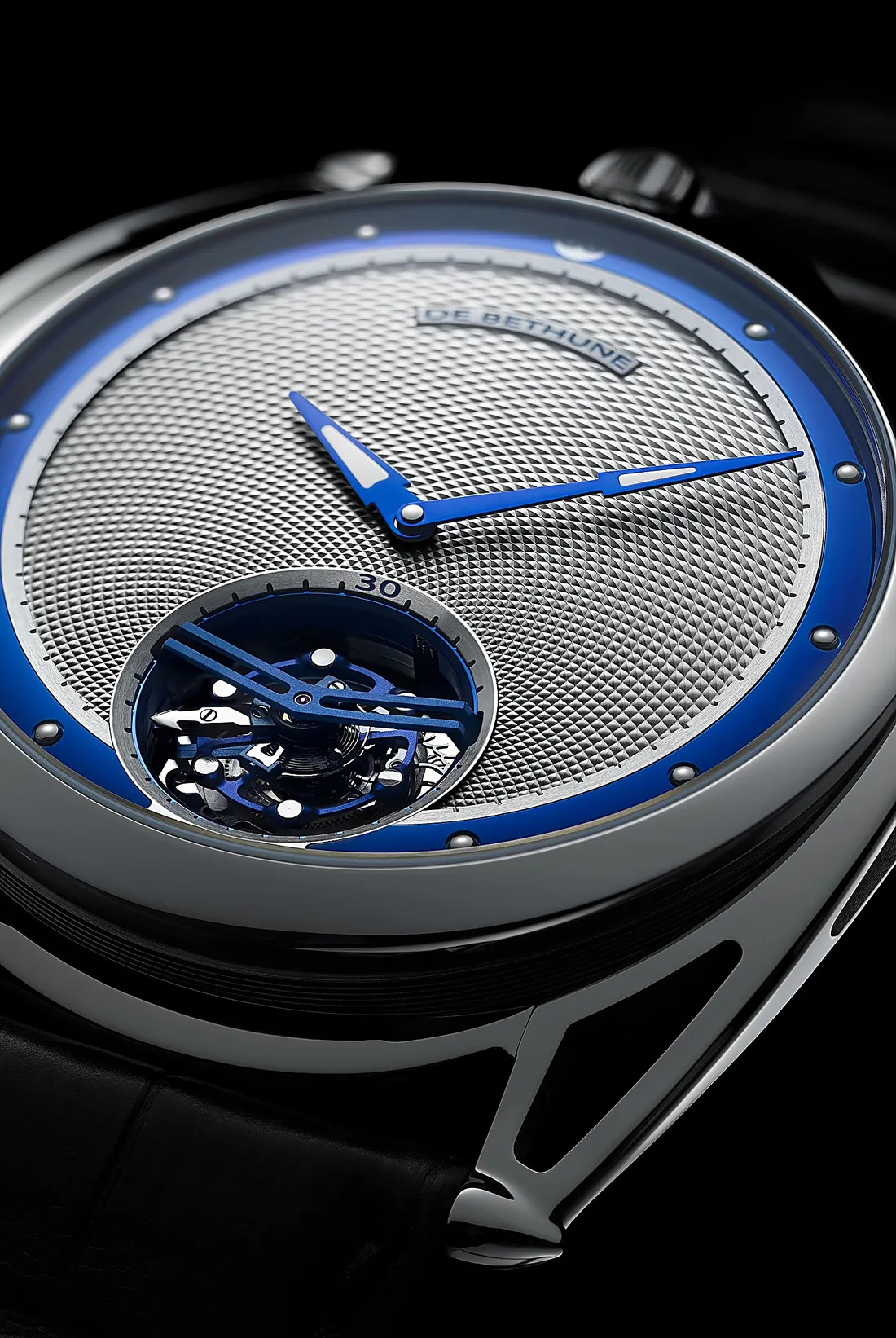
The balance wheel is made of titanium, with small white gold weights seated on its outer rim. That placement is not an accident. A body’s resistance to being turned, its moment of inertia, depends on its mass and on the square of that mass’s distance from the axis. Put the weight at the centre and you gain almost nothing; carry the same weight out to the rim and its effect multiplies. A light body with small weights on the outside therefore delivers both low total mass and high inertia. A balance with high inertia cares less about shocks arriving from outside.
The balance spring is unconventional too. On a classic Breguet spring the final coil is raised so the spring can breathe from its centre, and the price of that is height. Instead of raising the final coil, De Bethune left it flat and attached it to the outside of the spring. The spring opens and closes while holding its centre, the movement stays low, the index can be adjusted more finely and no pins are needed. The shape of the curve also behaves like a cushion under impact. Because the internal structure of the material is never strained, the spring is not damaged by its own tension.
The watch has a third defence against shock. De Bethune was the first to hold the balance bridge symmetrically from both sides rather than from one, so the balance axis is supported at each end. On top of that, a shock absorber has been added at each end of the bridge, and the balance already carries its own. Because three absorbers work together, the arrangement is called the triple pare-chute. The absorbers work with springs instead of screws, and the springs sit on polished axes, so instead of a hard contact there is a soft return.
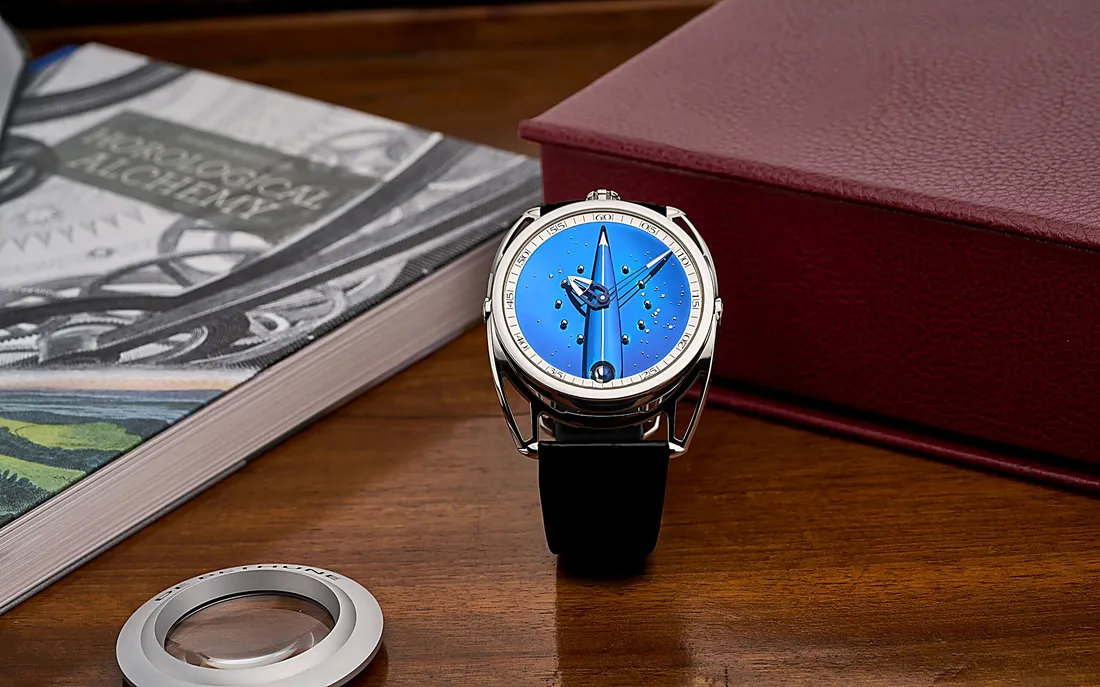
One name stands behind all of this: Denis Flageollet. As founder and master watchmaker of the house he designed every layer of the DB28 himself. Everything is produced in the maison’s own workshop, and since its founding the house has developed thirty-one calibres.
The DB28 therefore means more than a collection piece. When a watch house changes a design so little across a decade, that is proof the design was right from the start. Set today’s DB28 beside the first example from 2010 and the difference is hard to find.
format_quote"If a craftsman’s error comes to one day in a hundred and twenty-two years, what he is really saying is this: I did not set the measure, I only copied it."
Hasan Bekmezci
Look at this watch for long enough and a thought arrives. A watchmaker building a moon phase is not inventing anything. He is measuring an order already running overhead, counting it, and trying to copy it as faithfully as he can. Twenty-nine days, twelve hours, forty-four minutes and three seconds: nobody chose that number, nobody voted on it, nobody can alter it. The only thing a person can do is come closer to it.
Because the measure itself is not in human hands, the entire seriousness of watchmaking gathers in that effort to come closer. Going from forty-four minutes to fifty-seven seconds is a great labour, and it is still not zero. What you carry on your wrist is the nearest point the human hand has reached; the hand that set the order behind it belongs to someone else. That humility is what makes the DB28 beautiful. It does not put itself in the place of the sky. It watches the sky, carefully.