The last visitor had gone and the gallery held nothing but the white rings the ceiling spots threw on the floor. In the middle of the room stood a magenta balloon dog two and a half metres tall.
The art historian stopped in front of it and looked at the surface. She saw herself reduced, gently bent, and standing inside the whole room at once.
The materials scientist beside her put his hands in his pockets. Do you know why this thing works so well, he asked.
I have an art history answer, she said. I assume there is a physics answer too.
There are both, he said, but mine is shorter. What you are looking at is a convex mirror. A convex mirror compresses the entire hemisphere in front of it into one small image. So the flank of this dog does not hold only you. It holds the room, the doorway behind you, the lamps overhead and anyone who happens to walk in. A flat mirror shows you yourself. A convex mirror shows you yourself together with the place you are standing in.
She nodded slowly. That, she said, is the sentence an artist has spent thirty years trying to say in words.
The artist is Jeff Koons, and his story begins on a trading floor rather than in a studio. In the early 1980s he worked as a commodities broker in New York, watching the price of cotton and metals by day and making his own work at night. He never had to be taught how art behaves around money and advertising. He learned it by standing inside that machinery.
His first serious body of work placed brand new vacuum cleaners, never unboxed, inside sealed acrylic vitrines lit by fluorescent tubes. The object was new, unused, and would never be used. A machine built to do one job was forbidden from doing it, and because of that it would never wear out. By putting an appliance behind glass, Koons had granted it immortality.
The idea has a long pedigree. When Marcel Duchamp submitted a piece of factory plumbing to an exhibition in 1917, he proposed that art might be something the mind selects rather than something the hand makes. Forty years later a group of young British artists and architects asked the same question through consumer culture. Richard Hamilton’s small 1956 collage of magazine cuttings showed that every object inside a modern home is simultaneously an advertisement and a desire. The adjectives he used a year later to describe popular art still hold: transient, low cost, mass produced, young, witty and glamorous.
In America the movement turned colder and harder. Andy Warhol painted a soup can and demonstrated how an image becomes meaningless through repetition and, at exactly that moment, becomes an icon. Roy Lichtenstein enlarged the printing dots of a comic strip. Claes Oldenburg built hard objects out of soft cloth.
Koons arrived a generation after all of them. The artists before him looked at mass culture with a measured irony. Koons removed the distance.
The historian walked slowly around the sculpture as she spoke.
His entire body of work rests on one word, she said, and the word is acceptance. He does not want anyone to feel ashamed of what they love. Not of the toy they were given as a child, not of a birthday party, not of a cheap ornament or a cartoon. In his reading, shame begins when a person rejects their own past, and a person who rejects their own past cannot respect anybody else’s.
That is why the surfaces are mirrors. A mirror does not judge. Whoever steps in front of it is handed straight back. Koons has said many times that the surface tells the viewer a single thing: you are here, and you exist right now.
The scientist laughed. Your philosophy has a threshold value, he said. For a surface to behave as a mirror, its roughness must be smaller than about a tenth of the wavelength of the light falling on it. Visible light runs from four hundred to seven hundred nanometres. So every bump on this sculpture has been brought below fifty nanometres, roughly one two thousandth of the width of a human hair. Reaching that means sanding and polishing every square centimetre by hand. In his studio the surface work on a single sculpture can run for years.
She stopped walking. So producing the appearance of a balloon requires steel polished for years, she said.
It does, he answered. That is rather the whole point.
format_quote"A convex mirror does not show you yourself alone. It shows you together with the entire room you are standing in. All of Koons sits inside that one optical detail."
Hasan Bekmezci
The scientist leaned against the plinth and pulled the conversation back into his own field.
Let me tell you about the real object, he said. The actual balloon. There is nothing inside a balloon but air. What holds it up is the fact that the pressure inside is higher than the pressure outside. The rubber membrane stretches, resists as it stretches, and the instant those two forces balance, the balloon finds its shape. A balloon is a pressure vessel.
And when a clown twists one into a dog, what has he actually done? He has not divided the air. He has created compartments. Every twist isolates a pocket of the interior, and each pocket becomes a pressure vessel of its own. Squeeze one ear and the other does not swell. The compartments are what hold the form.
But the form is temporary, she said.
Unavoidably so, he said. Rubber is a porous polymer network and helium is the second smallest atom there is. It leaks straight through the mesh, and being light it also moves quickly; at the same temperature it escapes roughly two and a half times faster than a nitrogen molecule. That is why a party balloon is off the ceiling by morning. Metallised film balloons last far longer because the aluminium layer closes the paths an atom could take, but they deflate too. The life of a balloon is measured by the speed at which its breath escapes.
She turned back to the sculpture. Which is exactly why he cast it in steel, she said. To make a breath permanent you first have to take the breath out.
Koons made this shape inside a large body of work he began in the mid 1990s and called Celebration. It contained balloon dogs and balloon rabbits, an enormous heart, an egg and a bunch of tulips. What united them was the promotion of cheap objects from a birthday table to the scale of a monument.
Five large balloon dogs were made, and each was finished in a different colour: blue, magenta, orange, yellow and red. No two are alike, so an object that looks like mass production was in fact governed by the rules of singularity. In November 2013 the orange one sold at auction for more than fifty eight million dollars, the highest sum then paid for a work by a living artist. Six years later a stainless steel rabbit by the same hand passed even that figure.
Those numbers describe a market more than they describe an artwork, and they conceal something. More than a hundred people work in the Koons studio, and their job is not to invent ideas but to produce surfaces. Moulding, casting, erasing every weld, laying transparent colour over steel and finishing the polish can take years. The joke on the outside of the object is light. Nothing about making it is light at all.
format_quote"There is nothing inside a balloon except a breath. Koons cast that breath in steel; Hublot has now reduced the same idea to forty two millimetres and fitted it with a mainspring."
Hasan Bekmezci
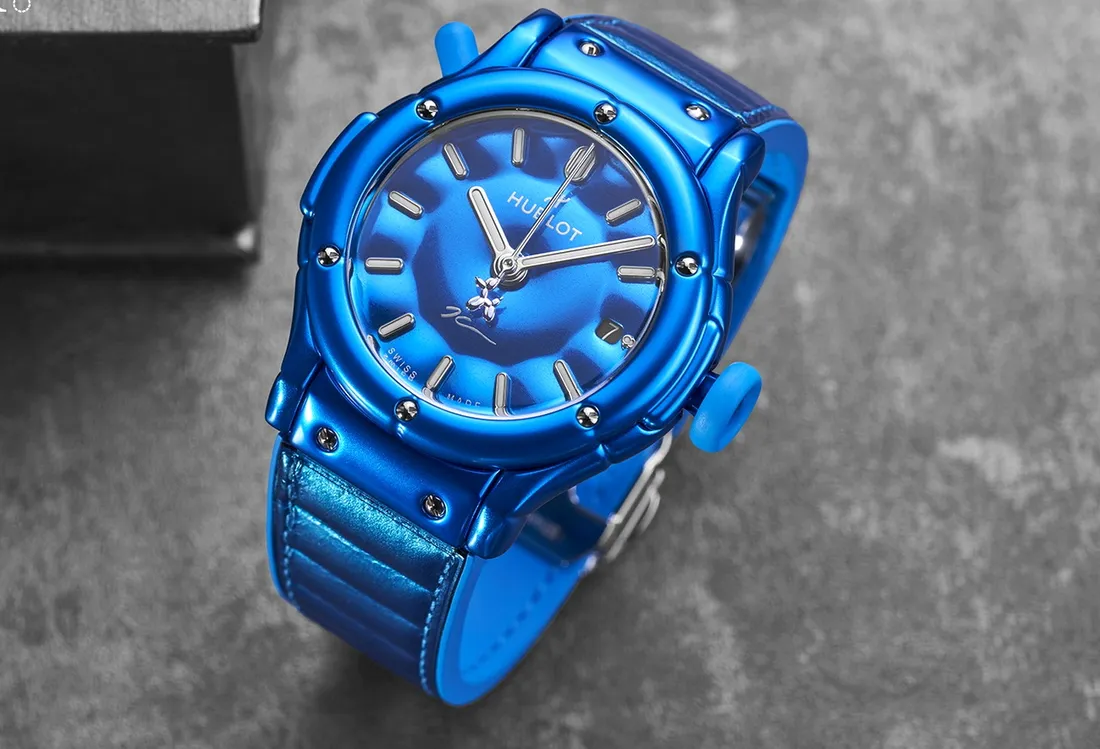
On the way out they stopped at a vitrine near the door, where the same idea sat at the scale of a wrist.
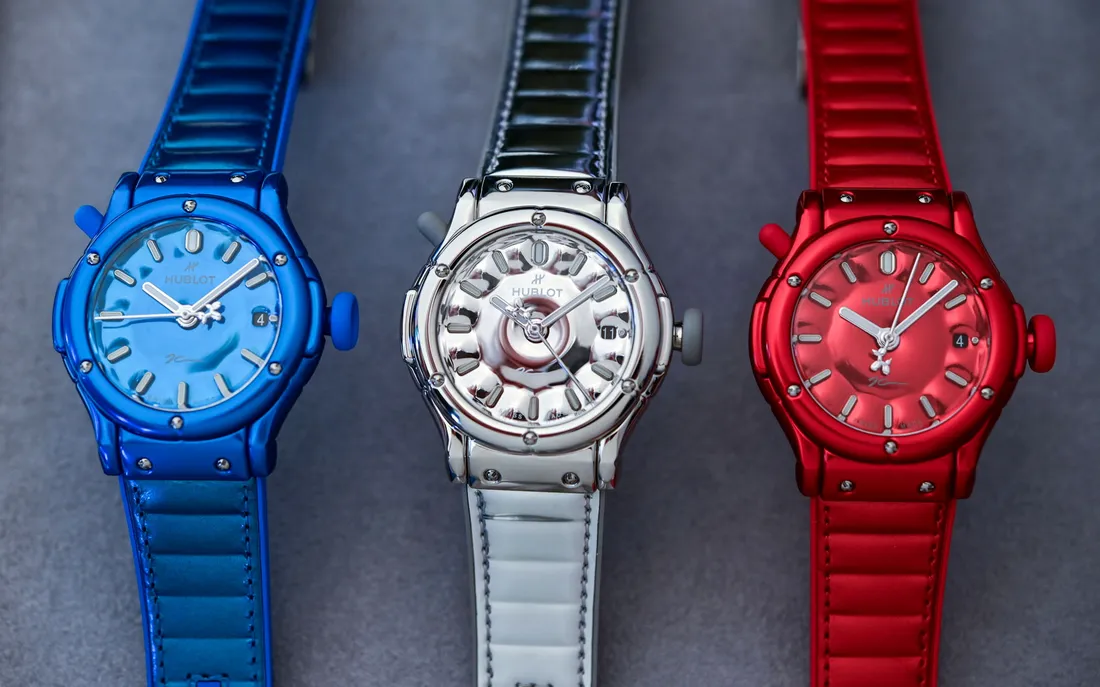
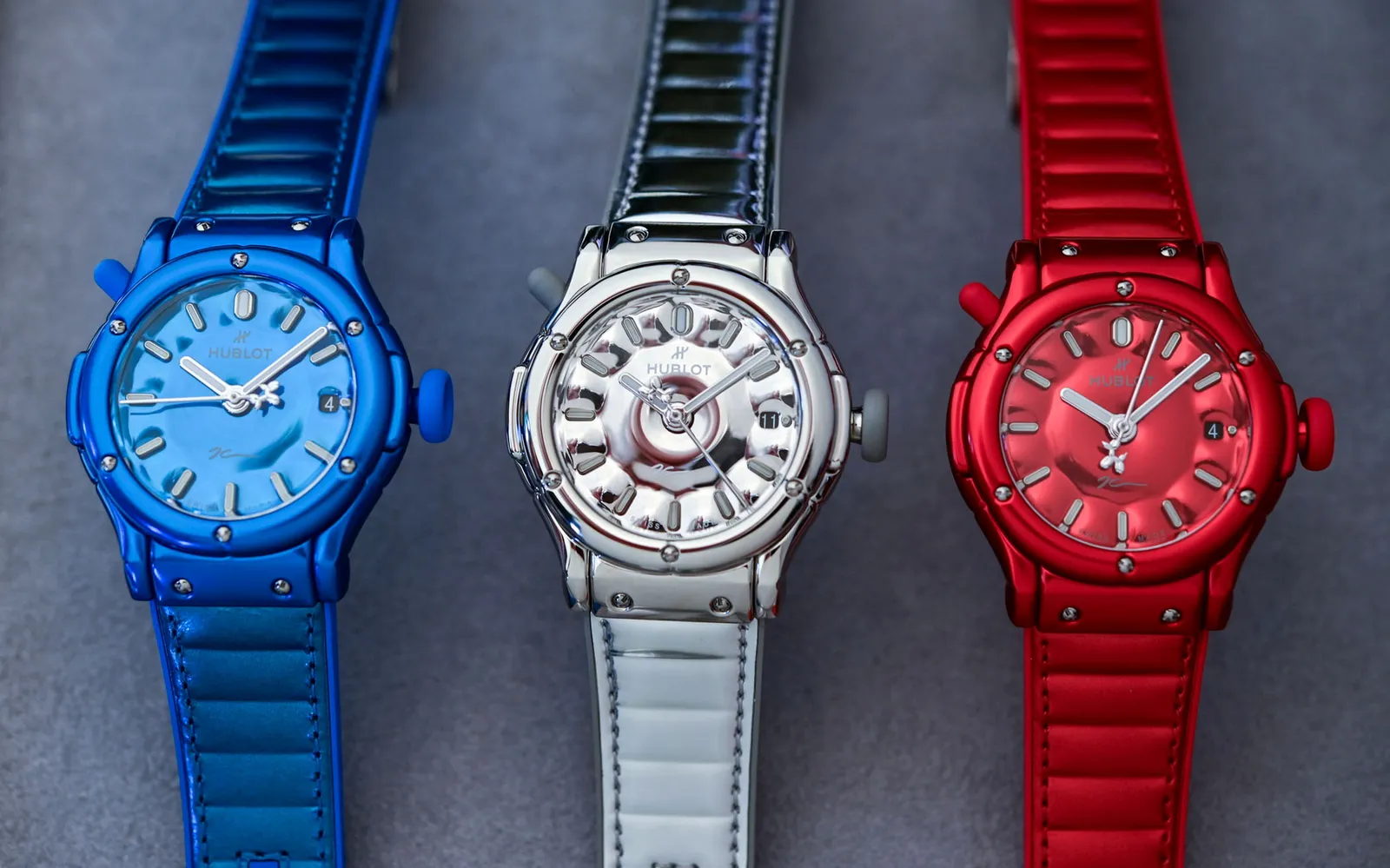
Hublot worked with the Koons studio for roughly two years to build it, eighteen months of that in intensive development. The artist’s own three dimensional design team sat with the brand’s engineers throughout, testing proportions and volumes. What came out is not a printed dial or a signature on a caseback. The case itself has been redrawn.
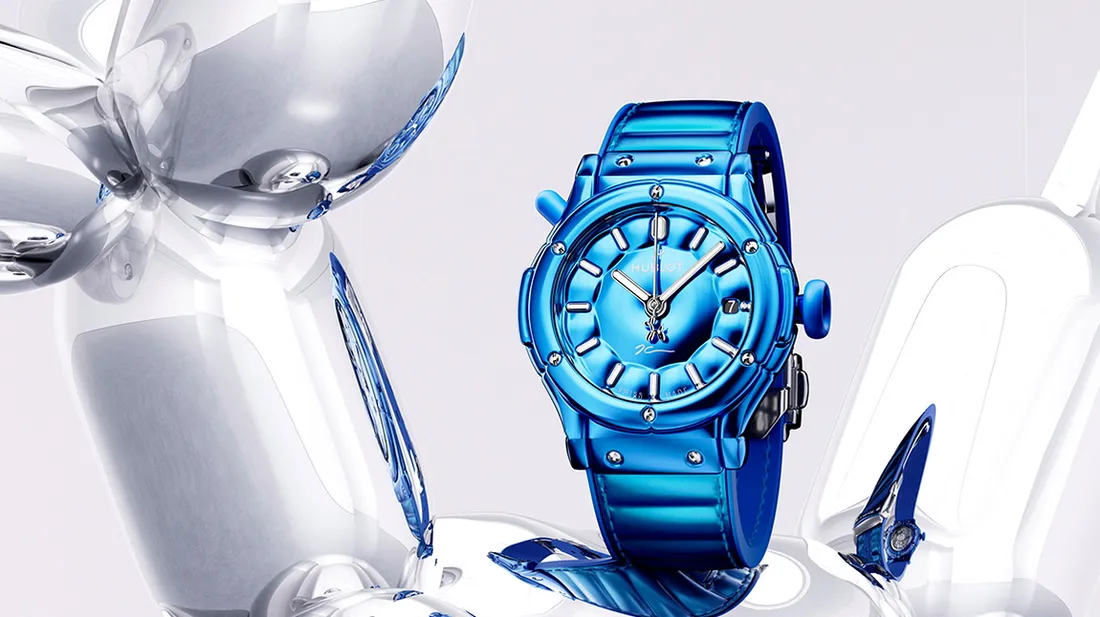
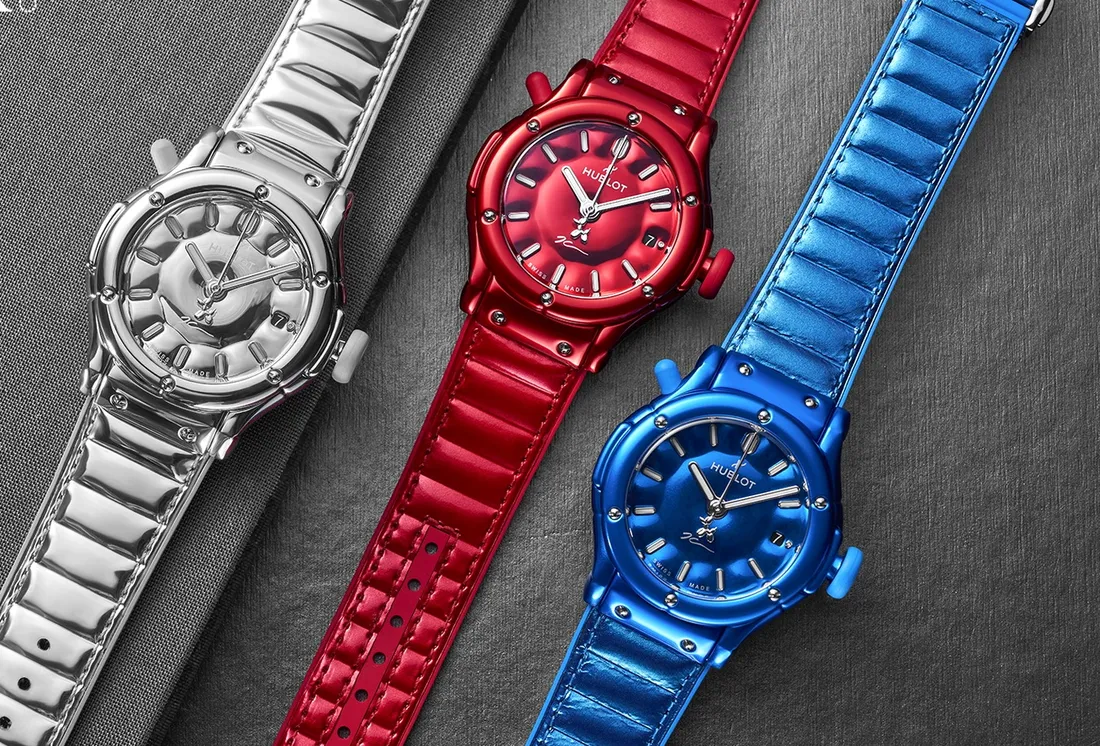
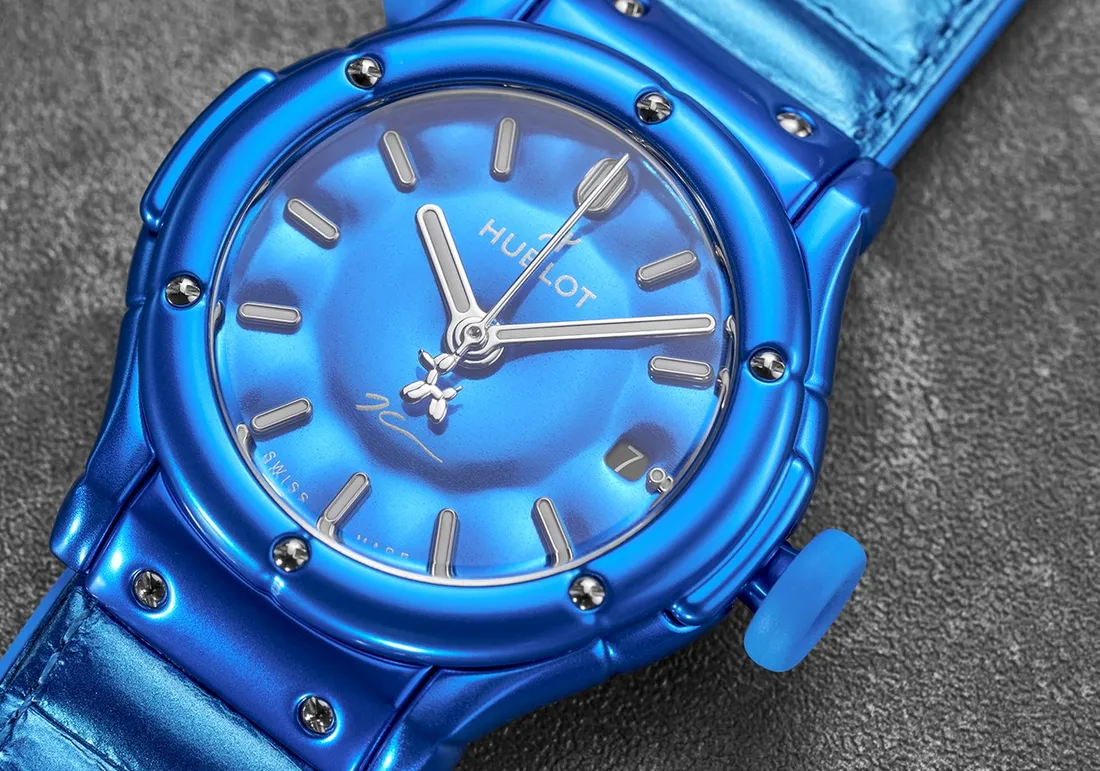
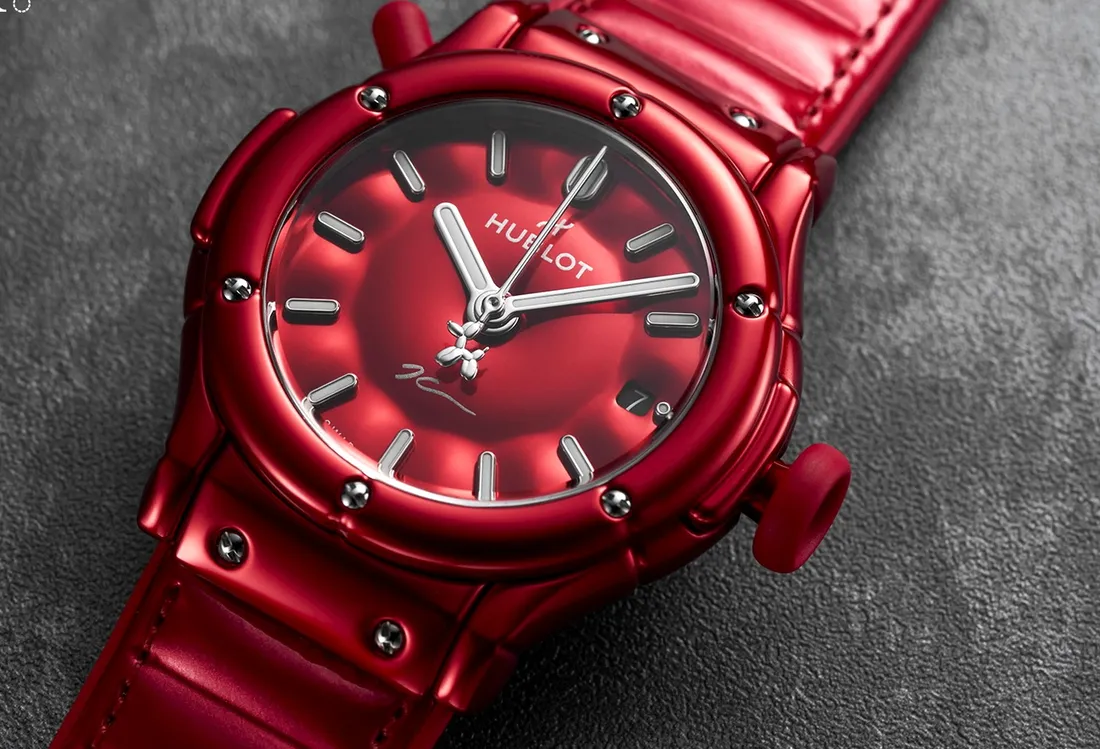
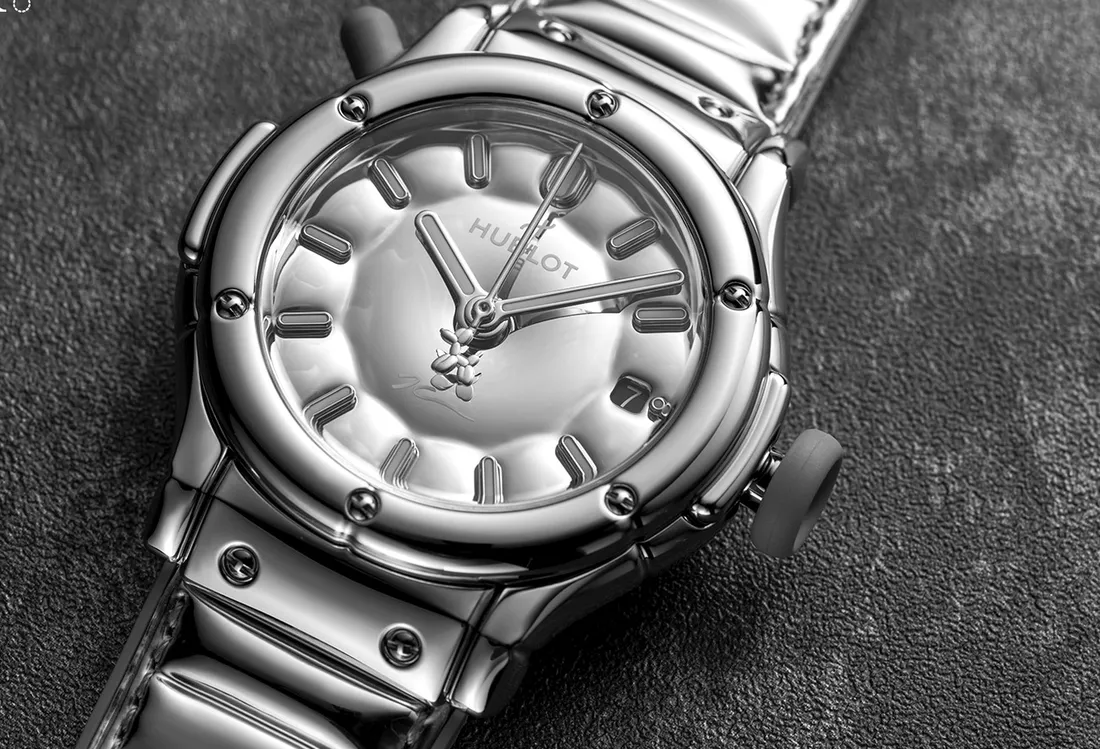
It measures forty two millimetres across and eleven millimetres deep, and it is machined from anodised aluminium. The flanks carry creases that echo the wrinkled edges of a metallised balloon. The sharp angles of the standard Classic Fusion have been softened and every line pushed outward. Even the H shaped bolts that hold the bezel and the strap have been given domed, mirror polished heads, so that not one detail has been left uninflated.
The material is more than a look. Aluminium has a density of two point seven grams per cubic centimetre against roughly seven point eight for steel, so the object on the wrist weighs about a third of what an equivalent steel case would. The eye sees a sculpture and the wrist feels a balloon. Anodising is an electrochemical process that grows a porous oxide layer on the surface of the metal and traps the colour inside those pores. The colour is not painted on; it lives within the skin of the metal. That is why light seems to come from underneath rather than off the top.
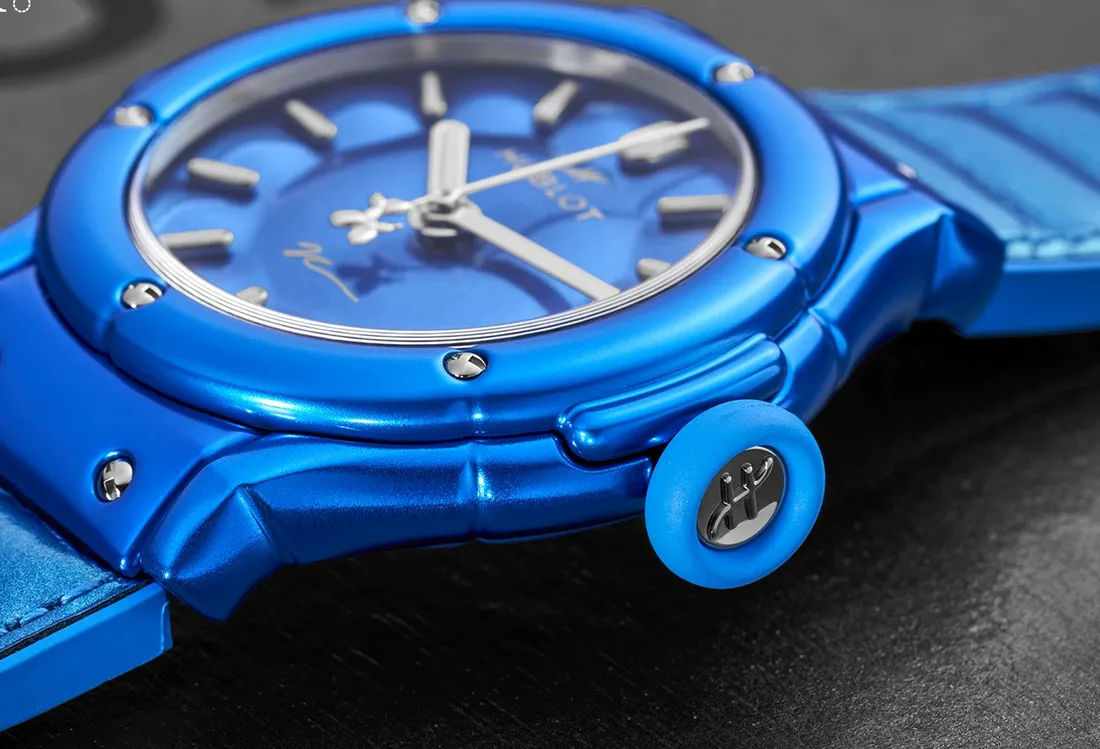
The crown is the most direct joke on the watch. It is unusually large and wrapped in soft touch rubber, so the finger meets the nose of the dog rather than a piece of metal. Winding the watch stops feeling like operating a mechanism.
At ten o’clock a second soft element emerges from the flank. This is the tail. It winds nothing, sets nothing and protects nothing. It simply exists, and it makes the useful point that what turns an object into a character is usually the detail with no function at all.
The dial follows the same logic. The surface looks pressurised from beneath, and the twelve applied markers sit on it as though pressing it down. The counterweight on the tail of the seconds hand has been cut into a miniature balloon dog, so the only fast moving element on the dial is the sculpture itself. A small date window in the lower half keeps a very playful object usable on an ordinary Tuesday.
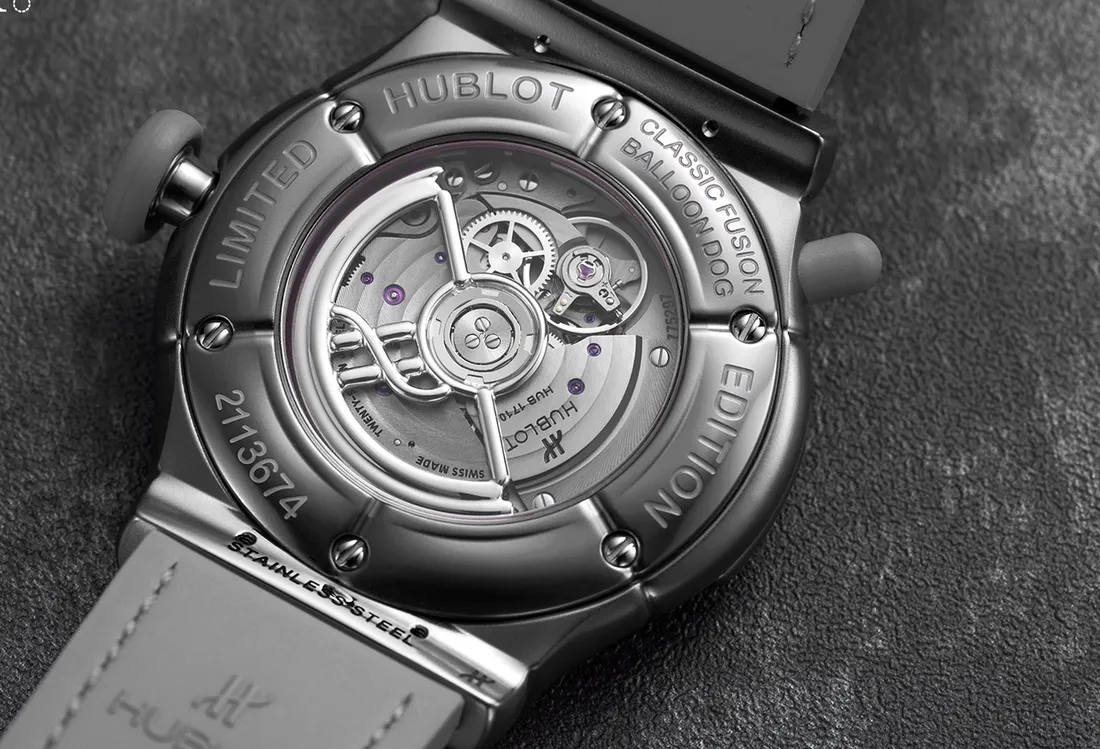
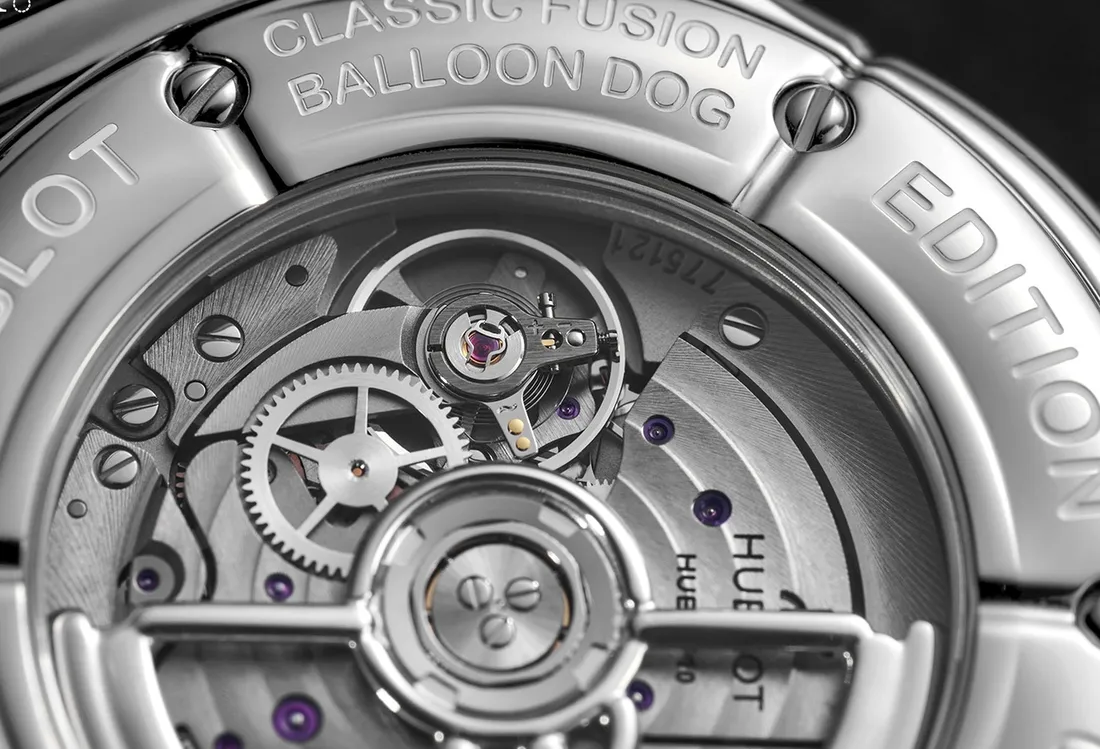
The engine is the HUB1710, Hublot’s treatment of the Zenith Elite architecture first drawn in the mid 1990s. Thirty years may sound old, but by the standards of this industry it is not; several of the most widely used automatic calibres in Switzerland are considerably older.
What has kept the Elite alive is its thinness. The movement stands just three point seven millimetres tall, and that figure is the only reason an inflated dial and a display back fit inside an eleven millimetre case. The balance beats at four oscillations a second, a rate quick enough to shrug off most of the knocks a wrist delivers in a day, and the barrel holds fifty hours, so a watch taken off on Friday evening is still running on Sunday morning.
Through the sapphire back the whole movement appears under an anthracite coating that reaches as far as the balance wheel itself, reducing every surface to a single tone. The circular Côtes de Genève on the bridges are cut with machine precision. The automatic rotor repeats the argument of the case and the dial: it too has been swollen, and it carries the brand’s own logo in that inflated form. A house agreeing to distort its corporate graphics for an artist is the quietest possible proof that this collaboration did not stay on the surface.
format_quote"An object does not have to be serious for art to elevate it. Nothing looked at with enough attention stays ordinary."
Hasan Bekmezci
Three colours are offered, each limited to two hundred pieces. The rubber straps of the red and blue models are inlaid with metallic finish leather in the tone of the case, while the silver uses a polymer for the same effect. Water resistance is fifty metres, the crystal is sapphire, and the price outside Switzerland is around twenty five thousand one hundred dollars before tax.
Aluminium is not the toughest material for a wristwatch and an anodised surface will mark under careless use. There is precedent for the choice, however, and the finish can be reapplied at service. Anyone planning to wear the watch daily has a quiet argument for the silver version, since its coating sits closest in tone to the metal underneath and a scratch shows less.
The sum of it is this. Hublot did not take the easy road with this collaboration. Instead of printing an artist’s signature onto a dial, it carried that artist’s entire logic of production into the geometry of a case. The result is unmistakably a Hublot, and just as unmistakably a Koons.
Outside, the street was wet and the shop lights were breaking apart on the asphalt.
Let me ask you something, the scientist said. The entire meaning of a balloon is that it will deflate. If you make one out of a material that never deflates, have you not destroyed the meaning?
She walked a few steps before answering. You have done the opposite, she said. Nobody watches a balloon while it is going down. A balloon that refuses to deflate stops a person, and it sends them back to the real thing. That steel dog is not about itself. It is about the balloon you once held.
She looked at the watch on her wrist and went on. The small one does the same work. You carry a swollen aluminium case and it weighs almost nothing, and inside it a balance swings four times a second, counting out a life. The joke sits on the outside. The seriousness is sealed in.
So it laughs and it counts at the same time, he said.
Any good watch does, she answered. Reminding a person that time is passing with solemn sadness is easy. The difficult thing is to remind them of exactly the same fact and leave them cheerful. A balloon dog manages it, because its whole existence depends on accepting that nothing lasts. Knowing that our time has an end does not cheapen it. That is precisely where its value comes from.

Before they separated at the corner she said one last thing.
A clown twists that balloon in thirty seconds. A sculptor polishes the same shape for years. A watchmaker takes it down to forty two millimetres and fits fifty hours of breath inside. All three are doing the same job, which is giving a form to the air in their hands.
The only difference is how long the form holds. And none of us knows how long our own will hold. Perhaps that is why we smile at a balloon dog.