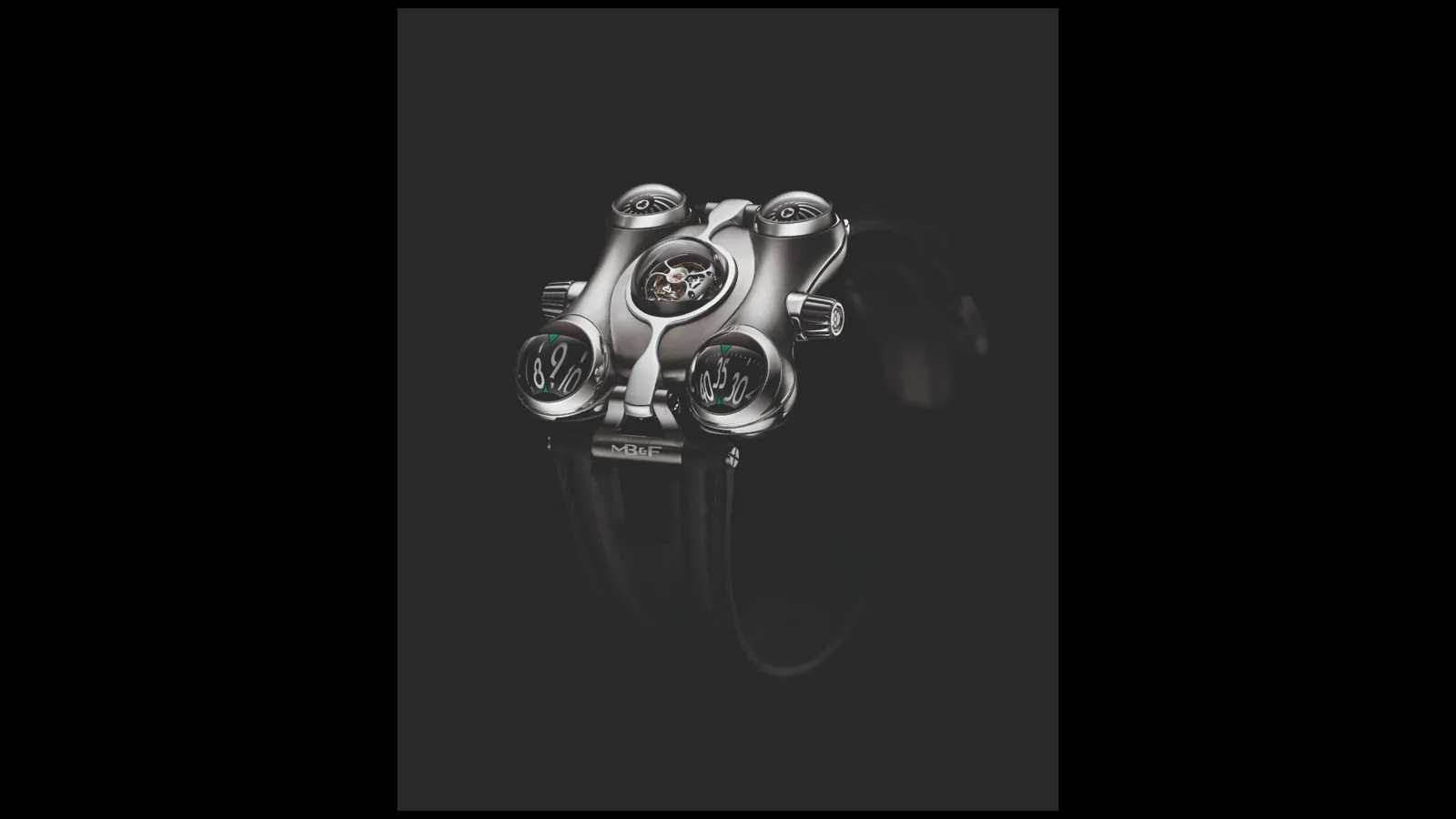
format_quote"While the legendary 1970s cartoon series Captain Future glided between red planets aboard the spaceship "Comet", a boy in front of the screen was dreaming. That boy was Max Büsser. Years later, when he met the brilliant watchmaker David Candaux, they fitted Captain Future’s spaceship into a watch case. The HM6 is a living micro-machine that explains complex physics through the simplest analogies."
PART I: CAPTAIN FUTURE AND THE BIOMORPHIC SPACESHIP "COMET"
Captain Future (Curtis Newton) is remembered for the ship he flew while defending the galaxy: the Comet. The Comet was not a sharp, cold, boxy spacecraft. It had rounded lines, it recalled a living organism, and with its spherical capsules front and back it was a biomorphic design, one that imitates the forms of living things.
When David Candaux designed the engine of the HM6, he did not treat the watch as a flat piece of metal but as a living miniature of Captain Future’s spaceship, carried on the arm.
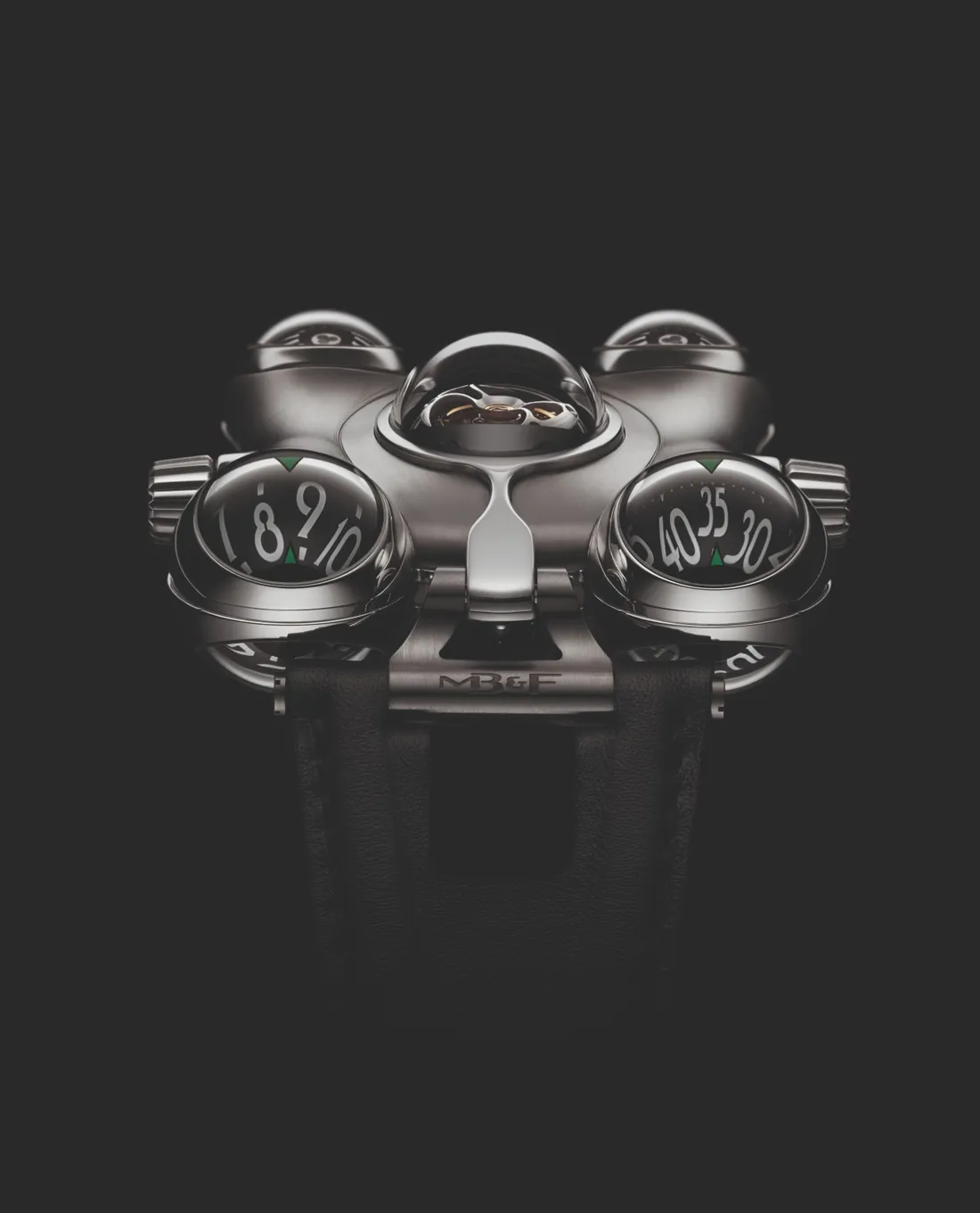
The full division of labour goes like this: the idea and the concept belong to Maximilian Büsser, the product design to Eric Giroud, and the mechanism itself to a three-year development run with David Candaux Horlogerie Créative. Captain Future himself was born in the American pulp magazines of the 1940s from the pen of Edmond Hamilton, long before the Japanese animated series of 1978 carried him to European screens under the name "Capitaine Flam". The Comet was two spheres joined by a tube. The question that lodged in Büsser’s mind was simple: what if you stacked two Comets together? The four globes of the HM6 are exactly that answer.
The case is machined from two solid ingots of grade 5 titanium, and bringing those curved surfaces to their satin texture takes more than a hundred hours of hand work. This first titanium version, launched in 2014, was limited to fifty pieces.
PART II: THE SCIENCE OF THE HM6 THROUGH MICRO-MECHANICAL ANALOGIES
Like a Car’s Driveshaft: Transmitting Power Through 90 Degrees (Kinematics)
The problem: in an ordinary watch the wheels turn side by side, like objects on a flat tray. But the hour and minute indications in Captain Future’s spaceship sit inside two globes standing upright.
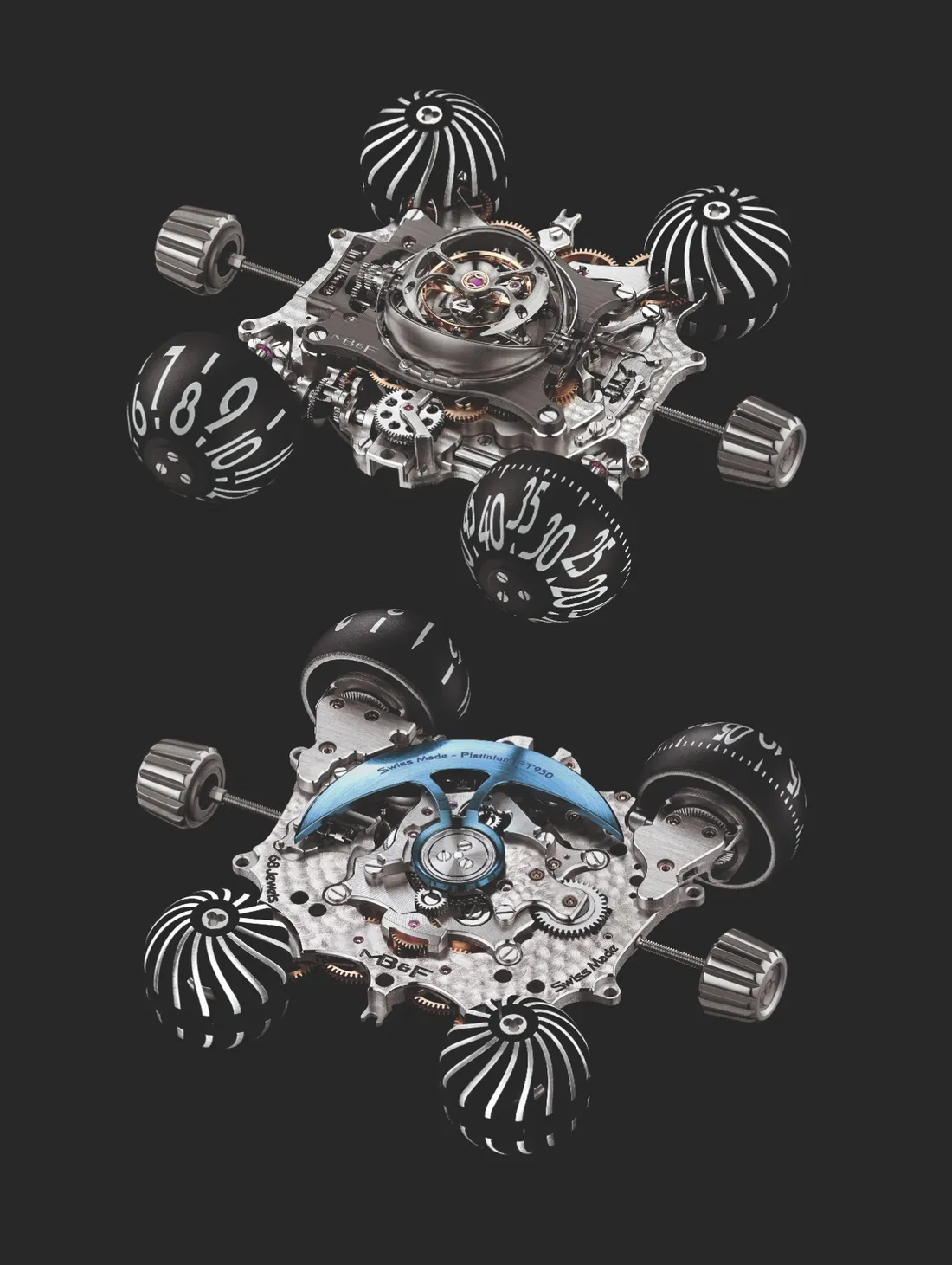
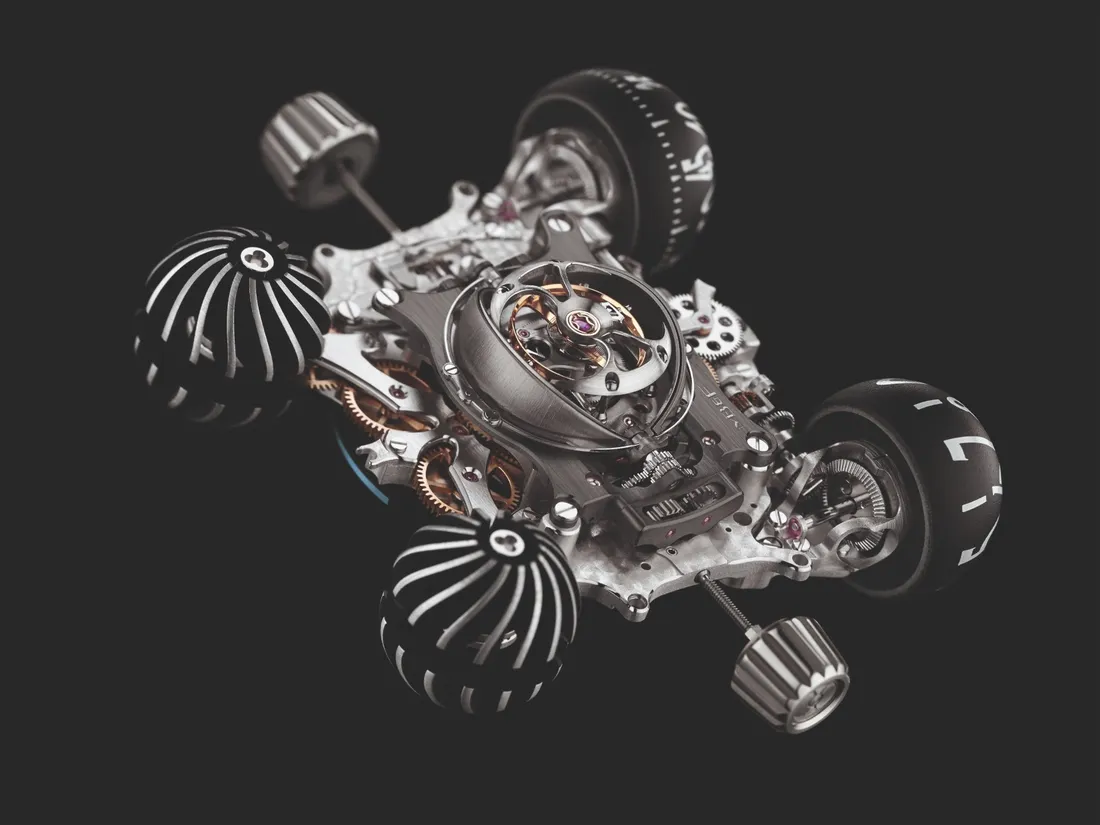
The simple analogy: exactly like the driveshaft that carries an engine’s horizontally spinning power to wheels turning on another axis. David Candaux developed dedicated bevel gears that bend the power of the movement through ninety degrees and deliver it to the upright aluminium globes. The globes are so light that they are thinner than paper, so they do not tax the engine.
The globes are machined from solid blocks of aluminium, hollowed to the thickness of paper, and turn on ruby bearings. Pulling the weight down that far is not vanity but necessity: a bevel gear loses a little efficiency at every point where it bends power through a right angle, and the only way to win that efficiency back is to shrink the mass being carried.
Like an Aircraft’s Air Brake: Aerodynamic Turbines (Fluid Mechanics)
The problem: swing your arm suddenly and the winding rotor inside the watch spins wildly, which can break its delicate gearing.
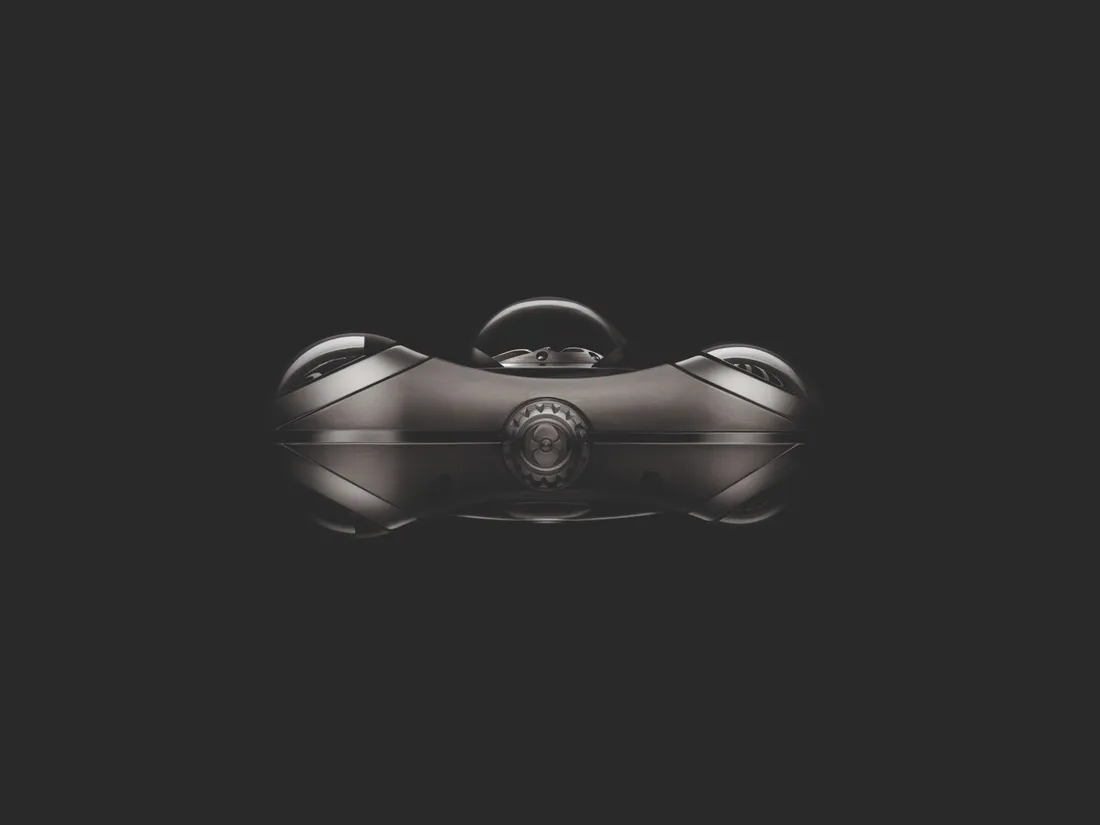
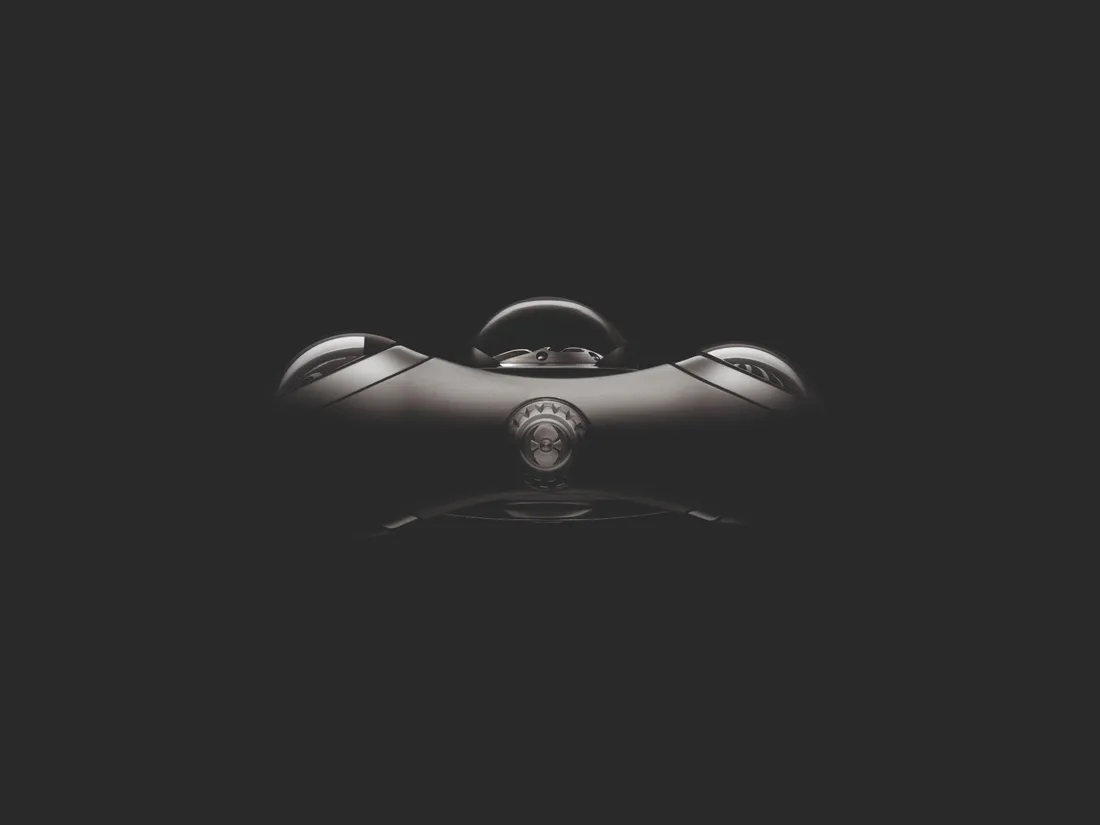
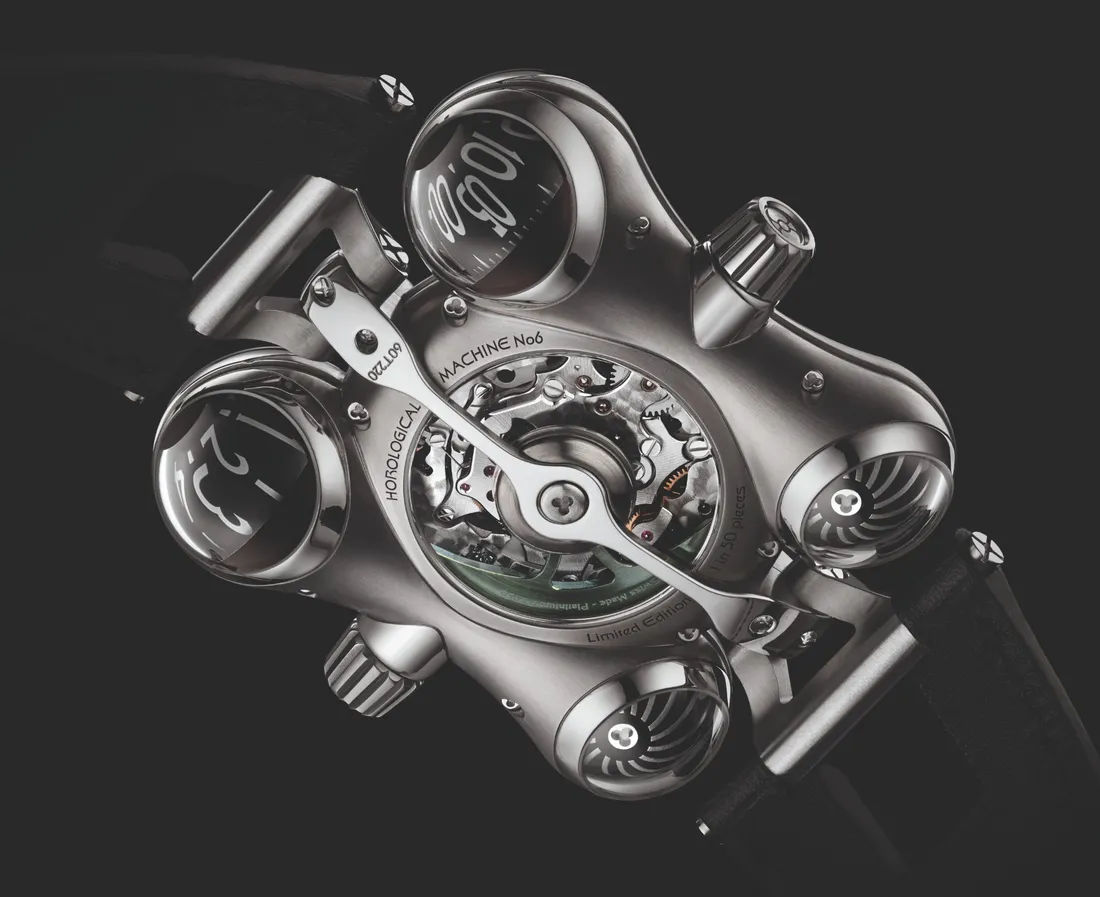
The simple analogy: like a landing jet raising the flaps on its wings and slowing itself against air resistance. Beneath the two sapphire domes at the rear sits one turbine each, machined from a solid block of aluminium and carrying fifteen curved vanes. When you swing your arm hard, these turbines use the friction of the air to stop the mechanism from spinning too fast and damaging itself.
The force that drives the turbines is the automatic winding rotor itself: the faster the rotor spins, the faster the turbines turn, the more resistance the vanes push into the air, and the harder the brake bites. Rather than adding an external friction pad to the winding system, this ties the strength of the brake directly to the size of the danger.
A Sun Visor: The UV Radiation Shield (Tribology and Photochemistry)
The problem: ultraviolet light from the sun dries out the special synthetic oils that lubricate the tourbillon at the heart of the watch. If the oil dries, the mechanism seizes.
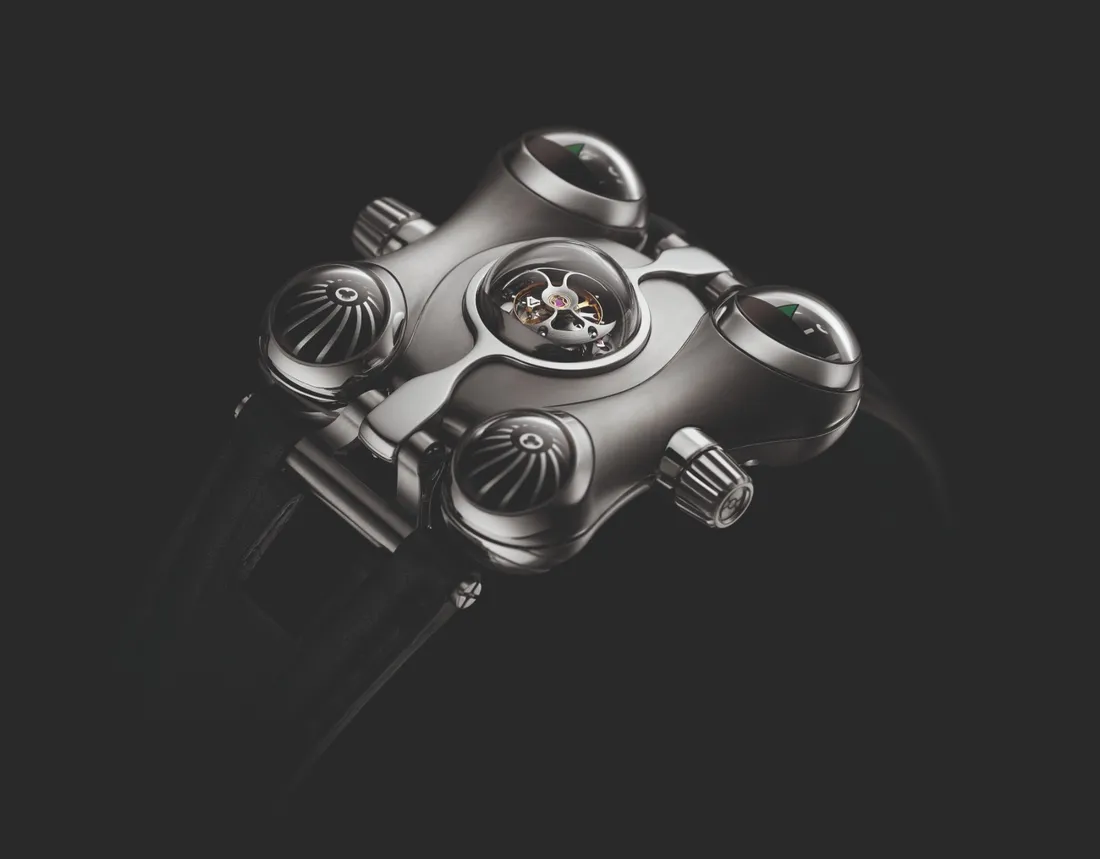
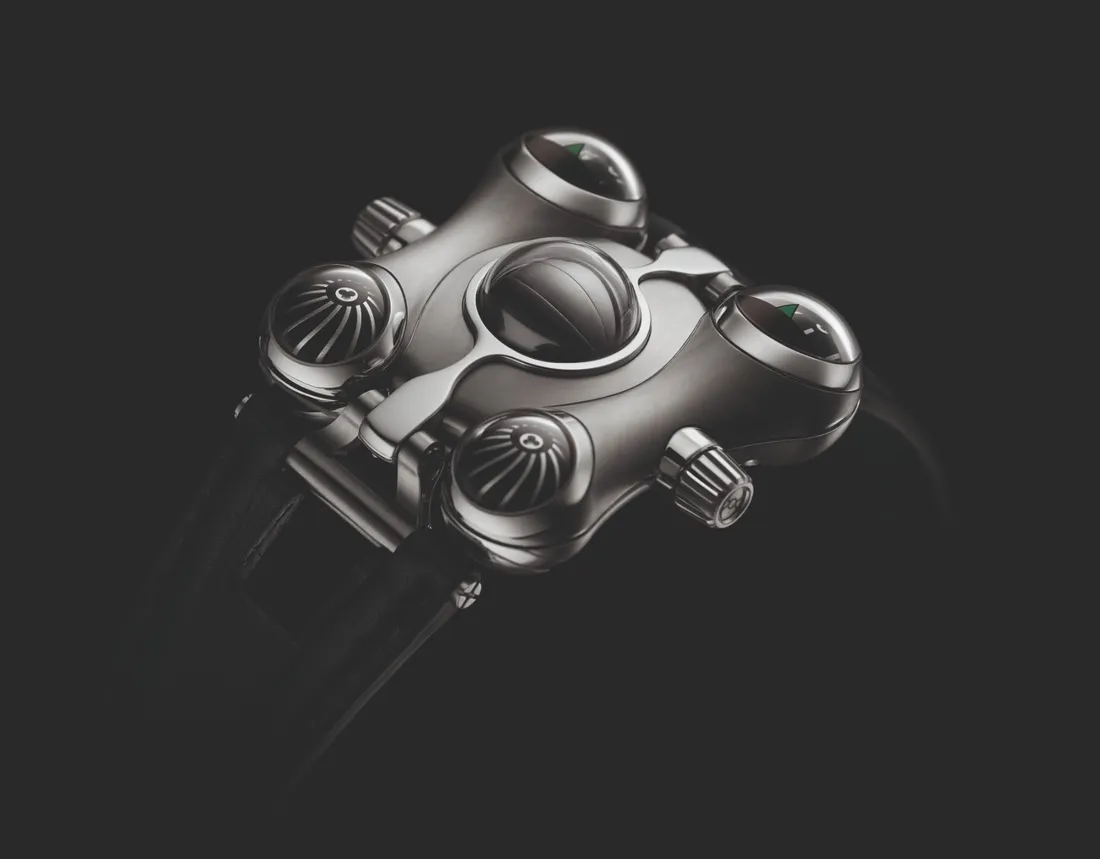
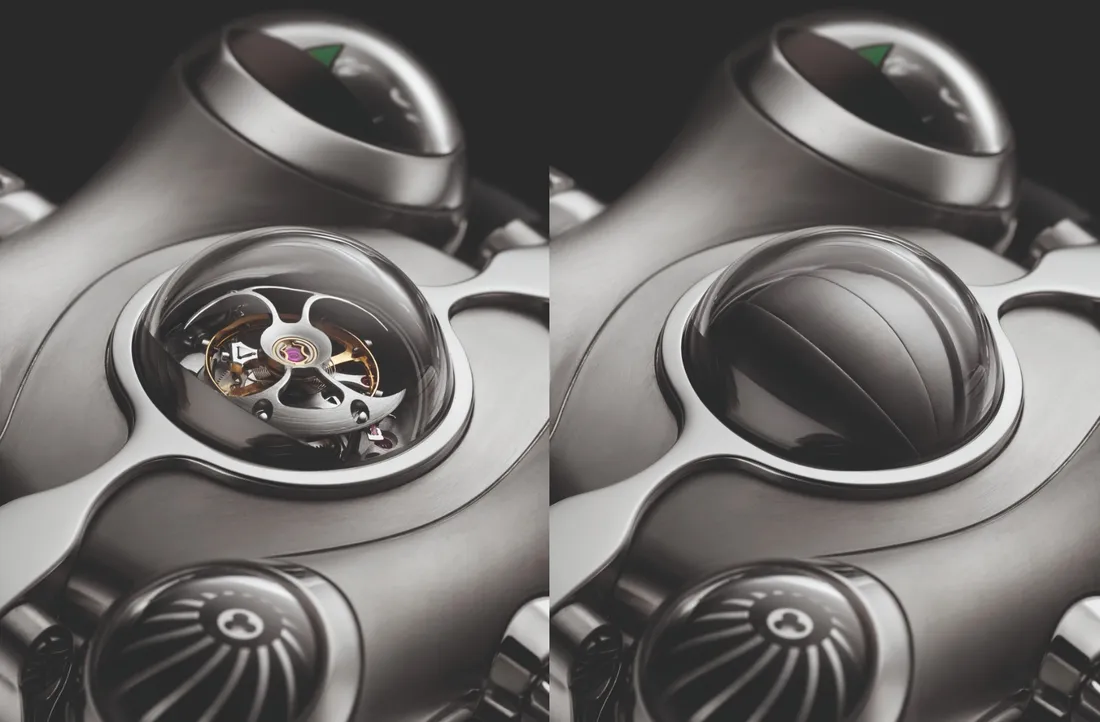
The simple analogy: like Captain Future lowering the black sun visor of his helmet as he approaches a star. Turn the second crown on the left flank of the watch and a six-bladed titanium shield closes over the tourbillon at the centre. When you want protection from the sun, you fit the mechanism with a pair of sunglasses.
The blades close by sliding over one another, like the diaphragm of a camera. It is a rare kind of confession in watchmaking: modern synthetic oils are not perfect, they age under ultraviolet light and their coefficient of friction climbs. Instead of hiding that fact, the HM6 hands the owner a lid.
The Aquarium Glass Effect: Nine Sapphire Domes (Optics and Materials Science)
The problem: round, curved glass bends what you see through it, gives a fisheye effect, and leaves the watch unreadable.
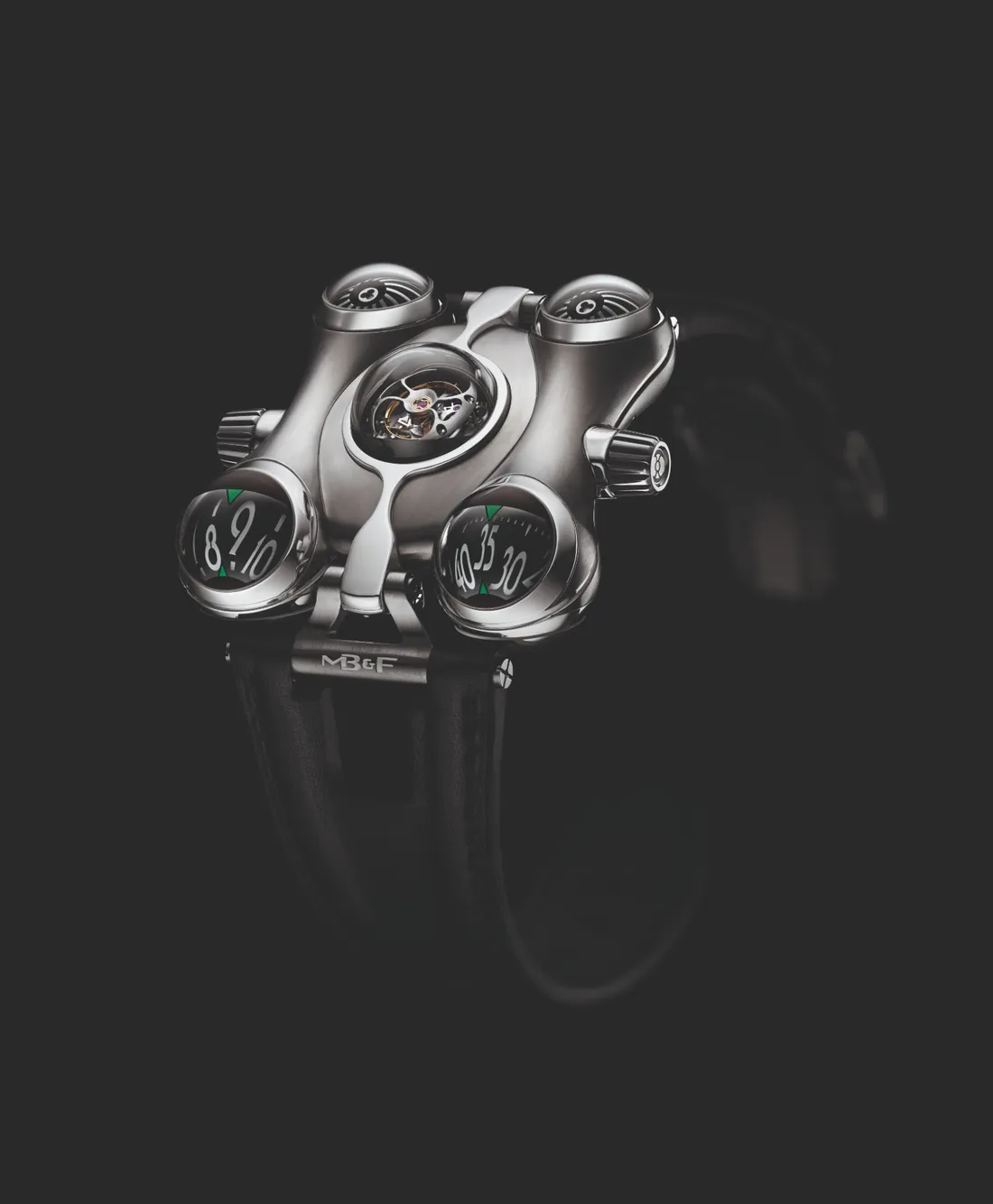
The simple analogy: like a good diving helmet or the glass of an aquarium. Nine sapphire crystal domes are cut to micro-tolerances that reduce optical distortion to a minimum. From whatever angle you look, you see the spaceship cockpit inside without distortion.
The count breaks down as follows: four domes for the hour and minute globes, four for the turbines, one for the tourbillon, nine in all. With the flat crystal in the case back, the watch carries ten separate pieces of sapphire. Every dome is carved from solid sapphire with diamond-tipped tools, its wall thickness equalised at every point, then polished inside and out separately. Leave a difference in thickness and the dome starts behaving like a lens; that is precisely why the domes of the HM6 work as windows and not as lenses.
format_quote"Leave a difference in thickness and the dome starts behaving like a lens; that is precisely why the domes of the HM6 work as windows and not as lenses."
PART III: THE SCIENTIFIC AND HOROLOGICAL RECORD
Body form: a biomimetic design descended from Captain Future’s Comet; a grade 5 titanium case (Ti-6Al-4V) machined from two solid ingots and hand-finished over more than a hundred hours.
Dimensions: 49.5 x 52.3 x 20.4 mm. The 2014 titanium "Space Pirate" is limited to fifty pieces; the launch price was CHF 215,000.
Front globes: kinematically the equivalent of a car’s driveshaft, ninety-degree bevel gears carry the power of the horizontal movement to the upright hour and minute globes. The globes are machined in aluminium and turn on ruby bearings.
Rear turbines: fluid mechanics. Two aluminium turbines of fifteen curved vanes each, driven by the winding rotor, brake it against air friction and protect the winding system.
Central shield: tribology and photochemistry. A six-bladed titanium shield, opened and closed by the second crown on the left, cuts ultraviolet light and slows the ageing of the synthetic oils.
Crystals: nine sapphire domes (four indications, four turbines, one tourbillon) plus one flat sapphire in the case back, ten pieces in total.
Engine: a three-dimensional calibre developed for MB&F with David Candaux Horlogerie Créative; flying tourbillon, platinum 950 battle-axe automatic winding rotor, 475 components, 68 jewels.
Running: 2.5 Hz (18,000 vph) balance frequency, 72 hours of power reserve.
By blending physics, aerodynamics and materials science with a childhood dream, David Candaux and Max Büsser lifted watchmaking out of the business of simply measuring time. The HM6 "Space Pirate" is a living comic-book machine that lets you feel Captain Future’s journey between galaxies on your wrist at every moment.
format_quote"The HM6 "Space Pirate" is a living comic-book machine that lets you feel a journey between galaxies on your wrist at every moment."
Hasan Bekmezci