"People think alchemy is only the turning of base metals into gold. But the true alchemists knew that as the metal on the fire is purified, the thing really being transformed is the mind holding it. Every movement in the universe, every tick, is part of the same invisible hierarchy."
On the stone-arched terrace of the Library of Alexandria, a warm evening wind off the Mediterranean was cooling the tea glasses on the table. Julian, professor of comparative literature, stroked the yellowed copy of The Alchemist in his lap, drew a long breath, opened it, cleared his throat and began to read.
"The alchemists spent years in their laboratories purifying metals. They would look at lead and say that one day this metal too will be gold, because they believed that everything in the universe is written in a single universal language and that every being in nature wants to reach its own perfection. Melting the metal in the fire and purifying it, they were in fact cleaning the sediment out of their own souls. What they called the Great Work was not merely turning lead into gold; it was bringing to the surface that hidden rhythm sleeping in the breast of matter, the Soul of the World."
Julian looked up. Beside him the astronomer and theoretical physicist Gabriel sat with his eyes closed, listening to the wind. He smiled faintly and began, without looking at the book, to speak the words one by one from memory.
"Do you remember this passage, Julian? It is carved into my mind: the universe was written by a single hand. Without that hand, the stars could not turn in their orbits, the seas could not rise, and the human heart could not go on beating. Because every movement in the universe is one of the letters in the letter written by that single hand. For an alchemist, the arrangement of the planets in the sky and the motion of mercury in a laboratory tube were the same thing. The planets are clocks turning in the sky."
Julian smiled in surprise. "I did not know you had it by heart. Then listen to what comes two pages later."
"The wise man gave the young visitor who had come to see his palace a spoon holding two drops of oil, and told him to walk through the palace but not to spill them. When the young man came back he had seen none of the beauty of the palace, because he had looked only at the spoon. The wise man sent him out again. This time the young man marvelled at the whole palace, but when he returned the oil in the spoon had been spilled. The wise man smiled: the secret of life is to see all the wonders of the world without spilling the two drops of oil in the spoon."
Gabriel sat up and gave the continuation of that story, again from memory.
"The Wind, the Sun and the Desert speak the same language. The Wind says to the Desert: I have travelled everywhere in the universe, from the pyramids of Egypt to the horizon where the Sun rises, and I have seen that everything obeys the Soul of the World; what we call time is only an illusion of that transformation. And the Desert answers: every grain of sand on me corresponds to a star in the sky. We are different letters of the same letter."
Julian laid the book on the table. "Four passages. One read, one spoken from memory, then read again, then given from memory again. It is a wonderful thing to see that book burning like a torch in an astronomer’s mind."
Gabriel fixed his eyes on the darkness of the sea.
"Because the metaphor of the two drops of oil in that book is the whole purpose of a watchmaker and of an astronomer. To watch that dazzling order in the sky without upsetting the balance of the microscopic wheels you carry on your wrist. That is real alchemy."
"And how did that alchemy become real in the world of micromechanics?"
"Two thousand years ago a Greek genius translated the enormous language of the sky into the language of bronze wheels," said Gabriel. "And in modern times the most unruly alchemist in Swiss watchmaking, Mathias Buttet, took that ancient inheritance and turned it into a simulation of the sky ticking on a wrist."
The Alchemist of Modern Times: Mathias Buttet
As Julian picked up the loupe, Gabriel went on.
"Mathias Buttet is a radical who broke down the sterile walls of traditional Swiss watchmaking. Across a career running from his BNB Concept days to the directorship of research and development at Hublot, his aim was never merely to show the time."
"And how did he get into the Antikythera business?"
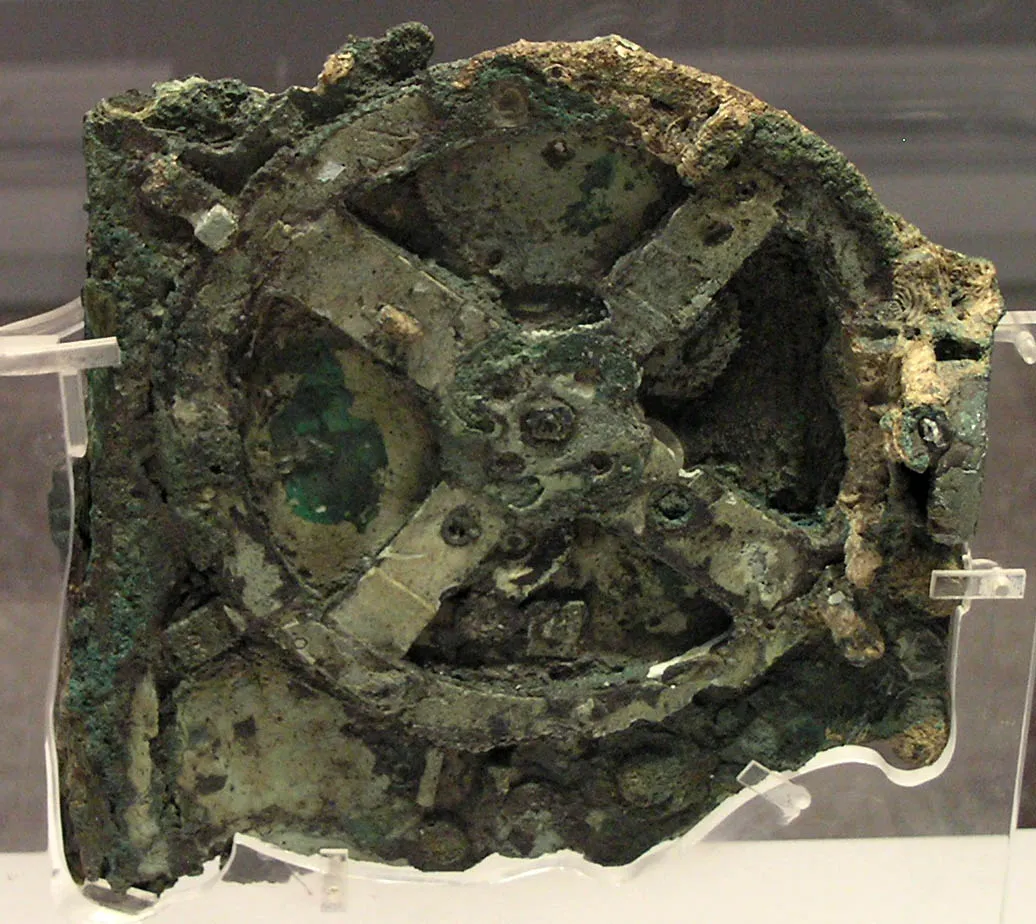
"When the tomography scans of the original mechanism were published. Those scans made every tooth and every arbor visible, one by one, inside a lump of bronze that had spent two thousand years in seawater and turned to stone. Buttet looked at those images and said: I am going to take this out from behind museum glass and turn it into an art you can wear."
"And he did."
"He made the big one first. In 2012 Hublot completed the Antikythera mechanism, a working interpretation of the original. But the most beautiful part of it begins here. Jean-Claude Biver, the chairman of Hublot, decided that only four of these movements would ever be made. Not one more. No commercial venture, he said; the project must stay beautiful."
"Where are the four?"
"The first was exhibited at the Musée des Arts et Métiers in Paris. The second entered the National Archaeological Museum in Athens officially on 5 April 2012 and was placed in the same display case as the original fragments. The Greek Ministry of Culture and the museum director Nikolaos Kaltsas were present. It was the first time in history that an archaeological museum had invited a watch manufacture to exhibit a movement in its collection. The third was put up for auction in aid of the Athens museum, to support the conservation of the original device. And the fourth stayed in Switzerland, with the watchmakers who had made it."
"So not one of them is for sale."
"That was the definition of alchemy in the first place. Not turning the metal into gold, but changing the man doing the turning."
"And what was that mechanism like?"
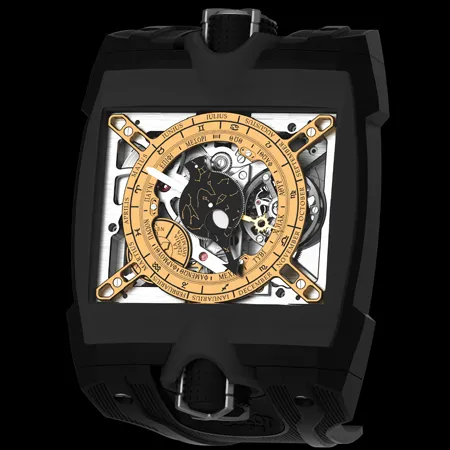
"Not a thing to be carried on an arm, and it never claimed to be. A titanium case of forty-nine point nine by fifty millimetres, twenty point eight millimetres thick. Hand wound, twenty-one thousand six hundred vibrations an hour, a hundred and twenty hours of reserve. As indications, only hours, minutes and the tourbillon."
"That is all? Rather little for an Antikythera."
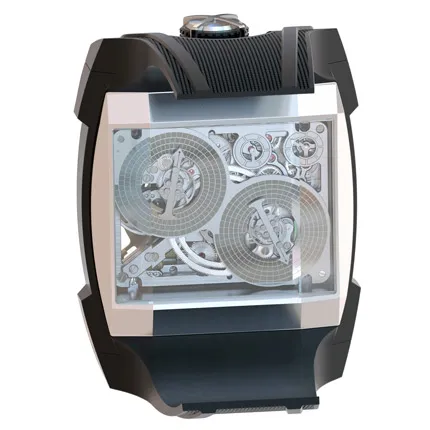
"Little on the dial, a great deal on the back. Turn it over and you see two large spiral dials, and that is where the real matter lies. They are what the two spirals on the back of the original device were: one the Metonic cycle, two hundred and thirty-five months in nineteen years, the point at which the lunar calendar settles onto the solar one; the other the Saros, two hundred and twenty-three months, the rhythm in which eclipses repeat. What Buttet did was not to put two indications on the back of a watch; it was to fit the architecture of a two-thousand-year-old computer into a case."
The Celestial Theatre Inside the Dial
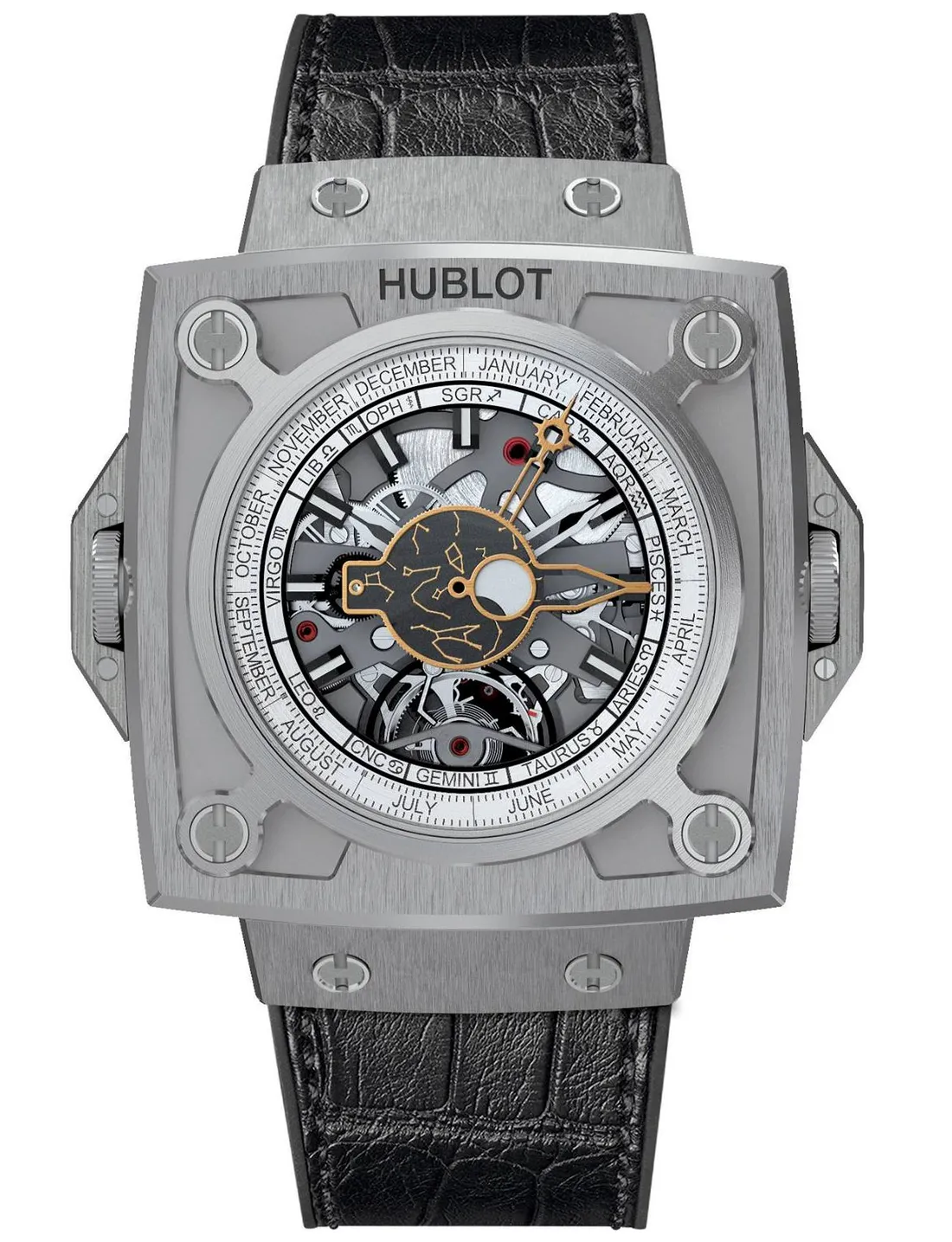
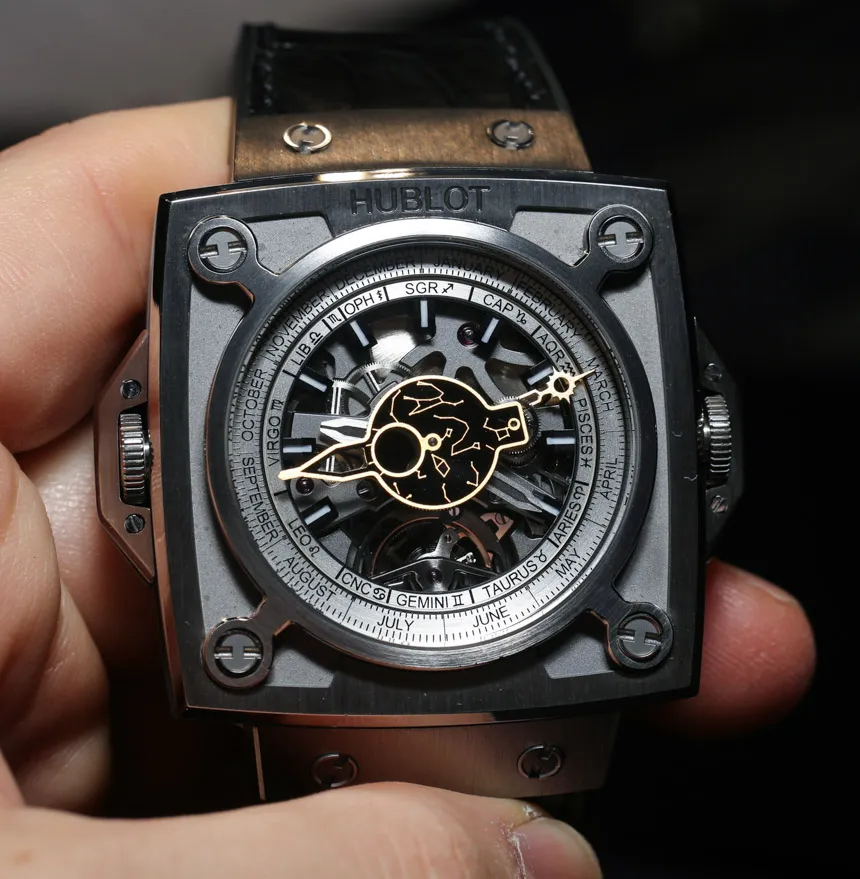
"And then he distilled it," said Gabriel. "Out of the four museum movements he drew something that could genuinely be worn: the MP-08 Antikythera SunMoon. Twenty were made this time, and this time they were sold."
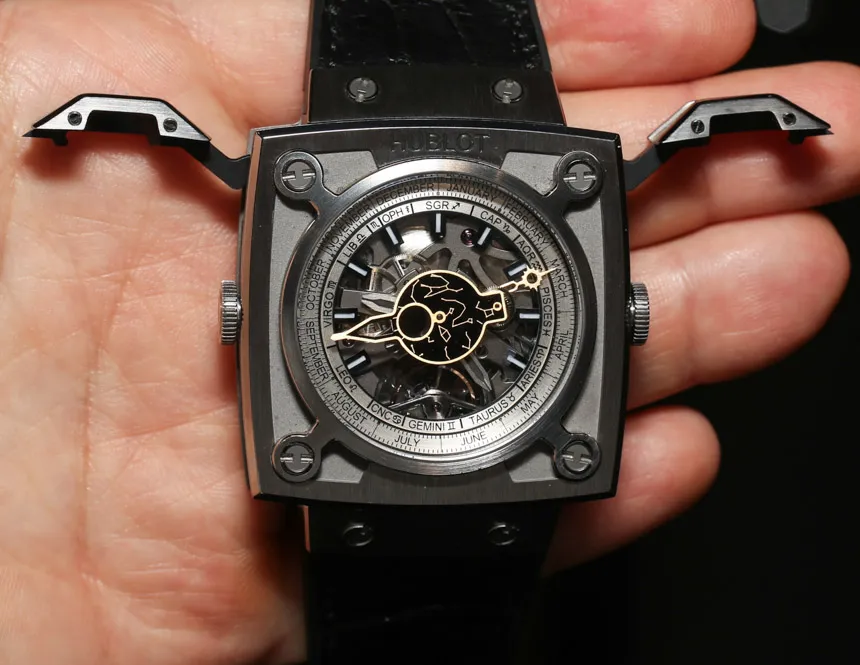
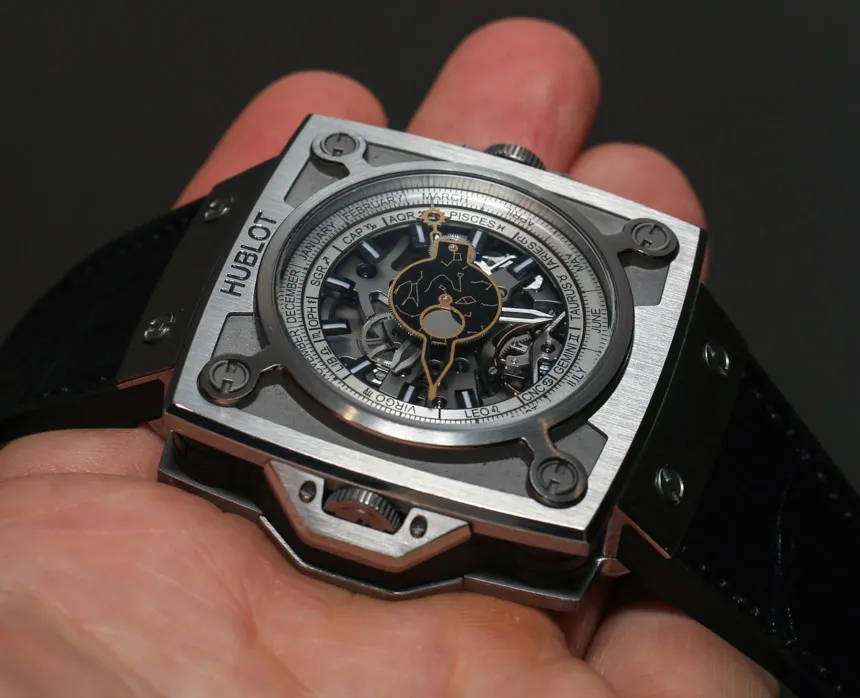
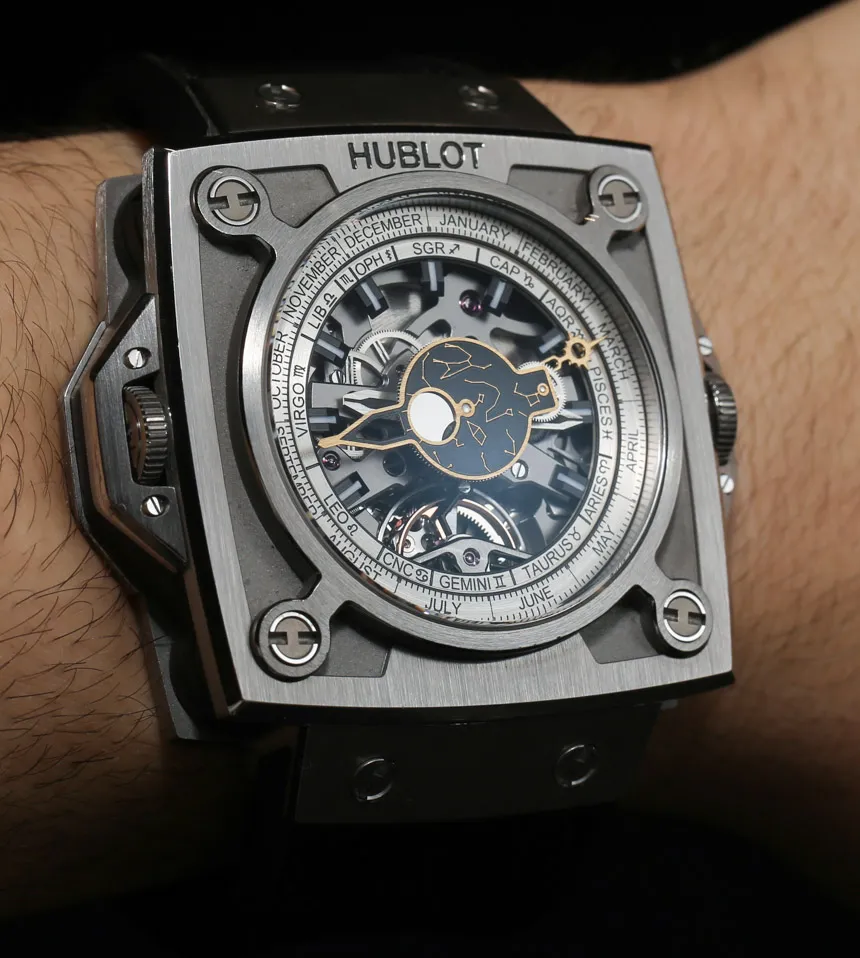
Julian went down into the dial with the loupe and frowned. "There are strange symbols on the ring around the dial. Zodiac, synodic month, sidereal month. Can you explain these to me simply enough for a man of letters, or for anyone at all, to get them at first sight?"
Gabriel set his tea glass aside.
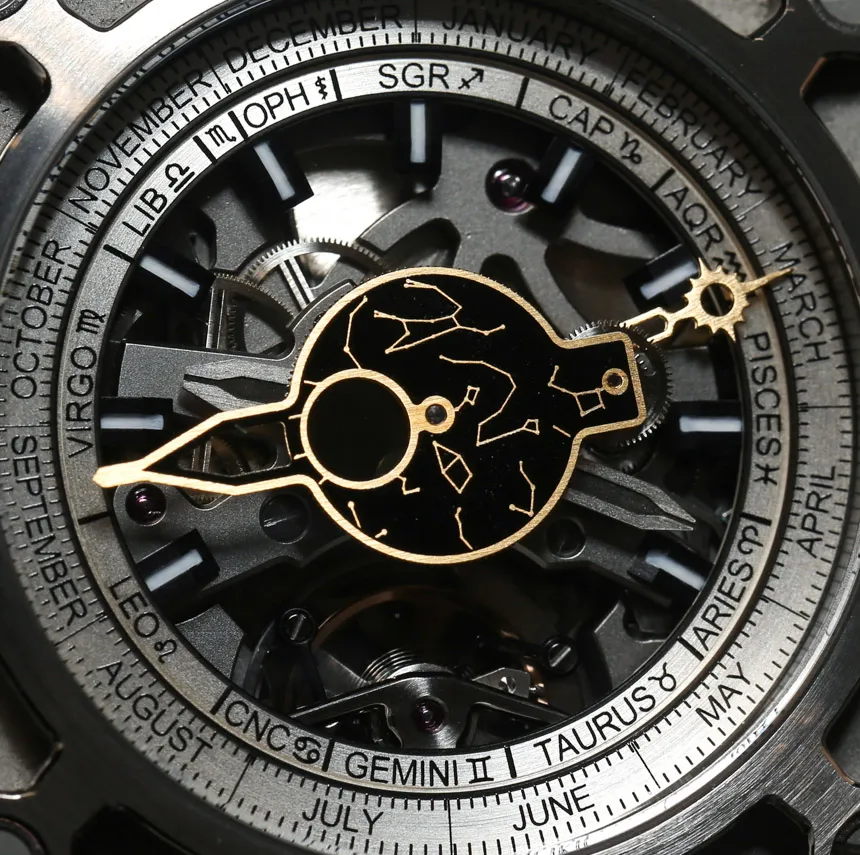
"The zodiac first. Think of it as an enormous railway line in the sky with twelve stops. Over the course of a year the Sun follows a particular path across the sky, and the twelve great constellations standing behind that path are called the signs of the zodiac. Each month the Sun calls at one stop. On the outer circle of this ring the names of the months are engraved, on the inner circle the names and symbols of the constellations. A wheel inside takes the sun hand once round that twelve-stop line in three hundred and sixty-five point two four days."
"And why not a whole number?"
"Because nature did not give us one. A year is a quarter of a day longer than three hundred and sixty-five, and the entire history of calendars is the history of where to hide that quarter."
"And the synodic and sidereal months?"
"Picture a circular running track," said Gabriel. "The sidereal month is the full three hundred and sixty degree lap the Moon makes around the Earth measured against a fixed star. About twenty-seven and a half days. Think of the runner coming back to the line on the track."
"And the synodic?"
"While the Moon runs its lap the Sun does not stand still; it too creeps forward along the track through the year. By the time the Moon reaches its old line the Sun has moved ahead. For the Moon to line up with the Sun again, that is, for there to be a new moon, it has to run a little over two days more. So the sidereal month is twenty-seven and a half days and the synodic month twenty-nine and a half."
"And how does that two-day difference sit inside the watch?"
"As two separate gear ratios side by side. Buttet tied them to one another. And remember this: when two different periods are tied together in a mechanism, a beat appears, and every event in the sky is in fact one of those beats. Eclipses, full moons, the seasons."
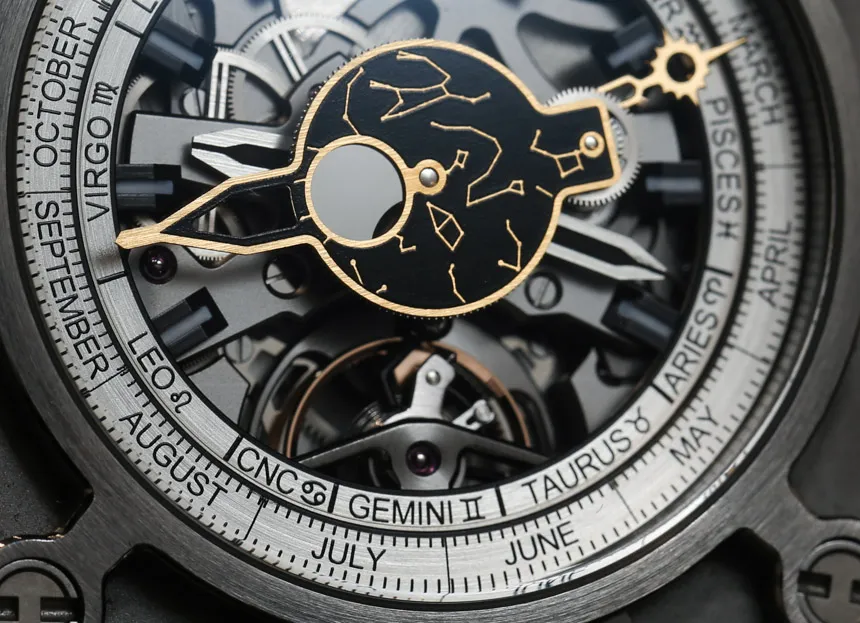
"And that round opening?"
"The moonphase. But note that it is not a sphere. It is a flat window cut into the disc, and as the disc beneath turns it passes from the lit face to the dark one. In the original Antikythera it worked the same way: there was a small ball, half silver and half black, that turned to show the phase. Buttet took a different road here, using an opening set into the sky chart itself instead of a three-dimensional sphere. The reason is simple: on this dial the moonphase is not an indication in its own right but a part of the sky chart. A sphere would have had to pierce the map."
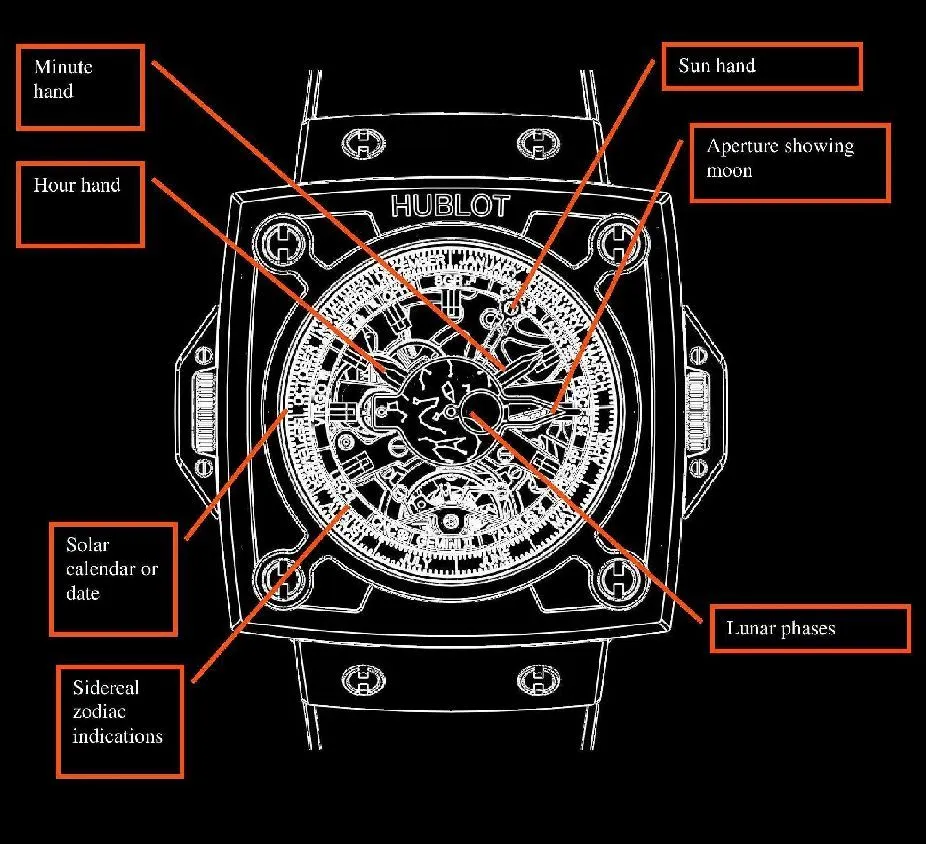
"And I have noticed something else," said Julian, moving the loupe. "I counted the constellations on the ring. There are thirteen, not twelve."
"And to me that is the boldest decision in this watch," said Gabriel. "Between Libra and Sagittarius, under the abbreviation OPH, sits Ophiuchus, the Serpent Bearer. On its true path across the sky the Sun passes through the boundaries of Ophiuchus for about eighteen days every year. Astrology pretends otherwise, because it ruins a scheme of twelve equal slices. Hublot chose to correct the tradition rather than the sky. What you carry on your wrist is an astronomical zodiac, not an astrological one."
"How is it wound? I see no crown on the dial side."
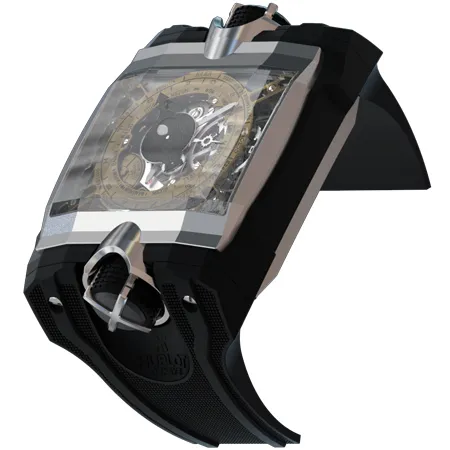
"There are two, both on the flanks of the case and both hidden under guards that lift like wings," said Gabriel. "One winds and sets the watch, the other synchronises the astronomical indications. You cannot touch either without raising a guard. That solves two things at once: the rigidity of the case is preserved, and there is no chance of shifting the sky chart by accident. Resetting a mechanism like this means a trip to the service department."
"What is inside?"
"A hand-wound calibre called the HUB9008. Two hundred and ninety-five components, thirty-seven jewels, twenty-one thousand six hundred vibrations an hour. Two barrels and a hundred and twenty hours, a full five days of reserve. And in the lower half of the dial a tourbillon turns."
"Why two barrels?"
"Because there are three constantly turning loads on this dial: the tourbillon carriage, the sky chart disc and two astronomical hands. Drive that from a single barrel and you get a watch that runs fast on the first day and slow on the last. Split the tank in two and the flat part of the torque curve gets longer."
"The case?"
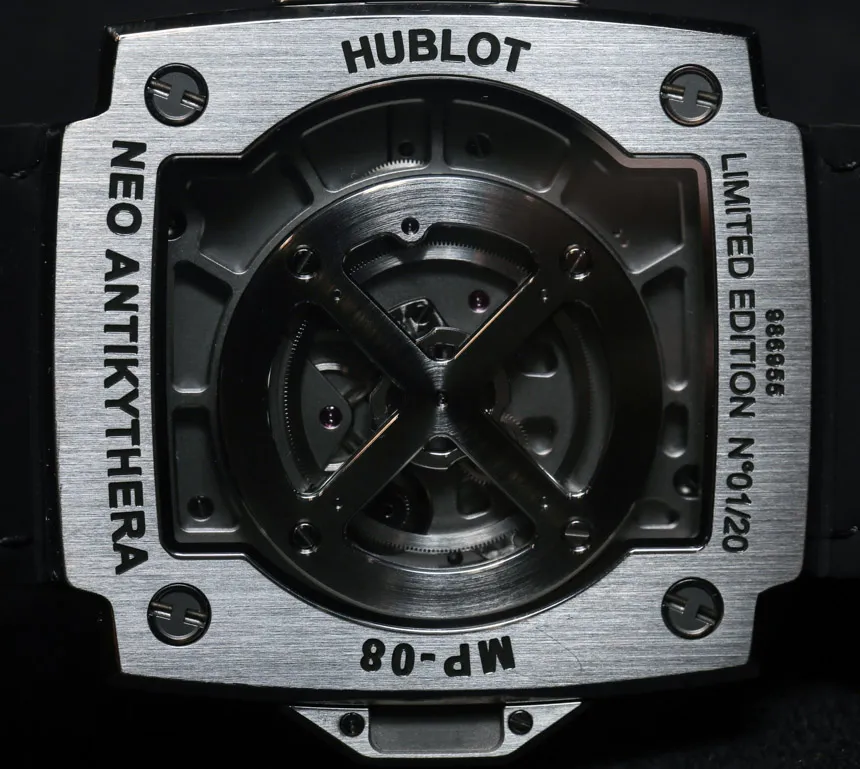
"A square-bodied titanium structure of thirty-five point two millimetres. Hublot’s registered H-shaped screws sit at the four corners, and they are not decoration but the real fixings holding the crystal and the back. Water resistant to thirty metres. On the back it reads NEO ANTIKYTHERA, and beneath it which of the twenty this one is."
Gabriel looked at the light coming off the sapphire of the watch on the table and drew a long breath.
"So there it is, Julian. To take a rusted lump of bronze, made in the second century before our era, gone down to the floor of the Aegean as cargo in a ship that sank in the first century, and left to drink seawater for two thousand years until sponge divers found it in 1901; and then to turn it into a mechanical monument that sits on a wrist and computes the rhythm of the sky. That is the most radical act of alchemy the history of watchmaking has seen."
"And the two drops of oil in the spoon?"
"Not spilled," said Gabriel. "The man walked the whole palace, rebuilt a two-thousand-year-old machine from scratch, made four of them and sold none. Then he sat down and distilled a wearable one out of it. He looked at the spoon and at the palace both."
format_quote"That was the definition of alchemy in the first place. Not turning the metal into gold, but changing the man doing the turning."
format_quote"The man walked the whole palace and did not spill the two drops of oil in the spoon."
Hasan Bekmezci