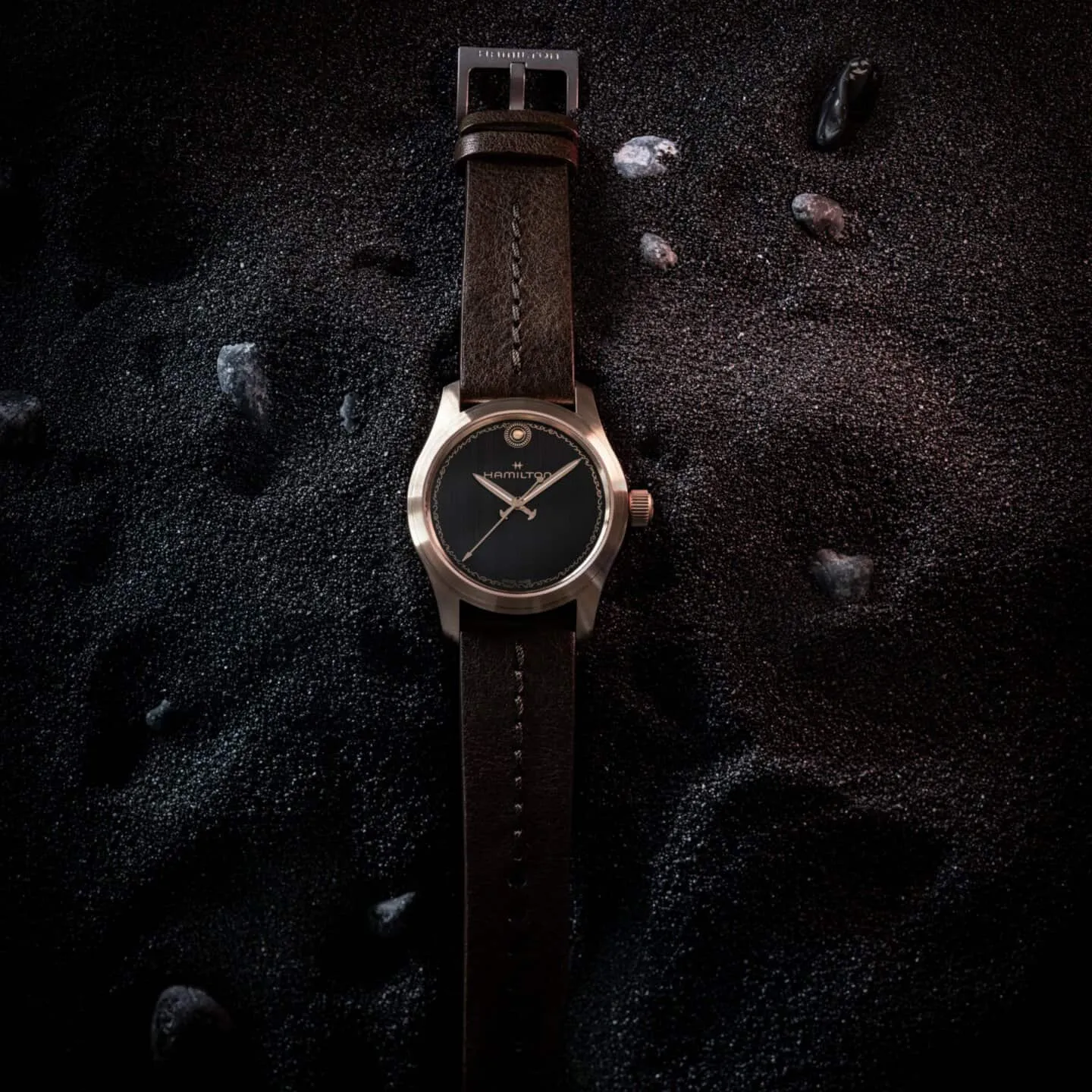
Twelve hundred years before anyone built a spring, a gear train, or a balance wheel, a soldier named Odysseus spent ten years trying to get home from a war, and it took him that long because a witch, a monster with one eye, an entire ocean's worth of bad luck, and his own curiosity kept getting in the way. There has never been a watch for that story, because there could not be. Nobody in the world of the Odyssey owned a watch. So when Hamilton and Christopher Nolan sat down to build a timepiece for Nolan's new film adaptation of Homer's epic, in theatres from the seventeenth of July, they had to solve a problem none of their four previous collaborations ever faced: how do you make a watch for a hero who has never seen one? Their answer, the Khaki Field Auto 'The Odyssey' Limited Edition, does not try to disguise the contradiction. It leans into it completely, and the result is one of the strangest, most thoughtful pieces of movie merchandise ever built, a watch that refuses to appear in the film it was made for and instead tries to become an artifact smuggled out of the story itself.
A War That Would Not End, and a Journey That Would Not Stop
Homer's Odyssey begins after the war has already been won. Troy has fallen, the Greek ships are meant to be sailing home, and Odysseus, the king of Ithaca whose wooden horse trick ended ten years of siege, is meant to be a hero returning to his wife and son. Instead he spends another ten years lost, because he blinds the Cyclops Polyphemus, and the consequences of that single act chase him across every sea he tries to cross, making sure that getting home costs him everything he has. What follows is less a straight path than a string of very specific temptations to stop trying: an island where eating a certain flower makes men forget they ever wanted to leave, a witch named Circe who turns his crew into pigs, sirens whose song is fatal to anyone who can hear it clearly, a monster on either side of a strait so narrow that avoiding one means sailing straight into the other, and finally a nymph named Calypso who keeps him on her island for seven years simply because she does not want him to go. Through all of it, back in Ithaca, his wife Penelope fends off a house full of suitors who assume Odysseus is dead and are trying to marry her for his kingdom, delaying them for years by weaving a funeral shroud during the day and secretly unpicking it every night. When Odysseus finally does return, disguised as a beggar so no one recognizes him, Penelope sets the men who want to marry her an impossible test: string her husband's old hunting bow and shoot an arrow clean through the aligned sockets of twelve axe heads, something only Odysseus himself has ever managed to do. He does it, of course, still in disguise, and only then reveals who he actually is. It is a story about time in a very specific sense: twenty years pass, a wife waits without knowing if waiting is foolish, and identity itself has to be proven rather than simply recognized. It is not hard to see why a filmmaker obsessed with exactly those two ideas would eventually be drawn to it.
(A Parenthesis on Christopher Nolan)
It is worth pausing here, because the choice of director is not incidental to this watch existing at all. Christopher Nolan has spent nearly three decades making films that are, underneath whatever else they are about, actually about time: Memento told its story backward, in fragments, because its amnesiac hero could not hold a normal timeline in his head. Inception nested dreams inside dreams, each layer running slower than the one above it, so that ten hours in the top level became a hundred years in the bottom one. Interstellar sent a father through a black hole and let relativity itself steal decades from him while his daughter aged without him on Earth. Dunkirk told three different timelines, a week on the beach, a day at sea, an hour in the air, and cut between them until they converged in the same instant. Tenet built an entire film around objects and people that move backward through time relative to everything else on screen. Given that history, it is fitting, not coincidental, that Hamilton has been Nolan's watch supplier of choice since Interstellar, to the point that Hamilton now calls itself, without much argument from anyone, the watchmaker of filmmakers. In Interstellar, a Hamilton was not a prop but a plot device: the watch Cooper leaves with his daughter Murph becomes the only channel of communication across a black hole, its second hand secretly transmitting a Morse code message that spells out EUREKA, sent back through time from inside a singularity to solve the equation that saves humanity. In Tenet, the Hamilton on screen carried a digital countdown built specifically to sync with the film's own scenes of inverted time. For Oppenheimer, Hamilton went the opposite direction entirely, dressing the cast in three different vintage 1930s and 1940s models for historical accuracy alone, no time travel, no hidden code, just a physicist's watch getting the decade right. And for Dunkirk, the connection got even more personal than a prop: Nolan gave Hans Zimmer a recording of his own pocket watch ticking, and Zimmer built the entire score around that single sound, stretching it into a Shepard tone, an audio illusion that seems to rise in pitch forever without ever actually getting anywhere, which is as good a description of a soldier trapped on a beach as any composer has ever found. A director this fixated on what a watch can represent was always going to end up here eventually, at a myth that is itself entirely about the terror and relief of time passing.
Why This Film, Shot This Way
The Odyssey marks Nolan's first outright adaptation of an existing myth, and by his own account the decision came from a fairly simple observation: a three thousand year old story that essentially invented the idea of the epic journey home had somehow never been given a proper modern blockbuster treatment. He has described wanting to challenge himself with a completely different kind of storytelling and finding, in Homer, exactly the kind of gap in the culture he was looking for. True to form, he did not make it easy on himself or anyone else. The Odyssey is the first feature film ever shot entirely on fifteen/seventy millimeter IMAX film, a format so demanding that the cameras themselves had never been quiet enough to record usable dialogue, since the mechanism that pulls that much film through the gate at that speed is loud enough to drown out an actor standing next to it. IMAX built a new soundproof housing, a blimp, just to make the shoot possible, and the resulting camera, nicknamed the Keighley, was so physically enormous that actors could no longer stand close enough to each other for a normal eyeline in dialogue scenes, the camera's own bulk was simply in the way. Nolan's solution was a mirror relay: one actor would stand beside the camera looking into a mirror, which reflected a second mirror positioned so the other actor, on the far side of the lens, could see their scene partner's face floating in it and act the scene as though the camera were not there at all. Tom Holland has said the illusion worked well enough that he genuinely forgot the camera existed. True to his long standing aversion to relying on digital effects, Nolan reportedly took his cast and crew out onto real open water for a four month shoot to capture Odysseus's journey using practical seas rather than a tank or a screen, going through more than two million feet of film in the process. The film premieres in London on the sixth of July and opens in the United States and the United Kingdom on the seventeenth, in IMAX and every large premium format available, with Matt Damon as Odysseus leading a cast that includes Anne Hathaway, Tom Holland, Robert Pattinson, Zendaya, Charlize Theron, Lupita Nyong'o, Jon Bernthal, Mia Goth, Elliott Page, and Travis Scott.
format_quote"I was looking for a gap in the culture. Greek mythology, The Odyssey itself, why hasn't it become part of modern cinema?"
Christopher Nolan
The Watch That Cannot Appear in Its Own Film
All of which brings the problem back to Hamilton's door. Every previous Nolan collaboration put a real, functioning Hamilton on screen, inside the story, doing narrative work. That option was never available here. Odysseus wore no watch, checked no wrist, waited for no alarm; mechanical timekeeping would not exist for roughly two and a half thousand years after he supposedly lived. So instead of building a prop, Hamilton built something closer to a relic, an object that feels as though it could have been recovered from the world of the myth itself rather than filmed inside it, and every decision on the watch follows from that constraint rather than fighting it.
The Watch Itself
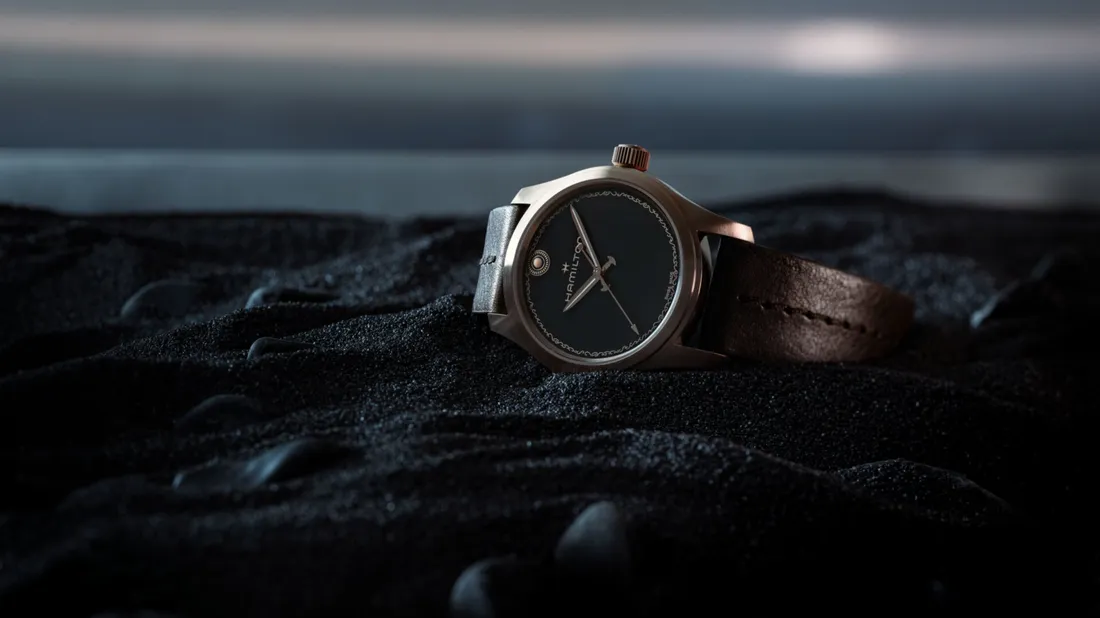
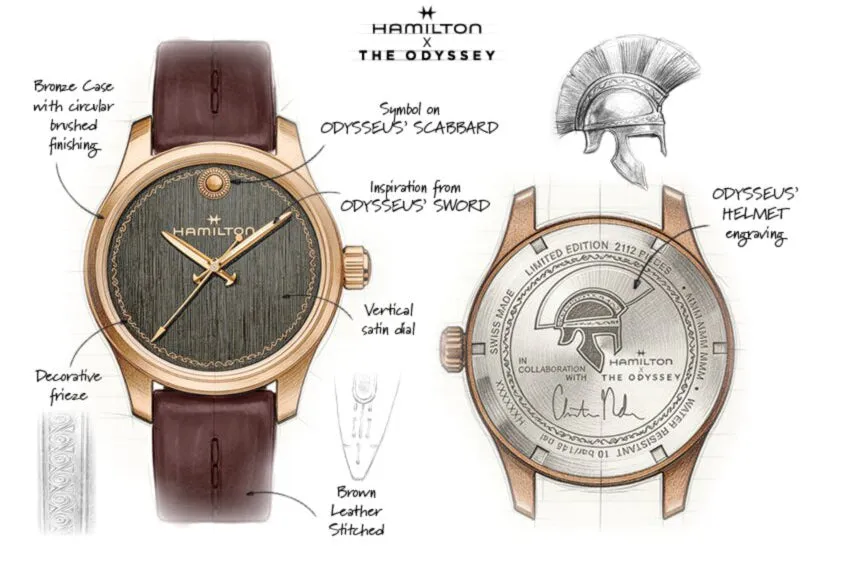
The Khaki Field Auto 'The Odyssey' takes Hamilton's familiar field watch case, 42 millimeters here, and casts the entire thing, case and all, in solid bronze, a material choice that does real narrative work rather than sitting there for looks: bronze is, quite literally, the metal of the Bronze Age, the period the epic itself is set in, roughly 1200 BCE, in the years just after the fall of Troy. The circular brushed case finish and 22 millimetre lug width will look immediately familiar to anyone who owns a Khaki Field, but almost nothing on the dial will. It is a deep, vertically brushed black, and it carries no numerals and no conventional hour markers at all. In their place, running around the whole perimeter where a minute track would normally sit, is a swirling bronze pattern lifted directly from the crest of Odysseus's helmet as designed for the film. At twelve o'clock, a circular, faintly sun-like index stands in for a marker, and Hamilton describes it as a direct reference to a rivet on the scabbard of Odysseus's sword. The hands complete the theme without subtlety: rather than the usual batons or swords-as-a-style-choice that plenty of field watches use, these are cast in the literal shape and bronze tone of the hero's own blade, so that the watch spends every second of every day quietly reenacting a sword being drawn across a shield. A brown, grained leather strap with a color matched center stitch finishes the case, understated next to everything happening on the dial.
The Talisman Pin and the Number 2112
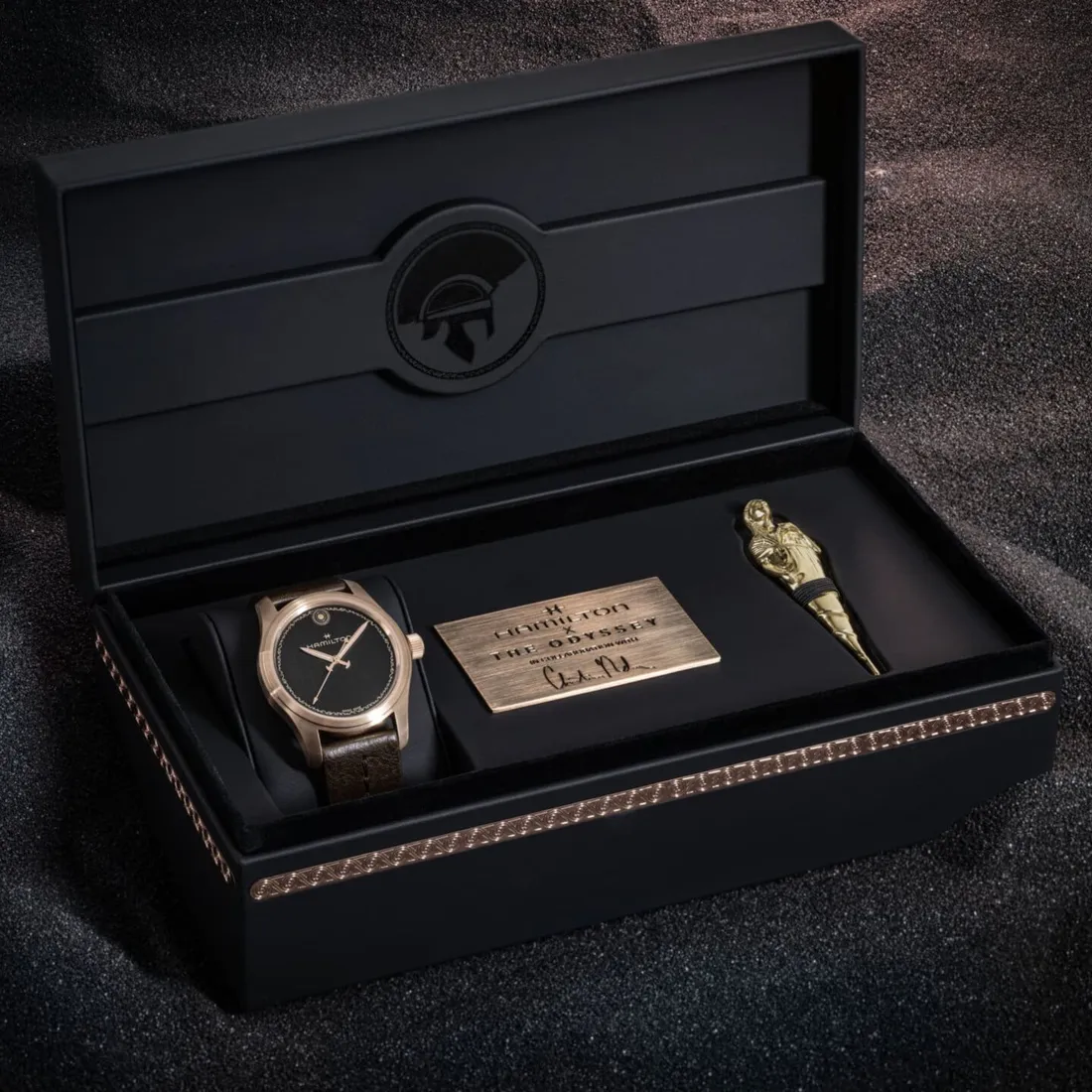
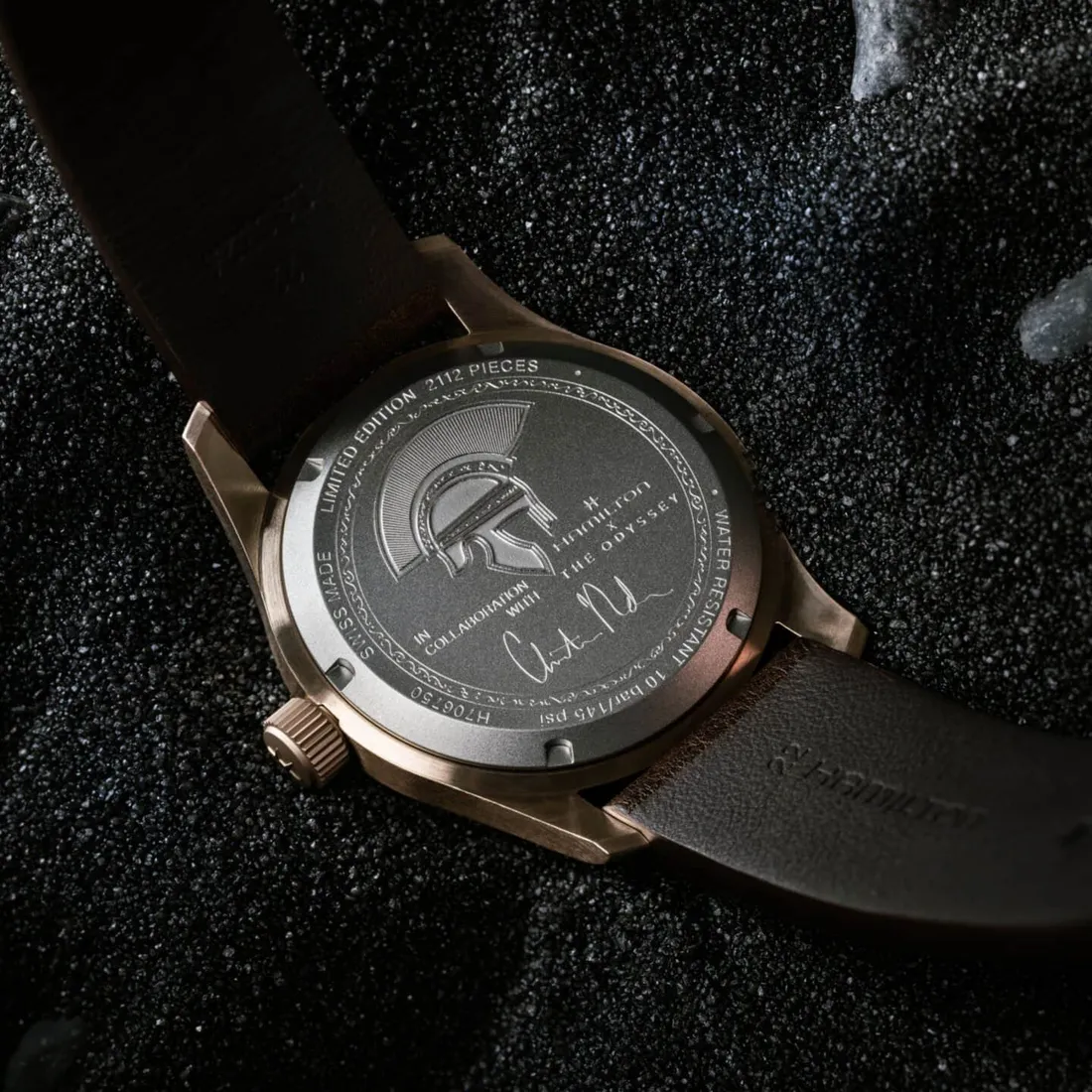
Hamilton did not stop at the watch. Every example ships inside a specially designed box alongside a second object entirely: a small bronze pin modeled on a protective talisman that, in the film, Penelope gives Odysseus before he sails for Troy, meant to keep him safe on a journey neither of them yet knows will take twenty years. Cast in the same bronze tones as the watch, it can be worn as a brooch or pinned to a jacket or bag, and it exists specifically because the watch itself could not carry the story onto a screen the way past Nolan collaborations did; Hamilton needed a second object to do the work of movie magic that the timepiece, by its own design logic, was not allowed to do. The edition is capped at exactly 2,112 pieces, and the number is not arbitrary. It nods simultaneously to three separate details buried in the poem itself: Homer's original epic runs to twelve thousand lines, twelve ships sailed from Ithaca to Troy at the story's outset, and the test Penelope sets her suitors at the end, the one only Odysseus can pass, requires firing a single arrow cleanly through the aligned sockets of twelve axe heads in a row. Three completely different twelves, folded into one production number. Flip the watch over and the story continues on the titanium caseback, engraved with the same helmet motif seen on the dial's perimeter, the words marking the limited edition and its run of 2,112, and, beneath all of it, Christopher Nolan's own signature.
format_quote"A watch that refuses to appear in the film it was made for, because the hero it honors never owned one."
The Movement
Underneath the mythology sits a genuinely modern engine. The watch runs on Hamilton's H-10 automatic caliber, fitted with a Nivachron balance spring, a relatively recent material in the brand's arsenal prized for its resistance to magnetism and shock, the kind of quiet, unglamorous reliability that has nothing to do with Bronze Age warfare and everything to do with making sure a watch this thematically ambitious still keeps honest time. It carries an eighty hour power reserve, long enough to survive a weekend off the wrist without needing to be reset, and is water resistant to 100 metres, considerably deeper than Odysseus himself ever willingly went.
There is something quietly moving about a watchmaker's most literal-minded collaborator finally being handed a story that will not let him put a watch in the movie. For four films running, Hamilton and Nolan built timepieces that lived inside the frame, doing narrative work in front of an audience: sending secret messages, counting down an inversion, dressing a physicist correctly for 1945. The Odyssey breaks that streak on purpose, and the result is arguably the most interesting object the partnership has produced, precisely because it had to solve a problem the other four never did. It could not be a prop. It had to be evidence, bronze and sword-handed and swirled with a dead king's helmet, that some stories are old enough to have existed before the tools we use to measure how old they are.