
History was being shaken by an inhuman decree in the palaces of Egypt, whose arrogance pierced the sky. Fearing a prophecy that would topple his throne, Pharaoh had ordered every newborn boy of the Israelites to be killed; the cries rising from the houses ran into the water of the Nile. And into a world like that Moses was born.
The account tells us that his mother was inspired in her heart to nurse her child and, when fear came upon her, to place him in a chest and set him on the river; not to be afraid, not to grieve, because the child would be given back to her and made a prophet. She laid her lamb in the small tarred cradle and let it go into the water with her tears.
The merciless current of the Nile carried that cradle straight into the reeds at the shore of Pharaoh’s palace. The servants who pulled the chest from the water took it to Asiya, Pharaoh’s wife, and the moment she opened the lid and met the eyes of that infant, a love fell into her heart. When Pharaoh wanted the child killed, it was she who stepped forward: let this child be a comfort of the eye for you and for me, do not kill him, perhaps he will be of use to us or we shall adopt him. What stopped a tyrant inside his own palace was not an army but a mercy living in his own house.
Meanwhile the mother’s world was going dark; had her heart not been bound with patience she would have given the secret away. She told her daughter to follow her brother from a distance, and the girl watched from behind the bushes as the cradle was carried into the palace.
In the palace there was a crisis: the baby refused every wet nurse brought to him and cried with hunger. At exactly that moment the sister slipped in through the door and whispered with courage: shall I show you a family who will take charge of him and mother him faithfully? And so the infant Moses returned to the arms of his own mother, this time under the protection of the palace guard and on a palace wage. His mother’s eyes were comforted and her grief ended. The orphan growing up in the heart of the palace would one day tear the machinery of Egypt’s oppression to the ground.

After Moses had led his people through the parted waters of the Red Sea into freedom, he was called to Mount Sinai, and the order revealed there was cut into stone tablets and handed to him: the Ten Commandments.
These ten clauses are a moral seal set not on one period but on the whole history of humanity, and each of them finds a concrete answer in the lives of three prophets. To take no god besides the Creator: Moses pulled his people out of the system of exploitation in which Pharaoh had made a god of himself, while Solomon built into his temple an order in which not the statues of worldly kings but only the One was worshipped. To make no idol: coming down from the mountain, Moses burned the calf his people had cast from their gold and scattered the ashes; David refused the bronze statues Goliath’s army worshipped and took refuge only in the unseen. Not to invoke the sacred name in vain: David swore by that name before Goliath not for display but to establish justice; Solomon forbade perjury, and the use of divine names for personal gain, in the harshest terms in his courts.
To keep one day of the week for the sacred: in the desert Moses taught his people to set aside the anxiety of provision on the Sabbath, and Solomon built the hours of worship in the temple and the astronomical Sabbath times with such care that the running of the palace followed that rhythm. To honour mother and father: Moses kept a lifelong gratitude both to the mother who saved him from the river and to Asiya who raised him in the palace; David never went against the word of his father Jesse, carrying provisions to his elder brothers in the army while keeping to his shepherding with reverence. Not to take a life: when David caught Tālūt defenceless in a cave, though the man had sought his life, he put his sword back in its scabbard; and Moses, having caused a man’s death by accident in his youth, carried the weight of it on his conscience for the rest of his life.
To guard chastity: with all the kingdoms of the world laid at his feet, Solomon gave his mind not to appetite but to wisdom; David held the sanctity of the family through his reign as the cornerstone of social justice. Not to steal: although he was king, David spent not a coin of the treasury on himself and earned his living by selling the coats of mail he bent and worked with his own hands; Solomon paid in full every craftsman who worked on his temple. Not to bear false witness: in the famous case of two women each claiming one baby, Solomon ordered the child divided in two, brought out the real mother’s tenderness and collapsed the lie. Not to covet: for forty years in the desert Moses taught his people to be content with the provision that came down to them; David and Solomon, knowing that property is not a privilege but a heavy trust, never coveted the goods of the peoples on their borders.
Nine of the ten are prohibitions and one is rest. That a moral order puts a single day of emptiness inside itself is the proof that it knows the human being.
format_quote"What stopped a tyrant inside his own palace was not an army but a mercy living in his own house."
Hasan Bekmezci


Now let us go down into that valley, in the words of an old soldier fighting in the army of Tālūt.
The sun was burning the plains like a furnace. The two armies camped on either side of the valley had been frozen for days in the cold breath of fear. A bellow rose from the opposite hill and the ground shook: Goliath was pacing the valley. He was covered from head to foot in bronze; every scale of his breastplate glittered under the sun like the scales of a dragon, and the iron head of the spear in his hand weighed as much as a man. From behind his enormous shield he thundered: send out one man from among you to fight me; if he kills me we shall be your slaves, and if I kill him you shall be ours until you die.
I saw the sword hands of the seasoned fighters beside me trembling. No one could step forward; terror had gone through our ranks like a poison. And at that moment a boy slipped out from between the lines. A young shepherd who had not yet grown a beard: David. He wore no armour and carried no sword at his belt; only a shepherd’s staff in his hand and a leather sling at his waist. Tālūt wanted to put his own heavy armour on him, and David took it off saying he could not even walk in it. He went down into the dry riverbed, chose five smooth pebbles there and put them in his pouch.
He walked into the middle of the valley. Seeing this unarmed child, Goliath burst out laughing: am I a dog, that you come at me with a stick? I will make you food for the birds of the sky. Then a deep silence fell over the valley, and David’s voice rang out not like a child’s but like thunder: you come at me with a sword, a spear and armour; I come at you in the name of the Lord of the worlds, whom you have insulted.
Goliath charged in fury and the ground shook under his tread. David stood still, took a stone from his pouch, set it in his sling and began to turn it above his head. The whistle of the sling was the only sound in the valley. Then he let the stone go. That small stone struck the one opening in Goliath’s armour, the forehead bone between his brows. We heard the sound of that bone from the rearmost ranks. The giant’s eyes rolled back, the spear fell from his hand and he went face down into the earth like a great oak coming over. A stone bringing down a giant is a matter not of the stone’s weight but of where it is thrown.
From that day the Creator gave David sovereignty and wisdom, and more astonishing still, the ability to shape iron like dough. Against Goliath’s heavy and useless armour, David learned to bend iron with his own hands and to make the light, linked mail that protects a human body. The first protective shield of justice was forged that day.
format_quote"A stone bringing down a giant is a matter not of the stone’s weight but of where it is thrown."
Hasan Bekmezci

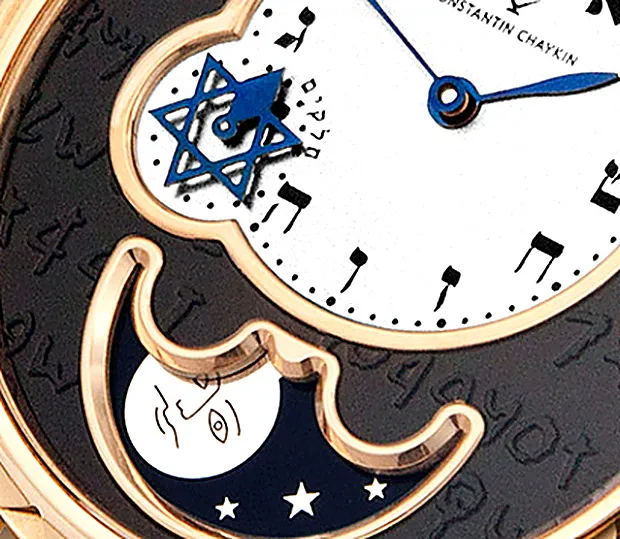
When the shield David gave to iron passed to his son Solomon, it was sealed with a mystical symbol: the Seal of Solomon, the Magen David.
Two interlocking equilateral triangles make a simple but complete code. The triangle pointing up represents the ascent of man towards the divine, his prayer, his hands opened to the sky; the triangle pointing down stands for the descent to earth of mercy, of abundance and of the order announced in the Ten Commandments. Both directions exist at once, and neither means anything without the other.
The symbol is a shared inheritance of the civilisations of the East. Seljuk architects cut it into the doorways of their madrasas, Ottoman sultans had it painted onto palace ceilings. Barbarossa Hayreddin Pasha, turning the Mediterranean into an Ottoman lake, put the Seal of Solomon in the very centre of his green banner, to honour the memory of the Solomon who commanded the wind and to place his fleet under protection. How many civilisations have claimed a symbol is the measure of how deep it goes.

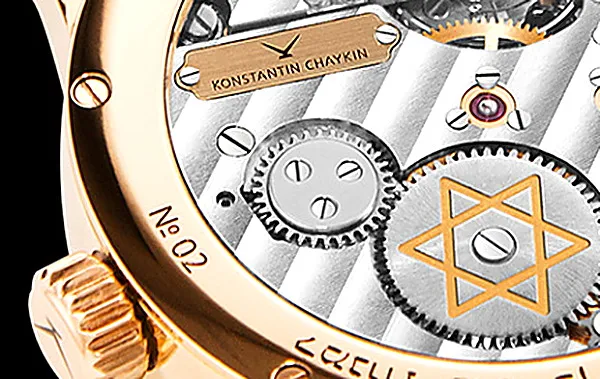
This whole body of memory, running from the cradle on the Nile to the tablets of Sinai, from David’s sling stone to the seal on Barbarossa’s banner, settles today onto a forty millimetre dial in the hands of one of the most contrary minds in independent watchmaking: the Konstantin Chaykin Decalogue Rega.
The dial is deep blue and it is not empty: the text of the tablets, in the shape of the ancient Aramaic script, has been raised in relief across the surface. The relief is so low that when light strikes from different angles the writing appears and disappears like an old manuscript on parchment. To write a text so that it is sensed rather than read is also a choice.
Hours and minutes are read on a silvered ring shifted off the centre. There are no numerals on that ring; letters stand where the indices should be. And exactly at twelve o’clock sits a blue Seal of Solomon: a small seal guarding the flow of time from above like a shield. In the lower left corner of the dial a nostalgic moon phase, its moon carrying a face, turns among stars in a navy sky. And in keeping with the founding idea of the Decalogue family the hands run counterclockwise, because the languages this dial speaks are written from right to left.
But the accomplishment that gives this watch its name is on the back. In Jewish reckoning an hour is divided not into sixty minutes but into one thousand and eighty parts, the halakim; each helek is about three and a third seconds. And a helek itself has a seventy-sixth: the rega. Around forty-four milliseconds, shorter than a blink. Chaykin has tied that unit to a hand: the rega hand on the movement completes a full revolution in seven point two seconds, and there is almost no hand in watchmaking that turns at that speed. Measuring a fraction of a second is no great feat; making it visible is.
The hand-wound calibre K.01-1 PS does this with a hundred and sixty-five parts and seventeen jewels; it is thirty-one point three millimetres across and seven point eight five deep, runs at 21,600 vibrations an hour and gives forty-eight hours from a full wind, with a daily rate in the band of fifteen seconds and a lever escapement. The case is forty millimetres in eighteen-carat rose gold, its coin-edge flank recalling the stonework of a temple. It is water-resistant to thirty metres, with sapphire front and back; the strap is navy alligator and the buckle a gold prong buckle made by Chaykin himself.
format_quote"Measuring a fraction of a second is no great feat; making it visible is."
Hasan Bekmezci



The Decalogue Rega is not an ordinary object of luxury carried on a wrist. It is the safety of a cradle drifting on the Nile, the moral order of the Ten Commandments revealed on Sinai, the faith of a sling stone that brought down Goliath’s pride, and the protection of the seal on Barbarossa’s banner.
As the hands drift from right to left, that blue seal on the dial whispers this: against the anxieties of the modern world that come at us like Goliath, what we need is not brute force but an unshakeable faith, armour forged in justice, and the ability to live time to its own rhythm.