
History was being written in blood and tears in the shadow of the great pyramids of Egypt. A people groaning under the proud whip of Pharaoh had been bound for generations by the merciless chains of slavery. In that dark age, when every newborn boy was killed and the cries went up to heaven, an orphan raised in the heart of the palace would become the leader of an entire people and of the truth.
Picture the moment of the escape from that fortress of oppression. Midnight; behind them the roaring war chariots of the Egyptian army, the clatter of bronze armour, clouds of dust rising from the hooves of the horses. Ahead of them the endless, pitch-black Red Sea. The helpless people cry out in terror: we are caught, death behind us and a bottomless abyss in front.
At that exact moment Moses did not turn around. The staff met the sea and the laws of physics bent. Gravity, hydrodynamics and the molecular bonds of water were suspended by a single command; the sea split in two as if it had taken an immense blow. The waters hung in the air on the right and on the left like two mountains of liquid, and the corals behind them looked as though they stood behind a transparent wall. The only place a law can be suspended is in the hand of the one who laid it down.
Through the parted water such a wind was sent that the floor of the sea, mud for centuries, turned within seconds into a dry road. While the people walked between those walls, hundreds of thousands of tonnes of water collapsed in a single instant onto the army that had plunged after them in arrogance. Pride was drowned beneath the waters, broken back into its molecules.

The oppression was behind them, but a man’s trial with his own soul was only beginning. Entering the burning deserts of Sinai, Moses was called to the mountain to receive the divine laws that would guide his people; there he spent forty nights in worship and supplication, and the tablets of the covenant, into which the unshakeable principles of truth had been cut, were handed to him.
But the sight waiting for him as he came down was appalling. In his absence his people, through the mischief of a man called Samiri, had melted down their ornaments and made a golden calf that bellowed, and had begun to worship it. A people who had crossed a sea by miracle had forgotten that order in the middle of the desert and taken refuge in a statue. Witnessing a miracle is not enough to keep a person faithful to it.
Shaken by anger and by a deep grief, Moses set the tablets down on the ground and turned to his brother Aaron, crying out to ask why he had not stopped them. That was the most violent collision between truth and idolatry, between the sacred and the worldly. After the people repented and were cleansed, the tablets would be lifted again, placed in the Ark of the Covenant and preserved for the temple that would one day be built.
Those ten commandments, for whose sake the mountains shook, were these universal principles: to take no god besides the Creator; to make no statue of anything and worship no material object; not to invoke the sacred name in vain or in falsehood; to interrupt the flow of time one day a week and give that day to the sacred; to honour one’s mother and father; not to take a life unjustly; to guard chastity and the bonds of family; not to seize another’s right or another’s property; not to pervert justice or bear false witness; and not to covet another’s property or another’s provision. Nine of the ten are prohibitions and one is rest; that a moral order puts a single day of emptiness inside itself is the proof that it knows the human being.
format_quote"The only place a law can be suspended is in the hand of the one who laid it down."
Hasan Bekmezci


Centuries after Moses, the Ark and the tablets inside it came into the hands of Solomon, son of David, and reached the majesty they deserved. He had been given a dominion granted to nobody else in the world.
The subjection of the wind means that atmospheric currents, and physical space itself, were assigned to his will; at his command the wind covered a month’s distance in a morning and a month’s distance in an evening. This was a transport order resting on the bending of space and the compression of time. And to know the language of birds is not to imitate animal sounds but to have access to the micro frequencies of the universe, to the biological acoustics of living things and to those hidden networks of communication. To be able to hear even the smallest creature’s cry inside the order is not an expansion of power but of understanding.
Building the temple on Mount Moriah, he made use of the unseen forces under his command and of springs of molten copper, and placed the Ark at the centre of the sanctuary. The two immense copper pillars raised at the entrance of that temple would return, centuries later, to the dial of this watch.

The greatest secret of Solomon’s palace, though, is the bringing of the throne and the story of Bilqis, the Queen of Sheba.
Before the queen of a sun-worshipping people had even reached the palace, Solomon asked: before they come in submission, who can bring me that throne of hers weighing tonnes? One of the jinn said he would bring it before Solomon rose from his place, and then the one who possessed a deep knowledge of the book stepped forward; in the old tradition he is remembered as Asaf ibn Barkhiya. I will bring it to you before you can open and close your eye, he said.
How is such a thing possible? It is the secret of matter changing place inside the continuum of spacetime: the knowledge that reads the atomic structure of a thing and rebuilds it at another point, months of distance away, inside a fraction of a second. Before the blink was finished, that throne from the land of Sheba appeared in the middle of the hall. Distance exists for the one who measures it, not for the one who lifts it.
When Bilqis stepped into the palace she found her throne in front of her. Asked whether her own throne was like this, she looked at a sight that strained the limits of her understanding and said, as though it were the very one, and fell into deep astonishment. Then she walked towards the floor of the hall. She did not know that the floor was made of crystal, a transparent glass with water running beneath it; thinking she was stepping into a deep pool, she gathered up her skirts. When she was told that this was a floor made of crystal, every worldly illusion in her mind was scattered.
That day, by her own account, she gathered up not her skirts but her proud soul. She had arrived as a queen who worshipped the burning light of the sun and took pride in the indestructibility of her golden throne; she left having seen that splendour lies not in worldly wealth but in an order sealed by an unseen will. She confessed that she had wronged her own soul, and submitted to the Lord of the worlds. What changes a person is usually not a miracle but that small moment in which they notice their own eyes have deceived them.
format_quote"Distance exists for the one who measures it, not for the one who lifts it."
Hasan Bekmezci
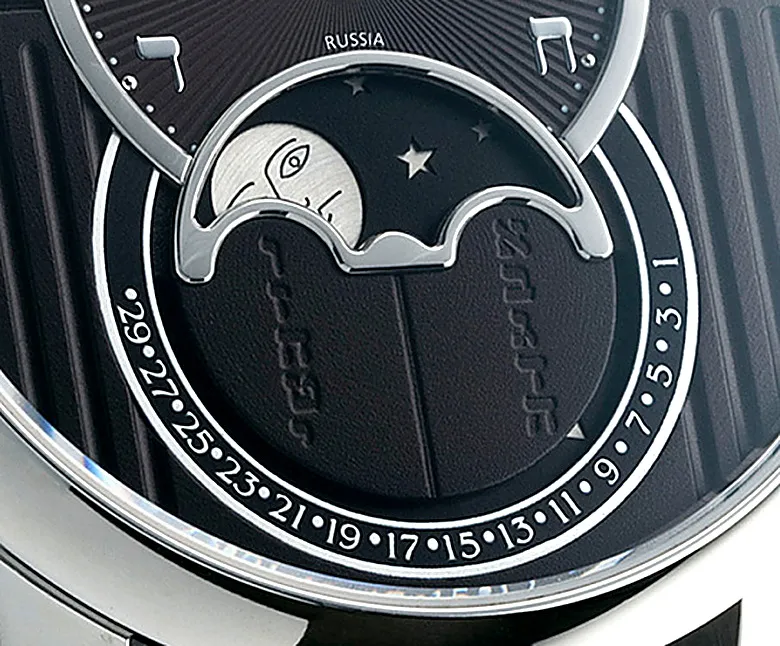
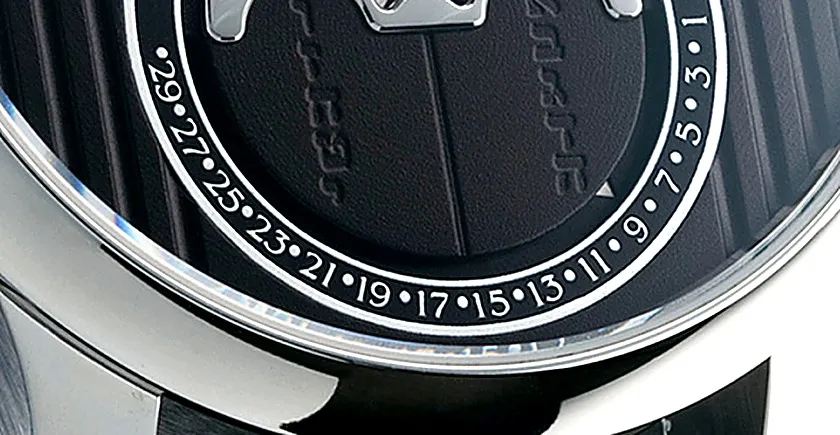
That ancient memory, running from the parted waters of the Red Sea to the tablets set down on Sinai, from Solomon’s temple to the crystal floor that astonished Bilqis, settles today onto a forty-two millimetre dial in the hands of one of the most contrary minds in independent watchmaking: the Konstantin Chaykin Decalogue Luah Shana.
Look at the dial and the hands do not turn to the right as you are used to. Because the Hebrew alphabet and the sacred texts are written from right to left, the K.01-0 calibre Chaykin designed from scratch also turns time counterclockwise. This is not a dial trick: reversing the direction of a gear train means rethinking every wheel in the transmission. If the direction of a script can change the direction of a mechanism, that mechanism is no longer a device but a sentence.
There are no numerals on the dial; in their place stand Hebrew letters whose numerical values run from one to twelve. Gematria, the ancient reading that turns letters into numbers, has translated the indices of this watch into its own language too. The vertical lines in the relief texture of the dial recall those two copper pillars raised at the entrance of the temple. At six o’clock a moon phase turns, and the moon disc carries a stylised image of the stone tablets. The ring around it shows the date on the traditional Jewish lunar calendar; that the moon and the calendar meet in the same window is because that calendar is tied to the moon in the first place.
And here lies the real idea of the Decalogue family. In Jewish reckoning an hour is divided not into sixty minutes but into one thousand and eighty parts, the halakim; each part is about three and a third seconds, and beneath it sits a still smaller unit called the regaim, shorter than a blink. Chaykin is the only watchmaker who calculates these units. To divide time by sixty is a habit; to divide it by one thousand and eighty is a worldview.
The hand-wound K.01-0 is thirty-one point three millimetres across and seven point three deep; it carries seventeen jewels, runs at 21,600 vibrations an hour and gives forty-eight hours from a full wind, with a daily rate in the band of fifteen seconds. For adjusting the hairspring Chaykin uses a regulator of his own drawing, known in the atelier as the Pac-Man for its shape. The case is forty-two millimetres of steel, water-resistant to thirty metres, with sapphire in front and a sapphire window at the back; the strap is leather with a steel clasp.
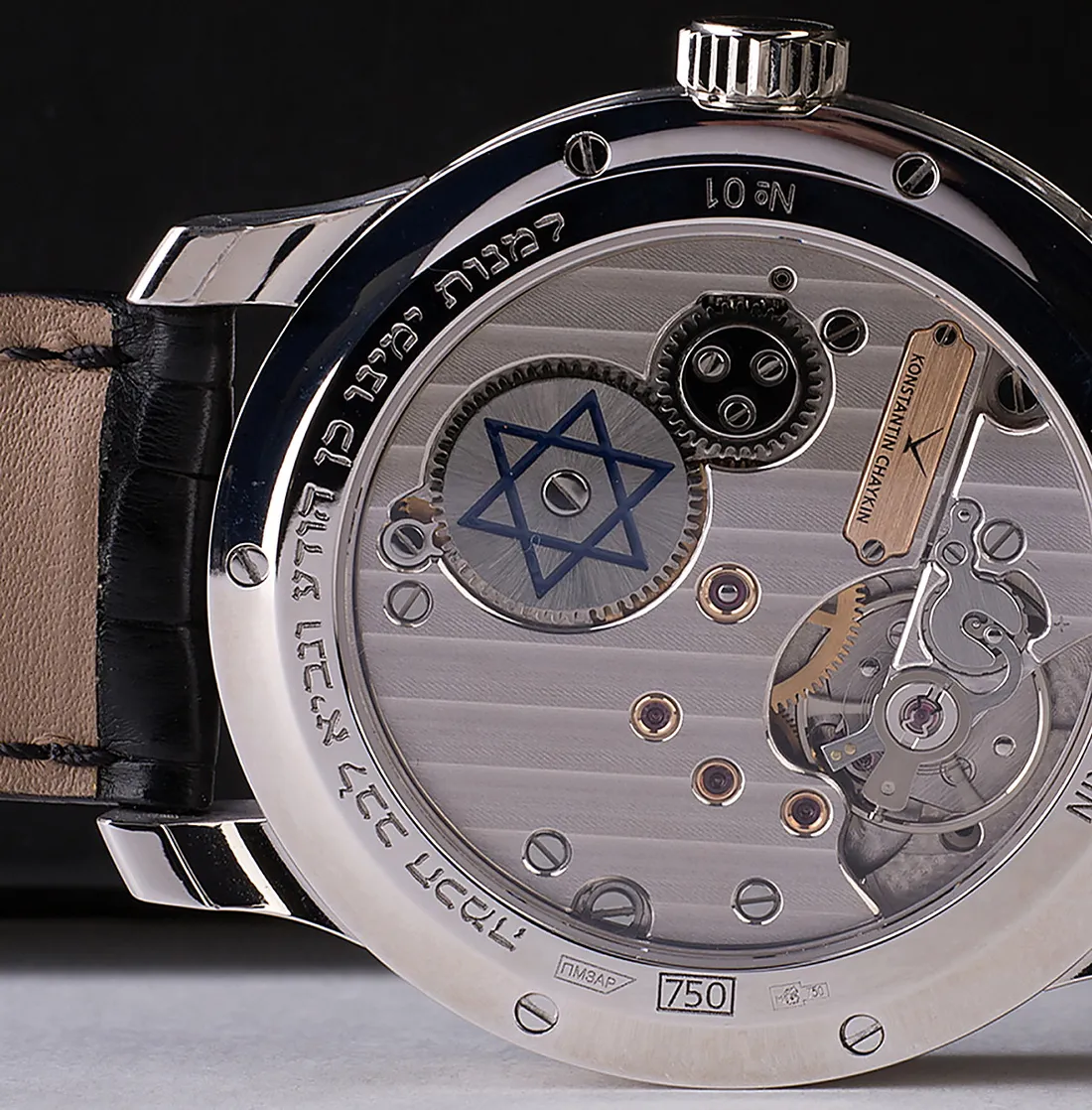
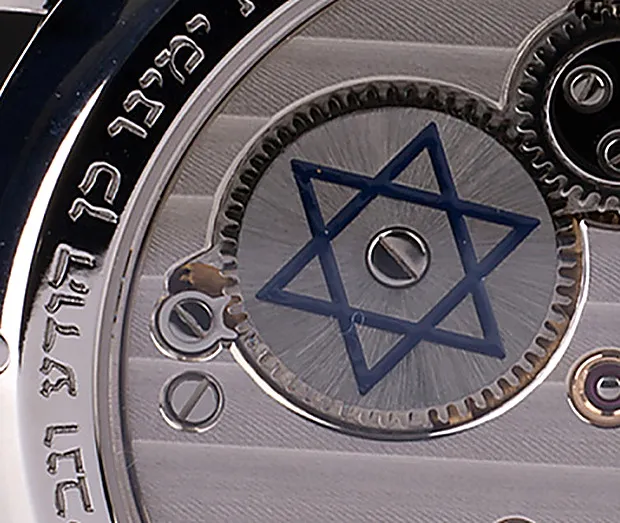

The Decalogue is not an accessory you carry on your wrist. As the hands drift from right to left it whispers this: modern man, chasing golden calves, speed and ambition, believes he is spending time.
Yet time is the ability to stand still like the unshakeable faith that parted the Red Sea, to take refuge in the morality of the tablets of Sinai, and to stop like Bilqis on that crystal floor and lift the veil from your own eyes.
format_quote"To divide time by sixty is a habit; to divide it by one thousand and eighty is a worldview."
Hasan Bekmezci