
In the high-ceilinged laboratory of the Botanical Institute at the University of Neuchâtel, the freezing damp of the Swiss winter outside was misting the windows. Among the slides laid out on the bench, the electron microscope images and the leaf sections, Professor Marc and his assistant Dr Julien were studying the seasonal metamorphosis of trees.
At that very moment a sharp gust of wind moved through the branches of the great maple in the institute garden. The two academics raised their heads and looked at the window. A single yellowed leaf slipped from its branch and drew a lonely arc towards the ground in the arms of the wind.
Julien sighed faintly and came closer to the window:
“Most people, when they see the leaves coming down one by one in autumn, say oh come on, it is simply getting ready for winter, and think no more of it. Whereas a leaf breaking from its branch and falling to the ground is the result of biochemical processes as exact, as lawful and as finely tuned as its own formation in spring.”

Professor Marc took off his glasses, laid them on the bench and smiled:
“Because a human being is deceived by the simplicity on the surface, Julien. That shedding of leaves, which we call abscission in plant physiology, holds behind it a flawless strategy for preparing for winter. When autumn comes, the shortening of the days and the drop in temperature change the hormonal balance in the leaf. The auxins and cytokinins that encouraged growth all through spring and summer decline, while inhibiting hormones such as abscisic acid and ethylene gradually rise. Abscisic acid acts on the genetic centres of the mesophyll cells in the leaf and triggers the synthesis of degrading enzymes such as protease, RNase and chlorophyllase. These enzymes break down, in that order, protein, RNA and the chlorophyll molecules that give the leaf its green. Once the green chlorophyll is withdrawn, the yellow carotenoids underneath are revealed.”
“And that tremendous principle of thrift comes into force,” Julien added. “Just as a space shuttle pumps all its precious energy into the main cabin after launch and then separates the emptied fuel tank from the body. The nutrients broken down by the enzymes pass through the leaf stalk and are stored in the parenchyma cells of the plant’s roots and trunk. Waste is zero, because when the leaves are born again in spring these materials will be used as building stock. Once the nutrients have been moved, an abscission layer is established at the point where the leaf stalk joins the branch. There abscisic acid and ethylene set cellulase and pectinase to work, dissolving the pectin bridges between the cells from the outside inwards. What is left is only the innermost, lifeless, hair-thin woody vessels that carry water to the leaf. The light gust of wind a moment ago was enough to snap those thin tubes.”
format_quote"A leaf breaking from its branch and falling to the ground is the result of biochemical processes as exact, as lawful and as finely tuned as its own formation in spring."
Hasan Bekmezci
“But the tree does not leave an open wound behind it!” said Marc. “New cells arise quickly where the leaf broke away and the place is sealed with a waterproof, corky callus tissue. Just as a fortress preparing for a winter siege seals its gates with waterproof armour. This tissue protects the plant from water loss, from cold, from harmful gases and from pathogens. How exactly it agrees with that deep expression found in the holy texts and echoed across every ancient tradition, does it not? Not a leaf falls outside His knowledge. And truly, every fall happens by an unerring measure held in that knowledge.”
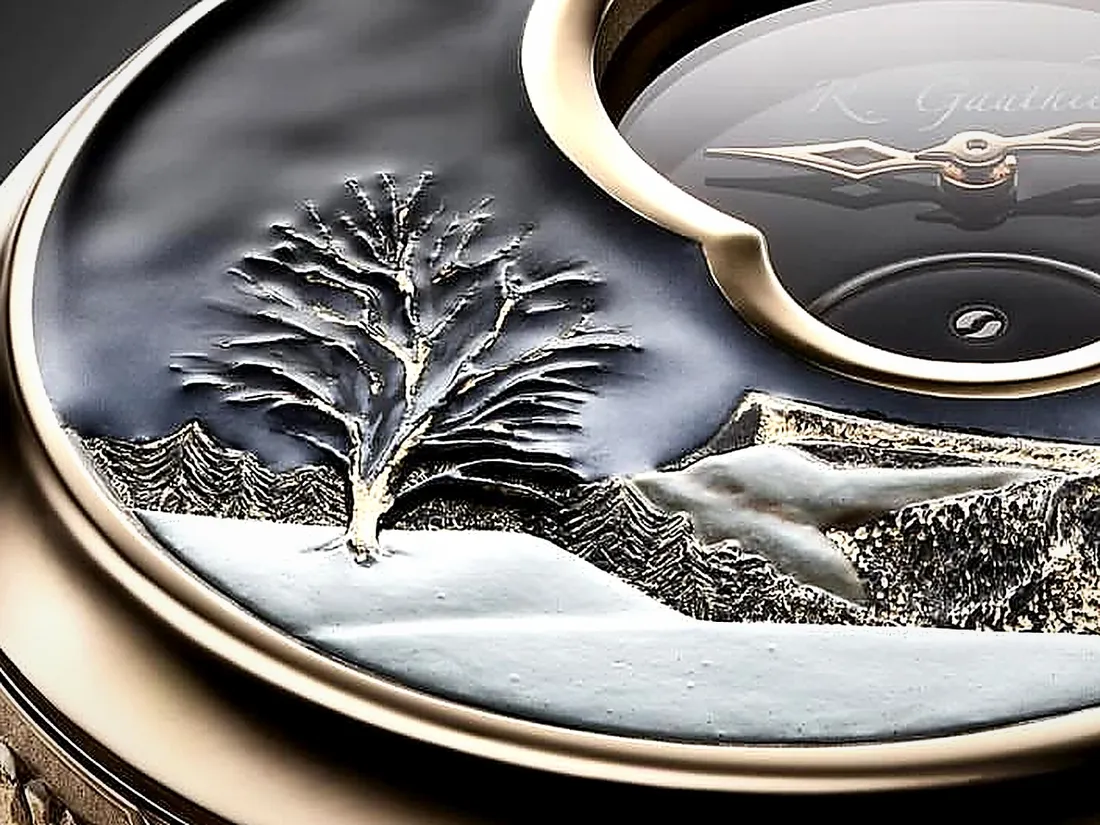
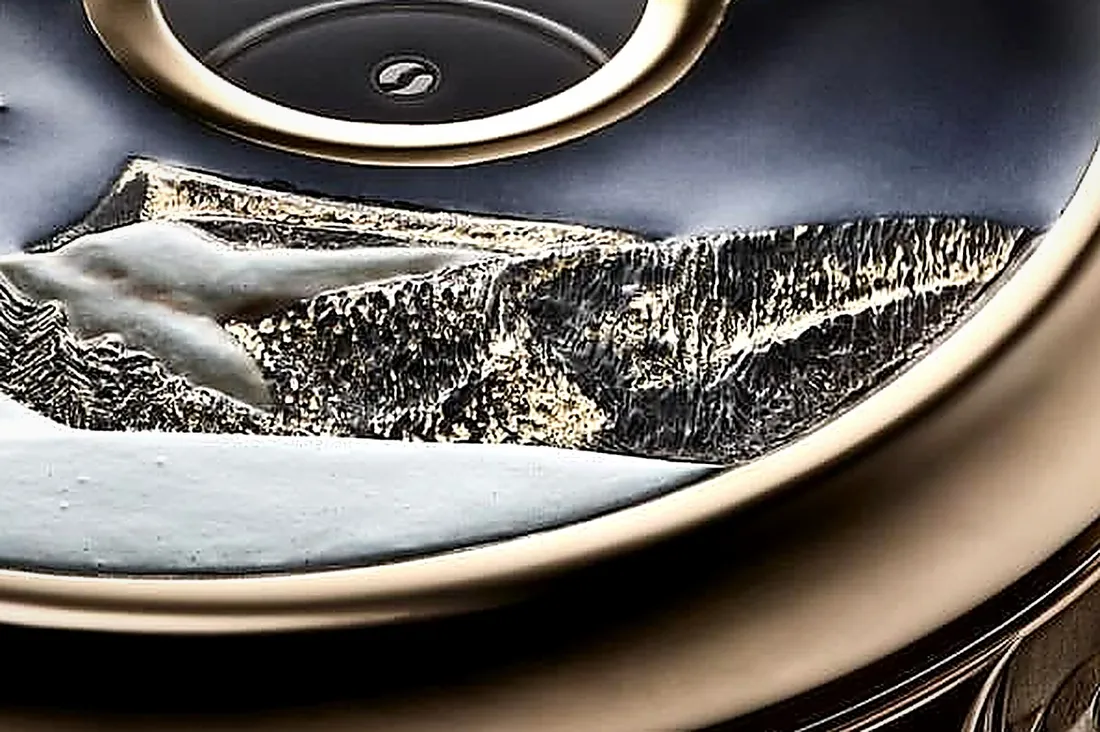
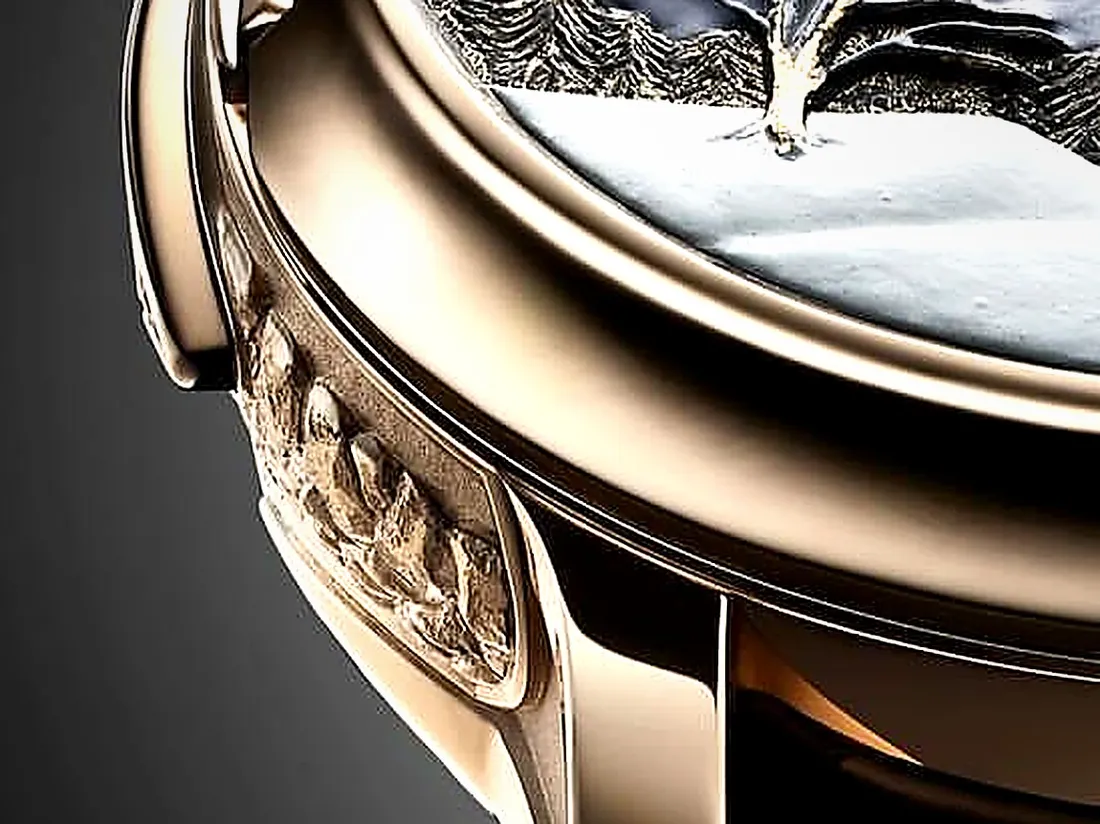
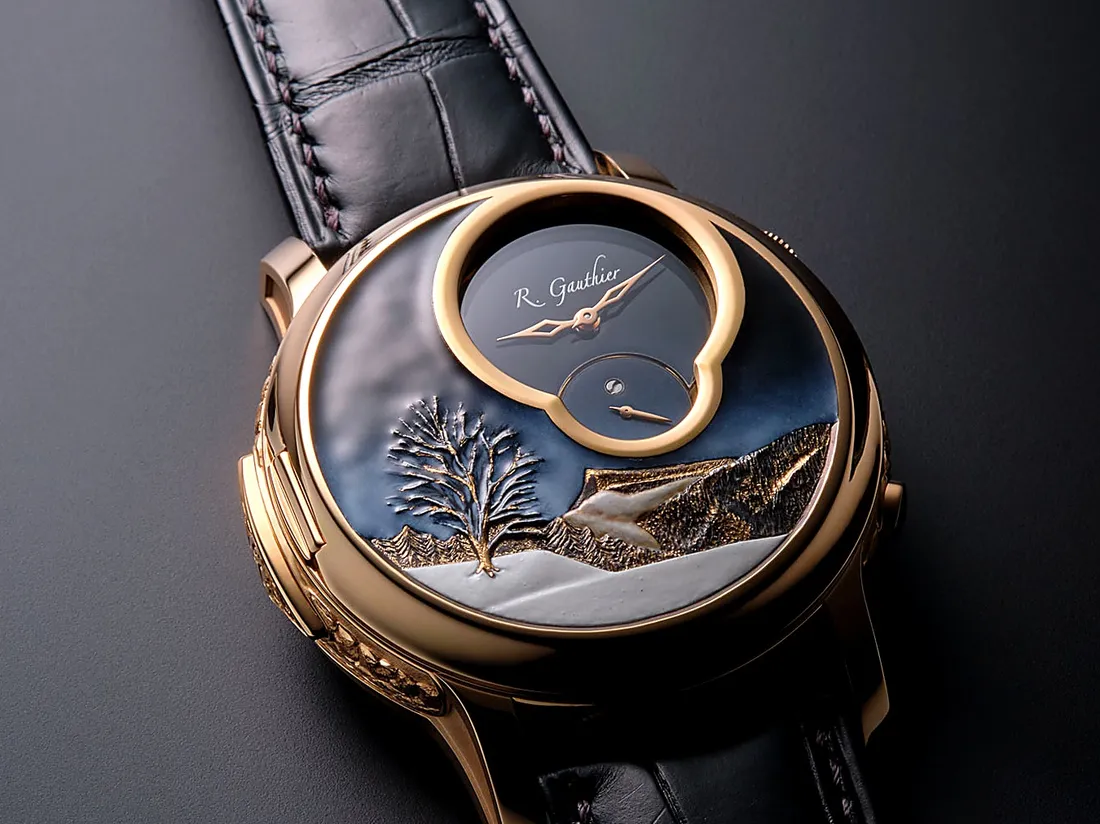
When Marc reached out his arm to wipe the mist from the window, the cuff of his jumper slid up. Julien’s eye caught the watch on the professor’s wrist. On the 18 carat rose gold case stood a freezing winter landscape worked by hand engraving: the snow-covered mountains of the Vallée de Joux, and at the centre of the cover the silhouette of a single bare tree standing upright.
Julien pointed at the watch excitedly:
“Marc. This piece on your wrist. It is carrying the abscission process you have just described, and that winter armour sealed with callus tissue, on a canvas of gold! Look at that bare tree and that monochrome winter scene on the outside of it.”
Marc smiled and held out his wrist:
“This is the Romain Gauthier Logical One Secret. Look, this outer cover, standing closed, is the protective winter sleep the tree passes through behind its callus tissue. The bare tree has sealed itself in golden armour against the freezing cold. But look at the small aperture towards twelve o’clock. Winter may rule outside, yet down below the time runs on without a break, like that hidden sap inside the trunk.”
“Is the cover the same landscape on every Secret?”
“No, and that is the whole idea, Julien. When the Secret appeared in 2014, Romain Gauthier did not put a watch in front of you, he put a blank canvas: what goes onto the cover is the owner’s decision. Hand engraving, miniature painting, enamel, guilloché or gem-setting; whichever is chosen is what gets done. And this detail delights me: on the inside of the cover, beside the maker’s logo, the signature of the artist who did the work is engraved. So the watch keeps the name of the hand that decorated it hidden inside itself. One known example carries a modernist reading of Rio de Janeiro on its cover, another a dynastic landscape, another reveals blue grand feu enamel counters when it opens. Mine carries the winter of the valley.”
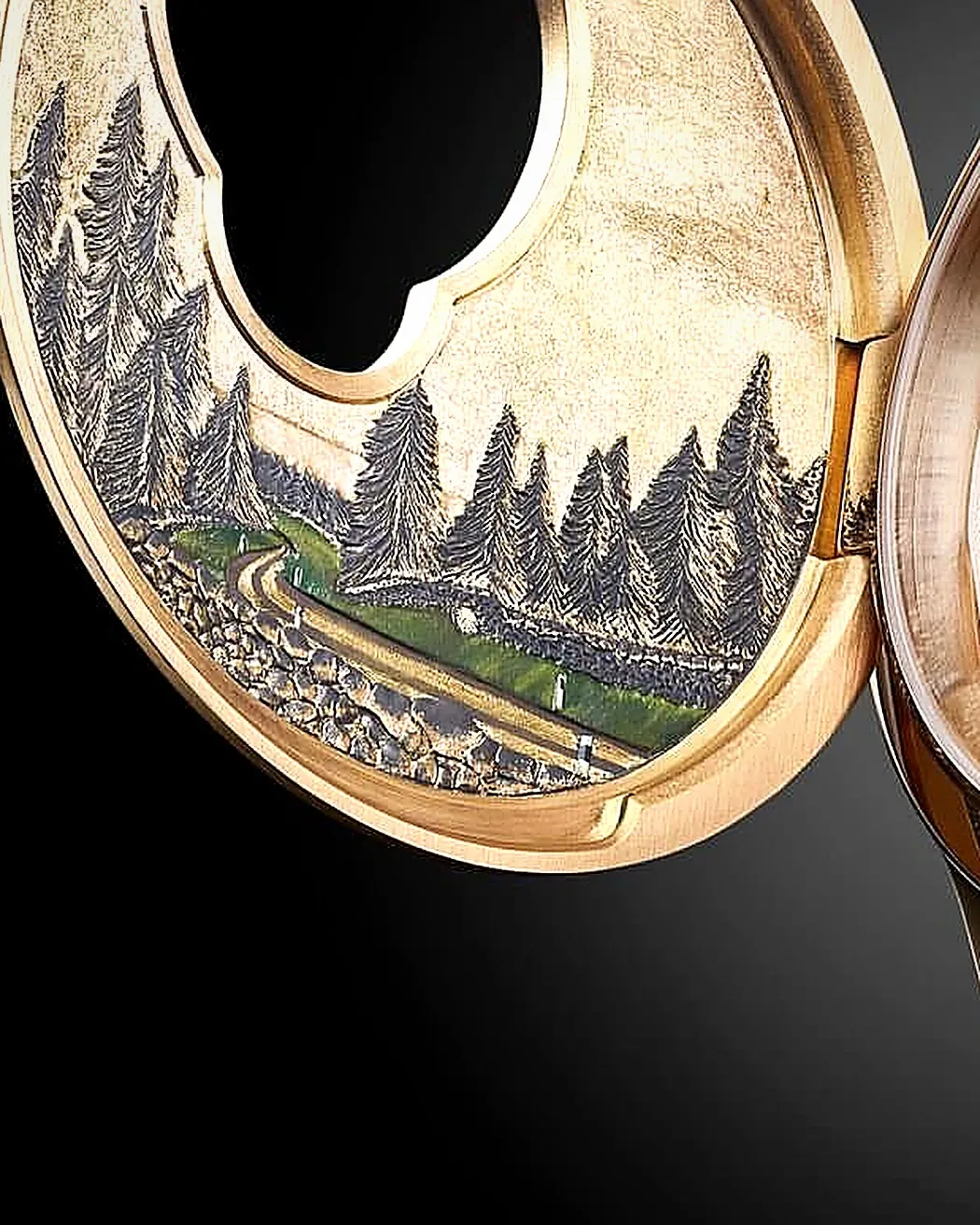
With the tip of his finger, Marc eased the hinged cover open. The moment it opened, the monochrome winter scene outside disappeared. On the inner face of the cover, living green pine forests, sunlit paths and warm spring tones came into view, worked by hand. At the same instant, behind the sapphire crystal, the heart of the movement began to work in the open.
format_quote"Winter may rule outside, yet down below the time runs on without a break, like that hidden sap inside the trunk."
Hasan Bekmezci
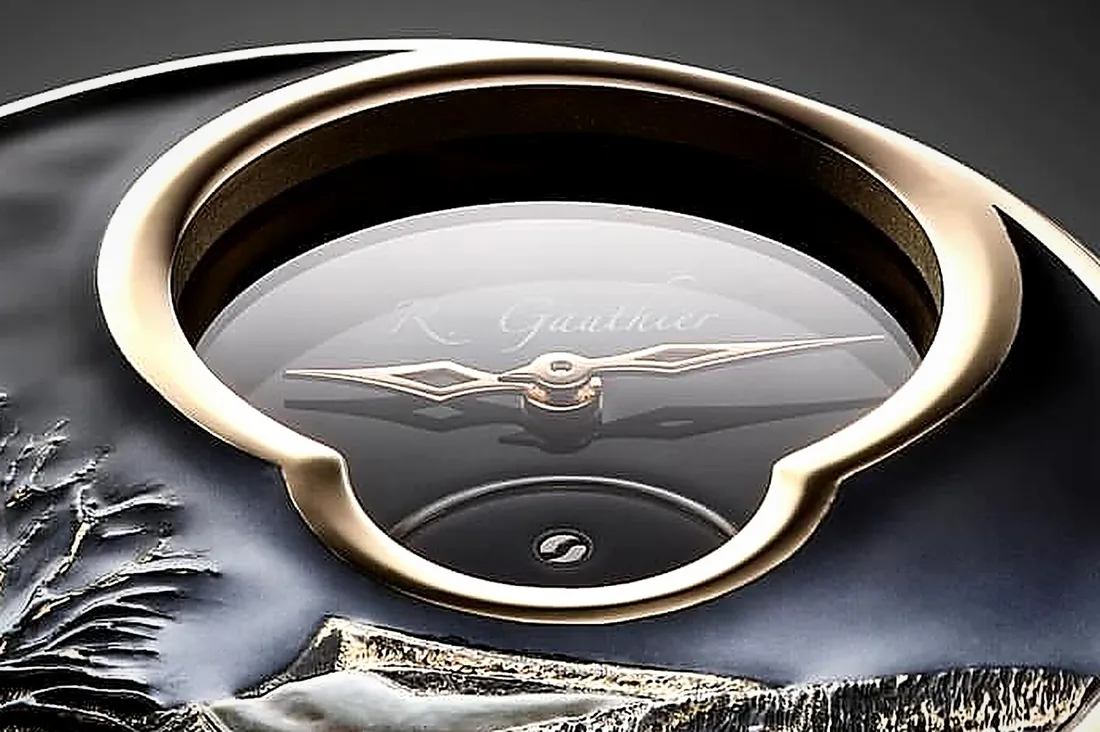
Julien leaned forward, looked into the cover and held his breath in admiration:
“Extraordinary! Open the cover and there is a whole landscape of waking inside! Let us talk about the biochemistry behind that waking too, Marc. That trunk, asleep and sealed with callus, how does it turn into this living green inside the cover once winter is over?”
Marc’s eyes lit up:
“Behind this green explosion inside the cover lies a tremendous biochemical waking, Julien! A plant does not pass the winter in a stupor, it passes it counting: the buds refuse to open until they have spent a certain time in the cold, and we call that endodormancy and the chilling requirement. When that reckoning is complete, abscisic acid is broken down. As the soil warms in spring, a storm of growth hormones breaks out in the roots. The starch held in the trunk all winter is turned instantly into glucose and sucrose by amylase. Root pressure peaks; the sugared sap is pumped up through the xylem channels like a giant hydraulic press.”
“Just like the gates of a dam being opened,” Julien whispered.
“Exactly! When that sugared fluid reaches the meristem cells beneath the bud scale, a furious round of division begins. The osmotic turgor pressure created by the water filling the cells cracks that hard bud scale open like a steam engine breaking frozen locks. In the cells that meet the light, chlorophylls are synthesised as though the solar panels of a space station had opened all at once, and photosynthesis begins. Every stored joule of energy was for this spring waking inside the cover!”

Julien looked at the mechanism ticking away and smiled:
“The movement is keeping time with that waking too.”
“Because the technical architecture agrees completely with this biological law,” said Marc. “Just as a plant balances its root pressure and its energy, this Logical One movement delivers constant force to the balance. In conventional watches torque falls as the mainspring unwinds, exactly like a plant losing its turgor pressure and shrinking when it runs out of water. Here, though, synthetic rubies in the links of the chain bring friction down to almost nothing. The flat snail cam gives the balance its energy with an even, complete and impartial equality, even as the mainspring runs down.”
“Chain-driven constant force is an old idea though, is it not?”
“The idea is old, the solution is new. A classical fusée is cone-shaped and stands above the mainspring barrel; the chain pulls at an angle, it is long, and the angle of pull changes with every turn. Romain Gauthier threw the cone away, put a slowly turning flat snail cam in its place, and set it on the same plane as the barrel. The pull therefore stays on a straight line at every moment and one short length of chain is enough. And in the links of that chain there are rubies rather than steel pins; every link turns like a tiny bearing, which is to say friction and wear were designed out at the start. The arrangement is protected by four separate patents.”
“Give me the numbers as well.”
“Thirty-seven jewels, twenty-eight thousand eight hundred vibrations an hour, a forty-six hour reserve and an indicator that lets you read that reserve on the dial. And the Logical One took the Men’s Complication prize at the GPHG in Geneva in 2013, so this architecture is not only to my taste.”
format_quote"In conventional watches torque falls as the mainspring unwinds, exactly like a plant losing its turgor pressure and shrinking when it runs out of water."
Hasan Bekmezci
Julien touched the rough textures at the edge of the case:
“The reliefs on the flanks of the case also call to mind the bark on the trunk of an old tree and the rocky structure of the Jura mountains.”
“And the winding system,” Marc added. “You do not turn a crown and force the mechanism. You press a single button set into the case; every press stores energy directly into the mainspring. Just like the spring sun striking a leaf and synthesising ATP in a single instant.”
“Do you know the man who made this?”
“He is a child of this valley. Romain Gauthier was born in 1975 in the Vallée de Joux, which is to say he grew up inside the landscape engraved on the cover. He made parts for other houses for years, decided around 1999 to start his own, and wrote the thesis of his business master’s in Lucerne directly as the business plan of his own manufacture. With the support of François Golay he began producing the components of his first calibre in 2005. He is still doing the same thing today: making his parts on his own machines, with tools he cuts himself. That is why the Logical One is not a story built on top of a supplier’s movement; from beginning to end it is the decisions of a single mind.”

As the two botanists looked at the sections on the bench, at that single leaf now mixing into the soil in the garden, and at the 18 carat rose gold case on Marc’s wrist, they understood once more that no shedding anywhere in creation is an ending, and that behind that cold armour of winter there always lies a constant, impartial and endless spring waking.
format_quote"No shedding anywhere in creation is an ending; behind that cold armour of winter there always lies a constant, impartial and endless spring waking."
Hasan Bekmezci
The Craft and the Technical Detail
The hinged secret cover: the outer face of the 18 carat gold cover carries a hand-engraved winter landscape, while the inner face becomes a miniature with a spring scene. When the Secret was introduced in 2014 the cover was deliberately left as a blank canvas: hand engraving, miniature painting, enamel, guilloché or gem-setting, whichever technique the owner chooses is the one applied. On the inside of the cover, beside the maker’s logo, the signature of the artist who did the work is engraved.
The reading aperture: a crescent-shaped opening cut into the upper part of the cover, which allows the hours and minutes to be read while the cover is closed. The watch thus shows that it is still running even when it is shut.
Constant force architecture: a classical fusée is cone-shaped and sits above the mainspring barrel, so the chain pulls at an angle and has to be long. Romain Gauthier removed the cone, put a slowly turning flat snail cam in its place and brought it onto the same plane as the barrel. The pull therefore stays on a straight line at every moment and a single short chain suffices. The arrangement is protected by four separate patents.
Ruby-linked chain: synthetic rubies are used in the links of the chain instead of steel pins; every link turns like a small bearing, and friction and wear are removed at the very start of the design.
Push-button winding: instead of turning a crown you press a button set into the case, and every press stores energy directly into the mainspring. It is a patented and ergonomic solution.
Calibre: hand-wound, 37 jewels, 28,800 vibrations an hour, a 46-hour power reserve with an indicator on the dial. Sapphire case back. The Logical One won the Men’s Complication prize at the GPHG in 2013.
Case texture and finishing: hand-worked rock and bark textures in relief on the flanks of the case; hand bevelling and mirror polishing on the bridges, with frosted surfaces. Most of the components are produced on the brand’s own machines in the Vallée de Joux.