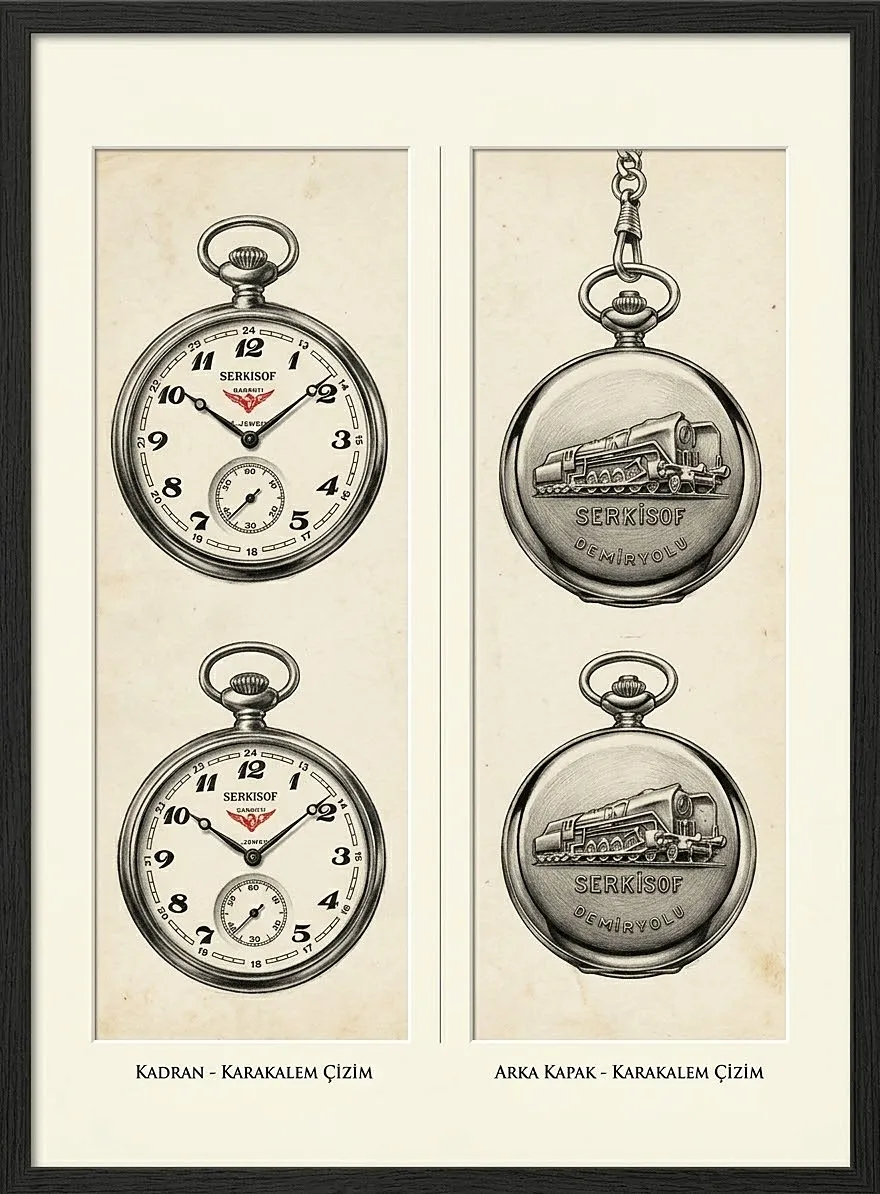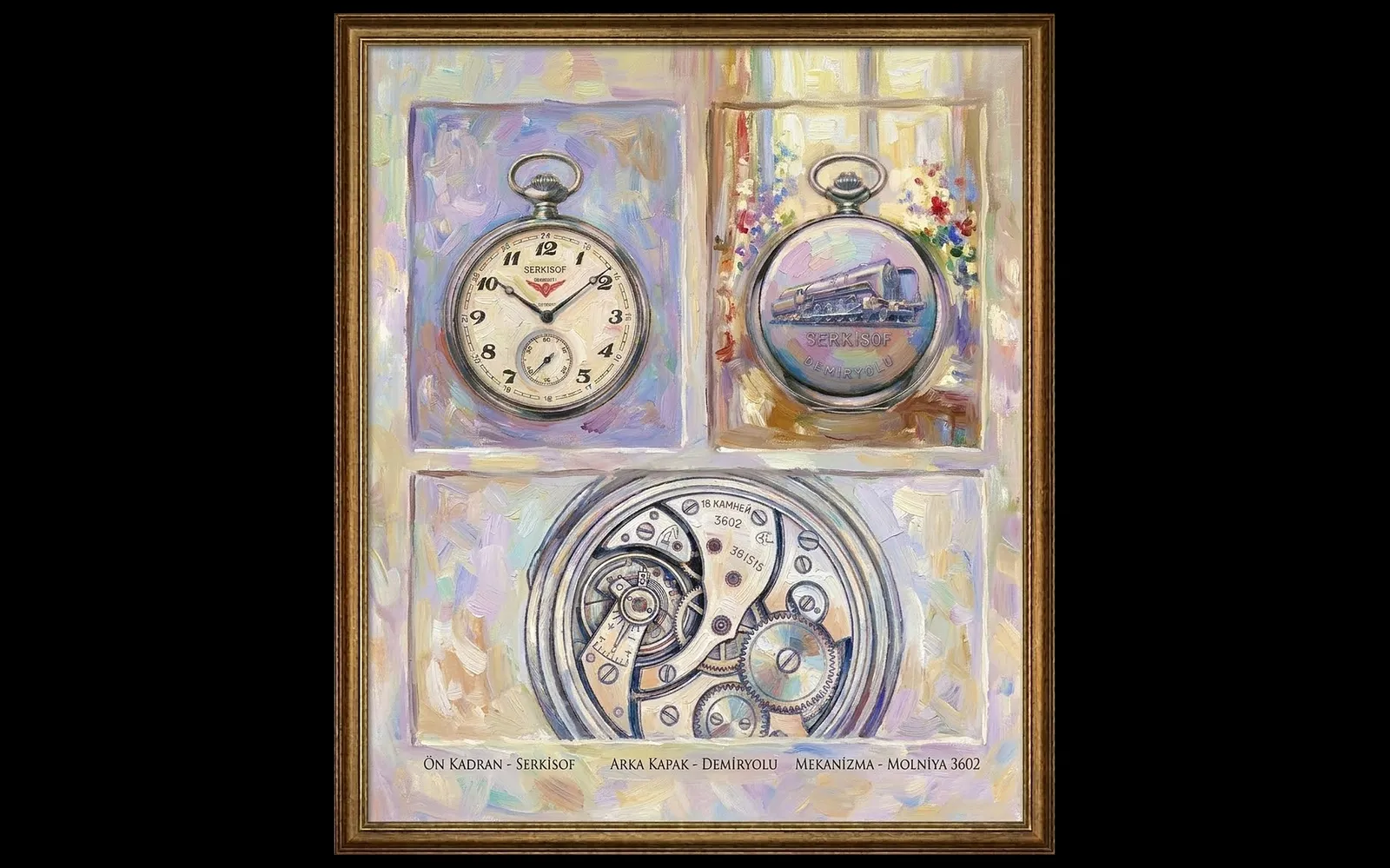
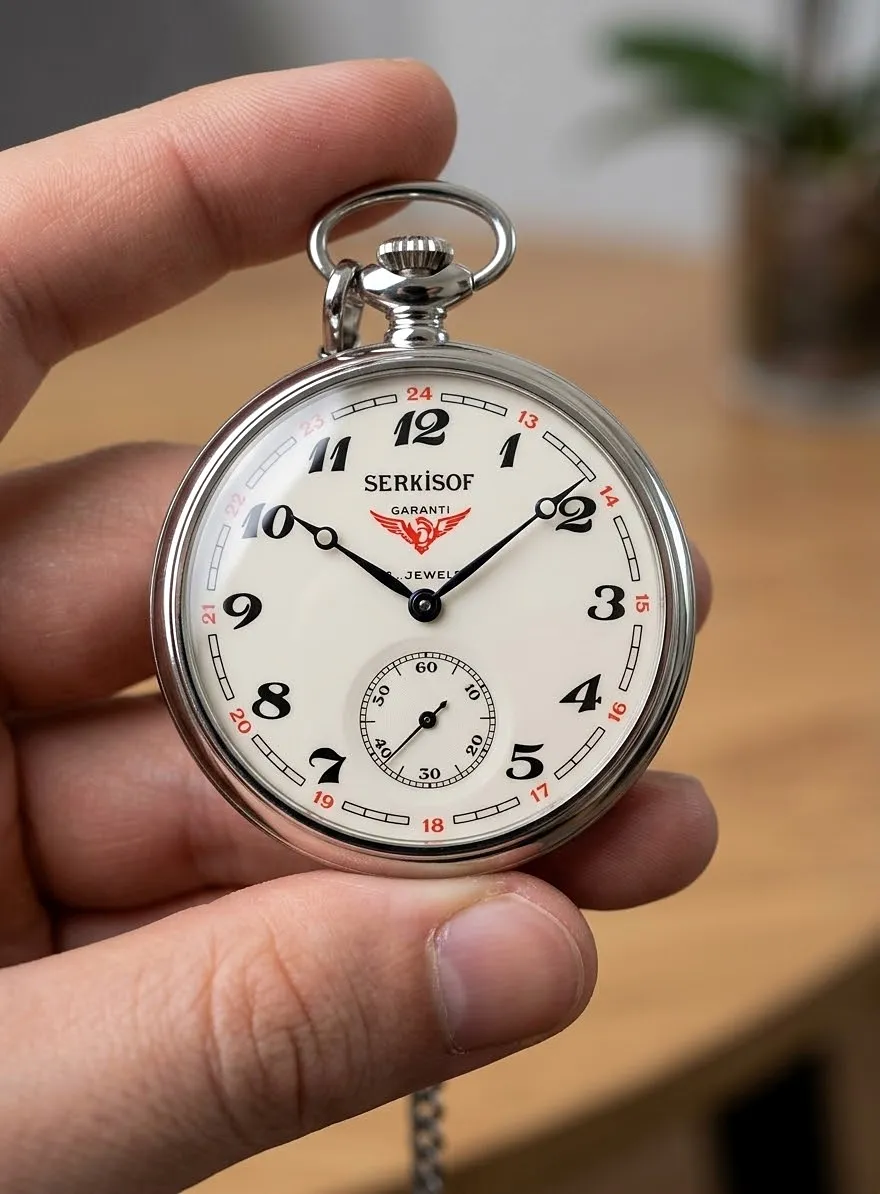
The watch we are holding is not merely a mechanical instrument ticking the time away. It is a historical monument that brings together in one body the precise horological genius of Switzerland, the industrial force of the Soviet Union at Tankograd, the commercial wit of the Sirkeci merchants who ran from the Ottoman era into the Republic, and the conscience of a Turkish railway clerk.
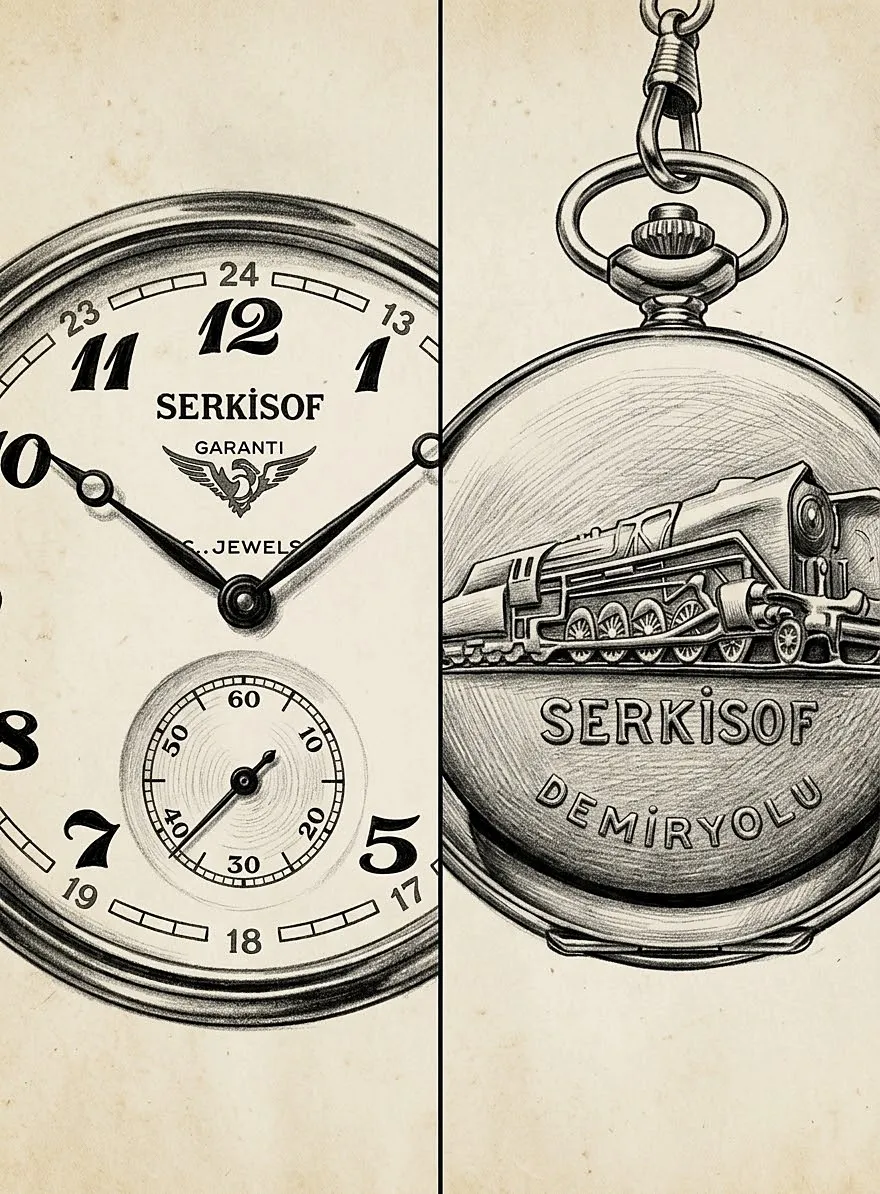
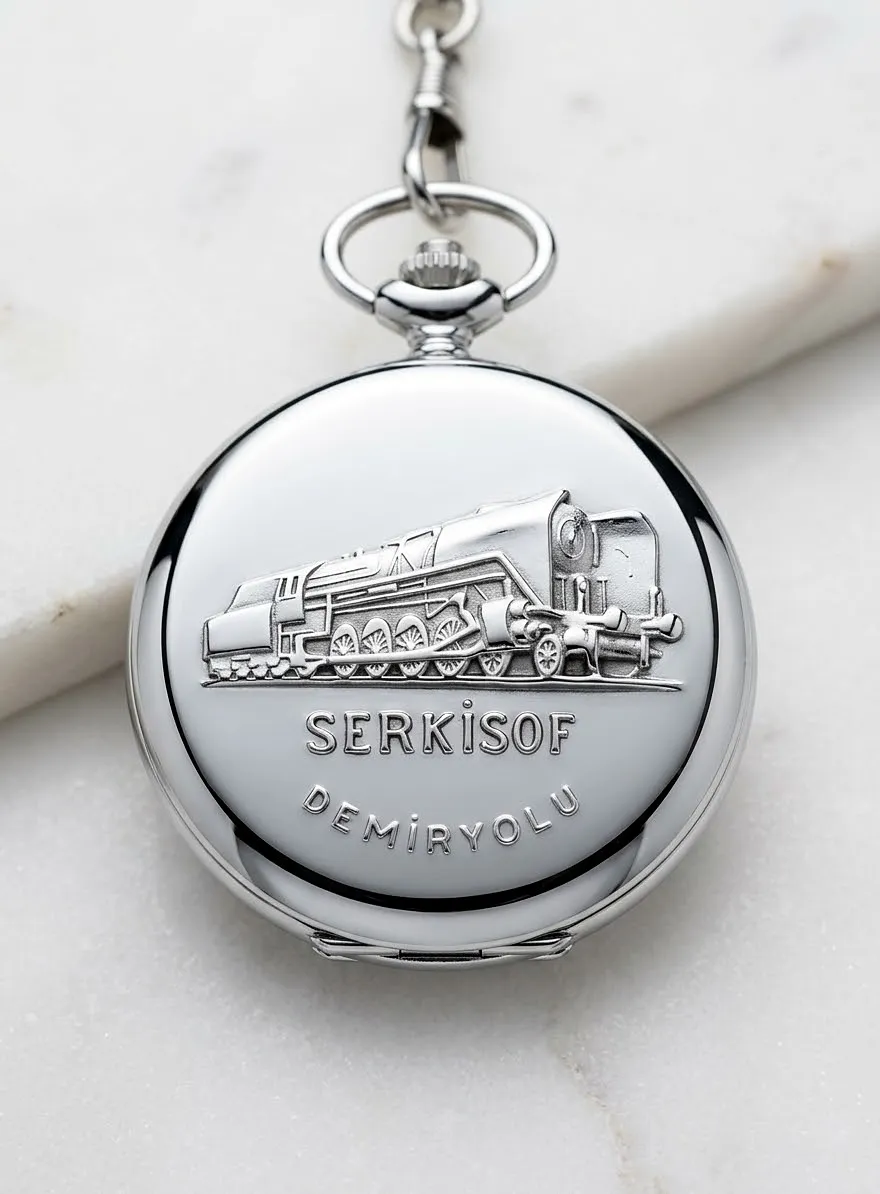
Its record, briefly, is this. The architecture of the movement comes from Switzerland, from Cortebert’s pre-war pocket watch calibres. The calibre inside is the Molnija 3602: thirty six millimetres across, with thick wheel teeth, beating eighteen thousand times an hour. The place of manufacture is the Chelyabinsk Watch Factory, east of the Ural mountains. On the dial the word GARANTI is written in Turkish, a red winged wheel stands below it, and the shift hours run from thirteen to twenty four around the edge. The locomotive on the caseback was struck in cold forging, then blackened and sanded back. And the hands are not painted but steel blued by heat.
format_quote"The watch we are holding is not merely a mechanical instrument ticking the time away."
Hasan Bekmezci
In the middle of the nineteen thirties, in Switzerland, the first drawings were born on the brass-smelling benches of the Cortebert workshops. The inertia of that calibre was so faultless and its torque so high that Rolex, the luxury giant of the day, turned in those same years to movements based on Cortebert.
The young craftsman Stefan, cutting the millimetric teeth of these wheels at the bench, believed his life would be made of nothing but brass and steel. Until he met Elena, the Russian painter and designer who came to the workshop as an apprentice with the depth of the Ural mountains in her eyes. Between Stefan’s fine callipers and Elena’s drawing pencils a silent, deep bond sprouted. Stefan gave her a small medallion worked from the finest steel balance staffs; and Elena whispered to him that steel is cold, but the intention you put into it warms it.
When the nightmare of the Second World War wrapped itself round Europe, the industrial plants of Moscow and its surroundings came under threat. By an enormous decision the Soviet Union dismantled the critical factories of the west, loaded them onto railway wagons and carried them to Chelyabinsk, east of the Urals. So many tanks and so much heavy ordnance were cast in that city that its name became, in effect, Tankograd: Tank City.
Elena had to return with her family to that frozen city behind the Urals, its chimneys smoking. Stefan, following his love, slipped in among the technical delegation that arrived in Chelyabinsk with production drawings and casting benches. The factory raised in the freezing Ural wind had been given its name: Molnija. In Russian it means exactly lightning. Fast, unstoppable, an energy that tears the dark.
Stefan and Elena met in secret in the soot-covered steel works of Tankograd. Stefan redimensioned the Swiss architecture in the hardest Soviet cast steels and took the diameter of the movement up to thirty six millimetres. This newly born calibre was named the Molnija 3602. It had thick wheel teeth and an enormous mainspring. Even if the oil froze and clotted, its torque would crush the obstacle and go on: a movement built like a tank.
In the early nineteen fifties, as the pressure of the iron curtain rose, escaping Chelyabinsk became a question of survival for Stefan and Elena. Out of the prototype line Stefan took a particular pocket watch, with a locomotive struck in cold forging on its back, and designed inside it a double-lidded chamber that hid their papers of freedom and a little saved gold.
One winter night, while the Ural storm mixed itself into the factory whistles, the two travellers hid in the wagon of a coal train. On that dangerous journey across Eastern Europe and the Balkans, when they clung to each other in fear in the dark wagon, their only comfort was the sound of the watch ticking in Stefan’s palm. Those heavy, blunt beats, five a second. It was the sound of the Lightning keeping the rhythm of their hearts against the storm.
And at last, one morning, the steam locomotive stopped with a steel scream. Outside came gulls, the salt smell of the Bosphorus and the shouting of the simit sellers: Sirkeci station.
Under the high yellow lights of the station the representative of the Serkisof family, waiting with his case, could not believe his eyes when he examined this enormous Soviet movement of Swiss descent. Stefan held out the watch from his pocket: this watch carries the mind of Cortebert and the unbreakable steel of Chelyabinsk, he said; it does not freeze, it does not stop, it does not give up. Serkisof Efendi snapped the lid shut: I shall put this watch in the palm of the Turkish railwayman, he said; we shall write GARANTI on the dial in Turkish and set the winged wheel upon it. This watch will be the honour of time in this country.
Editor’s note: this passionate story of escape, from Cortébert to Chelyabinsk and from there by coal wagon to Sirkeci station, was without doubt an invention of watchmaking literature and of our imagination. Something in us wishes that behind the cold steel in your hand there lay a past as romantic as that.
Yet set the magic of literature aside, go into the dusty archives of history, and what comes up is an epic of commercial intelligence far more real, far more far-sighted and far more industrial than the story of Stefan and Elena.
At the end of the eighteen hundreds, in the Ottoman Empire, time meant the unfailing wheels of the state and of the railways. The synchronisation of train services, the precision of stationmasters and engine drivers, held the order of the empire together. The watch merchants of Armenian descent gathered around Sirkeci and the station in Istanbul were at the heart of that trade.
The signature K. Serkisoff & Co. Constantinople is a real signature, still legible today on the pocket watches of that period. Inside those watches ran Billodes movements; Billodes is the former name of the Swiss manufacturer that would later be called Zenith. Which is to say that the name Serkisof entered Turkey not with Soviet watches but with Swiss ones.
After the founding of the Republic, and from the nineteen thirties onwards, movements in the exchange rate made Swiss watches extremely expensive in the Turkish market. The State Railways, meanwhile, had to give its staff solid, unfailing but affordable pocket watches every year.
At exactly that point the direction turned east. The factory founded at Chelyabinsk had put into series production, straight after the war, a pocket watch design bought from Switzerland. The watches had both the Swiss architecture and, thanks to the scale of Soviet heavy industry, a far more accessible cost.
As the story is told, a special production was ordered from the Soviets under the Serkisof name: the dial would say GARANTI in Turkish and not in Russian, the red winged wheel of the railwaymen would sit on the dial, and a three-dimensional locomotive would be struck into the caseback. The details of that agreement rest not in archives but mostly in the memory of families and collectors; but the object that came out of it is there in front of us.
These watches earned their real fame in Turkey through the gift given to railwaymen on their retirement. The State Railways cut the tradition in 1994 to save money and resumed it after a long gap. Which is to say that the watch in your hand is not usually an object that was bought but an object that was given. It is what a working life was worth.
Now let us look at the parts, because the real story is there.
The movement’s descent runs back to Switzerland, to Cortebert’s pre-war pocket watch calibres. The sources do not agree on which number was the base; some say 616, others 620. The first Soviet version was called the ChK-6 and had fifteen jewels; it was later taken up to eighteen and renamed 3602. The 18 КАМНЕЙ legible on the plate, eighteen jewels, is exactly that.
As for the Rolex connection, here one has to be careful. What is documented is this: Rolex too used Cortebert-based movements in those same years. The claim that the tooling the Soviets bought was the very tooling Rolex had ordered for the Panerai watches it assembled for the Italian navy is a collectors’ account and rests on no primary source. The kinship is real; the exact degree of the kinship is hearsay.
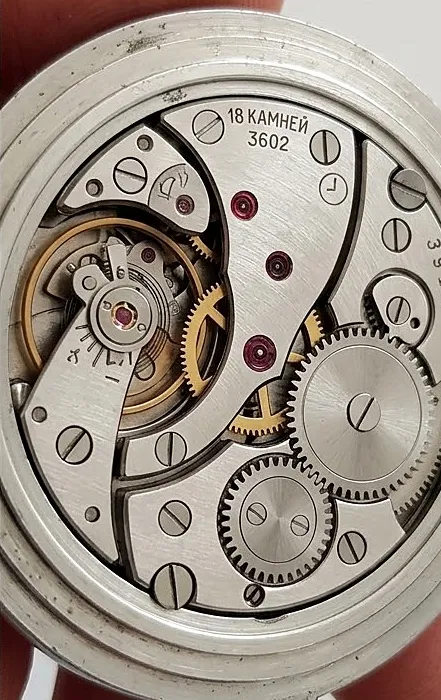
The thirty six in the calibre’s name gives the movement’s diameter in millimetres. When a modern wristwatch movement runs between twenty five and thirty millimetres, this is an enormous figure, and it makes one thing possible: thicker wheel teeth and a far larger mainspring.
The practical consequence is this. Micro dust and dried oil cannot stop wheels of that thickness; the movement crushes the obstacle with the torque of the barrel and goes on turning. The heavy balance beats five times a second, eighteen thousand vibrations an hour. It runs slowly but with great inertia, which is why knocks and shaking do not easily disturb it. The hardened Soviet steel staffs hold their line even without shock-absorbing jewels.
The three-dimensional locomotive on the caseback is neither printed nor engraved. A metal blank set between hardened steel dies is crushed, without being heated, under a hydraulic press of several hundred tonnes. Under that pressure the metal behaves almost like a liquid and fills every last line of smoke and every spoke in the die.
The lid that comes out of the press is blackened in a chemical bath. Then the body of the locomotive and the lettering, which stand proud, are sanded and polished back; together with the blackness left in the hollows, a shadowed surface with real depth appears. Which is to say that the depth of the relief is made not with paint but by light being held in the hollow and thrown back from the ridge.
format_quote"Under that pressure the metal behaves almost like a liquid and fills every last line of smoke in the die."
Hasan Bekmezci
The most striking detail on the dial, though, is the deep blue of the hour, minute and small seconds hands. That blue is not a paint and not a coating; it is thermal bluing, one of the oldest and hardest techniques in horology.
First the surface is prepared. Once made, the steel hands are cleared of every micro burr and polished by hand until they reach a surface like glass. Since the smallest touch of oil or grain of dust would make the colour come out uneven, the parts are degreased completely.
Then comes the graduated heating. The cleaned parts are laid out in baths of brass filings, which spread the heat evenly, or on special heating plates, and warmed slowly. As the steel heats, the iron atoms at the surface react with the oxygen in the air and form a transparent film of iron oxide. As the film thickens the refraction of light changes and the metal steps through its colours: pale straw at around two hundred and twenty degrees, brown at two hundred and forty, purple at two hundred and sixty five, and between two hundred and ninety and three hundred and ten, that cornflower blue.
The last step is the sudden quench. At the moment the metal reaches exactly that deep blue it is lifted off the heat and plunged into an oil bath, and the colour is frozen there. A few seconds late and the blue turns grey, and the part is made again.
A painted hand gives a matt, opaque, flat layer. Heat-treated steel, by contrast, throws back a deep black, purplish transitions or a striking cobalt blue depending on the angle of the light. And the thin oxide film that forms becomes one with the substance of the metal: it does not peel or flake with time, and it adds no thickness that would blunt the sharpness of the hand.
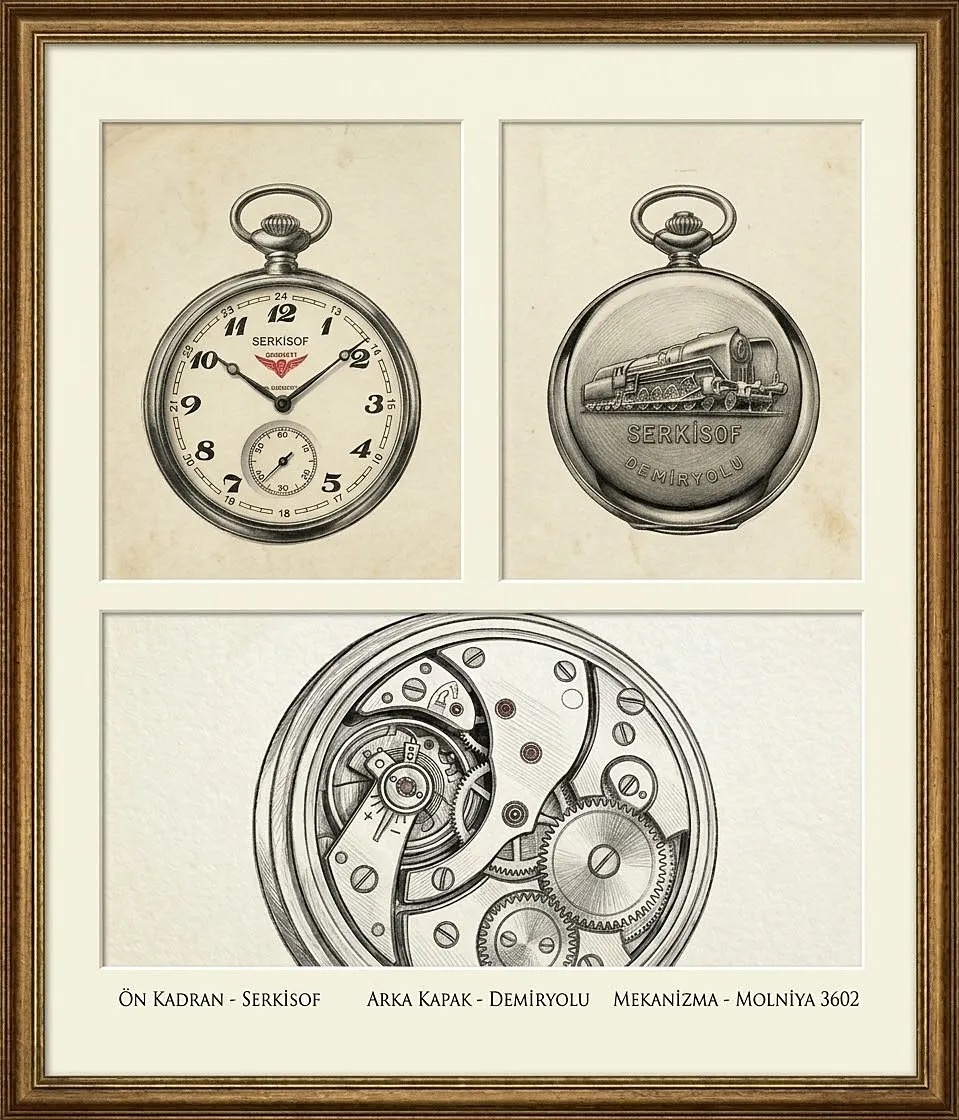
Whether we listen to the story of Stefan and Elena in our imagination, or to the hard-fought import diplomacy of the Serkisof family in Sirkeci.
This Serkisof Demiryolu pocket watch you are holding carries the Cortebert genetics in its movement, the heavy industrial force of Chelyabinsk in the factory that made it, the commercial wit of the Sirkeci merchant on its dial, the traditional mastery of heat treatment in its hands, and the sweat of a Turkish railway clerk in its design.
Today this watch has no maker. The Chelyabinsk factory closed in 2007, and there is no factory standing behind the name Serkisof. Which is to say that this is no longer an object that is bought, only one that is handed on.
Those slow, blunt and stately ticks you hear when you wind the spring and lift it to your ear are the finest melody on the rails of both literature and real history.
format_quote"This is no longer an object that is bought, only one that is handed on."
Hasan Bekmezci
The author’s dedication: I dedicate this article to the dear memory of my late grandfather Ali Bekmezci, who first made me feel the worth of time and of labour in the ticking of mechanical watches, and who left marks on my life that will not be erased.
To my dear father Şaban Bekmezci, who placed this horological inheritance in my palm, this historic Serkisof pocket watch that runs from Cortébert to the Urals and from there to Sirkeci station, and so granted me a family bond beyond time, I offer my endless thanks.
This steel heart, which carries both the pride that belonged to my father and the dear memory of my grandfather, I declare and undertake here and now that I shall hand on with pride, when the day comes, to my beloved son Deniz Alper Bekmezci, in the hope that he will be the witness of the days ahead.
Let it not be forgotten that to contemplate things and the universe, and to look for the order behind them, is the ancestral sport of the Bekmezci family. My prayer is that my child Deniz Alper too, guided by these mechanical ticks, will make contemplation a purpose of his life, and through that deep looking reach the endless wisdom and the artistry of the Creator.
Let time flow and the wheels turn; let this quiet, grave and contemplative inheritance of the Bekmezci family go on ticking for generations.