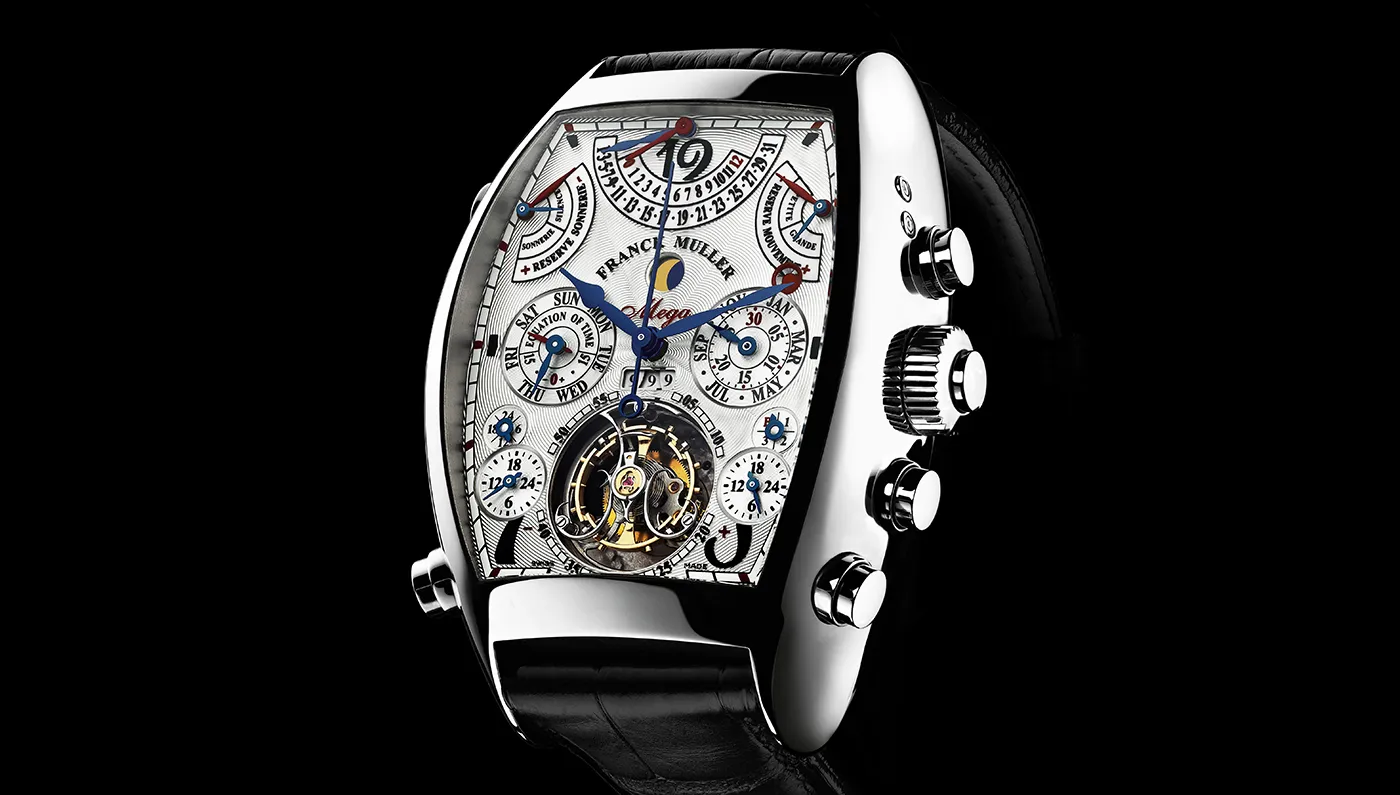
Somewhere on the wrist of the person wearing a Franck Muller Aeternitas Mega 4, a tiny war is being fought between two clocks. One of them is the watch itself, ticking along in perfectly even steps. The other is the sun, which does not tick evenly at all; it runs a little fast for part of the year and a little slow for the rest, arriving at true noon anywhere up to sixteen minutes before or after the clock says it should. Most watches ignore this disagreement entirely. The Aeternitas Mega 4 does not. It has a small hand whose only job is to measure the argument, every single day, and tell you exactly who is winning.
That one complication alone would be enough to make most watches interesting. The Aeternitas Mega 4 has thirty-five more sitting beside it in the same case, more than any other wristwatch mechanism has ever carried at once. This is the story of what is actually happening inside it, and of the science each mechanism quietly performs every time your wrist moves.
The Watchmaker Who Signs Himself Master
Franck Muller founded his own house in 1991, after training as a watch restorer and complications specialist in Geneva, and he built his reputation on a very specific promise: almost nobody else was attempting the hardest mechanical complications in watchmaking at the time, and he attempted nearly all of them, repeatedly, in the same watch. The nickname the industry gave him, Master of Complications, was not modest marketing copy invented by a press office. It was a description other watchmakers used because it was accurate, and the Aeternitas Mega 4 is the clearest possible proof of it: five years of research condensed into a single wristwatch, unveiled at the end of 2009 as, at the time, the most complicated wristwatch ever built.
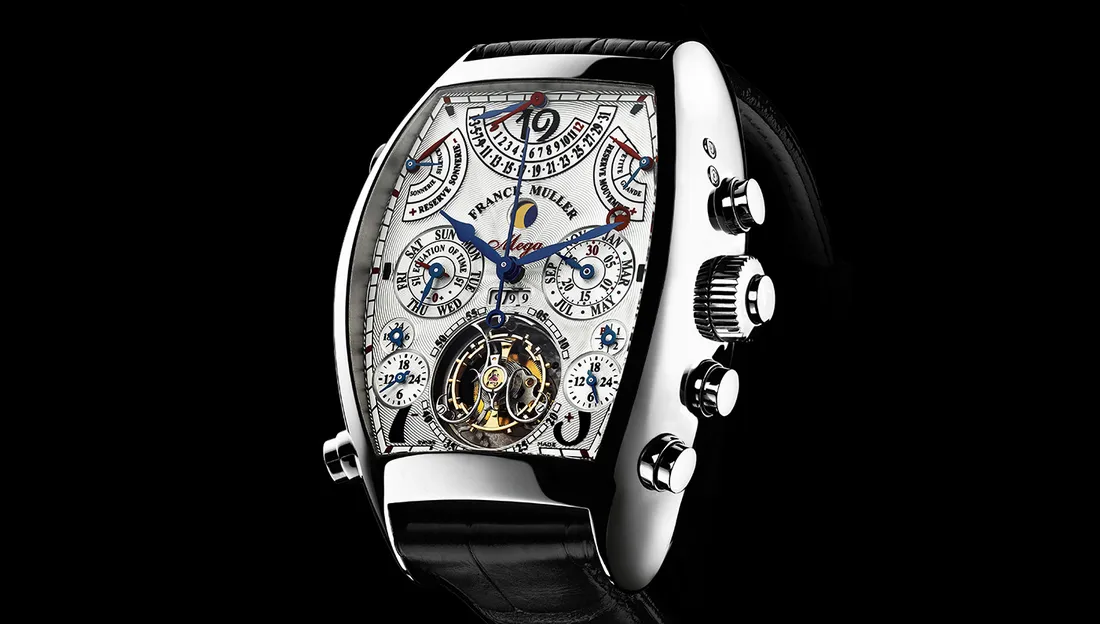
The house is also known for one visual signature that appears on almost everything it makes, including this watch: the Cintrée Curvex case, a tonneau shape bent along a gentle curve so it follows the natural curve of the wrist rather than sitting flat against it. It looks unmistakably like nothing else in watchmaking, and it exists for a structural reason as much as an aesthetic one, since a curved case has to be engineered very differently from a flat round one to keep its internal components properly aligned. On the Aeternitas Mega 4 that case measures 42mm wide, 61mm long and just over 19mm thick, large enough to hold a movement that is itself an unusually generous 34.4mm by 41.4mm.
A Name Built From Thirty-Six
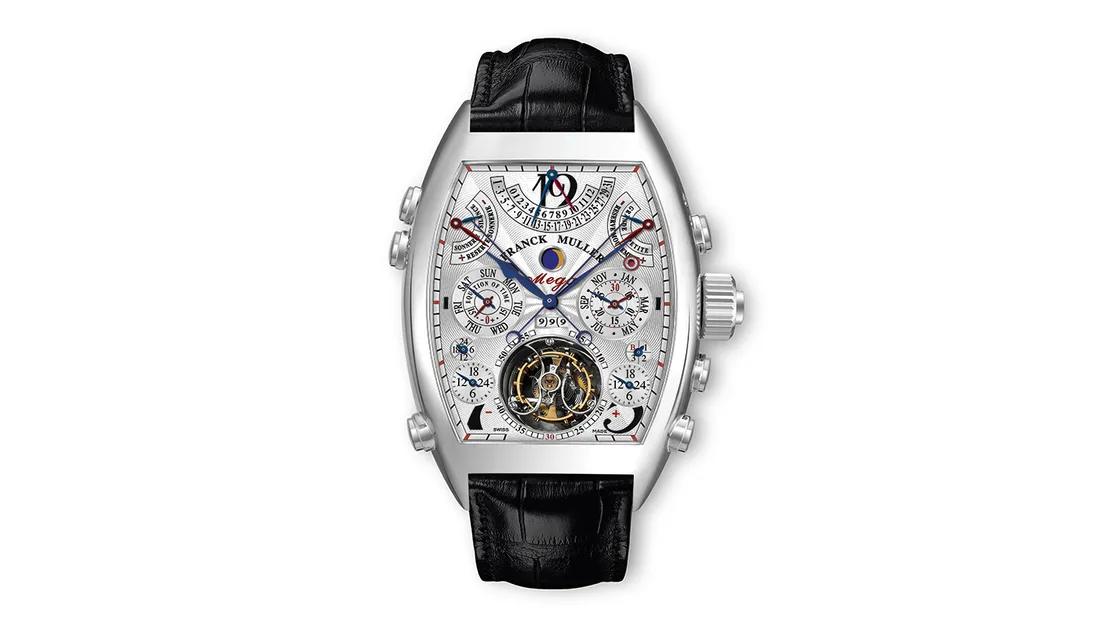
Aeternitas is Latin for eternity, chosen because the watch carries a calendar mechanism designed to run correctly for a thousand years without help, which is about as close to eternity as a mechanical object can honestly claim to get. Mega 4 marks it as the fourth and most extreme watch to come out of that project, the one where every idea the Aeternitas name stood for was pushed as far as it could go: 36 complications, 1,483 components, 99 jewels and 91 wheels, operated through 7 pushers and 4 correctors set into the case band, delivering 23 separate indications by way of 18 hands and 5 discs. Of the 36 complications, 25 are visible on the dial at any given moment. The first example was delivered to a collector in Monaco in November 2009 for 2.7 million dollars, the end point of five years spent by Franck Muller’s workshop trying to fit as much of watchmaking’s accumulated knowledge as possible into one case.
The Tourbillon: Outrunning Gravity
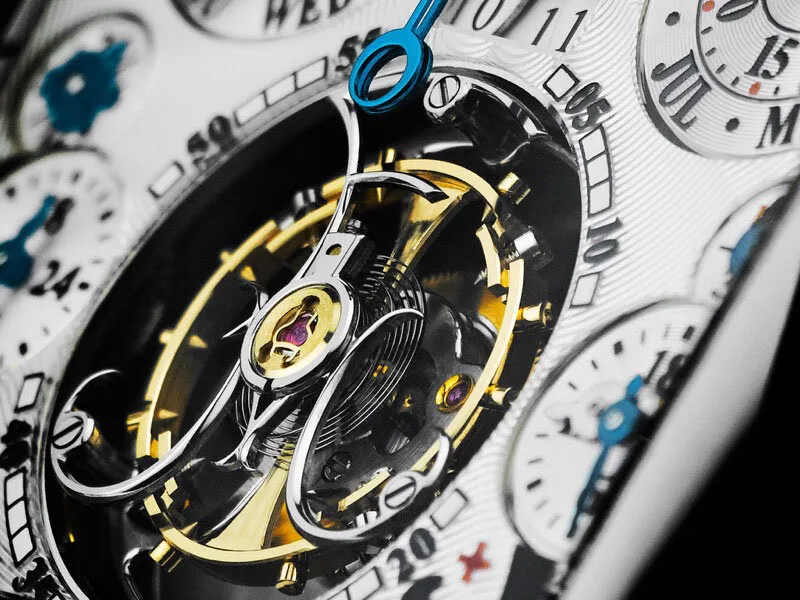
A watch keeps time by counting the oscillations of a balance wheel swinging back and forth on a hairspring, and that oscillation is supposed to take exactly the same amount of time in every position. In practice it does not, because gravity pulls on the balance and its pivots slightly differently depending on whether the watch is lying flat, standing on its edge, or anywhere in between, introducing small positional rate errors that add up over a day. Abraham-Louis Breguet solved the problem in 1795 with an idea that is easiest to picture as a wobbly spinning top: a top that always leans the same way when you spin it on a table will always drift toward the same corner of the room, but slowly spin the whole table in a wide, steady circle while the top is spinning on it, and the wobble no longer points in one direction; it points a little bit everywhere over time, and stops sending the top toward any single corner. Breguet’s tourbillon does exactly that to a watch’s escapement, mounting the balance wheel, hairspring, lever and escape wheel together inside a rotating cage that completes a full turn once a minute, so that the errors speeding the watch up in one orientation are cancelled by the errors slowing it down in the opposite one. The Aeternitas Mega 4’s balance carries gold timing screws for fine adjustment and a Breguet overcoil, a second Breguet invention in which the hairspring’s outer end is raised and curved back in toward the centre so the spring expands and contracts more evenly around its own axis, a refinement that makes the watch’s heartbeat steadier still, quite apart from the tourbillon spinning around it.
The Chronograph: Three Wheels Coordinating One Argument
An ordinary chronograph starts, stops and resets a single seconds hand to time one event, all three actions choreographed by a column wheel, a small stepped gear that a lever’s tip walks around notch by notch so that a single push always produces the correct next action rather than a jammed or contradictory one. The Aeternitas Mega 4 needs three separate column wheels rather than one, because it asks its chronograph to do three different things at once. A split-seconds, or rattrapante, function adds a second seconds hand stacked directly on the first, sharing the same pivot, so the watch appears to have only one hand until a pusher commands a spring-loaded clamp to grip the second hand’s heart-shaped cam and hold it stationary while the first keeps running underneath, uninterrupted; release the clamp and the held hand snaps instantly back into place behind the first, catching up to it in a fraction of a second, exactly what rattraper means in French. A fly-back function, operated from a single push-piece, lets the running chronograph be stopped, reset and instantly restarted in one motion instead of the usual three separate steps, useful for timing one event immediately after another without ever missing a start. Layered on top, an instantaneous minute counter and a retrograde hour counter, a hand that sweeps forward across its scale and then jumps back to zero rather than continuing in a circle, complete the reading.
The Perpetual Calendar: A Rule About a Rule About a Rule
A standard perpetual calendar complication already knows, mechanically, that April has thirty days and February has twenty-eight, except every fourth year when it has twenty-nine, and it adjusts the date correctly across all of that without anyone touching it. But the real calendar we use, the Gregorian calendar introduced in 1582 to fix centuries of drift accumulated under the older Julian calendar, hides a rule inside its rule: years divisible by 100 are not leap years, unless they are also divisible by 400. The year 2000 was a leap year under this exception. The year 2100, though divisible by 4, will not be. An ordinary perpetual calendar has only ever learned the first, simpler rule, so once every hundred years or so, in a centurial year that is not a leap year, it quietly starts showing the wrong date every March until someone opens the case and nudges it back by hand. The Aeternitas Mega 4’s secular calendar adds a further slow-turning cam, geared to complete a single rotation only every hundred or four hundred years, encoding this rarer exception directly into the mechanism, with its own dedicated leap-year indicator and secular indicator on the dial confirming which of the deeper rules currently applies. A separate year display counts upward to 999 before rolling over, an odometer for the calendar’s own thousand-year cycle, so the watch does not just quietly obey the rule about the rule about the rule; it shows you, at a glance, exactly how far into that cycle it currently stands.
The Equation of Time: Arguing With the Sun
The clock on your wrist measures mean solar time, an average day of exactly twenty-four hours defined for convenience so that every day is the same length. The sun itself keeps no such tidy schedule. Apparent solar time, the time you would read directly off a sundial, drifts ahead of and behind mean time throughout the year by up to about sixteen minutes in early November and about fourteen minutes in mid February, crossing zero four times along the way. Two effects layer on top of each other to cause this: the Earth’s orbit around the sun is elliptical rather than circular, so by Kepler’s laws it moves faster when closer to the sun and slower when farther away, constantly changing the sun’s apparent speed across the sky, and the Earth’s axis is tilted relative to its orbital plane, which skews how the sun’s motion projects onto the celestial equator where clock time is actually measured. Together the two effects trace a smooth, repeating, kidney-shaped curve across the year known as the analemma, the same curve you would get by photographing the sun’s position at exactly noon, from the same spot, every few days for a full year. Somewhere inside the Aeternitas Mega 4 sits a tiny cam cut into precisely that kidney shape, tracing the sun’s yearly laziness and hurry the way a fingertip might trace the edge of a leaf, and a lever riding along its bumpy edge drives a small hand that tells you, on any given day, exactly how far ahead or behind the real sun currently is compared to your own perfectly punctual watch.
Two Time Zones and an Astronomic Moon
The watch also carries additional hour indications, independently adjustable in one hour jumps without disturbing the running seconds or the rest of the gear train, so a second and third local time can be read alongside the home time shown at the centre of the dial, as if two travellers shared the same watch, one who never leaves home and one who has already landed wherever you are. Beside them sits an astronomic moon phase, a small disc painted with two moons that rotates into view through a dial aperture to track the moon’s cycle from new to full and back. An ordinary moon phase mechanism approximates the moon’s 29.53059-day orbit with a simple 59-tooth wheel, which drifts a full day out of sync after only about two and a half years. An astronomic moon phase gears that approximation far more finely, so the display can go a full century or more before it needs correcting by so much as a day, tracking a genuine astronomical cycle rather than a rough mechanical guess at one.
When a Watch Learns to Sing
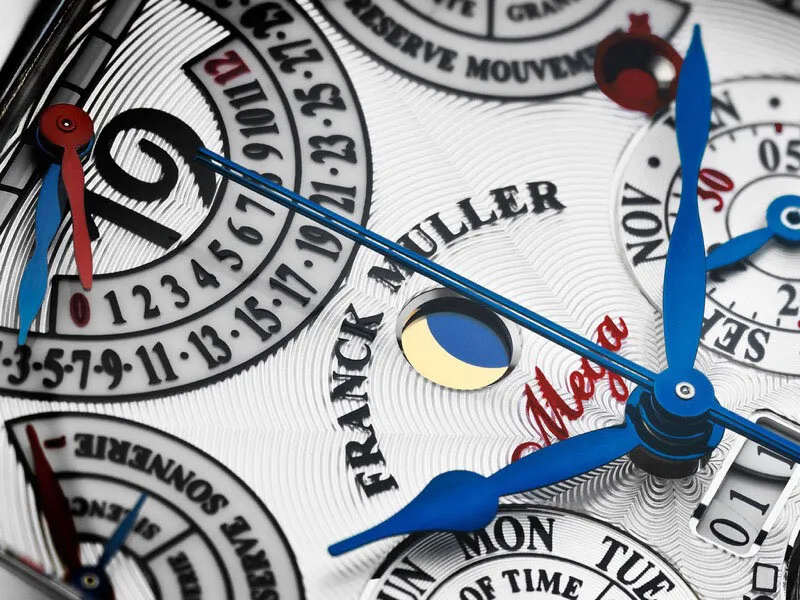
A minute repeater is a striking complication that chimes the time on demand, using a rack and snail mechanism to measure the current hour, quarter hour and minute and translate each into a number of hammer strikes on a gong, purely by winding and releasing a small spring when a slide or pusher is activated, with no electronics involved anywhere. The Aeternitas Mega 4 goes further still, adding a full grande and petite sonnerie on top of the on-demand repeater: in grande sonnerie mode the watch strikes the hours and quarters automatically as each one passes, the way a church tower would, while petite sonnerie strikes only the quarters in passing and leaves the hour silent, a quieter setting the wearer can select at will. All of it rings out on a Westminster carillon, four hammers and four gongs instead of the usual two, playing the same four-note melodic pattern used by London’s most famous clock tower, cycling through its variations to mark each quarter before striking the hour itself in a deeper tone, a tiny mechanical orchestra small enough to live inside a wristwatch. Because a striking mechanism this elaborate would otherwise drain the watch’s power reserve on its own, the Aeternitas Mega 4 carries two separate automatic winding systems under one caseback, one keeping the going train wound with a three-day reserve, the other winding the chiming barrel independently with a 24-hour reserve of its own, so that ringing the hour never costs the watch a minute of running time.
Reading the Case: Seven Pushers, Four Correctors
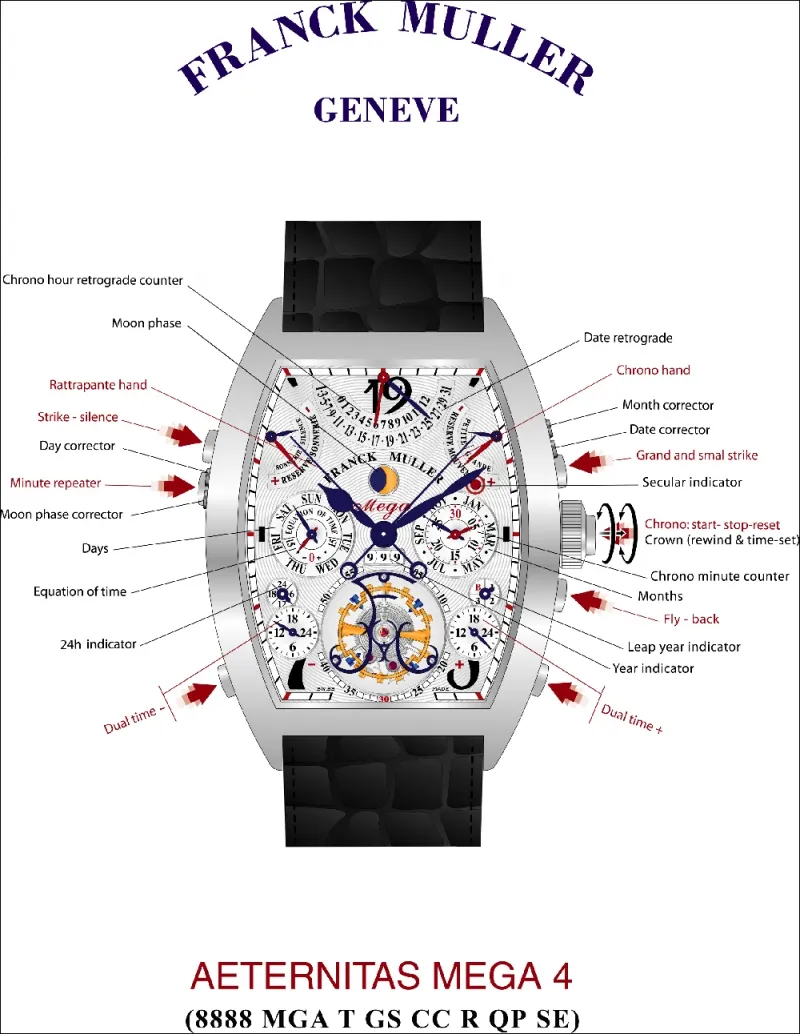
With 23 indications competing for space around a single dial, the Aeternitas Mega 4 has to be operated as carefully as it is built. Seven pushers set into the case band and crown side handle the watch’s active functions: the chronograph’s start, stop and reset; the rattrapante catch; the fly-back reset; the minute repeater’s striking slide; and a strike-silence selector to switch between grande sonnerie, petite sonnerie and silence. Four further correctors, recessed so they can only be pressed with a tool rather than a fingertip, exist purely to set the slower-moving displays, the day, the moon phase, and the two additional time zones, without disturbing the watch’s primary timekeeping while doing so. Every one of those 23 indications is carried by 18 separate hands and 5 discs, moved by a gear train built from 91 wheels among the watch’s 1,483 total components, all of it finished with the Côtes de Genève striping, circular graining and hand engraving that Geneva watchmaking has used for over a century to make a movement as pleasant to look at as it is accurate to run.
format_quote"Thirty-six complications, one case, and a small hand whose only purpose in life is to keep score in an argument with the sun that has been running since the Earth first tilted on its axis."
A Calendar for the Next Thousand Years
Even a secular calendar, correct through centurial exceptions, will eventually drift, since the Gregorian calendar itself is not perfectly matched to the true solar year and accumulates roughly a day of error every three thousand or so years. The Aeternitas Mega 4’s calendar is built around a cycle designed to stay correct for a thousand years before needing any adjustment at all, an ambition that goes considerably further than strict necessity requires, since no watch and almost no owner will exist across that span, but which reads like a set of instructions written so completely that whoever found them a thousand years from now would not need to change a single word.
One Watch, One Argument
The Aeternitas Mega 4 does not actually need to exist. A clock that loses ten minutes a year, forgets the centurial leap year exception, and cannot tell you the equation of time will still get you to your meeting on schedule. Its entire purpose is to solve problems nobody strictly needs solved, using nothing but gears, springs, cams and hundreds of hours of hand-finishing, because the people who built it found the problems themselves irresistible. The small hand that measures the daily disagreement between clock time and sun time is not correcting an error. It is simply keeping an honest, permanent record of the fact that the universe and the wristwatch have never quite agreed on what time it is, and giving you a very small, very beautiful window onto that disagreement every time you check the hour.