In a cryogenic laboratory, at the chambers cooled to a temperature very close to absolute zero, to two point one seven kelvin, two researchers are standing: Dr Harun Soylu, a specialist in thermodynamics, and Dr Nevin Derin, a researcher in extremophile materials.
At that critical threshold, called the lambda point, the liquid helium in the glass passes abruptly into the superfluid phase. Its internal friction, its viscosity, falls to zero. In open defiance of gravity the liquid climbs the vertical wall of the vessel that holds it, crosses the rim and drips off the outside. It seeps through the finest pores without meeting any resistance at all.
For classical thermodynamics, Nevin, gravity has to pull a liquid down, says Dr Harun Soylu, pointing at the thin film climbing vertically up the edge of the vessel. For a fluid to move without internal resistance and without friction is mechanically impossible.
Because the Architect is showing us how the laws of friction and of gravity can be suspended once the thermodynamic conditions are complete, Harun, answers Dr Nevin Derin. In a universe without friction, a liquid climbs and passes the obstacle. The causes run out, and the quantum fluidity the Architect has set in place appears.
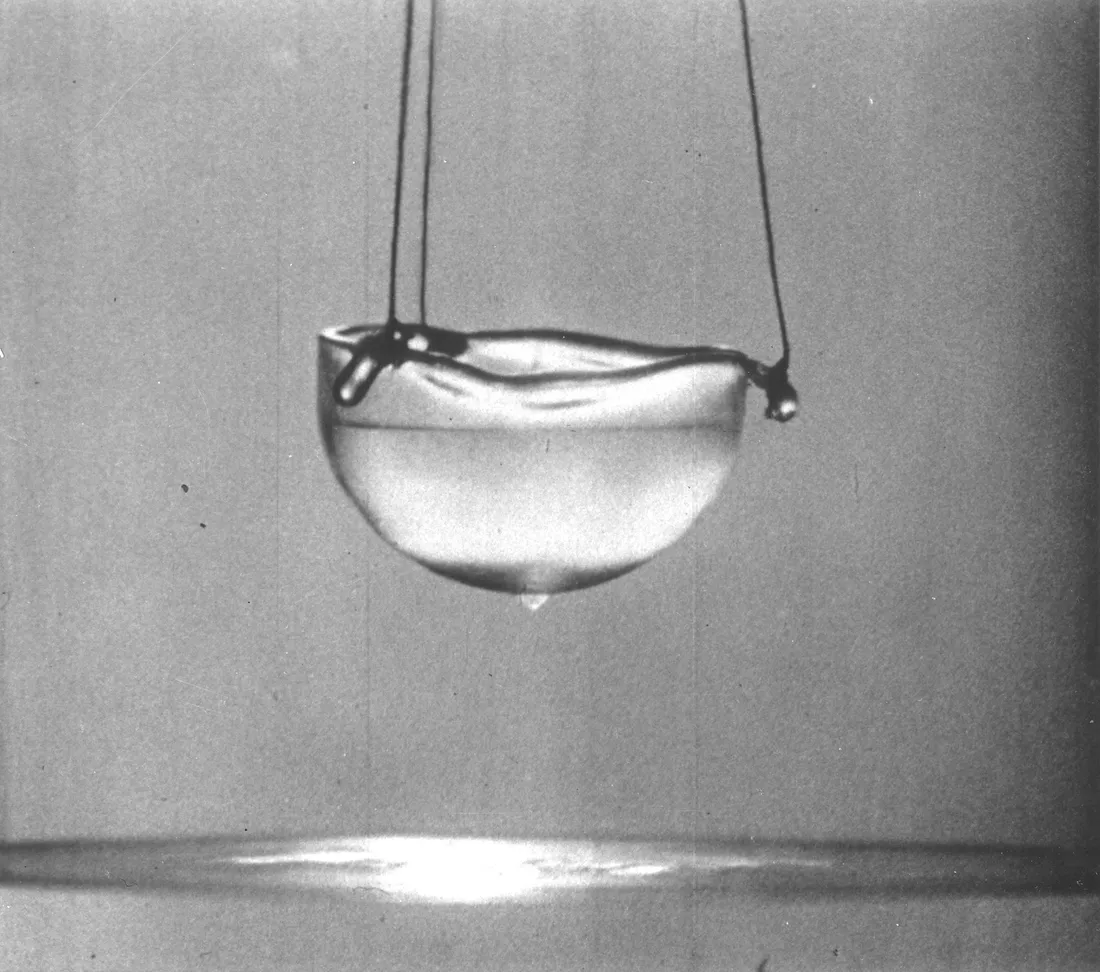
format_quote"In open defiance of gravity the liquid climbs the vertical wall of the vessel that holds it."
Hasan Bekmezci
A few plain comparisons help to grasp this state in which matter reduces friction to nothing and defies gravity.
The first is a waterfall running upward. It is as if the water in a jug climbed the sides and poured out of its own accord, with nobody tilting the jug. In superfluidity the atoms move as a single wave.
The second is capillary seepage. A liquid that passes through the smallest pore without meeting resistance redraws the limits of what flowing means.
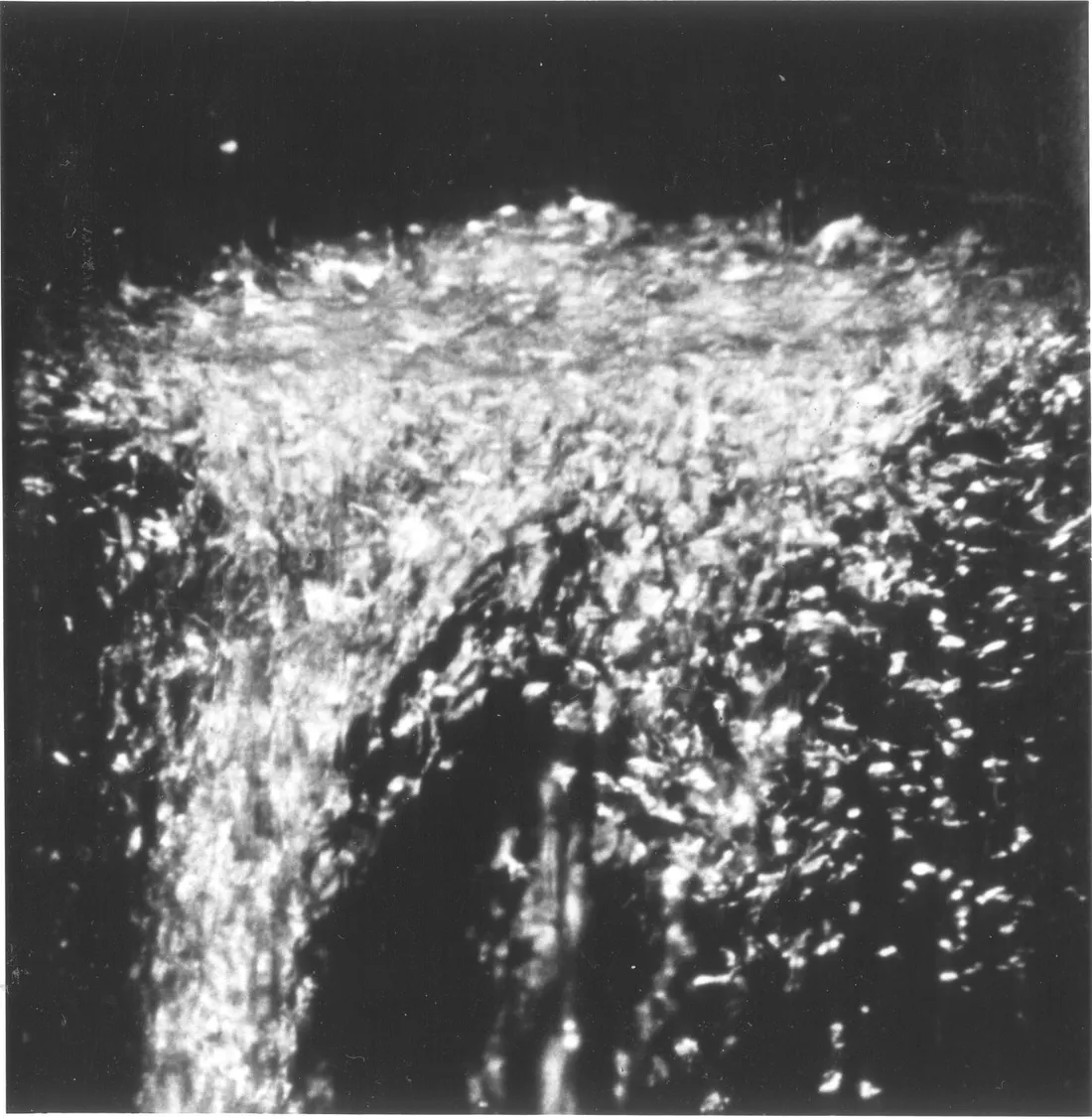
The third is the vortex that does not end. Spin a superfluid in a vessel and, because there is no friction, the turning does not slow by itself; the vortex goes on exactly as it was left.
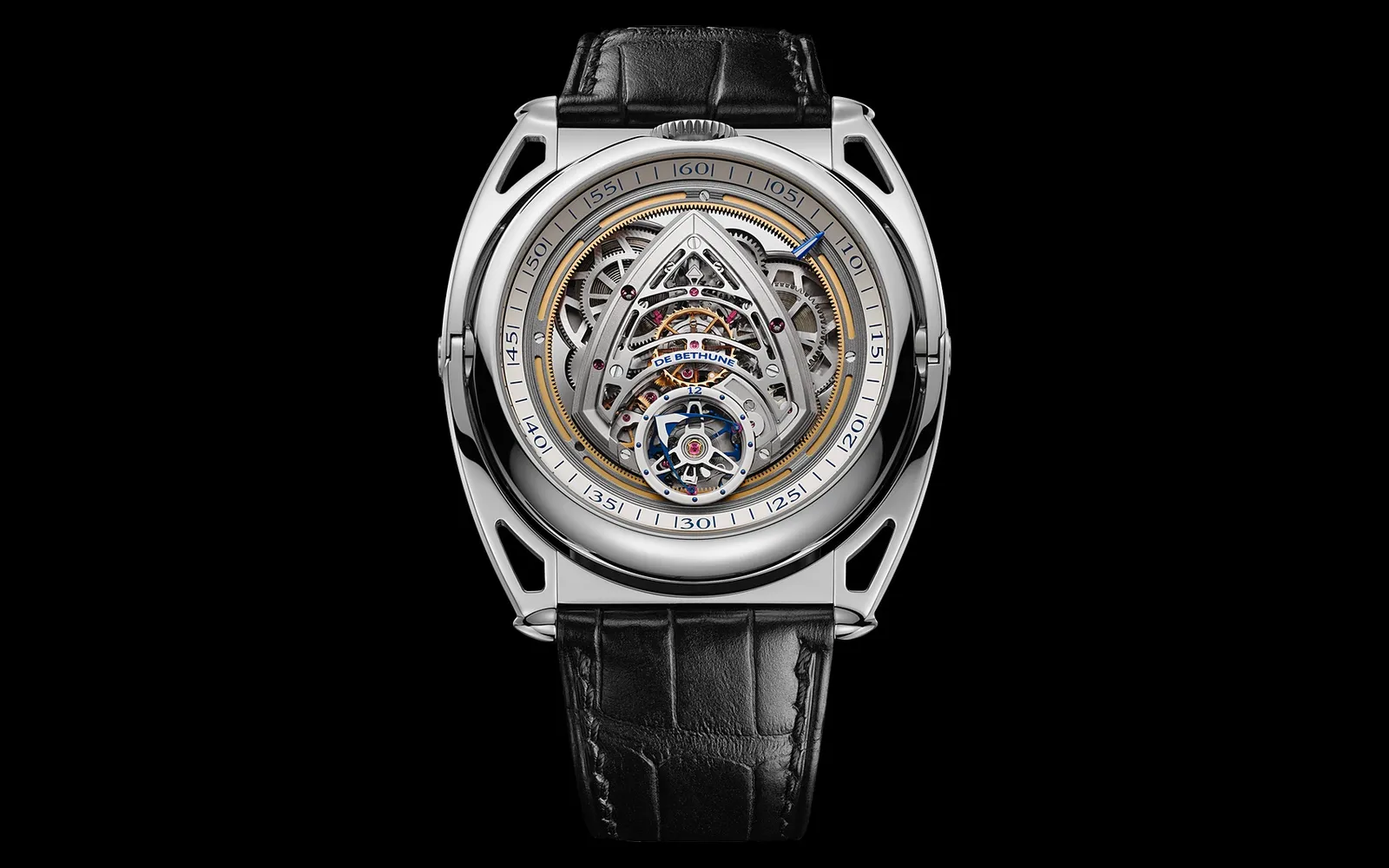
The watch that reduces the effect of gravity and of mechanical friction on its balance to a minimum, through titanium and silicon, is De Bethune’s DB28 Kind of Two; on the house’s own site it stands as the Jumping GMT, reference DBK2V1.
The case is polished grade 5 titanium, forty three point three millimetres across and eleven point four thick. The floating lugs the house patented in two thousand and six carry a pivot here: the case turns on itself and can be locked with either face uppermost. The crystals on both sides are sapphire, at eighteen hundred Vickers, with anti-reflective coating on both faces.
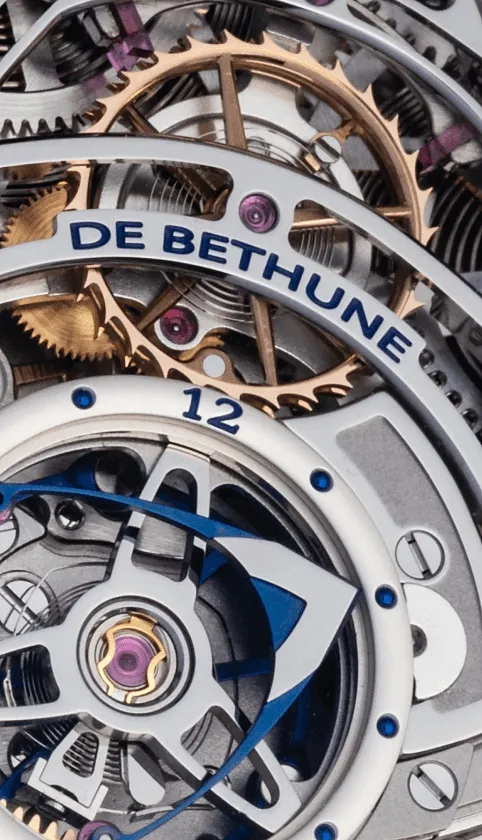
The calibre DB2517 inside is wound by hand. Its power reserve is four days, held by the self-regulating twin barrel the house developed in two thousand and four. The balance wheel is titanium with white gold inserts, a construction optimised both for differences of temperature and for the resistance of the air, patented in two thousand and sixteen. The balance spring is the house’s own, with a flat terminal curve, patented in two thousand and six. The escape wheel is silicon. And the seconds step, by the dead-beat system developed in two thousand and eleven.
format_quote"The case turns on itself; whichever face you leave uppermost, the hands run the right way."
Hasan Bekmezci
The two faces of the watch are two separate watches. On the front there is a silver hour ring with polished blued indexes; the minutes are read on the outside, around the periphery, while the hour is centred around the balance wheel at six. On the back there is a classical dial: silvered and in relief, with convex levels and a guilloché centre. Its hands are blued titanium, and the dead-beat seconds hand is plain titanium.
The link between the two is a GMT. The two time zones are set separately and each face shows its own; home on one, the city you are in on the other. Turning the case is how you move to the second hour. And the movement makes sure the hands run in the right direction whichever face is up.
The blue titanium that is De Bethune’s signature is here too: that deep blue is obtained by heat, and it is not paint. It is the colour of the thin oxide layer heat leaves on the surface of the metal.
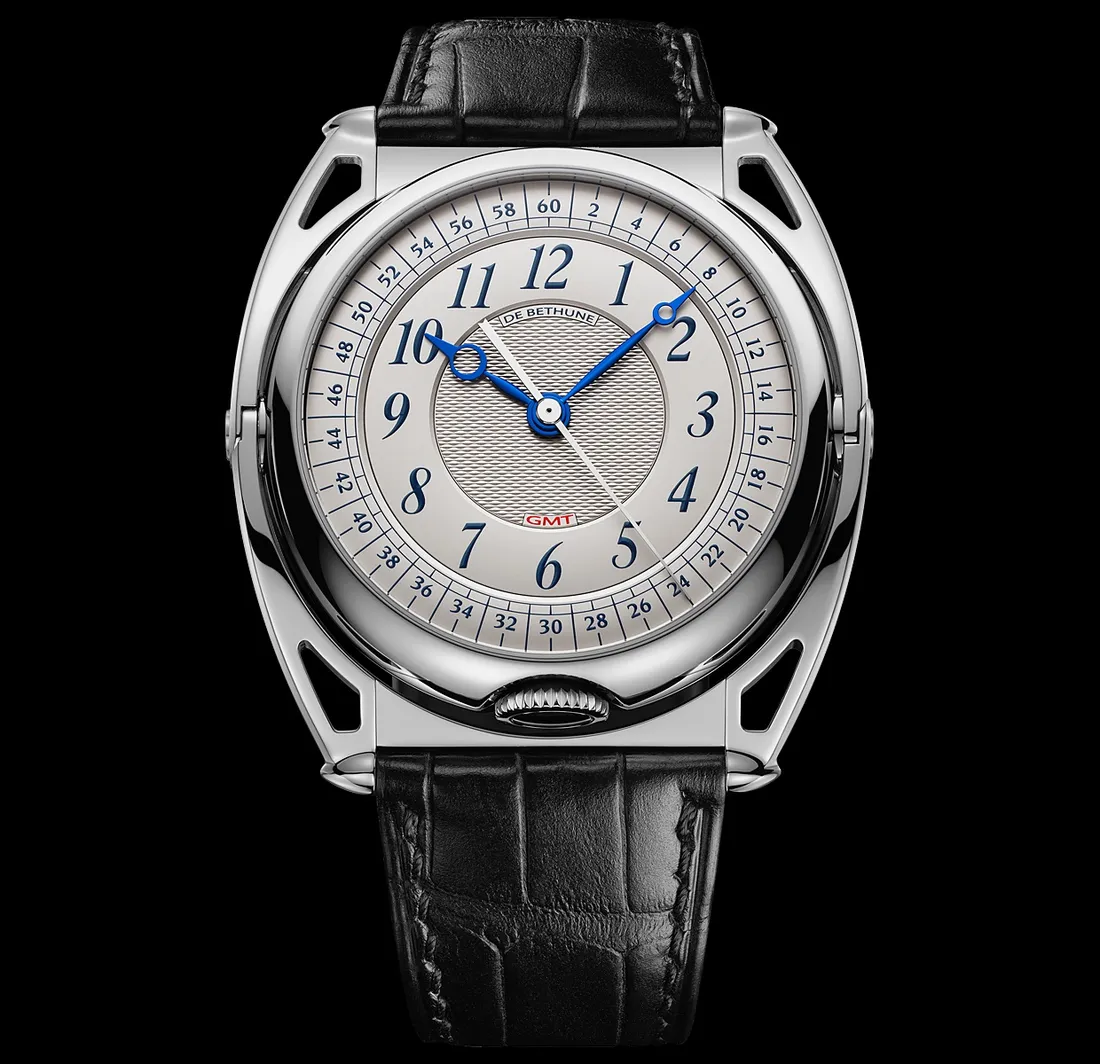
format_quote"That blue is not paint. It is the colour of the thin oxide layer heat leaves on the surface of the metal."
Hasan Bekmezci
Superfluid helium shows what matter can do when friction is taken away altogether; a watch can never take friction to zero, only make it smaller. The titanium balance, the silicon escapement and the twin barrel of the DB28 Kind of Two are where that work of making it smaller stands today. Anyone who looks at the distance between the two sees at once how far the human hand has come, and how far it still has to go.
The watch on its maker’s own site: De Bethune, DB Kind of Two Jumping GMT