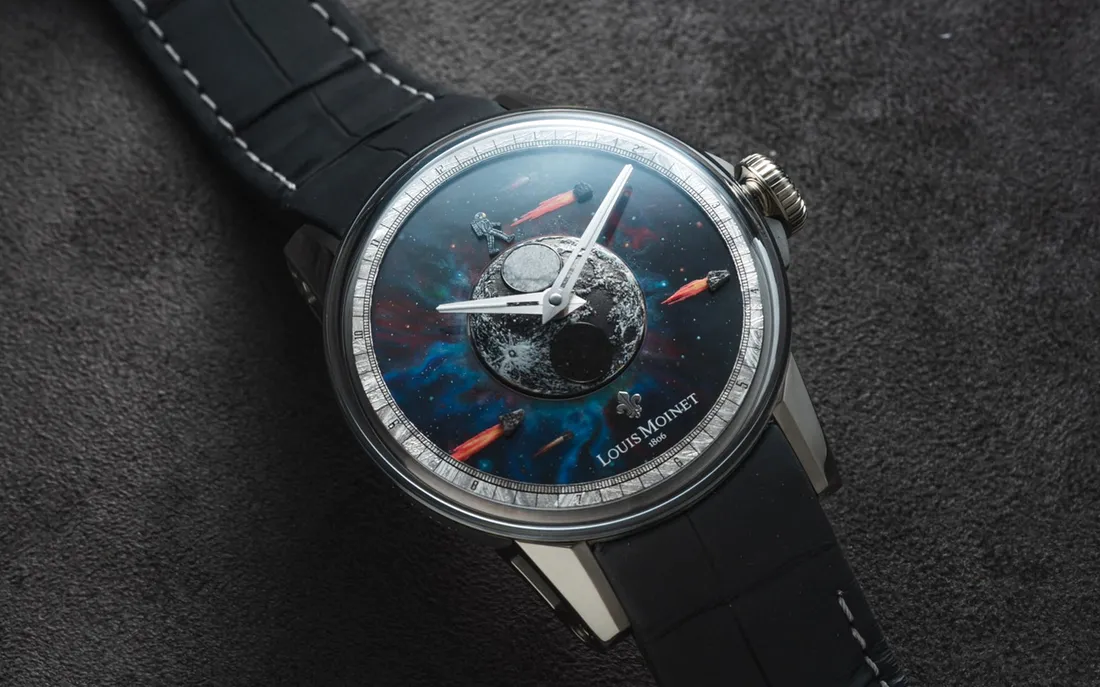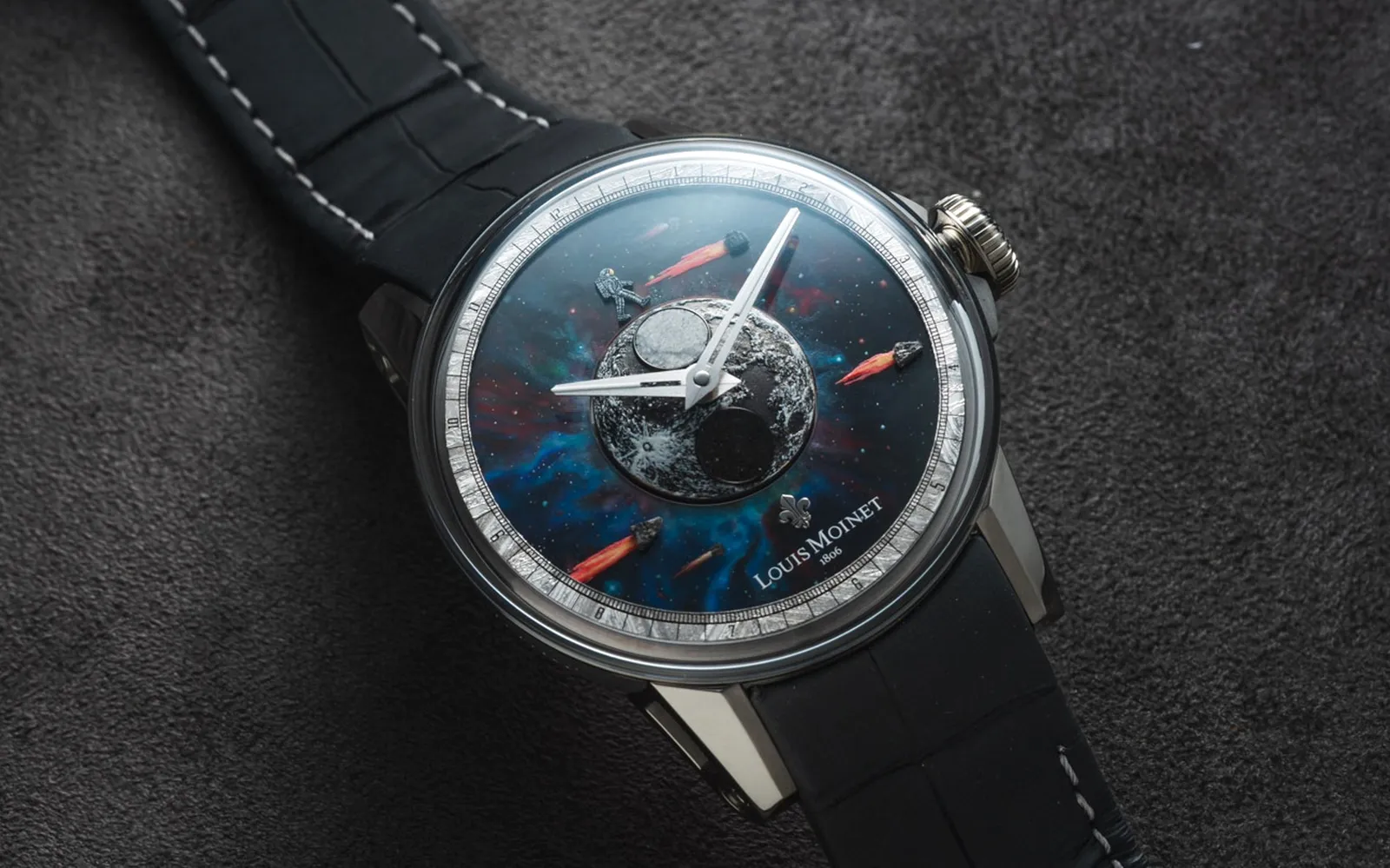
The miniature painter’s studio was small and lit by a single lamp on the bench. A binocular microscope stood in the middle of the table, and beneath it waited a dial blank smaller than a coin.
The door opened and a meteorite curator came in carrying a little plastic box with three thin slices inside it.
I have brought them, he said. But let me say one thing first. These are not a painting surface. You will not put a brush on them.
I will not, said the painter. I am going to paint the spaces between them. They arrive with their own colours already.
The curator opened the box and laid the slices out one by one. The first was reddish grey, the second almost coal black, and the third was matte and looked dusty.
Now, said the curator, I am going to tell you what these three are. After that you will not be able to look at them the same way again.
He pointed at the reddish one. This came from Mars, he said. It was found in north west Africa and it is a volcanic rock.
Its age is the interesting part. Most stones in the solar system are four and a half billion years old, because they all solidified at the beginning and nothing has happened to them since. Rocks of this kind from Mars are far younger. Some are only a few hundred million years old.
What that means is this: Mars was still producing lava at a time when a planet of its size ought to have cooled and fallen silent. There was heat coming from inside it, and that heat was reshaping the surface. A planet that looks quiet today was active in a past that is not, on our scale, especially distant.
The painter slid the slice under the microscope and looked. There are crystals in it, she said.
There are, said the curator. And those crystals once grew inside flowing lava. You are looking at the inside of a volcano on another planet.
The second slice was the black one.
This is a carbonaceous chondrite, said the curator. It was found in the western Sahara. What makes it particular is that it belongs to a family carrying water bearing minerals and carbon compounds.
Stones of that family formed in the coldest regions of the solar system, in places where water could remain as ice. Over time that ice entered the mineral and became chemically bound inside it. Heat such a stone today and water comes out of it.
Where a planet’s first water came from is one of the questions science has worked on longest, and stones like this one are the most important part of the answers given so far. They also contain chains of carbon, and molecules resembling the building blocks of living things have been identified in some of them.
The painter took her hand off the brush. So this black mark, she said, comes from a stone that may have carried the material of life.
It may have, said the curator. We are not claiming it. We only know this much: the necessary material was present at the necessary time and in the necessary place. That alone is worth sitting with.
format_quote"The building blocks of life were present at exactly the time they were needed and in exactly the place they were needed. That resembles preparation more than coincidence."
Hasan Bekmezci
The third slice, the matte and dusty one, the curator had kept for last.
This is an enstatite chondrite, he said. And there are diamonds inside it at the nanometre scale.
The painter laughed. Diamonds, she said. Inside a stone this small?
Far too small to see, said the curator. They are on the scale of a millionth of a millimetre. But the point is not their size. It is their age.
Almost everything inside a stone came together while the solar system was being assembled, and at that moment it melted, mixed and solidified again. It all came out of the same furnace. A few very small grains, however, stayed outside that melting and kept their original state.
When the ratios of the elements in those grains are measured, they give values seen nowhere in the solar system. There is only one explanation. They did not form here. They formed in material flung out of the outer layers of dying stars, and they arrived already made.
So inside the stone in my hand, the painter said, there are pieces older than the Sun.
Older than the Sun, said the curator. Older than this planet, than this dial, than you, than me, and than the whole of this story.
The curator pointed to the ring shaped piece at the edge of the table. This one, he said, is a different story altogether.
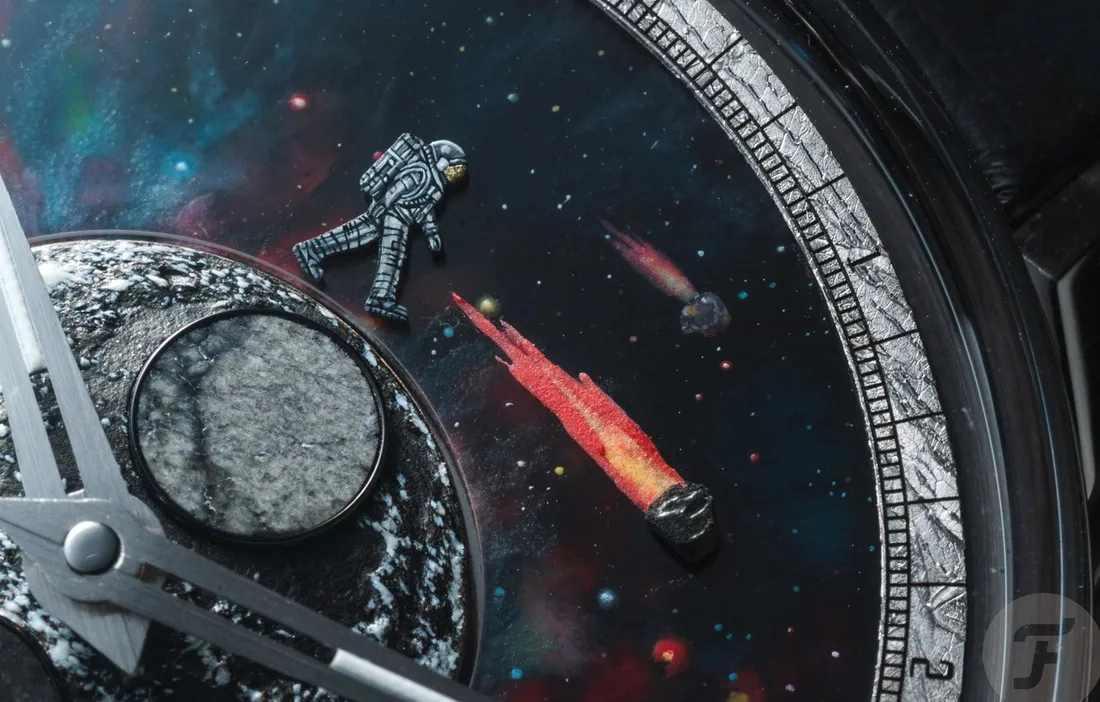
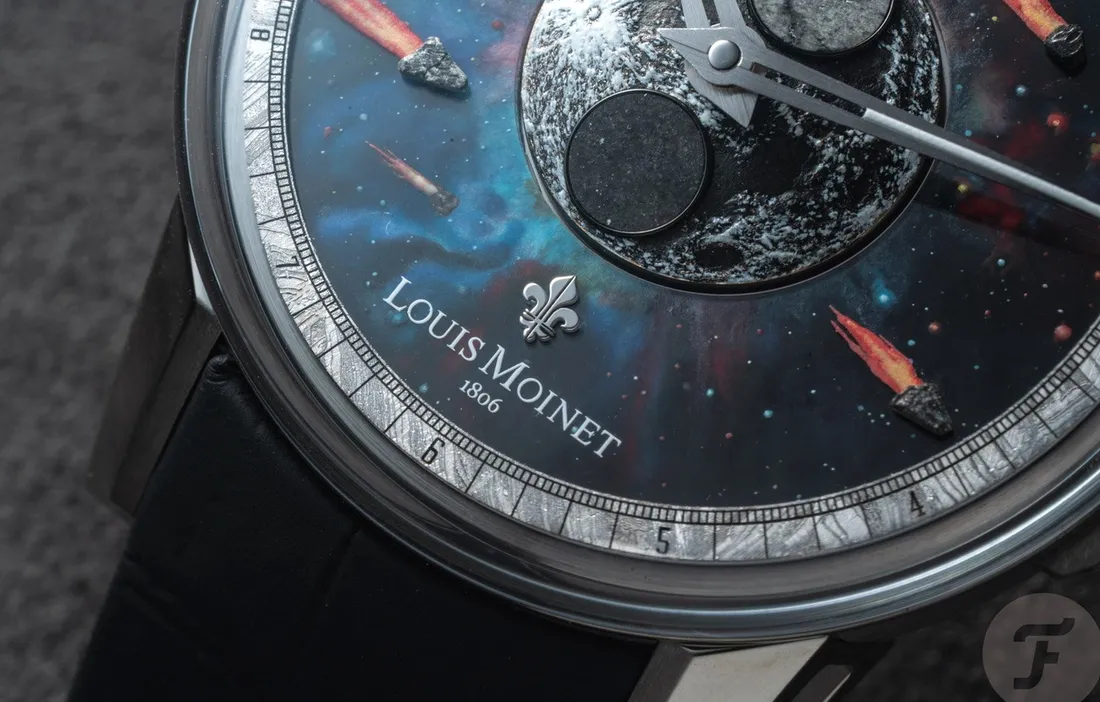
That flange around the dial was cut from an iron meteorite found in the north of Sweden. The body fell here about a million years ago and was discovered at the start of the twentieth century. Its age is four and a half billion years.
The fine interlocking bands across its surface did not form by chance and were not painted on. The pattern arises when two different iron and nickel alloys grow into one another. For that growth to happen the metal has to cool unbelievably slowly.
Let me tell you how slowly: a few degrees per million years. That is only possible inside the core of a celestial body. The rock around such a core holds the heat for millions of years, and the metal crystallises without the slightest hurry.
Which is why the pattern cannot be faked. No furnace, no forge and no process on this planet can deliver a cooling rate like that. If you see this pattern in a piece of iron, you know the thing in your hand once sat at the centre of a world.
The pattern does not appear on its own. The metal is cut, polished and etched with a weak acid. One of the two alloys is attacked more than the other and a difference in shade rises to the surface. That is the moment the pattern appears. More than two centuries ago two researchers, working without knowledge of each other, discovered it within a few years.
format_quote"All this pattern needed was patience, and that patience was a cooling of a few degrees per million years. No furnace on this planet can imitate it."
Hasan Bekmezci
The painter went back to her microscope and described her own work.
I am painting a landscape onto this dial, she said. I apply the colour with single hair brushes and I wait for every layer to dry. There is no shortening the drying time; hurry and the layer beneath stays soft and the one above lifts it.
Over each layer of colour I lay a thin varnish. The varnish does two jobs. It protects the colour underneath, and it stops the colour above from mixing into it. The depth you see on this dial is not achieved with pigment. It is achieved with the number of layers.
But the real matter is what I mix into the paint. Into certain areas I add a luminous compound, and that compound is invisible in daylight.
It works like this: it absorbs light, stores the energy it has absorbed in traps within its crystal structure, and then releases it very slowly. It behaves like a sponge. It fills during the day and empties at night.
So this dial becomes another dial in the dark. The landscape you see by day and the landscape you see by night are not the same. I am making two separate pictures, and both of them live on one surface.
format_quote"This dial turns into an entirely different dial in the dark. The painter makes two separate pictures, and both of them live on one surface."
Hasan Bekmezci
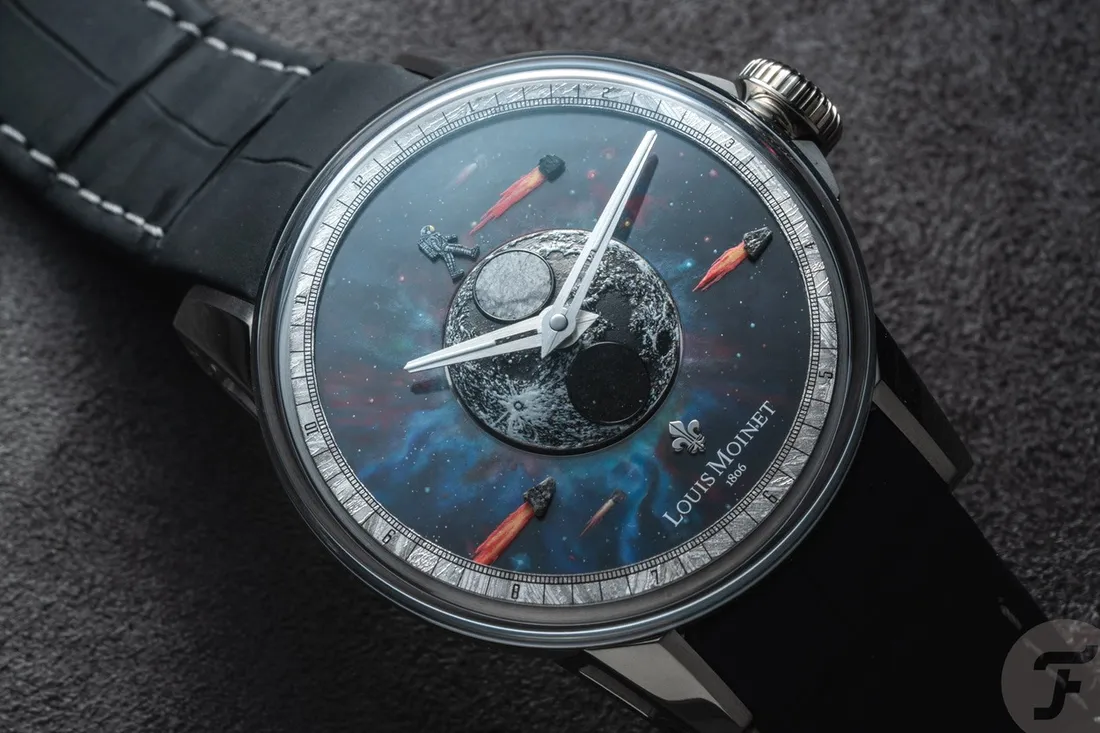
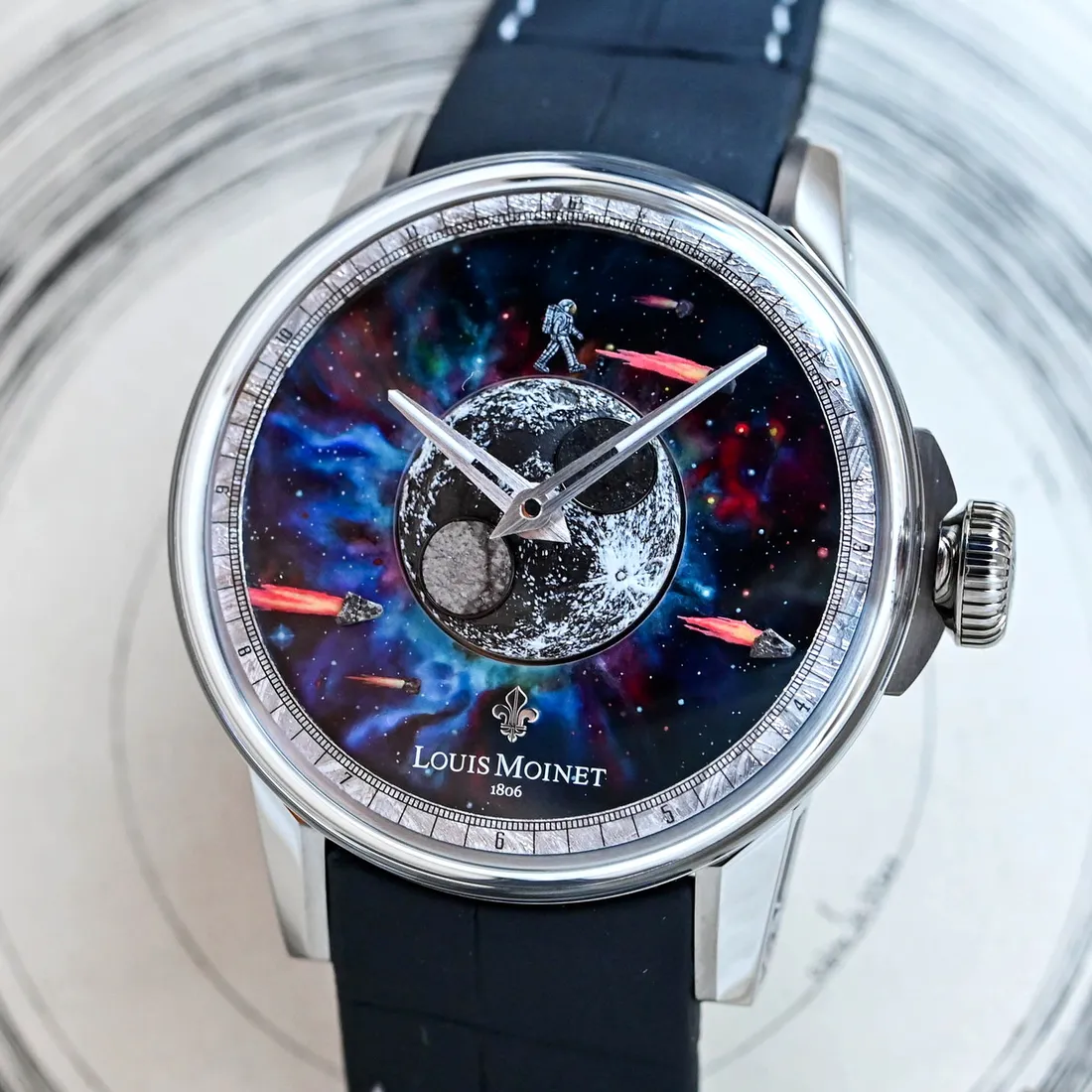
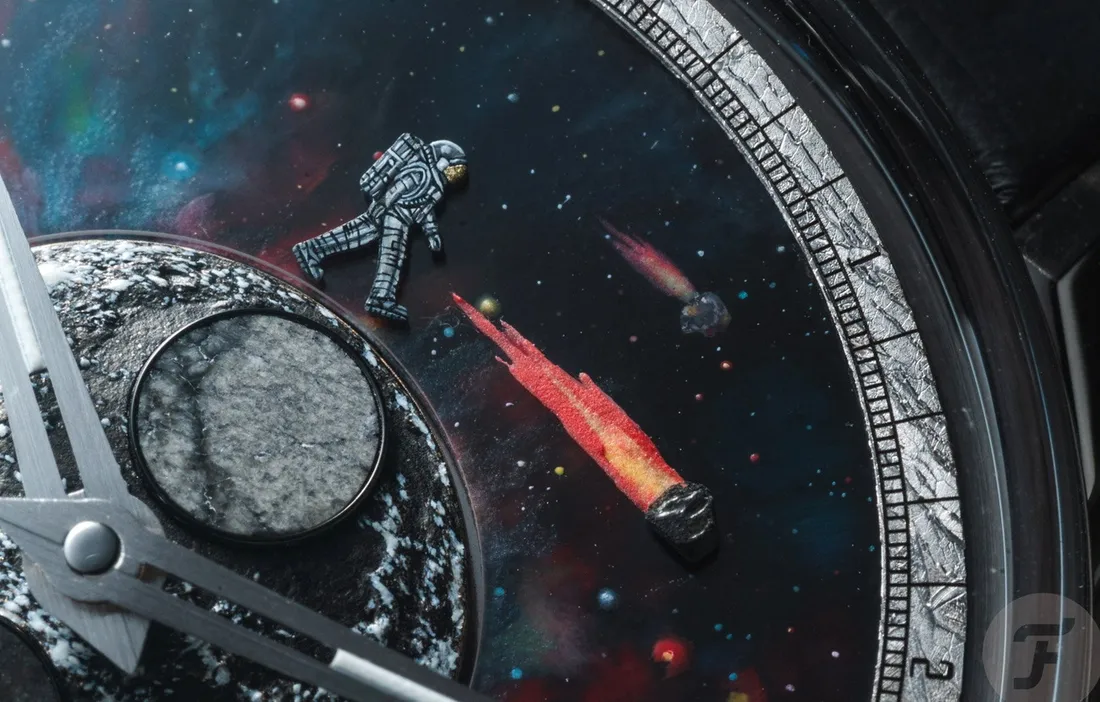
A domed disc sits at the centre of the dial, and that disc is the Moon itself. Its craters were engraved first and then painted by hand, with the same luminous compound mixed into the paint.
Two lunar meteorites are set into the disc, representing the full moon and the new moon. The indication uses the material of the Moon in order to describe the Moon.
The marker that shows where the cycle stands is not a hand. It is a small hand painted astronaut walking across the disc. The phase is read from where that figure has arrived.
At first glance the idea might look merely charming. Think about it a moment longer and the opposite emerges. The phase of the Moon depends on the angle between the Sun and the Moon, and what sets that angle is where we happen to be standing. The phase is born from the position of the observer. Putting a figure of an observer onto the dial says exactly that.
The accuracy of the mechanism is one day in one hundred and twenty two years. That is roughly fifty times better than an ordinary moon phase display. The ordinary kind falls a day behind every two years and seven and a half months, because it treats a lunar month as twenty nine and a half days. Reaching this figure requires far larger gear ratios and a much longer train.

The case is forty point seven millimetres across and seventeen point nine two millimetres deep. On paper that reads thick, but the material is grade 5 titanium and the whole case weighs only eighteen grams.
Density explains the gap. Titanium sits at around four point four grams per cubic centimetre against seven point eight for steel, so the same volume comes out at roughly half the weight. The lugs are openworked as well, which reduces both the mass and the visual bulk.
A box type sapphire crystal covers the dial, treated against reflection on both faces. That detail is compulsory on a dial carrying a miniature painting; without it, surface glare hides half the picture. The crown is wide and fluted, and water resistance is thirty metres.
Inside runs the LM113, developed with Concepto. It is self winding, turns on twenty nine jewels, beats four times a second and holds forty eight hours. It measures thirty point four millimetres across and twelve point seven deep.
The strap is Louisiana alligator with an alligator lining. The triple folding clasp carries a fine adjustment and the house fleur de lys. Production is limited to twelve pieces and each is engraved to say so. The price is forty eight thousand francs.

Towards midnight the painter switched off the bench lamp and the two of them stood in the dark. After a few seconds the dial began to appear.
The curator said nothing. The landscape had changed completely. What had been a sky in warm colours by day was now filled with a cold greenish light. The rims of the craters had sharpened and the small figure on the disc stood out clearly.
Let me ask you something, the curator said. While you are making this second picture, do you think about who will see it?
I do, said the painter. But something else interests me more.
The stones on this dial sat for millions of years in places nobody ever saw. Not one of them was there to be looked at. Then one fell, one was found, one was cut, and all of them were gathered inside a circle.
I paint the empty spaces of that circle. So what I am really doing is preparing a place where things that went unlooked at for a very long time can finally be looked at.
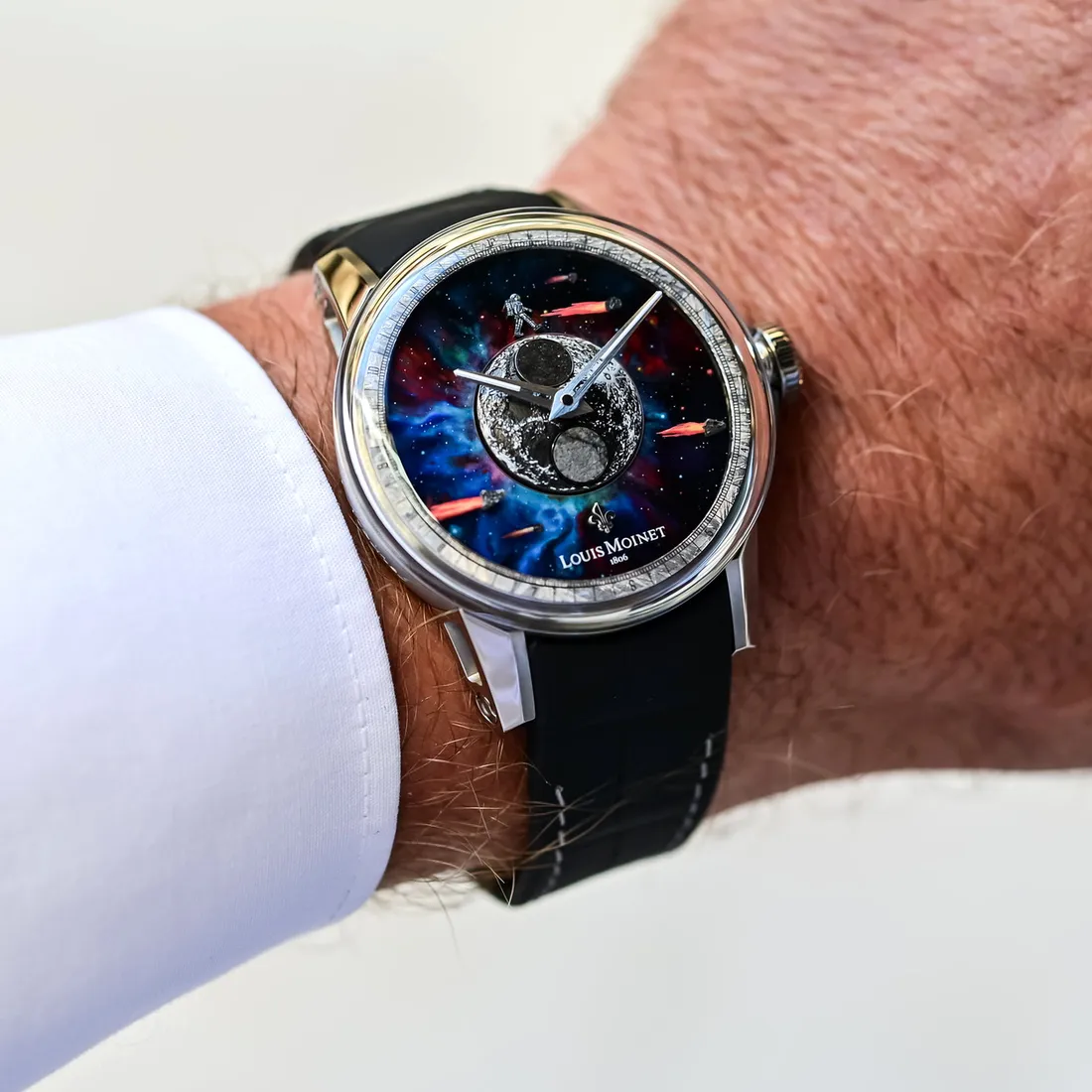
The curator stopped on his way to the door and looked once more at the glowing dial.
I have kept a meteorite catalogue for years, he said. We give each one a number, record where it was found, measure its mass. The work is entirely numerical. Then one day somebody cuts one and sets it on a dial, and the stone turns into something else.
The painter covered the microscope. It does not turn into anything, she said. It already was that. The only difference is that somebody is now looking at it.
Perhaps that is the summary of our relationship with the sky. An order was there for billions of years, and what established that order was not our curiosity. We came afterwards, we looked, and we began to count. They did not exist because we looked. We were able to look because they existed.
Which is why the small figure walking across this dial is more than an ornament. That figure is us. We are walking across our own picture of a celestial body, showing the phase of an order we did not put in place.