In David Fincher’s The Curious Case of Benjamin Button, the tragic taxi accident Daisy suffers in Paris, which ends her career as a dancer in a moment, is one of the finest visualisations of causation and destiny in the history of cinema. Benjamin, in voice-over, sets the scene by saying that sometimes we are on a collision course with one another and simply do not know it, and that whether it happens by accident or by design, there is nothing at all we can do about it.
In the scene, micro human acts and small failures occurring in different corners of Paris that day, with no connection whatever to one another, come together step by step like the invisible wheels of an enormous clock. The year is 1954. A woman in Paris is on her way to go shopping, but goes back for a coat she has forgotten; when she has her coat the telephone rings and she stops to talk for a few minutes. A taxi driver, having dropped a fare, has stopped for a cup of coffee. The taxi has to stop for a man crossing the street, who left for work five minutes later than usual because he forgot to set his alarm. The woman waits in a shop for a gift, but the package has not been wrapped, because the girl who was to wrap it had broken up with her boyfriend the night before and forgot. When the package is wrapped, a delivery truck blocks the taxi. The truck pulls away and the taxi moves off, while Daisy, the last to be dressed, waits for a friend whose shoelace has broken. While the taxi stands at a traffic light, Daisy and her friend come out of the back of the theatre. For a moment the driver’s attention wanders.
And Benjamin builds the reasoning: if that woman had not forgotten her coat, if the driver had taken his coffee and gone straight on, if the package had been wrapped in time, or if that man’s alarm had been set, the taxi would already have passed, Daisy would have crossed that road, and her leg would not have been broken.
At first glance the scene gives the mind the feeling that a hidden hand has handed out parts to everyone and that an unavoidable destiny has unfolded. But examine each individual’s small move in their own world, and the hardest question in the history of thought is raised: did those people make these mistakes of their own free will, or was that accident an inescapable decree?
There is a difference worth noticing. With a driver running a red light there is one person breaking one rule, and it is easy to show where the responsibility sits. In Paris, nobody has broken any rule at all. Forgetting a coat is not an offence. Neither is a cup of coffee, nor answering a telephone, nor a shoelace giving way. A series of small moves, every one of them innocent on its own, intersects in an outcome none of them intended. Which is why the problem is harder here: it is not a fault that needs analysing but the chain itself.
format_quote"Did those people make these mistakes of their own free will, or was that accident an inescapable decree?"
Hasan Bekmezci
In the great hall of thought of East and West the schools of kalam, the giants of philosophy, the quantum physicists and the neuroscientists have gathered, and are analysing step by step that scene from Paris set down in the middle of the table.
The Jabriyya school speaks first. Did you see, it says. The man’s alarm was not set, the woman forgot her coat, the driver stopped for coffee. Nobody has a fault, and nobody has an independent power. Those people were bound to forget their coats. Even had the woman not forgotten hers, some other mishap would have come up and that leg would have been broken whatever happened. A human being is a leaf in the wind.
Baruch Spinoza agrees with him. The universe is one necessary chain of causes. If a stone thrown into the air had consciousness, it would believe it was flying of its own will and falling of its own will; that is exactly the example Spinoza gives in one of his letters. The taxi driver believed he took his coffee break of his own will; but he was a link in the eternal laws of the universe. Had the leg not been broken in that second, the chain of causation would have brought the same result about by another road.
Against this passivity the Mu’tazila school objects furiously. Never, it says. The Creator is just. Had those people not made their own careless and free choices, that leg would not have been broken. Had the driver not drunk that coffee, had the woman not gone back home, Daisy would have gone on her way and her leg would certainly not have been broken. Those careless people created this catastrophe by their own free choices.
Jean-Paul Sartre, the father of existentialism, supports him. In a human being existence comes before essence, he says. A human being is condemned to be free. The driver, the shop girl and the woman who forgot her coat all chose freely. Nobody can escape responsibility by saying it was fate; that is called bad faith. The driver could have gone without the coffee, the shop girl could have wrapped the package quickly. Had they done so, Daisy’s life would have run in a completely different direction.
From the science side of the table the neurobiologist Benjamin Libet joins in. Look at the brain of the woman who forgot her coat, or of the taxi driver, he says. If we had measured the brain waves we would have seen a readiness potential forming in the motor cortex about five hundred and fifty milliseconds before the driver became conscious of thinking I shall have a coffee; and yet a person notices the urge only about two hundred milliseconds before the movement. Between the two there is a gap of roughly three hundred and fifty milliseconds.
But do not forget, Libet adds. Even once the brain has started the inclination, consciousness can step in during the last hundred to two hundred milliseconds before the act and stop it. We call this free won’t, the right of veto. The driver could have given up the coffee; which is why the moral responsibility for the delay rests with the person.
Then Werner Heisenberg, the pioneer of quantum physics, takes the floor. Spinoza and the Jabriyya are wrong, he says. The universe is not a rigid wheel. In the subatomic world the uncertainty principle holds. That moment on the Paris street was not locked into a single future; there was a set of possibilities there.
But do not draw a human freedom straight out of this, Heisenberg adds. The uncertainty principle unlocks the door; it does not open it. A die that falls at random is not free either. All I am saying is this: to claim that the leg would have been broken anyway even without the coffee is not an answer physics can give. Freedom itself is a matter not for physics but for ethics and for kalam.
The schools that speak last carry the relation between human responsibility and divine decree to its final point.
The Ash’ari school says this: the Mu’tazila, by saying it would not have been broken, claim to know the unseen; the Jabriyya, by saying it would have been broken whatever happened, absolve people of their mistakes. The right answer is this: what would have happened had the coffee not been drunk, or the coat not forgotten, is unknown to us; we cannot know. What falls to us is to know that people are responsible for their own inclinations and their own carelessness.
Immanuel Kant confirms him. In the physical world causation operates, he says; but in the moral world freedom and duty are what count. The driver and the shop girl were both obliged to be careful. What the outcome would be belongs to the noumenal world, but a person is responsible for having trampled their duty.
The Maturidi school unties the knot. My friends, it says, every one of those people used a free inclination in their own daily life. The driver was not forced to take his coffee, the woman was not forced to go home. A human being has an independent partial will that exists before the act as well.
Let us seal the truth with an enormous theatre stage and one small angle of light, it goes on. It is the Director who built the magnificent stage, set the great projectors, supplied the hall with electricity and laid down all the laws of physics. The will given to a human being is the authority to turn a small mirror at the edge of the stage a millimetre to the right or to the left. There is no power in turning that small mirror that could bring the stage down or make light out of nothing. But the Director laid the rule down so that, knowing in his eternal knowledge that millions of people would turn their own mirrors freely, he created by his own universal power the crossing of those small reflections on that Paris street in that very second.
What would have happened had one of those steps not been taken is unknown to the human mind. But the one thing we do know is that every person is responsible to the last for where they point that small mirror in their hand, and for which choice they make.
Though both schools meet before this scene at the point that the future is unknown to us, they part in the philosophy behind it.
For the Ash’ari school a person’s power and will are created at the very moment the act takes place; there is no independent power of will standing ready beforehand. That power of choice was created in the instant the driver reached for the coffee. For the Maturidi school there is an independent potential of choice in a person before the act as well; before he put out his hand for the coffee the driver was in a position to choose not to, and the act was created according to that choice already in place.
The reason for the unknown differs too. For the Ash’ari school its source is divine power and eternal knowledge; for the Maturidi it is a potential that really exists in the person and could have been used otherwise. They part on the role of reason as well: for the Ash’ari school reason cannot declare good and evil with certainty without revelation, while for the Maturidi school reason can find it by its own grasp even with no religion and no law at all.
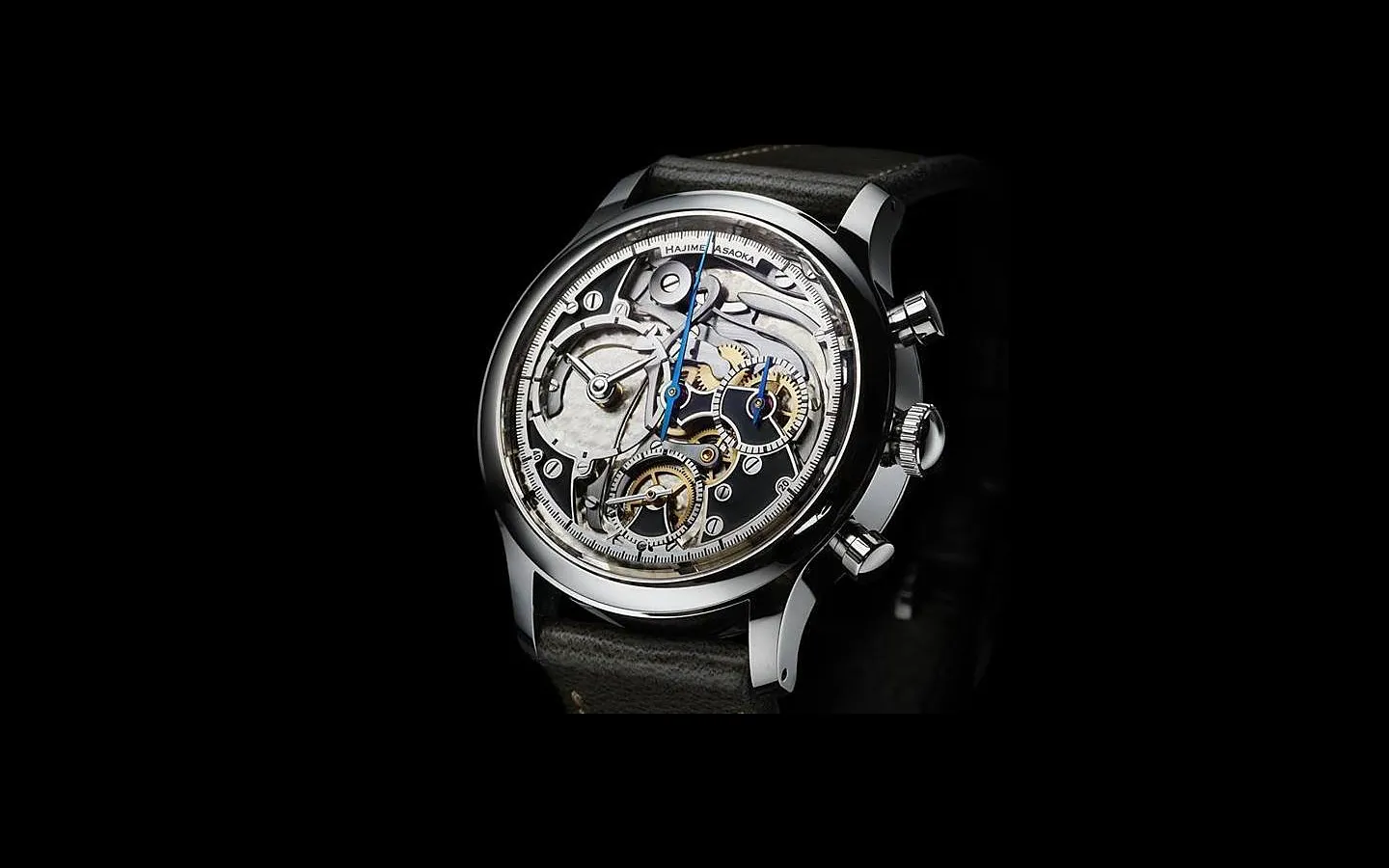
That split-second intersection on the Paris street finds its most concrete counterpart in the Hajime Asaoka Chronograph standing on our table.
Hajime Asaoka never passed through the traditional Swiss watchmaking schools. He is an independent master who climbed from nothing to the summit by his own effort, by reading books, by building his own lathes and by working every wheel by hand in his Tokyo atelier. That journey is the most concrete living horological emblem of the principle that reason can find the truth by its own effort and that a person can reach a result by striving along the line of their own inclination.
A chronograph mechanism is the plainest chain of causes in the world of watchmaking. The moment you press the button at two o’clock, the micro force your finger applies stands for the inclination of a human being. The button pushes a lever, the lever turns the column wheel by one tooth, the arms that fall into the gaps between the columns are released, the carrying arm brings the wheel of the horizontal clutch up against the seconds wheel, and the chronograph hand begins to turn. Your finger holds no force capable of driving that chain; that force gathered in the mainspring before you arrived. The only thing your finger does is decide the moment at which it is let go.
Asaoka built this chain without leaving anything out. By the maker’s own description the watch has a column wheel, a horizontal clutch with a carrying arm, a brake lever, two buttons and a sliding gear; none of the elements found in the masterpieces of the 1950s and 1960s has been omitted. The minute counter, too, advances in a single jump rather than creeping.
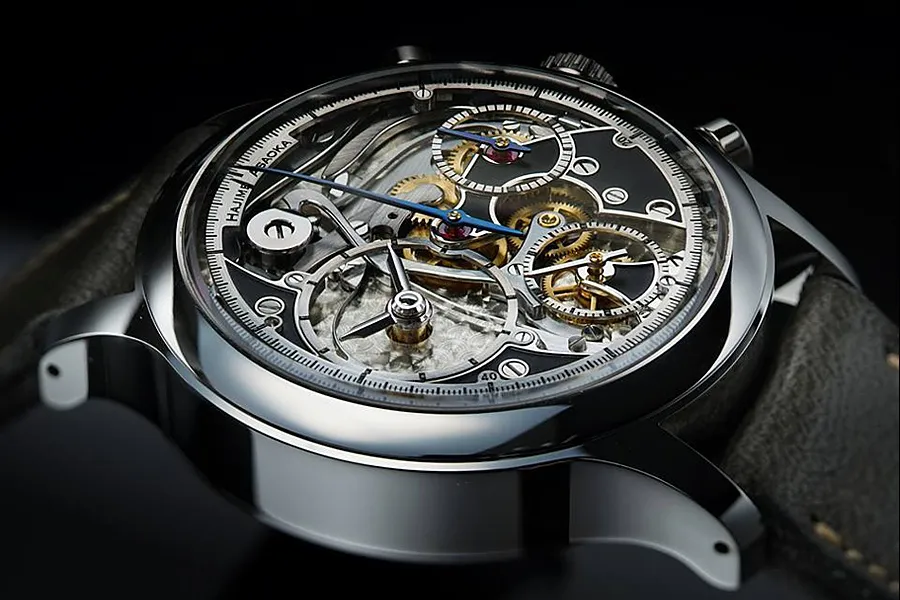
But the real decision is this: Asaoka placed the chronograph mechanism not under the dial but on the face of it. Looking at the watch, you see with your own eye how one action triggers another, and which wheel presses on which lever. This dial is a microscopic model of the universe, laying bare the working of the veil of causes. Just as on that Paris street a coffee break, an alarm nobody set and a shoelace giving way locked together unseen, here the locking together is in plain sight.
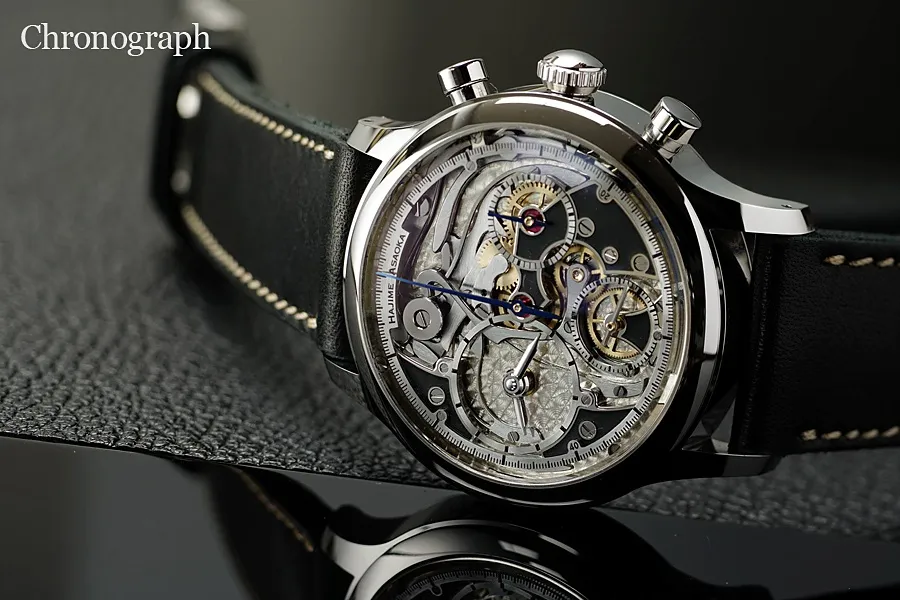
format_quote"A chronograph mechanism is the plainest chain of causes in the world of watchmaking."
Hasan Bekmezci
The technical part is this. The case is stainless steel and thirty eight millimetres across. The balance beats eighteen thousand times an hour and the power reserve is forty hours. The buttons sit at two and at four o’clock, with the crown between them.
Asaoka made two things deliberately large: the balance wheel is fifteen millimetres across and the barrel is far bigger than usual. The reason is this: when the chronograph is engaged an extra load comes onto the system, and in an ordinary watch the amplitude of the balance falls, which is to say the watch loses its rate. A large balance and a large barrel keep that fall to a minimum; the watch goes on keeping time even while the chronograph runs.
Which is to say that when one link of the chain goes into action, the rest of the system is not thrown out. That is a quiet answer to the question on the stage: one cause coming into play does not have to shake the whole order, so long as enough margin has been left behind it.
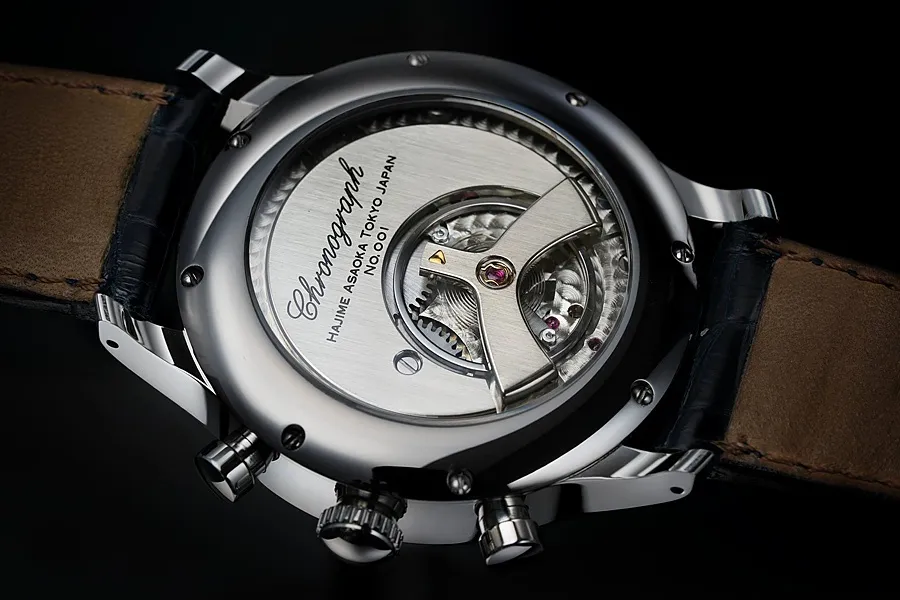
Against the complication of the dial, the back is plain; Asaoka’s modern manner lies in that contrast. On the caseback are the name of the piece, the name of the Tokyo atelier and its number.
The truth the Ancient Master of the East pointed to when he said that once this knot is untied the knot in the matter is untied too, and the truth the great minds of human history have looked for, is this.
A human being cannot say I did all of it; because the enormous physics, the train of wheels and the outcome between pressing a button and hundreds of wheels turning are not made by a human being. The web of causation that Spinoza and Libet saw is real.
A human being cannot say it is not my fault, destiny created it, either; because the Creator tied that enormous act and its result to a person’s choice to carry their finger to that button. The moral responsibility that Kant and Sartre defended is unavoidable.
A watch lover looking at Hajime Asaoka’s faultless chronograph, faced with that mechanical genius which sets hundreds of wheels and levers going at a single micro touch of the finger, remembers once again the unshakeable and delicate responsibility of their own partial will, in the universe and in society. The human will is the angle of a small mirror at the edge of the stage; and the outcome that discloses itself when that mirror turns belongs to the Infinite Architect of the worlds.
format_quote"This dial is a microscopic model of the universe, laying bare the working of the veil of causes."
Hasan Bekmezci
The watch on its maker’s own site: Hajime Asaoka, Chronograph