

At Lucerne the river Reuss leaves the lake and cuts the town in two. Two wooden bridges cross it, and both are covered, which is to say roofed. The roof is there to keep the rain off the timber, and it is precisely that roof which creates triangular gaps between the trusses.
Those triangular gaps were painted. The most famous pictures in Lucerne therefore sit on surfaces no architect ever intended, left over by the load-bearing structure. The painter did not choose the shape of his panel. The geometry of the roof chose it for him.
The older and better known of the two is the Kapellbrücke, dated 1333 and reckoned the oldest covered wooden bridge in Europe. Its triangles carried one hundred and fifty-eight panels, all painted in the seventeenth century by a local man, Hans Heinrich Wägmann. Their subject was the history of the town and the country; Lucerne had hung its own past under the roof of a bridge.
On the night of 18 August 1993 the bridge burned. By morning more than eighty-six of the panels had been destroyed outright. Forty-seven fragments were gathered from the wreckage, and of those only thirty could be fully restored. The bridge was rebuilt in eight months, cost the city three and a half million francs, and reopened in April 1994.
A structure that had carried a city’s memory for three hundred and fifty years lost most of it in a few hours. The gaps you see walking the bridge today are not accidents of design. They are panels that could not be replaced.
format_quote"A city can carry its memory for three hundred and fifty years and lose it in a few hours. Memory is as flammable as everything else."
Hasan Bekmezci
A little further upstream, where the mills stood, is the second bridge: the Spreuerbrücke, dated 1408. Its triangles do not carry the history of the town. They carry something else.
Between 1616 and 1637, across twenty-one years, Kaspar Meglinger painted sixty-seven panels under that roof, and his subject was the Dance of Death. Forty-five of them are still in place. It is the most extensive cycle of its kind known anywhere.
The Dance of Death is a form that appeared in late medieval Europe in the wake of the plagues, and it makes one argument. The skeleton takes everyone. It takes the pope and it takes the beggar. It takes the bishop with his crozier, the merchant with the money still in his hand, the soldier inside his armour, the child out of its mother’s arms. No one is exempted and no one is offered a different rate.
The real subject of these pictures, in other words, is not fear. It is equality.
Now to the thing that is genuinely remarkable, and it is the heart of this piece.
Meglinger did not paint these pictures on the wall of a church. He did not paint them over the gate of a graveyard either. He painted them under the roof of a bridge.
Nobody lives on a bridge. Nobody has a house there, or a shop, or a bed. If you are on a bridge then at that moment you are certainly going from somewhere to somewhere, and you are between two banks. A bridge is not a destination. It is a crossing.
These panels therefore speak not only through what they show but through where they were put. The structure repeats with its own body what the painting says: this is not a place to stay, it is a place to pass. Death was painted not on a wall but on a crossing.
format_quote"The panels were painted on a bridge rather than in a church. The structure repeats with its own body what the pictures say: this is not a place to stay."
Hasan Bekmezci
Memento mori is usually heard as a dark warning, and its function is entirely different. Remember that you will die is not a threat but a statement of measure. It tells you not the size of death but the size of everything else.
You can only know how large a thing is by setting it beside another. Nothing on its own can be called big or small; you have to lay a rule beside it. The true size of our quarrels, our ambitions and our accumulated grievances also appears only when a measure is set next to them. Those panels are that rule.
Which is why the watch in this piece comes from a house of regulators. In a watchmaker’s workshop the regulator was the master clock on the wall, the one clock by which every other watch was set. It was itself set by nothing. It supplied the measure. However many watches a workshop held, correctness came from a single point.
Chronoswiss was founded in Munich in 1983. Its founder was Gerd-Rüdiger Lang, a master watchmaker left unemployed by the collapse of Heuer’s German arm. It was the middle of the quartz crisis and the mechanical watch was reckoned all but dead. Lang began in a garage with heaps of mechanical parts.
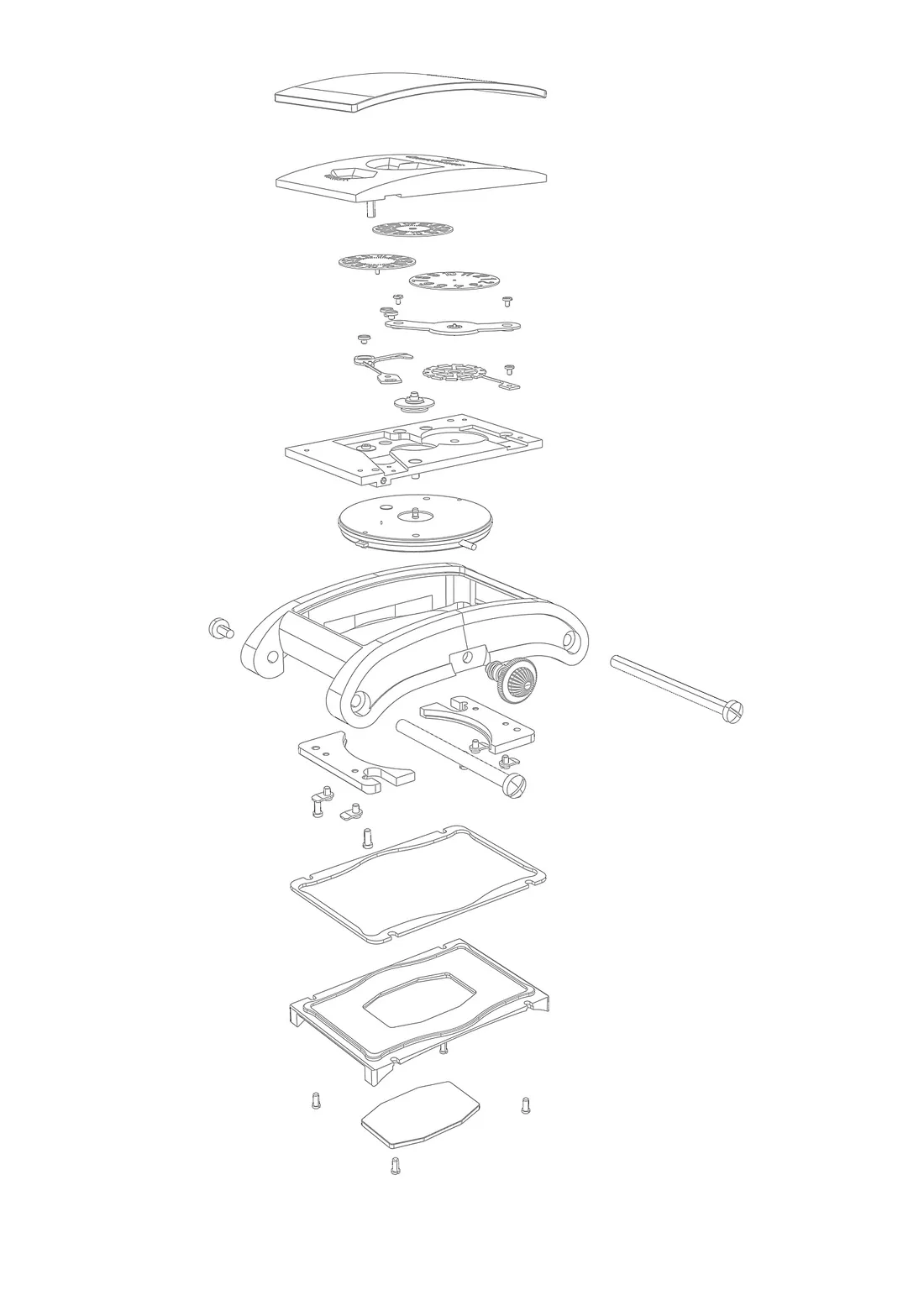
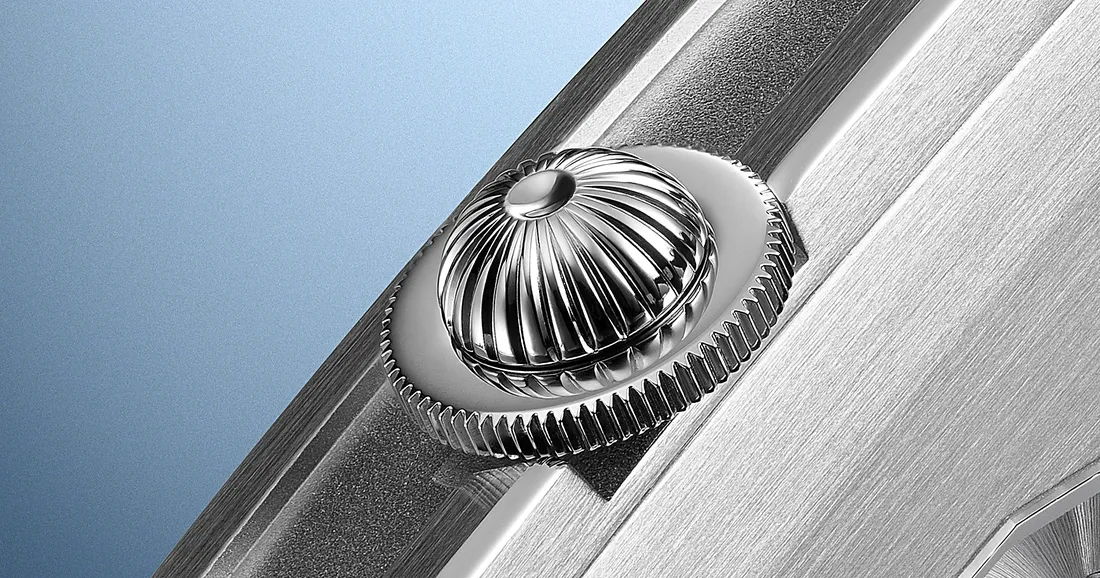
The house found its signature in 1987. The Régulateur it presented that year was the first serially produced wristwatch with a regulator dial, driven by their own reworked calibre 122. It refused to gather hours, minutes and seconds on one centre and gave each of them its own axis. With that watch came the design language the house is still known by: the onion crown, straight lugs, a finely fluted bezel and a case built from nineteen parts.
Today Chronoswiss works from the Löwenstrasse in Lucerne, within walking distance of those bridges.
The house’s 2026 novelty is the Neo Digiteur, and its ancestry runs back to the Digiteur Lang made in 2005. That watch drew on the digital-display pocket watches of the early twentieth century and did away with hands entirely.
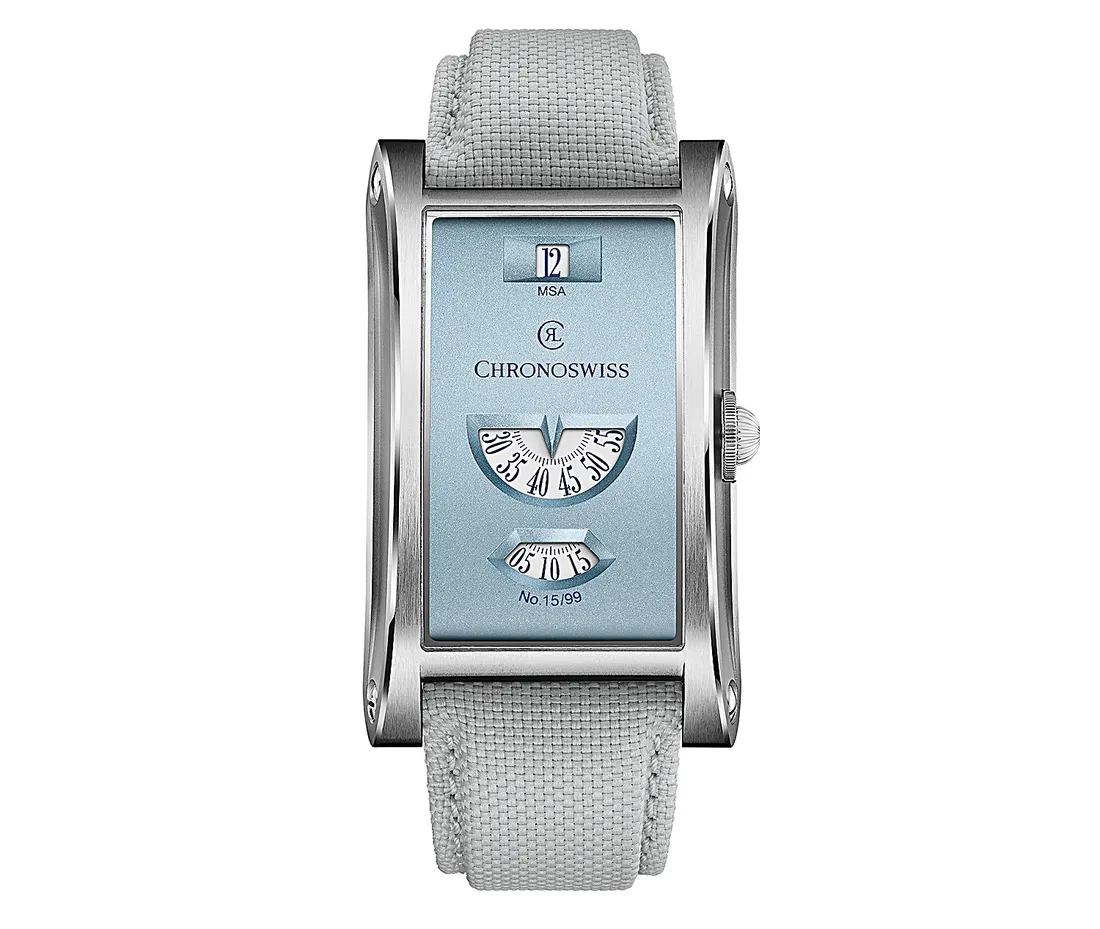
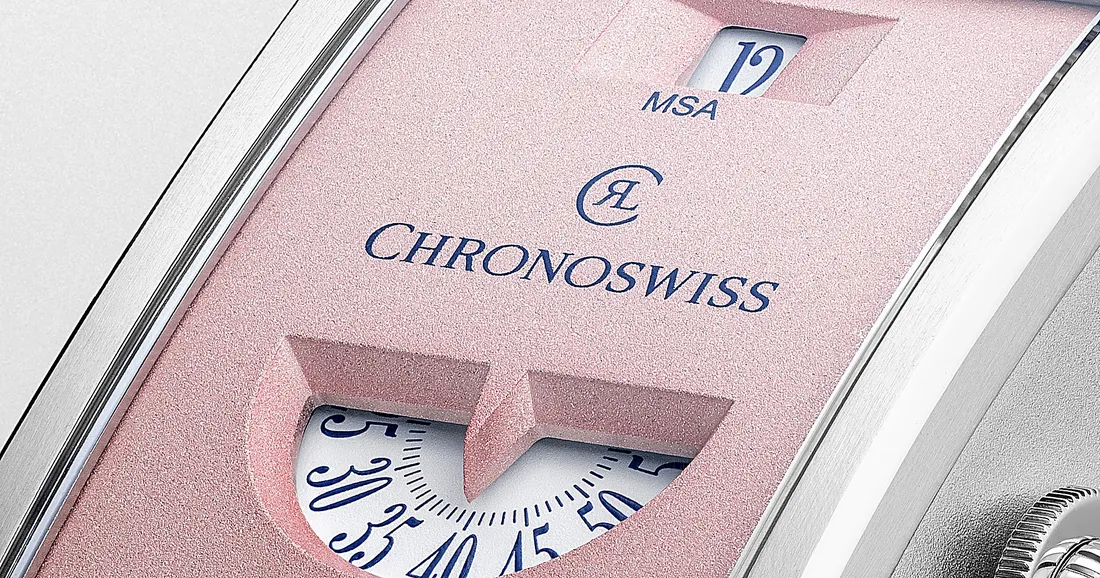
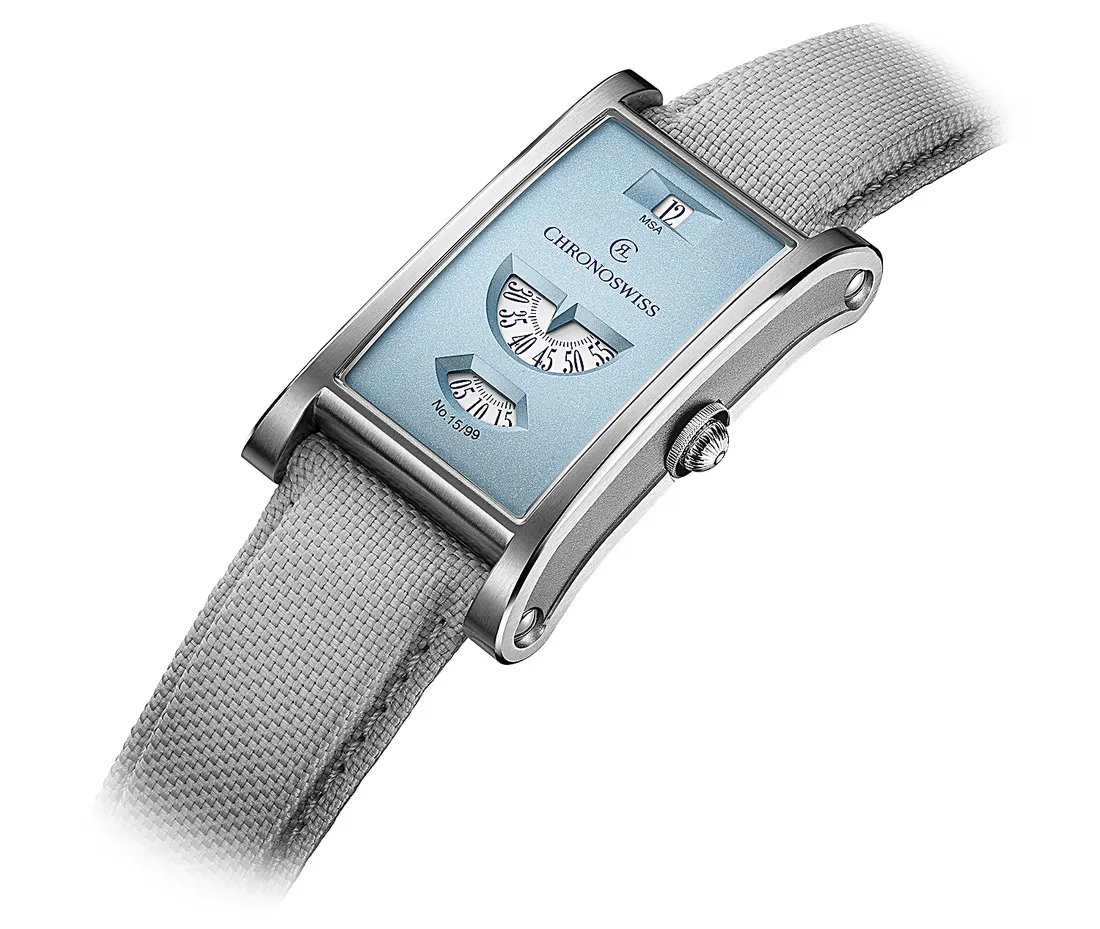
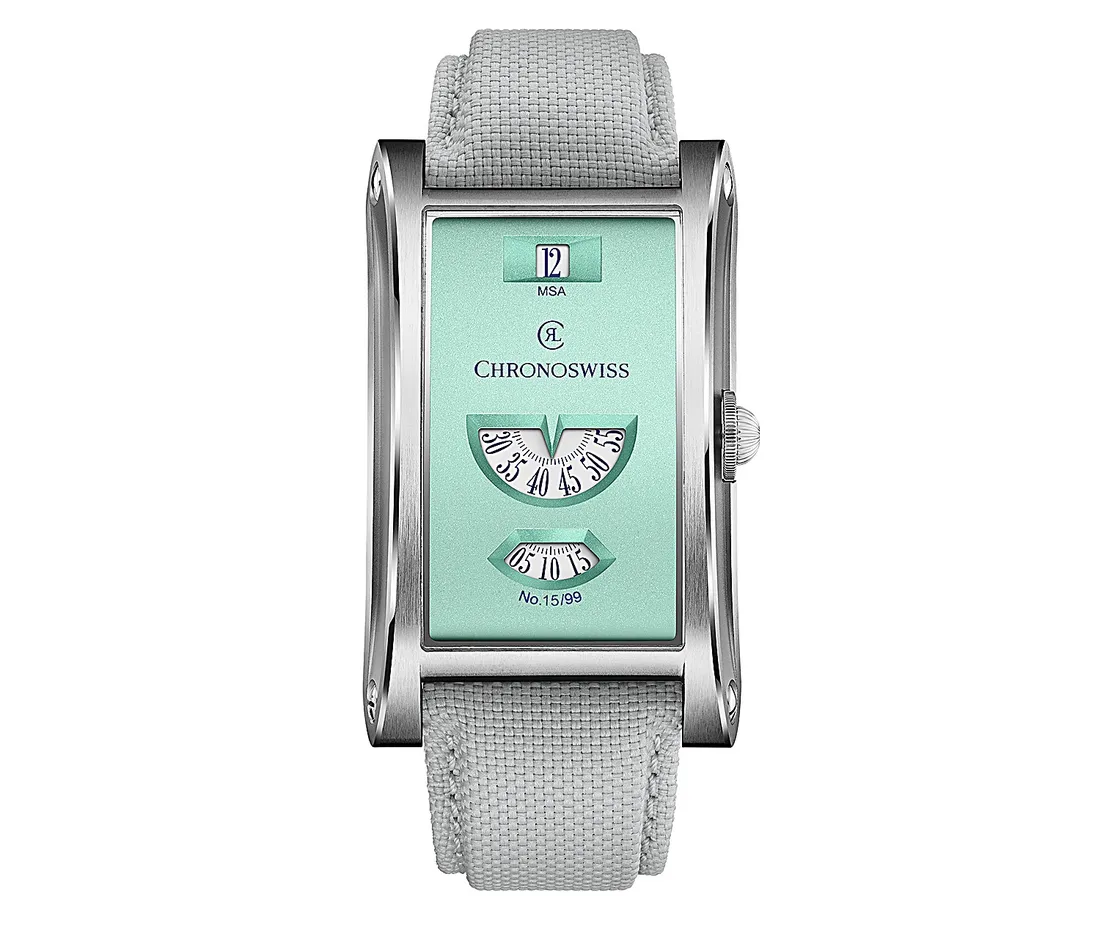
The new Neo Digiteur does the same. There are no hands on the dial at all. The hour appears by jumping into a small aperture at twelve, the minutes sweep across a wide curved window in the centre, and the seconds run below. All three are read through separate apertures cut into a curved dial, and all three are entirely mechanical. In the maker’s own description, it is a regulator without hands.
What the jumping hour carries here is more than a technical charm.
A hand lets you watch the transition. You see the minute hand approaching twelve; it approaches, approaches, passes. Time appears to flow, and you grow used to the flow.
A jumping hour does not allow that. The numeral stands still, and then in an instant a different numeral is standing there. You see nothing in between. You do not witness the change; you notice that it has happened.
Meglinger’s panels are built exactly this way. In none of them is the skeleton shown approaching from a distance. The skeleton is always already there, already holding the sleeve, already leading the dance. There is no scene of arrival. There is the state before and the state after, and nothing between them.

Picture two people at the bench arguing about this dial: the constructor who cut the apertures and the designer who drew the face.
The designer makes the simplest objection. You have cut three holes in the dial and thrown away the hands. People read hands without thinking.
The constructor treats that not as a defect but as the problem itself. That is exactly the point. A hand lets you read the time without looking. You catch the angle from the corner of your eye and you never actually look at all.
The designer asks what the aperture does instead.
The constructor answers. In an aperture there is no half reading. A numeral is either read or it is not. You are made to look.
The designer asks the real question. And why does that matter?
The constructor is brief. An hour you glance at costs you nothing. An hour you have to read does.
format_quote"A hand lets you read the time without looking. An aperture makes you look. The difference between them is noticing."
Hasan Bekmezci
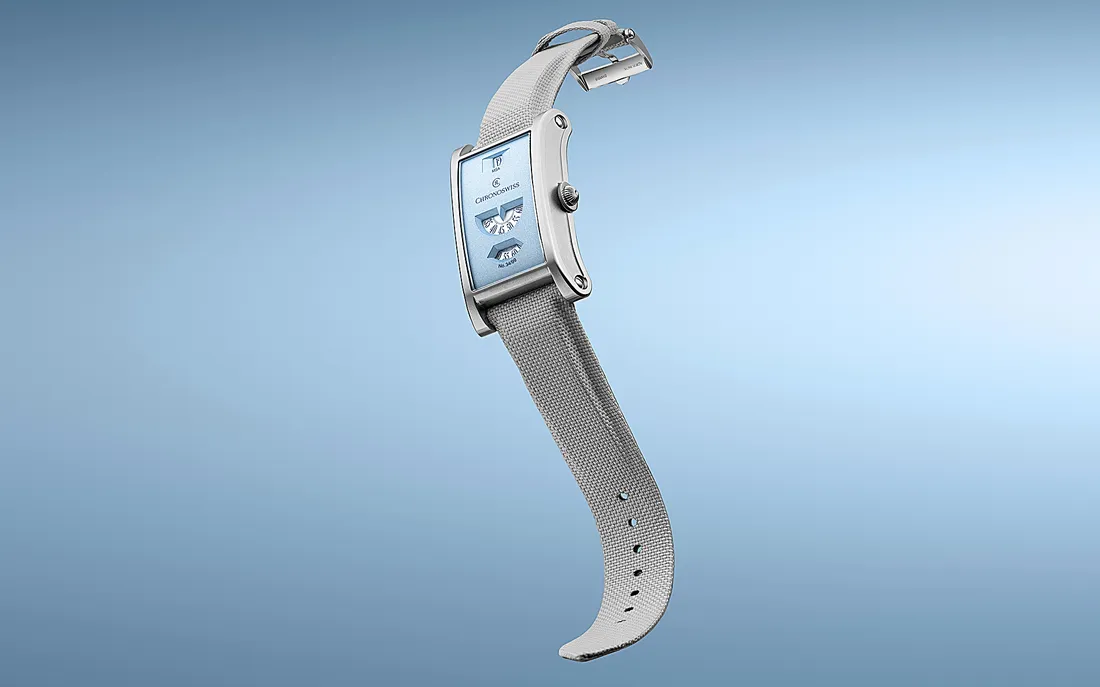
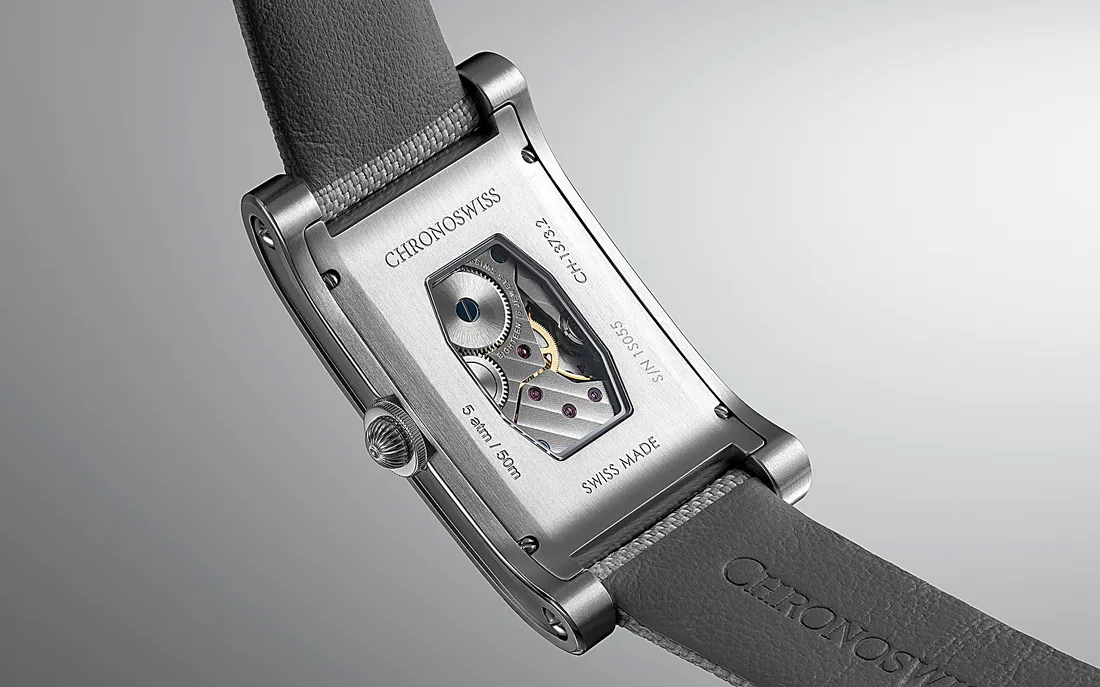
The figures run as follows. The case is stainless steel, rectangular, and forty-eight millimetres. Water resistance is fifty metres. Inside runs the hand-wound calibre C.85757, and the module that governs the jumping hour and the sweeping minutes and seconds was developed in Lucerne specifically for this architecture. The movement is visible through a rectangular window in the back; hand-guilloché is worked onto gold- and ruthenium-plated components.
The matte texture of the dial is achieved by a particular sandblasting technique, and the lacquer laid over it gives the colour depth. The series is called Pastel Code and comes in three colours: Sky blue, Rose and Mint. Each colour is limited to ninety-nine pieces and costs eleven thousand five hundred Swiss francs.

There is a detail in a jumping hour that tends to be missed. When the hour is complete, the disc does not stop. The numeral on it leaves the aperture, but the disc goes on turning and brings a new face to the window.
What ends, then, is not the hour. What ends is the face that was showing. The disc is the same disc, the same mechanism turns at the same rate, and the next numeral is already there, already written, merely not yet visible.
Meglinger’s bridge says the same thing. The panels were painted on a crossing rather than a wall. People who lived through plague and saw death every day chose, in order to speak about it, the structure that joins the two banks of their town. A bridge is not an ending. A bridge is the name for going from one bank to the other, and the far bank is not made non-existent by the fact that you cannot see it.
One question is left, and it concerns the disc. The disc does not turn by itself. There is a spring that turns it, there is a hand that winds the spring, and it is not we who decide how far the thing that hand winds will turn.
The panels that have stood over that bridge for four hundred years are the work of people who knew this. They knew they had not set the measure; they only tried to remind others that a measure exists. And they wrote it in the one right place, where everyone is obliged to cross.
The watch on its maker’s own site: Chronoswiss, Neo Digiteur Sky