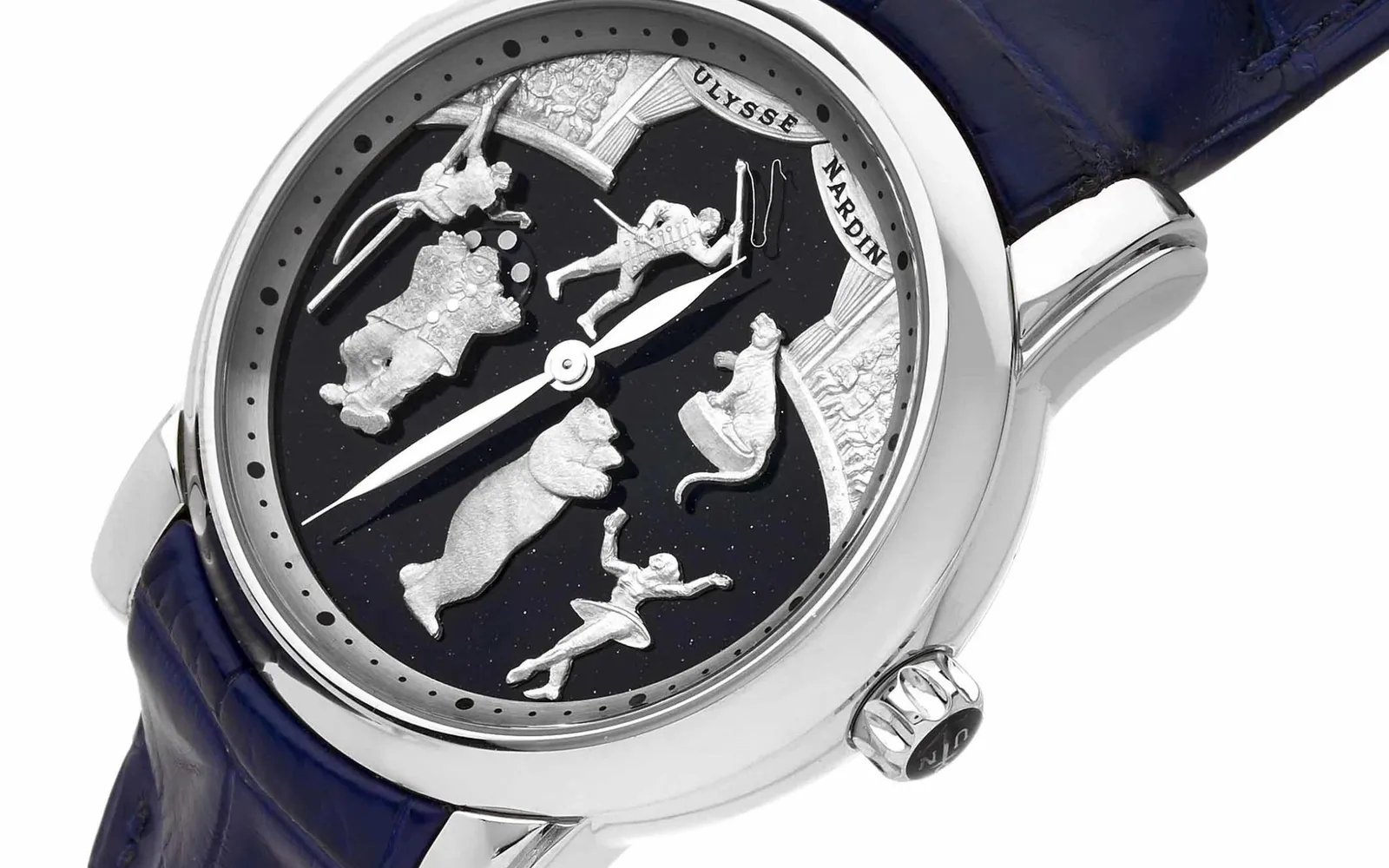
In a grand room in Mondorf-les-Bains, the town in the south of Luxembourg known for its thermal waters and its quiet, a private auction was being held for a handful of collectors. In front of one of the glass vitrines in the middle of that high-ceilinged, velvet-curtained room stood Gülfidan, seven years old, unable to take her eyes off a watch.
The watch was the Ulysse Nardin Circus Minute Repeater, carrying miniature circus figures carved in white gold on a deep blue ground that glitters like a night sky. Pull its slide and the hammers inside chime, and the figures on the dial come alive in rhythm.
Gülfidan tugged at the sleeve of her grandfather Hasan’s jacket and whispered: Grandad, look at that. The circus inside the dial is just like a film. The bear, the clown, the ringmaster. As though somebody set up a little cinema screen in there.

Grandfather Hasan stroked her head. He lifted his eyes from that glittering watch, carried them to the far end of the room, and then to the slow passage of time itself. His voice rang as though it had been filtered through the still, misted framing of an Andrei Tarkovsky film:
Yes, my girl. Just like a film. But this is a slow-motion scene of illusion, shot in order to make us forget the truth.
How do you mean, grandad, Gülfidan asked.
Look, my Gülfidan. We are standing here, in this heated and ornamented room in Mondorf. Think of those scenes of stopped time in Tarkovsky’s Mirror, or in Stalker. Raindrops fall into a puddle, objects rot, time folds in on itself. Tarkovsky defined cinema as sealed time. And this watch claims the same thing: that it has sealed time inside a small case. Like the orchestra playing on the deck of a sinking ship, it is a miniature frame of cinema that keeps our eyes and ears occupied.
Then grandfather Hasan turned to that giant of literature, Fyodor Dostoevsky. The great master throws light on exactly this scene when he writes about the abyss in the human soul and the prisons a man builds with his own hands, he said. In Crime and Punishment, Raskolnikov sets out with the arrogance that the extraordinary man is capable of anything; but the moment he commits the murder, time stops for him and he is shut inside the prison of his own conscience. When a man makes idols of his own mind and his own appetites, he becomes the slave of the web he wove himself, like the wheels inside that case. And in the Grand Inquisitor chapter of The Brothers Karamazov, Dostoevsky cries out how people take shelter in false miracles, in bread and in entertainments, to flee from freedom and from the heavy responsibility that comes with it. In Notes from Underground he says the human soul will not fit rational moulds: mechanical perfection with the coldness of two times two making four does not save a man, it turns him into an automaton without feeling.
format_quote"Any instrument that believes it has sealed time inside a case only makes you hear more clearly how fast time is running."
Hasan Bekmezci
Gülfidan looked again at the figures on the watch; in the movement of the bear she seemed now to catch not only cheerfulness but the sorrow of a creature taken away from what it was made for. But grandad, she asked, why would a person put a circus on a dial?
Grandfather Hasan sighed. Because a man satisfies his own arrogance by supposing he has brought the wild world and its animals to heel with a whip and a cage, my girl, he said. And yet no living creature betrays the nature it was created with; a bear lives as a bear, a bird flies as a bird. But a man, like Dostoevsky’s characters, forgets the spirit the Creator gave him and shuts himself in among the wheels, the appetites and the false stages. In a sinking world he consoles himself by watching the little cages he built himself.
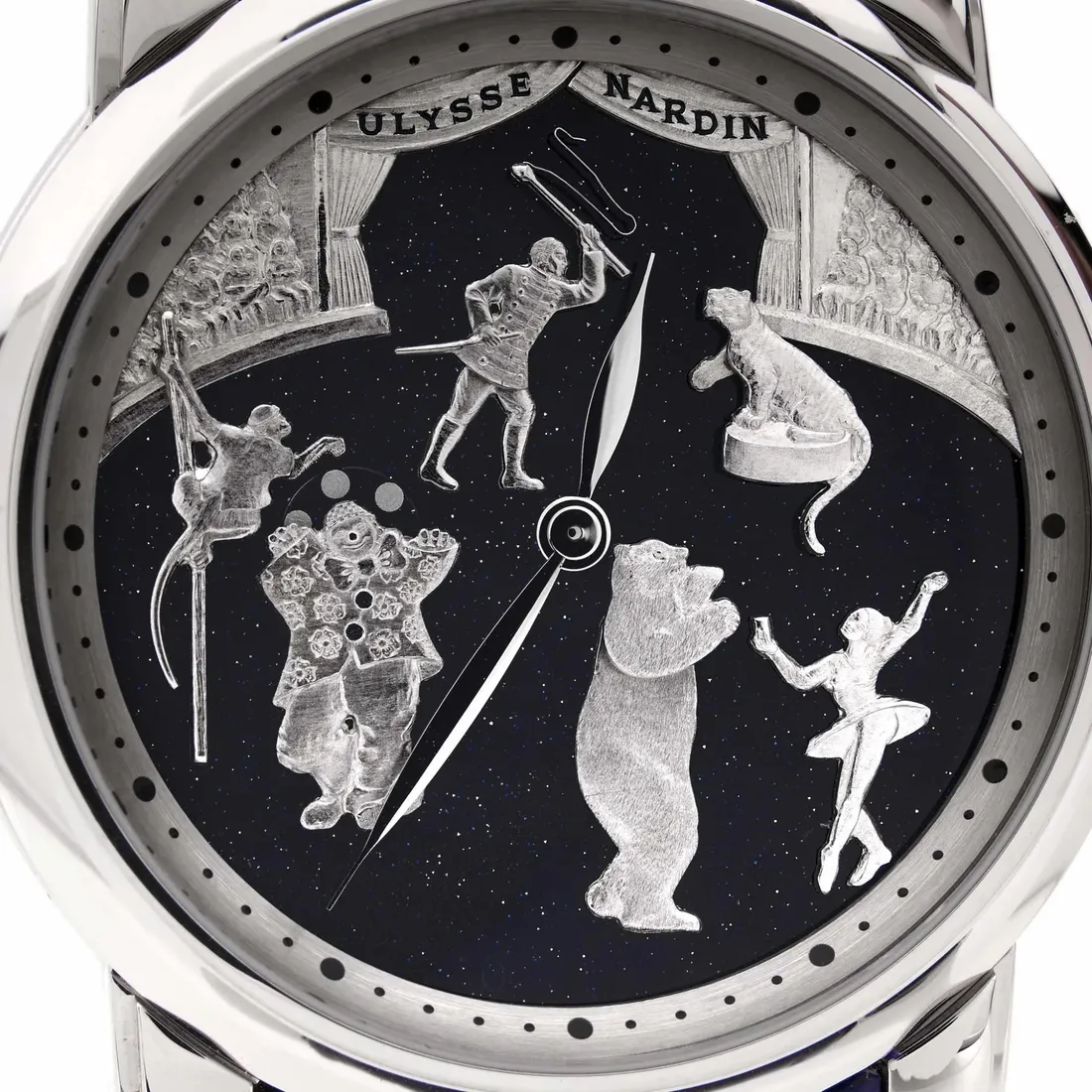
Grandfather Hasan reached a hand toward the vitrine and pointed at the sound system of the watch and at the architecture of its miniature theatre.
Look, my Gülfidan. Pull that hidden slide on the left flank of the case downward and the most laborious mechanical symphony in the history of watchmaking wakes up. The minute repeater is the most merciless complication of this craft, and the one that asks the most mastery. The gong wires set inside the case are tuned to a tolerance finer than a human hair. When the slide is pulled, a small memory device of snails and racks programmes the mechanism to strike first the hours, then the quarters, then the minutes that remain. As the steel hammers fall on the wires, the tone of every stroke has to hold; if the tuning slips, that masterpiece goes in the bin and the work begins again.

And there is more, my girl, said grandfather Hasan. Ulysse Nardin married this acoustic work to the art of the jaquemart, which is to say to moving automaton figures. The monkey on his pole, the ringmaster with his whip raised, the tiger on its pedestal, the juggling clown, the bear rising to its feet and the ballerina: each is engraved out of white gold with diamond-tipped tools and linked by microscopic joints to the train of cams and wheels behind. Every time the gongs sound, these figures move with the rhythm of the sound. A deviation of a thousandth of a millimetre will jam the figures or lock the mechanism. The hard part is not the sound itself; it is having the sound and the movement be right at the same instant.
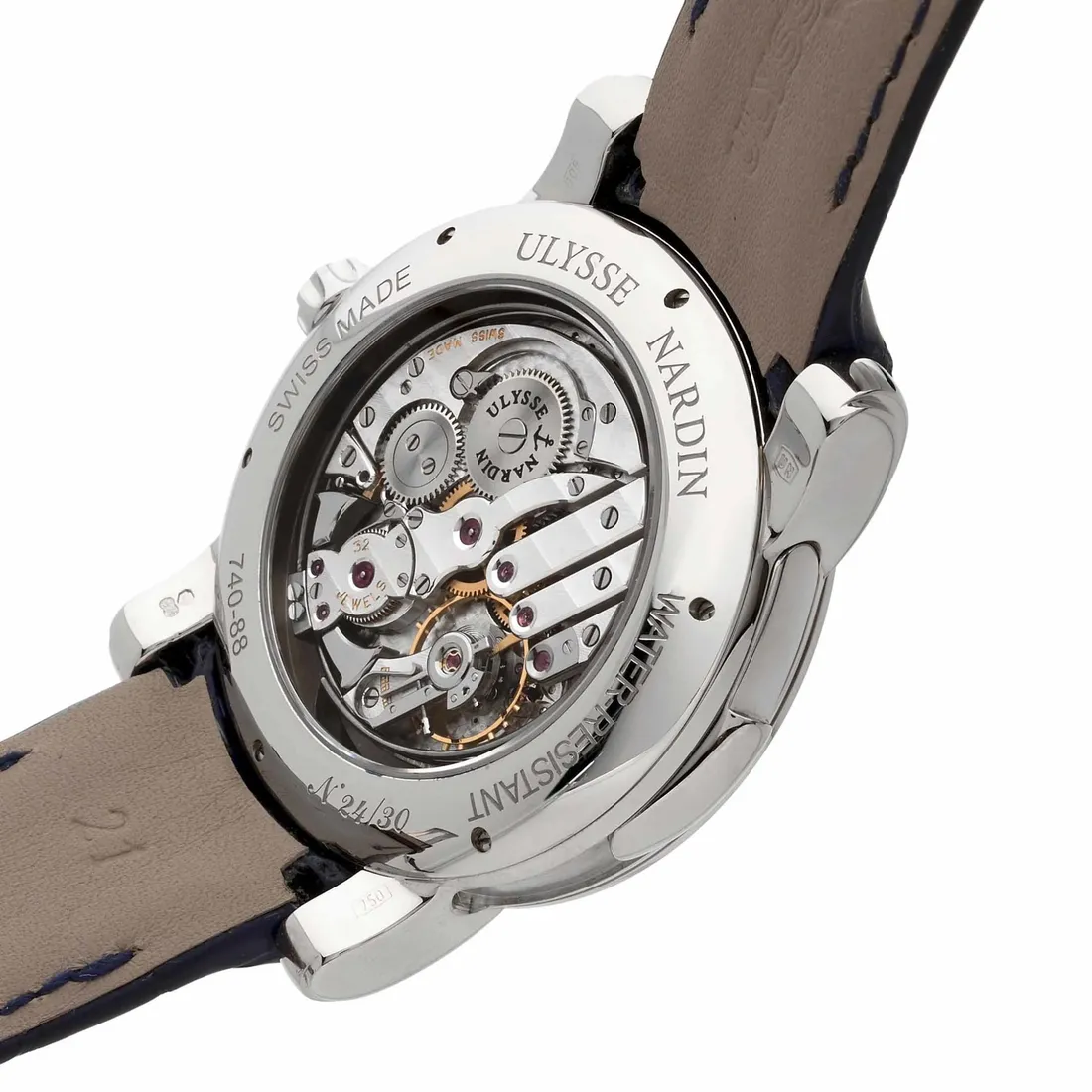
Turn the watch over and you see a hand-wound movement of thirty-two jewels. On the rim of the back stand the reference and the serial: 740-88, and the twenty-fourth of thirty. The case is eighteen-carat white gold and the dial is aventurine, a dark blue glass seeded with fine sparks. That is why Gülfidan took it for a night sky, because aventurine is chosen for exactly that.
format_quote"The most elegant form a cage can take is the one that makes you forget it is a cage."
Hasan Bekmezci
Grandfather Hasan finished like this: people are spellbound in front of this workmanship, and they suppose they have bought time, that they have shut time into a dial like a frame of film. But every one of those ringing notes is the ticking of the merciless remorse beating in Raskolnikov’s temples. This watch does not freeze time; it whispers how time grinds us down, and how many of our seconds remain before the presence of the Creator. If you look at it and do not think of His power and of the order in creation, then it is nothing but an expensive puppet worked on a sinking ship.
format_quote"A child’s eye sees the play first; it learns to see the time afterwards."
Hasan Bekmezci

Gülfidan took her grandfather’s hand and held it tight. The circus on the dial no longer looked to her like a cheerful toy. Inside that navy depth she seemed to sense the long framing of Tarkovsky’s cinema, the vast mirror Dostoevsky holds up to the human soul, and the wisdom at the bottom of existence.
I understand, grandad, she said. What matters is not the show on the dial but not forgetting the Creator who keeps us and the whole universe alive in a flawless order.
Grandfather Hasan smiled and kissed his granddaughter on the forehead. Now you have read the time properly, my girl, he said. Come, let us go.
The watch is out of production; the collection it belongs to is on its maker’s site: Ulysse Nardin, Classico