
We fix our eyes on the depths of space and imagine enormous galaxies; and yet the universe that truly cannot be grasped is flowing in the veins of a tree climbing toward the sky from a hand’s breadth under the soil. What we see when we look at a pine or a cedar is not simply wood and leaf; it is a living cathedral that defies gravity, carries water metres upward and works at the molecular level like an enormous industrial plant, and all of that magnificence is the work of the flawless power and the endless knowledge of the Creator.
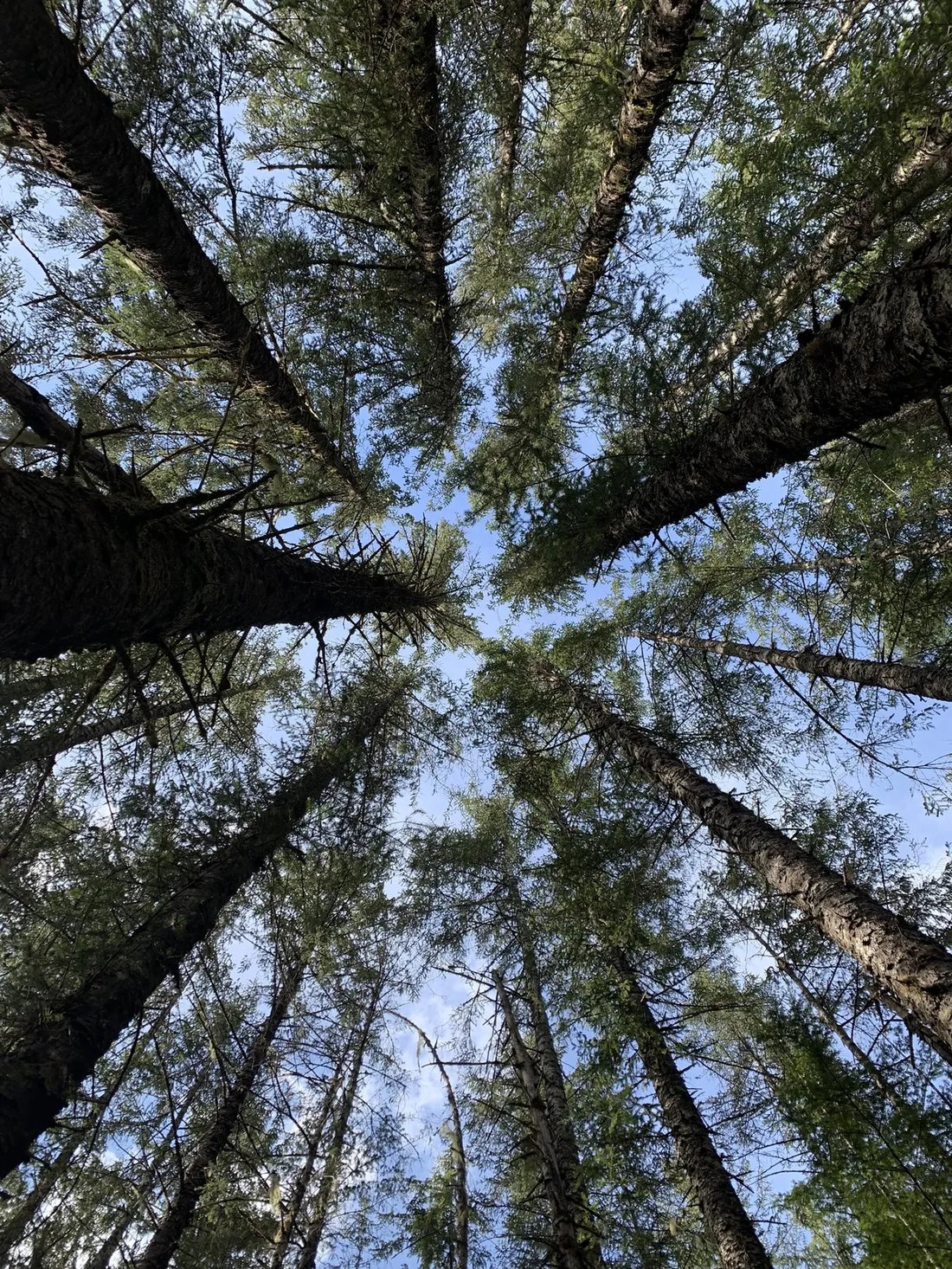
A tree has to raise water from metres underground to the very top, and there is no motor anywhere in the process. It evaporates water from its leaves and draws the column of water in the trunk upward like an enormous syringe. Imagine trying to draw water from the bottom of a fifty-storey building through a single straw from the roof. The column is stretched so tight that if one tiny bubble of air gets in, that rope of water snaps and the system collapses at once.
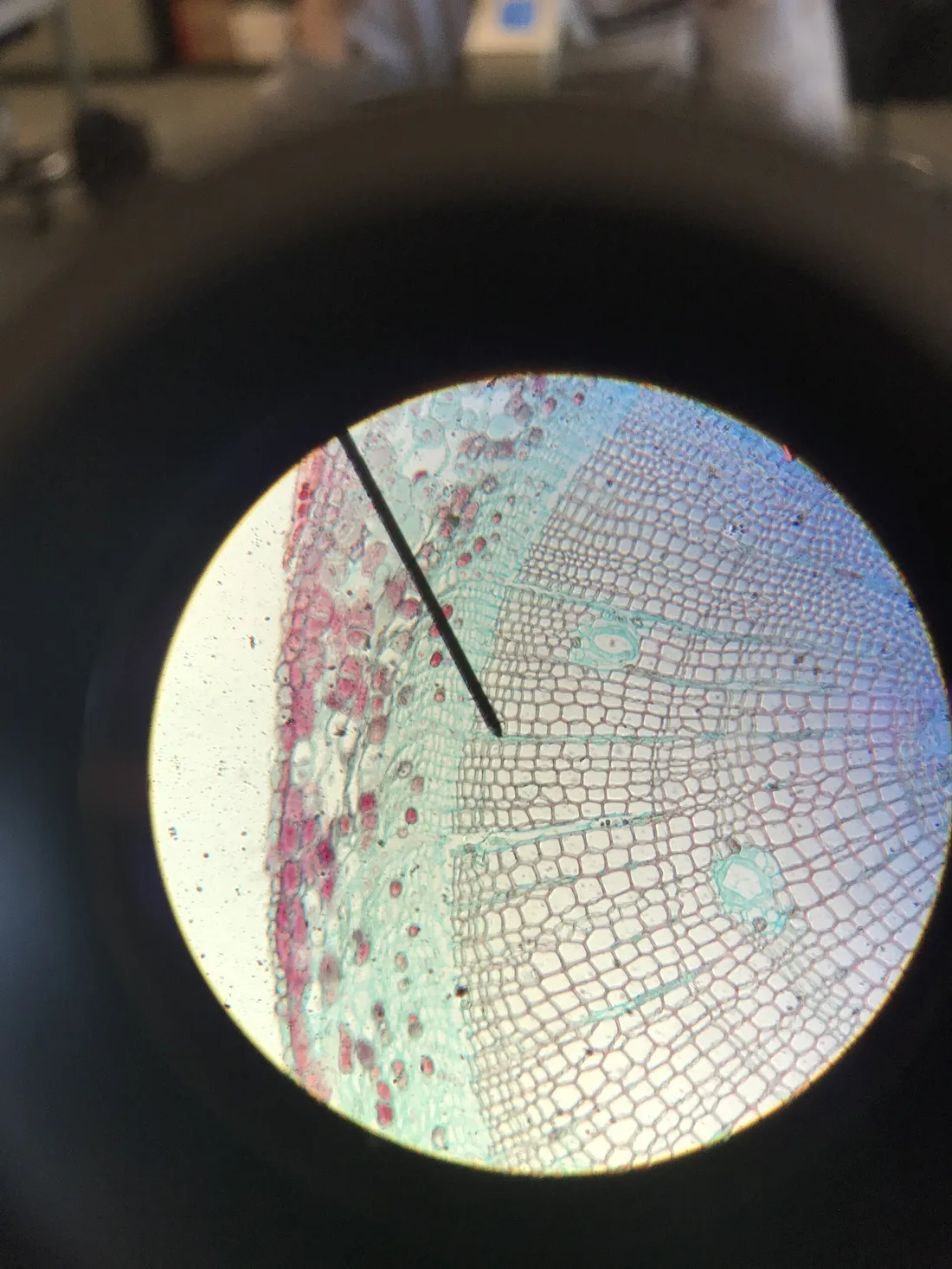
This is where the cell walls in the wood pipes, the xylem, work exactly like a safety valve. The passage between two pipes is a fine web with a thick disc at its centre. While all is well the water passes through the web; but the instant a bubble appears on one side, the difference in pressure pushes that disc across the web and seals the passage. One pipe dies and its neighbour goes on living. That lid, at the scale of nanometres, is what stops a forty-metre column of water from snapping.
format_quote"What pulls the water up is not a pump but evaporation at the tip of a leaf; which is to say that what holds a tree up is the thing it loses."
Hasan Bekmezci
The stomata, those microscopic gates under the leaves, have to let the outside air in while preventing the plant from drying out as it transpires. Think of a smart house system that weighs the humidity, the light, the wind and the carbon dioxide outside and decides exactly how many millimetres to open the window. A plant does this without a brain. The guard cells on either side of each pore adjust the fluid pressure inside themselves, their turgor, according to those four inputs; filled with water they bow apart and open, emptied they slacken and close. In drought a hormone carries the order to shut. This is not a computer calculating billions of possibilities; it is a feedback valve with four variables and extraordinary sensitivity, and that is exactly why it is more impressive.
The sugar made in the leaf by sunlight has to travel down to the roots. The sugar is at the top, the root is at the bottom. Imagine a thick syrup being made on the roof of a factory. That dense syrup draws water out of the watery pipes beside it by osmosis, and such a pressure builds that this hydrostatic force pushes the sweet liquid down against gravity all the way to the deepest roots. This is the most flawless anti-gravity hydraulic lift the Creator has built, and the thing driving it is not a motor but a difference in concentration.
And when an insect or a fungus bores into the bark, the chemical defence is instant. Picture a besieged castle in the middle ages; the moment the enemy climbs the wall, boiling oil comes down. The tree too pumps terpenes and resin into the spot the instant the bark is breached. That resin is both a sticky ointment that seals the wound in seconds and a chemical armour that suffocates the attacking insect.
format_quote"All the engineering of a tree gathers into one sentence: no motor anywhere, a difference in pressure everywhere."
Hasan Bekmezci
When this hydraulic and chemical perfection of nature turns into platinum in the hands of the Dutch Grönefeld brothers, what stands in front of us is the Parallax Tourbillon. This version from the workshop at Oldenzaal is in Pt950 platinum, forty-three millimetres across and twelve and a half thick, and only five were made in the world.
The name is no accident. Parallax is the apparent shift in the position of an object when the person looking changes their own position; if there is a gap between a hand and its dial, then tipping your head a little to one side makes the seconds hand appear to point at a line other than the one it really points at. The Grönefeld brothers raised the seconds scale toward the glass, so that the long blue hand sits almost in the plane of its own track and the error disappears. The entire name of the watch comes from that small lift.

The ground of the dial is solid silver, given a frosted surface and plated in 5N gold, which is where the salmon tone comes from. Hours and minutes sit in a small dial at one o’clock, and the flying tourbillon at seven, inside a polished steel sleeve. The inside of that sleeve is a mirror and throws back the turning balance.
The arc at the upper left gives the power reserve, and its mechanism is an old idea of Breguet’s: a cone that travels up and down a threaded barrel arbour like a nut on a screw. The small indicator at the lower right travels between W and S, between winding and setting. The crown is not pulled but pressed; each press moves the watch into one of the two modes, and the letter on the dial tells you which one you are in.
Just as the water in the pipes of a tree climbs metres upward without breaking, the energy stored in the mainspring of the watch is carried along the wheels to the escapement with the same unbroken fluidity as blood or water in a vein.
The flying tourbillon turning in all its splendour low on the dial, as though suspended in the air, cancels the deviations gravity causes in the movement. That mechanical motion is the exact reflection of the physical resistance, and of the mechanical genius, with which a tree pumps tonnes of water metres upward against gravity.
The power reserve on the asymmetric indicator at the upper left of the dial is the mechanical counterpart, on a dial, of the vital energy a tree stores and of plant metabolism.
The large seconds arm that centres the dial, together with the stop-seconds system, stands for those precise reactions a tree makes at the microscopic scale, second by second, and for the flawless discipline in the flow of time.
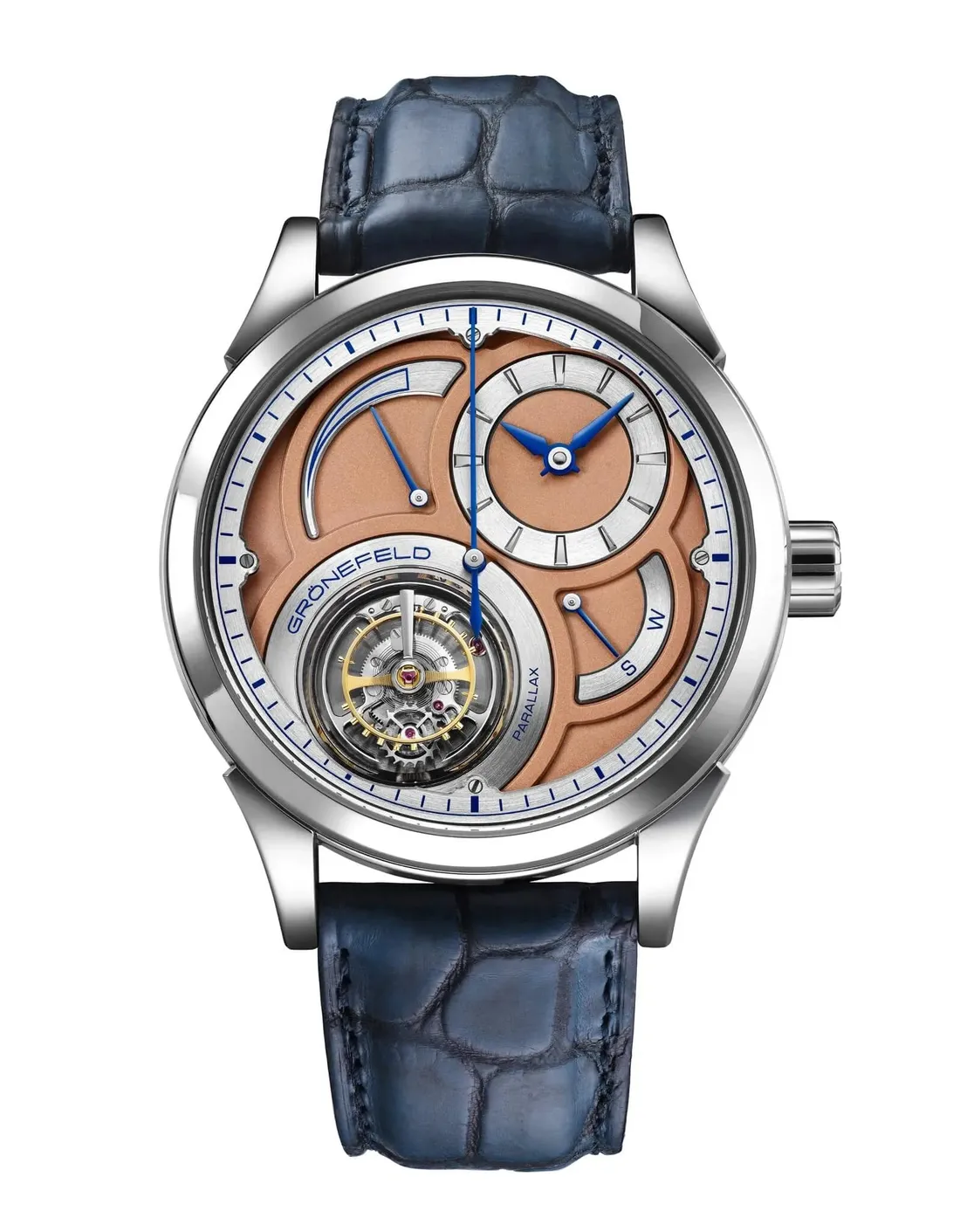
When the watch is put into the setting position the seconds hand stops, but not just anywhere: the tourbillon cage and the hand stop exactly at sixty. So you can synchronise the seconds while you set the time against another clock. And this central seconds has no friction spring, which is normally compulsory. That spring stops the hand from fluttering but eats energy; instead of it, the brothers added an extra wheel and pinion and made the spring unnecessary. The seventy-two hours of reserve come from there.
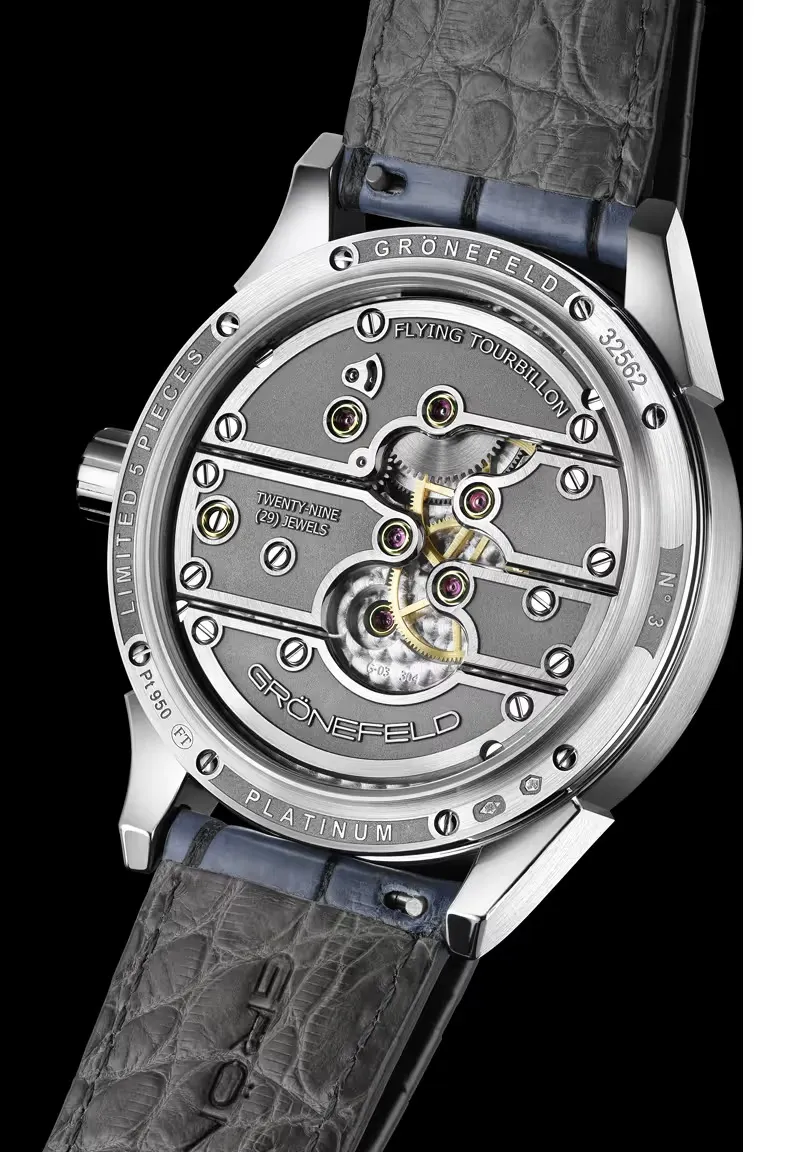
Inside beats the hand-wound calibre G-03: two hundred and seventy-eight components, twenty-nine jewels set in gold chatons, twenty-one thousand six hundred vibrations an hour. The flying tourbillon cage turns on ceramic ball bearings. The balance is ten millimetres across, of variable inertia, free sprung with a Phillips overcoil. The bridges are stainless steel, their bevels polished by hand, their centres micro-blasted, their tops circular grained, with the lettering engraved in relief into that blasted surface.
format_quote"Parallax is not the hand’s error but the observer’s; the only cure is to bring the hand down level with its own scale."
Hasan Bekmezci
One of them is the living factory of a pine tree that lifts tonnes of water into the sky out of the darkness under the soil and breathes with a quantum intelligence; the other is the Grönefeld Parallax Tourbillon Platinum, the masterpiece in which that vital balance has been cut by the Grönefeld masters into platinum, into salmon tones and into time.
One is the undeniable living work of the Creator; the other is the mechanical philosophy by which a human being read the perfection in that work and translated it into a watch.
The watch, as its maker describes it: Grönefeld, Parallax Tourbillon Platinum