History is not always the cold figures written on the leaves of a calendar; history is the cruel and equally spellbinding tale of how the human spirit climbs out of the darkest ravines with grace and obstinacy. 14 May 1940. As the steel gears of the Second World War began to crush Western Europe, the Netherlands held out far longer than expected against the German armies and shook the legend of the lightning war. Rotterdam, with its geographic and strategic arteries, was the heart of that resistance. But the arrogance of the invasion could not stomach that hard resistance, nor the stubborn defence at the river bridges.
That morning the ultimatum handed to the Dutch commander in Rotterdam, Colonel Pieter Scharroo, fell as a black stain on the history of humanity: surrender the city at once, or we will destroy it. The German operational directive signed the same day ordered the resistance at Rotterdam to be broken quickly, and the Luftwaffe was to carry it out. The Dutch tried to sit down at the negotiating table, but the merciless mechanical gears of war had already begun to turn; the bombers were already in the air.
At the last moment, to call off the attack, the German units at the bridgehead fired red flares. The eastern arm of the formation saw them and turned back. The fifty-odd aircraft coming from the west did not.
And then those thirteen minutes of terror began. At around half past one in the afternoon, eleven hundred and fifty bombs, close to a hundred tonnes, were rained onto a city six hundred years old. In a breathless span of thirteen to fifteen minutes, that noble medieval fabric, thousands of homes, shops, schools and churches, was levelled at a stroke. The firestorm that rose into the sky did not go out for days.
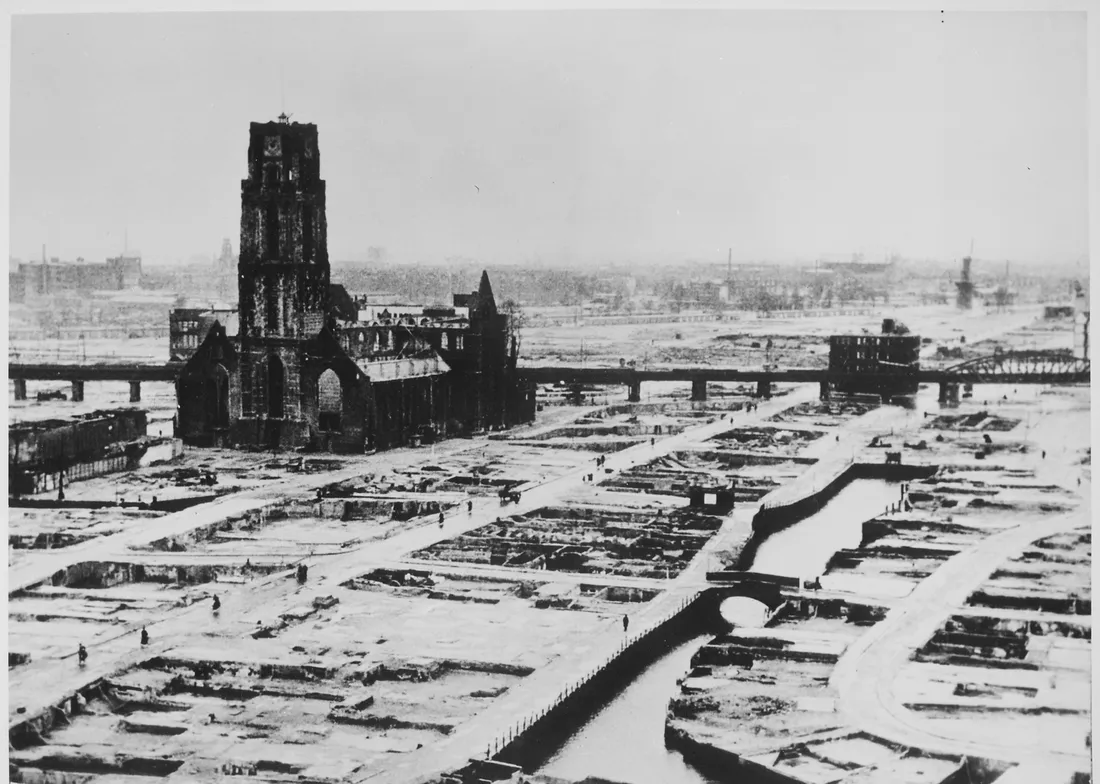
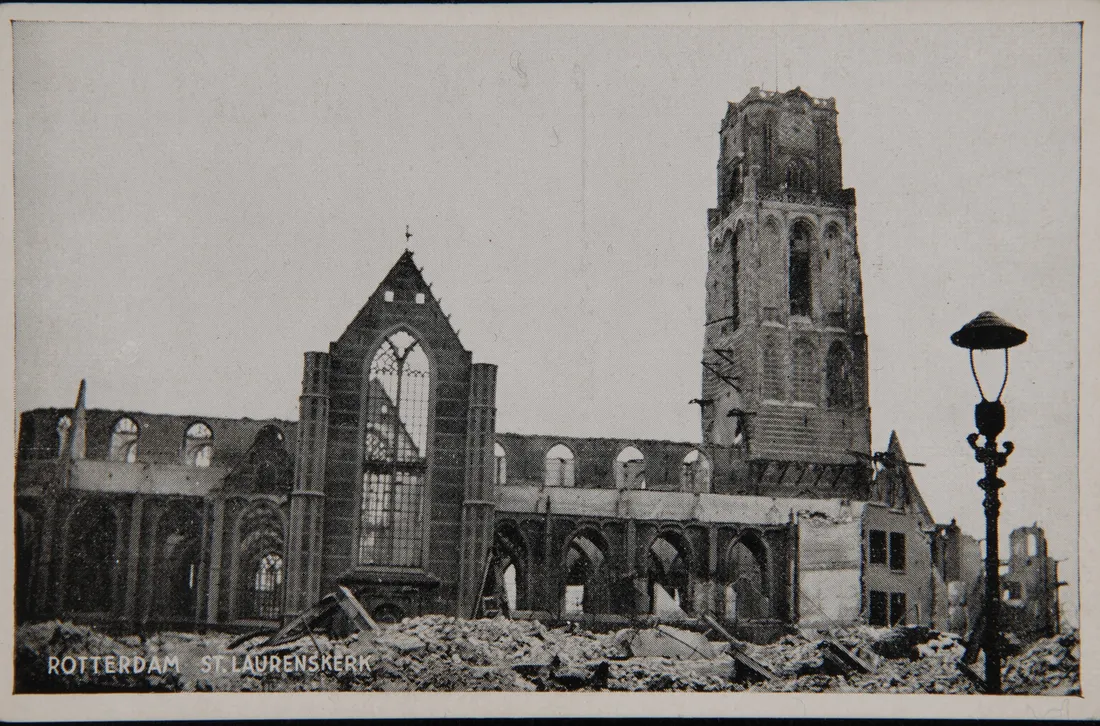
More than eight hundred innocent civilians died under that rubble, and eighty thousand people were left at a stroke without home, without town, without anyone. In those days figures of thirty thousand dead spread around the world; those were the rumours of the first days of the war, and they later proved false. The real number was smaller, but almost the whole of the city centre was simply no longer there. Only a few surviving landmarks were left: the Sint-Laurenskerk and the Witte Huis.
New threats followed: surrender, or Utrecht is next. So that no more of its children and no more innocents should bleed, the Dutch high command bowed its head the following day, but it never surrendered its spirit.
format_quote"No fire can turn wholly to ash a people whose roots run deep into the soil."
Hasan Bekmezci
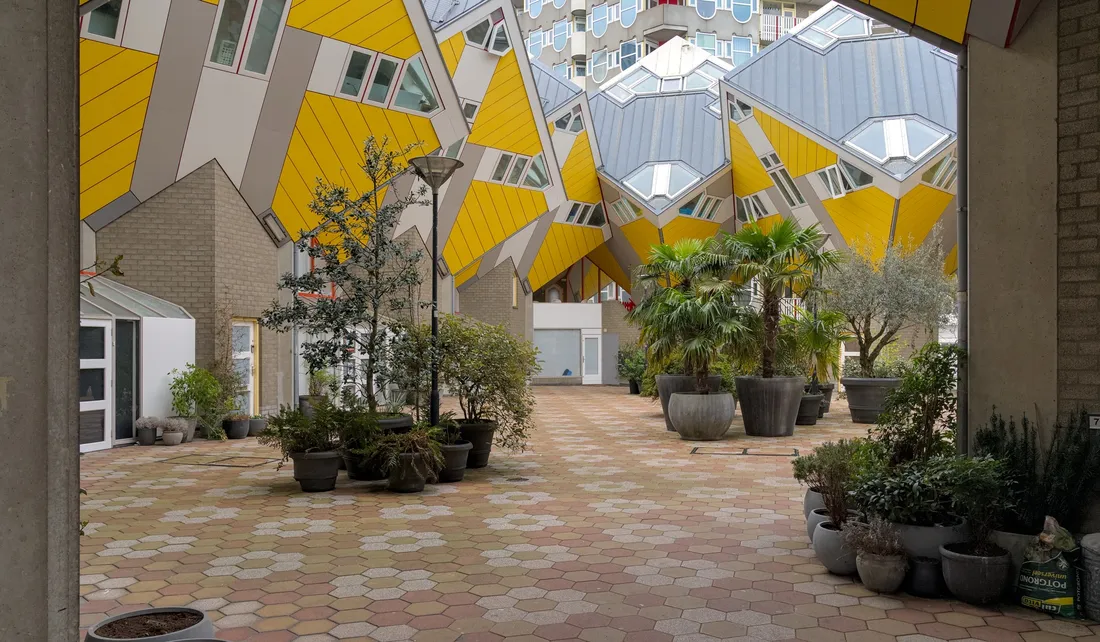
And at that moment a truth came out. Rather than imitate the ruined historic buildings as they had been, the people of Rotterdam raised on that rubble and those tears the most radical, the most modern architecture in the world, the kind that dares the future. The towers, the wide avenues and the Cube Houses that Piet Blom completed in 1984 are the tears shed that day and the belief that we will rise again, made solid. That obstinate Dutch spirit, living below sea level and bringing water to heel with dikes and canals, refused to bow to bombs either and was born again out of its ashes.
format_quote"To imitate what was destroyed is not to remember it; the real monument is the building that faces the next century."
Hasan Bekmezci
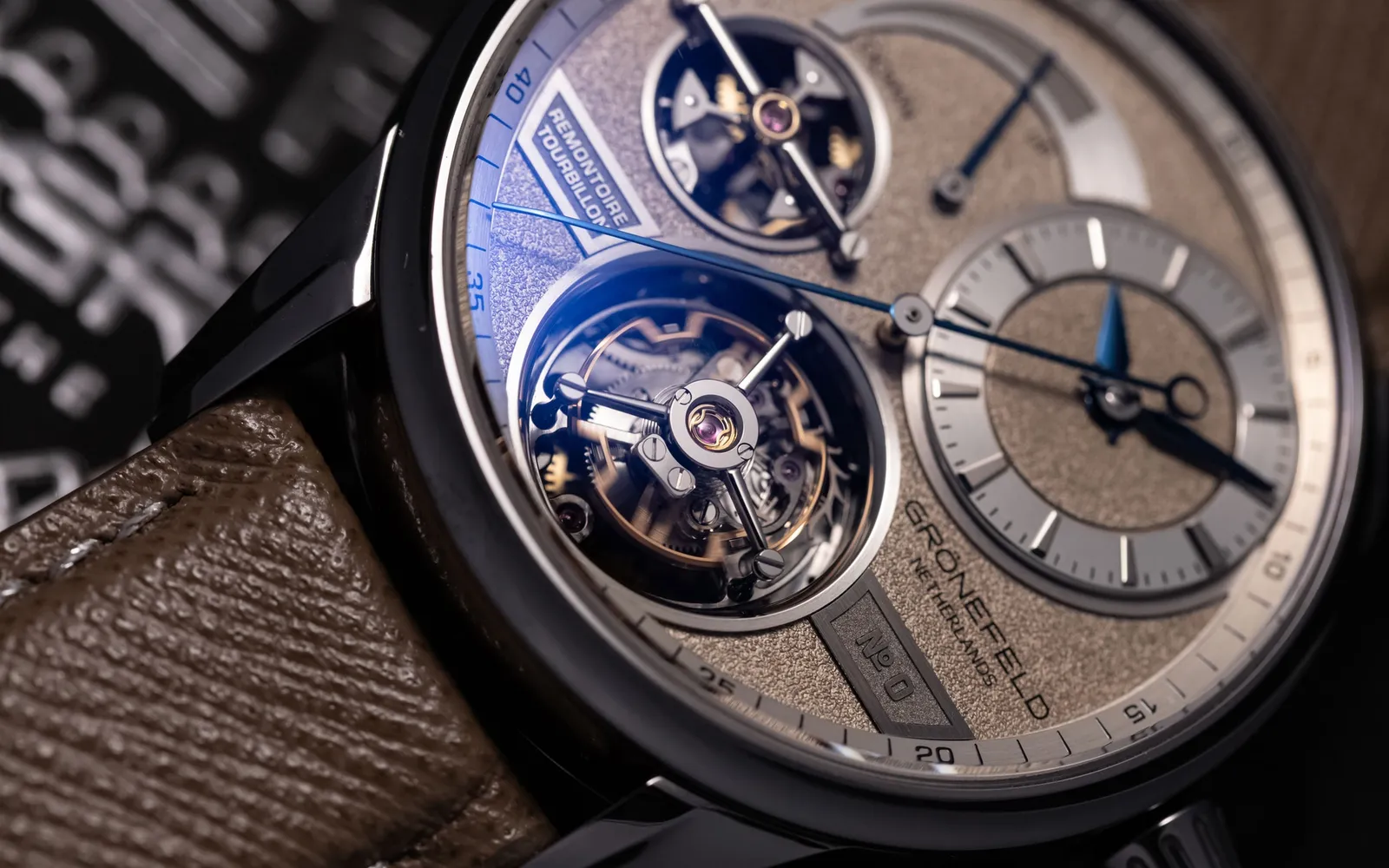
The mechanical expression on the wrist of that epic resistance and that geographic fate is the 1941 Quadrivium, out of the hands of the Dutch masters of independent high watchmaking, the brothers Bart and Tim Grönefeld. The workshop is not in Rotterdam but in a small town near the German border, in Oldenzaal, in the shadow of the Sint Plechelmus basilica, on the spot where their grandfather Johan set up shop in 1912.
And the four figures in the name of the watch are not a stylistic reference. 1941 is the year their father was born, Joseph Albertus Johannes Grönefeld, the man everyone knew as Sjef: 5 November 1941, in Oldenzaal. Which is to say eighteen months after Rotterdam burned, with the country under occupation. The number you read on the dial is the year of a child born in the middle of the darkness. That Bart went on to learn his trade in Rotterdam between 1986 and 1989, in the city rebuilt from the ashes, is the second knot in the story.
Looking at the dial you do not see only precious metals and wheels; you read a character there. That granular, sandy surface, a texture that drinks the light rather than returning it, calls to mind the tireless dikes that separate the sea from the land in the Netherlands, and the raw contest of water with soil. And the word NETHERLANDS, engraved low on the right just beneath the name of the house with a quiet but proud insistence, stands like a declaration of craft and independence that refuses a monopoly centuries old. These are not things the brothers have said; they are things the person looking at the dial reads in it.
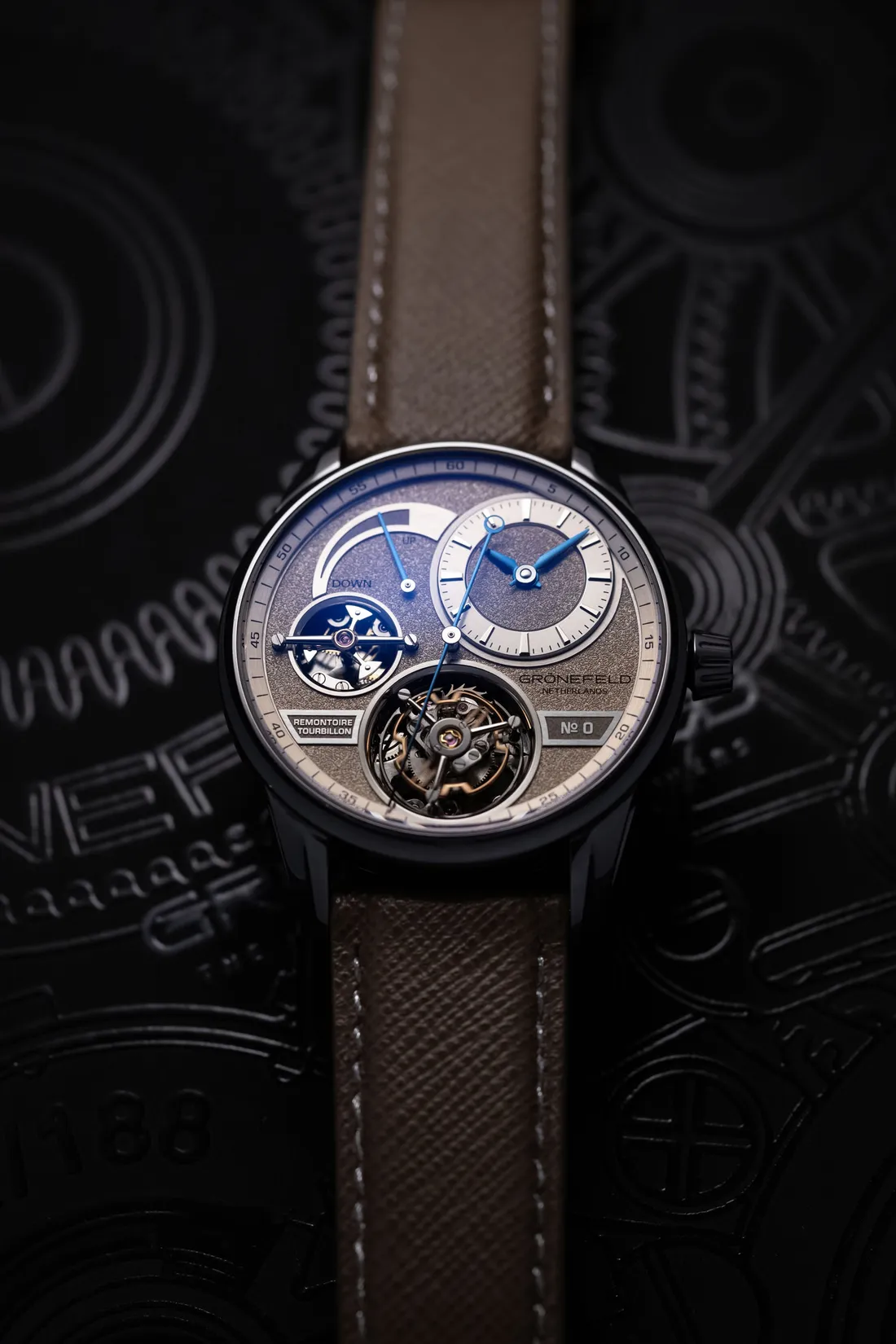
Quadrivium means four. Four complications the house had developed separately over the years are brought together for the first time in a single watch, and the movement was designed from nothing to carry them.
The first is the seven-and-a-half-second remontoire, the constant force mechanism. As the mainspring unwinds, the power it gives falls away and the rate of the watch drifts. With this mechanism at the lower left of the dial, Grönefeld pumps an equal and unshakeable charge of energy into the escapement every seven and a half seconds, independent of the fluctuating force of the barrel. It is like the great Dutch sea walls holding the ocean to a millimetric balance: whatever happens outside, the level inside stays the same.
format_quote"The mainspring unwinds and the force wavers; constant force is giving the same promise again every seven and a half seconds."
Hasan Bekmezci
The second is the one-minute flying tourbillon. At the bottom of the dial, the cage that breaks up the trick gravity plays on the regulating organ turns with no bridge holding it from above, as though suspended in empty space. Its diamond-polished inward angles and its hand finishing are the work of months of an artisan’s eyesight.
The third is the central jumping seconds. The seconds hand does not flow; every second it leaps to its mark with a sharp, settled, absolute movement, and crosses the outer track step by step. The fourth is the power reserve at the upper left: the small blue hand travelling between DOWN and UP warns how much breath this mechanical titan has left to stay alive.
format_quote"The second does not flow, it leaps; and every leap is like a decision."
Hasan Bekmezci
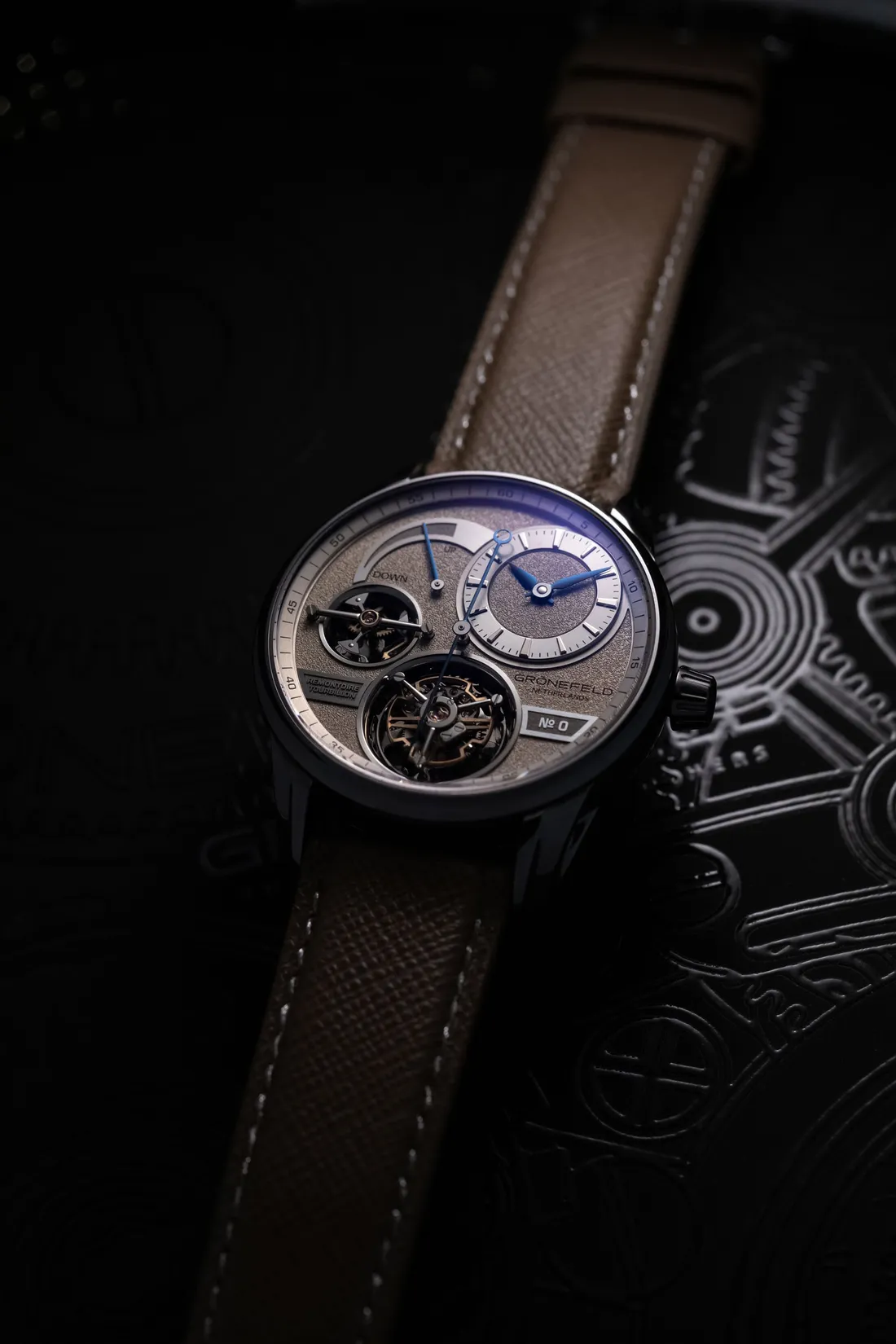
What feeds all of it is a pair of concentric twin barrels connected in series. The first edition comes in a tantalum case of forty millimetres across and eleven point three millimetres thick, in twenty-eight pieces; a second edition follows with case and buckle in platinum, twenty-eight again. Tantalum is a bluish lead-grey metal, rare in watchmaking and hard to work, and it suits the misted light of Oldenzaal more than well.
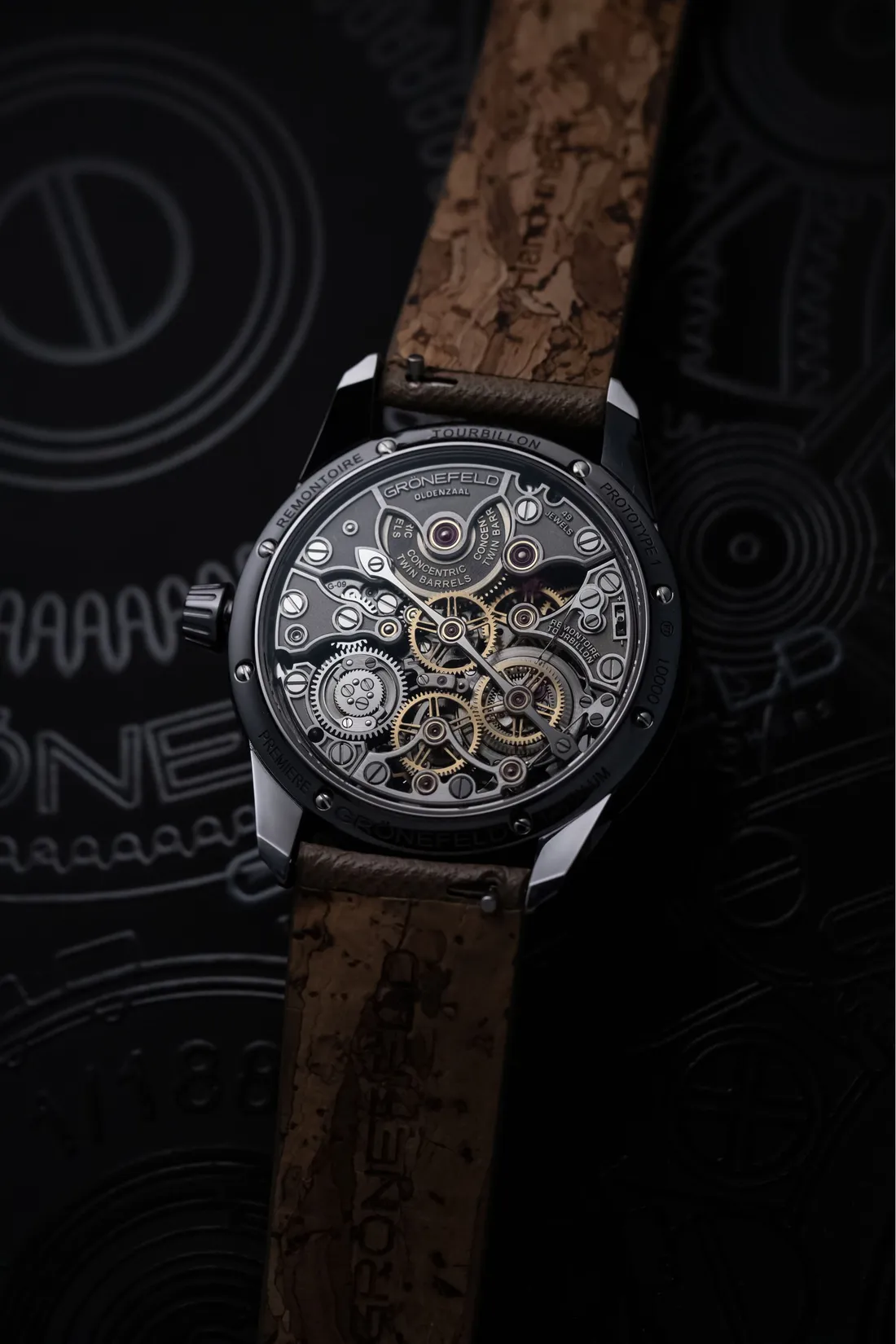
One of them is Rotterdam and the Dutch spirit, which died under the bombs and then built a civilisation again out of its own ashes with its human dignity intact; the other is the Grönefeld 1941 Quadrivium, the answer to that spirit in craft, in independence and in belief.
One is a story of resistance that defies the darkest destruction in history; the other is the most noble mechanical monument to that story, ticking on the wrist.
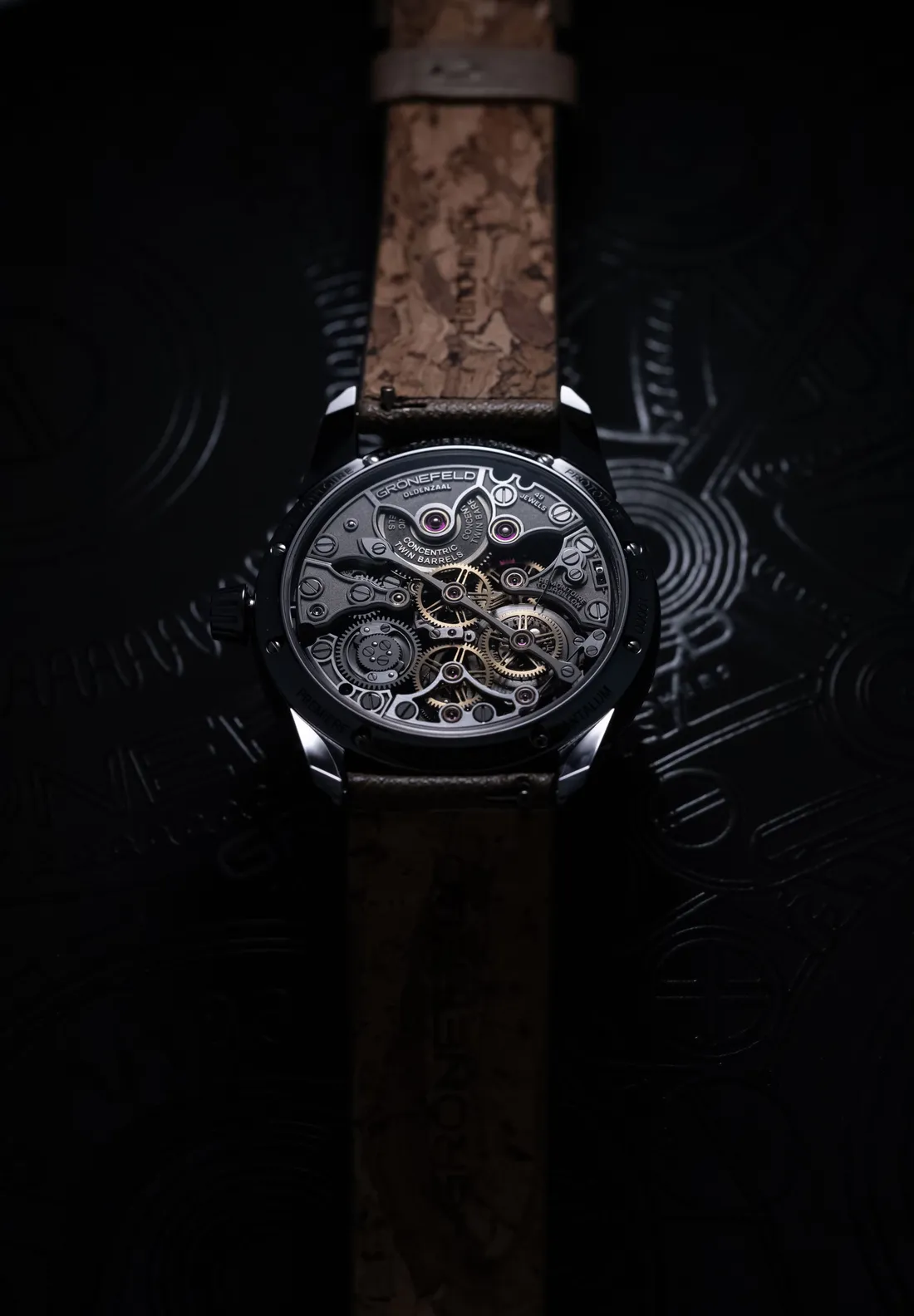
The watch, as its maker describes it: Grönefeld, 1941 Quadrivium