In the autumn of 1900, in the cold grey laboratories of Berlin, the German physicist Max Planck sat at his desk for hours on end, brooding. Planck was no ordinary scientist writing out formulas; he was the most respected figure in German science, exceedingly disciplined, bound to his rules, with a deep philosophical cast of mind. He had suffered great tragedies through his life, and inwardly he was a devout physicist who believed the universe had a flawless and unshakeable order.
In those days a single question was eating at him: why does nature work in a way so lawful and so measured, rather than at random? Planck could see very clearly that everything classical physics had taught humanity up to then had run into a wall. Physicists could not measure the new universe with the old rulers in their hands, and the equations came out infinite every time. And at that moment, at the risk of his own career, he took the revolutionary gamble and set about prising open the deep codes of creation. Years later he would call that step an act of desperation.
The physicists gathered in those Berlin laboratories had a very concrete, practical and nonetheless enormous problem: to light the streets more efficiently, and to measure exactly the energy that heaters give off.
To grasp it, picture this scene. A closed box, a furnace, that lets in no light at all, made of a special ceramic that is entirely black inside. On this box is a hole no bigger than a needle point. You begin to heat the furnace from below, and as it warms, coloured light begins to leak from that tiny hole: pitch dark first, then a faint red ember, then, as the furnace grows hotter, bright orange, yellow, and finally a white so fierce it hurts the eye. The real question was this: when we bring this furnace to such and such a degree, why does the colour of the light coming out change, and how much energy is hidden in which colour?
Classical physicists thought light flowed in waves, like water. By their logic the furnace should radiate infinite energy as it heated. But if that logic had been right, the moment you lit the stove the kettle in your kitchen would have sent out a burst of ultraviolet enough to scorch the universe. Physicists could see with their own eyes that the furnace gave out light in perfectly measured, limited, particular colours, and still they could not build the mathematics of it. The name ultraviolet catastrophe would be given to that contradiction later, eleven years after Planck made his move.
format_quote"The real balance of things is built from that indivisible quantum brick at the very bottom, the one no eye can see."
Hasan Bekmezci
Planck had no prophecy handed down from the sky; he had two concrete numbers measured by his colleagues in the laboratory. The first was the total radiation given off per square centimetre per second, seven point three one times ten to the fifth ergs. An erg is a very, very small unit of energy, a drop as small as the energy a flea spends in a jump. So the number tells us this: from every square centimetre, every second, this furnace throws out exactly that many tiny drops of energy. The measurement was Ferdinand Kurlbaum’s, and it gave the difference in radiation between boiling water and freezing water.
The second was the peak wavelength, zero point two nine four centimetre kelvin. That is the colour at which the furnace radiates most intensely, multiplied by the temperature; the mathematical fingerprint of the rule by which an iron bar turns from red to yellow as you heat it. Lummer and Pringsheim had measured it.
Planck sat down and built his formula on the assumption that energy flows in discrete packets: the energy of one packet is its frequency multiplied by a constant. But he had two great unknowns, two radio dials that needed setting. One was the size of the energy packets, the thickness of the brick. The other was the bridging coefficient that says how wildly atoms shake with heat. Imagine you are in a pitch-dark room with two dials in your hands, and you are trying to find exactly where they must stand by listening to the tone of the music in the room as it carries outside.
Then, in the kitchen of mathematics, he folded the total-energy results of the first experiment into the colour rule of the second, and set the two equations one beneath the other. Out of the first came a ratio of the shaking coefficient divided by the cube of the brick, like a recipe in which flour and sugar are set in proportion. Out of the second came the plain ratio of the same two unknowns. When Planck took one and put it inside the other, a piece of mathematical magic happened: the shaking coefficient cancelled, which is to say it vanished. One mysterious guest was left standing: the brick itself.
format_quote"The number had to come out at that value because that is how nature radiated the light in that furnace."
Hasan Bekmezci
When he solved the equation, the figure he reached in the old units of the day was six point five five times ten to the minus twenty-seven erg seconds. The erg and the joule are both units of energy, the way the gram and the kilogram differ; the erg is the ruler of very small things, the joule the measure of our world, of lifting an apple by a metre. So that science might speak one language, the value is written today as six point six two six times ten to the minus thirty-four joule seconds.
And the most striking part is this. From those same two laboratory numbers Planck took out not only the brick but also the coefficient of atomic shaking, and from that he calculated Avogadro’s number and the charge of the electron. Neither had yet been measured directly by anyone, and he was astonishingly close on both. By measuring the light leaking from a hole in a furnace, he had counted the grain of matter.
The secret is out. The number is no abstract fantasy descended from the heavens; it is a pure laboratory coefficient born of dividing furnace temperature data and colour ratios into each other inside equations. Today it is not even measured: since 20 May 2019 its value has been fixed by definition, and the kilogram itself is now derived from it. The measure has become the measure of measurement.
The constant Planck drew out of that furnace is the most basic quantum brick of creation, and the work it does falls into three. First, it is the invisible shield that stops the atom collapsing: without this brick, the positive charge in the nucleus and the negatively charged electrons around it would pull together at once, the electron would fall into the heart of the nucleus and be gone in a second. The size of the brick is the order to halt that fixes how close the electron may come. Second, it is the basic discipline of chemistry and of life: what keeps electrons in stable orbits is this discrete structure, and chemical bonds, molecules and the double helix of our DNA exist under that rule. Third, it is the boundary between chaos and order; the delicate balance that stops the universe melting entirely into a cloud of energy is owed to the existence of this smallest indivisible packet.
So why did the Creator set so small, so odd, so finely tuned a constant into the most basic stone of the universe; why is everything not loose and flowing instead of wrapped in so strict a quantum discipline? This constant is nothing other than His signature of measure and balance in creation. Had it not existed, or had it been created at a different value from the one it has, stars would not catch fire, elements would not be synthesised, light would not spread, and the universe would have stayed a dark nothing. Its existence shows us that creation is no loose chain of coincidences, but is designed with a flawless reckoning and order from the lowest quantum layer to the greatest galactic web.
There are plenty of places to look if you want to feel this brick. Classical physics is a slide, a continuous flow; the quantum world is a piano keyboard, where you press C or you press D and there is no sound between the two. On a ramp you walk without steps; on a staircase you are either on this tread or the next one up. Approach the smooth image on a screen and you find pixels. In trade you cannot pay less than the smallest coin allowed. Words are built from indivisible letter forms, and so is a page of type. The universe is not a castle of sand but, at its lowest layer, a structure that locks together like bricks of Lego. You cannot pass a turnstile with half a token: either you go through or you stop. And the tap water you take for a continuous stream is, seen close, a run of separate drops.
format_quote"Time is the silent reflection of the eternal upon a train of wheels."
Hasan Bekmezci
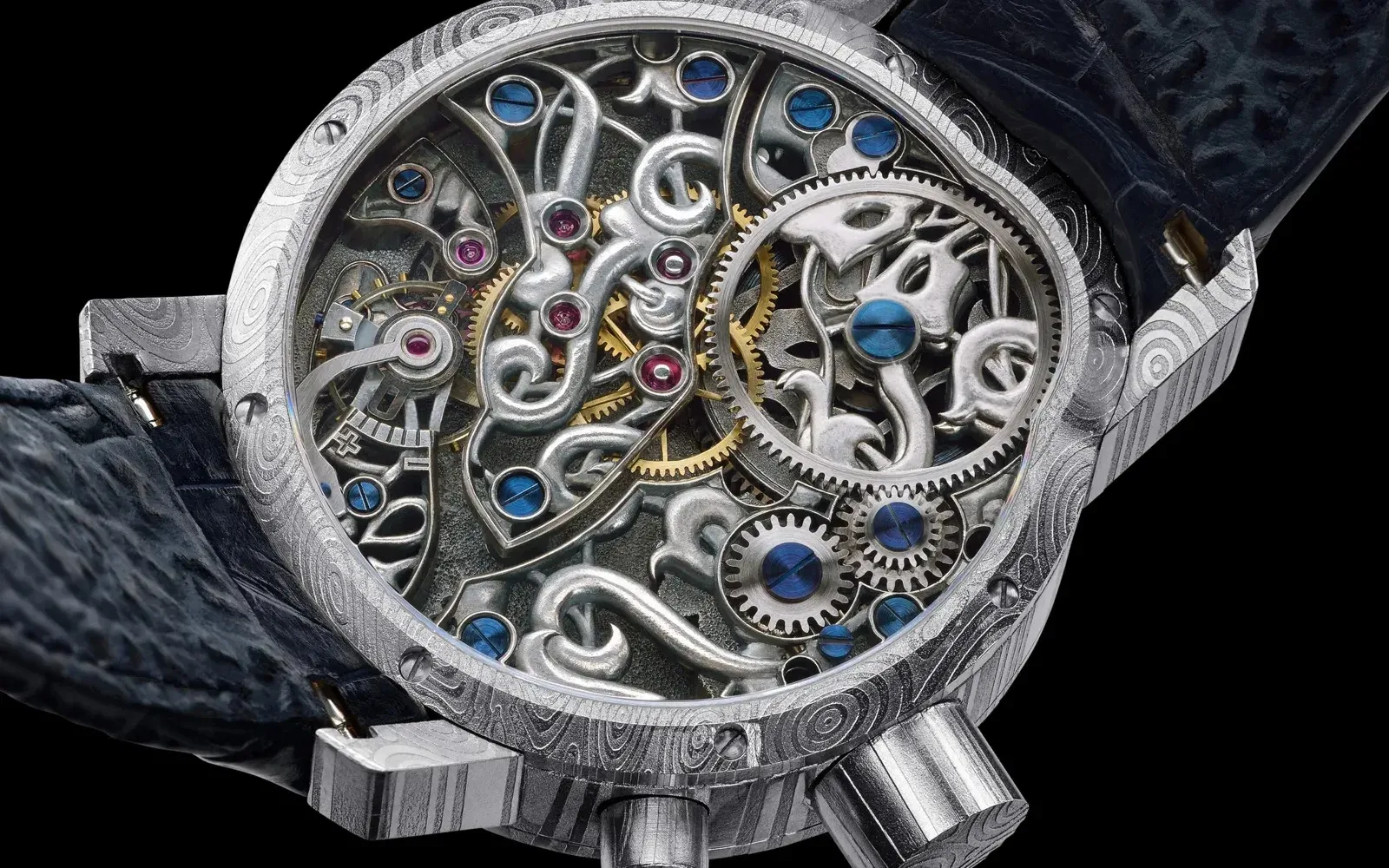
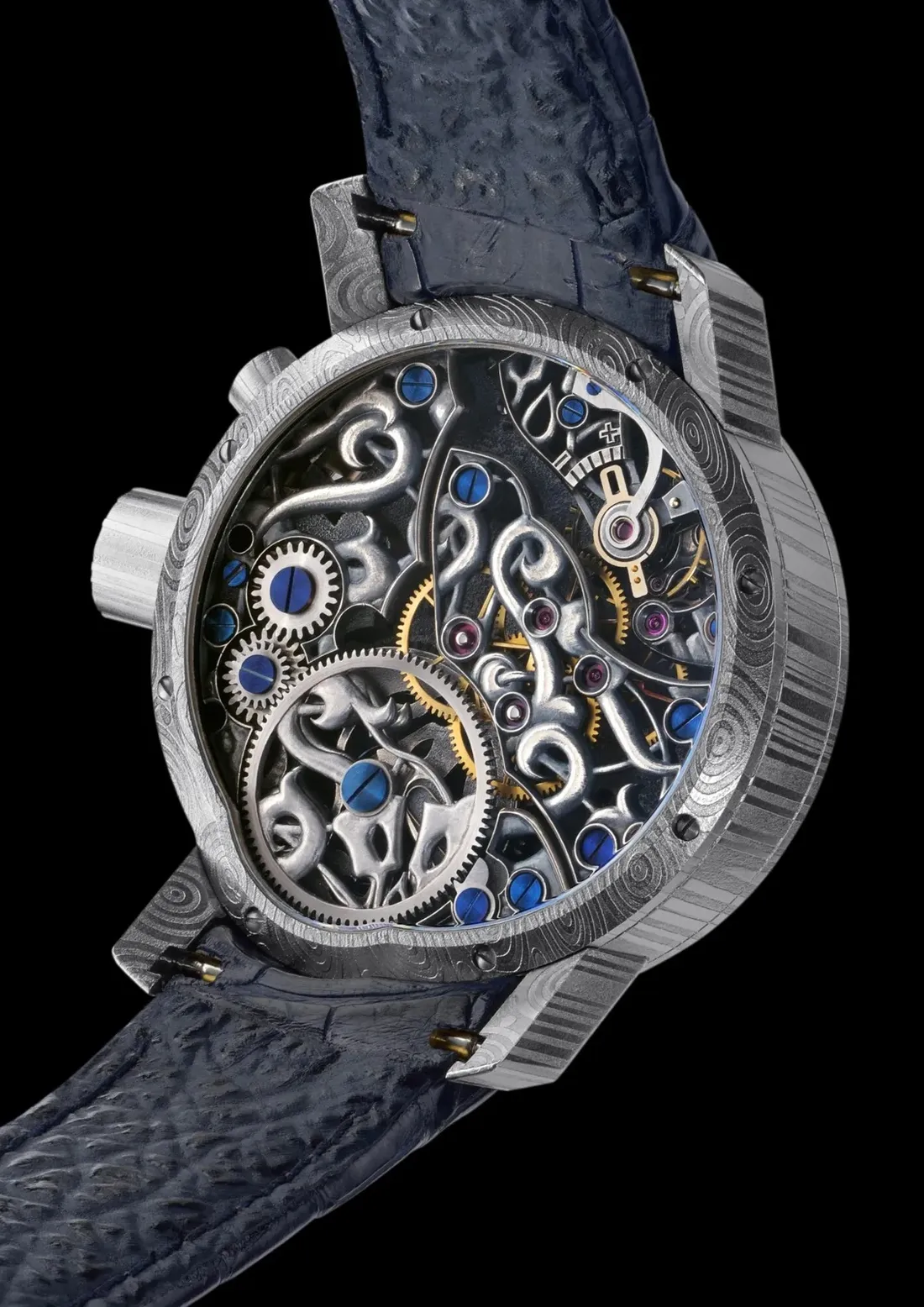
We bring those discrete packets at the lowest layer of the universe, that flawless handwork at microscopic scale and those layers of metal together in a masterpiece by the Geneva name of independent watchmaking, Kees Engelbarts: the Arabesque Damast. It comes from a workshop that has made singular watches since 1997, and this one is a unique piece.
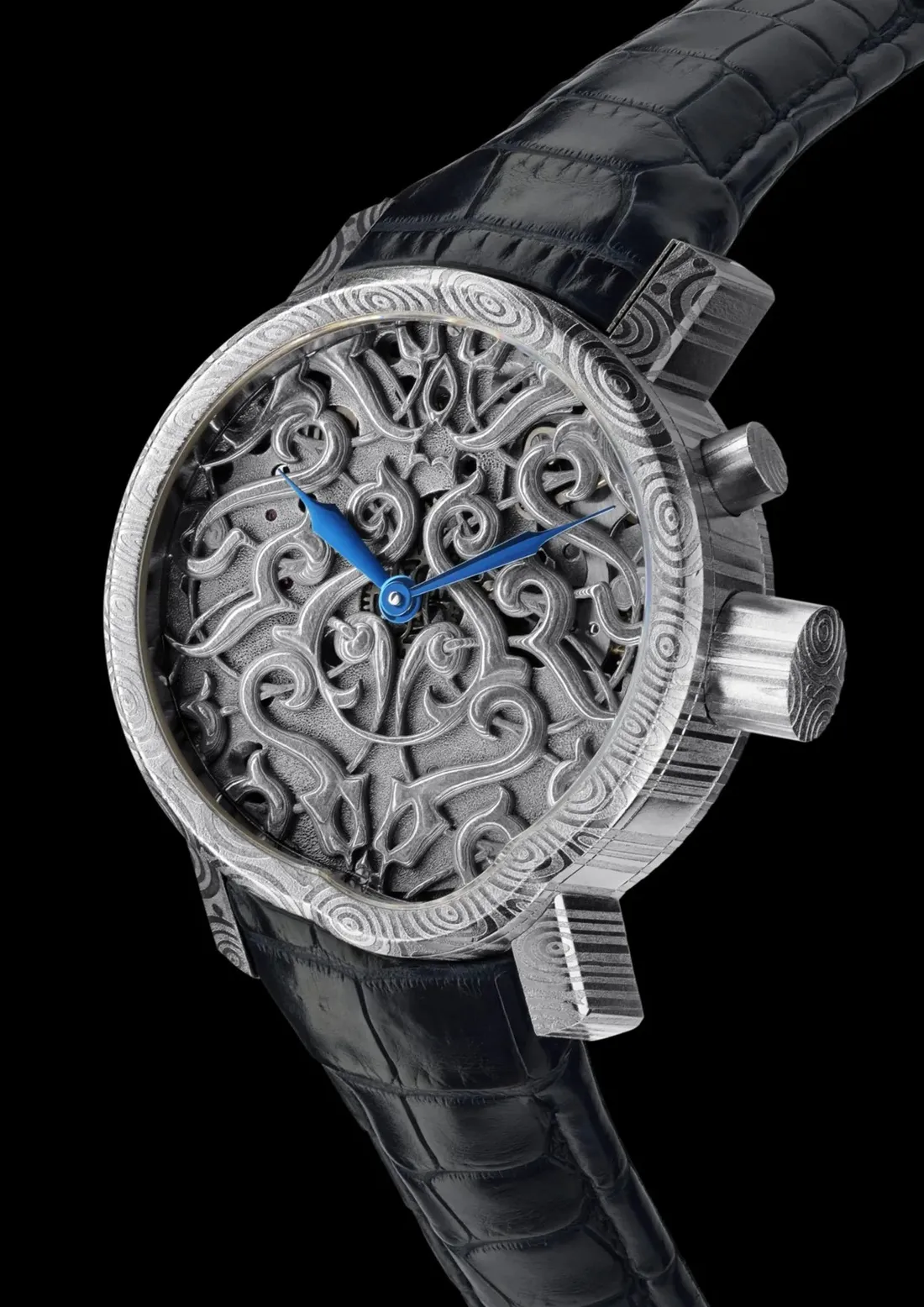
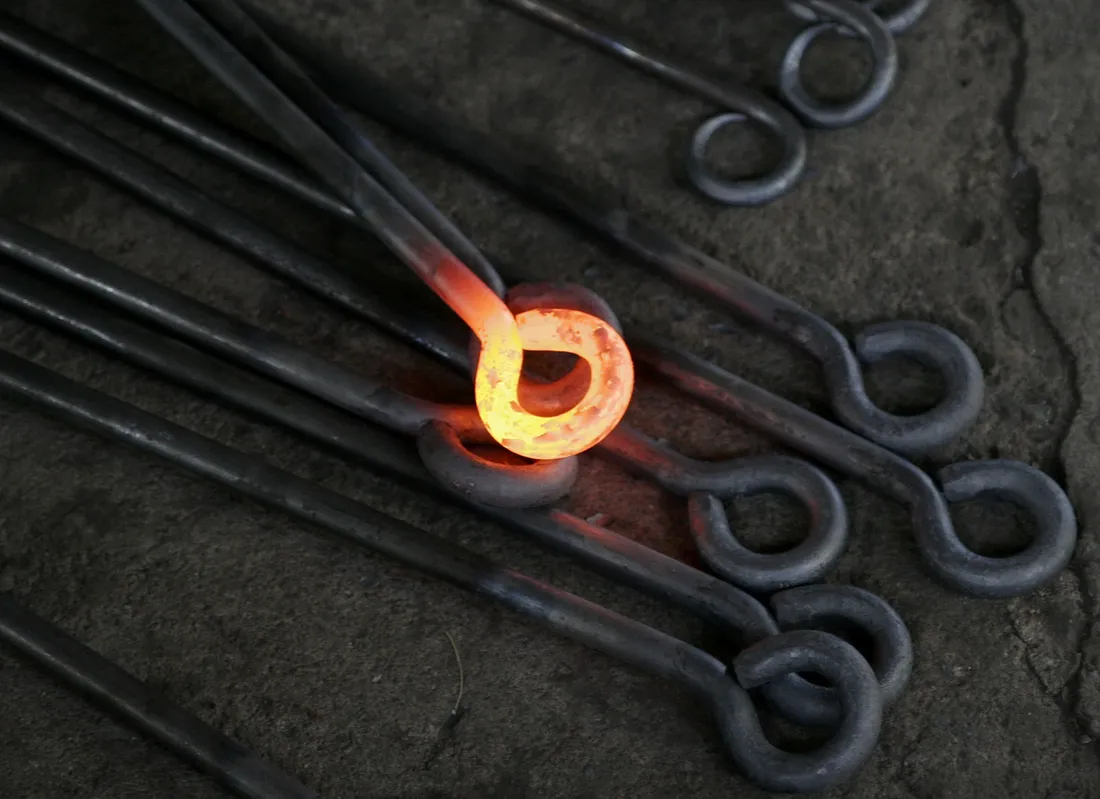
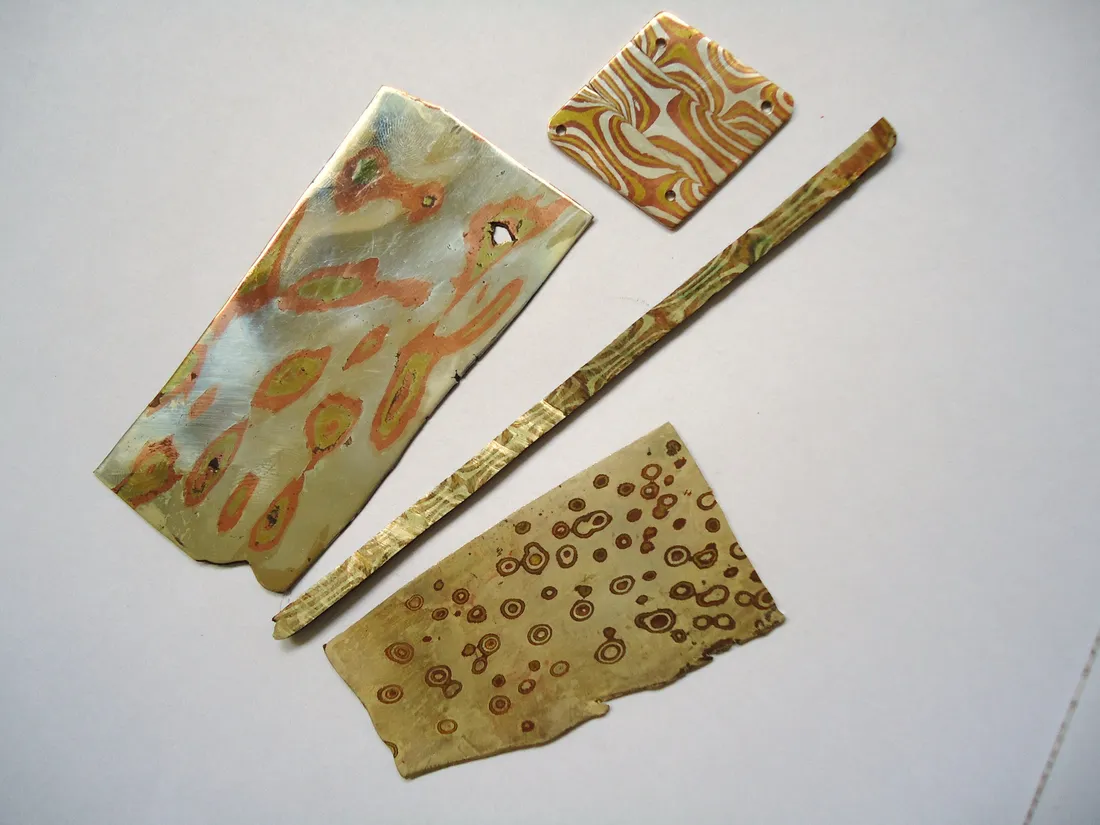
The damast steel of the forty-nine by sixteen millimetre case is built by folding layers of iron and steel over and over and forging them in fire. Those organic, undulating lines on the surface are not decoration; they are the section through the layers, and every line is the boundary between two of them. That is exactly the point: a pattern becomes visible because there is a boundary in between. In a metal that is wholly continuous and wholly homogeneous there is no such thing as a pattern. The quantum brick does the same for creation: it sets a boundary on energy, and because of that boundary the world has a pattern at all.

At the heart of the watch beats a historic NOS AS 690, skeletonised and decorated entirely by hand. With its eight days of power reserve, the calibre is set by the button at two o’clock, so that winding and setting are kept apart. Both faces of the case carry sapphire with anti-reflective treatment on both sides, which means you watch the movement from the front as well as the back. The strap is alligator outside and shark skin within, and its buckle too is damast steel. The blued steel hands carry time steadily across that layered ocean.
format_quote"A layer becomes visible because there is a boundary in between; continuity has no pattern."
Hasan Bekmezci
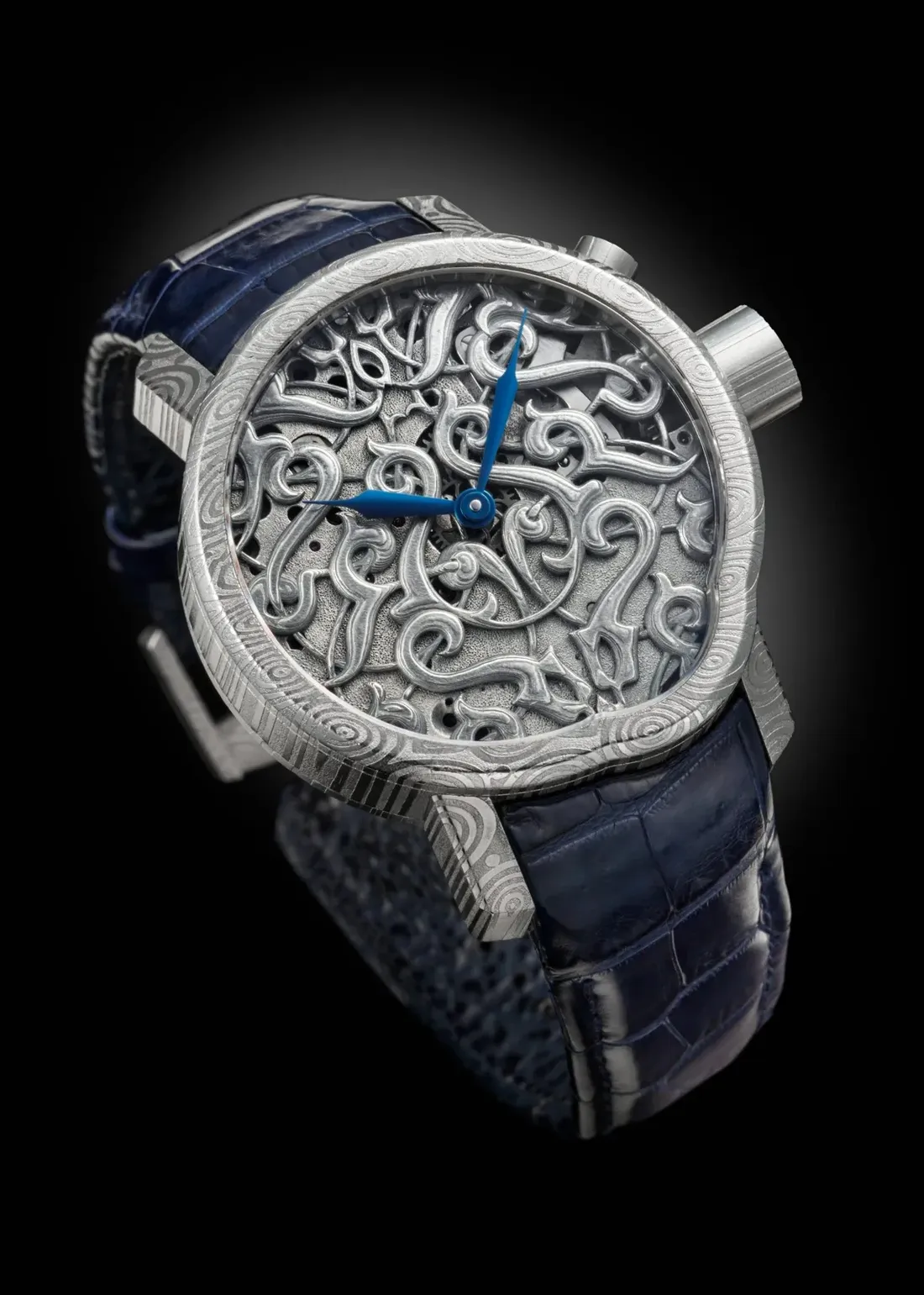
Planck’s constant, which Max Planck reached by solving the temperature data and colour ratios of his furnace experiment, is the most basic quantum brick of creation, the one that shows energy flowing in discrete packets. The Arabesque Damast of Kees Engelbarts is a mechanical masterpiece of philosophy that carries that layered metallic texture and the elegance of microscopic handwork to the wrist.
One of them is the quantum brick at the lowest layer of the universe; the other is the genius of independent watchmaking that works that same order with fire and patience.
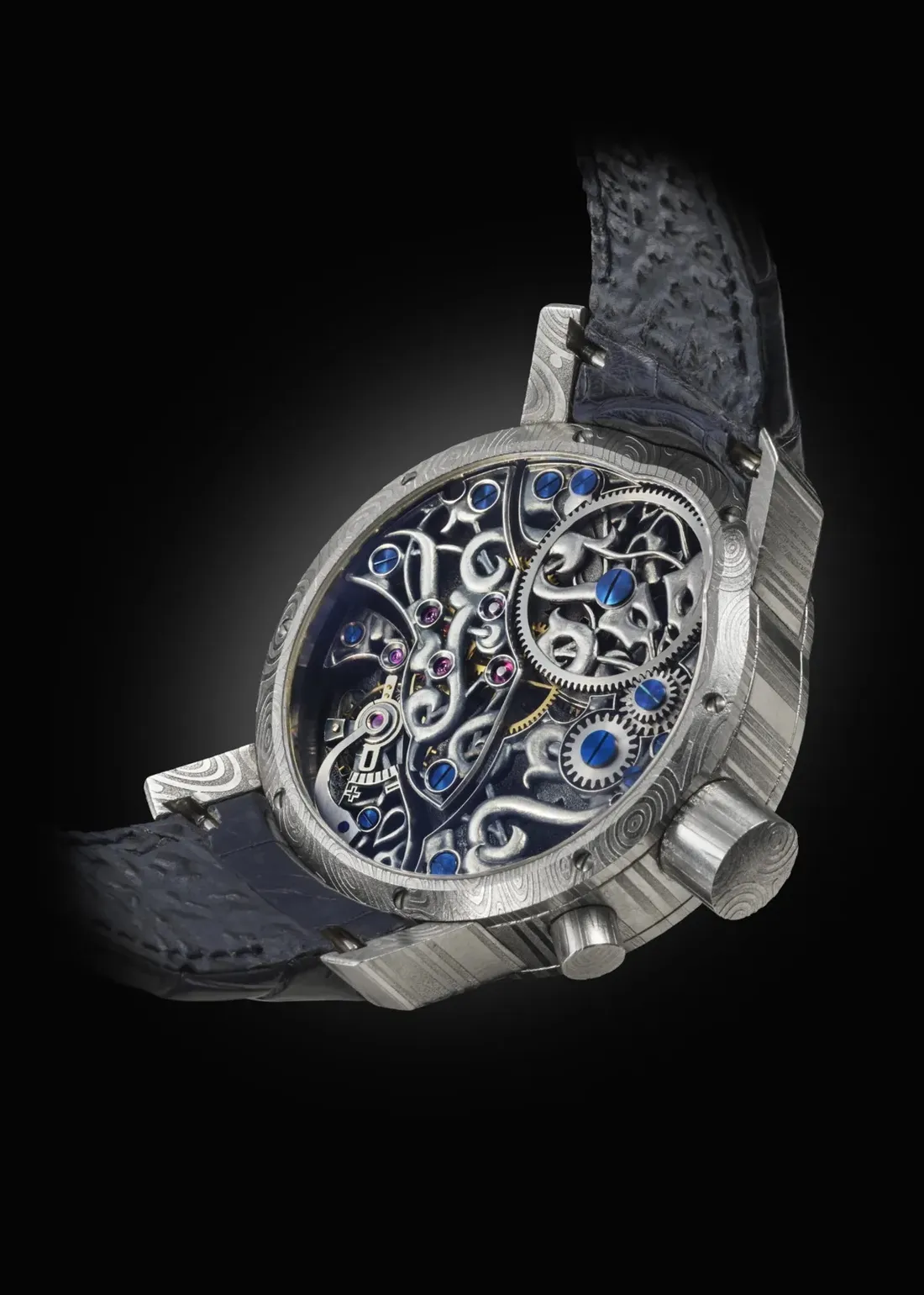
The watch, as its maker describes it: Kees Engelbarts, Arabesque Damast