Picture yourself at night, standing in the projection room of an empty cinema.
On the screen a vast river is thundering along, leaves are tumbling in the wind, a horseman is driving his horse at full gallop. To an eye watching from outside, the movement on that screen is flawless, smooth and unbroken. Time, like the river, is flowing.
Then you step over to the projector, put your hand on the turning reel, and meet a shattering truth: nothing is flowing at all.
The film on that reel is nothing but thousands of separate still pictures, motionless and tacked one to the next. The lens throws a single frame onto the screen; then the shutter comes between, and for a fraction of a second the room falls into total darkness. Then the second frame is thrown. Because our eye cannot catch those dark jumps, our mind deceives us with a magnificent illusion: time is flowing.
And who is the projectionist holding that reel? The moment you hold it, you understand that the strip has a beginning, a width and an end. The film is not the cinema itself; it is a made object with drawn borders, played inside the room after the room was there.
This is exactly what quantum physics and the Planck scale whisper to us. Time is not a god, not an endless river, not an eternal void; it is a created thing, run frame by frame in the projection of the universe.
Classical physics told us space was as smooth as oil. You believed you could halve any distance forever. Modern quantum mechanics demolished that notion.
When the German physicist Max Planck examined the fabric of the universe he ran into a startling lower bound: the Planck length, roughly 1.6 times ten to the minus thirty-five metres.
Take an enormous eight-K television, ultra sharp. From a distance the human face on it is so smooth you take it for real. Put a magnifying glass right up against the screen and the face disappears; all that is left is tiny red, green and blue squares. There is no such place as "between" two pixels. Either you are on one pixel or you are on the other.
The Planck length is our universe’s pixel size. A subatomic particle moving through space does not glide; it jumps from one Planck pixel to the next. That is the smallest stitch in the universal cloth. No shorter distance can physically exist, or even be defined.
So how long does light, the fastest courier in the universe, take to cross that smallest universal pixel? That span is called Planck time, and it is about 5.39 times ten to the minus forty-four seconds.
Think of an animator at a drawing table with thousands of sheets of transparent paper. On the first sheet the character’s hand is down; on the second it is a little higher. Riffle the sheets with a thumb and the character raises its hand. Now the question: between the first sheet and the second, where is that hand? Nowhere, because there is no sheet in between. The character jumps from one frame to the next.
These Planck frames, flashing on and off ten to the forty-three times a second, show us that between one Planck moment and the next there is no time flowing at all. Time does not run like a river; it ticks forward like a digital clock. What we call flow is a perceptual illusion, our eye and our consciousness averaging out jumps of staggering speed.
format_quote"Time does not run like a river; it ticks forward like a digital clock."
Hasan Bekmezci
For a thing to be created rather than eternal, three conditions must hold: it must have a limit, it must be divisible, and it must not be beginningless.
If time can be divided into micro-packets of 5.39 times ten to the minus forty-four seconds, that shows it was built, like a building raised out of bricks. A structure with bricks has an Architect.
At the moment of the Big Bang the Planck length and Planck time were created together. At the zero before it there was neither a pixel of space nor a frame of time. What has a beginning cannot be eternal.
Time is a measure locked to the movement of matter. Beside a black hole, where gravity is immense, the Planck frames flash more slowly; in empty space they speed up. Something that its Owner can bend, slow, hasten and cut into frames is not the God of the universe; it is a perishable object inside the universe.
format_quote"A structure with bricks has an Architect."
Hasan Bekmezci
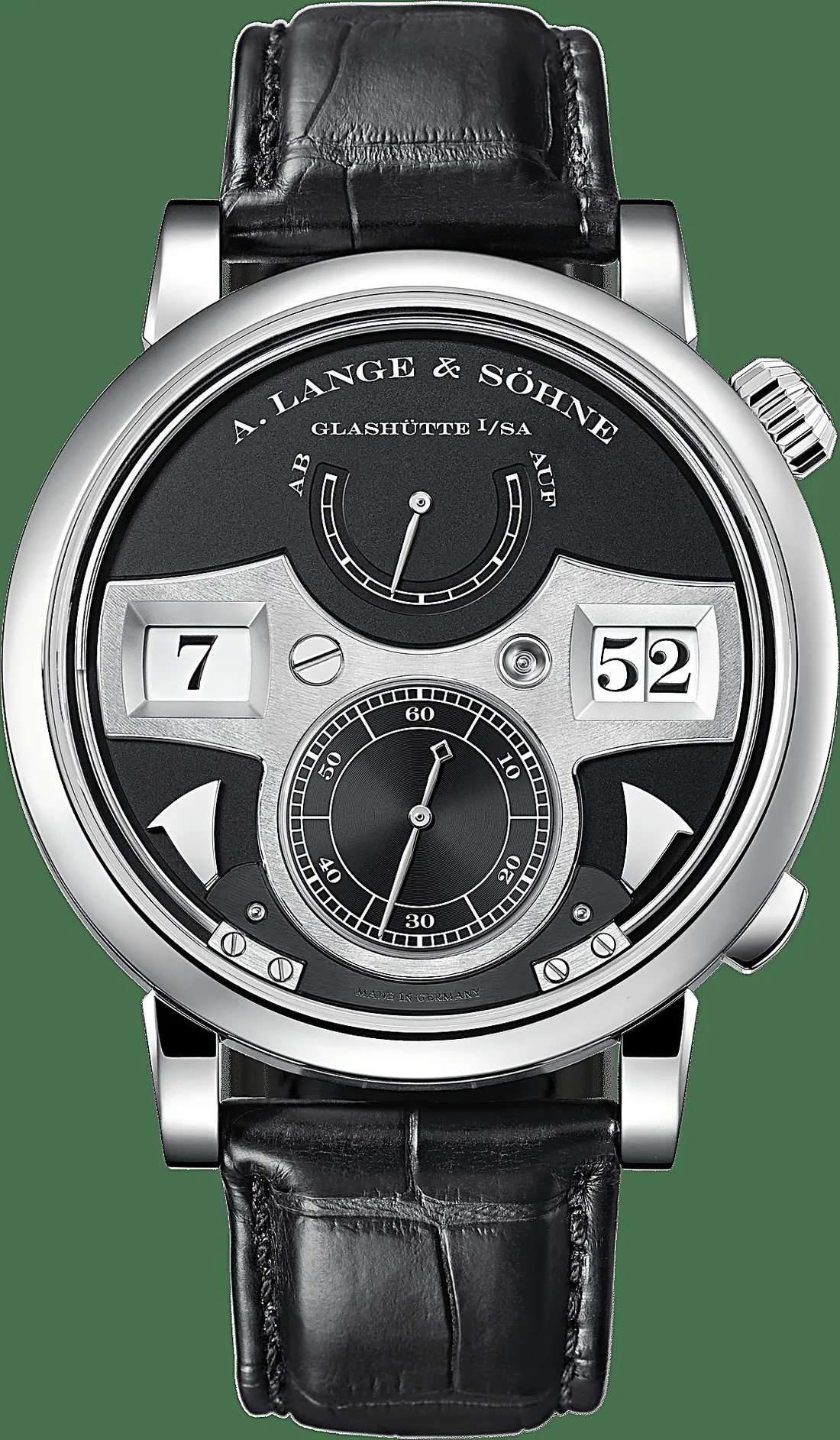
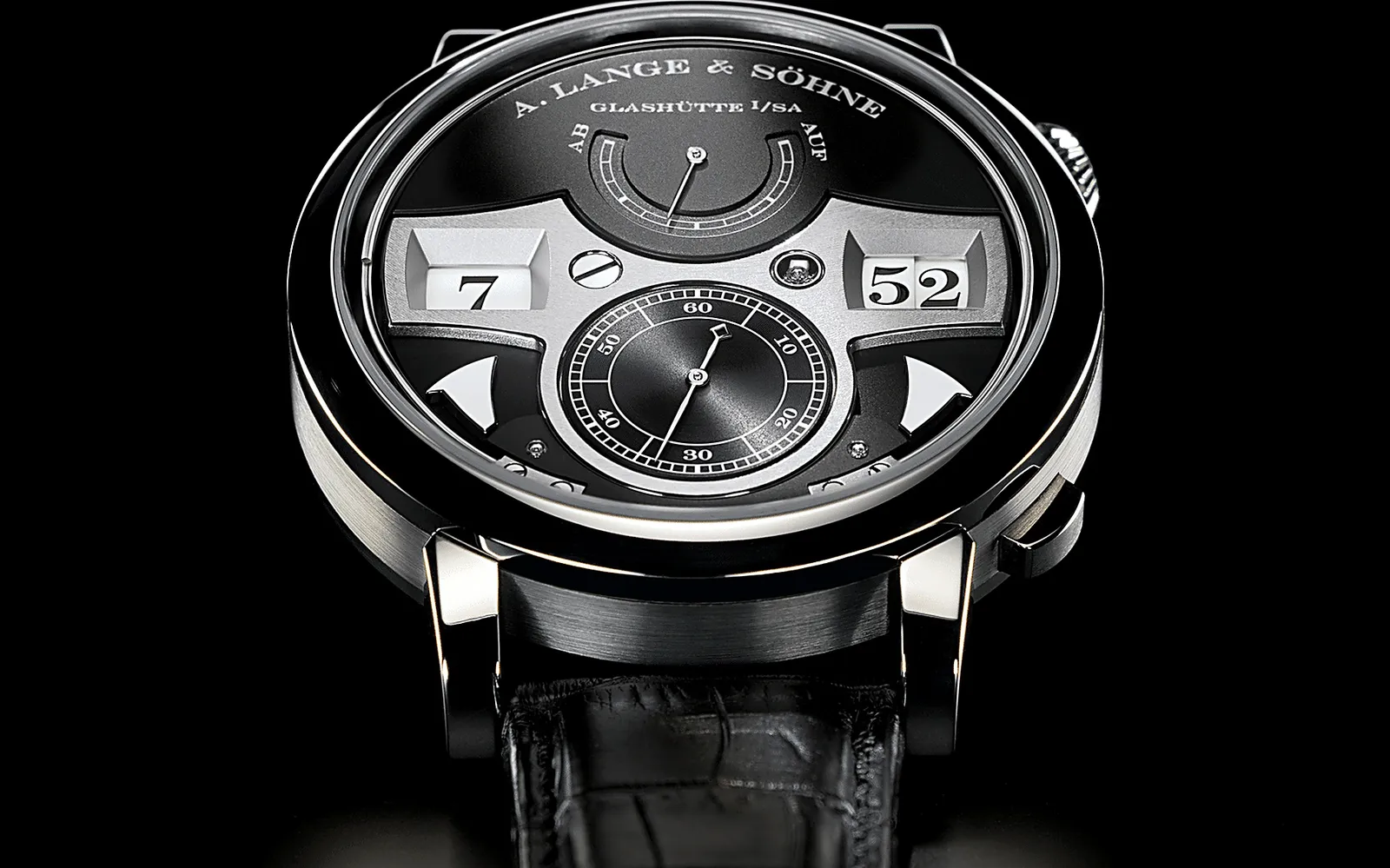
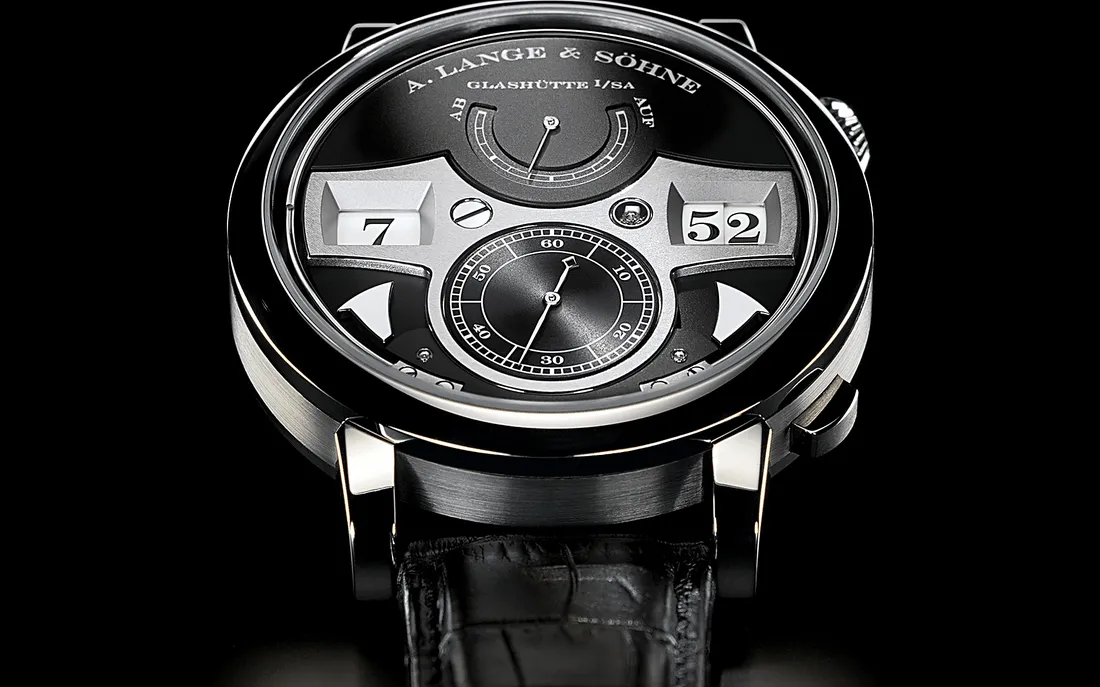
The truth that time is not a seamless flow but a discrete, digital, mechanical jump of frames takes on flesh and bone in this masterpiece, the summit of German engineering in high watchmaking: the A. Lange & Söhne Zeitwerk Striking Time.
Almost every luxury mechanical watch sweeps its hour and minute hands and hands us that illusion of flowing time. The Zeitwerk refuses the illusion and shows time in pieces instead, setting out in mechanical form the very jump we read in the weave of time itself.
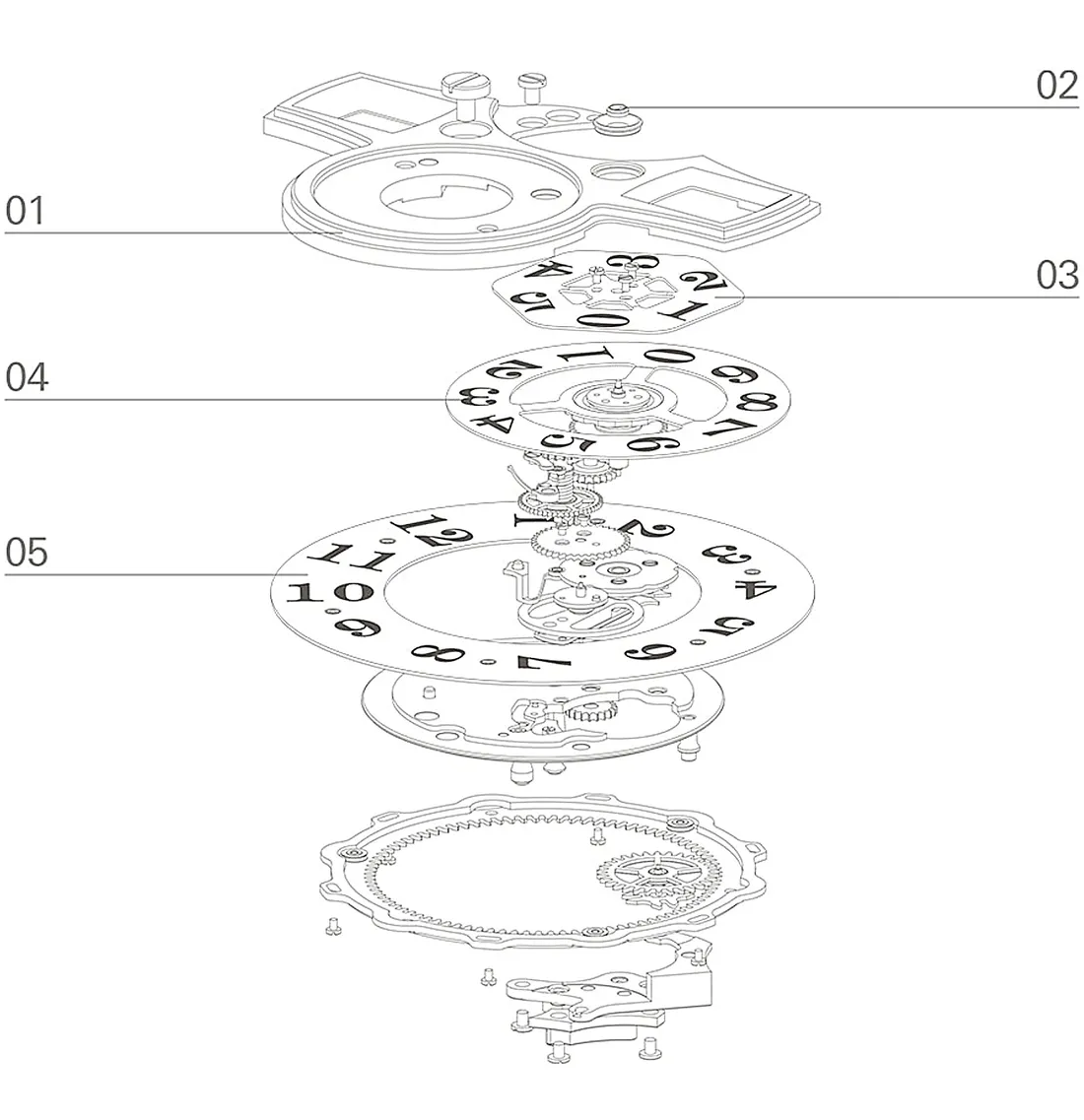
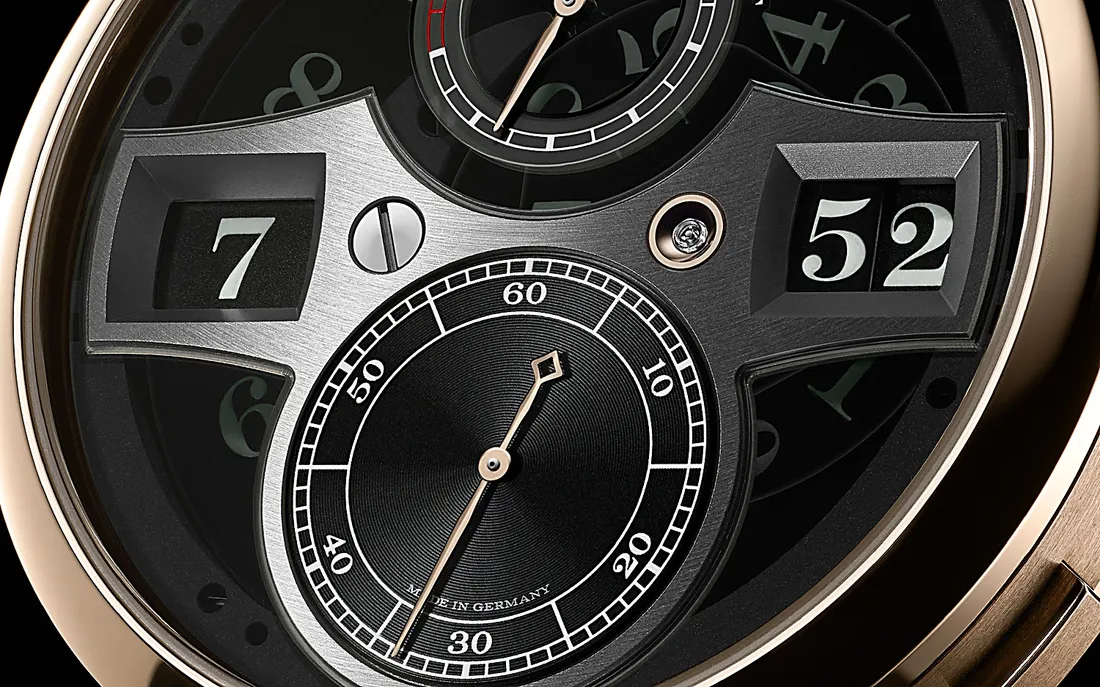
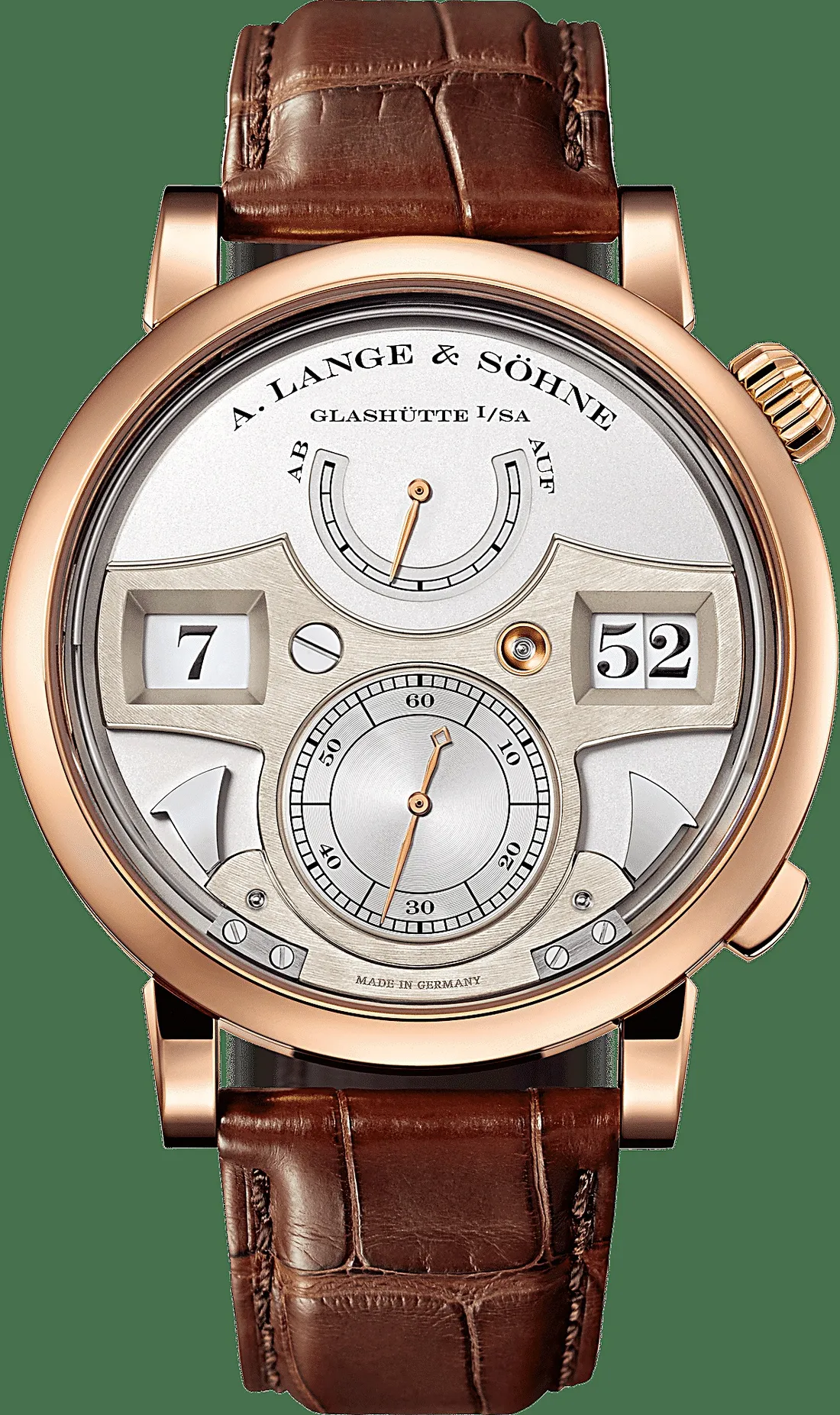
Look at the Zeitwerk dial and you will find no conventional hands. In their place sit great mechanical digital windows, hours on the left, minutes on the right. A time bridge carved from German silver carries all three indications: two discs for the minutes on the right, a ring for the hours on the left.
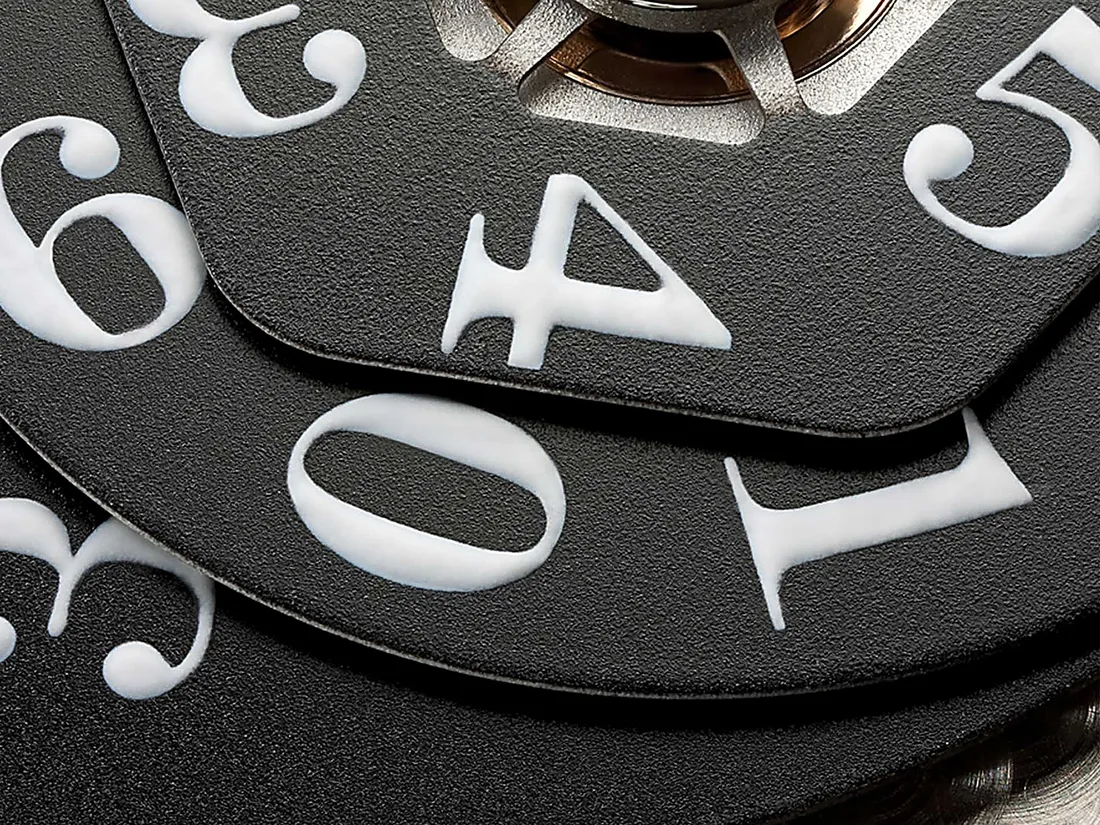
As time passes, the minute disc on the right does not creep around. Every sixty seconds the energy stored in the constant-force mechanism is released by a hidden trigger, and the units disc jumps exactly one fifth of a turn, seventy-two degrees. As the units disc goes from nine to zero, which is to say every ten minutes, it turns the tens disc by one sixth of a revolution; and when the tens disc passes from five to zero, the hour ring advances by a quarter turn.
The numerals never glide between two minutes; they jump from one frame to the next. Anyone wanting a mechanical figure for Planck time will struggle to find a better one than this.
format_quote"Between one Planck moment and the next there is no time flowing at all."
Hasan Bekmezci
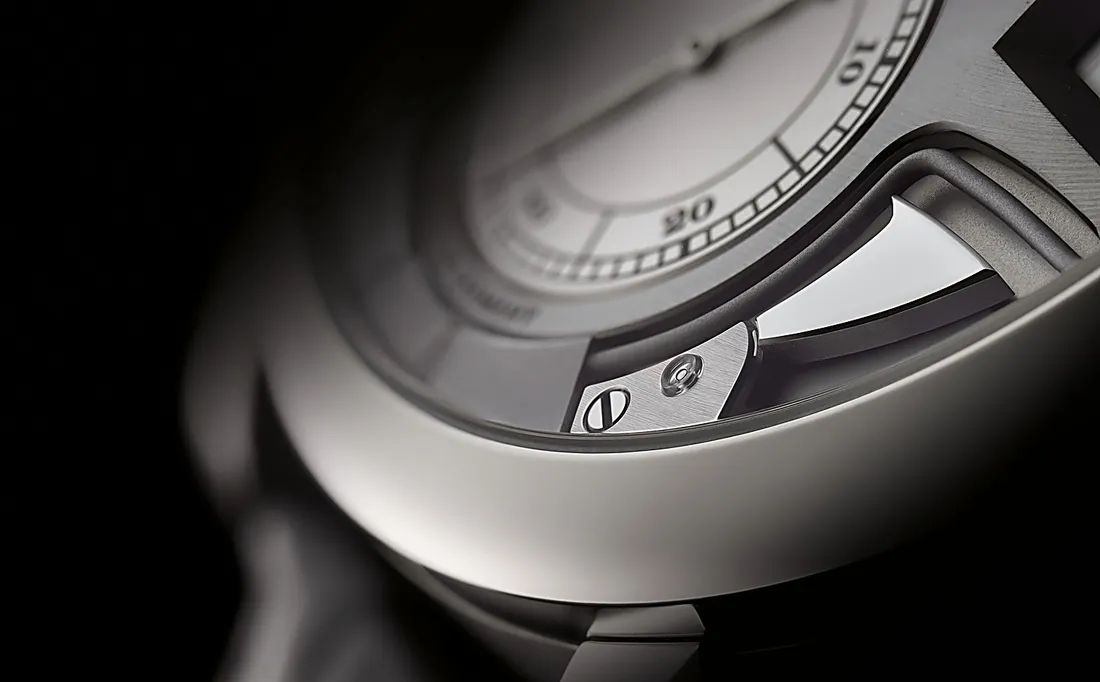
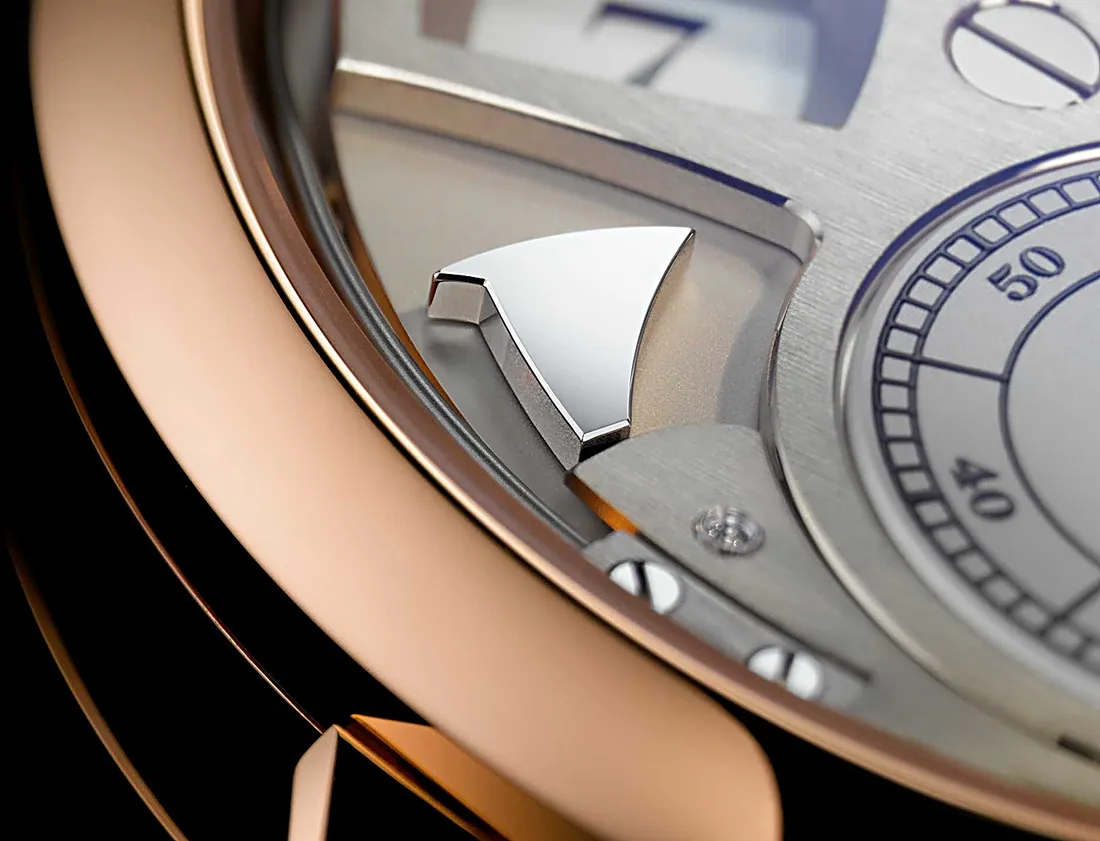
The Zeitwerk Striking Time is the world’s first mechanical wristwatch to join a jumping numerals display to a visible striking mechanism. The two arrows standing at the left and the right of the dial are in fact two steel hammers, and the gong wires run around the dial.
Every quarter of an hour the right-hand hammer lifts and strikes its gong, producing a clear, high tone. On the hour the left-hand hammer takes over with a deeper, more vigorous note. The steel of the gongs is hardened through a long process, and the weight of each hammer, its angle of impact and its speed of impact are matched one by one to the sound. If you want silence, a pusher in the lower right case flank deflects the hammers away from the gongs towards the centre of the dial, where they wait.
That sound is like the projectionist snapping his fingers. It reminds a person that one more frame of time has been left behind, that you have moved into the next scene of creation. It whispers in your ear that time is a capital being spent, tick by tick.
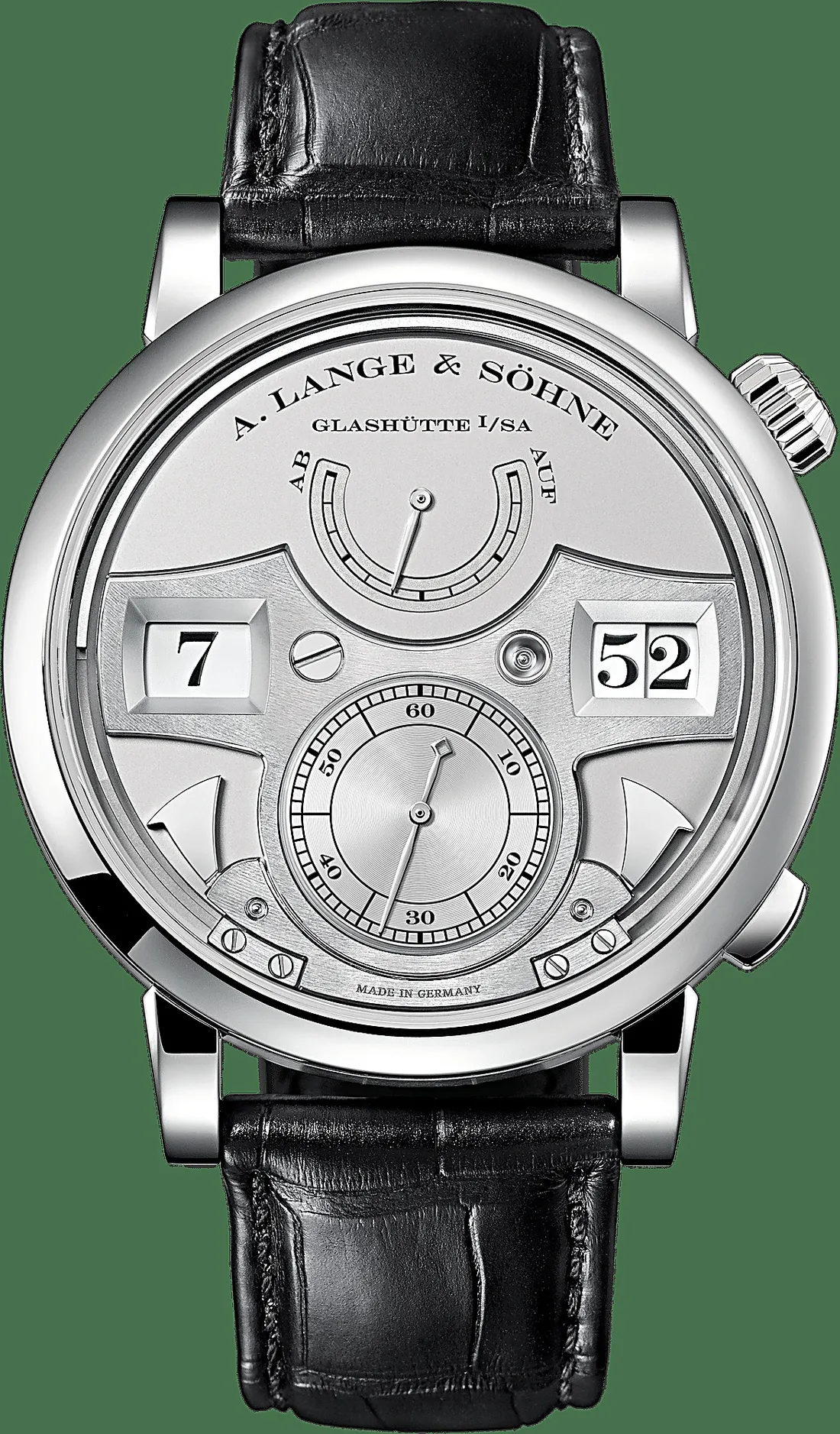
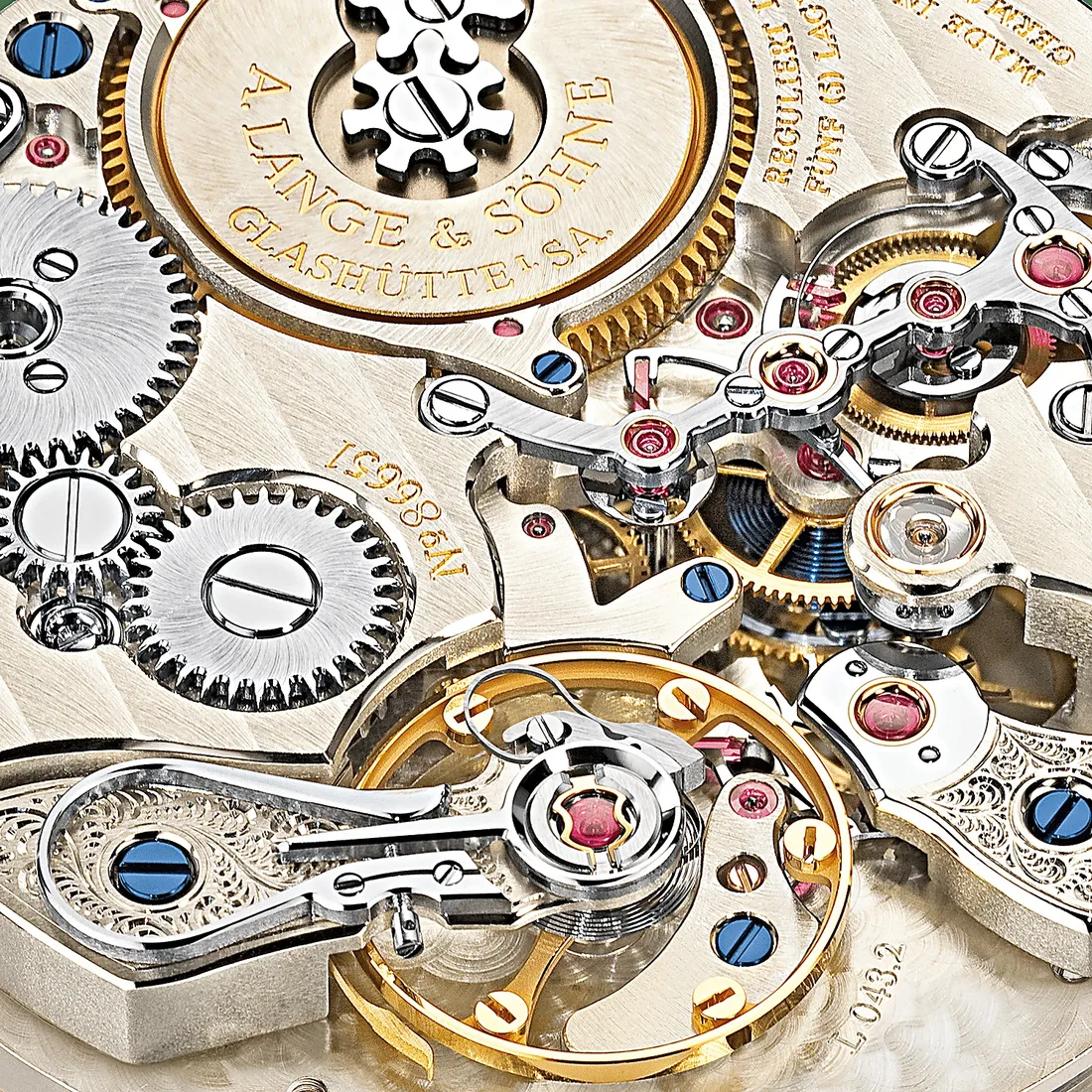
Making those blocks of numerals leap in the same split second takes enormous force. Lange’s engineers answered with a constant-force arrangement inside the movement that divides the mainspring’s power into equal packets. The energy left over after each switching cycle is swallowed by a fly governor; without it the discs would fling themselves round at their own speed.
That arrangement reads like a mechanical answer to the question of why every Planck moment in the universe flashes for exactly the same length of time. The order of the cosmos comes from energy being handed out in packets, and the Zeitwerk too divides its energy into equal packets before passing it to the dial.
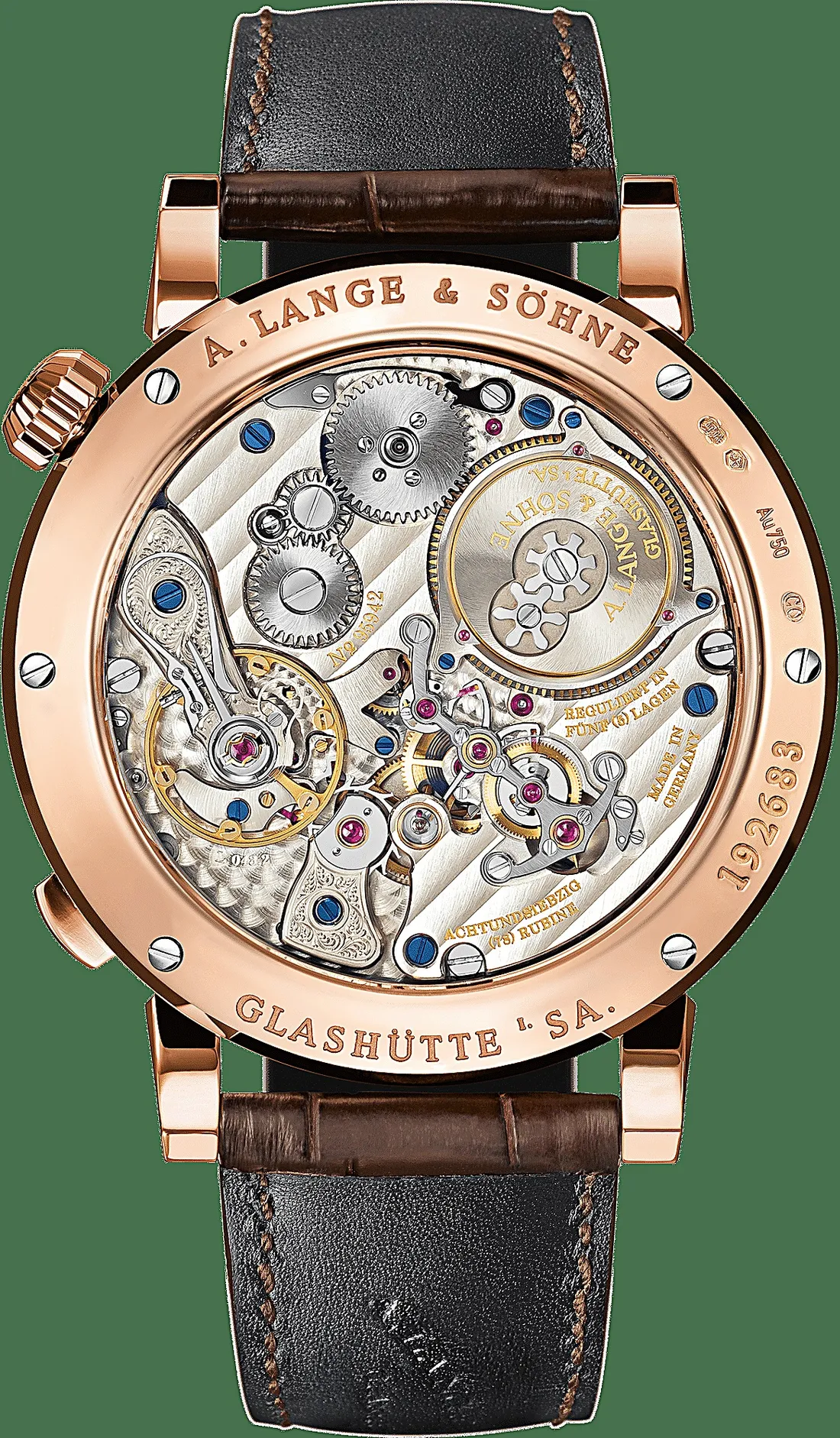
The case is forty-four point two millimetres across and thirteen point one deep. Inside beats the hand-wound calibre L043.2, built from five hundred and twenty-eight parts, offering thirty-six hours of reserve and running at eighteen thousand semi-oscillations an hour, two point five hertz. The fan above twelve shows what is left of that reserve. Water resistance is three bar, the back is sapphire, the strap is alligator and the lugs are twenty-one millimetres apart.
The model was made in three metals: white gold with a black dial, pink gold with an argenté dial, and platinum. Every dial is solid silver. None of the three references is part of Lange’s current collection today; the watch is now found only on the secondary market.
The man in the cinema can watch the river on the screen and dream about how beautifully time flows. But the physicist, and the one who has woken to the truth behind the lens, knows that the river is an illusion made of Planck frames flashing ten to the forty-three times a second. Time is a perishable cloth with a beginning, an end, visible seams and a pixel size.
With a Zeitwerk Striking Time on your wrist you watch those mechanical discs snap to the next numeral at the top of every minute. In that instant the steel gong reaching your ear whispers the greatest secret of the universe.
Time is not flowing, my friend. Time is being created frame by frame by its Owner, and laid out in front of us.
format_quote"Time is not flowing. Time is being created frame by frame by its Owner, and laid out in front of us."
Hasan Bekmezci
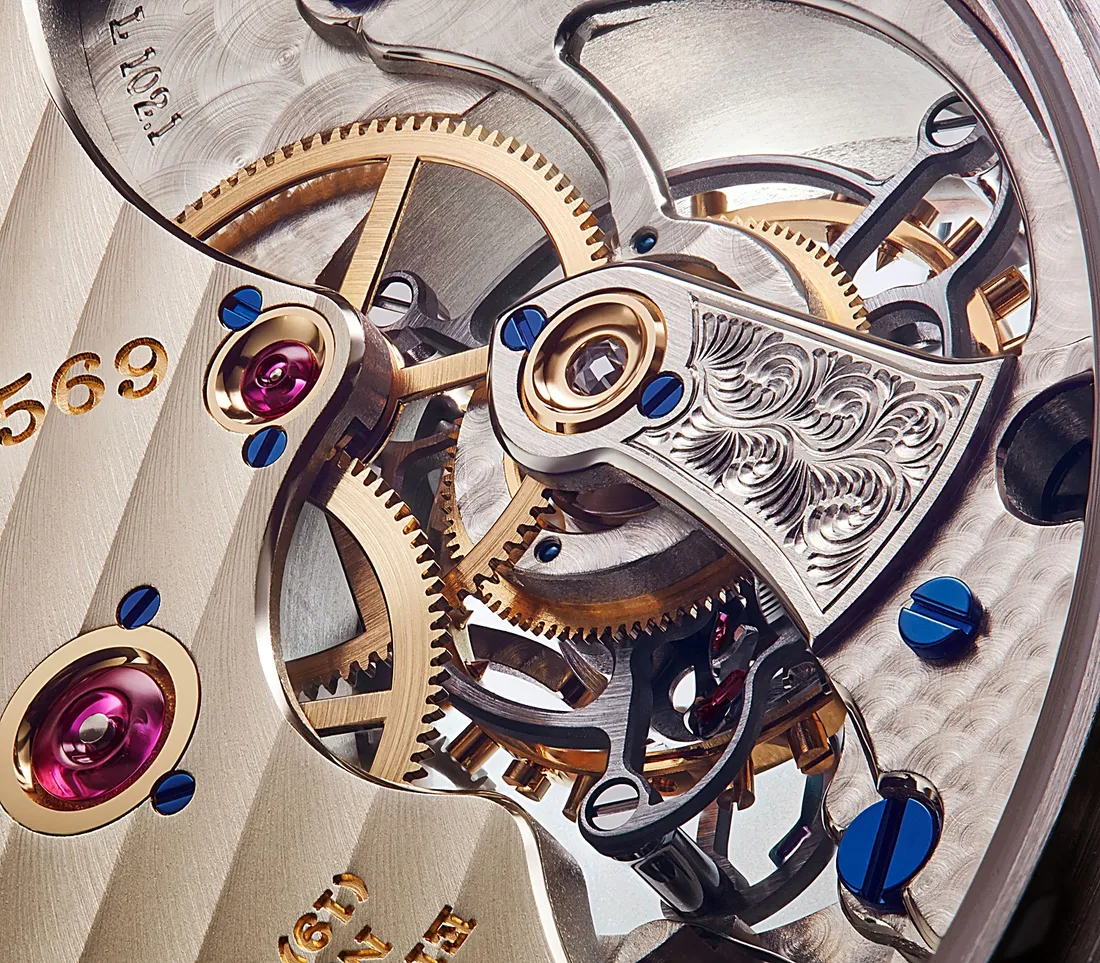
The watch on its maker’s own site: A. Lange & Söhne, Zeitwerk Striking Time