In the Madre de Dios region of Peru, at dusk, where the humidity weighs the air down like lead and the canopy closes over the sky like an enormous green ceiling, two biologists are standing. A rare shaft of sunlight filtering to the forest floor lights a trunk that stands as though risen up on its own huge stilt roots.
Every time I look at this, says Dr Aris Thorne, examining through his loupe the angles at which the roots drive into the ground, every botanical dogma in my head collapses. What have we been taught since school biology? A plant is passive, it is fixed, it is nailed to the soil. By the principle of causality, movement belongs to the animal and rooting belongs to the plant. And yet here, standing in front of us, Socratea exorrhiza, the one walking tree on Earth, makes fun of every law of biology we know. The tree walks, Elena. It literally walks.
Because there are points in nature, answers Dr Elena Rostova without taking her eyes off the trunk reaching towards the sky, where the architecture and the ordinary chain of cause and effect break down completely, where you see the miraculous fracture in which the Creator suspends by His own power the rigid rules we call cause. Think about it: you are a tree. You have no muscle to move with, no nervous system, no brain. But thirty metres above you another giant falls and a window of light opens. While every other plant on Earth only watches that light and waits to dry out in the shade, this tree, with an unimaginable awareness, locates the direction the light is coming from. It throws huge fresh stilt roots out towards the light. The roots on the shaded side it lets rot away. It slides its trunk onto the new roots. Twenty centimetres a year. This is not an ordinary botanical reaction; it is a miraculous walk that crosses the ground step by step to reach the light, beyond the reach of causes.
format_quote"You are a tree. No muscle, no nervous system, no brain. And still you find the direction of the light and walk twenty centimetres a year towards it."
Hasan Bekmezci
The Amazon basin is the ground of a relentless chemical war between plants and animals. To protect their fruit and leaves from herbivores, trees produce within themselves extremely lethal secondary metabolites, which is to say poisonous alkaloids. These plants are in effect saying: eat me and I will poison you.
So how is that enormous biological lock opened? The clay licks on the bank of the Tambopata river in Peru, the colpa, are the most concrete example of that immense antidote mechanism in nature.
Hundreds of macaws pour onto the open clay walls beside the river at first light. This behaviour is no ordinary feeding; it is a genuinely intelligent biochemical detox.
The raw fruit and seeds the macaws eat in the tropical forest carry a high load of poisonous alkaloids. If they digested those seeds directly, their livers would fail. But the macaws swallow the particular clay of the river bank. The layered aluminosilicate minerals in that clay work like a molecular magnet, or like a sponge of activated charcoal inside the stomach. The clay binds the poisonous alkaloids, keeps them from entering the blood and lets them leave the body safely. The clay is at the same time a providential supplement that closes the sodium and mineral deficit in the birds.
Thanks to this miraculous chemical armour, the macaws that survive take on the most critical function in the forest.
Breaking the hardest shells with their powerful beaks, and protected by the clay, they carry for kilometres the enormous seeds they cannot digest. Freed from the shade of the old trees, those seeds germinate in a natural bed of fertiliser along with the birds’ droppings.
Without this clay phenomenon the macaws would be poisoned and die, the seeds would not be spread, and the Amazon forest would be unable to renew itself and would be dragged towards extinction. A handful of clay holds up the future of an entire rainforest.
format_quote"A handful of clay holds up the future of an entire rainforest."
Hasan Bekmezci
Stop for a moment and turn your mind to this unimaginable biological alchemy.
A tropical plant builds within itself a relentless system to protect against the microscopic fungi wrapping its roots, the pathogenic bacteria that want to invade its cellular tissue and the insects gnawing its leaves. A cry of immunity rises in the cell walls and the plant begins to secrete salicylic acid as a cellular defence mechanism. For the plant this molecule is a purely biological shield; it prevents the tissue from rotting and destroys invading microorganisms.
Now look at the other side of that equation. A completely different kind of creature, a human being, peels the bark of that plant and takes it into the body. What happens when the particular molecule a plant made to protect itself from fungi and insects begins to circulate in a human bloodstream?
Human metabolism recognises that molecule. The inflammation receptors, the synthesis of prostaglandins and the pain centres of the brain are locked by this molecular key. The cellular shield a plant raised against insects turns, in a human being, into a miraculous chemical alchemy that lowers fever, quiets throbbing pain and regulates clotting: aspirin.
Two entirely separate kingdoms of life, one a plant that photosynthesises and the other a vertebrate human, are communicating in the same molecular language. Every leaf in the Amazon is, for that reason, a divine molecular library humanity has not yet finished reading.
format_quote"The shield a plant raised against insects becomes, in a human being, a medicine that lowers fever. Two separate kingdoms speak one molecular language."
Hasan Bekmezci
The trophic pyramid of the Peruvian forest is a perfect proof of the flow of energy from the sun towards the predator.
The capybaras that live at the water’s edge, enormous grazers, feed on leaves and water plants and form the level of the primary consumer. One floor above, spider monkeys hanging from the lianas feed on fruit while green tree snakes are the flawless hunters waiting in ambush among the branches. On the forest floor, moving in silence, the jaguar is the apex predator whose jaw pressure can crack even the shell of a tortoise.
Without jaguars the population of grazers would explode, consume the young saplings of the forest, and leave no room to live even for trees that walk.
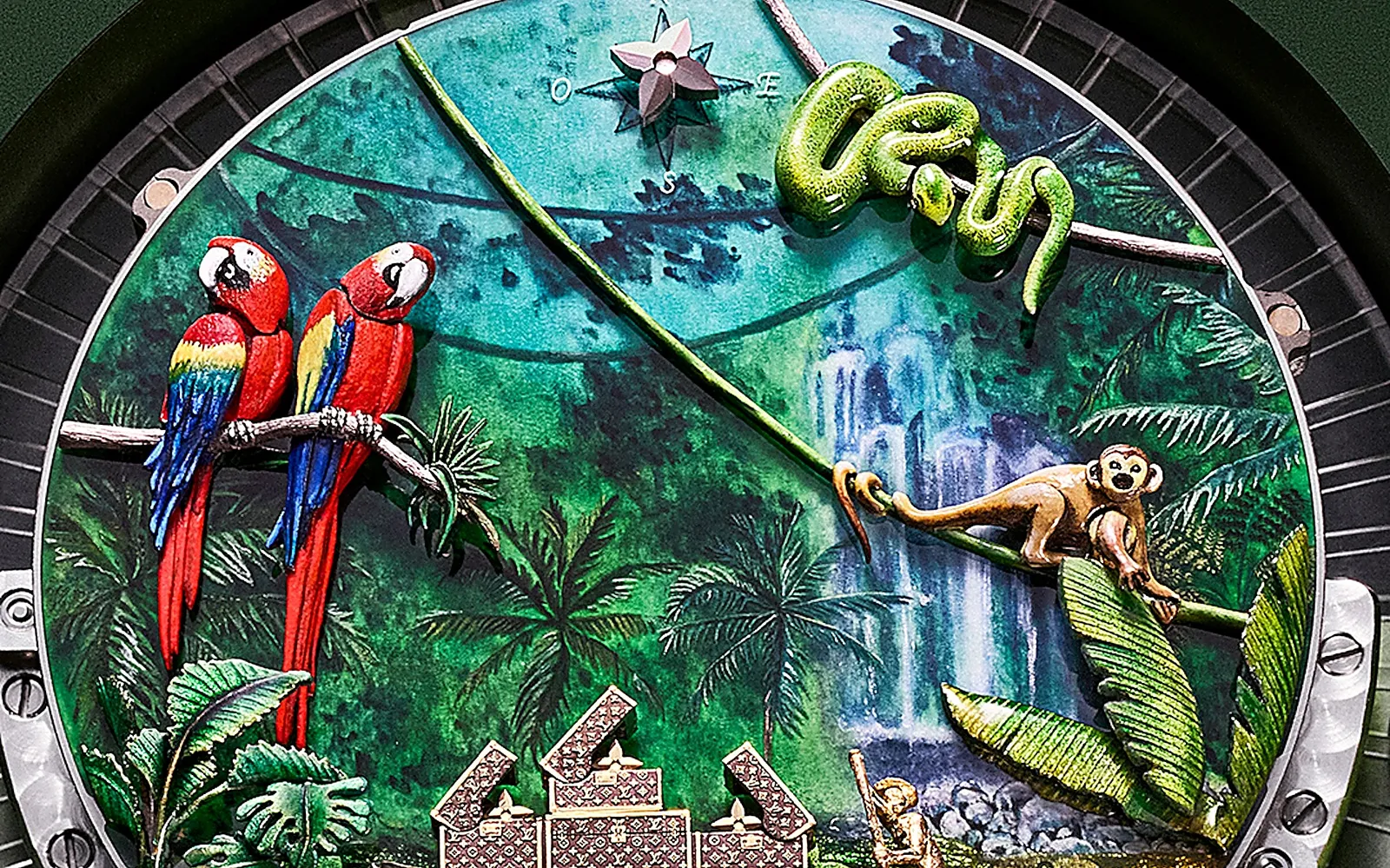
All of this biological depth, this resonance of photosynthesis and this ecological balance, becomes a concrete work of art in the Louis Vuitton Escale en Amazonie pocket watch.
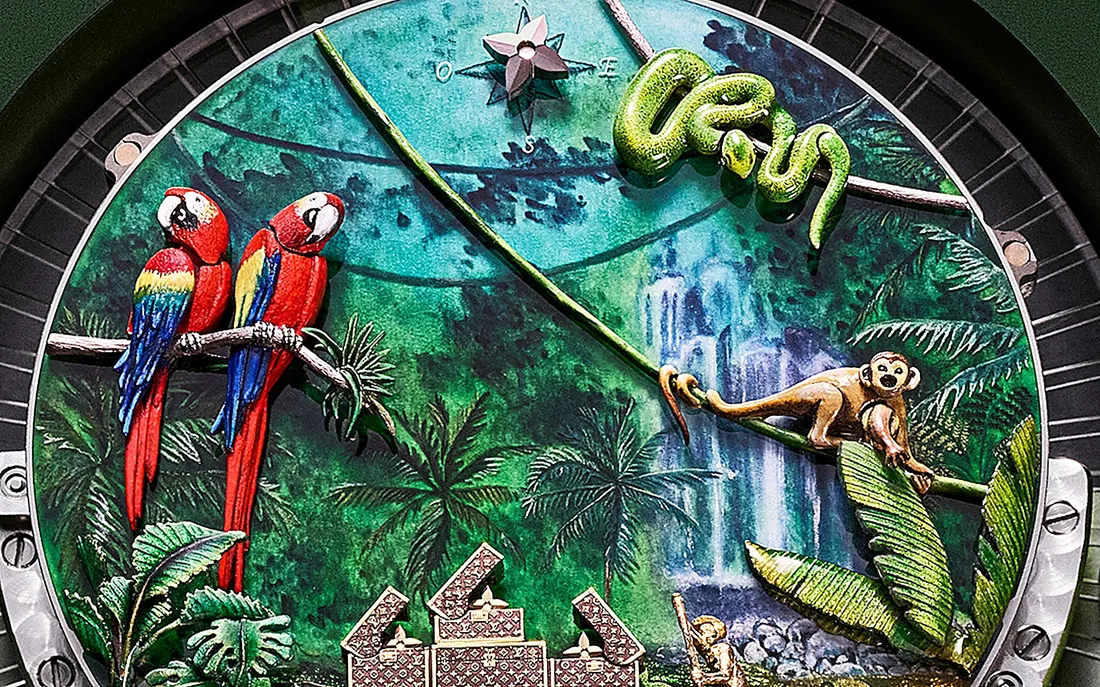
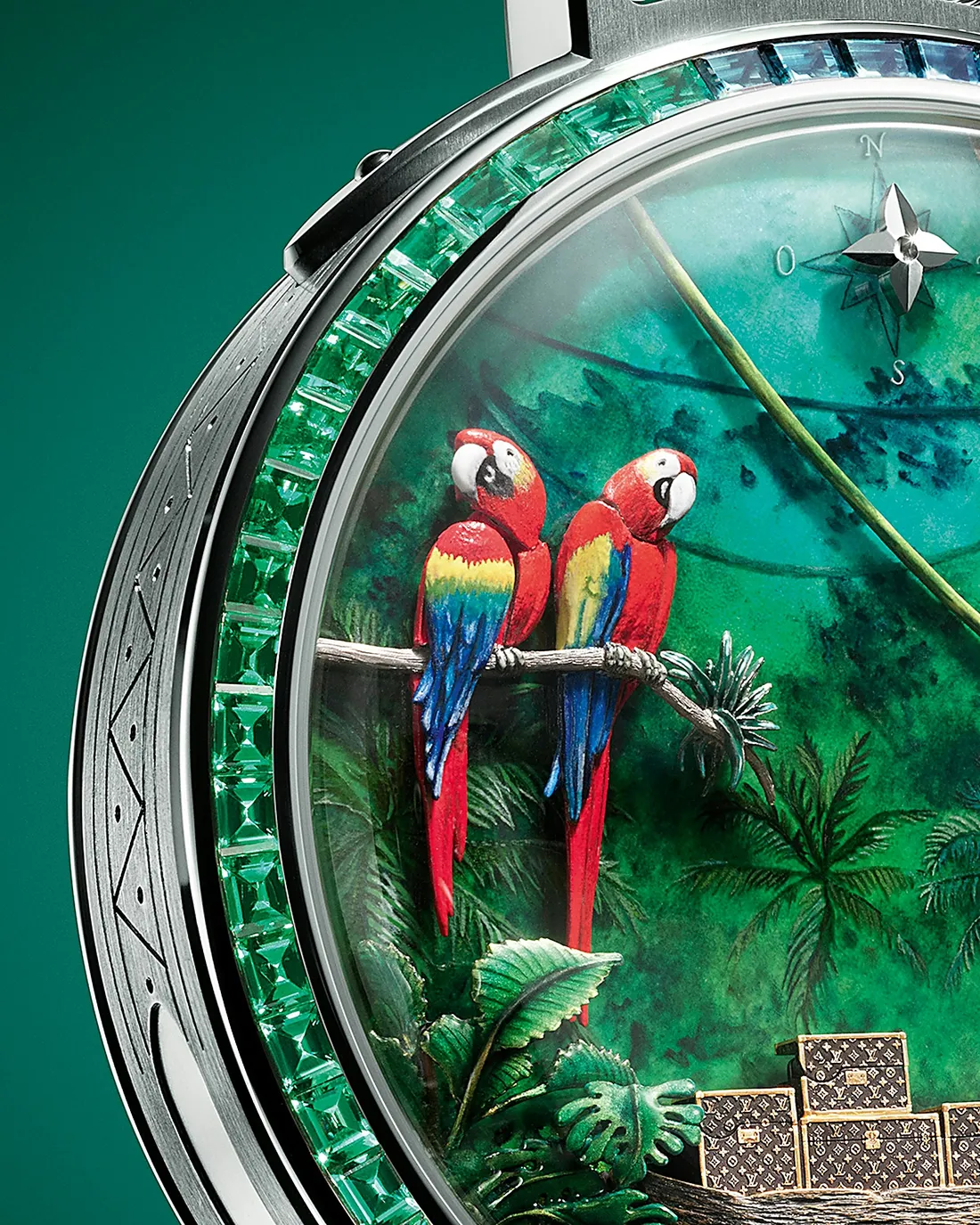
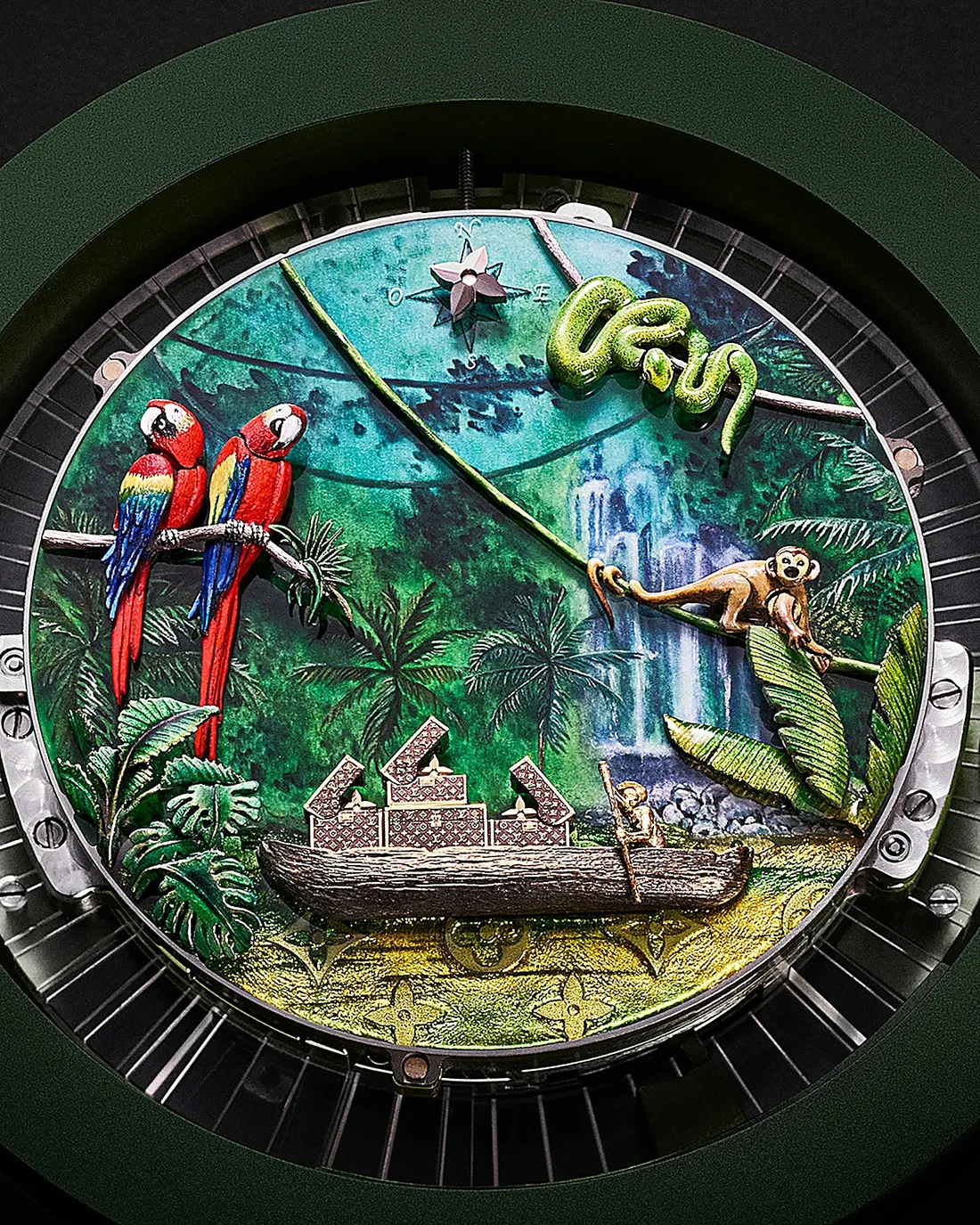
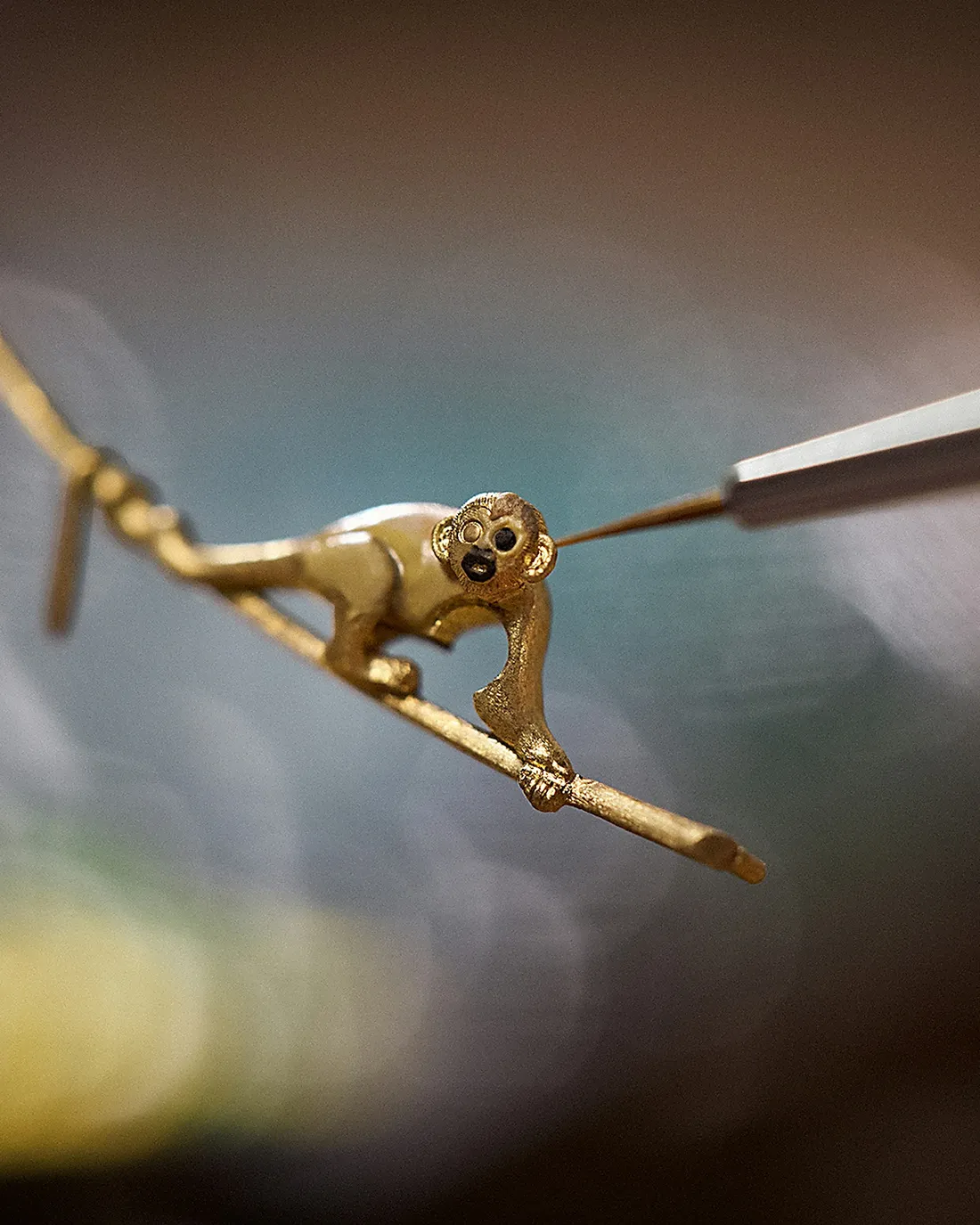
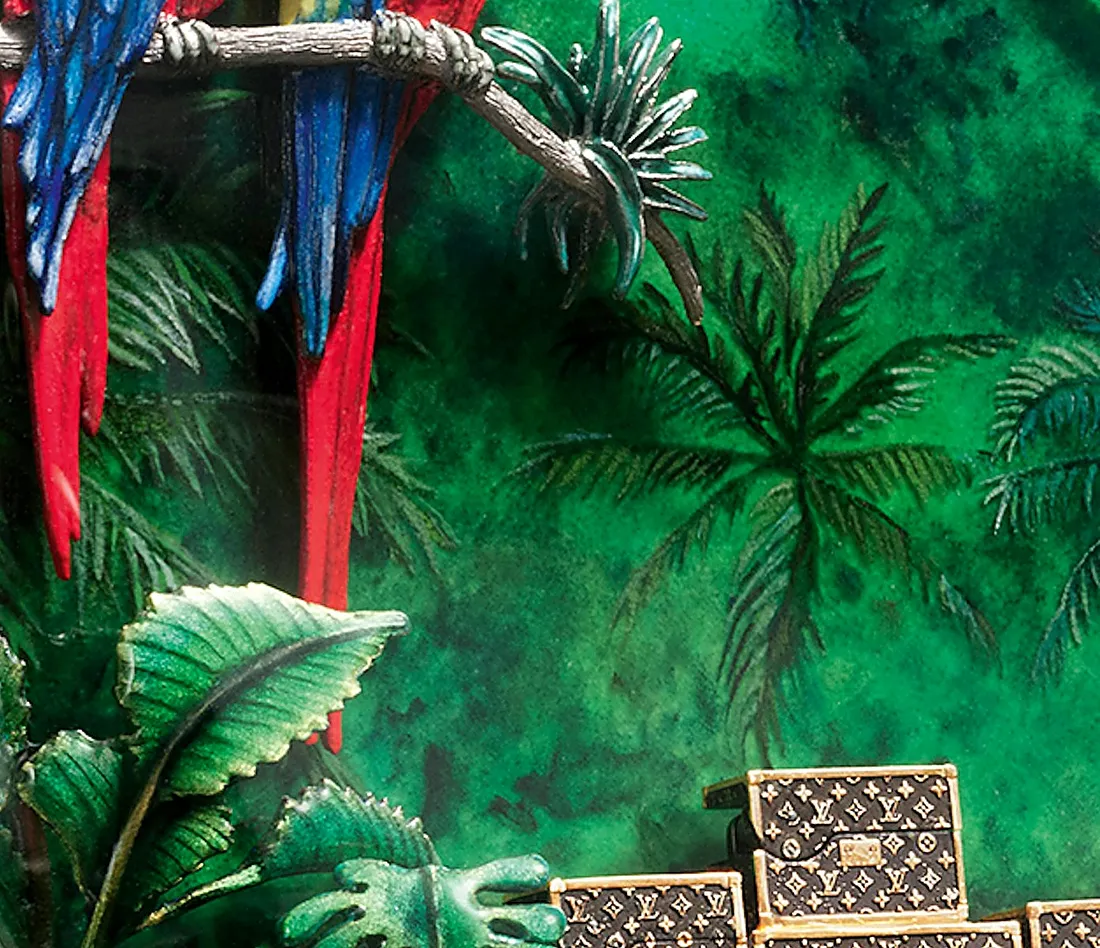
At the left of the dial sit the macaws, painted in vivid red and blue as though they had just come back from that miraculous detox at the clay walls. The monkey hanging among the leaves and the green tree snake coiling above carry the life of the middle storey onto the dial at microscopic scale. The waterfall behind and the green depth are the emblem of the Amazon’s unending water cycle.
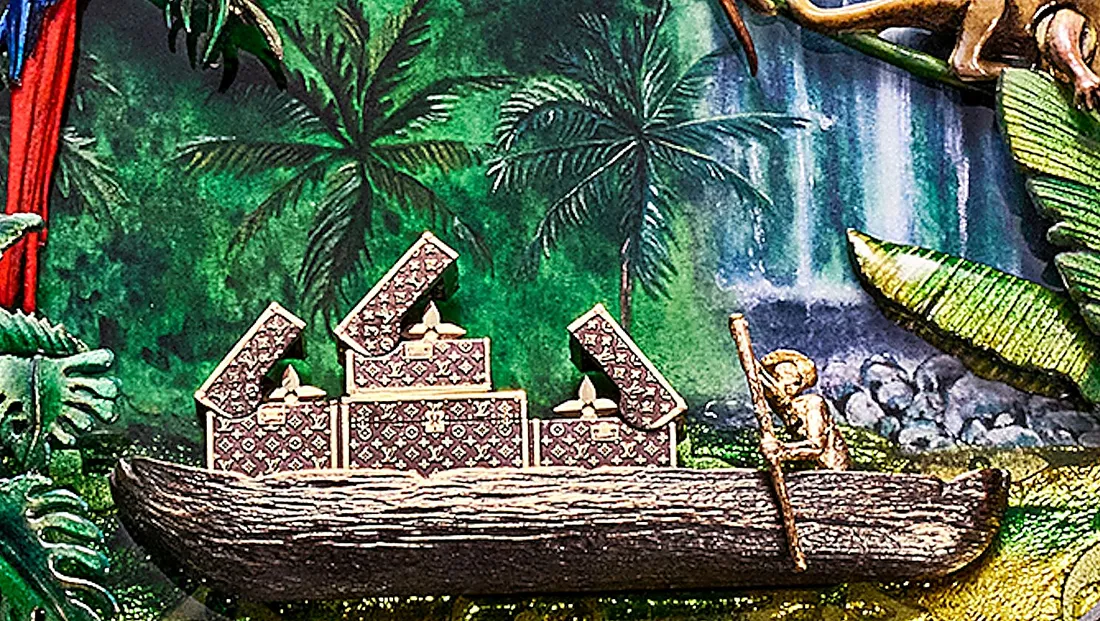
At the bottom of the dial there is no pyramid but a canoe hollowed from a single log, and onto that canoe monogrammed trunks have been stacked. With the small gold figure pulling the paddle, the scene sets the house’s own signature in the middle of the forest: the idea of travel itself, on the river, given over to the current.
Seven of the figures on the dial move. The watch is also a minute repeater; at any moment it tells the time in chimes, and when that sound begins the monkey, the macaws and the canoe come alive. In watchmaking a device of this kind is called a jacquemart.
The figures run as follows. The case is made of eighteen-carat white gold, measures fifty millimetres across and stands nineteen millimetres thick. The crystal is sapphire, water resistance is thirty metres, and the chain is white gold as well.
Inside runs the hand-wound calibre LFT AU14.03. It beats twenty-one thousand six hundred times an hour, which is three times a second, and gives eight days of power reserve. Beside the hours and minutes it carries a tourbillon and a minute repeater.
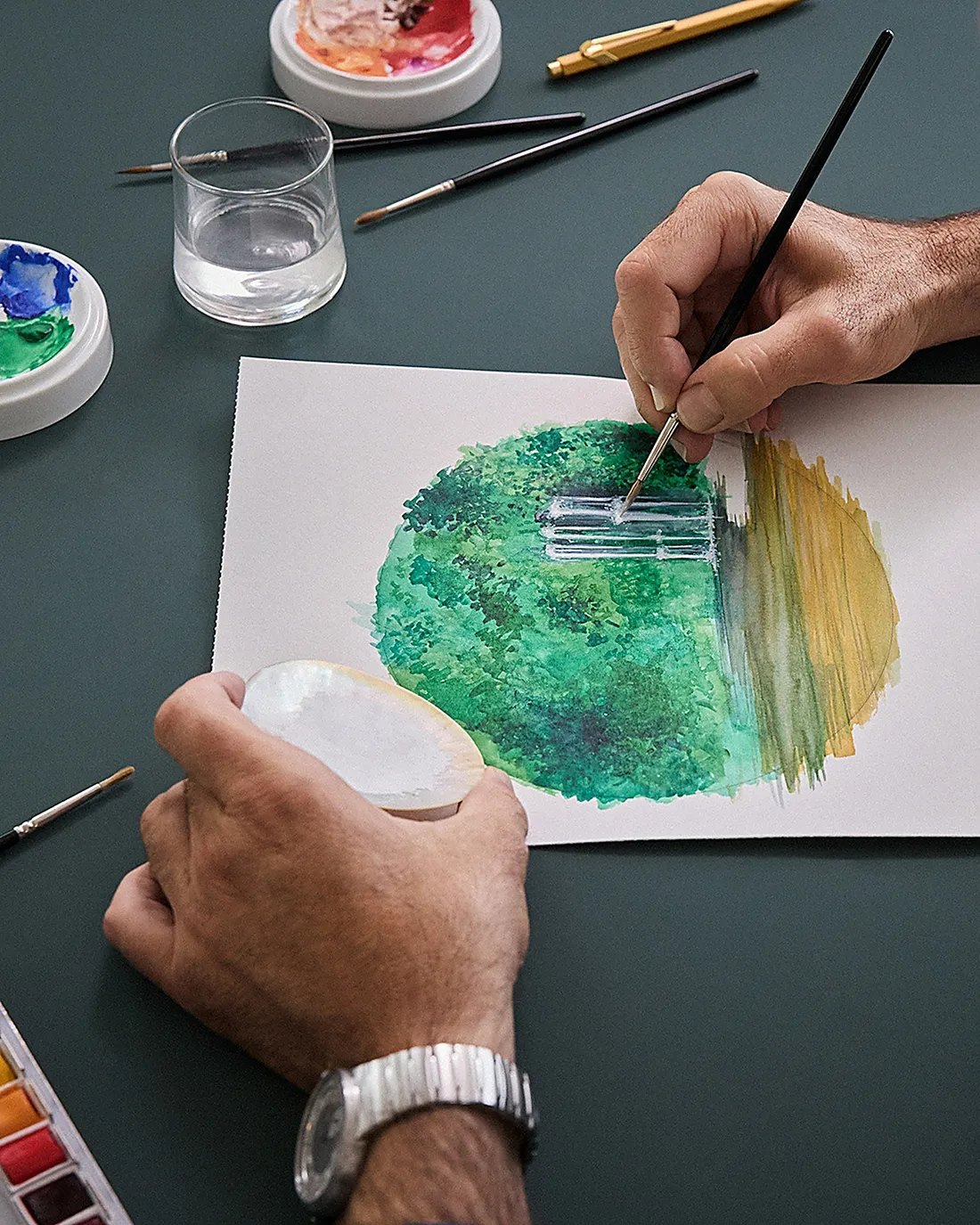
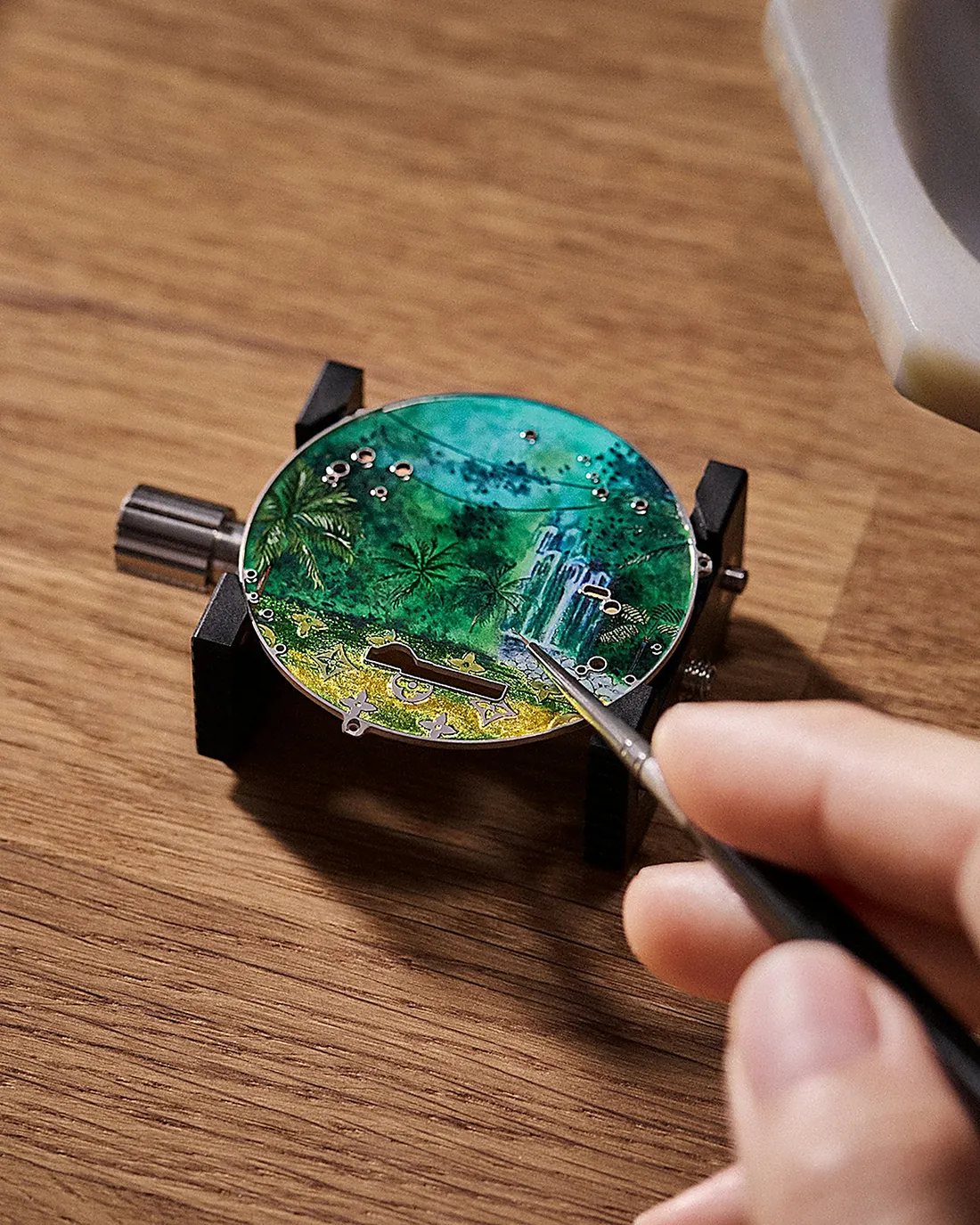
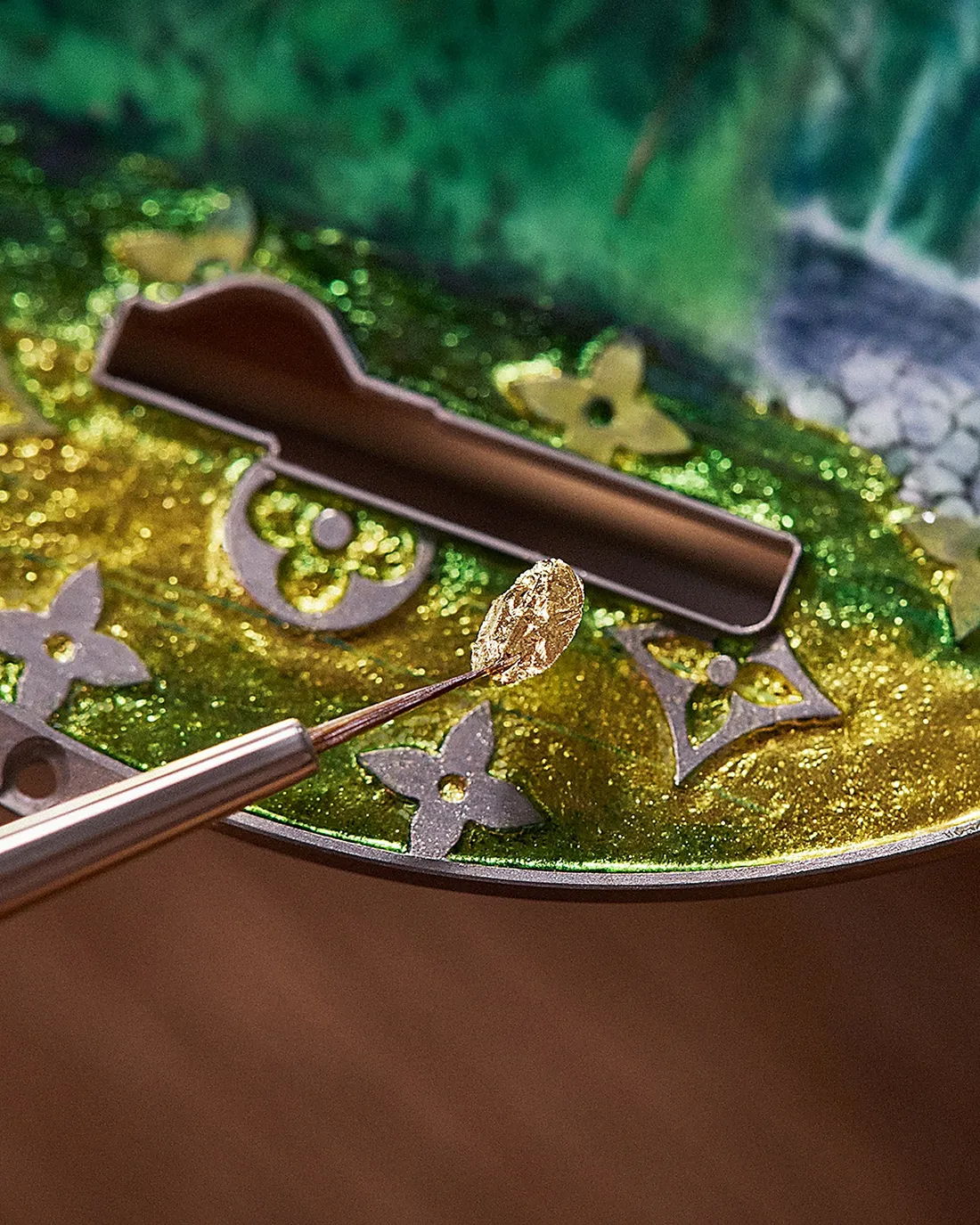
All the creatures on the dial were made by micro-painters using a single hair in place of a brush, working powdered enamel in layers under a microscope. About thirty different colours were used and the dial went through thirty separate firings, with the risk of cracking and damage on the bench at every one of them. The glitter of the river was given by the paillonné technique, with fine gold leaf set beneath the enamel.
The stones around the watch carry the same climatic scale. Roughly sixty baguette-cut stones are set with the invisible technique: blue-green tourmaline, emerald, tsavorite and yellow sapphire. The range of colour that runs from the yellow sunlight filtering through the canopy to the deepest dark green shade is in this way carried onto metal. The watch is a unique piece and is priced at three million euro before taxes.
The Louis Vuitton Escale en Amazonie takes time out of the ticking of mechanical gears and binds it to the miraculous root-step a walking tree takes towards the light in the Peruvian Amazon, to the antidote ritual of the macaws at the clay walls, and to that immense salicylic alchemy of nature.
Every time its cover is opened, this pocket watch shows not the time but the endless, flawless resonance of life that the Creator has inscribed on the earth, beyond every chain of cause.
The watch on its maker’s own site: Louis Vuitton, pocket watches