A Foggy London Evening
Jules Verne's hero, Phileas Fogg, sits one foggy London evening in the leather armchairs of the Reform Club and enters into one of history's most audacious wagers: to travel around the world in eighty days. In his pocket is a watch he checks to the second; for him, time is a web woven from train timetables and meridians. You will remember the famous twist at the novel's end: travelling eastward around the globe, he had gained a day without realising it. Time, it turns out, is no longer a matter of a place, but of where you stand upon the turning sphere of the Earth.
But what if, instead of chasing the sun around the world, you could turn the world itself in the palm of your hand? What if you could capture that turning planet beneath a dome of sapphire and wear it on your wrist? This is exactly what Andreas Strehler's Sauterelle à Heure Mondiale does: it turns the global time Verne dreamed of into a genuine mechanical miracle.
A Watch Named After a Grasshopper
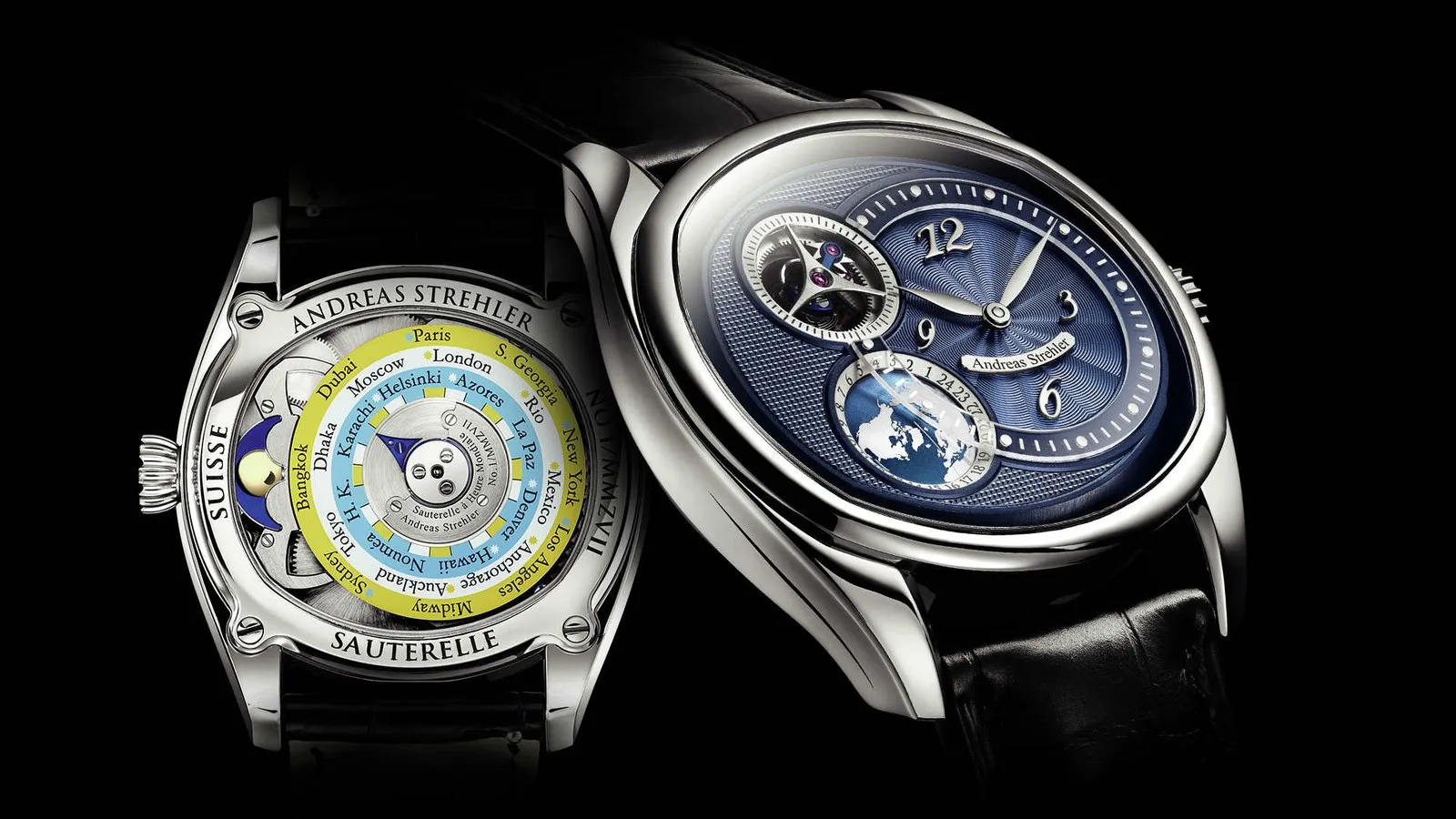
Andreas Strehler, who works in the Swiss town of Sirnach, is one of the world's few true engineer-watchmakers. 'Sauterelle' is French for grasshopper, and the name comes from the spring in Strehler's patented constant-force device that leaps like a grasshopper. In this model, the master adds a world-time (heure mondiale) complication on top of that grasshopper; and he does so in a manner more three-dimensional than anyone had attempted.
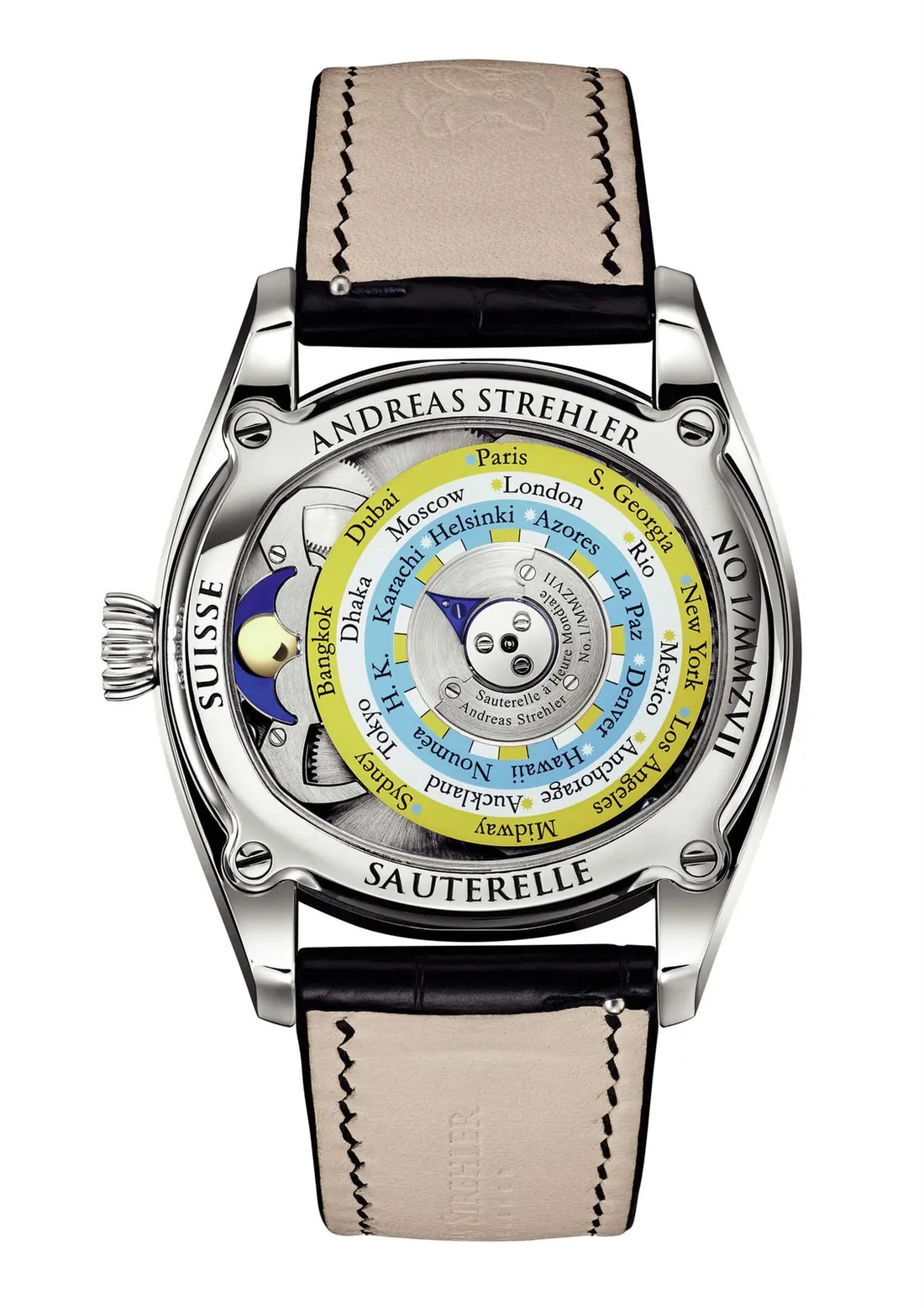
At six o'clock on the dial stands a real globe: a tiny Earth showing the northern hemisphere from above. And this globe, just like the real planet, turns once every 24 hours around its own axis, counter-clockwise. The sapphire crystal minute ring above it marks the face of the Earth that lies in darkness, the border of night. Turn the watch over and, on the movement side, 24 cities representing the 24 time zones, from Paris to Tokyo, from Denver to Auckland, are arranged in a ring, while a blued steel arrow shows which city you are in. This is a unique piece signed No 1/MMZVII; within its 41-by-37.3-millimetre steel case, a planet turns.
How Do You Turn the World on a Wrist?
The true difficulty of a world-time watch is to carry the time to a new city without ever losing your reference. Strehler solves it thus: when you pull the crown to its first position, you can jump the hour hand forward or back in one-hour steps; at that very moment, the city and destination disk behind moves along with it. So in every new city you step out into, you hop the hand a few times and set the local time instantly; yet your global reference (GMT) never disappears from view.
Beneath this seemingly simple gesture lie a city ring driven by a 24-hour wheel, a jumping correction mechanism, and a precise gear train that turns the globe exactly once every 24 hours. When you jump the hand forward by one hour, the Earth must turn by exactly 15 degrees; for when you divide 360 degrees into 24 slices, each time zone is precisely 15 degrees. This little planet on your wrist obeys the mathematics of astronomy to the letter.
The Grasshopper's Leap: the Remontoir d'Égalité
Now to the true heart of the watch, that skeletonised device at ten o'clock: Strehler's patented remontoir d'égalité, or constant-force mechanism. The problem is this: a watch's mainspring is strong when wound and grows weaker as it unwinds; this changing force ruins precision. The remontoir is a small secondary spring placed between the mainspring and the escapement. The mainspring constantly rewinds this little spring, and the little spring delivers to the escapement, every single time, exactly the same unwavering force. Whether the mainspring is full or nearly empty, the force the escapement sees never changes.
Think of it as a water tower: whether your reservoir is brimming or half empty, the pressure at the tap stays the same, because a tower of constant height stands in between. Strehler's remontoir gives the escapement just such a constant 'pressure'. And because this device is wound and released once every second, the seconds hand does not sweep; like the beat of a heart, it hops once per second. This is called the dead-beat second. And the reason the mechanism is named 'Sauterelle', the grasshopper, is precisely this leap of its spring.
Two Hearts, Conical Gears and a Record
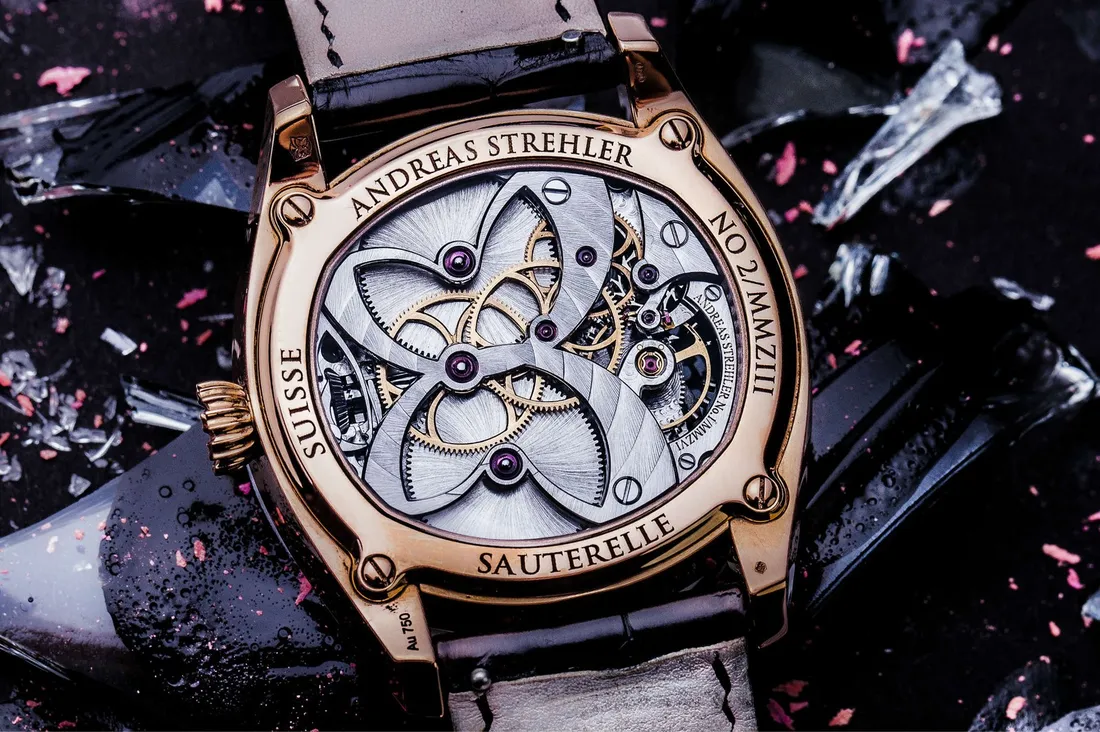
The energy feeding all this comes not from one but from two mainspring barrels; the pair are linked by a differential gear and together offer a 78-hour power reserve. That same differential also governs a stop-work that cuts out the strongest and weakest turns of the springs, so the watch runs only in the most stable region of the mainspring. Winding is done through conical gears; this rare solution gives the fingers a velvet-smooth, precise feel as you turn the crown.
At its heart beats a free-sprung balance running at 21,600 vibrations per hour (3 Hz), with a Breguet overcoil and four adjustment screws; in all, 25 jewels and 206 parts. The bridges are reduced to that flower- or butterfly-shaped skeleton particular to Strehler, brushed like rays of the sun. A collector may add a world record to this watch: a moon-phase display that deviates by a single day only once every two million years; 18k gold moons upon a blued steel disc. In other words, long before this watch shows the wrong phase of the moon, human civilisation will most likely have turned into something else entirely.
Fogg Chased the Sun; Strehler Bottled It
Phileas Fogg ran after the sun to circle the world. Andreas Strehler took the sun, the Earth and time itself and set them upon a wrist, beneath sapphire. Before us stands not merely an instrument that tells you the hour in Tokyo; it is a tiny planet, turning gently on its own axis, driven by the leap of a grasshopper and by a force that never wavers. Had Verne seen it, I suspect he would have fallen silent for a long while before beginning his next novel.