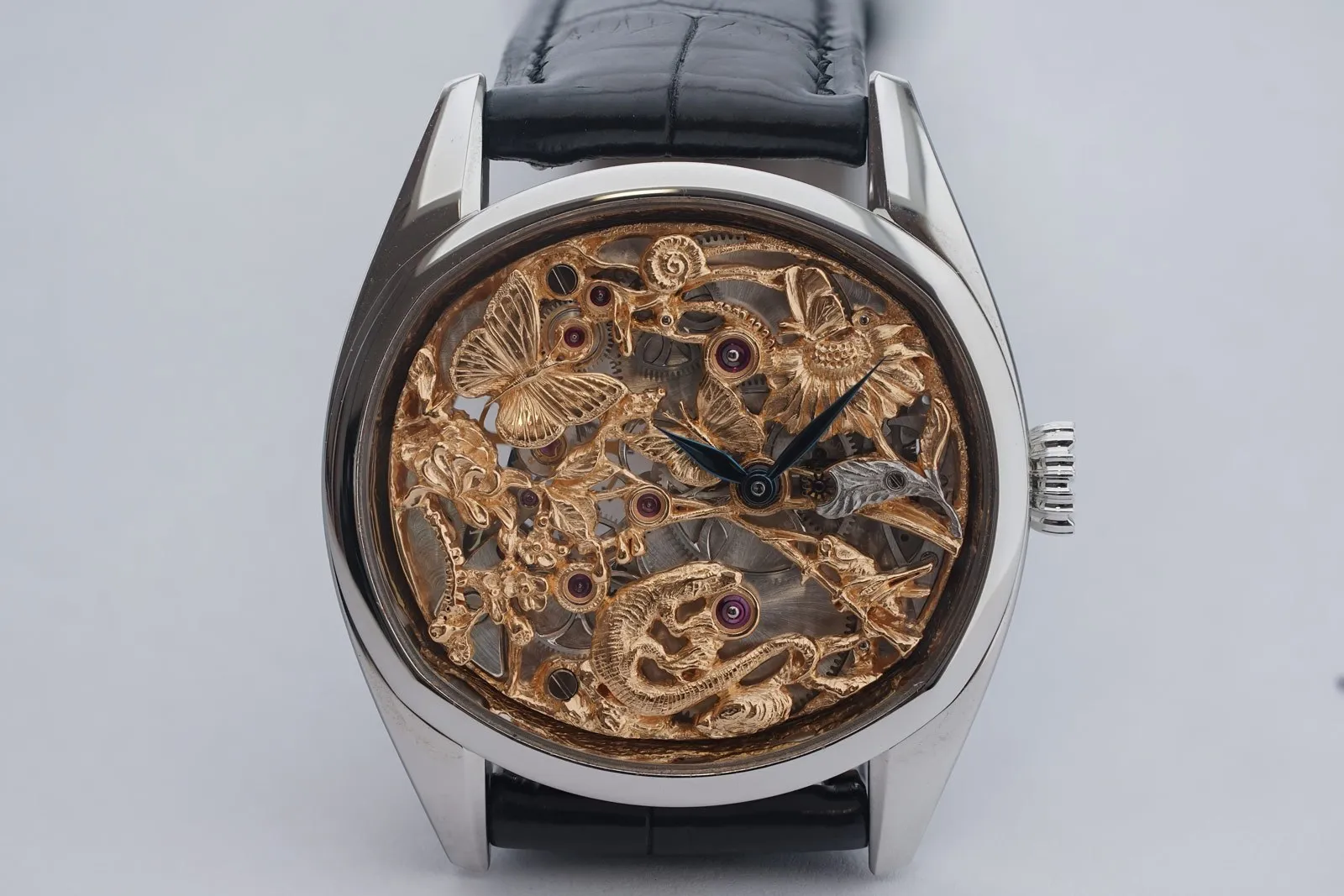
In the Middle of a Garden
Summer is at its ripest. Imagine standing in the very middle of a garden: the scent of flowers hangs in the air, a light breeze stirs the leaves into a soft rustle, and at the corner of your eye something moves. A butterfly. Its wings open and close in the sun.
In Native American cultures the butterfly is a symbol of rebirth, of transformation, and therefore of hope; the story of a caterpillar undoing itself and creating itself anew. In China, the butterfly represents love, beauty, freedom and the human soul. That tiny wing has carried, for thousands of years, mankind's dream of 'becoming something else'.
Now fit this garden into the palm of your hand. Take the flowers, the butterflies, a lizard hidden among the grasses, a snail, a cricket; carve them all from solid gold and set them over a living machine that turns without ceasing beneath them. This is precisely the miracle of Andreas Strehler's Jardin des Papillons: over a heart that beats without pause, a summer that will never wilt.
Not a Dial, but a Bridge
Andreas Strehler, who works in the small Swiss town of Sirnach, is one of watchmaking's most technical minds. His name is usually spoken alongside moon-phase displays of record accuracy, extraordinarily precise remontoirs and complex movements; through his own company, UhrTeil AG, he even develops movements and parts for houses such as Harry Winston, Garrick and Maurice Lacroix. In short, Strehler is often the genius behind the curtain.
The Faune et Flore collection is a bold departure from this technical world; a decision to wed engineering to handcraft, haute horlogerie to the métiers d'art. The first design is the Jardin des Papillons we examine here. And its greatest surprise is this: that captivating dial you see is not actually a dial at all. It is the load-bearing bridge of the movement, inside the 41-by-47-millimetre ovoid Papillon case.
From Behind the Curtain to Centre Stage: Roman Houdek
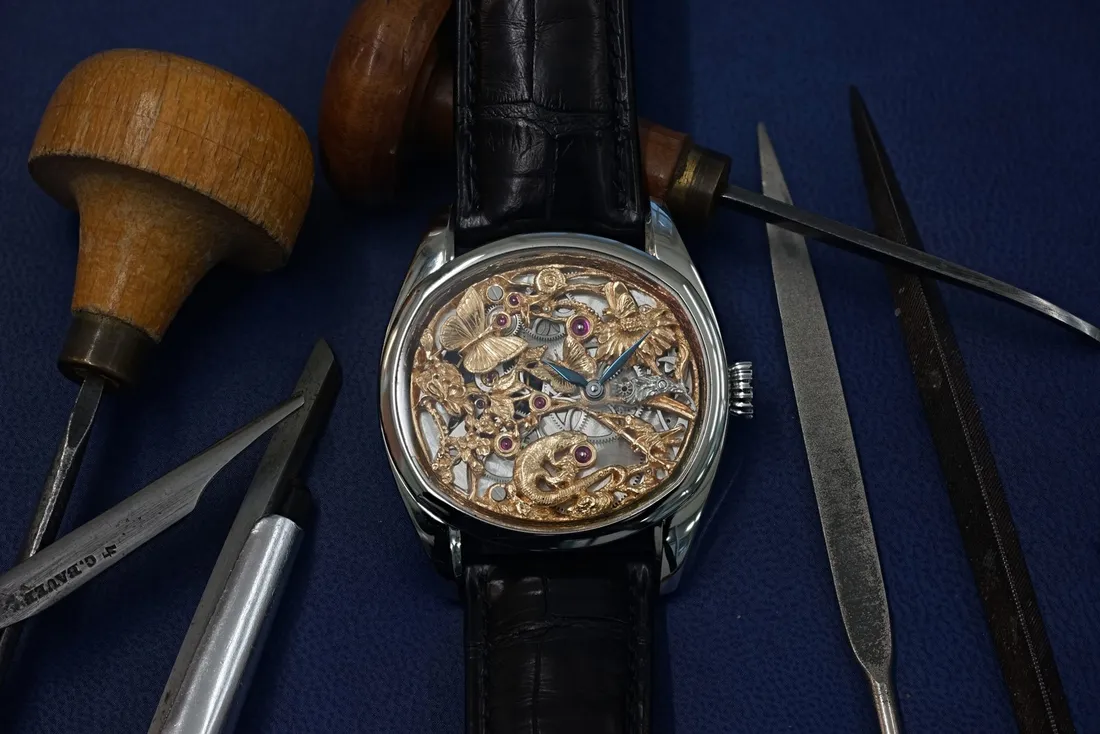
The hand that created this golden garden belongs to Roman Houdek, the chief engraver at Strehler's UhrTeil AG. This master had never worked at any other watch brand before joining Strehler; he learned and matured his craft entirely under this roof. For years he engraved his signature onto bridges and parts no one ever saw; with Strehler's decision, he was carried for the first time to the very centre of the stage, to the heart of the watch.
The material Houdek works is 18k solid gold, and gold is the engraver's cruellest friend: it is soft, it does not forgive. Under a microscope, with steel burins (gravers) sharpened into different profiles and wooden-handled chisels, Roman cuts into the metal for days, even weeks. No stamping, no mould, no digital aid; only the rhythm of the hand, the eye and the breath.
Art Made Into the Watch, Not Onto It
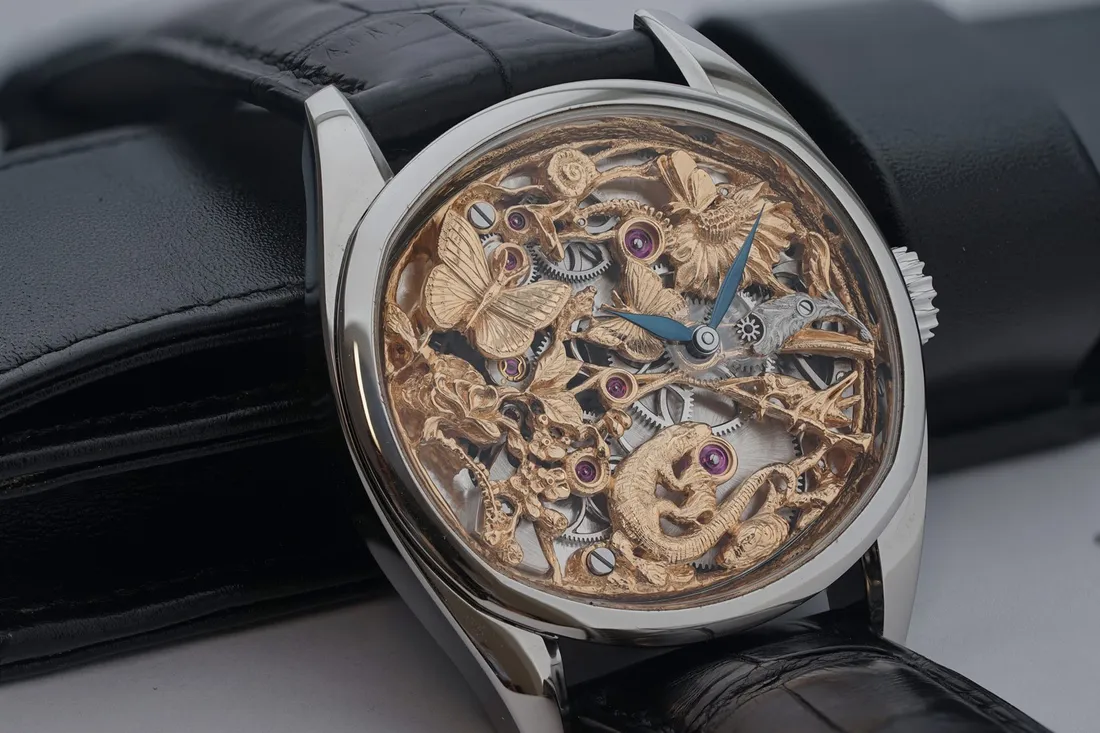
But this is not the decoration of a flat surface. Houdek raises the figures out of the metal itself; this is called relief engraving. The butterflies, the lizard and the leaves are undercut until they seem to have been set on top of the plate; the scale-texture of the wings is worked in fine parallel lines, the lizard's skin in tiny stippled dots, and the backgrounds in a matte, granular texture. When the light strikes, some surfaces shine like a mirror while others fall silent like velvet; and so two-dimensional gold turns into three-dimensional life.
The true genius is this: the engraving is made into the watch, not onto it. That gold plate is at the same time the working bridge of the movement; it supports part of the going train and the two barrels. The red ruby jewels set into the bridge become part of the engraving; one the heart of a flower, another the eye of an animal. As he works each figure, Roman must respect the micron-level positions of the functional holes, screws and pivots, and keep the bridge both sound and flat. On solid gold there is no going back: a single slip of the hand turns to scrap not only weeks of art, but a working component of the watch. And Roman hides the butterflies, the lizard, the snail and the cricket among the flowers so cunningly that discovering them, one by one, is left to the beholder.
A Living Ecosystem Beneath the Glass
Looking through the gaps between the golden figures, you see the wheels, the bridges and those red rubies; the mechanism turning in the background transforms the garden into a breathing ecosystem. Here Strehler adds one more touch of genius: the wheels carrying the hands are made of sapphire, that is, transparent. So the turning gears never shadow Roman's work; the life beneath the garden remains visible, covering nothing. Anyone who knows how difficult it is to cut teeth into sapphire understands the quiet pride of this detail.
Part Museum, Part Time Machine
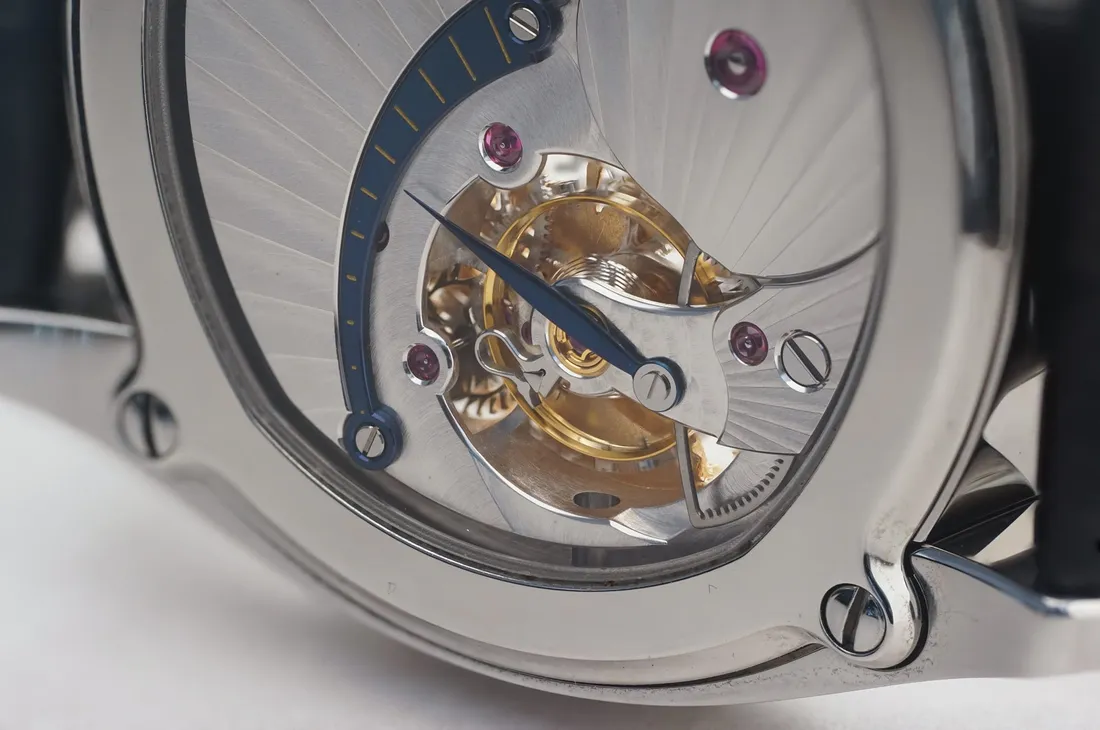
Beneath all this art beats a calibre of Strehler's own making. With its two barrels it offers a 78-hour power reserve, and it balances that energy with a differential stop-work mechanism that is the master's signature; the aim is to smooth away the difference between the mainspring's strongest and weakest moments, and so preserve precision. Through the sapphire back appear bridges brushed like rays of the sun, a blue power-reserve arc and Strehler's own particular architecture. The Jardin des Papillons, in other words, is art and engineering in equal measure.
Forever on the Edge of Flight
In the end, before us stands a work with no equal in the world, one that will belong to a single person for 165,000 Swiss francs. But neither its price nor its function is the true story of this watch. The Jardin des Papillons is a summer that a master hid inside solid gold: flowers that never fade, a butterfly frozen in flight, and beneath it a heart that beats without pause. The hope of the Native American, the free soul of the Chinese and the patience of the Swiss master all meet upon a single wrist. And that butterfly, just as it symbolises, beats its wings forever on the threshold of a transformation.