format_quote"Before time, man is at once the hero of a tragedy and a clown laughing at his own mask. This watch deserves to be taken seriously because it has fitted both faces onto one dial."
Hasan Bekmezci
As the ancient thinkers and the people of wisdom have said, death is not an annihilation or an absolute end but merely a change of dimension. In this world a man lives inside a heavy garment of body, put on over his soul. When a life is complete that mortal garment is set aside; consciousness passes into a higher dimension, freed from the constraints of time and place. While the river of time runs on below, the souls in that dimension go on watching the world and the works of art humanity produces as though watching them in a mirror.
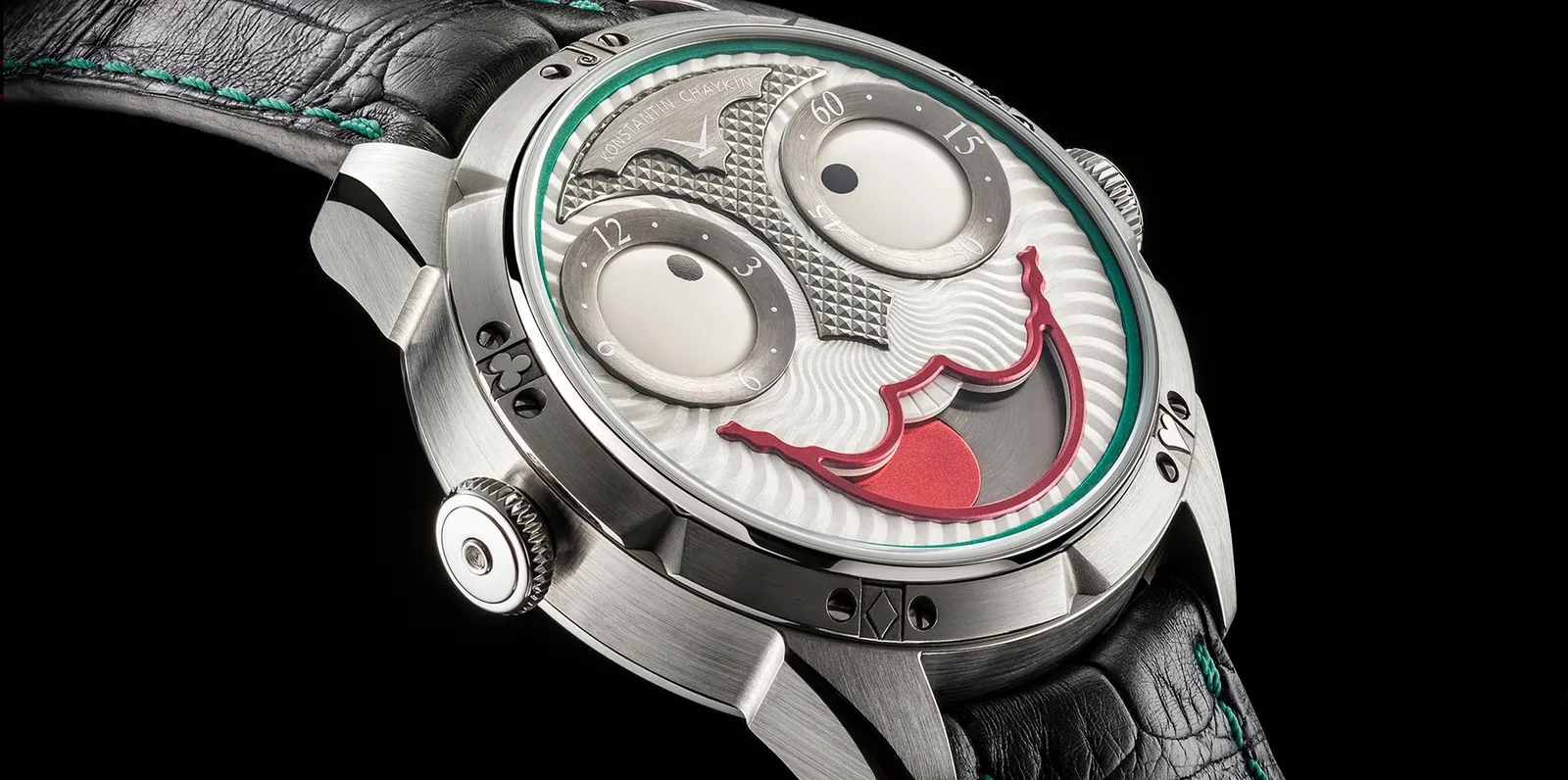
And so, meeting in such a dimension beyond time and place, the two giants of Russian literature, Fyodor Dostoevsky and Count Lev Tolstoy, had fixed their attention on the sound of steel rising from a workshop in twenty-first century Moscow. Down in the mortal world the independent watchmaking genius Konstantin Chaykin was manufacturing the Joker, casting the tragicomic mask of the human soul into mechanics.
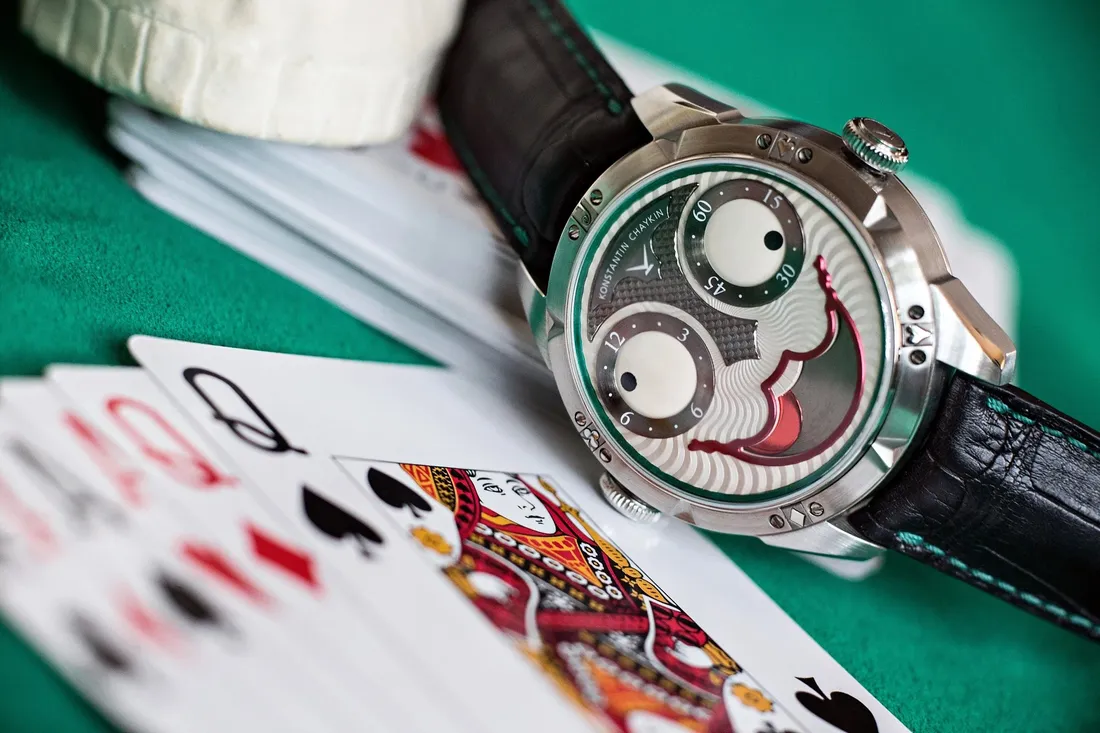
With the sharp consciousness of one stripped of the narrow garment of the mortal body, Dostoevsky looked at the two turning discs and that mischievous expression on Chaykin’s dial and smiled. He murmured as though calling the characters of his own works onto the stage:
“Look, Lev Nikolayevich. Look at how the eyes on this dial go cross-eyed every second, at how the hands turn independently of one another. Prince Myshkin, in my Idiot, looked at the world exactly like this: pure, helpless and strange in the face of all society’s lies and masks. But a minute later the same eyes turn into Raskolnikov’s uncanny, guilty sidelong glances after the murder in Crime and Punishment! A man’s soul does not fit into one fixed expression; laughter and horror, pure innocence and an uncanny sinfulness change places constantly, like those two independent discs on the dial.”
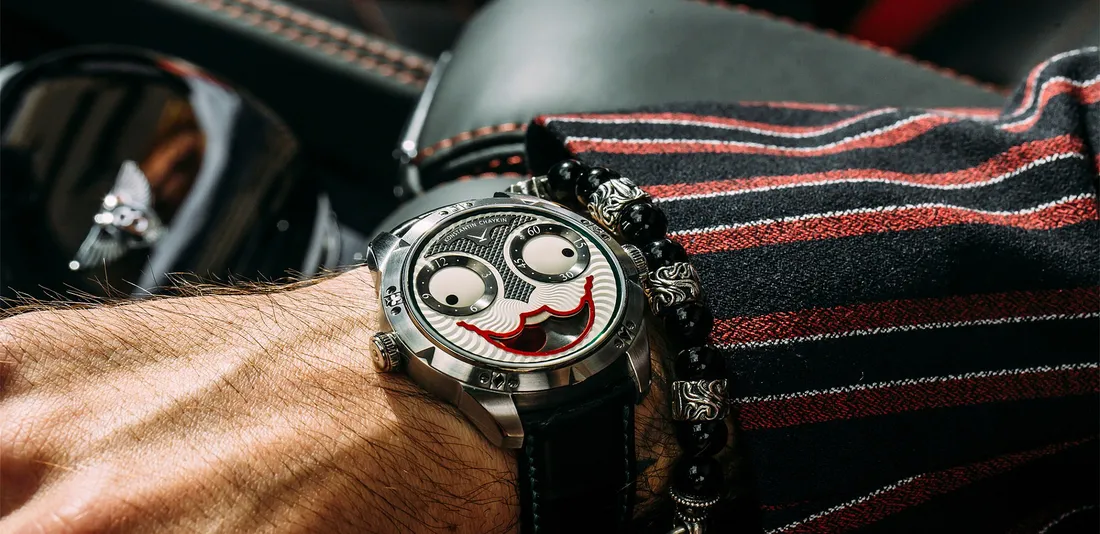
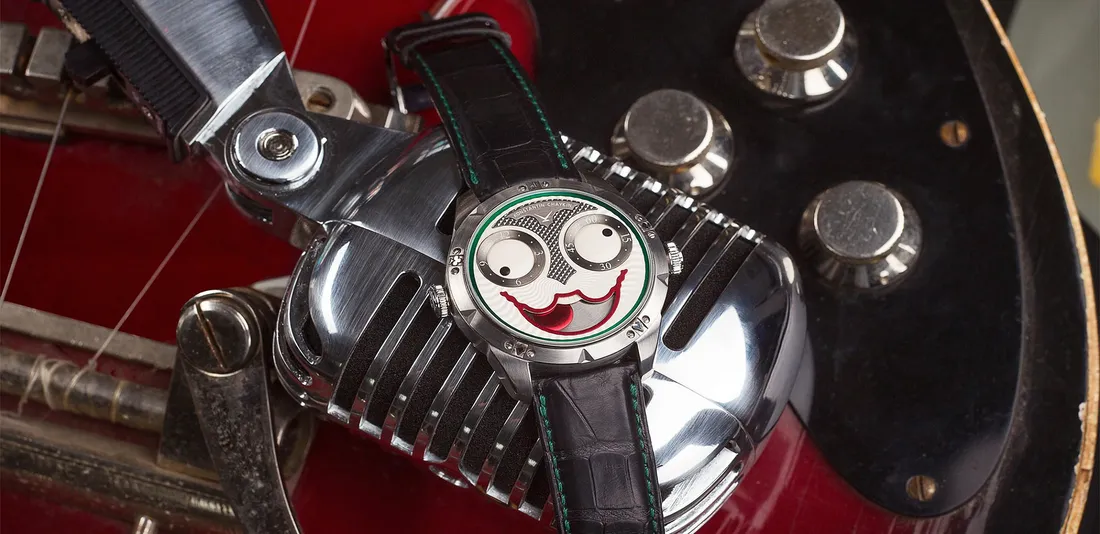
What he said was technically true as well. On this dial Chaykin has removed the classical hour and minute hands entirely and put two separate discs in their place. The disc at lower left shows the hours, the one at upper right the minutes, and the black pupil on each is in fact the tip of a pointer. The eyes are not looking; they are indicating. And because the two turn at different speeds, the direction of the gaze changes every minute and the face enters a different mood every minute.
Tolstoy, looking at the relief guilloché work on the dial and at the unshakeable train of wheels behind it, answered from the world of his own stories:
“And what of that arrogant rich man in my What Men Live By, Fyodor Mikhailovich? The one who came to Simon the shoemaker’s shop and boasted, make me boots such that they neither wear out nor lose their shape for a year. Yet he did not know that he would be dead by evening, and that what he needed was not a long-lasting boot but a soft slipper for his corpse! And Pahom in my How Much Land Does a Man Need? Let me go a little further, let me take in that fine field too, he said, and ran on in greed, and as the sun set his breath failed and he died, and all the land he needed was the length of his grave! Man grins with an insatiable greed like that Joker on the dial, makes plans for a year ahead, and has no idea that death will knock at his door that very evening.”
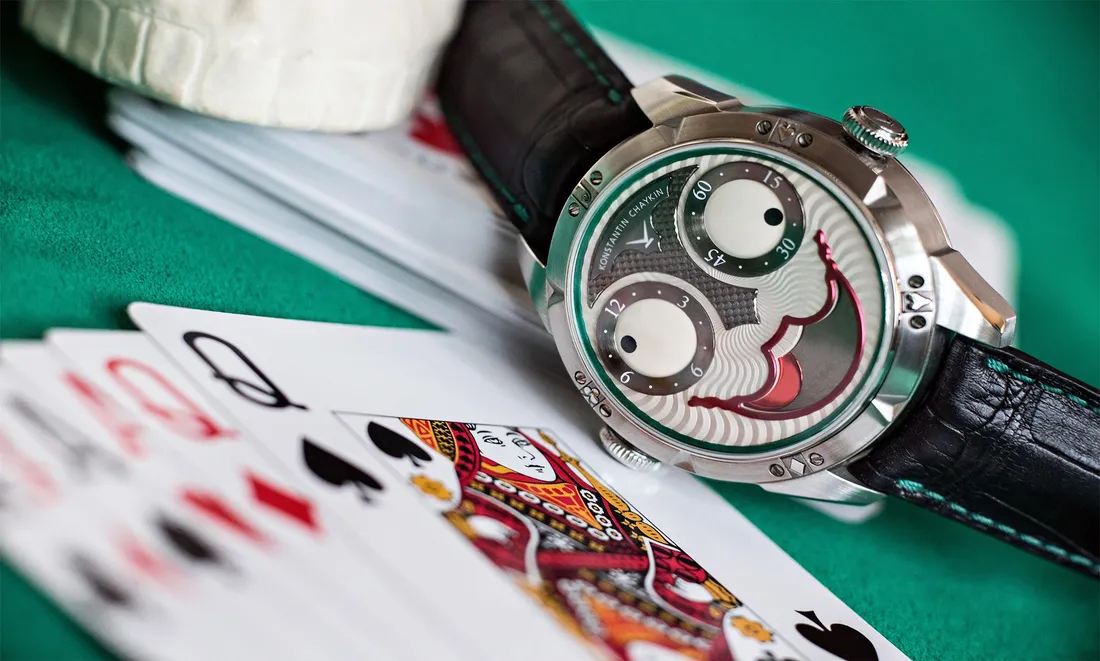
Dostoevsky nodded and pointed to the red tongue on the dial:
“And this is exactly why Chaykin has put that red tongue in the watch’s mouth! It is the illogical but exuberant cry of the passionate Dmitri Karamazov in The Brothers Karamazov. Man cannot live by reason alone, Lev Nikolayevich; logic tells him twice two is four, but purely to prove that he is human he sticks out that tongue and laughs at the dark side of the Moon!”
Tolstoy was silent for a moment, then looked more carefully at the watch’s mouth.
“Fyodor Mikhailovich, that tongue is not a tongue.”
“What do you mean?”
“That red thing is the Moon itself. Chaykin has taken the moon phase indicator and set it inside the mouth; the moon disc has been painted red. So the tongue you think the Joker is sticking out is in fact the dial’s counterpart of the moon in the sky. As the moon waxes the tongue comes out, as it wanes it draws back into the mouth. The man has attached your exuberant Dmitri to the heavens.”
The Moon in the Mouth: A Complication Turned into a Joke
A classical moon phase indicator works like this: beneath the dial a disc bearing two pictures of the moon turns, and the moon’s current state is seen through a crescent-shaped window in the dial. What drives the disc is a wheel with fifty-nine teeth. The number is not arbitrary: the interval between two full moons is about twenty-nine and a half days, and two moons correspond to fifty-nine days. This is why very nearly every moon phase display in the world has the same fifty-nine standing behind it.
What Chaykin did was not to change the mechanism but to change the window. He took that classical crescent aperture and turned it into a mouth; he painted the moon red and turned it into a tongue. Mechanically there is no innovation at all; as a story, everything changes. A complication that has been a symbol of seriousness for centuries becomes a joke through one change of colour and one change of shape.
And here is the real refinement: the indication still works entirely correctly. The red tongue genuinely tells you the phase of the moon that day. The joke is not a mask laid over the function; it is the function itself.
A separate solution was found for setting it too. You will see a second crown at nine o’clock on the case, but it does not turn; it is fixed, and a hidden pusher for advancing the moon phase is concealed inside it. A setting device has been hidden on the face of the watch without breaking its symmetry.
With a solemn air, recalling the existential reckoning of his own Confession, Tolstoy looked at the mechanical heart of the watch and made his point:
“In my Confession, searching for the meaning of life, I cried out at how all the glory and ambition of the mortal world is nothing but an illusion before the cold reality of death. This watch is not merely the individual deliriums you wrote in the world; it is man, time and the helplessness of fate. As I wrote in War and Peace, the two strongest warriors are patience and time. In the mortal world man puts on a garment of body, wears masks like a clown before time, grins and rolls his eyes. But in the background an unshakeable Russian mechanical discipline, placed there by Chaykin, goes on working. Time flows, the watch mocks the human face, but fate ticks on.”
format_quote"Tolstoy tells time like a river, Dostoevsky like a crisis. On this dial the two stand side by side: a calm lunar cycle next to the momentary spasm of a laugh."
Hasan Bekmezci
Who Is This Man
Let the joke on the dial not lead anyone to underestimate the man behind it.
Konstantin Chaykin was born in 1975 and learned watchmaking not at a school but on his own. He founded the workshop bearing his name in the early two thousands. Russian watchmaking had by then largely stopped; when a country’s long-established watch factories close, what remains is individual people.
The work that made him visible internationally was not a clown but a calendar. He built a mechanical clock that computes the date of Orthodox Easter. That date changes every year and, because it depends on the phases of the moon, cannot be solved with a simple calendar wheel; it is a computation done by hand for centuries. Chaykin solved it with gearing. For a mechanism to find a moon-dependent religious date merely by turning is something very few people in watchmaking have attempted.
He became the first Russian admitted to the Académie Horlogère des Créateurs Indépendants, the small society of watchmakers who produce under their own names and with their own hands. He holds dozens of patents. And today only a few dozen watches a year leave his Moscow workshop.
So the smile on the Joker’s dial is not a marketing idea. It is the smile of a man who first proved he could do serious work and then decided he had earned the right to make a joke.
The Seriousness Beneath the Dial
That background Tolstoy spoke of is the side of this watch at least as important as its face, and it is impossible to see.
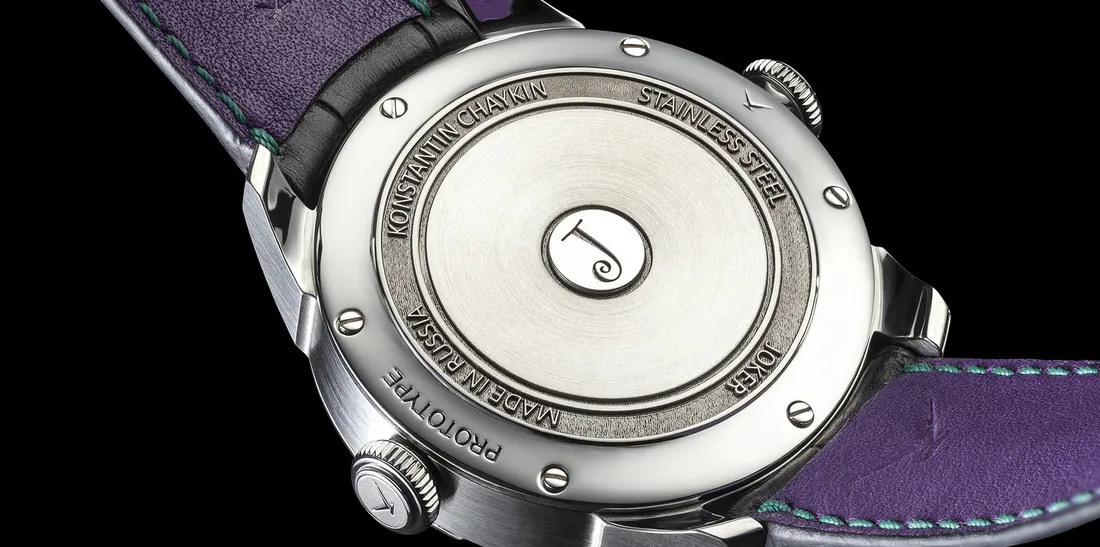
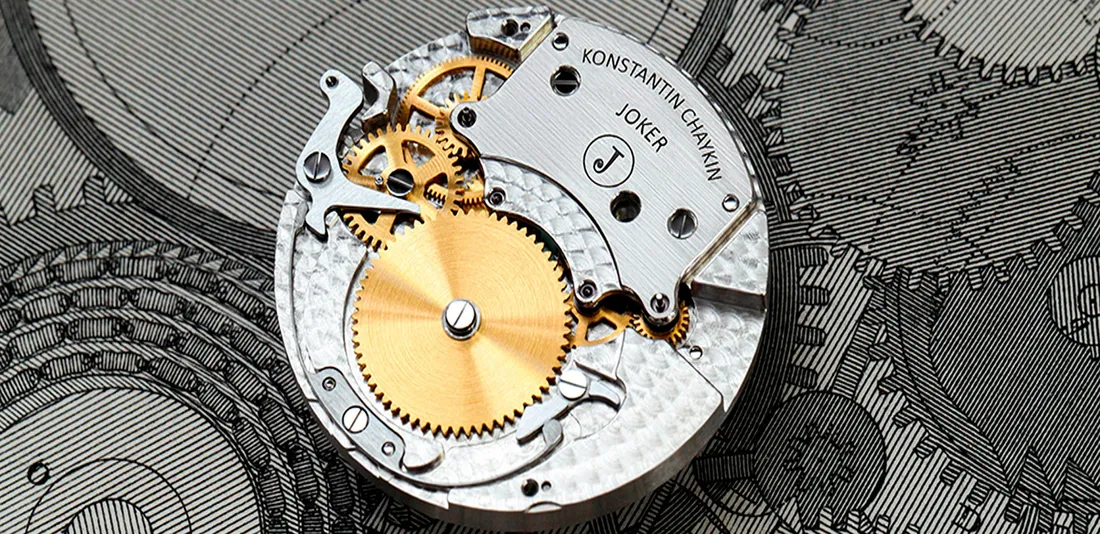
For the Joker and for all the Wristmons that followed it, Chaykin designed a separate display module. The module is called K07-0 and is made of sixty-one parts; it sits on top of an automatic base movement. The total jewel count is thirty-three: twenty-five in the base movement and eight in the module. The movement is thirty-one and a half millimetres across and seven point six millimetres thick; it beats at twenty-eight thousand vibrations an hour, gives thirty-eight hours of reserve, and the house declares its daily deviation as plus or minus fifteen seconds.
One should be honest here: the base movement is Swiss-made, and the part Chaykin manufactures is the module that sits on top of it. This was a first in the brand’s own history; his earlier watches used movements entirely of his own. But the point is this: what makes this watch what it is is not the base movement but those sixty-one parts.
And the way those sixty-one parts are finished is perhaps the most surprising detail in this piece. The module sits under a completely opaque dial; which is to say nobody, including its owner, ever sees it while wearing the watch. In spite of that, every one of its components is finished with the classical techniques of high watchmaking: pearlage, fine longitudinal and circular graining, sandblasting, hand-bevelled and hand-polished chamfers, engraving, polished countersinks for screws and jewels, spherically polished pivot tips, rhodium plating.
Why would a craftsman finish sixty-one parts nobody will ever see in this way? The answer is not technical but moral. To take the unseen side of a job as seriously as the seen side is a promise a man makes to himself. If all that playfulness on the dial can be taken seriously, this is exactly why: the hand making the joke is not joking at all behind it.
And there is this: technically, this dial is a regulator dial.
The regulator is a very old and very serious arrangement in watchmaking. In eighteenth-century workshops there was a reference clock against which every other clock was set; on it the hours, minutes and seconds were shown not by hands issuing from one centre but in separate subdials. The reason was not aesthetic: overlapping hands cause reading errors, separated indications are read without error. The regulator was seriousness itself.
Chaykin has taken that seriousness and turned it into a face. Hours apart, minutes apart, each in its own subdial. Technically what he has done is preserve a two-hundred-year-old arrangement for precise reading. Visually what he has done is turn that arrangement into two eyes. All the intelligence of the piece lies here: he has changed everything without breaking anything.
It also explains why the watch is genuinely legible. Many shaped dials sacrifice legibility for form. Here the reverse has happened: the form has been laid on top of an arrangement that was invented for legibility in the first place.
How a Face Is Made
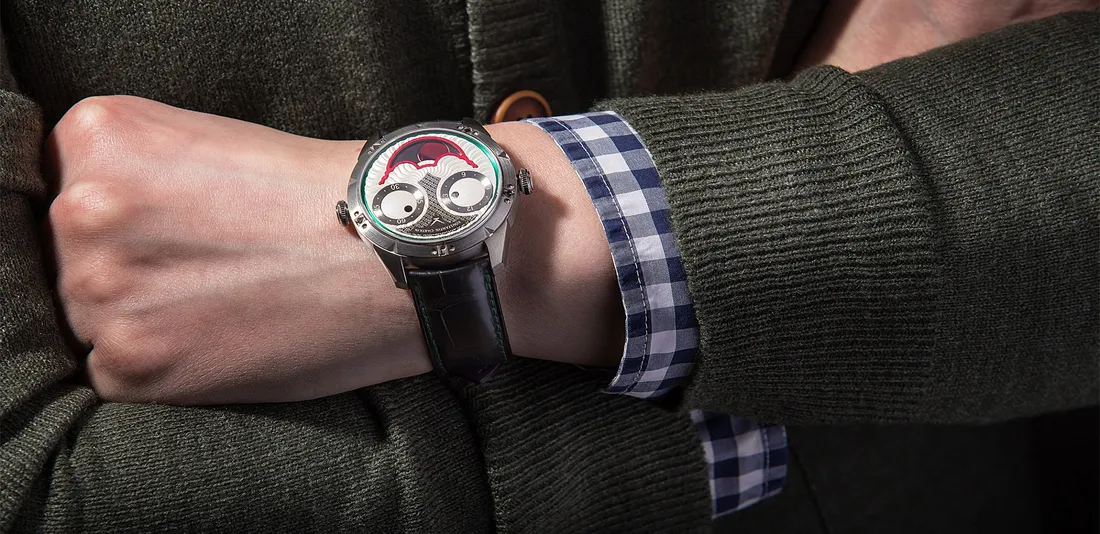
The dial is a surface worked on at least as much as the module. It is made of nine separate parts and carries two different types of relief guilloché: a wave texture on the cheeks and forehead, and a grid-like lattice on the nose. When the two textures come together the eye sees a face without looking for one.
The reason is psychological. There is a region of the human brain dedicated to recognising faces, and it works so eagerly that it builds a face wherever it sees two dots and a line: in power sockets, in car grilles, in clouds. It is called pareidolia. Chaykin has used this reflex as a design tool: there is no face on this dial in reality, only two circles and an arc. You make the face.
The finishing of the dial runs to a long list too: silver plating, ruthenium coating, pad printing and protection under multiple layers of lacquer. On the case parts, fine longitudinal graining, sandblasting and polishing are used together; the case is made of thirty-six parts. The house specifically notes that not a single plastic component is used in the production of this watch.
The dimensions are deliberately classical: forty-two millimetres across, thirteen point seven millimetres thick, a sapphire crystal thirty-four and a half millimetres in diameter with anti-reflective coating, three atmospheres of water resistance. The strap is purple alligator with a calfskin lining and green stitching. So there is a clown on the dial, but every dimension of the watch is that of a classical watch that takes itself seriously.
Dostoevsky smiled.
“We think we are seeing a face, but there are two circles and an arc, is that it?”
“That is it.”
“Then this watch is the summary of all my novels, Lev Nikolayevich. Man is the same. You think you see a character in the person opposite you; what you see is a face you have built yourself out of a few signs. The inspector who thought he was reading Raskolnikov’s face was reading a face of his own making.”
The numbers support that seriousness too. The house produces a few dozen watches a year and all of them come out of the same workshop: case, dial, strap buckle and display module. There is no design studio here drawing something and having it made elsewhere; most of the parts pass through the lathe under the same roof.
That scale also explains why the joke on the dial has not gone cheap. Had a fashion brand produced the same idea a hundred thousand times a year, nobody would have looked at it by the third year. Here the production number protects the idea itself: because so few are made, each one is still an object rather than a product.
And note the colour of the strap. Purple alligator with green stitching. Purple and green are two colours that have been used together in clown iconography for a century and carry no natural harmony; side by side they make the eye uneasy. Chaykin has not erased that unease, he has carried it onto the strap. The seriousness of the watch is consistently broken all the way from the dial to the wrist.

format_quote"An ordinary complication hands you a piece of information; this dial gives you a look. The difference belongs less to engineering than to the theatre."
Hasan Bekmezci
The Seriousness of a Joke
When the Joker was presented in 2017 the watch world split in two. One camp counted it a toy; the other saluted it as the most original idea in years. Chaykin himself says he did not expect the attention. In his own words, what interested him in designing this watch was not complex mechanics in itself but the idea of a watch as an art object provoking an immediate emotional reaction.
And precisely for that reason the model became a series. The Wristmons, the mechanical monsters on the wrist, today carry dozens of different faces: Dracula, Minotaur, Kolobok, White Rabbit, the cat Matroskin, Kalavera. The same idea works beneath all of them: two discs, a mouth, a face.
But the Joker remained the ancestor of them all, because it was first and because the face it chose was the hardest one. A cat or a rabbit is endearing; a clown is not. The clown is the only character whose smile can carry a threat, and literature has known this for centuries. Putting a clown on a dial is not taking the easy road; it is choosing the most uncanny option.
There is one more detail that speaks directly to literature. The clown mask is not one of the oldest tricks on a dial; on the contrary, it is something almost never attempted in watchmaking. The reason is plain: a wristwatch is a sentence its owner says about himself to the world, and nobody wants to carry a clown on his wrist.
Because Chaykin knew this, he did not soften the mask; he sharpened it. The red of the mouth, the asymmetry of the eyes, the shadow beneath the brows. These are not the features of a friendly cartoon face. What faces you is a countenance you think is looking at you and which is in fact not looking at all.
And that is exactly why it belongs to Dostoevsky’s world. In his novels people always do two things at once: they laugh while suffering, they humiliate while showing love. A fixed expression would be a lie in that world. This dial is not fixed; it builds a different face every minute, and it lies in none of them.
One question remains: why did this watch catch on so completely?
The answer probably lies in timing. The Joker appeared at a moment when the watch world had long been repeating the same handful of formulas; everyone was trying to make things thinner, larger, more complicated, and nobody was laughing. Chaykin made something that laughed, and did it while doing something technically serious.
But there is a deeper reason too. A wristwatch is the only object man has produced in order to look at himself. Dozens of times a day you look at your wrist, and each time you look at a surface that tells you how much time you have left. When Chaykin put a face on that surface, the act of looking was reversed: you are no longer looking at the watch, the watch is looking at you.
And what looks back is a clown. The object that reminds you of your mortality reminds you of it while laughing. In European painting this is called memento mori and it is usually done with a skull. Chaykin has removed the skull and put a smile in its place. The meaning is the same, the tone is different.
While the smiling red mouth on the Joker’s dial showed the phases of the moon in the mortal world, in the other dimension the souls of two great writers came together on the watch’s anthropomorphic dial: before time, man was at once the hero of a tragedy and a clown laughing at his own mask.
Tolstoy had the last word:
“I have noticed something, Fyodor Mikhailovich. On this watch the eyes show time and the mouth shows the sky. So a man’s gaze has been tied to the clock and his laugh to the moon. And we misread both all our lives: when we look at the clock we think we have plenty of time, and when we look at the moon we think we are always seeing the same one.”